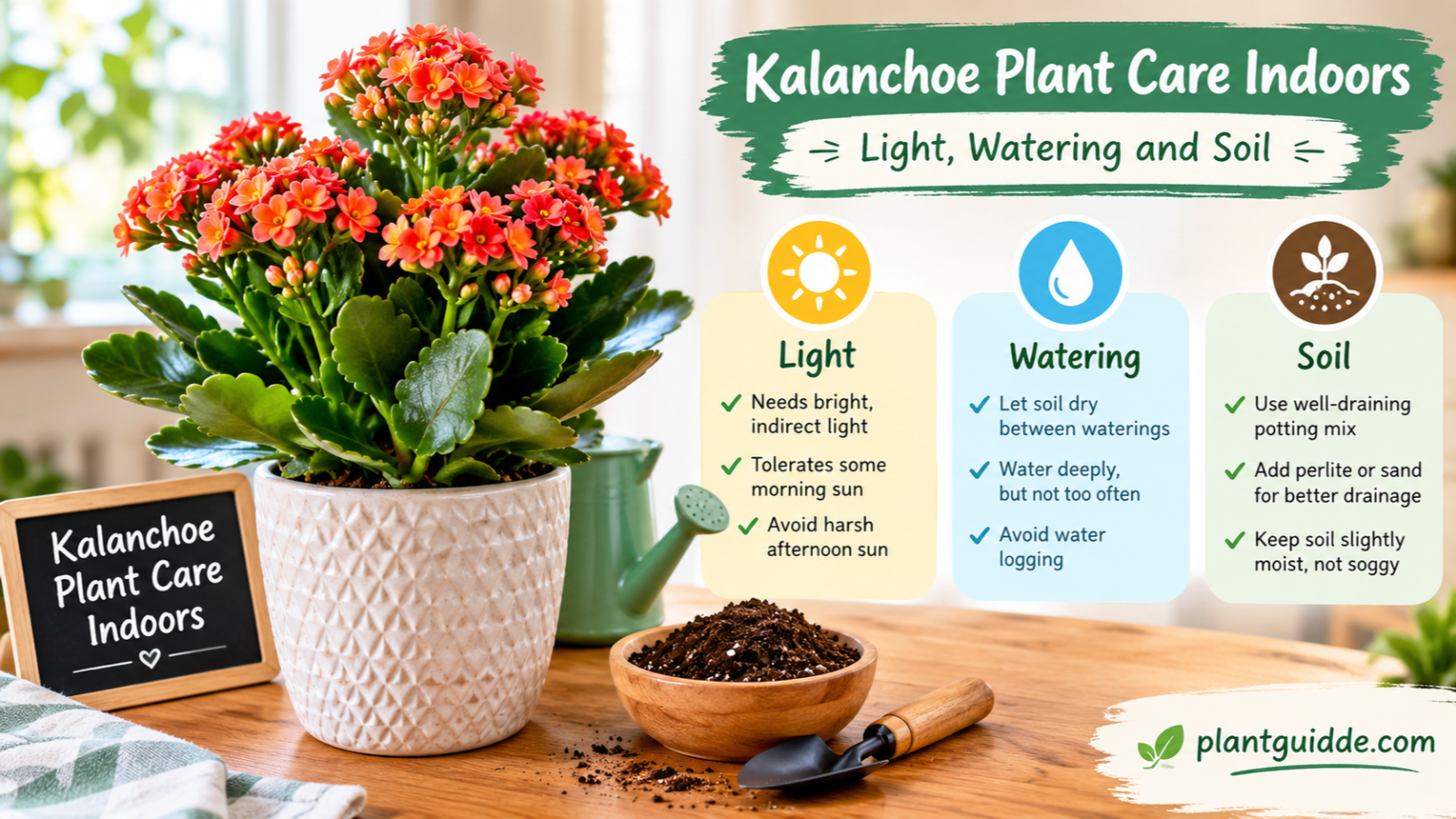
Kalanchoe is one of those houseplants that looks almost effortless to grow. Its thick green leaves handle periods of dryness, while flowering varieties can brighten your home with colorful blooms for weeks. kalanchoe plant care indoors.
But problems often appear after it settles into a new environment. Yellow leaves, crispy edges, soft stems, shriveled foliage, or a lack of flowers can all signal that something is off. The common mistake is trying to fix these issues by watering more, moving the plant to a darker spot, or adding extra fertilizer, changes that can sometimes make things worse.
Successful kalanchoe plant care indoors comes down to getting a few basics right: bright light, careful watering, well-draining soil, good airflow, and proper temperature. Once you understand what your kalanchoe is telling you, keeping it healthy and blooming becomes much easier.
Quick Answer
For successful kalanchoe plant care indoors, place your plant near a bright window where it receives several hours of strong, indirect or filtered light. Use a well-draining succulent or cactus mix, water thoroughly only when the soil has mostly dried, and always use a pot with drainage holes. Keep temperatures comfortably warm, provide good airflow, and avoid constantly wet soil. If you want repeat blooms, light exposure and proper seasonal darkness are especially important.
Understanding the Kalanchoe Plant
Kalanchoe is a group of succulent plants in the Crassulaceae family. The kalanchoe commonly sold as a flowering houseplant is often Kalanchoe blossfeldiana, although nurseries and garden centers sell several other Kalanchoe species and hybrids.
Its thick leaves are an important clue about how the plant should be treated.
Like other succulents, kalanchoe can store water in its fleshy foliage. That means it does not need constantly moist soil. In fact, keeping the roots wet for prolonged periods is one of the easiest ways to create problems.
Kalanchoe can grow as a long-lived houseplant when its basic requirements are met. Flowering plants may also be encouraged to bloom again, although reblooming requires more attention to light duration than simply keeping the plant alive.
Image Suggestion: Close-up botanical illustration showing a kalanchoe’s fleshy leaves, stems, roots, and drainage layer.
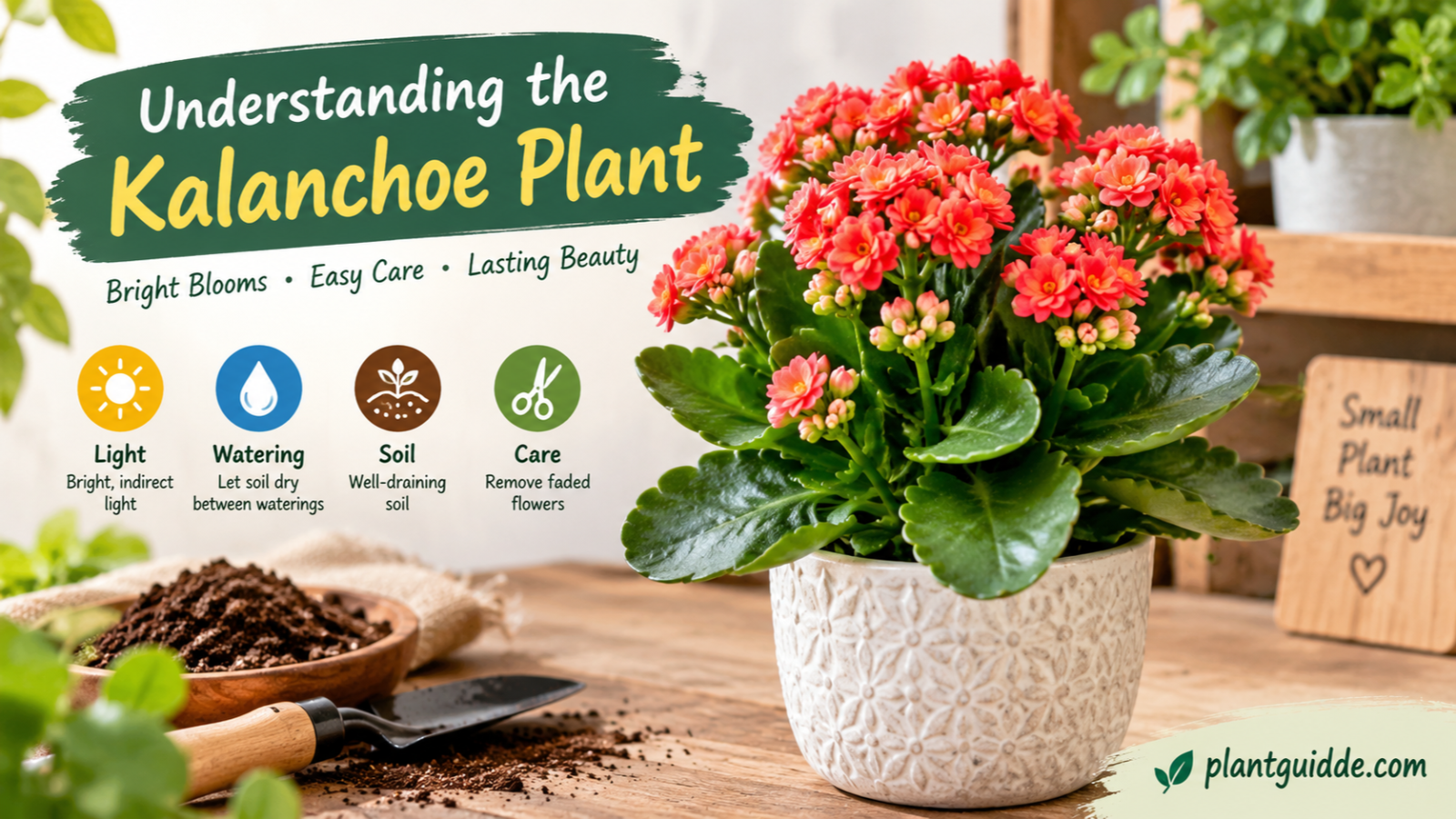
How to Care for a Kalanchoe Plant Indoors
Rather than following a rigid calendar, use the condition of the plant and soil to guide your routine.
Give Kalanchoe Plenty of Bright Light
Light is one of the most important factors in indoor kalanchoe care.
Place your plant close to a bright window. An east- or west-facing window can work particularly well, while a south-facing window may provide strong enough light for flowering in many homes.
However, there is an important distinction between bright light and intense heat.
A kalanchoe sitting directly against hot glass during the strongest part of the day can experience scorched or bleached leaves, particularly when the plant was previously grown in lower light.
Look for these clues:
| What you see | Possible light issue |
|---|---|
| Long, weak growth | Not enough light |
| Plant leaning toward window | Insufficient or uneven light |
| Small or sparse flowers | Light may be inadequate |
| Pale or bleached patches | Excessively intense sun or heat |
| Healthy compact growth | Light is probably suitable |
A useful approach is to increase light gradually if your kalanchoe has been growing in a relatively dim location.
A practical light test
Look at the plant around midday.
kalanchoe plant care indoors the room is bright but the plant receives little direct or strong filtered light, it may eventually become stretched and produce fewer flowers.
kalanchoe plant care indoors sunlight is extremely intense and creates excessive heat on the leaves, move it slightly farther from the glass or filter the strongest rays with a sheer curtain.
Expert tip: Rotating the pot every week or two can help keep growth more balanced when the plant receives light primarily from one direction.
Image Suggestion: Three-window comparison showing a kalanchoe in low light, ideal bright light, and harsh direct sunlight.
Water Only When the Soil Has Mostly Dried
Watering is where many beginners go wrong.
Because kalanchoe has succulent leaves, it is generally more tolerant of a short dry period than of continuously wet soil.
Instead of watering every Sunday or following a fixed schedule, check the growing medium first.
A simple watering method
- Press a finger into the upper portion of the soil.
- Check whether the mix still feels noticeably moist.
- If it has mostly dried, water thoroughly.
- Allow excess water to drain completely.
- Empty standing water from the saucer or decorative container.
The exact interval depends on your home.
A kalanchoe growing near a sunny window in a warm room may dry considerably faster than one sitting in a cool, dim room.
How much water does kalanchoe need?
When watering is necessary, give enough water to thoroughly moisten the root zone and allow excess water to escape through the drainage holes.
Then wait.
The goal is not to give the plant tiny amounts of water every few days. Frequent small sips can leave parts of the root zone inconsistently moist and make it harder to judge when the plant actually needs water.
Signs of overwatering
Watch for:
- Yellowing leaves
- Soft or mushy stems
- Leaves becoming unusually soft
- Persistent wet soil
- Unpleasant smell from the potting mix
- Leaf drop
- Dark or damaged roots
Signs of underwatering
A thirsty kalanchoe may develop:
- Shriveled leaves
- Limp foliage
- Dry, brittle leaves
- Soil pulling away from the pot
- Noticeable loss of firmness in the leaves
One dry period is not automatically a disaster. Repeated severe dehydration, however, can stress the plant.
The important distinction: A kalanchoe with slightly dry soil is often recoverable. A kalanchoe whose roots remain wet for long periods can develop much more serious problems.
Choose Fast-Draining Kalanchoe Soil
The best kalanchoe soil allows water to move through the root zone instead of remaining trapped around the roots.
A commercial cactus or succulent potting mix is a convenient starting point. If the mix stays wet for too long in your particular home, improving its drainage and aeration can be helpful.
The exact recipe matters less than the result.
A good growing medium should:
- Drain readily
- Contain enough air space for the roots
- Avoid becoming compacted
- Dry at a reasonable rate between waterings
Avoid heavy garden soil for an indoor container. It can compact inside a pot and hold more moisture than kalanchoe roots need.
Why soil and watering cannot be separated
Suppose two identical kalanchoes receive the same amount of water.
One is planted in a loose succulent mix. The other is planted in dense, poorly draining soil.
The watering routine may be identical, but the roots experience very different conditions.
kalanchoe plant care indoors is why simply telling someone to “water less” does not always solve an overwatering problem. The soil, pot size, drainage, light, and temperature all influence how quickly moisture disappears.
Use a Pot With Drainage Holes
A drainage hole is more useful than many decorative features on a plant container.
When excess water has somewhere to escape, you have much greater control over the moisture level around the roots.
Choose a container that is only moderately larger than the root ball. A very large pot can hold a large volume of wet soil around a relatively small root system, increasing the time it takes for the medium to dry.
kalanchoe plant care indoors you use a decorative cachepot without drainage, keep the kalanchoe in a separate nursery pot with drainage holes.
Expert tip: Never assume a layer of gravel at the bottom of a container will compensate for a pot with poor drainage. The better solution is to use an appropriate, well-draining growing medium in a container that actually allows excess water to escape.
Image Suggestion: Cross-section diagram comparing a properly draining kalanchoe pot with an oversized, water-retaining container.
Keep Indoor Temperatures Comfortable and Stable
Kalanchoe generally performs well at ordinary indoor temperatures.
The bigger concern is often sudden environmental stress rather than finding a precise temperature number.
Avoid placing the plant directly beside:
- Cold drafts
- Frequently opened exterior doors
- Strong heating vents
- Air-conditioning outlets
- Very hot appliances
- Extremely hot window glass
A plant can survive in a room that is slightly different from the ideal, but repeated temperature swings can make growth less consistent.
During winter, pay particular attention to cold windows at night. A sunny windowsill can become significantly colder after sunset than the rest of the room.
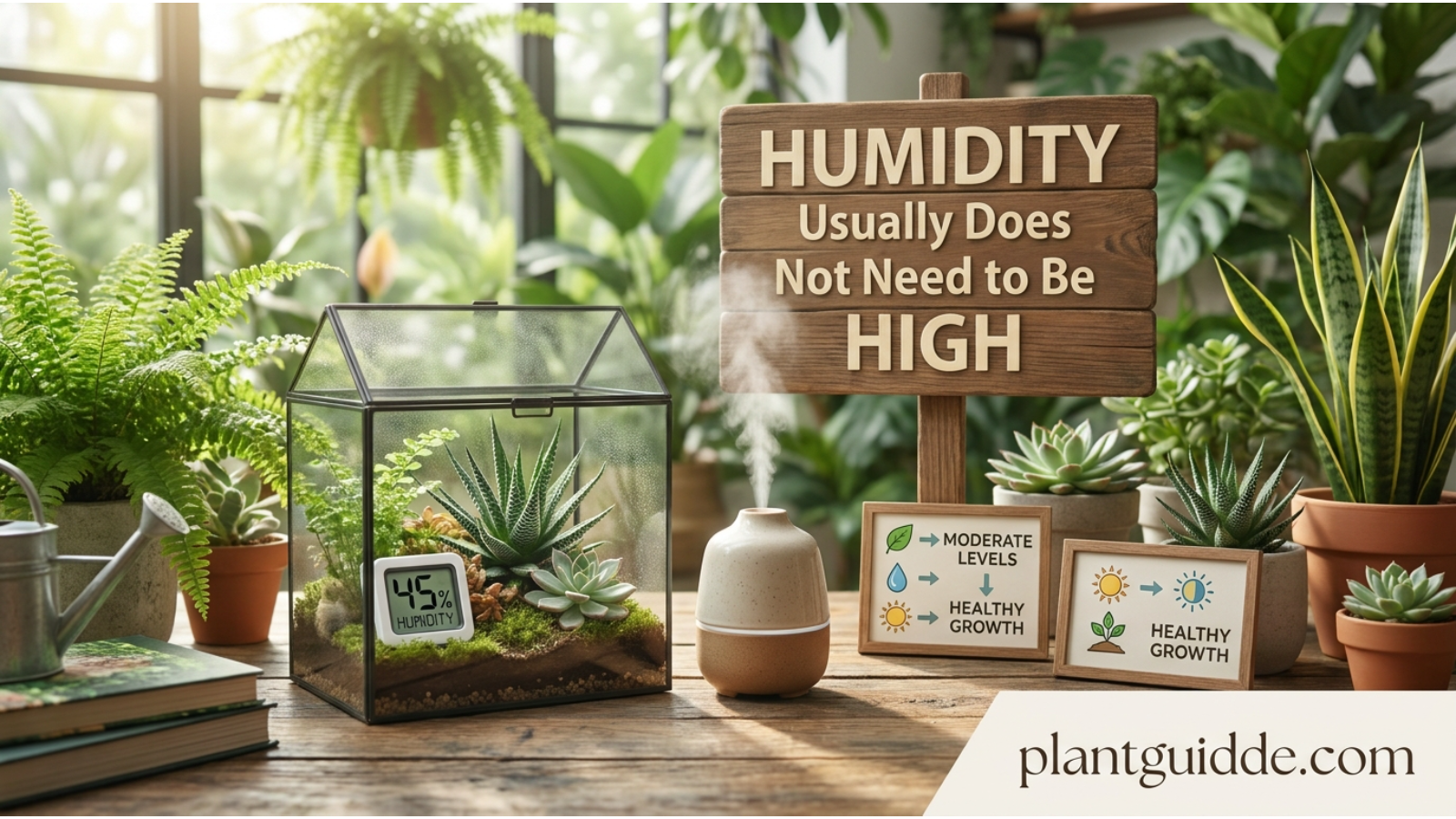
Humidity Usually Does Not Need to Be High
This is an area where kalanchoe differs from many tropical houseplants.
Because it is a succulent, kalanchoe generally does not require the high humidity that plants such as calathea or some ferns prefer.
Normal household humidity is often adequate when the plant has appropriate light, drainage, and airflow.
You usually do not need to mist kalanchoe leaves every day.
Constantly wet foliage combined with poor airflow can create a less favorable environment rather than improving the plant’s health.
If your home is extremely dry, focus first on proper watering and preventing the plant from sitting beside a strong heating source.
Fertilize Carefully
Kalanchoe does not need heavy feeding.
During active growth, a balanced houseplant fertilizer used according to its label directions can provide nutrients when the plant is growing in a container with limited soil.
Avoid the temptation to fertilize every time the plant looks unhealthy.
Yellow leaves, drooping, brown tips, or poor flowering do not automatically mean the plant needs fertilizer.
For example, if roots are stressed from excess moisture, adding fertilizer will not fix the underlying problem.
A better order of diagnosis
When something looks wrong:
Check light → check soil moisture → check drainage → inspect roots if necessary → then consider nutrition.
This simple sequence prevents many unnecessary fertilizer applications.
Prune Kalanchoe After Flowering
Once flowers fade, removing spent flower clusters can improve the plant’s appearance and redirect its energy toward new growth.
Use clean, sharp scissors or pruning shears.
Remove dead flowers and damaged plant material without making unnecessary cuts to healthy stems.
If the plant becomes leggy, pruning can also help encourage a more compact shape.
Don’t throw away healthy cuttings automatically. Depending on the kalanchoe species or cultivar, healthy stem or leaf material may be useful for propagation.
Why Is My Kalanchoe Not Flowering?
A kalanchoe can remain alive and healthy without producing flowers, so flowering problems require a slightly different diagnosis.
The most common issue is often insufficient light during the plant’s growing period.
But there is another important factor: flowering kalanchoes are influenced by the length of the day and night.
Many kalanchoes are short-day plants, meaning flowering can be encouraged by providing sufficiently long, uninterrupted periods of darkness along with appropriate daytime light.
This is why a plant that bloomed beautifully in a nursery may stop flowering in your home.
It is not necessarily unhealthy.
Your home may simply provide a different light cycle.
If you want to encourage reblooming
After the previous flowering period:
- Keep the plant healthy and actively growing.
- Give it strong daytime light.
- Avoid excessive watering.
- Allow an appropriate long, uninterrupted night period.
- Continue the routine consistently for several weeks.
- Once flower buds develop, return to normal daytime indoor lighting.
Artificial light at night can interfere with the dark period, so consistency matters.
Advanced tip: If you are deliberately trying to initiate flowering, do not rely on an approximate “dark room.” Consistent darkness is more useful than repeatedly changing the schedule.
Image Suggestion: Infographic explaining the relationship between daytime light, nighttime darkness, and kalanchoe flowering.
Kalanchoe Leaves Turning Yellow: What It Usually Means
Yellow leaves are a symptom, not a diagnosis.
The first thing to investigate is the soil.
If the soil stays wet for a long time and several leaves are turning yellow, excessive moisture is a strong possibility.
Other causes can include:
- Insufficient light
- Normal aging of older leaves
- Root damage
- Environmental stress
- Nutritional problems
What to do
Do not immediately remove every yellow leaf and increase watering.
Instead:
- Check how wet the soil is.
- Examine the pot’s drainage.
- Look at the light level.
- Check whether the stem feels firm or soft.
- If the soil is staying wet unusually long, inspect the roots.
A single older yellow leaf is very different from widespread yellowing combined with soft stems and persistently wet soil.
Why Are Kalanchoe Leaves Curling or Shriveled?
Curling or shriveling can indicate that the plant is losing water faster than it can replace it.
Check:
- How dry the soil is
- Whether the roots are healthy
- How much light the plant receives
- Whether the plant is near a heat source
- Whether watering has been inconsistent
There is an important complication: root damage can also cause wilting or shriveling even when the soil is wet.
This happens because damaged roots cannot function normally.
So if a kalanchoe looks thirsty but the soil is constantly wet, do not automatically add more water.
Investigate the roots and drainage first.
Kalanchoe Brown Leaves or Crispy Edges
Brown, dry leaf edges can result from several environmental stresses.
Possible causes include:
- Severe dryness
- Excessive heat
- Strong direct sunlight after a sudden change in exposure
- Root problems
- Environmental fluctuations
Look at the pattern.
If only the side facing a very hot window has damaged tissue, excessive light or heat becomes more suspicious.
If the entire plant is dry and the soil is extremely dry, dehydration becomes more likely.
If brown leaves appear alongside wet soil and declining stems, root problems deserve attention.
Expert approach: Never diagnose a plant from a single symptom. Look at the symptom, the soil, the roots, the light, and the recent changes in the plant’s environment together.
What to Do About Soft Stems or Root Rot
Soft stems are more concerning than a few dry leaf tips.
If the base of the plant is becoming soft while the soil remains wet, excessive moisture and root or stem rot may be involved.
What to check
Remove the plant carefully from its container and inspect the root system.
Healthy roots should generally be firm rather than slimy or decomposing.
If there are clearly damaged roots:
- Remove the plant from saturated soil.
- Inspect the roots carefully.
- Remove severely damaged tissue with clean tools.
- Repot into fresh, appropriate succulent soil.
- Use a clean container with drainage.
- Avoid immediately returning to frequent watering.
Recovery depends on how much healthy tissue remains.
If the main stem is extensively damaged, saving healthy cuttings may sometimes be more realistic than trying to preserve the entire original plant.
A Simple Kalanchoe Care Routine
You do not need to inspect your kalanchoe constantly.
A practical routine is:
Once a week
- Look at the leaves.
- Check for pests or obvious damage.
- Observe whether new growth looks healthy.
- Check the soil if you suspect it may have dried.
Every few weeks
- Rotate the plant if growth is leaning.
- Check whether roots are emerging from the drainage hole.
- Inspect for dust or debris on leaves.
- Reassess whether the plant is receiving enough light.
During watering
- Confirm that the soil has mostly dried.
- Water thoroughly.
- Allow excess water to drain.
- Empty any standing water.
After flowering
- Remove spent flowers.
- Prune damaged or excessively leggy growth.
- Evaluate whether the plant needs repotting.
- Adjust its light and care routine if you want to encourage another flowering cycle.
This routine is more reliable than putting watering on autopilot.
Seasonal Kalanchoe Care Indoors
Your plant’s needs can change throughout the year.
Spring and Summer
As light levels increase, kalanchoe may grow more actively and use water faster.
Monitor the soil rather than automatically increasing watering.
If your plant moves outdoors during warm weather, introduce it to stronger light gradually. A plant accustomed to indoor filtered light can be damaged by sudden exposure to intense sunlight.
Autumn
Flowering kalanchoes may respond to changing day length.
This can be a useful period to prepare a healthy plant for another flowering cycle.
Also watch watering as temperatures and light levels begin to change.
Winter
Indoor winter conditions can be deceptive.
A plant may sit in a sunny window but still grow slowly because the days are shorter and temperatures are lower.
At the same time, heating systems can create dry air and warm drafts.
The biggest mistake is continuing a summer watering routine when the plant is using considerably less water.
Winter rule: Check the soil before watering, and never assume the calendar tells you when the plant needs water.
Common Kalanchoe Care Mistakes
Mistake 1: Watering on a Fixed Schedule
A calendar cannot account for changes in light, temperature, soil, pot size, and humidity.
Better approach: Check the growing medium first.
Mistake 2: Keeping the Soil Permanently Moist
Kalanchoe is not a bog plant.
Better approach: Allow the soil to dry substantially between waterings.
Mistake 3: Keeping It Too Far From a Window
A bright-looking room may still provide insufficient light for strong growth and flowering.
Better approach: Place the plant where it receives substantial natural light without exposing it to damaging heat.
Mistake 4: Using a Huge Decorative Pot
More soil means more moisture retention.
Better approach: Use a container appropriately sized for the root system and equipped with drainage.
Mistake 5: Fertilizing a Sick Plant
Fertilizer cannot repair rotting roots or compensate for poor light.
Better approach: Diagnose the environment first.
Mistake 6: Misting the Plant Constantly
Kalanchoe does not need rainforest-level humidity.
Better approach: Focus on proper root-zone moisture and airflow.
Mistake 7: Moving It Into Full Sun Suddenly
A kalanchoe grown under filtered indoor light may not tolerate an abrupt change to intense sunlight.
Better approach: Acclimate it gradually.
Kalanchoe Care: Quick Reference
| Requirement | Best general approach |
|---|---|
| Light | Bright indoor light; protect from excessive heat |
| Water | Water thoroughly after soil has mostly dried |
| Soil | Fast-draining succulent/cactus mix |
| Pot | Container with drainage holes |
| Humidity | Average indoor humidity is usually adequate |
| Temperature | Comfortable, stable indoor conditions |
| Fertilizer | Moderate feeding during active growth |
| Pruning | Remove spent flowers and damaged growth |
| Flowering | Strong light plus appropriate long-night conditions |
| Repotting | When soil structure deteriorates or roots outgrow the container |
How to Tell Whether Your Kalanchoe Is Actually Healthy
A healthy kalanchoe does not necessarily look like a plant that is growing rapidly.
Look for:
- Firm, substantial leaves
- Strong stems
- Compact growth
- Healthy new leaves
- No persistent soggy soil
- No widespread yellowing
- No mushy tissue
- Gradual, steady growth during active periods
Remember that succulent growth can be relatively slow.
Trying to force faster growth by watering more frequently is one of the most common ways beginners create problems.
A better goal is stable growth rather than maximum growth.
Can Kalanchoe Grow in Low Light?
Kalanchoe may survive for a while in relatively low light, but survival and healthy growth are not the same thing.
Insufficient light can cause weak or stretched growth and may reduce flowering.
If your plant is becoming unusually leggy or repeatedly fails to bloom, evaluate the light before changing the watering routine.
If natural light is limited, a suitable grow light can supplement available daylight.
Can You Keep Kalanchoe in a Bathroom?
It depends on the bathroom.
The humidity itself is usually not the deciding factor. The bigger question is light and airflow.
A bright bathroom with a good window may work well.
A dark bathroom with little natural light is unlikely to provide enough light for strong long-term growth.
Should You Mist Kalanchoe Leaves?
Usually, no.
Misting is not necessary for routine kalanchoe plant care indoors.
If the plant has dry or stressed leaves, investigate the root moisture, temperature, light, and airflow rather than assuming humidity is the problem.
Can Kalanchoe Live Indoors Year-Round?
Yes. Kalanchoe can be grown indoors throughout the year when it receives adequate light and appropriate watering.
The biggest adjustment is seasonal.
During periods of lower light or slower growth, the plant may use water more slowly. Continuing a heavy watering routine during these periods can increase the risk of root problems.
How Often Should You Repot Kalanchoe?
Kalanchoe does not need frequent repotting simply because a certain amount of time has passed.
Consider repotting when:
- The roots have substantially filled the container.
- The potting mix has broken down or become compacted.
- Drainage has become poor.
- The plant has become unstable in its container.
- You are correcting a serious soil or root problem.
When repotting, avoid moving the plant into a dramatically oversized container.
Can Kalanchoe Be Propagated?
Many kalanchoes can be propagated from suitable leaves or stem cuttings, depending on the species and cultivar.
Stem cuttings are often a practical option for maintaining a compact plant or saving healthy material from a damaged plant.
Allowing a succulent cutting to form a dry callus before placing it into an appropriate propagation medium can help reduce the risk of rot.
Propagation success varies, so avoid treating every kalanchoe species exactly the same way.
When Should You Move Kalanchoe to a Brighter Location?
Consider increasing light when you notice:
- Leggy stems
- Wide spacing between leaves
- Persistent leaning
- Weak new growth
- Poor flowering despite otherwise healthy growth
Make changes gradually if the plant has been in low light for an extended period.
A sudden jump from a dim room to intense direct sun can cause leaf damage.
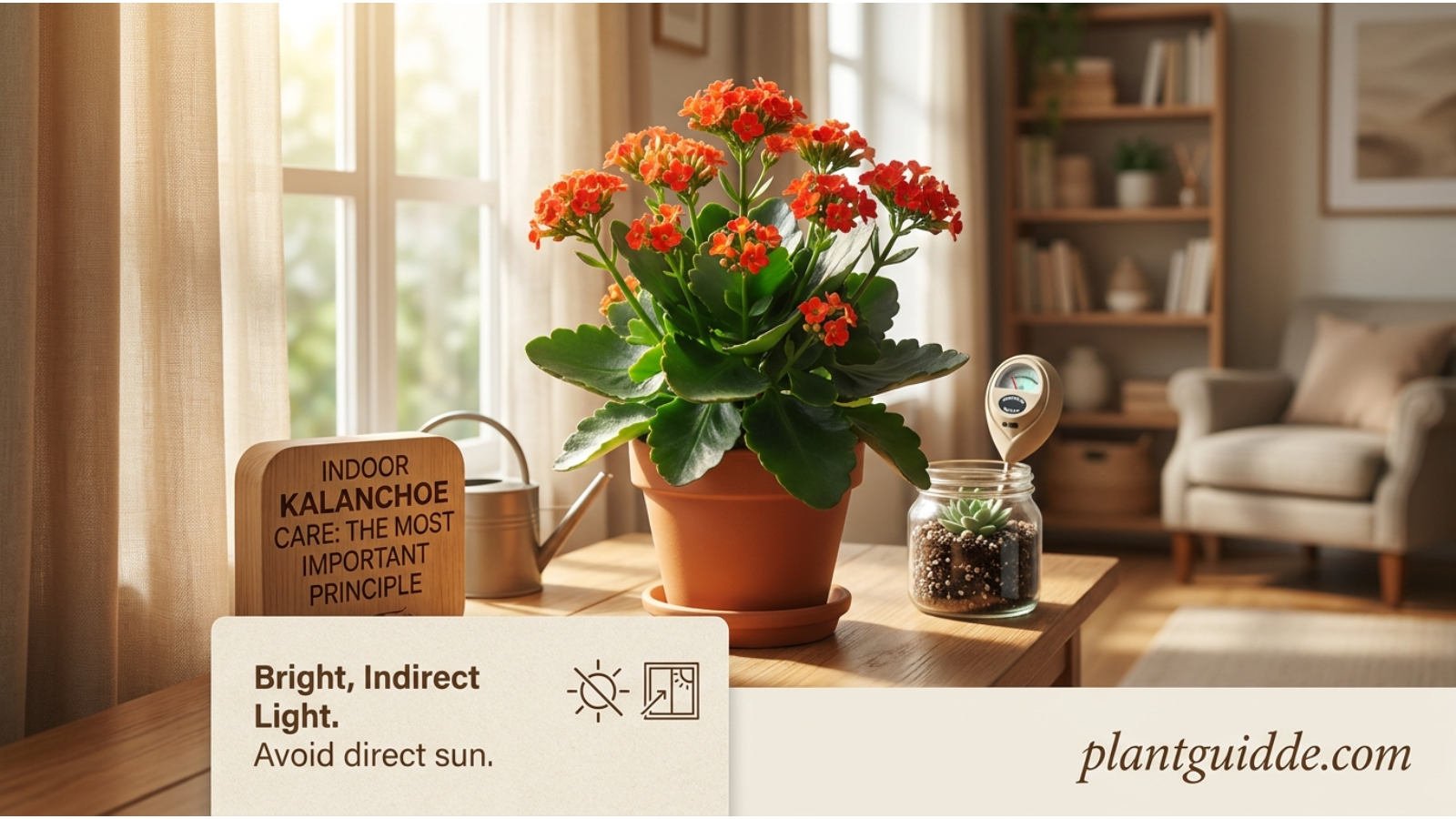
Kalanchoe Plant Care Indoors: The Most Important Principle
The most useful way to think about kalanchoe care is to stop treating every problem as a watering problem.
Instead, look at the entire growing environment.
A kalanchoe’s condition is influenced by the interaction between:
Light + soil + pot + water + temperature + airflow + season
For example, a plant in bright light and a fast-draining mix may dry quickly. The same plant in a large container with dense soil may stay wet for much longer.
That is why two people can follow the same watering schedule and get completely different results.
The best indoor growers learn to observe the plant rather than blindly follow a calendar.
FAQs:
How often should I water a kalanchoe indoors?
Water when the soil has mostly dried rather than according to a fixed weekly schedule. When watering, soak the root zone thoroughly and allow excess water to drain completely.
Does kalanchoe need direct sunlight?
Kalanchoe benefits from strong light, but intense direct sunlight through hot glass can damage foliage. Provide bright light and introduce stronger sun gradually when necessary.
Why are my kalanchoe leaves turning yellow?
Overwatering is a common possibility, especially when the soil stays wet for long periods. However, yellowing can also result from low light, aging foliage, root damage, or other environmental stresses.
Why is my kalanchoe not blooming?
Insufficient light is a common reason. Flowering kalanchoes are also influenced by day length, so consistent long periods of uninterrupted darkness can be important when deliberately encouraging reblooming.
What is the best soil for kalanchoe?
Use a loose, fast-draining cactus or succulent mix. The goal is to provide good drainage and air around the roots rather than retaining moisture for long periods.
Should I mist my kalanchoe?
Usually not. Kalanchoe is a succulent and generally does not require frequent leaf misting. Focus instead on proper soil moisture, drainage, light, and airflow.
Can overwatered kalanchoe recover?
It can, particularly if the problem is identified early and healthy roots and stems remain. Move the plant out of persistently saturated soil, address drainage, and remove severely damaged tissue when necessary.
How do I make my kalanchoe bloom again?
Keep the plant healthy, provide strong daytime light, and use an appropriate uninterrupted dark period to encourage flowering. Once flower buds appear, maintain consistent conditions.
Can kalanchoe grow in a bedroom?
Yes, provided the bedroom has enough light. A bright windowsill or suitable supplemental grow light is more important than the room itself.
Is kalanchoe easy to care for indoors?
Yes, once its basic requirements are understood. The biggest beginner mistakes are usually excessive watering, poor drainage, and insufficient light.
Final Takeaway
Successful kalanchoe plant care indoors comes down to giving the plant conditions that match its succulent nature.
Give it bright light, fast-draining soil, a container with drainage, thorough but infrequent watering, and stable indoor conditions. Do not keep the soil constantly wet, and do not assume yellow leaves or poor flowering automatically mean the plant needs more fertilizer or water.
Most importantly, learn to read the combination of symptoms. A shriveled plant in dry soil needs a different response from a shriveled plant sitting in saturated soil.
Once you stop watering by the calendar and start responding to the plant’s actual environment, kalanchoe becomes much easier to grow, and much more likely to reward you with healthy foliage and another round of colorful flowers.

Asad Mumtaz is a dedicated plant enthusiast and gardening writer with a passion for helping people care for their plants successfully. He specializes in plant care guides, indoor gardening, and practical growing tips for all skill levels. His content focuses on making gardening simple, enjoyable, and rewarding. Through his work, Asad shares reliable advice to help readers create thriving green spaces.