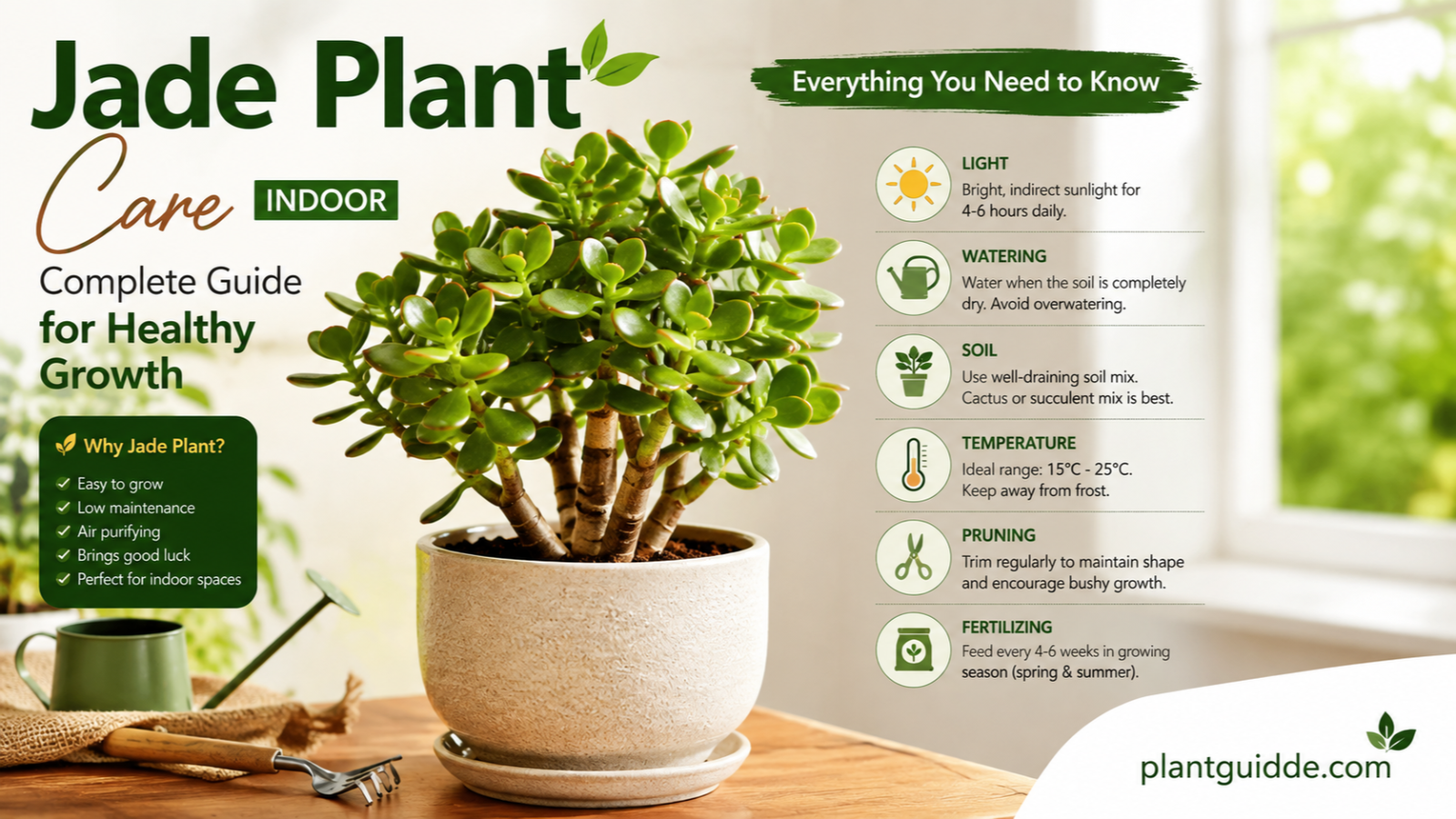
Jade plant care indoor can be one of the easiest houseplants to maintain, but only when its basic growing conditions match what it naturally prefers. Its thick, fleshy leaves and stems store water, allowing the plant to tolerate dry periods far better than consistently wet soil.
That water-storage ability is also where many beginners get into trouble. It is easy to assume that a jade plant needs frequent watering because its leaves look healthy and substantial. In reality, jade plant care indoor is largely about controlling moisture rather than constantly supplying it.
If your jade plant has yellow leaves, soft stems, dropping leaves, brown spots, or slow growth, the problem is often environmental. Light, watering habits, soil drainage, pot size, temperature, and seasonal growth all influence how the plant responds.
This guide explains not just how to care for a jade plant indoors, but how to recognize what your plant is telling you and what to change when something goes wrong.
Quick Answer
For successful jade plant care indoor, place your jade plant in bright light, ideally near a sunny south- or west-facing window. Use a fast-draining succulent or cactus soil in a pot with drainage holes, and water thoroughly only when the soil has dried out. Keep temperatures stable, provide good airflow, and avoid frequent watering. Most jade plant problems come from insufficient light, excess moisture, or poor drainage.
What Is a Jade Plant?
The jade plant is commonly known as Crassula ovata, a succulent native to southern Africa. It is valued as an indoor plant because its thick stems and fleshy oval leaves can remain attractive with relatively little water.
Unlike plants with thin leaves that lose moisture quickly, jade plants store water in their foliage and stems. This adaptation explains one of the most important rules of indoor jade plant care:
Jade plants can eventually become small, branching trees indoors, especially when they receive strong light and are pruned appropriately.
Why Jade Plants Are Popular Indoor Plants
They offer several practical advantages:
- They tolerate periods of dryness.
- Their compact root system works well in containers.
- They can live for many years with suitable care.
- Their woody stems can be shaped through pruning.
- Mature plants can develop a miniature tree-like appearance.
- They are relatively forgiving compared with many tropical houseplants.
However, “easy-care” does not mean “indestructible.” A jade plant sitting in dim light with constantly wet soil can decline surprisingly quickly.
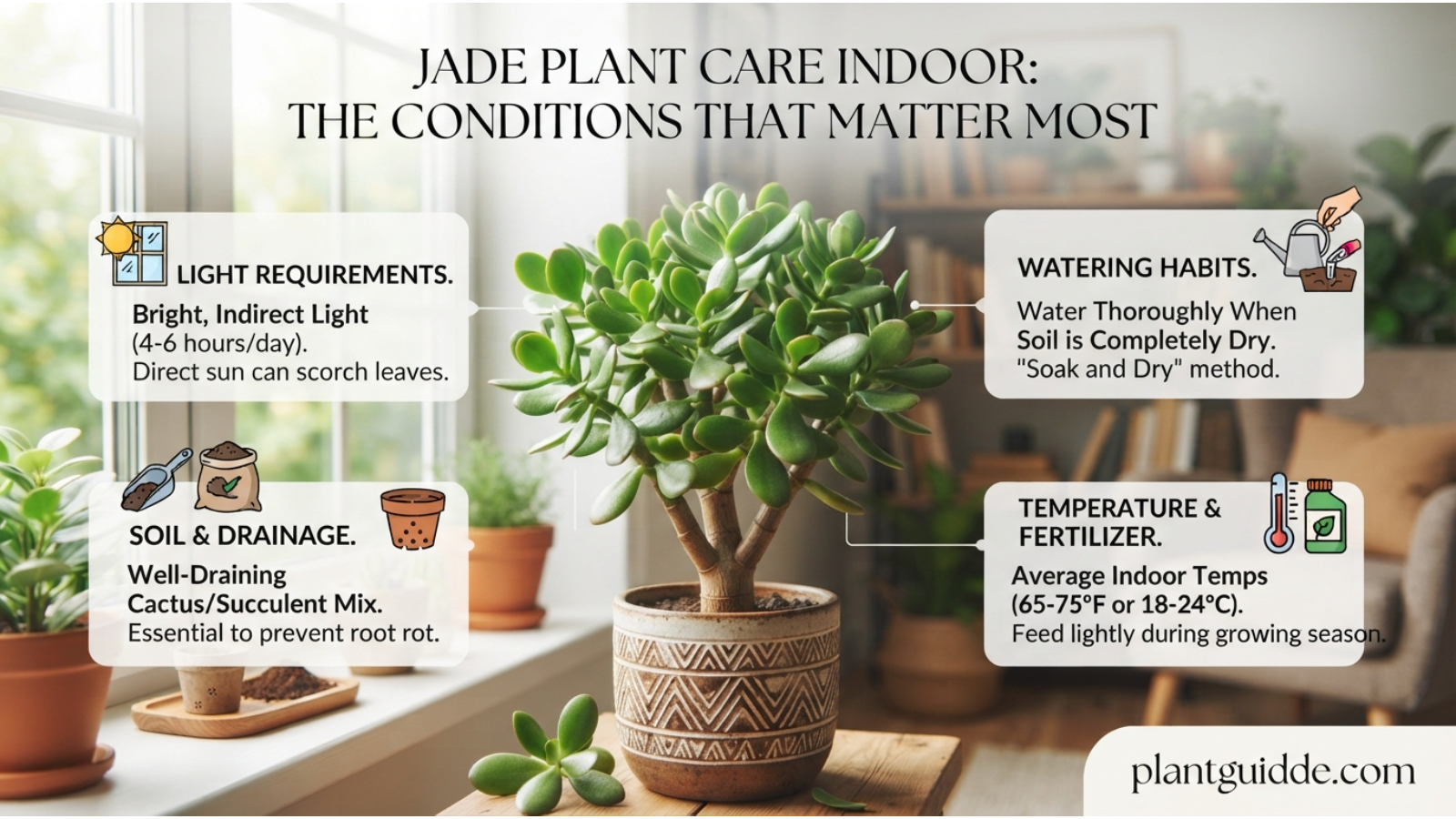
Jade Plant Care Indoor: The Conditions That Matter Most
Successful care comes down to balancing five major factors:
| Care factor | What a jade plant generally prefers | Common problem |
|---|---|---|
| Light | Bright light with several hours of strong indirect or direct sunlight | Leggy growth |
| Water | Thorough watering followed by a drying period | Root or stem rot |
| Soil | Fast-draining succulent soil | Waterlogged roots |
| Temperature | Warm, stable indoor conditions | Leaf drop or stress |
| Pot | Drainage hole and appropriately sized container | Persistent wet soil |
The important point is that these factors interact.
For example, a plant receiving strong sunlight may use water faster than one sitting several feet from a window. Therefore, a fixed schedule such as “water every Sunday” is less reliable than checking the actual soil and plant conditions.
Give Your Jade Plant Enough Light
Light is arguably the most underestimated part of jade plant care indoor.
Jade plants are succulents, and they generally perform best when they receive plenty of light. A bright windowsill is usually much better than a dark corner of a room.
Where should you place a jade plant?
Good locations include:
- A bright south-facing window
- A bright west-facing window
- An east-facing window with strong morning light
- A very bright room where the plant receives several hours of direct or strong filtered light
Jade plant care indoor the plant is several feet away from a window, the amount of usable light can fall considerably.
Signs your jade plant needs more light
Watch for:
- Long spaces between leaves
- Thin or weak stems
- Leaning toward the window
- Small new leaves
- Slow growth
- A generally stretched appearance
This stretched growth is called etiolation. It occurs when the plant elongates in search of stronger light.
Important: Increase sunlight gradually
A jade plant that has been kept indoors under relatively weak light can become stressed if suddenly moved into intense direct sun.
Jade plant care indoor you want to increase its exposure, do so gradually over several days or weeks. This gives the foliage time to adjust and reduces the chance of sunburn.
Image Suggestion: A comparison showing a compact, well-lit jade plant beside a stretched jade plant growing toward a window.
How Often Should You Water a Jade Plant Indoors?
There is no single watering schedule that works for every indoor jade plant.
Instead, use the condition of the soil as your main guide.
A practical watering method
- Check the top several inches of soil.
- If the soil is still noticeably moist, wait.
- When the soil has dried substantially, water thoroughly.
- Allow excess water to drain completely.
- Empty water that remains in the saucer or outer container.
The goal is deep watering followed by a drying period, rather than frequent small amounts of water.
Why overwatering is so dangerous
Jade plant roots need oxygen as well as moisture. When soil remains saturated for too long, the spaces that normally contain air become filled with water.
This can create conditions that favor root deterioration.
Beginners often interpret drooping leaves as thirst and immediately add more water. With succulents, that can make the original problem worse.
Signs of possible overwatering
Look for combinations such as:
- Yellowing leaves
- Leaves becoming soft or translucent
- Unusual leaf drop
- Soft or darkening stems
- Soil that stays wet for many days
- An unpleasant smell from the soil
Don’t diagnose the problem from one symptom alone. Yellow leaves, for example, can have several causes.
Signs of underwatering
A genuinely thirsty jade plant may show:
- Wrinkled leaves
- Soft, less-plump foliage
- Dry soil pulling away from the pot
- Leaves dropping after prolonged dryness
A slightly dry jade plant is generally easier to recover than one repeatedly kept waterlogged.
Choose Fast-Draining Jade Plant Soil
The best soil for jade plants indoors should drain efficiently rather than holding large amounts of water around the roots.
A commercial cactus or succulent potting mix is a convenient starting point.
You can also improve a standard potting mix by incorporating materials that increase drainage and aeration, depending on the ingredients available to you.
What good jade plant soil should do
It should:
- Allow excess water to move away from the roots
- Maintain enough moisture for roots to absorb water
- Contain air spaces
- Avoid becoming compacted
- Dry within a reasonable period after watering
A common mistake is choosing a dense, moisture-retentive indoor potting mix simply because it feels rich and healthy.
For jade plants, “more moisture” does not necessarily mean “better growth.”
Use a Pot With Drainage Holes
A drainage hole is one of the simplest ways to reduce watering problems.
The container should allow excess water to escape freely after irrigation.
Avoid choosing a pot that is too large
A very large pot contains more soil than the plant’s root system needs. That extra soil can retain moisture for longer, increasing the time required for the root zone to dry.
Choose a container that provides room for growth without dramatically increasing the volume of unused soil.
Terracotta vs. plastic
Both can work.
Terracotta is porous and can allow moisture to escape through the container walls, making it useful for growers who tend to overwater.
Plastic retains moisture longer and can also be perfectly suitable when watering is adjusted accordingly.
The material is less important than proper drainage, appropriate soil, and good watering habits.
Image Suggestion: Cross-section diagram of a jade plant pot showing drainage holes, fast-draining soil, and healthy roots.
Temperature and Indoor Placement
Jade plants generally prefer warm, stable indoor conditions.
Keep the plant away from:
- Cold drafts
- Constant blasts from air conditioners
- Extremely hot heating vents
- Sudden temperature changes
A bright window is useful, but remember that glass can become very hot under intense sunlight. Monitor the plant if it is pressed directly against a particularly hot window.
Stable conditions are generally more useful than constantly moving the plant around the house.
Does a Jade Plant Need High Humidity?
Usually, no.
Unlike many tropical houseplants, jade plants do not require highly humid indoor air to remain healthy. Their succulent leaves are adapted to conserve moisture.
This means you generally don’t need to:
- Mist the plant every day
- Keep it in a bathroom simply for humidity
- Place a humidifier directly beside it
Instead, focus on light, drainage, watering, and airflow.
If your indoor environment is reasonably comfortable for people, humidity is rarely the first thing I would change when troubleshooting a jade plant.
Fertilizing Jade Plants
Jade plants do not need heavy feeding.
During active growth, a balanced fertilizer formulated for houseplants or succulents can be applied according to the product’s directions.
Avoid assuming that more fertilizer will produce a healthier plant.
Excess fertilizer can contribute to salt accumulation and may damage roots or cause foliage problems.
A sensible approach
- Fertilize during active growth rather than constantly.
- Follow the recommended dilution.
- Avoid feeding a severely stressed or recently repotted plant until it has recovered.
- Reduce or stop routine feeding during periods of slow winter growth.
How to Repot a Jade Plant
Jade plants don’t necessarily need annual repotting.
Repot when the plant has genuinely outgrown its container, the soil has degraded, drainage has become poor, or there is another clear reason to disturb the root system.
Step-by-step repotting
- Choose a pot only moderately larger than the current one.
- Make sure it has a drainage hole.
- Prepare fresh, fast-draining soil.
- Remove the plant carefully.
- Inspect the roots for obvious damage or decay.
- Place the plant at an appropriate depth.
- Fill around the roots without aggressively compacting the soil.
- Allow the plant to settle before returning to its normal watering routine.
Avoid immediately saturating a plant simply because it has been repotted. Your watering approach should account for the condition of the roots and the moisture level of the new soil.
Pruning Jade Plants for Bushier Growth
Jade plants can become tall and sparse when light is inadequate or when they are allowed to grow without pruning.
Pruning can encourage branching and help maintain a more compact shape.
How to prune
Use clean, sharp pruning shears and cut just above a leaf node or branching point where appropriate.
You can remove:
- Weak growth
- Dead or damaged branches
- Overly long stems
- Branches that make the plant unbalanced
Don’t remove large portions of healthy growth without a reason. Jade plants grow relatively slowly, so excessive pruning can set the plant back.
An important pruning tip
Light should be corrected alongside pruning.
If you prune a leggy jade plant but leave it in the same low-light location, the new growth may become stretched again.
Propagating a Jade Plant From Cuttings
One of the enjoyable aspects of jade plant care is how readily healthy material can be propagated.
Stem cuttings are commonly used.
Basic method
- Select a healthy stem.
- Make a clean cut.
- Allow the cutting to dry and form a callus.
- Place it into an appropriate well-draining growing medium.
- Provide bright light without immediately exposing it to harsh conditions.
- Water carefully rather than keeping the medium constantly wet.
- Wait for rooting and new growth.
A common mistake is treating a succulent cutting like a tropical plant and keeping the propagation medium constantly saturated.
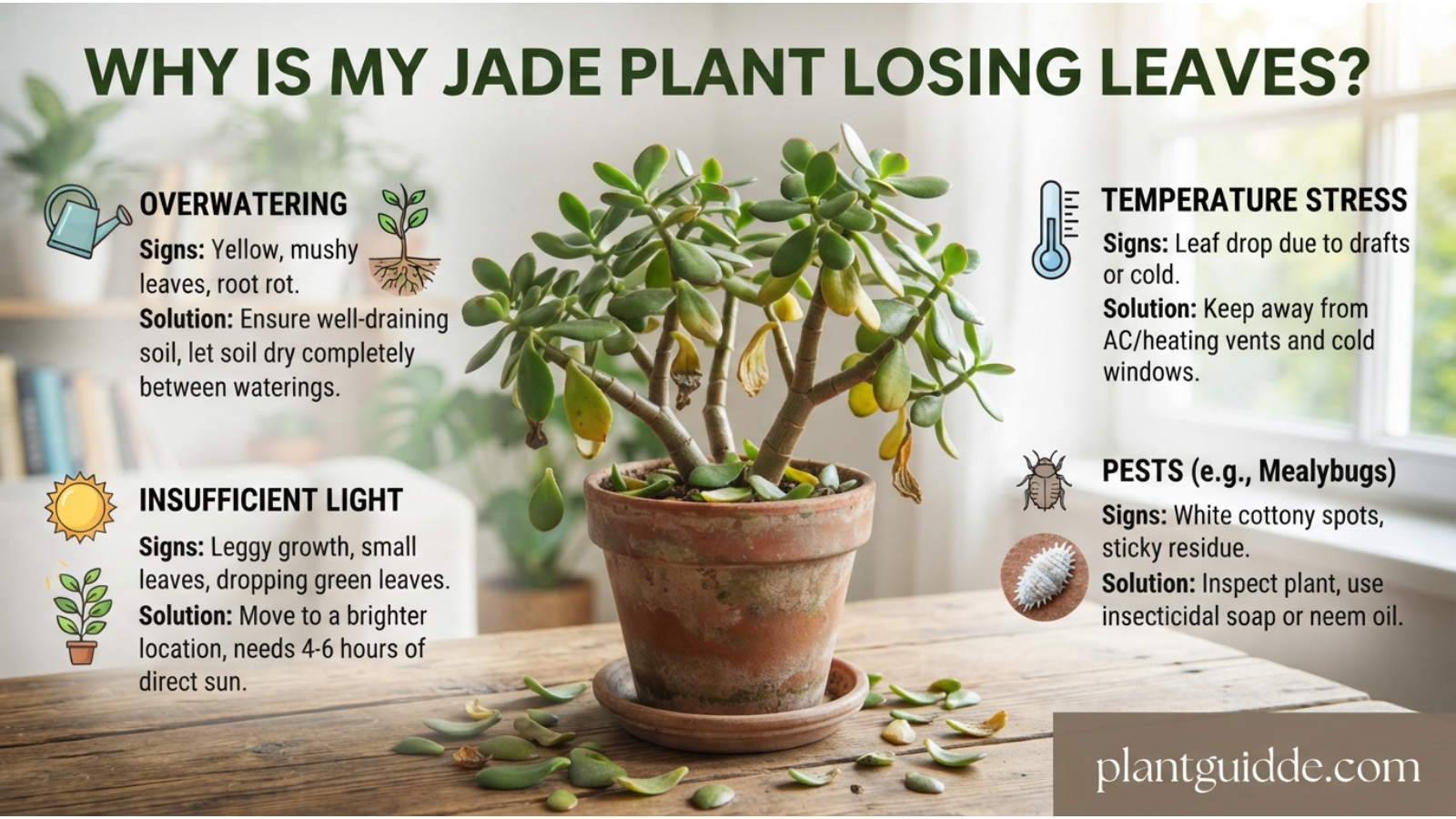
Why Is My Jade Plant Losing Leaves?
Leaf drop is a symptom, not a diagnosis.
Several factors can cause it.
Common causes
Overwatering:
Roots may be stressed when the soil remains wet for extended periods.
Underwatering:
Prolonged dryness can eventually cause leaves to shrivel and drop.
Insufficient light:
Weak growth can make the plant more vulnerable to other stresses.
Sudden environmental changes:
Moving the plant, changing light levels, or exposing it to temperature fluctuations can cause temporary stress.
Root problems:
If roots are damaged, the plant may struggle even when soil moisture appears adequate.
The most useful approach is to evaluate the entire growing environment rather than immediately adding fertilizer or water.
Jade Plant Leaves Turning Yellow
Yellow leaves are one of the most common complaints in indoor jade plants.
Before changing anything, ask:
- Is the soil staying wet for too long?
- Has the plant recently been moved?
- Is it receiving enough light?
- Are only older leaves affected?
- Does the stem feel firm or soft?
- Is there evidence of root damage?
If yellowing is accompanied by persistently wet soil and soft foliage, excess moisture deserves particular attention.
If only an occasional older leaf turns yellow while the plant continues producing healthy growth, the situation may be much less serious.
Why Are My Jade Plant Leaves Wrinkled?
Wrinkled or shriveled leaves often indicate that the plant is losing water faster than it is replacing it.
Check the soil first.
If the soil is extremely dry, a thorough watering may be appropriate.
But if the soil is already wet and the leaves are still wrinkled, do not automatically water again. The problem could involve root damage, which prevents the plant from taking up water effectively.
This distinction is important because the same visible symptom can result from completely different underlying problems.
Why Are Jade Plant Leaves Falling Off?
If your jade plant suddenly drops leaves, consider what changed recently.
Possible triggers include:
- Major watering changes
- A move to a different location
- Sudden temperature changes
- Low light
- Root stress
- Prolonged dryness
- Excessive moisture
A useful troubleshooting habit is to identify what changed in the week or two before symptoms appeared.
That often reveals more than searching for a single universal cause.
Jade Plant Brown Spots and Scorched Leaves
Brown areas can develop for different reasons.
Possible causes include:
- Excessive direct sun after a sudden transition
- Physical damage
- Water-related root stress
- Environmental stress
- Leaf tissue damage from temperature extremes
If brown patches appeared soon after moving a low-light plant into intense sunlight, gradual acclimation would have been preferable.
Don’t automatically interpret every brown spot as a watering problem.
Seasonal Jade Plant Care Indoor
Your jade plant’s needs can change throughout the year.
Spring and Summer
During brighter months:
- Growth may increase.
- The plant may use water faster.
- Fertilization may be more appropriate.
- Strong sunlight can increase heat near windows.
Still, don’t water simply because the calendar says it’s time.
Fall and Winter
Indoor conditions often change because:
- Days become shorter.
- Growth slows.
- Heating systems can alter the room environment.
- Soil may dry more slowly.
This means watering frequency may need to decrease.
A jade plant that needed frequent monitoring during bright summer growth may require considerably less water during a darker winter period.
Common Jade Plant Care Mistakes
1. Watering on a fixed schedule
Why it fails: Indoor conditions aren’t identical every week.
Better approach: Check soil moisture and consider light, temperature, pot size, and recent weather.
2. Keeping the soil constantly damp
Why it fails: Jade plants store water and don’t need continuously wet roots.
Better approach: Allow substantial drying between thorough waterings.
3. Keeping the plant in a dark corner
Why it fails: Jade plants need strong light for compact growth.
Better approach: Move it closer to a bright window and acclimate it gradually if direct sunlight increases significantly.
4. Using a huge decorative pot
Why it fails: Excess soil can remain wet for too long.
Better approach: Use an appropriately sized container with drainage.
5. Fertilizing a struggling plant
Why it fails: Fertilizer does not correct root rot, poor light, or inappropriate watering.
Better approach: Identify the environmental problem first.
6. Ignoring the roots
When a jade plant repeatedly declines despite seemingly correct care, inspect the root zone. Healthy roots should not be reduced to soft, deteriorating tissue.
A Simple Jade Plant Troubleshooting Chart
| Symptom | Possible cause | What to check first |
|---|---|---|
| Yellow leaves | Excess moisture, stress, natural aging | Soil moisture |
| Wrinkled leaves | Dryness or root dysfunction | Soil + roots |
| Soft stem | Severe moisture/root problem | Root zone |
| Long, stretched growth | Insufficient light | Window placement |
| Leaf drop | Watering, light, temperature, stress | Recent environmental changes |
| Brown/scorched patches | Sun or environmental damage | Recent light change |
| Slow growth | Low light, season, limited resources | Light and growing conditions |
Image Suggestion: A visual troubleshooting chart showing healthy jade leaves, wrinkled leaves, yellow leaves, leaf drop, and sun damage.
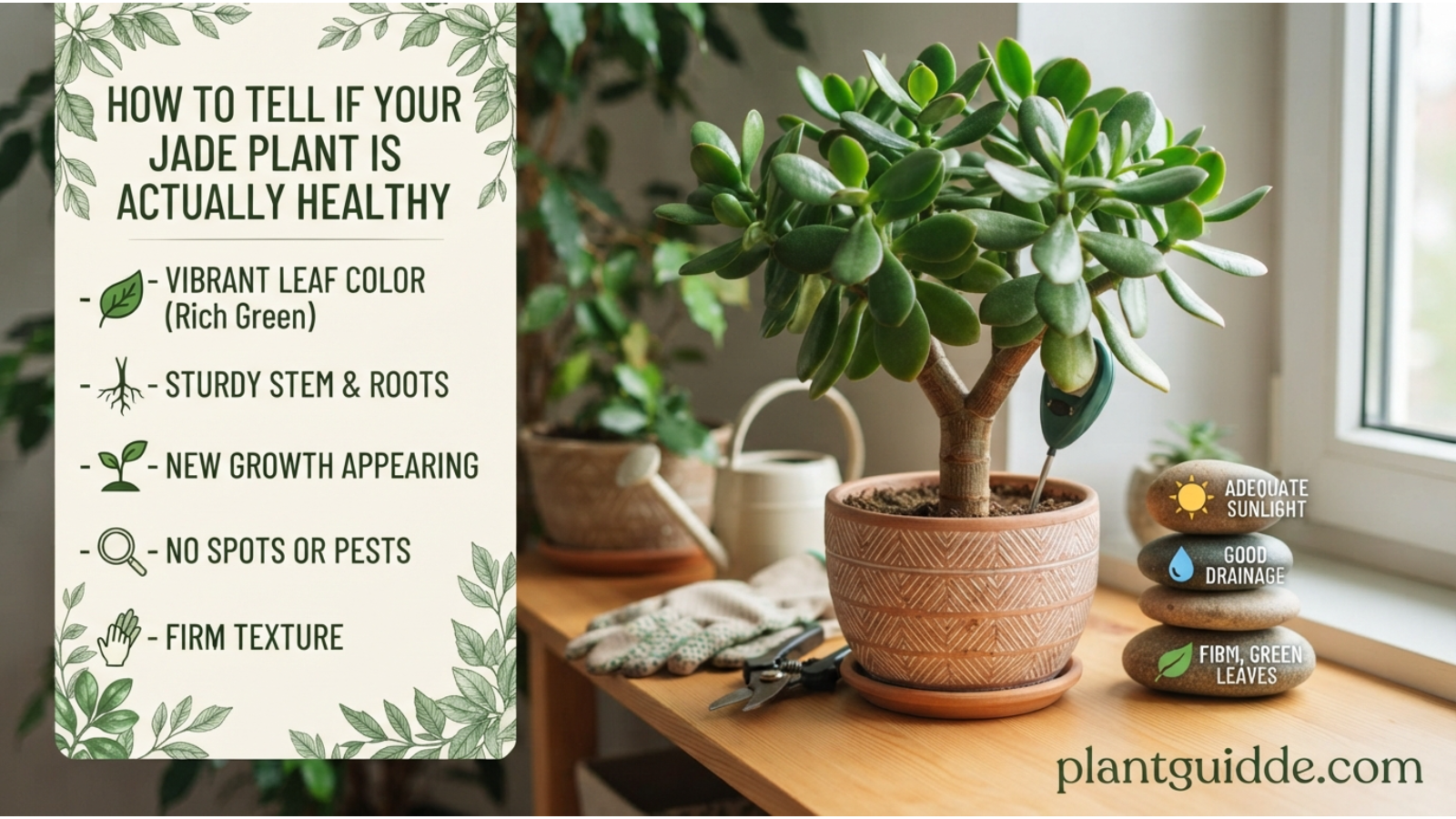
How to Tell if Your Jade Plant Is Actually Healthy
Don’t judge the plant only by its newest leaf.
A healthy indoor jade plant will generally show:
- Firm, plump leaves
- Stable stems
- New growth during its active growing period
- Good color appropriate to the cultivar and light conditions
- No persistent foul-smelling or waterlogged soil
- Compact growth when light is adequate
Some mature jade plants naturally develop woody stems and may have occasional older leaves that fall. That alone doesn’t mean the plant is unhealthy.
The overall trend matters more than one imperfect leaf.
Expert Tips for Better Jade Plant Care
Rotate the plant occasionally
If one side receives much more light, the plant may grow unevenly. Rotating it periodically can help maintain a balanced shape.
Watch the plant after watering
Don’t just record the date. Notice how quickly the soil dries.
This teaches you how your particular plant responds to its environment.
Treat light as part of the watering equation
A jade plant in strong light may dry substantially faster than one in a dim room.
Therefore, watering frequency should change with growing conditions.
Don’t confuse drought tolerance with neglect tolerance
A jade plant can survive dry periods, but that doesn’t mean it can thrive indefinitely without adequate light, nutrients, or water.
Change one major variable at a time
If your plant is struggling, moving it, repotting it, fertilizing it, and dramatically changing watering all at once makes diagnosis difficult.
Where possible, identify the most likely problem and correct it first.
FAQs:
How often should I water my jade plant indoors?
Water when the soil has dried substantially rather than following a strict weekly schedule. Water thoroughly, allow excess water to drain, and wait for the soil to dry again before watering.
Does a jade plant need direct sunlight?
Jade plants generally benefit from strong light and can handle direct sunlight, but a plant accustomed to lower light should be acclimated gradually to intense sun.
Can a jade plant survive in low light?
It may survive, but prolonged low light commonly produces weak, stretched growth. A brighter location is usually better for maintaining a compact, healthy-looking plant.
Why is my jade plant turning yellow?
Overwatering is a common possibility, but yellowing can also result from natural aging or other forms of environmental stress. Check the soil moisture, light, and overall plant condition before changing your routine.
Should I mist my jade plant?
Regular misting is generally unnecessary. Jade plants are succulents and don’t require the high humidity commonly associated with tropical houseplants.
What is the best soil for jade plants?
Use a fast-draining cactus or succulent mix, ideally in a container with a drainage hole. The goal is to prevent prolonged water retention around the roots.
Do jade plants need fertilizer?
They can benefit from occasional fertilization during active growth, but they do not require heavy feeding. Follow the fertilizer’s recommended dilution and frequency.
When should I repot my jade plant?
Repot when the plant has outgrown its container, the soil has degraded, drainage has become poor, or the roots require attention. Annual repotting is not automatically necessary.
How can I make my jade plant bushier?
Provide strong light and prune overly long stems strategically to encourage branching. Pruning without improving inadequate light can result in the same leggy growth returning.
Conclusion
Good jade plant care indoor is less about following a rigid watering calendar and more about understanding how the plant responds to its environment.
Give your jade plant strong light, fast-draining soil, a pot with drainage, thorough but appropriately spaced watering, stable temperatures, and good airflow. Most importantly, learn to read the plant and soil together rather than reacting to individual symptoms.
If the leaves are wrinkled, don’t immediately assume it needs water. If they are yellow, don’t automatically add fertilizer. Check the roots, soil moisture, light, and recent changes first.
Once those fundamentals are right, jade plants can become remarkably long-lived indoor companions, and with proper light and occasional pruning, a small cutting can eventually develop into an attractive, tree-like specimen.

Asad Mumtaz is a dedicated plant enthusiast and gardening writer with a passion for helping people care for their plants successfully. He specializes in plant care guides, indoor gardening, and practical growing tips for all skill levels. His content focuses on making gardening simple, enjoyable, and rewarding. Through his work, Asad shares reliable advice to help readers create thriving green spaces.