Learning how to take care of a jade plant starts with understanding one simple thing: jade plants store water in their thick, fleshy leaves and stems. That makes them naturally drought-tolerant, but also easy to overwater.
Too much moisture can quietly damage the roots, leading to yellow leaves, leaf drop, soft stems, or soil that stays wet for too long. The good news is that jade plants are relatively forgiving when they receive the right balance of light, drainage, and watering.
In this guide, you’ll learn how to take care of a jade plant properly, including watering, light, soil, pruning, fertilizing, repotting, propagation, seasonal care, and how to spot common problems before they become serious.
Quick Answer
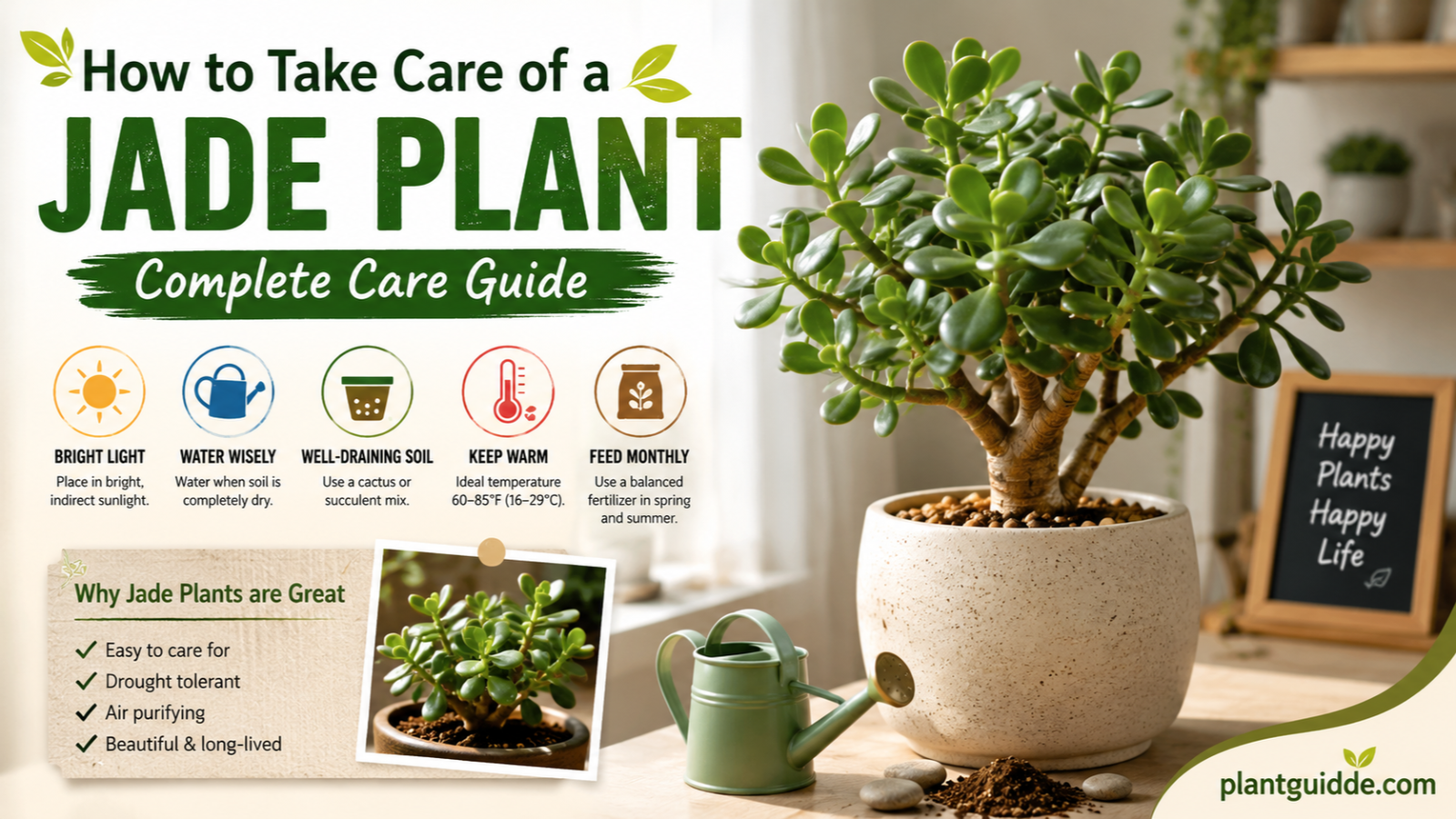
To take care of a jade plant, place it in bright light, use a fast-draining soil mix, and water only when the soil has dried substantially. Keep it in a pot with drainage holes and avoid letting the roots sit in water. Jade plants prefer warm, stable conditions and relatively low humidity. During active growth, provide adequate light and occasional balanced fertilizer; reduce watering and feeding during winter.
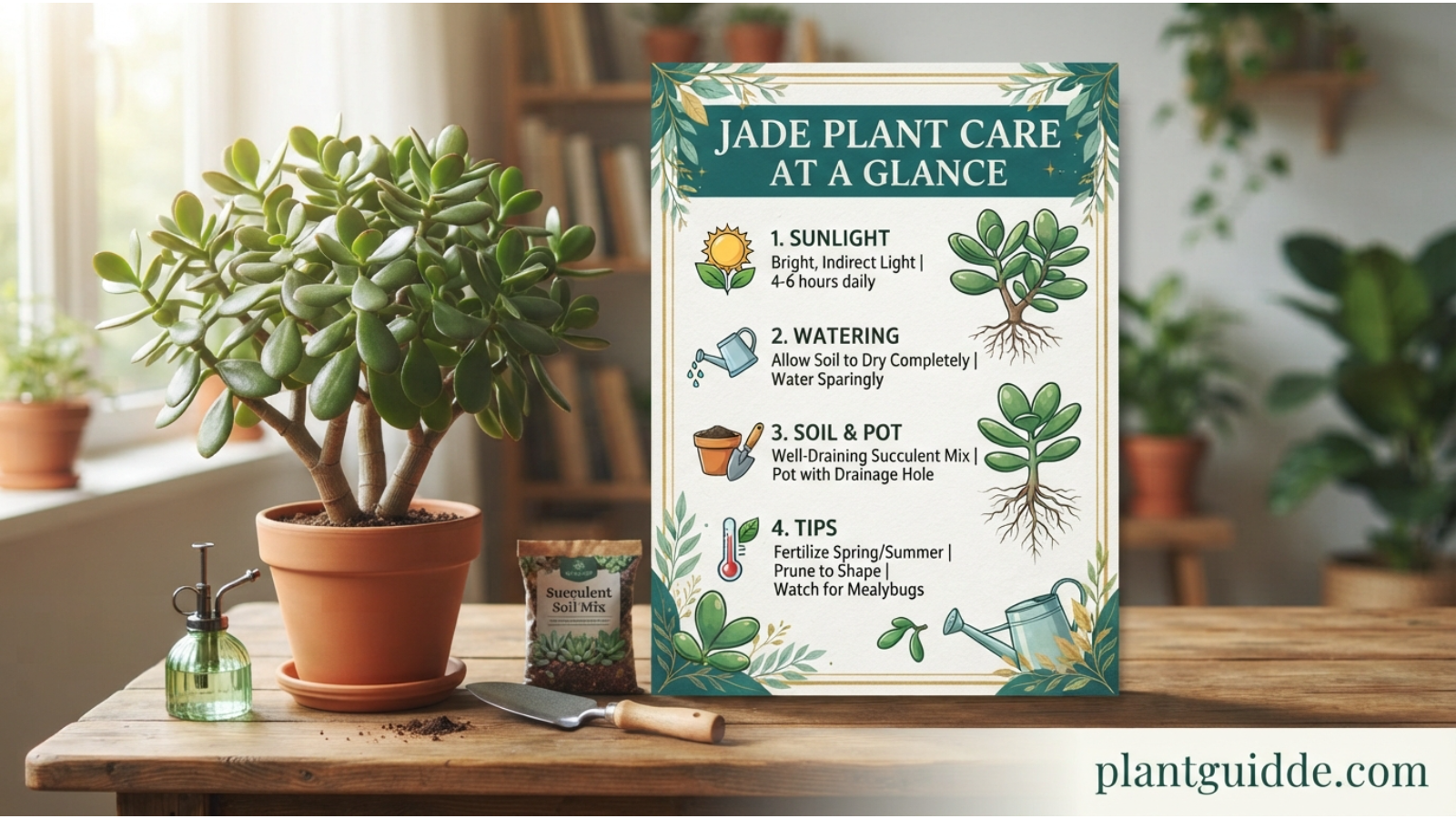
Jade Plant Care at a Glance
| Care requirement | What a jade plant prefers |
|---|---|
| Light | Bright light; several hours of direct sun can be beneficial after gradual acclimation |
| Water | Thorough watering followed by a drying period |
| Soil | Fast-draining, porous mix |
| Pot | Container with drainage holes |
| Humidity | Average household humidity is usually adequate |
| Temperature | Warm, stable indoor conditions |
| Fertilizer | Light feeding during active growth |
| Pruning | Occasional pruning to control shape and encourage branching |
| Repotting | Only when the plant or roots actually need more space |
| Propagation | Stem or leaf cuttings |
| Main risk | Overwatering and poor drainage |
The most important principle is simple: jade plants handle dryness better than constantly wet roots.
Understand What Makes a Jade Plant Different
The jade plant, commonly known as Crassula ovata, is a succulent native to southern Africa. Its fleshy leaves and stems function as water-storage organs.
This explains several important aspects of jade plant care.
When the soil dries, a healthy jade plant can draw on moisture stored in its leaves and stems. When the soil remains wet for too long, however, the roots may not receive the balance of oxygen they need.
That is why treating a jade plant like a tropical houseplant often causes problems.
A healthy jade plant typically has:
- Firm, plump leaves
- Strong stems
- Compact or naturally branching growth
- Good color appropriate to its growing conditions
- New growth during favorable conditions
- Soil that dries between thorough waterings
A plant does not need to be watered simply because the calendar says it is time.
The condition of the soil and the plant should guide your decision instead.
How Much Light Does a Jade Plant Need?
Light is one of the most important factors in successful jade plant care.
Give your jade plant the brightest practical location available indoors. A bright south- or west-facing window can work well, although the intensity of sunlight varies considerably depending on the season, window glass, climate, and whether the plant is directly exposed to the sun.
Jade plants grown in insufficient light often become stretched and sparse. Their stems may lengthen between leaves as the plant searches for more illumination.
Signs your jade plant needs more light
Watch for:
- Long spaces between leaves
- Thin or weak-looking stems
- Leaning toward a window
- Slow growth
- Pale or less vigorous foliage
A common mistake is moving a jade plant suddenly from a dim room into strong direct sunlight. Even a sun-loving succulent can develop leaf damage if it has not been acclimated.
Better approach
If your plant has been growing in low light:
- Move it closer to a bright window.
- Increase exposure gradually.
- Watch the leaves for bleaching, scorching, or unusual discoloration.
- Maintain the stronger light once the plant has adjusted.
Image Suggestion: A comparison showing a compact, well-lit jade plant beside a stretched jade plant grown in insufficient light.
How Often Should You Water a Jade Plant?
There is no single watering interval that works for every jade plant.
Instead of asking, “How many days should I wait?” check whether the potting mix has dried sufficiently.
Environmental conditions change the rate at which soil loses moisture. A jade plant in a small terracotta pot near a sunny window may dry much faster than a large plant in a plastic container in a cool room.
The correct watering method
When the plant needs water:
- Check the soil first.
- If the mix has dried substantially, water thoroughly.
- Allow excess water to escape through the drainage holes.
- Empty any standing water collected beneath the pot.
- Allow the soil to dry again before watering.
Avoid giving tiny amounts of water every few days simply to “keep it moist.” This can leave portions of the root zone continually damp.
How to check the soil
You can use your finger to check the upper portion of the mix, but don’t rely solely on surface appearance. A dry-looking surface does not always mean the entire root zone has dried.
For larger containers, a wooden stick, moisture meter, or simply lifting the pot to compare its weight can provide additional clues.
What does an underwatered jade plant look like?
Possible signs include:
- Leaves becoming less firm
- Wrinkled or slightly shriveled foliage
- Excessive dryness in the potting mix
- Drooping or weakened growth
What does an overwatered jade plant look like?
Potential warning signs include:
- Yellowing leaves
- Leaves dropping unexpectedly
- Soft or mushy stems
- Persistently wet soil
- A sour or unpleasant smell from the soil
- Dark or deteriorating roots
One important distinction is that wrinkled leaves do not automatically mean your jade plant needs water. Root damage from excessive moisture can also prevent the plant from absorbing water properly.
The Best Soil for Jade Plants
Good soil is essential because jade plants need both moisture and oxygen around their roots.
A dense, water-retentive potting mix can remain wet for too long, particularly indoors where evaporation may be slow.
Use a well-draining succulent or cactus potting mix, or create a porous mix using suitable components that improve drainage and air space.
The exact recipe matters less than the final characteristics:
- It should drain readily.
- It should not stay saturated for long periods.
- It should provide enough stability for the plant.
- It should not compact heavily around the roots.
Why ordinary garden soil can be problematic
Garden soil can become dense inside a container and may not provide the drainage and aeration a potted jade plant needs.
Similarly, simply adding a small amount of sand to heavy soil does not necessarily solve drainage problems. Some fine sands can actually make a mix denser.
Expert tip: If you repeatedly struggle with wet soil, examine the entire system rather than blaming your watering habits alone. Pot size, drainage holes, soil structure, light levels, and temperature all affect how quickly the root zone dries.
Choose a Pot With Proper Drainage
A jade plant should be grown in a container that allows excess water to escape.
Look for:
- One or more drainage holes
- A stable base
- Enough space for the roots without excessive unused soil
- A size appropriate for the plant
Terracotta pots can be particularly useful for people who tend to overwater because the porous material can allow moisture to evaporate through the sides. However, terracotta is not a cure for overwatering; watering habits still matter.
Avoid oversized pots
A very large container holds more soil, and more soil generally means more moisture remains around the roots after watering.
Instead of automatically moving your jade into the biggest decorative pot available, increase pot size gradually when repotting is necessary.
Temperature and Humidity
Jade plants generally perform well under normal indoor temperatures.
Keep them away from extreme temperature fluctuations such as:
- Cold drafts
- Very hot heating vents
- Air-conditioning blasts
- Poorly insulated windows during freezing weather
- Sudden transitions between very different environments
Unlike many tropical houseplants, jade plants do not require high humidity to remain healthy.
That means you generally do not need to mist the leaves constantly or place a humidifier beside the plant simply because it is a houseplant.
In fact, increasing humidity does not compensate for poor drainage or excessive watering.
Should You Fertilize a Jade Plant?
Jade plants do not require heavy feeding.
During periods of active growth, an occasional balanced houseplant or succulent fertilizer used according to its label can support healthy development.
Avoid the temptation to fertilize every time you water. More fertilizer does not automatically mean faster or healthier growth.
Excessive fertilizer can contribute to salt accumulation in the potting mix and may damage roots.
A sensible approach
- Feed during active growth.
- Use a moderate concentration according to the fertilizer instructions.
- Avoid feeding stressed or recently repotted plants until they have recovered.
- Reduce or stop routine feeding during periods of slow winter growth.
If your jade plant is already growing strongly in good light and suitable soil, aggressive fertilization is usually unnecessary.
How to Prune a Jade Plant
Pruning is useful when you want to control the shape, encourage branching, remove damaged growth, or prevent a plant from becoming unbalanced.
Jade plants can develop woody stems as they mature, which contributes to their tree-like appearance.
Basic pruning method
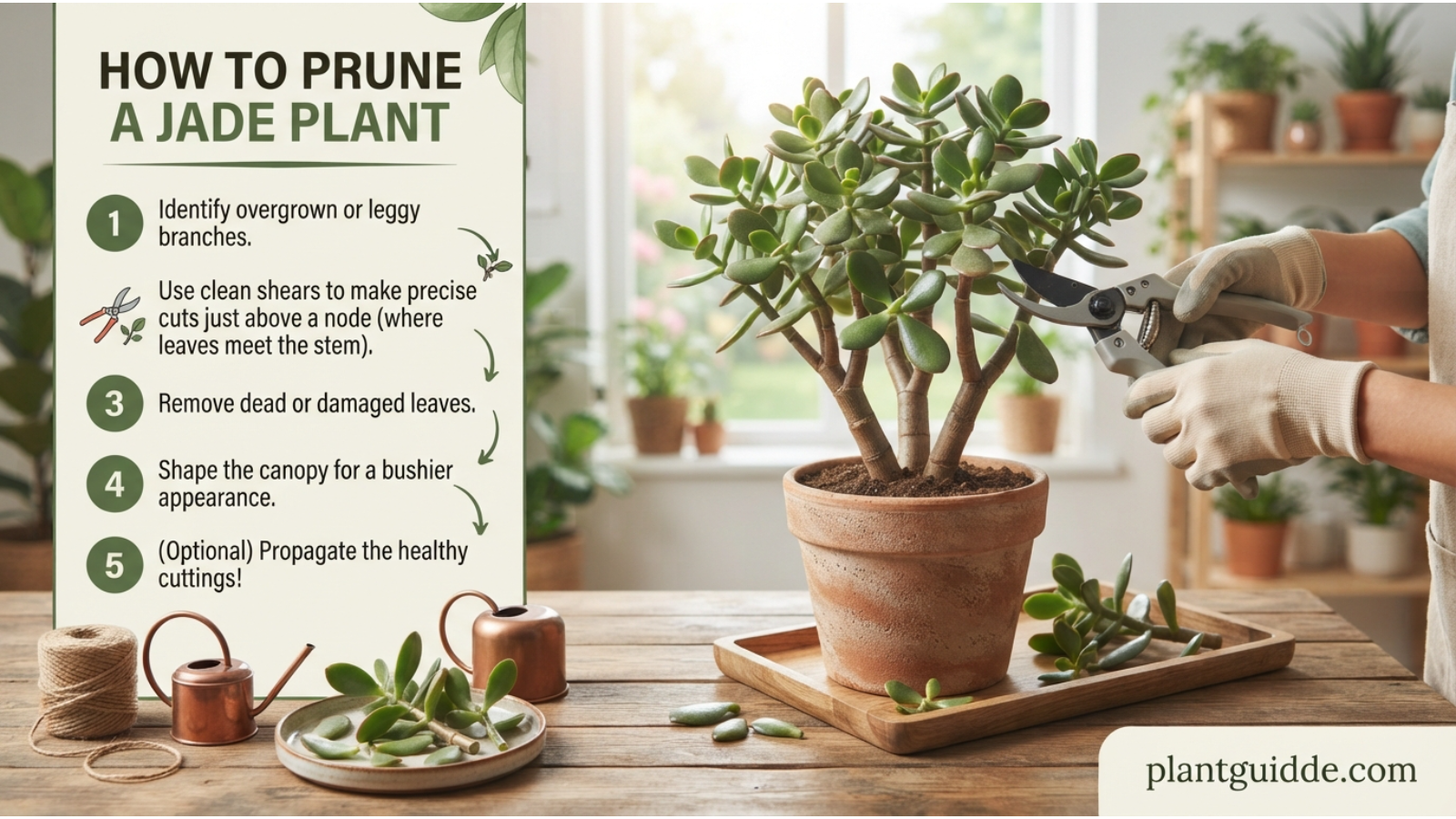
Use clean, sharp pruning shears and remove selected stems just above a healthy node or branching point.
Do not remove large amounts of foliage simply because you want the plant to grow faster. Jade plants need healthy leaves to produce energy.
Pruning can help with:
- Leggy growth
- Uneven shape
- Weak or awkward branches
- Excessively top-heavy growth
- Creating a fuller appearance
Expert observation: If a jade plant is becoming tall and sparse, pruning is only part of the solution. The underlying light problem should also be corrected. Otherwise, new growth may become stretched again.
Image Suggestion: Annotated jade plant showing where to make pruning cuts to encourage branching.
When Should You Repot a Jade Plant?
Jade plants generally do not need frequent repotting.
Repot when the current container is genuinely limiting the plant or when the growing medium has deteriorated.
Possible signs include:
- Roots becoming severely crowded
- Water running through the pot unusually quickly because the mix has broken down
- The plant becoming unstable
- The container no longer providing adequate support
- Poor drainage caused by degraded soil
Choose a container only modestly larger than the existing one.
After repotting, avoid immediately saturating the plant repeatedly. Give damaged roots time to settle and make sure the new soil drains effectively.
How to Propagate a Jade Plant
One of the easiest ways to create new jade plants is through cuttings.
Stem cutting method
- Select a healthy stem.
- Make a clean cut with sterilized shears.
- Allow the cut end to dry and callus.
- Place the cutting into a suitable, well-draining growing medium.
- Provide bright, indirect-to-bright light while it establishes.
- Water cautiously rather than keeping the medium constantly wet.
The cutting needs time to develop roots. Avoid repeatedly disturbing it to check for root development.
Leaf propagation
Healthy jade leaves can also produce new plants under suitable conditions, although leaf propagation is generally slower than starting with a stem cutting.
Image Suggestion: Step-by-step infographic showing a jade stem cutting from pruning through callusing and rooting.
Common Jade Plant Problems and What They Mean
The fastest way to solve a jade plant problem is to look at the symptoms alongside the growing conditions.
Yellow Leaves
Yellow leaves can have several causes, but excessive moisture is one of the first things worth investigating.
Check:
- How wet the soil remains
- Whether the pot has drainage holes
- How frequently you water
- Whether the container is oversized
- Whether the plant receives enough light
Do not automatically remove every yellow leaf and assume the problem is solved. Correct the environmental cause first.
Jade Plant Leaves Falling Off
Leaf drop can result from environmental stress, watering problems, sudden changes in conditions, inadequate light, or root problems.
Consider what changed recently.
For example, if a jade plant was moved from a bright window to a darker location and began dropping leaves afterward, the change in light may be more important than the calendar or watering frequency.
Wrinkled Leaves
Wrinkled foliage often indicates depleted water reserves, but context matters.
If the soil is bone dry and the leaves are becoming soft and wrinkled, watering may be appropriate.
If the soil is constantly wet while the leaves remain wrinkled, the problem could involve damaged roots rather than a simple lack of water.
That distinction prevents one of the most common mistakes: watering an already overwatered plant because its leaves look thirsty.
Soft or Mushy Stem
A soft stem is a serious warning sign.
Inspect the soil and roots. Persistent moisture, poor drainage, and root or stem rot may be involved.
If rot is suspected, simply adding more water or fertilizer will not fix the underlying problem.
Brown or Scorched Leaves
Brown patches can result from excessive direct sun after a sudden move, environmental stress, or other growing-condition problems.
Consider whether the plant was recently relocated into much stronger sunlight.
A jade plant that has been growing indoors under filtered light should be acclimated gradually before receiving intense direct exposure.
Jade Plant Care Through the Seasons
Your watering routine should change as the growing environment changes.
Spring and Summer
When light and temperatures increase, growth may become more active.
You may notice:
- Faster soil drying
- New leaves and stems
- Increased water use
- Greater need for occasional fertilizer
Check the soil rather than increasing watering automatically.
Fall
Growth may begin slowing as daylight decreases.
Monitor the soil more frequently rather than following your summer routine unchanged.
Winter
Indoor conditions can change dramatically during winter.
Lower light and cooler temperatures can slow water use, while heating systems can alter the immediate environment.
The important adjustment is usually less frequent watering, not simply giving smaller amounts on the same schedule.
Let the plant’s actual moisture needs determine when you water.
The Most Common Jade Plant Care Mistakes
Even experienced houseplant owners can run into problems when several small issues combine.
1. Watering on a fixed schedule
“Every Sunday” sounds convenient, but plants do not use water at exactly the same rate every week.
Better: Check the soil and consider light, temperature, season, and pot size.
2. Keeping the soil constantly moist
Jade plants are succulents, not moisture-loving tropical plants.
Better: Allow substantial drying between thorough waterings.
3. Using a pot without drainage
Decorative containers can trap excess water.
Better: Keep the plant in a drainage pot and use a decorative outer pot if desired.
4. Giving too little light
A jade plant may survive in a dim location while producing weak, stretched growth.
Better: Give it the brightest suitable indoor location available.
5. Moving it suddenly into intense sun
A plant accustomed to low light can suffer sun damage after an abrupt change.
Better: Acclimate gradually.
6. Repotting too often
Frequent repotting can disturb the roots without providing a meaningful benefit.
Better: Repot when the plant actually needs it.
7. Fertilizing a struggling plant
Fertilizer is not medicine.
Better: Fix light, watering, drainage, and root conditions first.
8. Treating every wrinkled leaf as a watering emergency
Wrinkling can indicate dehydration, but root damage can create similar symptoms.
Better: Check both the leaves and the soil before watering.
A Simple Jade Plant Care Routine
If you prefer a practical routine rather than memorizing dozens of rules, use this checklist.
Every few days
Look at the plant rather than automatically watering it.
Check for:
- New growth
- Leaf firmness
- Unusual leaf drop
- Signs of pests
- Soil moisture
Before watering
Ask:
Is the soil sufficiently dry?
If yes, water thoroughly and allow the excess to drain.
If no, wait.
Every few weeks
Inspect:
- Stem health
- Leaf condition
- Plant stability
- Light exposure
- Signs of stretching
During active growth
Consider occasional fertilizer if the plant is healthy and actively growing.
When growth changes
Adjust watering rather than forcing the plant to follow the same routine throughout the year.
This approach is much more reliable than trying to memorize an exact watering interval.
Advanced Tips for Healthier Jade Plants
Once the basics are correct, a few additional practices can make a noticeable difference.
Rotate the pot
If the plant receives light primarily from one direction, rotate it periodically to encourage more balanced growth.
Do not rotate it constantly. The goal is simply to prevent extreme one-sided development.
Observe new growth
New growth often tells you more about current conditions than old leaves do.
If fresh stems are compact and sturdy, your light conditions are probably more suitable than if new growth becomes long and widely spaced.
Watch the pot weight
Over time, you can learn how heavy the container feels after watering and how light it becomes as the soil dries.
This is an especially useful skill for plants whose soil can be difficult to judge visually.
Keep the foliage clean
Dust can accumulate on broad leaves. Gently cleaning the foliage can improve its appearance and makes it easier to notice pests or changes in leaf condition.
Avoid aggressive rubbing that could damage the leaf surface.
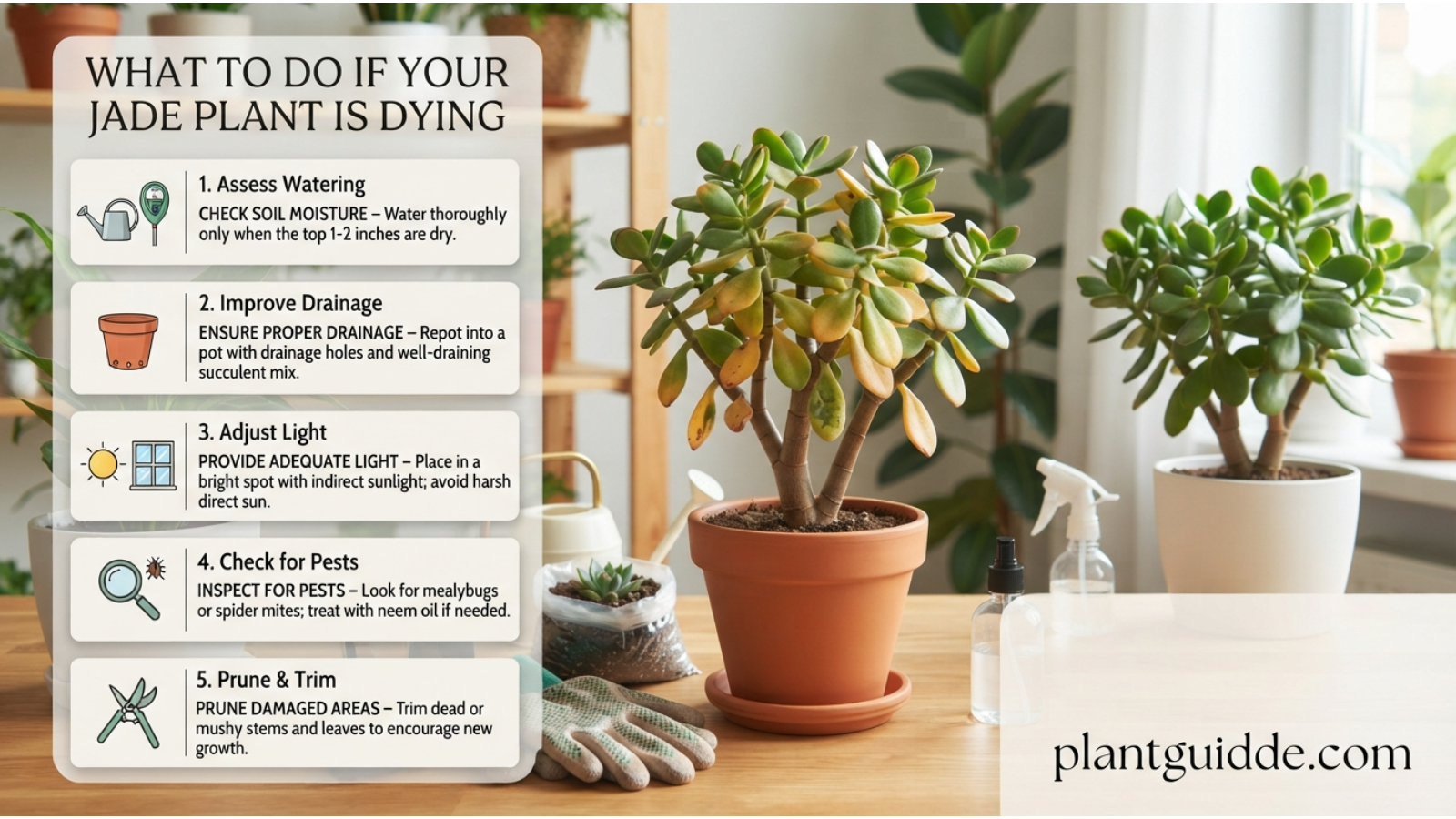
What to Do If Your Jade Plant Is Dying
If your jade plant suddenly looks unhealthy, don’t immediately change everything at once.
Start with the highest-impact questions:
Step 1: Check the soil
Is it completely dry, moderately dry, or staying wet for an unusually long time?
Step 2: Inspect the roots if necessary
If the plant has soft stems, persistent leaf drop, or wet soil that refuses to dry, root problems may be involved.
Step 3: Evaluate light
Is the plant receiving enough bright light for healthy growth?
Step 4: Check the pot
Does water drain freely?
Step 5: Look for pests
Inspect stems, leaf joints, and the undersides of leaves.
Step 6: Think about recent changes
Ask whether you recently:
- Moved the plant
- Repotted it
- Changed its watering routine
- Increased sunlight
- Changed indoor temperature
- Applied fertilizer
The timing of the symptoms can provide a valuable clue.
Expert tip: Avoid responding to a sick jade plant by simultaneously watering more, fertilizing, repotting, and moving it into stronger sunlight. Multiple changes make it difficult to identify the real cause and can increase stress.
FAQs:
How often should you water a jade plant?
Water when the soil has dried substantially rather than following a fixed weekly schedule. Water thoroughly when needed, then allow excess water to drain completely before the next watering.
Does a jade plant need direct sunlight?
Jade plants benefit from bright light, and they can tolerate or appreciate direct sunlight when properly acclimated. Plants that have been growing in low light should be introduced to stronger sun gradually.
Why are my jade plant leaves turning yellow?
Yellow leaves can have several causes, but excessive moisture is a common concern. Check the soil, drainage, pot size, watering routine, and light before deciding what to change.
Can jade plants grow indoors?
Yes. Jade plants can grow very well indoors when placed in a bright location and planted in a fast-draining medium. Insufficient indoor light is one of the more common reasons they develop weak, stretched growth.
Should I mist my jade plant?
Usually, misting is unnecessary. Jade plants store water in their leaves and generally do not require the high humidity preferred by many tropical houseplants.
Why is my jade plant dropping leaves?
Leaf drop can be associated with overwatering, underwatering, sudden environmental changes, insufficient light, temperature stress, or root problems. Look at the timing and growing conditions rather than treating leaf drop as a single diagnosis.
Can I grow a jade plant from a cutting?
Yes. Healthy stem cuttings can be allowed to callus and then planted in a suitable, well-draining medium. With proper conditions, the cutting can develop roots and begin producing new growth.
Do jade plants need fertilizer?
They can benefit from occasional fertilization during active growth, but they generally do not require heavy feeding. Overfertilizing can create problems rather than producing healthier growth.
When should I repot my jade plant?
Repot when the plant has become significantly root-bound, the container no longer provides adequate support, or the potting medium has deteriorated. Avoid repotting simply because a certain amount of time has passed.
How do I make a jade plant grow thicker?
Provide strong light, avoid excessive nitrogen fertilizer, and prune strategically to encourage branching. A thick trunk also develops naturally as the plant matures, so patience is important.
Conclusion
The key to how to take care of a jade plant is understanding that this succulent is built to handle periods of dryness. Its thick leaves and stems store water, so constantly moist soil is usually more dangerous than allowing the growing medium to dry between waterings.
Give your jade plant bright light, fast-draining soil, a pot with drainage, thorough but appropriately spaced watering, and stable temperatures. Then pay attention to what the plant is telling you. Wrinkled leaves, yellowing, stretching, leaf drop, and soft stems are clues, not instructions to automatically add more water.
Once you stop treating jade plant care as a rigid schedule and start responding to the plant’s actual growing conditions, maintaining a healthy jade becomes much simpler. The goal is not to give it more attention; it is to give it the right conditions consistently.

Asad Mumtaz is a dedicated plant enthusiast and gardening writer with a passion for helping people care for their plants successfully. He specializes in plant care guides, indoor gardening, and practical growing tips for all skill levels. His content focuses on making gardening simple, enjoyable, and rewarding. Through his work, Asad shares reliable advice to help readers create thriving green spaces.