Learning how to care for a jade plant starts with understanding one simple fact: its thick, fleshy leaves and stems store water. This makes Crassula ovata drought-tolerant, but also sensitive to overwatering.
A jade plant can easily handle a missed watering, but roots that stay wet for too long can quickly lead to yellow leaves, leaf drop, soft stems, or brown spots. Light, soil, drainage, and watering habits all play a role in keeping the plant healthy.
The good news? Jade plants are forgiving when their basic needs are met.
This guide explains how to care for a jade plant indoors, from light and watering to soil, temperature, fertilizing, pruning, repotting, propagation, and common problems.
Quick Answer
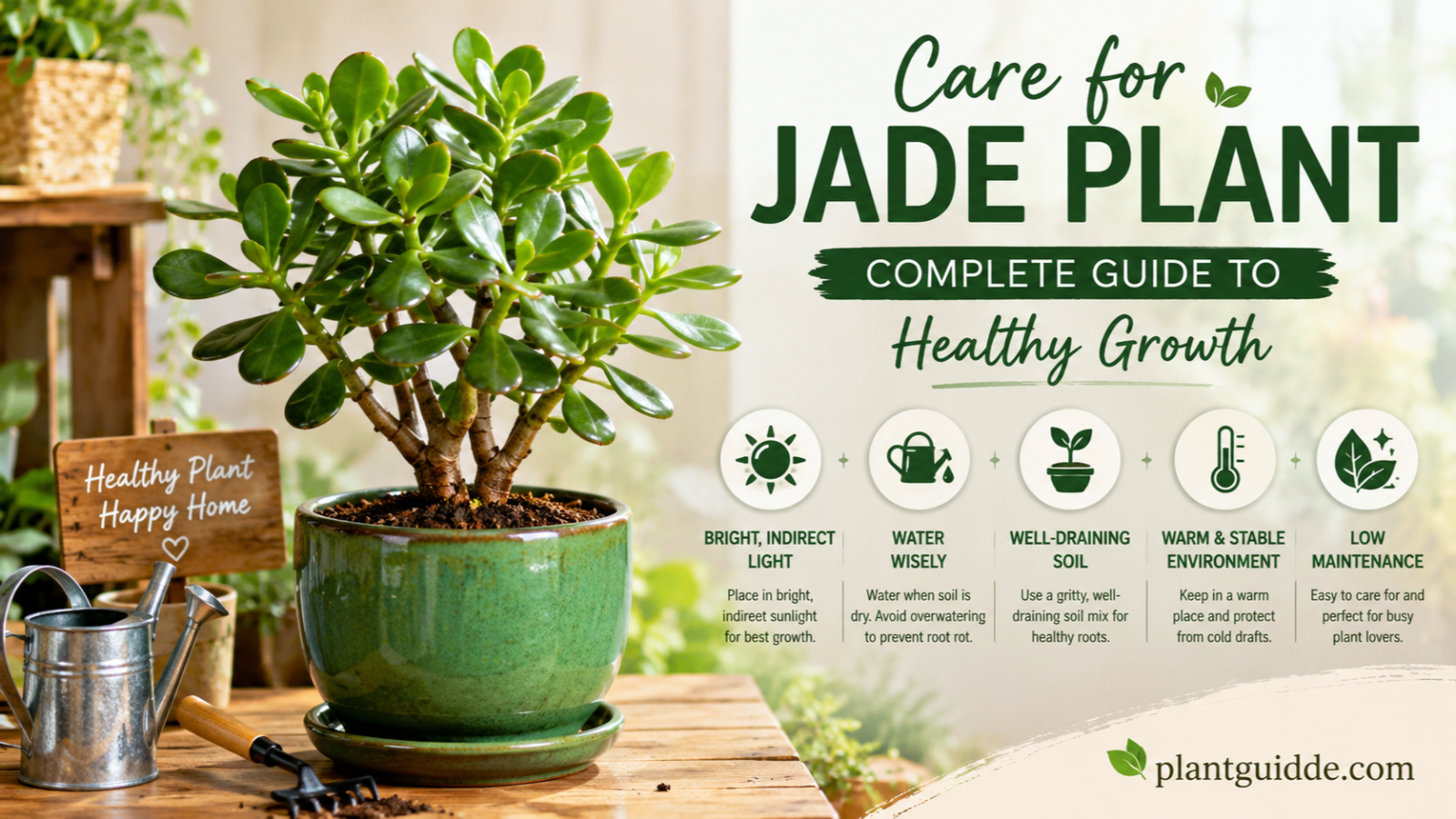
To care for a jade plant, give it plenty of bright light, use a fast-draining succulent or cactus potting mix, and let the soil dry thoroughly before watering again. Water deeply rather than giving frequent small amounts, and always use a pot with drainage holes. Keep the plant away from freezing temperatures and sudden environmental changes. Prune lightly to maintain shape, and fertilize only during active growth.
Jade Plant Basics
The jade plant is commonly known as Crassula ovata. It belongs to the Crassulaceae family and is a succulent with thick branches and rounded, fleshy leaves.
Mature plants can eventually become substantial, tree-like specimens when grown under suitable conditions. The RHS lists jade plants as evergreen, slow-growing plants that can reach significant size over time.
Their succulent structure explains most of their care requirements:
- Fleshy leaves store water, so the plant does not need constant moisture.
- Woody stems become heavier with age, making good light and pruning important for structure.
- Slow growth means excess fertilizer is unnecessary.
- Roots prefer well-drained conditions rather than permanently wet soil.
- Strong light encourages compact growth and can help maintain the plant’s characteristic appearance.
Understanding these traits is more useful than memorizing a rigid watering schedule.
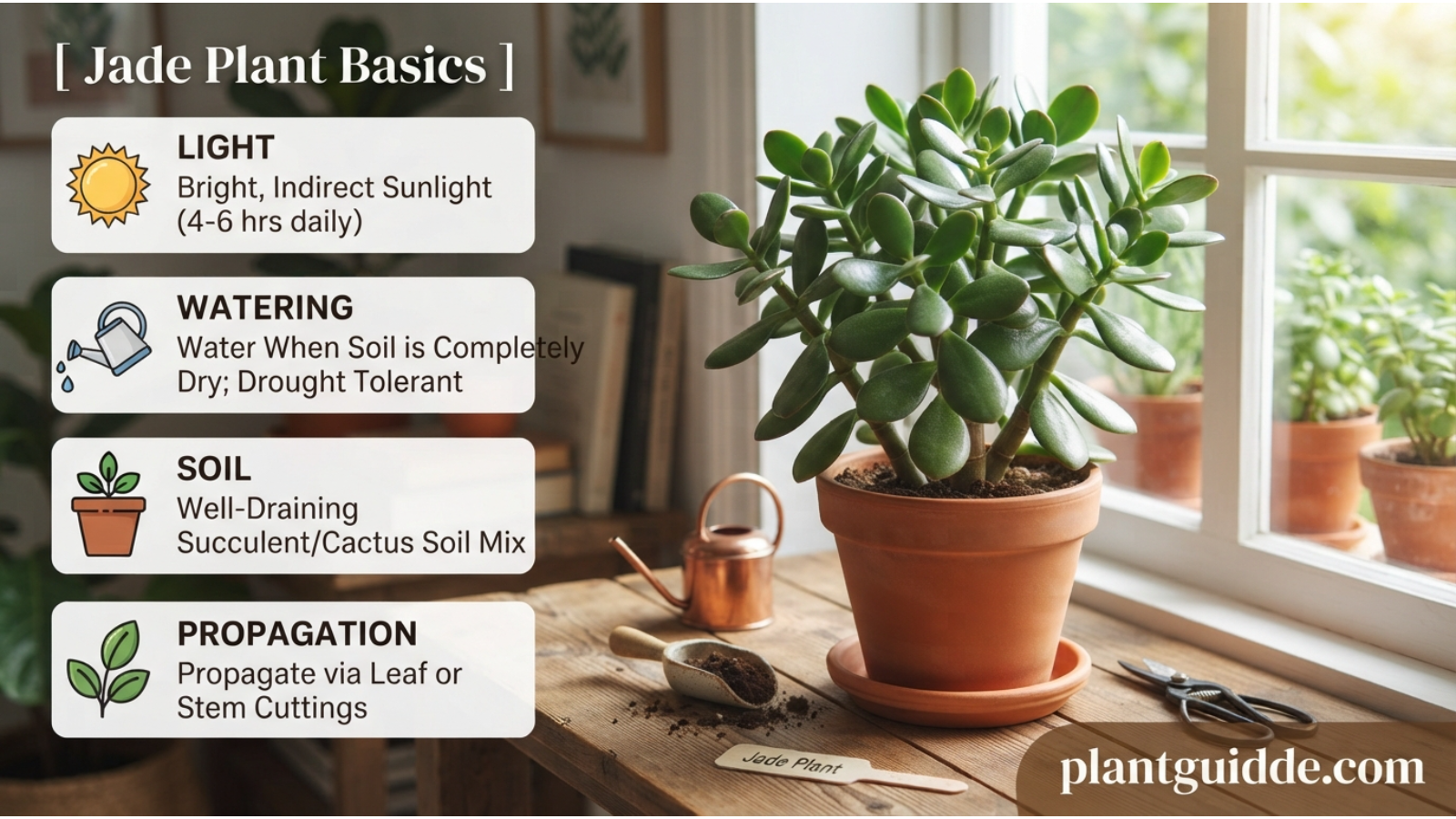
Jade Plant Care Requirements at a Glance
| Care factor | What a jade plant generally needs |
|---|---|
| Light | Bright light; several hours of strong light is beneficial |
| Water | Water thoroughly, then allow soil to dry well |
| Soil | Fast-draining succulent or cactus mix |
| Pot | Drainage holes are essential |
| Humidity | Average household humidity is usually adequate |
| Temperature | Warm, stable indoor conditions; protect from cold |
| Fertilizer | Light feeding during active growth |
| Pruning | Optional, but useful for shape and branching |
| Repotting | When root-bound or when the soil has deteriorated |
| Propagation | Stem and leaf cuttings can be rooted |
| Common pests | Mealybugs, aphids and spider mites |
The most important principle is simple: bright light + fast drainage + thorough watering followed by a proper dry period.
Give Your Jade Plant Enough Light
Light is one of the most overlooked parts of jade plant care.
A jade plant can remain alive in relatively poor indoor light, but surviving is not the same as growing well. Insufficient light can produce long, weak stems with larger gaps between leaves. The plant may gradually lose its compact, tree-like appearance.
For strong growth, place your jade plant in a very bright location. A bright south- or west-facing window can work well indoors, depending on your climate and how intense the sunlight is. The RHS recommends growing jade plants in full light, while its houseplant guidance notes that a bright location is particularly beneficial.
How to tell if the light is too low
Watch the plant rather than relying only on a clock or light meter.
Signs can include:
- Long spaces between leaves
- Thin or weak new growth
- Leaning toward the window
- Slow growth
- Loss of the compact shape
- Leaves that remain smaller than expected
Can jade plants receive direct sunlight?
Yes, but transition gradually if the plant has been growing indoors under weaker light.
A jade plant moved suddenly from a dim room to intense direct sun can develop leaf scorch. Increase exposure progressively instead of making a dramatic overnight change.
Expert tip: Rotate the pot every week or two if the plant consistently leans toward the window. This encourages more balanced growth and reduces the need for corrective pruning later.
Image Suggestion: A jade plant placed beside a bright window, showing ideal light positioning versus a stretched jade plant kept in low light.
Water Jade Plants by Soil Condition, Not the Calendar
If there is one rule worth remembering when learning how to care for a jade plant, it is this:
Do not water simply because several days have passed. Check the soil first.
Jade plants store moisture in their leaves and stems. They therefore prefer a cycle of thorough watering followed by substantial drying rather than frequent small drinks.
The RHS recommends allowing jade plant compost to dry between waterings and reducing watering during winter when growth slows.
How to water correctly
When the soil is sufficiently dry:
- Water the soil thoroughly.
- Allow excess water to escape through the drainage holes.
- Empty water collected in the saucer or outer container.
- Do not water again until the soil has dried sufficiently.
The exact interval will vary dramatically depending on pot size, soil, temperature, light, humidity, and season.
A jade plant sitting in a small terracotta pot beside a sunny window may dry much faster than a large jade planted in a plastic pot in a dim room.
Why small, frequent watering can cause problems
Giving only a little water every few days can create an awkward situation: the upper layer may appear dry while deeper soil remains damp.
Over time, the roots may spend too much time in poorly aerated, wet soil.
Better approach: When the plant actually needs water, water thoroughly. Then allow the growing medium to dry before repeating the process.
Learn the Difference Between Thirst and Overwatering
This is where many beginners struggle.
A jade plant with wrinkled leaves does not automatically need water. A plant with yellowing leaves does not automatically need less water either.
Look at several symptoms together.
Signs the jade plant may be too dry
You may notice:
- Wrinkled or slightly shriveled leaves
- Leaves becoming thinner or softer
- Dry soil pulling away from the pot
- Increased leaf drop after prolonged dryness
- Slower growth
Signs of excessive moisture
Potential warning signs include:
- Yellowing leaves
- Soft or mushy stems
- Leaves dropping while the soil remains wet
- Persistent moisture deep in the pot
- Unpleasant-smelling soil
- Root deterioration
The key is to inspect the soil and roots, not diagnose the plant from one leaf.
A practical diagnostic test
If your jade looks unhealthy, ask:
1. How much light does it receive?
Low light slows water use.
2. What does the soil feel like several inches below the surface?
The top layer can dry before the root zone does.
3. Does the pot have drainage holes?
Without them, watering becomes much harder to manage.
4. What type of soil is being used?
Dense general-purpose soil can hold moisture much longer than a suitable succulent mix.
5. Is the plant in a pot much larger than its root system?
Excess soil can stay wet for too long.
This five-question check is often more useful than simply increasing or reducing the watering frequency.
Choose Fast-Draining Jade Plant Soil
Jade plants need moisture, but they do not need soil that stays wet.
A well-draining succulent or cactus mix is a practical starting point. The RHS specifically recommends cactus compost for jade plants.
A good growing medium should allow excess water to move away from the roots while still holding enough moisture for the plant to use.
What to avoid
Be cautious with very dense mixes that remain wet for extended periods.
A common beginner mistake is to think:
“My jade plant is a houseplant, so regular houseplant soil must be fine.”
Not necessarily.
Standard indoor potting mixes can be appropriate in some situations, but a jade plant’s succulent growth habit means drainage needs to be considered carefully.
A simple soil principle
Instead of searching for one magical soil recipe, focus on three characteristics:
- Good drainage
- Good airflow around the roots
- Enough structure to prevent the mix from becoming compacted
Expert tip: If your plant repeatedly stays wet for many days after watering, changing the growing medium may be more effective than simply watering less.
Image Suggestion: Cross-section diagram comparing dense, water-retentive soil with a loose, well-draining succulent mix around jade plant roots.
Use a Pot With Drainage Holes
The container is part of the watering system.
A drainage hole gives excess water somewhere to go. Without one, even an otherwise excellent soil mixture can become difficult to manage.
Choose a pot that is appropriately sized for the root system rather than dramatically oversized.
Why an oversized pot can be troublesome
A large container contains more growing medium. If the jade plant has a relatively small root system, much of that soil may remain unused and wet after watering.
That can slow drying and make overwatering easier.
Terracotta vs. plastic
Both can work.
Terracotta:
- Porous
- Often dries faster
- Useful for growers who tend to overwater
Plastic:
- Holds moisture longer
- Lightweight
- Useful when the plant dries unusually quickly
The best choice depends on your environment and watering habits.
Humidity: You Usually Don’t Need to Mist a Jade Plant
Unlike tropical houseplants, jade plants generally do not require high humidity.
The RHS notes that Crassula ovata adapts well to average indoor conditions and does not require special humidity measures.
That means you usually do not need:
- Daily misting
- Humidity trays
- A dedicated humidifier
- Constantly wet surroundings
If your home has ordinary indoor humidity and the plant has good airflow, humidity is unlikely to be the main problem.
In fact, repeatedly wetting the foliage while maintaining poor airflow is not a substitute for proper root care.
Keep Jade Plants Warm and Away From Sudden Temperature Changes
Jade plants prefer stable indoor conditions.
The RHS recommends protecting jade plants from drafts and sudden temperature changes and notes that temperatures below about 10°C should be avoided for typical indoor growing.
Keep the plant away from:
- Freezing temperatures
- Cold drafts
- Very cold windows
- Heating vents
- Air-conditioning vents
- Sudden temperature swings
A bright window is useful, but if the glass becomes extremely cold overnight, moving the plant slightly farther into the room may be sensible during cold weather.
Fertilize Jade Plants Lightly
Jade plants are not heavy feeders.
During active growth, a balanced houseplant or succulent fertilizer can provide nutrients, but excessive fertilizer does not automatically mean faster or healthier growth.
The RHS recommends regular feeding during the growing season and reducing or stopping feeding when growth slows in autumn and winter.
A sensible approach
- Feed during active growth.
- Follow the fertilizer manufacturer’s dilution instructions.
- Avoid repeatedly applying stronger concentrations.
- Reduce feeding when the plant is barely growing.
- Do not fertilize a severely stressed or potentially rotting plant until the underlying problem is addressed.
Important: Fertilizer cannot compensate for inadequate light, poor drainage, or damaged roots.
Prune Your Jade Plant for Shape and Stronger Branching
Pruning is not mandatory, but it can make a major difference to the appearance of a mature jade plant.
Without occasional shaping, branches can become long and uneven, especially when light is coming predominantly from one direction.
How to prune
Use clean, sharp scissors or pruning shears.
Remove:
- Weak branches
- Extremely long, bare sections
- Damaged growth
- Branches growing in an undesirable direction
Make deliberate cuts rather than repeatedly trimming tiny pieces from every branch.
Jade plants can respond well to pruning during active growth, and healthy cuttings can also be used for propagation. The RHS lists stem and leaf cuttings among the propagation methods for Crassula ovata.
Expert tip: Before pruning a large branch, step back and look at the entire plant. Jade plants can look sparse immediately after a major cut but may fill out as new branches develop.
Image Suggestion: Step-by-step visual showing where to cut a leggy jade branch to encourage a fuller structure.
How to Repot a Jade Plant
Jade plants do not need constant repotting.
Repot when:
- Roots are becoming crowded
- Water runs through unusually quickly because the root mass has filled the container
- The soil has broken down or become compacted
- The container has become unstable
- The plant has clearly outgrown its pot
The RHS suggests repotting jade plants approximately every two to three years or when root-bound.
Repotting steps
- Choose a container only moderately larger than the current one.
- Make sure it has drainage holes.
- Prepare fresh, well-draining succulent soil.
- Carefully remove the plant.
- Inspect the roots.
- Remove obviously damaged or rotten material with clean tools if necessary.
- Place the plant at approximately the same depth as before.
- Fill around the root ball with fresh mix.
- Avoid immediately returning to a heavy watering routine.
The exact watering approach after repotting depends on the condition of the roots, soil, and plant.
How to Propagate a Jade Plant
Jade plants are among the easier succulents to propagate.
The two common methods are stem cuttings and leaf cuttings.
Stem cutting method
A healthy stem section can be removed with a clean cutting tool.
Allow the cutting surface to dry before placing the cutting into an appropriate growing medium. This gives the damaged tissue time to dry rather than immediately sitting in wet soil.
Once established, the cutting can develop roots and begin new growth.
Leaf propagation
Healthy individual leaves can also produce new plants under suitable conditions, although this method generally takes longer than using a stem cutting.
The RHS recognizes both stem and leaf cuttings as propagation methods for jade plants.
Practical tip: If you’re pruning an overgrown jade plant, don’t automatically throw away every healthy cutting. Several suitable pieces can become new plants.
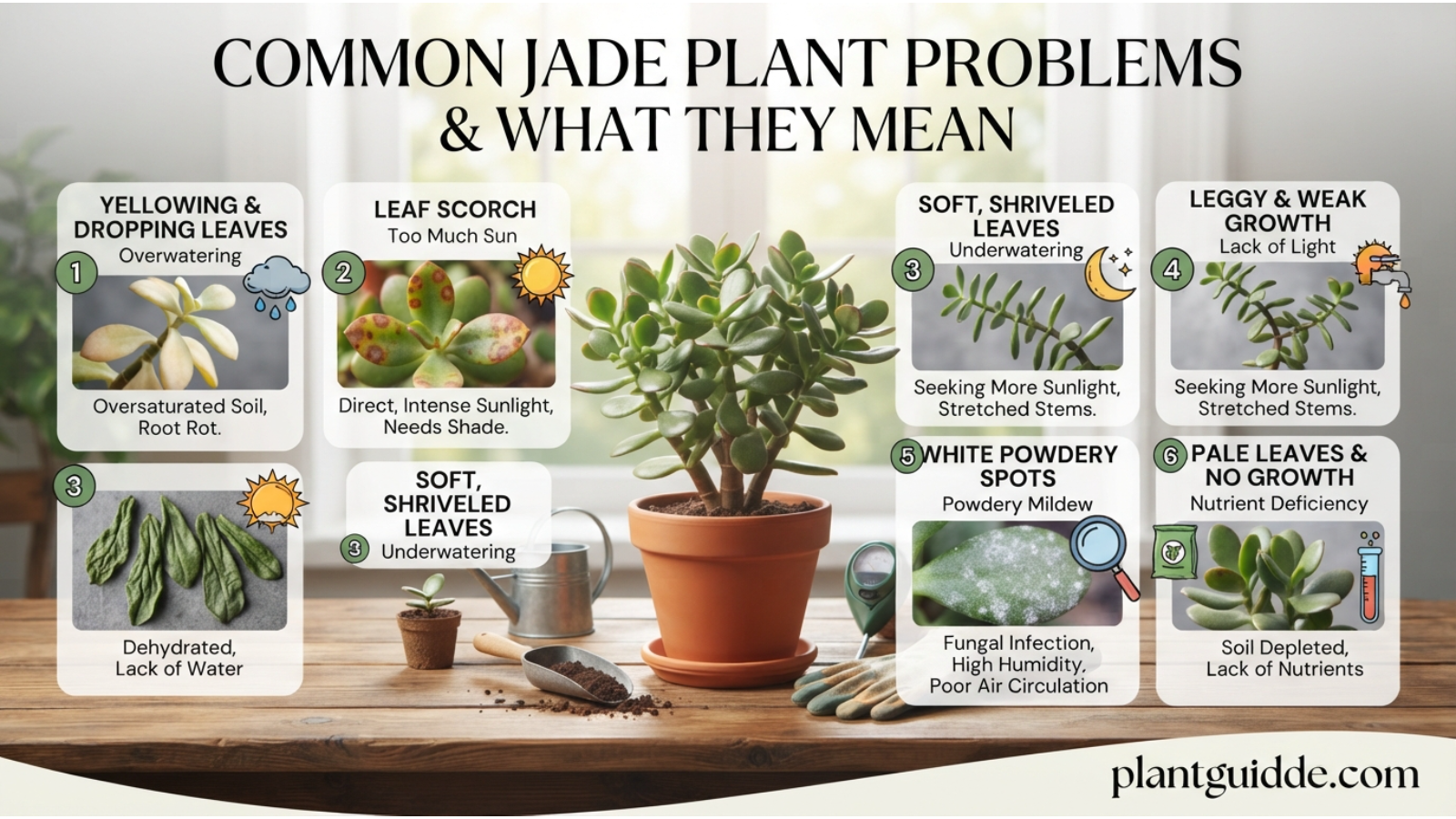
Common Jade Plant Problems and What They Mean
Jade Plant Leaves Turning Yellow
Yellow leaves can have several causes, so avoid immediately assuming that the plant simply needs less water.
Check:
- How wet the soil is
- How frequently you’re watering
- Whether the pot drains properly
- How much light the plant receives
- Whether the plant is undergoing a recent environmental change
If multiple leaves are yellow and the soil remains wet for a long time, excessive moisture deserves particular attention.
Jade Plant Leaves Falling Off
Some leaf loss can occur naturally, but sudden or widespread leaf drop is a reason to investigate the growing conditions.
Possible contributors include:
- Overwatering
- Prolonged drought
- Low light
- Sudden temperature changes
- Root problems
- Pest activity
Look at the whole plant rather than focusing on the fallen leaves alone.
If the leaves are dropping while the soil is consistently wet, check the roots and drainage before adding more water.
Jade Plant Leaves Wrinkling
Wrinkled leaves often indicate that the plant’s stored water is being depleted.
But don’t immediately water without checking the soil.
If the soil is genuinely dry throughout the root zone, a thorough watering may be appropriate.
If the soil is wet while the leaves are wrinkled, the problem may be damaged roots rather than a simple lack of water. In that situation, adding more water can make the problem worse.
This distinction is one of the most useful troubleshooting lessons in jade plant care.
Jade Plant Leaves Turning Red
Some jade plants can develop reddish margins or coloration under strong light and certain growing conditions.
Red coloration is not automatically a sign of disease.
However, if the leaves are also showing bleaching, crispy patches, or obvious scorch, the plant may be receiving more intense sunlight than it can tolerate after a sudden change.
Evaluate the entire leaf rather than treating red edges alone as a problem.
Jade Plant Has Soft or Mushy Stems
Soft stems are more concerning than ordinary leaf discoloration.
Check the plant immediately for:
- Persistently wet soil
- Poor drainage
- Root damage
- Rotting tissue
- A container that is too large
- Recent overwatering
If rot is suspected, keeping the soil wet is unlikely to solve the problem.
Healthy sections may sometimes be salvaged as cuttings, depending on how far the damage has progressed.
Jade Plant Is Tall and Leggy
Leggy growth is often a light problem.
When a jade plant does not receive enough usable light, it may stretch toward the brightest direction.
The solution is usually not simply “prune it shorter.”
Instead:
- Improve the light.
- Gradually acclimate the plant to stronger exposure.
- Prune excessively stretched growth.
- Rotate the container periodically.
- Maintain adequate light as new growth develops.
Pruning without correcting the light problem often produces the same problem again.
Common Jade Plant Care Mistakes
1. Watering on a fixed schedule
A calendar cannot account for changing temperature, light, soil, and pot size.
Better: Check the soil and plant condition.
2. Using a pot without drainage
This removes one of your best safeguards against excess water.
Better: Use a container with drainage holes.
3. Keeping jade plants in dark corners
The plant may survive but become stretched and weak.
Better: Give it a bright location.
4. Using dense soil
Soil that remains wet for too long can create root problems.
Better: Use a well-draining succulent or cactus mix.
5. Watering a little every day
Frequent shallow watering can keep the root zone inconsistently moist.
Better: Water thoroughly when the plant actually needs it, then allow the soil to dry.
6. Repotting into a huge container
More soil is not automatically better.
Better: Increase pot size gradually.
7. Fertilizing a stressed plant
Nutrients cannot repair damaged roots or compensate for poor light.
Better: Correct the environmental problem first.
A Simple Jade Plant Care Routine
You do not need to spend hours caring for a jade plant.
Weekly
- Look for pests.
- Check the leaves and stems.
- Observe whether new growth appears healthy.
- Check the soil if you suspect it may be dry.
Every few weeks
- Rotate the pot if growth is becoming one-sided.
- Inspect the drainage hole.
- Check whether the plant is becoming unstable.
During active growth
- Fertilize appropriately and conservatively.
- Prune if the plant needs shaping.
- Monitor how quickly the soil dries.
During winter or slower growth
- Expect the plant to use water more slowly.
- Reduce watering accordingly.
- Reduce or stop fertilizer while growth is minimal.
- Protect the plant from cold drafts and sudden temperature changes.
This flexible approach is safer than following a watering calendar that says, for example, “water every Sunday.”
Seasonal Jade Plant Care
Spring
As light and growth increase, the plant may begin using water more quickly.
This can be a good period for:
- Repotting
- Pruning
- Propagation
- Beginning regular fertilization
- Increasing watering only as the soil actually dries
Summer
Bright light and warm temperatures can increase water use.
Check the soil more frequently, but don’t assume that hot weather means daily watering. A large pot can still remain wet even during warm conditions.
Autumn
Growth may begin slowing.
Gradually adjust watering and fertilizer rather than following the same summer routine indefinitely.
Winter
Indoor jade plants often use less water when light levels and growth decrease.
Avoid the common mistake of continuing a summer watering schedule throughout winter.
The RHS specifically recommends much more restrained winter watering.
How to Make a Jade Plant Grow Bushier
If your jade plant looks sparse, three factors matter most:
More usable light
Light is the foundation of compact growth.
Strategic pruning
Removing selected growing tips can help reshape the plant and encourage branching.
Patience
Jade plants are not instant-growth plants. Cutting a plant today does not mean it will become bushy tomorrow.
The goal is to create conditions that support new branches and then allow time for those branches to develop.
A useful rule: Don’t use aggressive pruning as a substitute for fixing poor lighting.
Can Jade Plants Flower?
Yes. Mature jade plants can produce small, star-shaped white to pale pink flowers under suitable conditions.
However, flowering is not something you should expect from every indoor jade plant.
Plant maturity, seasonal conditions, light, and environmental changes can influence flowering.
If your main goal is a healthy jade plant, prioritize strong growth and good structure rather than trying to force flowers.
Are Jade Plants Safe for Pets?
This is an important consideration for households with cats or dogs.
The ASPCA lists jade plant as toxic to dogs, cats, and horses. Reported clinical signs include vomiting, depression, and incoordination.
The ASPCA also notes that jade plants (Crassula ovata) can cause gastrointestinal and other symptoms when ingested by pets.
If you have pets that chew plants, keep the jade plant somewhere inaccessible and contact a veterinarian or appropriate animal poison-control service if ingestion occurs.
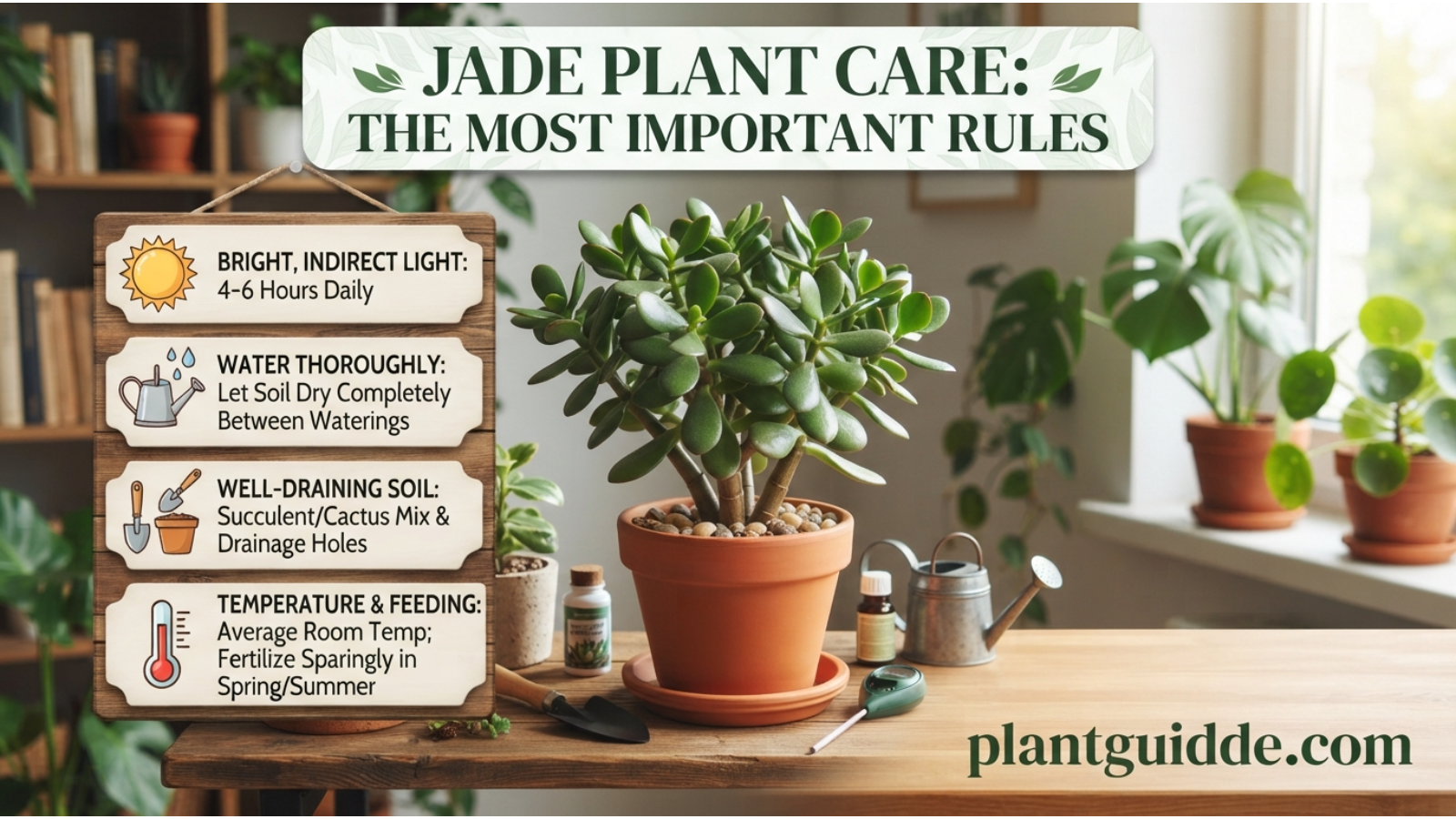
Jade Plant Care: The Most Important Rules
If you remember nothing else from this guide, remember these principles:
- Give your jade plant plenty of light.
- Let the soil dry substantially between waterings.
- Use a fast-draining growing medium.
- Always provide drainage.
- Do not rely on a fixed watering calendar.
- Reduce watering when growth slows.
- Keep temperatures reasonably stable.
- Prune strategically rather than aggressively.
- Fix light and drainage problems before adding fertilizer.
- Treat sudden changes in leaves or stems as clues, not diagnoses.
The biggest improvement in jade plant care usually comes from changing the way you think about watering. Instead of asking, “When should I water?”, ask, “Is the plant ready for water based on its soil, light, pot, and current growth?”
That small change can prevent many of the problems beginners encounter.
FAQs:
How often should you water a jade plant?
There is no universal number of days. Water when the growing medium has dried sufficiently, then water thoroughly and allow excess water to drain. Light, temperature, pot size, soil, and season all affect how quickly the plant dries.
Does a jade plant need direct sunlight?
Jade plants benefit from strong light and can grow well with substantial sun exposure. However, plants accustomed to lower light should be acclimated gradually before receiving intense direct sunlight to reduce the risk of leaf scorch.
Why are my jade plant leaves falling off?
Leaf drop can result from overwatering, prolonged dryness, insufficient light, sudden environmental changes, temperature stress, or root problems. Check the soil, roots, light, and recent changes before deciding on a solution.
Why are my jade plant leaves wrinkled?
Wrinkled leaves often indicate water stress, especially when the soil is completely dry. But wrinkling can also occur when roots are damaged and unable to take up water. Always check soil moisture before watering.
What is the best soil for a jade plant?
A fast-draining cactus or succulent mix is a practical choice. The goal is a growing medium that drains excess water efficiently rather than remaining saturated.
Should I mist my jade plant?
Usually, no. Jade plants are adapted to relatively dry conditions and generally do not require high humidity or routine misting.
How much light does an indoor jade plant need?
Give it the brightest suitable location available. A bright window can work particularly well. If the plant begins stretching or leaning strongly toward the light, reassess its placement.
When should I repot a jade plant?
Repot when the plant becomes root-bound, the soil has deteriorated, or the current container is no longer appropriate. Repotting every two to three years can be reasonable, but the plant itself should determine the timing.
Can I grow a jade plant from a cutting?
Yes. Jade plants can be propagated from stem and leaf cuttings. Stem cuttings are generally a straightforward way to produce a new plant, particularly when taken from healthy growth.
How do I make my jade plant bushier?
Provide strong light, then use selective pruning to encourage a more balanced structure. If the plant remains in low light, pruning alone will not solve the underlying cause of leggy growth.
Can jade plants live outdoors?
They can be grown outdoors in suitable climates, but cold tolerance is limited. If temperatures become too cold or conditions change abruptly, move container-grown plants to a protected location.
Conclusion
Good care for jade plant is not about keeping the soil constantly moist or following a strict watering calendar. It is about creating conditions that match the plant’s natural succulent growth habit.
Give your jade plant strong light, fast-draining soil, a container with drainage, thorough but appropriately spaced watering, and stable temperatures. Then pay attention to what the plant is telling you. Wrinkled leaves, yellow foliage, stretched growth, leaf drop, and soft stems are clues that something in the environment may need to change.
The most useful habit is to look at the whole system, light + soil + pot + roots + watering + season, instead of trying to fix each symptom individually.
Once those fundamentals are right, jade plants can become remarkably low-maintenance, long-lived houseplants with attractive, tree-like forms.

Asad Mumtaz is a dedicated plant enthusiast and gardening writer with a passion for helping people care for their plants successfully. He specializes in plant care guides, indoor gardening, and practical growing tips for all skill levels. His content focuses on making gardening simple, enjoyable, and rewarding. Through his work, Asad shares reliable advice to help readers create thriving green spaces.