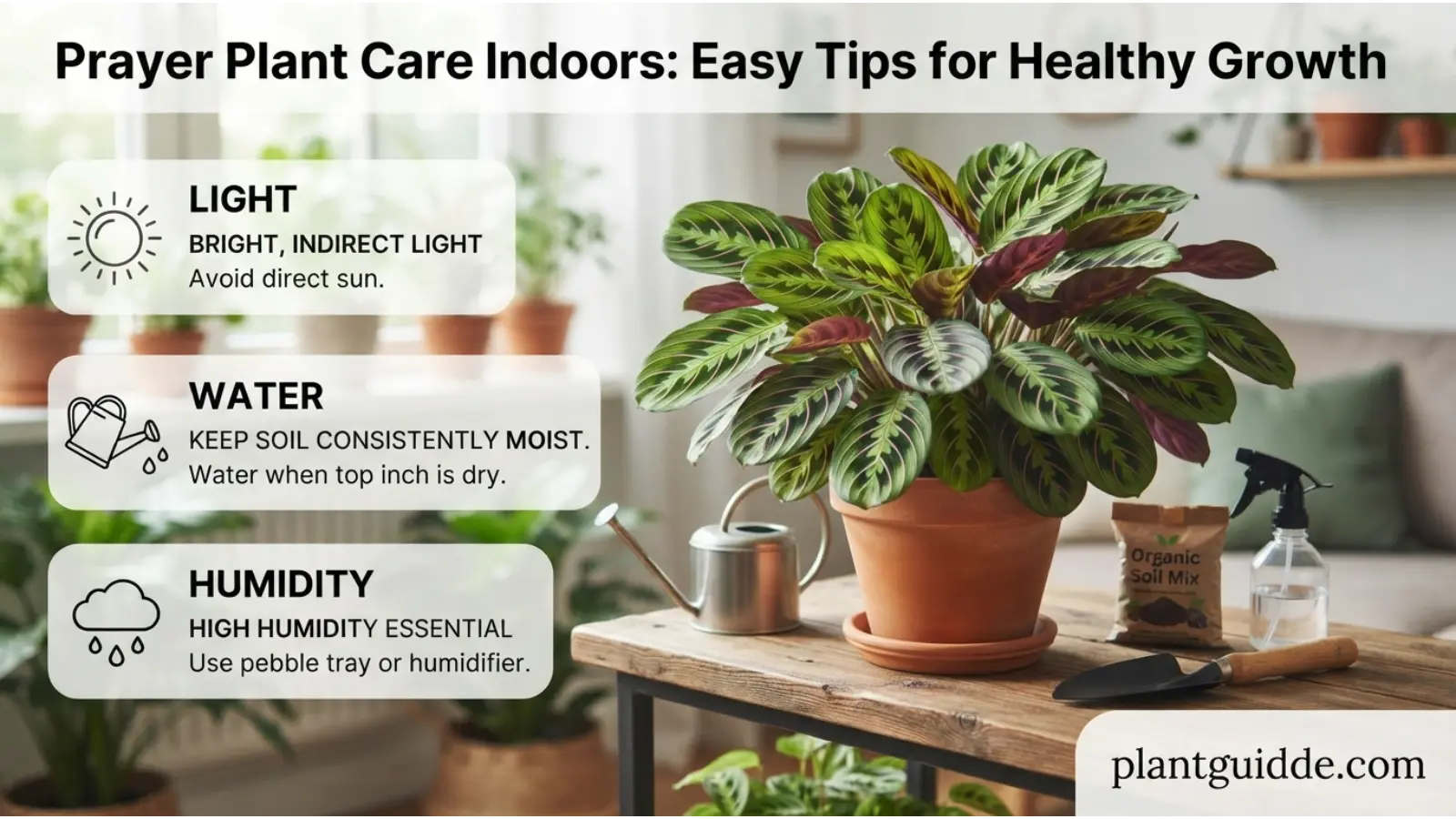
Prayer plants are popular indoor plants because their beautifully patterned leaves can make an ordinary room feel much more tropical. Their leaves also move in response to the light cycle, folding upward at night. one reason the plant earned its common name. Prayer Plant Care Indoors: Easy Tips for Healthy Growth.
But attractive foliage comes with a catch: prayer plants can quickly show signs of environmental stress. Brown leaf tips, curling leaves, yellow foliage, drooping, and crispy edges are among the problems indoor growers commonly encounter.
The good news is that prayer plant care indoors becomes much easier once you understand what the plant is actually responding to.
The goal isn’t to keep the soil permanently soaked or to mist the leaves constantly. It is to create a stable environment with suitable light, moisture, humidity, temperature, and airflow.
This guide explains how to do that. and, more importantly, how to diagnose problems when your plant isn’t responding well.
Quick Answer
For successful prayer plant care indoors, place your Maranta in bright, indirect or filtered light, keep the potting mix consistently moist but well-drained, and provide moderate to high humidity. Avoid harsh direct sunlight, cold drafts, heaters, and letting the soil remain soggy. Water when the upper layer of the mix begins to dry, and reduce watering during slower winter growth.
What Is a Prayer Plant?
The name “prayer plant” most commonly refers to plants in the genus Maranta, particularly Maranta leuconeura. They belong to the Marantaceae family and are tropical, rhizomatous perennials grown primarily for their decorative foliage.
The RHS describes Maranta leuconeura as a clump-forming evergreen perennial with patterned leaves and notes that its foliage folds at night.
Several plants sold or described as “prayer plants” are closely related members of the Marantaceae family, including some plants formerly classified as Calathea. Their care requirements can overlap considerably, although individual species and cultivars may have different tolerances.
Common prayer plant varieties
You may encounter:
- Maranta leuconeura
- Maranta leuconeura ‘Kerchoveana’
- Maranta leuconeura ‘Fascinator’
- Maranta leuconeura var. erythroneura, often sold as the red-veined or herringbone prayer plant
The RHS lists bright filtered light, moisture-retentive but well-drained growing conditions, and high humidity among the important growing requirements for Maranta leuconeura.
Image Suggestion: Close-up comparison of three prayer plant varieties showing differences in leaf patterns and vein colors.
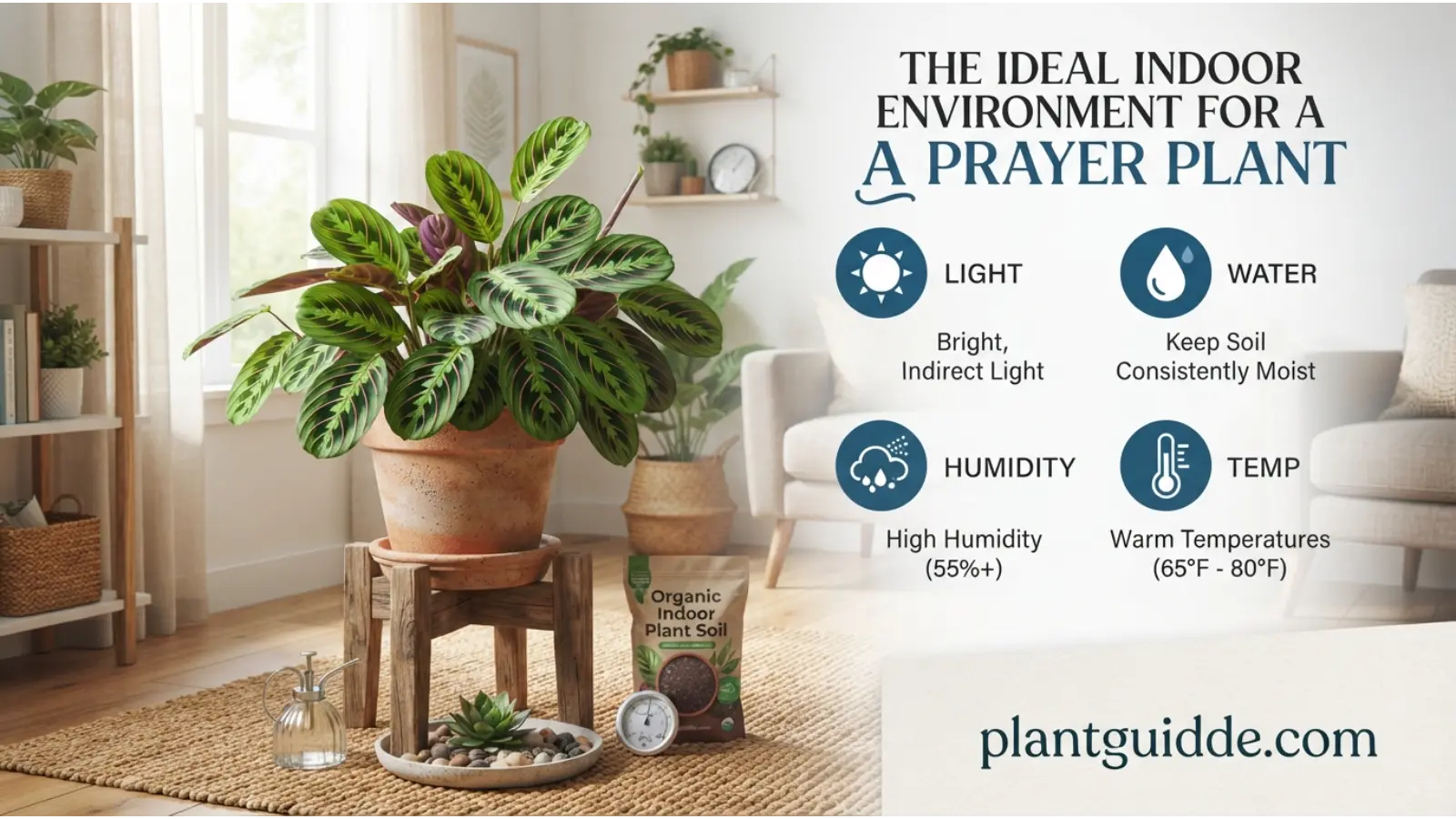
The Ideal Indoor Environment for a Prayer Plant
Rather than memorizing a rigid watering schedule, think of your prayer plant as responding to its entire environment. Prayer Plant Care Indoors: Easy Tips for Healthy Growth.
A plant sitting beside a sunny window in a dry, heated room may need very different care from the same species growing in a humid bathroom with filtered light.
| Care factor | Good indoor target | What to avoid |
|---|---|---|
| Light | Bright, indirect or filtered | Harsh direct sun |
| Soil | Moist but well-drained | Permanently soggy soil |
| Water | Water when the upper mix begins drying | Severe repeated drying |
| Humidity | Moderate to high | Very dry air |
| Temperature | Warm and stable | Cold drafts and sudden changes |
| Fertilizer | Moderate feeding during active growth | Heavy or excessive feeding |
| Pot | Drainage hole required | Containers that trap water |
The RHS recommends bright filtered light and moist but well-drained growing conditions for Maranta leuconeura.
Give Your Prayer Plant the Right Light
Light is one of the most important parts of indoor prayer plant care.
Prayer plants naturally grow in environments where intense sunlight is filtered before reaching the foliage. Indoors, this translates to bright indirect light rather than hours of strong direct sunshine.
A position near an east- or north-facing window can work well, provided the plant receives enough ambient light. A brighter window may also work if the plant is protected from intense direct rays. Prayer Plant Care Indoors: Easy Tips for Healthy Growth.
The RHS specifically recommends bright filtered light and notes that prayer plants can be grown in partial or full shade conditions.
Signs of too much light
Watch for:
- Faded leaf markings
- Bleached-looking foliage
- Brown or scorched patches
- Crispy leaf edges
- Leaves becoming unusually dry
Signs of too little light
You may notice:
- Slow growth
- Smaller new leaves
- Longer gaps between leaves
- Less vibrant coloration
- Soil staying wet for unusually long periods
A common mistake is interpreting “shade tolerant” as “doesn’t need light.”
It still needs enough light for photosynthesis. Even shade-loving houseplants cannot thrive in a completely dark room.
Practical tip
Instead of asking whether your room is “bright,” look at the plant’s actual position.
A room may feel bright to your eyes while providing relatively little useful light several feet away from a window. Prayer Plant Care Indoors: Easy Tips for Healthy Growth.
Image Suggestion: Diagram showing a prayer plant positioned at different distances from a window, with direct sun, filtered light, and low-light zones.
How Often Should You Water a Prayer Plant?
There is no universally correct watering schedule such as “every three days” or “once a week.”
The better approach is to check the potting mix.
Water when the upper portion of the soil has started to dry, while avoiding prolonged dryness or waterlogging. The RHS recommends keeping prayer plant compost moist but well-drained and reducing watering during winter.
A simple watering method
- Check the surface of the potting mix.
- Push your finger into the upper layer.
- If it has started to dry, check deeper into the root zone.
- If the plant needs water, water thoroughly.
- Allow excess water to drain from the bottom.
- Empty any standing water from the saucer.
Don’t water simply because it is the same day of the week.
Indoor conditions change with temperature, sunlight, humidity, pot size, and season.
Why overwatering is so dangerous
Beginners often assume that a tropical plant must always have wet soil.
That’s not quite right.
Prayer plants appreciate consistent moisture, but their roots still need oxygen. When the pot remains saturated for too long, roots can become stressed and may eventually rot.
This is why moist and well-drained is a better goal than wet all the time.
Why underwatering causes problems
Allowing the plant to become severely dry can lead to:
- Curling leaves
- Drooping
- Brown edges
- Crispy foliage
- Temporary loss of firmness
Repeated severe drying can be especially stressful for a plant accustomed to relatively consistent moisture. Prayer Plant Care Indoors: Easy Tips for Healthy Growth.
Water Quality Can Matter More Than Beginners Expect
If your prayer plant repeatedly develops brown tips despite apparently good watering habits, don’t automatically assume that you are underwatering it.
Water quality can sometimes contribute to leaf-tip problems, particularly when plants are repeatedly exposed to mineral-heavy water.
A practical experiment is to use:
- Filtered water
- Rainwater
- Distilled water where appropriate
for several weeks and observe whether new growth develops healthier edges.
This doesn’t mean every prayer plant requires distilled water. Your local water quality and the plant’s response matter.
The important lesson is to diagnose the whole environment instead of immediately increasing watering.
Humidity: The Often-Missed Part of Prayer Plant Care
Humidity is one of the biggest reasons a prayer plant can look unhappy even when the soil is being watered correctly. Prayer Plant Care Indoors: Easy Tips for Healthy Growth.
Tropical houseplants can lose water from their leaves rapidly when indoor air is very dry. The RHS notes that many tropical houseplants benefit from higher humidity and that low humidity can increase water loss through the foliage.
How to increase humidity indoors
The most reliable options include:
- A room humidifier
- Grouping plants together
- A naturally humid room such as a suitable bathroom
- A tray containing damp pebbles or similar material
A humidifier is generally the most controllable option because you can monitor and adjust the room’s humidity.
Is misting enough?
Misting can temporarily wet the leaf surface, but it should not be treated as a substitute for maintaining appropriate ambient humidity.
For plants that genuinely need higher humidity, changing the surrounding air is more useful than repeatedly spraying the leaves.
The RHS also notes that a moist gravel tray or ultrasonic humidifier can help increase humidity around tropical houseplants.
Image Suggestion: Infographic comparing a humidifier, plant grouping, pebble tray, and occasional misting.
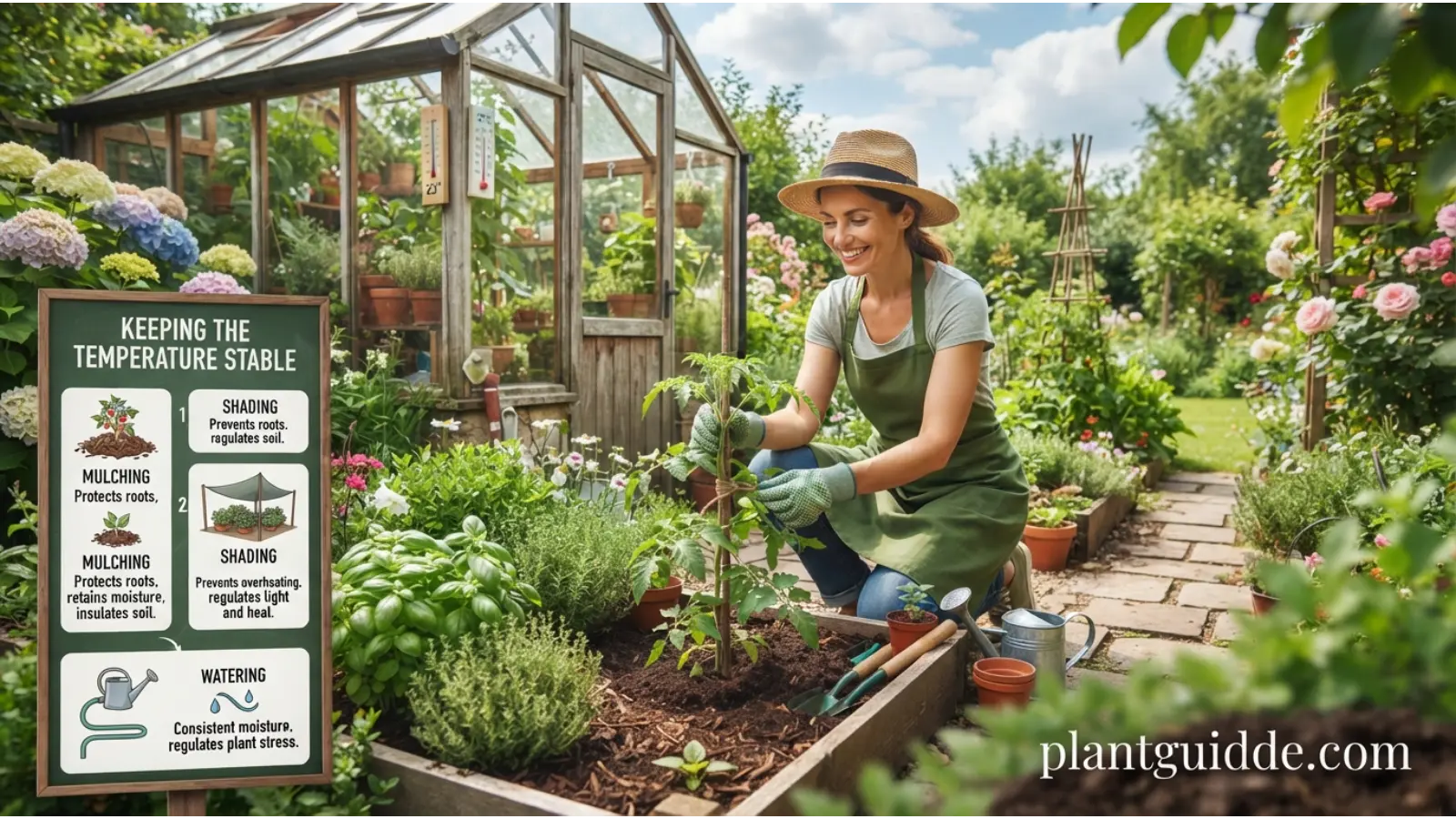
Keep the Temperature Stable
Prayer plants prefer warm indoor conditions and can react badly to sudden temperature changes.
Keep them away from:
- Cold drafts
- Frequently opened exterior doors
- Air-conditioning vents
- Heating vents
- Radiators
- Very cold windows during winter
The RHS recommends sheltered conditions for Maranta leuconeura, and its guidance for moving Maranta outdoors indicates that these plants are particularly sensitive to cooler temperatures. Prayer Plant Care Indoors: Easy Tips for Healthy Growth.
A useful rule
Don’t just ask, “Is my room warm enough?”
Ask:
Is the temperature stable where the plant actually sits?
A plant can be in a generally comfortable room while sitting directly beside a cold window or air-conditioning outlet.
Choose a Potting Mix That Holds Moisture Without Staying Soggy
The ideal prayer plant soil needs to solve two problems at once:
It should retain enough moisture for the plant while allowing excess water and air to move through the root zone.
A dense, compact soil can stay wet for too long.
An extremely coarse mix may dry out too rapidly.
A practical indoor mix can include:
- Quality indoor potting mix
- Coco coir or another moisture-retentive component
- Perlite or another aerating component
- Fine bark or similar material, if appropriate for the mix
The exact recipe is less important than the final result: moisture retention plus drainage and aeration.
Don’t forget the drainage hole
A decorative container without drainage can become a hidden problem.
If excess water has nowhere to escape, the plant’s root zone can remain saturated even if you are watering “carefully.”
Whenever possible, grow the plant in a pot with a drainage hole and place that pot inside a decorative cover pot. Prayer Plant Care Indoors: Easy Tips for Healthy Growth.
How to Fertilize a Prayer Plant
Prayer plants don’t need heavy feeding to produce attractive foliage.
During active growth, a balanced houseplant fertilizer used according to its label can support continued growth. The RHS recommends monthly feeding for Maranta leuconeura.
Avoid the “more fertilizer = more growth” mistake
Excess fertilizer can accumulate in the potting mix and may damage roots or contribute to leaf-edge problems.
A safer approach is:
- Fertilize during active growth.
- Follow the product’s dilution instructions.
- Don’t repeatedly increase the dose because growth seems slow.
- Reduce feeding when growth naturally slows.
If the plant is struggling because of poor light, cold temperatures, root problems, or inconsistent watering, fertilizer usually isn’t the first solution.
Fix the growing environment first.
Pruning and Cleaning Prayer Plant Leaves
Prayer plants generally don’t require heavy pruning.
Instead, remove:
- Completely dead leaves
- Severely damaged foliage
- Yellowing leaves that are clearly declining
Use clean, sharp scissors and cut damaged foliage neatly rather than repeatedly tearing leaves.
What about brown tips?
You can trim the brown portion for appearance.
However, don’t cut deeply into healthy green tissue simply to remove every trace of brown.
More importantly, investigate why the tips turned brown.
Possible contributing factors include:
- Dry air
- Inconsistent watering
- Water quality
- Physical damage
- Environmental stress
Removing the brown section improves appearance, but it doesn’t correct the underlying problem.
Why Are My Prayer Plant Leaves Curling?
Curling leaves are one of the most common prayer plant problems.
The important point is that curling is a symptom, not a diagnosis.
Possible causes include:
The soil is too dry
If the potting mix has become very dry and the leaves are curling or drooping, water stress is a likely contributor.
The air is too dry
Low humidity can increase moisture loss from foliage and may produce crispy edges and curling.
The plant is receiving too much direct sun
Strong light and heat can increase water loss and damage sensitive foliage.
The roots are stressed
Overwatering can damage roots, which means the plant may struggle to absorb water even though the soil is wet.
This creates a frustrating situation:
The soil is wet, but the leaves look thirsty.
That is why simply adding more water can make the problem worse.
Why Are Prayer Plant Leaves Turning Brown?
Brown leaves or brown tips have several possible causes.
| Symptom | Possible cause | What to check |
|---|---|---|
| Brown crispy tips | Dry air or inconsistent moisture | Humidity and watering |
| Bleached brown patches | Excessive direct sunlight | Window exposure |
| Brown spots with wet soil | Root stress/overwatering | Drainage and roots |
| Browning after cold exposure | Temperature stress | Drafts/windows |
| Repeated brown tips | Water quality or dry air | Water source and humidity |
Don’t diagnose the problem from the leaf alone.
Check the soil, roots, light, humidity, temperature, and recent changes together.
Why Are Prayer Plant Leaves Turning Yellow?
One or two older yellow leaves don’t necessarily mean something is seriously wrong. Older leaves naturally decline.
But widespread or rapidly increasing yellowing deserves investigation.
Check these first
1. Is the soil staying wet for a long time?
If yes, inspect drainage and the root zone.
2. Has the plant been allowed to become extremely dry?
Repeated drought stress can also cause yellowing and decline.
3. Is the plant receiving enough light?
Very low light can slow growth and change how quickly the soil dries.
4. Did you recently move or repot the plant?
Environmental changes can temporarily affect foliage.
The biggest mistake
Seeing yellow leaves and immediately watering more.
Yellow foliage does not automatically mean “thirsty.”
Why Is My Prayer Plant Drooping?
Drooping can happen when the plant is:
- Too dry
- Waterlogged
- Experiencing temperature stress
- Exposed to very dry air
- Suffering from root problems
The fastest way to narrow it down is to inspect the soil.
Dry soil + drooping
Water thoroughly if the plant is genuinely dry.
Wet soil + drooping
Don’t automatically add more water.
Instead, investigate drainage, pot size, soil structure, and root health.
This simple distinction can prevent a common cycle in which a grower repeatedly waters a stressed plant and unintentionally makes the root problem worse.
How to Repot a Prayer Plant
Prayer plants don’t need to be repotted every few months.
Consider repotting when:
- Roots are becoming crowded
- Water runs through the pot unusually quickly
- The plant has clearly outgrown its container
- The potting mix has broken down significantly
- Drainage has become poor
Choose a container only moderately larger than the existing root ball.
An oversized pot can hold a larger volume of wet soil around a relatively small root system, making moisture management more difficult.
Repotting steps
- Water the plant normally before repotting if the soil is extremely dry.
- Remove the plant gently.
- Inspect the roots.
- Remove obviously dead or damaged material with clean tools.
- Place it in fresh, well-draining potting mix.
- Keep the plant in suitable indirect light.
- Avoid immediately compensating with excessive fertilizer or water.
Prayer Plant Care in Winter
Indoor conditions often change dramatically during winter.
Heating systems can reduce indoor humidity, daylight becomes weaker, and plants usually grow more slowly.
As a result, the same watering routine that worked during summer may become excessive.
During winter
- Check soil moisture more frequently rather than following a fixed schedule.
- Reduce watering if the plant is using water more slowly.
- Keep it away from cold drafts.
- Protect it from hot heating vents.
- Maintain reasonable humidity.
- Continue providing adequate indirect light.
The RHS specifically recommends reducing watering in winter for Maranta leuconeura.
A Simple Weekly Prayer Plant Care Routine
You don’t need to inspect your prayer plant constantly.
Once or twice a week, perform a quick check.
Step 1: Look at the leaves
Check for:
- Curling
- Brown edges
- Yellowing
- Pests
- New growth
Step 2: Check the soil
Feel the upper portion of the mix rather than watering automatically.
Step 3: Check the environment
Ask:
- Has the plant been moved?
- Is direct sunlight hitting it?
- Is an air conditioner blowing toward it?
- Has the room become unusually dry?
Step 4: Inspect the pot
Make sure water can drain freely.
Step 5: Check underneath the leaves
Look for tiny pests, webbing, cotton-like clusters, or other unusual marks.
This routine takes only a few minutes but catches many problems before they become severe.
Common Prayer Plant Care Mistakes
Mistake 1: Putting it in direct afternoon sun
The plant may initially look fine, but sensitive foliage can become faded or scorched.
Better: bright filtered or indirect light.
Mistake 2: Keeping the soil constantly soaked
Tropical does not mean aquatic.
Better: maintain consistent moisture while allowing excess water to drain.
Mistake 3: Watering on a strict calendar
A plant doesn’t know that it’s “watering day.”
Better: check the soil and environmental conditions.
Mistake 4: Using fertilizer to fix every problem
Fertilizer cannot compensate for inadequate light, root damage, or poor humidity.
Better: identify the environmental problem first.
Mistake 5: Ignoring air humidity
A plant can have perfectly moist soil and still struggle in extremely dry air.
Better: consider the room’s humidity as part of the care routine.
Mistake 6: Using a decorative pot without drainage
Water trapped around the roots is a recipe for trouble.
Better: use a drainage pot inside the decorative container.
Mistake 7: Moving the plant repeatedly
Constantly changing locations makes it difficult to determine what is actually helping.
Better: choose a suitable position and give the plant time to adjust.
Prayer Plant Troubleshooting Guide
Use this quick diagnostic table before changing your entire care routine.
| Problem | First thing to check | Likely next step |
|---|---|---|
| Leaves curling | Soil moisture and humidity | Correct dryness or increase humidity |
| Brown tips | Humidity, watering, water quality | Stabilize moisture and humidity |
| Yellow leaves | Soil staying wet or severe dryness | Inspect watering and drainage |
| Drooping despite wet soil | Roots and drainage | Stop adding water; inspect root conditions |
| Faded leaves | Direct sunlight | Move to filtered light |
| Slow growth | Light and temperature | Improve light and stabilize conditions |
| Crispy edges | Dry air or inconsistent moisture | Increase humidity and consistency |
| Sudden decline | Temperature, roots, pests | Inspect environment and root zone |
How to Check for Common Prayer Plant Pests
Prayer plants can be affected by pests including mealybugs and spider mites. The RHS lists red spider mite and mealybugs among pests that may affect Maranta leuconeura.
Inspect:
- Leaf undersides
- New growth
- Leaf joints
- Stems
Look for:
- Fine webbing
- Tiny moving dots
- White cotton-like material
- Sticky residue
- Distorted new leaves
Early detection is much easier to manage than a large infestation.
Image Suggestion: Macro-style diagram identifying spider mites and mealybugs on prayer plant foliage.
How to Make a Prayer Plant Bushier
A healthy prayer plant naturally grows as a clump rather than forming a tall tree-like structure.
If your plant looks sparse, first investigate the growing conditions.
Improve the basics
- Provide adequate indirect light.
- Keep moisture consistent.
- Maintain suitable humidity.
- Avoid unnecessary stress.
- Remove dead foliage.
If the plant has become very sparse, propagation by division can also be considered when the plant has multiple established sections.
The RHS lists division and basal cuttings among propagation methods for prayer plants.
Can Prayer Plants Grow in Low Light?
They can tolerate relatively shady conditions, but low light should not be confused with no light.
The RHS identifies Maranta leuconeura as suitable for shadier conditions, while also recommending bright filtered light for cultivation.
If your prayer plant is in a darker room, watch its growth rather than assuming that survival means ideal conditions.
A plant may survive in low light but produce slower or weaker growth.
If natural light is insufficient, a suitable grow light can be considered.
Should You Put a Prayer Plant in the Bathroom?
A bright bathroom can be an excellent location if it provides adequate indirect light.
Bathrooms can naturally have higher humidity than dry living spaces, which may benefit tropical foliage plants.
However, don’t choose a bathroom solely because it is humid.
If the room has almost no natural light, humidity alone will not provide the energy required for healthy growth.
Best combination:
Adequate indirect light + stable warmth + higher humidity + good drainage.
Can Prayer Plants Live Under Grow Lights?
Yes. A grow light can be useful when a home doesn’t provide enough natural light.
Position the light according to the manufacturer’s recommendations rather than assuming that closer is always better.
The goal is to provide useful supplemental light without overheating or stressing the foliage.
Grow lights are especially useful for:
- Dark rooms
- Winter conditions
- Offices
- Rooms far from windows
- Plants that repeatedly show weak growth because natural light is inadequate
Advanced Tip: Diagnose the Root Zone, Not Just the Leaves
One of the biggest improvements an experienced indoor gardener can make is learning to investigate below the soil surface.
Leaves show symptoms, but roots often explain the cause.
If your prayer plant is repeatedly:
- Wilting despite wet soil
- Yellowing rapidly
- Declining despite good humidity
- Producing unhealthy new growth
inspect the root zone.
Healthy roots generally should not smell rotten or appear extensively mushy and decayed.
If the root system is compromised, changing the watering schedule alone may not solve the problem.
The “Stable Environment” Strategy
If you are struggling with a prayer plant, don’t change five things at once.
This is one of the most useful troubleshooting habits for indoor plants.
For example, suppose the leaves are curling.
Instead of simultaneously:
- Repotting
- Changing the soil
- Moving the plant
- Fertilizing
- Increasing watering
- Misting every hour
make one or two evidence-based changes.
For example:
Dry soil + dry room → improve watering consistency and humidity.
Then observe the plant.
This makes it much easier to understand what actually helped.

Internal Linking Opportunities
For a houseplant-focused website, this article could naturally link to related guides such as:
- How to Care for Prayer Plant for Beginners
- Why Are My Prayer Plant Leaves Curling?
- Why Are Prayer Plant Leaves Turning Brown?
- How Often Should You Water Indoor Plants?
- Best Indoor Plants for Low Light
- How to Increase Humidity for Houseplants
- How to Repot Indoor Plants Without Damaging Roots
- Prayer Plant vs Calathea: What’s the Difference?
These topics address closely related problems and can create a useful topical cluster around indoor plant care.
FAQs,
How often should I water a prayer plant indoors?
Water when the upper portion of the potting mix begins to dry, rather than following a fixed calendar. Keep the mix consistently moist but well-drained and reduce watering when growth slows in winter.
How much sunlight does a prayer plant need?
Prayer plants generally perform best in bright, indirect or filtered light. Avoid strong direct sunlight, which can damage or fade the foliage.
Why are my prayer plant leaves curling?
Curling can be caused by insufficient moisture, dry air, excessive light or heat, temperature stress, or root problems. Check both the soil and the plant’s surroundings before deciding on a treatment.
Why are the tips of my prayer plant turning brown?
Brown tips can result from dry air, inconsistent watering, water quality, physical damage, or environmental stress. Check humidity and watering first, then consider whether your water source could be contributing.
Do prayer plants need high humidity?
They generally perform better in humid conditions than in very dry indoor air. A humidifier is one of the easiest ways to increase and control room humidity.
Can prayer plants grow in low light?
They can tolerate shadier locations, but they still need usable light for healthy growth. Very dark rooms are not suitable for long-term growth.
Should I mist my prayer plant?
Misting can temporarily wet the foliage but shouldn’t be your only strategy for increasing humidity. Maintaining appropriate ambient humidity is more reliable.
Why is my prayer plant drooping even though the soil is wet?
Wet soil with drooping foliage can indicate root stress or poor drainage rather than a lack of water. Check the drainage holes, soil structure, and roots before watering again.
Do prayer plants need fertilizer?
They benefit from moderate feeding during active growth. The RHS recommends monthly feeding for Maranta leuconeura, while watering and feeding should generally be reduced during slower winter growth.
How do I make my prayer plant grow more leaves?
Start with the basics: adequate indirect light, consistent moisture, appropriate humidity, suitable temperatures, and moderate nutrition. If those conditions are right, healthy plants can gradually produce fuller growth.
Can I keep a prayer plant in a bedroom?
Yes, provided the bedroom has adequate indirect light and suitable temperature and humidity. Avoid placing it directly beside a heater, air conditioner, or cold draft.
Is a prayer plant difficult to care for indoors?
It is more sensitive to environmental inconsistency than some extremely hardy houseplants, but it becomes much easier to manage once its requirements are understood. Stable moisture, indirect light, humidity, and warmth are the key priorities.
Final Takeaway
Successful prayer plant care indoors is less about following a complicated schedule and more about creating a stable environment.
Give your plant bright filtered light rather than harsh sun. Keep the soil moist without leaving it waterlogged. Provide higher humidity when indoor air is dry. Protect it from drafts and sudden temperature changes, and don’t use fertilizer as a substitute for fixing environmental problems.
Most importantly, learn to read the plant alongside its growing conditions.
A curling leaf doesn’t automatically mean “water it.” A yellow leaf doesn’t automatically mean “it needs fertilizer.” Brown tips don’t automatically mean “you aren’t watering enough.”
Look at the soil, roots, light, humidity, temperature, and recent changes together.
Once you approach prayer plant problems this way, the plant becomes much less mysterious. and much more manageable.
Image Suggestion: Final hero image of a healthy, full prayer plant beside a bright filtered window, with visibly patterned leaves and a clean indoor setting.

Asad Mumtaz is a dedicated plant enthusiast and gardening writer with a passion for helping people care for their plants successfully. He specializes in plant care guides, indoor gardening, and practical growing tips for all skill levels. His content focuses on making gardening simple, enjoyable, and rewarding. Through his work, Asad shares reliable advice to help readers create thriving green spaces.