Prayer plants are popular for a good reason: their patterned leaves can look spectacular, and the foliage changes position throughout the day. But they can also be frustrating for beginners. Brown leaf tips, curling leaves, yellow foliage, and sudden wilting are common complaints. How to Care for Prayer Plant for Beginners.
The problem is usually not that prayer plants are impossibly difficult. It is that they respond quickly when their environment is too dry, too sunny, too cold, or inconsistent.
Learning How to Care for Prayer Plant for Beginners is therefore less about following a fixed watering calendar and more about creating a stable environment. A healthy Maranta should have access to filtered light, moisture without waterlogged roots, reasonable humidity, and good airflow.
This guide explains not only what a prayer plant needs, but how to recognize when something is wrong and what to change first.
Quick Answer
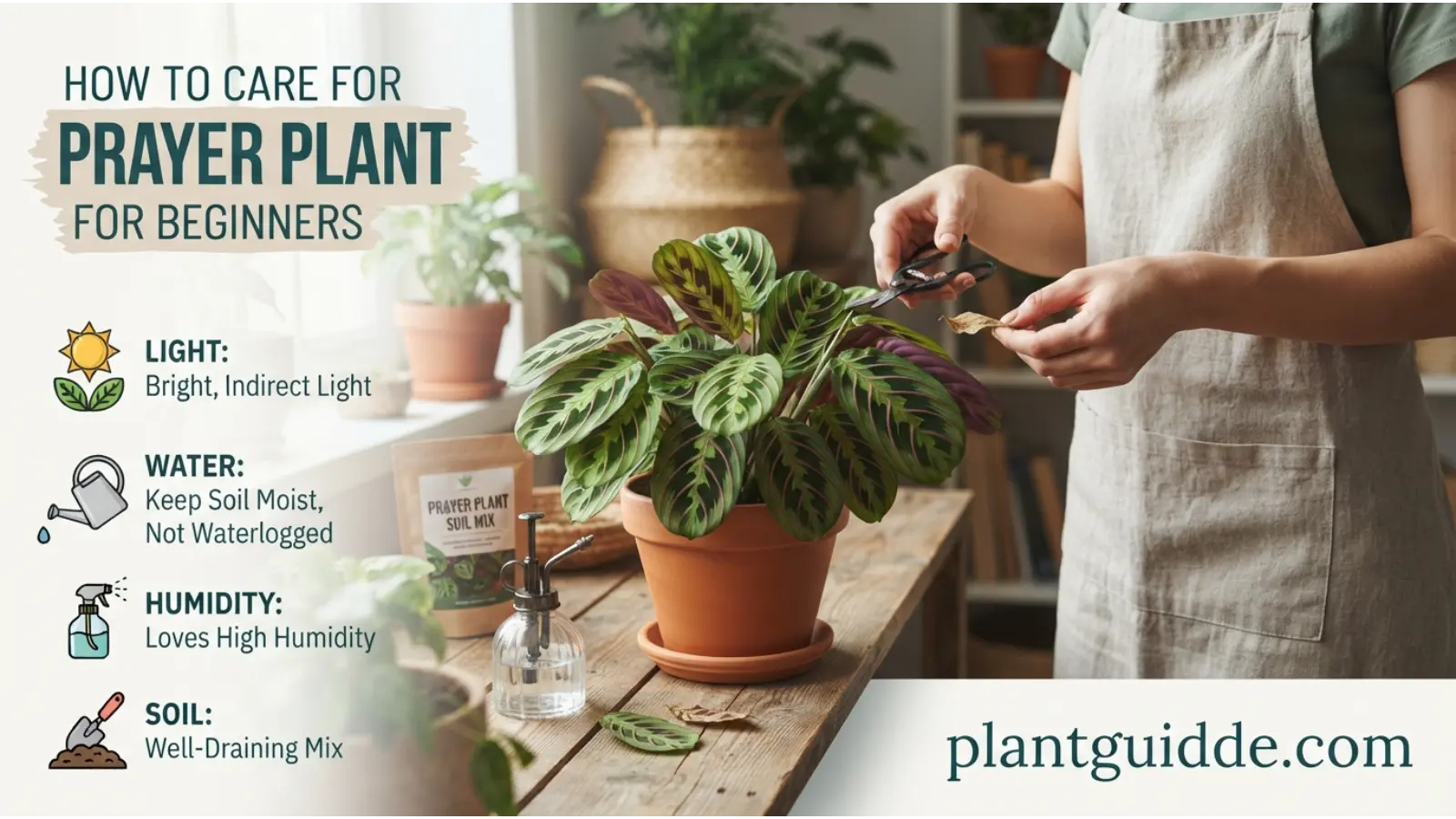
To care for a prayer plant, Maranta leuconeura, give it bright, indirect light, consistently moist but well-drained soil, high humidity, and warm, draft-free conditions. Water when the soil begins to dry rather than following a rigid schedule, and avoid both harsh direct sunlight and constantly soggy soil. Feed lightly during active growth and reduce watering and fertilizer during winter.
What Is a Prayer Plant?
The name “prayer plant” commonly refers to Maranta leuconeura, a tropical, rhizomatous perennial in the Marantaceae family. It is native to Brazil and is commonly grown indoors in temperate climates.
Its common name comes from its unusual leaf movement. During the evening, the leaves can fold or rise upward, creating an appearance similar to hands held in prayer. During daylight, they generally flatten out again.
Prayer plants are grown primarily for their foliage rather than their flowers. Small flowers can appear under good conditions, but they are much less significant ornamentally than the patterned leaves
Prayer Plant Care at a Glance
| Care factor | What a prayer plant prefers | What to avoid |
|---|---|---|
| Light | Bright, filtered or indirect light | Strong direct afternoon sun |
| Water | Evenly moist soil | Bone-dry soil or constantly soggy soil |
| Humidity | High humidity | Very dry indoor air |
| Soil | Moisture-retentive but well-draining mix | Heavy, poorly draining soil |
| Temperature | Warm, stable conditions | Cold drafts and sudden temperature drops |
| Fertilizer | Light feeding during active growth | Heavy or excessive fertilization |
| Pot | Drainage hole and appropriately sized | Oversized pot without drainage |
| Location | Sheltered, bright indoor position | Near heating/cooling vents |
RHS recommends bright filtered light, high humidity, moderate watering, and reduced watering in winter. Missouri Botanical Garden similarly recommends bright indoor light without strong direct sun and consistently moist soil during active growth.
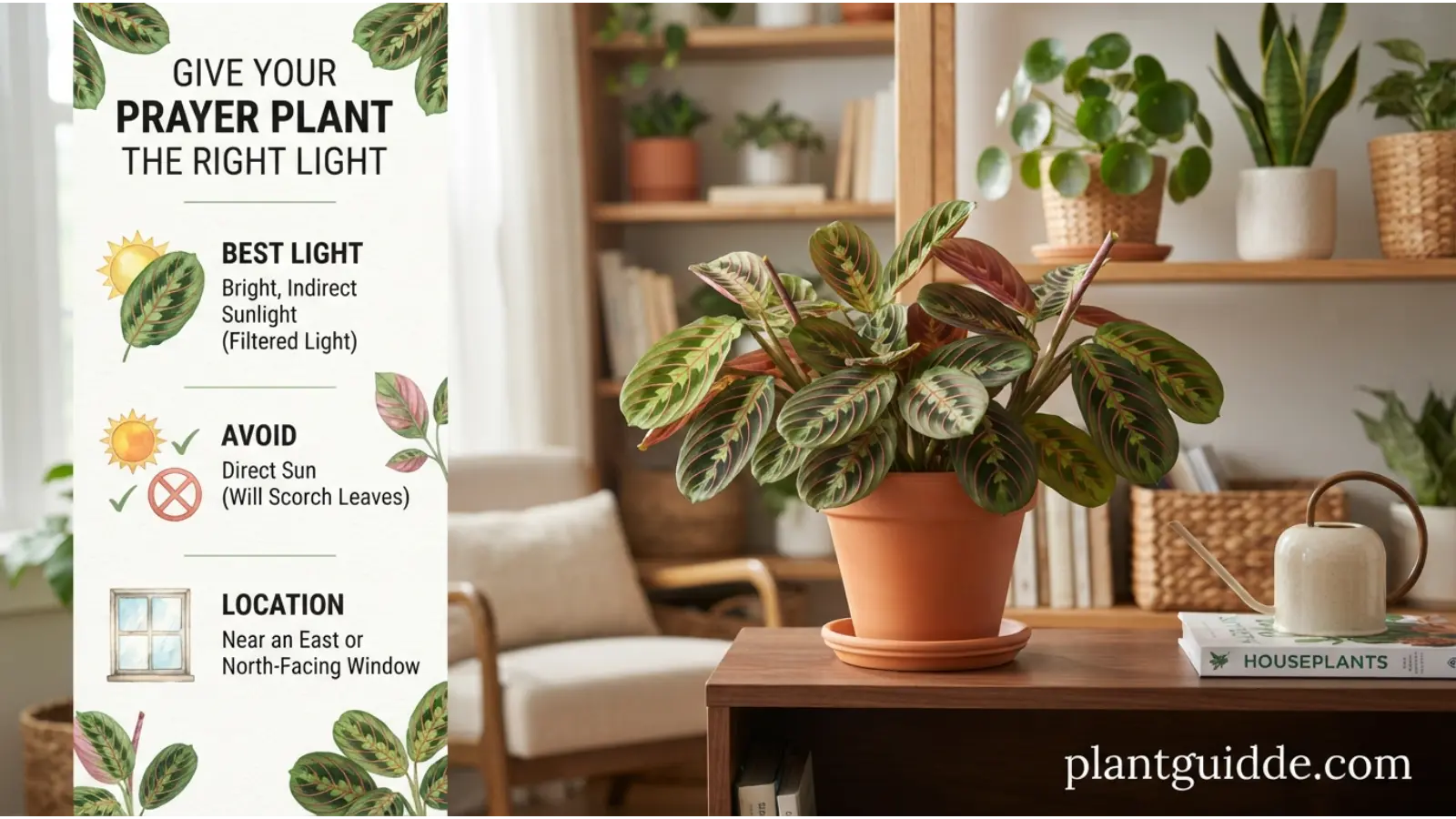
Give Your Prayer Plant the Right Light
Light is one of the first things to check when a prayer plant starts looking unhealthy.
Prayer plants generally perform best in bright, indirect or filtered light. They can tolerate lower light than many houseplants, but insufficient light can reduce growth and affect the appearance of the foliage. How to Care for Prayer Plant for Beginners. Strong direct sunlight can bleach or scorch the attractive leaf patterns.
What does “bright indirect light” mean?
A good location might be:
- Near an east-facing window
- A short distance from a bright south- or west-facing window
- Behind a sheer curtain
- In a bright room where sunlight does not hit the leaves directly for long periods
You do not need to put the plant directly against a sunny window to give it enough light.
Signs the light is too strong
Watch for:
- Faded leaf markings
- Bleached-looking foliage
- Brown or scorched patches
- Leaves becoming unusually pale
Move the plant farther from the window or filter the sunlight with a curtain.
Signs the light is too low
You may notice:
- Slow growth
- Smaller new leaves
- Less vivid foliage
- Long, weak growth toward the light
Instead of immediately adding fertilizer, improve the light first. A plant cannot compensate for inadequate light simply by receiving more nutrients.
Practical tip: If your prayer plant is several feet away from a window and receives little natural daylight, consider moving it gradually toward a brighter position rather than suddenly placing it in direct sun.
Water a Prayer Plant Without Overwatering It
Watering is probably the area where beginners make the most mistakes.
A prayer plant likes evenly moist soil, but that does not mean its roots should sit in water. Missouri Botanical Garden specifically places prayer plants among indoor plants that prefer soil that does not completely dry out. How to Care for Prayer Plant for Beginners. At the same time, excessive water can reduce oxygen around the roots and contribute to root rot.
How often should you water a prayer plant?
There is no reliable universal schedule such as “every three days.”
Watering frequency changes with:
- Room temperature
- Light intensity
- Humidity
- Pot size
- Pot material
- Soil composition
- Season
- Plant size
Instead, check the soil.
When the upper layer is beginning to dry and the pot feels noticeably lighter, check the moisture deeper in the root zone. If the soil is still wet, wait. If it is becoming dry, water thoroughly.
Missouri Botanical Garden also recommends judging watering by the plant, environment, and soil rather than watering strictly according to a calendar.
How to water correctly
- Check the soil before watering.
- If it has begun to dry, water thoroughly.
- Allow excess water to escape through the drainage hole.
- Empty standing water from the saucer.
- Return the plant to its normal position.
The objective is moist soil with oxygen around the roots, not permanently saturated soil.
What if the soil becomes completely dry?
A severely dried-out pot can sometimes become difficult to re-wet because water runs around the edge instead of penetrating the root ball. In such cases, thorough rehydration may be necessary rather than simply adding a small splash of water.
Image Suggestion: Three-panel illustration showing correctly moist prayer plant soil, severely dry soil, and waterlogged soil.
Choose a Soil Mix That Holds Moisture but Drains Well
Prayer plants need moisture, but their roots still need air.
That means the ideal potting mix should retain enough water to prevent rapid drying while allowing excess moisture to drain. How to Care for Prayer Plant for Beginners.
A basic indoor tropical plant mix can work well when it is sufficiently airy and well draining. The exact ingredients are less important than the final structure of the mix.
A good mix should:
- Hold some moisture
- Drain excess water
- Resist becoming compacted
- Allow air around the roots
Avoid using ordinary garden soil by itself in a small indoor container. It can become dense and drain poorly.
RHS recommends moist but well-drained conditions for Maranta leuconeura.
A common mistake
Some growers react to a prayer plant’s preference for moisture by choosing an extremely water-retentive soil.
That can backfire.
If the pot remains wet for a long time, the issue may not be that you are watering too often. The soil and container combination itself may be holding too much water.
Use a Pot With Drainage
A drainage hole is essential.
Even excellent soil cannot compensate for a container that traps excess water at the bottom.
When choosing a pot:
- Make sure it has a drainage hole.
- Choose a size appropriate for the root system.
- Do not automatically move the plant into a very large container.
- Use a saucer to protect furniture, but empty collected water.
Prayer plants have relatively shallow root systems and spread horizontally, so a wide, appropriately sized container can be more practical than an unnecessarily deep one.
Why an oversized pot can cause problems
A large container holds more soil. If the plant has a relatively small root system, that extra soil can remain wet for longer.
This creates a difficult situation: the plant may appear to need water because the upper surface looks dry while the lower portion of the pot is still saturated.
When repotting, increase the pot size modestly rather than jumping several sizes.
Keep Humidity High
Humidity is particularly important for prayer plants.
They come from tropical environments and can struggle when indoor air becomes very dry. Both RHS and North Carolina Extension recommend high humidity for Maranta leuconeura.
Low humidity can contribute to:
- Brown leaf tips
- Crispy leaf edges
- Curling leaves
- Increased water stress
Practical ways to increase humidity
You can:
- Use a humidifier
- Group several plants together
- Place the plant in a naturally humid room
- Use a tray of moist pebbles beneath the pot, while keeping the pot itself above standing water
RHS notes that grouping plants and using a tray of moist gravel can increase local humidity.
Does misting solve the problem?
Misting can temporarily increase moisture around the foliage, but it is not always the most reliable way to maintain consistently higher humidity.
If your home is genuinely dry, a small humidifier is usually easier to control than repeatedly spraying the leaves.
Important: Higher humidity does not mean stagnant air. Good airflow still matters, especially when foliage stays damp for extended periods.
Keep the Temperature Stable
Prayer plants prefer warm conditions and dislike cold drafts.
Missouri Botanical Garden recommends temperatures that do not fall below about 60°F (16°C) for Maranta leuconeura grown under its conditions, while North Carolina Extension notes that the plant is intolerant of low temperatures and cold drafts.
Avoid placing your prayer plant:
- Directly beside an air conditioner
- Against a cold window in winter
- Near a heater
- In a location with frequent temperature swings
- Where cold outdoor air hits it whenever a door opens
A stable room is generally more important than finding a location with a specific temperature number.
Fertilize Lightly During Active Growth
Prayer plants do not need heavy feeding.
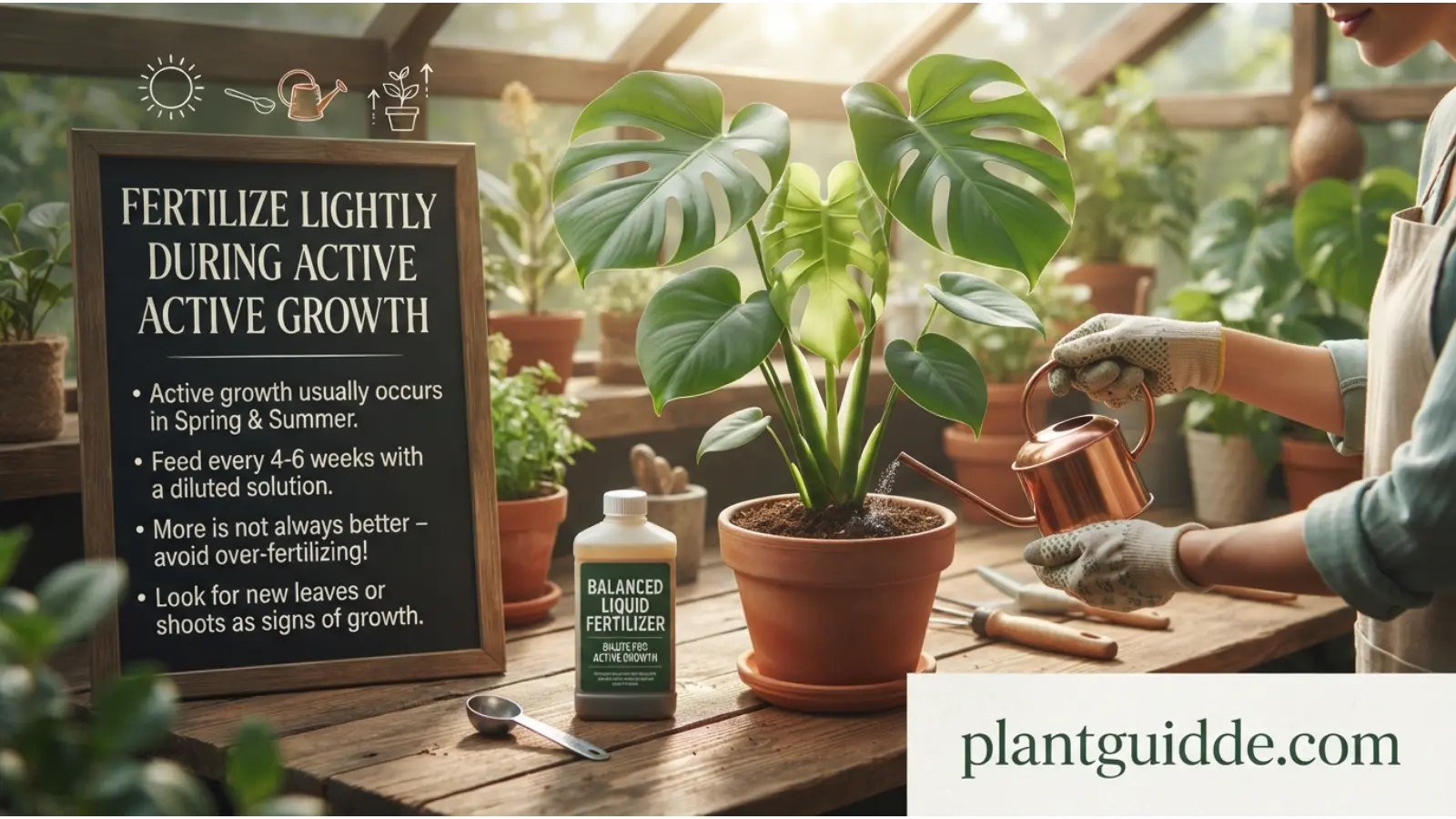
During active growth, a balanced houseplant fertilizer can be applied according to its label directions. Missouri Botanical Garden recommends monthly feeding during the growing season for Maranta leuconeura and reducing fertilizer substantially from autumn through late winter.
Why less is often better
Overfertilization can damage foliage and contribute to salt accumulation in the growing medium. North Carolina Extension specifically notes that high fluoride exposure and over-fertilization can burn prayer plant leaves
If the plant is struggling because of poor light, root problems, or dehydration, adding more fertilizer is unlikely to solve the underlying problem.
Better approach: Fix light, moisture, temperature, and humidity first. Fertilizer supports healthy growth; it does not replace good growing conditions
Water Quality Can Matter When Leaf Tips Keep Browning
Brown tips do not automatically mean “underwatering.”
Several factors can produce similar symptoms, including dry air, inconsistent moisture, fertilizer buildup, and water quality.
North Carolina Extension notes that prayer plant leaves can be affected by high fluoride exposure.
If your care routine is otherwise good but the plant repeatedly develops brown tips, consider whether the water source could be contributing.
You can experiment with a suitable alternative water source and observe whether new growth improves. Avoid assuming that expensive bottled or distilled water is automatically necessary for every prayer plant; diagnose the broader growing conditions first.
Pruning and Cleaning a Prayer Plant
Prayer plants generally do not require heavy pruning. RHS lists no pruning requirement for Maranta leuconeura.
However, removing damaged foliage can improve its appearance and allow you to monitor new growth.
Use clean scissors to remove:
- Completely dead leaves
- Severely damaged leaves
- Brown sections when only part of a leaf is affected
Do not remove healthy leaves simply because they have a few minor imperfections.
Cleaning dusty leaves
Because prayer plants have broad foliage, dust can accumulate on the leaf surface.
Gently wiping the leaves with a clean, damp cloth can improve their appearance. Avoid relying on oily commercial leaf-shine products.
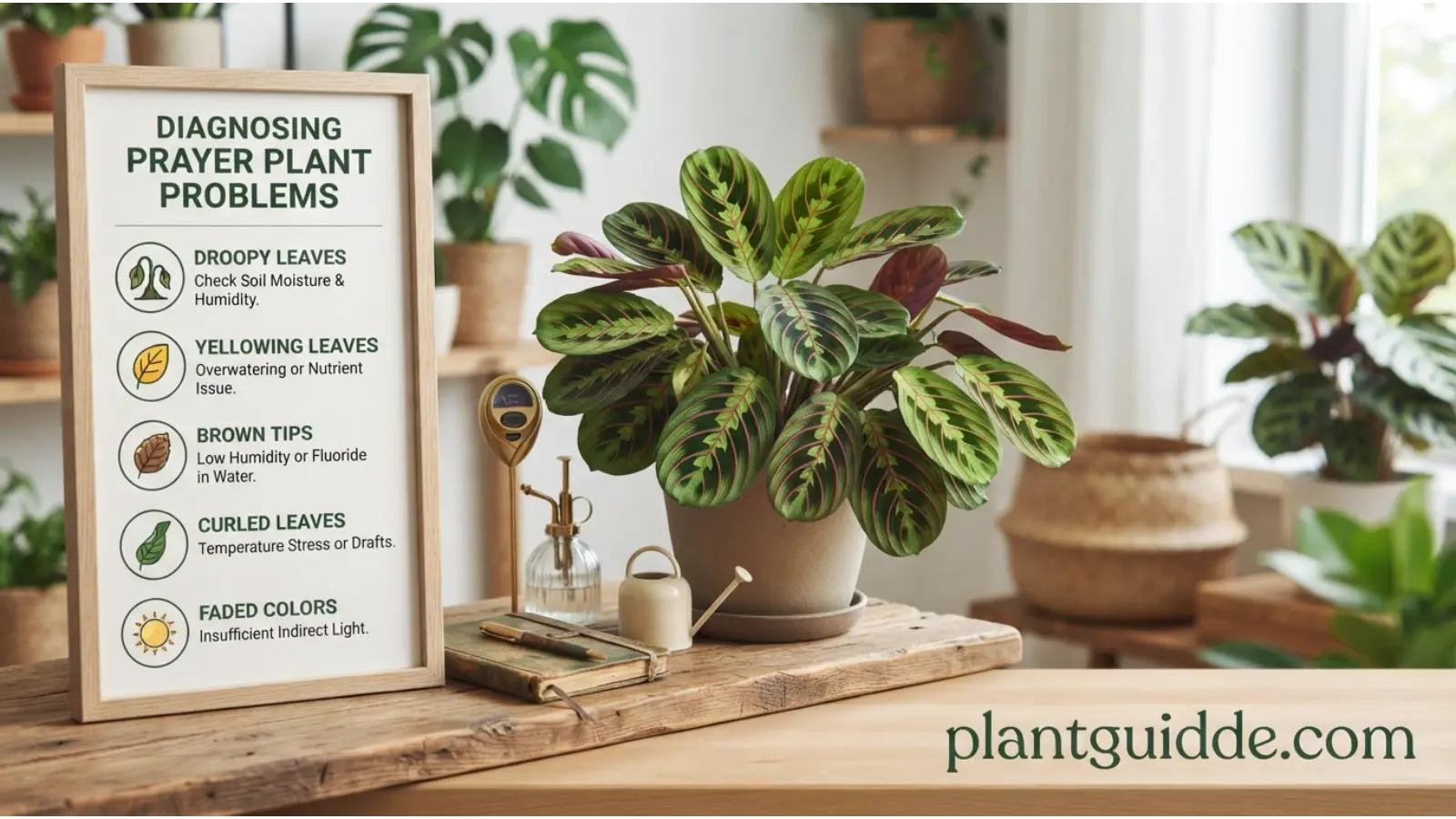
Why Are My Prayer Plant Leaves Curling?
Curling leaves are one of the most common prayer plant problems.
The first things to investigate are:
- Soil that has become too dry
- Low humidity
- Excessive direct sunlight
- Cold drafts
- Root problems
- Sudden environmental changes
North Carolina Extension notes that prayer plants are intolerant of low humidity, direct sunlight, low temperatures, and cold drafts.
A useful diagnostic approach
Don’t immediately water a curling plant.
First touch the soil.
If the soil is dry: dehydration may be contributing.
If the soil is wet: adding more water may make the situation worse. Check drainage, roots, light, and airflow instead.
If the soil moisture is appropriate: examine humidity and temperature.
This simple process prevents one of the most common houseplant mistakes: treating every symptom as a watering problem.
Why Are Prayer Plant Leaves Turning Brown?
Brown edges or tips can have several causes.
| Symptom | Possible cause | What to check first |
|---|---|---|
| Brown, crispy edges | Low humidity or moisture stress | Humidity and soil moisture |
| Bleached patches | Too much direct sun | Move into filtered light |
| Brown tips after heavy feeding | Fertilizer/salt stress | Recent fertilizer application |
| Brown leaves with persistently wet soil | Root stress | Drainage and roots |
| Browning near cold exposure | Temperature stress | Drafts and cold windows |
Do not diagnose the plant from one symptom alone.
For example, a brown leaf edge plus bone-dry soil points toward a different problem than a brown leaf edge on a plant sitting in saturated soil.
Why Are My Prayer Plant Leaves Turning Yellow?
Yellow leaves can occur from both too much and too little water, so the color alone does not provide a complete diagnosis. Missouri Botanical Garden specifically notes that yellowing and wilting can occur with improper watering in either direction.
Check:
- How wet the soil remains
- Whether the container drains properly
- Whether the plant has recently been repotted
- How much light it receives
- Whether the roots appear healthy
- Whether the plant is receiving excessive fertilizer
If the soil stays wet for a prolonged period, root problems become more concerning.
If the plant is extremely dry, dehydration becomes more likely.
Why Are My Prayer Plant Leaves Drooping?
Drooping does not always mean “give it water.”
Check the soil before doing anything.
If the soil is dry
Water thoroughly and monitor the plant over the next several hours.
If the soil is wet
Do not automatically add more water.
Investigate:
- Poor drainage
- Compacted soil
- Root damage
- Low temperatures
- Sudden environmental changes
Missouri Botanical Garden emphasizes that improper watering can stress roots and that overwatering can contribute to root rot.
Why Is My Prayer Plant Not Growing?
Slow growth can be caused by several factors, but light is an excellent place to start.
A prayer plant cannot produce strong new growth without enough energy from light.
Check:
- Is the plant receiving bright indirect light?
- Has daylight decreased seasonally?
- Is the plant crowded behind other plants?
- Is the soil staying wet too long?
- Has the plant been recently repotted?
- Are temperatures too low?
- Are there visible pests?
Do not automatically increase fertilizer because growth is slow. Missouri Botanical Garden notes that fertilizer requirements depend partly on how actively the plant is growing and how much light it receives.
Common Prayer Plant Pests
Prayer plants can be affected by pests including:
- Spider mites
- Mealybugs
- Thrips
- Whiteflies in some growing environments
RHS and Missouri Botanical Garden both identify common pests such as spider mites and mealybugs on prayer plants.
What to inspect
Look closely at:
- Leaf undersides
- New growth
- Leaf joints
- Stems
- Areas where leaves overlap
Spider mites can produce fine webbing and stippled or discolored foliage. Mealybugs often appear as small cottony clusters.
Early detection is much easier than trying to control a large infestation later. How to Care for Prayer Plant for Beginners.
Image Suggestion: Macro comparison showing healthy prayer plant leaves alongside spider-mite webbing and mealybugs.
Should You Mist a Prayer Plant?
Misting is optional rather than a complete humidity strategy.
If your home’s air is very dry, repeatedly misting may not maintain stable humidity for long enough to make a meaningful difference.
For consistently dry indoor conditions, consider:
- A humidifier
- Grouping plants
- A humid room such as a suitable bathroom
- A pebble tray used correctly
RHS recommends several of these methods for raising humidity around houseplants.
If you mist, avoid keeping the foliage continuously wet in cool conditions or in an area with poor airflow.
Prayer Plant Care in Winter
Winter care should not simply copy your summer routine.
When temperatures and light levels fall, growth often slows, so the plant may use water more slowly.
Missouri Botanical Garden recommends reducing soil moisture and substantially reducing fertilizer from autumn through late winter.
During winter:
- Check soil moisture before watering.
- Move the plant away from cold glass.
- Protect it from drafts.
- Watch for dry indoor air from heating systems.
- Reduce fertilizer when growth slows.
- Maintain suitable indirect light.
The biggest winter mistake is often continuing a summer watering schedule when the plant is receiving less light and growing more slowly.
How to Repot a Prayer Plant
Repot when the plant has genuinely outgrown its container or the growing medium has deteriorated—not simply because a calendar says it is time.
Signs that repotting may help include:
- Roots filling the container
- Water passing through unusually quickly because the root ball is crowded
- Poor growth despite otherwise suitable care
- Soil that has become compacted or degraded
Choose a container only modestly larger than the existing one.
RHS guidance for houseplants emphasizes appropriate drainage, while Missouri Botanical Garden advises against unnecessarily large increases in pot size when bringing plants indoors.
After repotting, expect the plant to need some time to adjust.
How to Propagate a Prayer Plant
Prayer plants can be propagated by division, and propagation by basal cuttings is also recognized by RHS.
Division is particularly useful when a mature plant has developed multiple sections.
A practical approach is:
- Remove the plant carefully from its container.
- Examine the root system.
- Separate suitable sections with roots attached.
- Place each division into an appropriately sized container.
- Use a moist, well-draining growing medium.
- Return the divisions to warm, humid conditions with indirect light.
Avoid dividing a very small or severely stressed plant. Propagation works best when the parent plant is actively growing and healthy.
A Simple Weekly Prayer Plant Care Routine
You do not need to inspect your plant obsessively.
Once or twice a week, check:
Soil
Is it still moist, or is it beginning to dry?
Leaves
Are the leaves firm and well-colored? Look underneath for pests.
Light
Has anything changed around the plant that affects its light?
Humidity
Is the room unusually dry?
Temperature
Is the plant exposed to a draft, heater, or air conditioner?
Pot
Is water draining normally?
This routine is more useful than following an arbitrary watering schedule.
The Most Common Prayer Plant Care Mistakes
Watering on a fixed calendar
A plant does not know that it is “watering day.”
Room conditions change, so check the soil instead.
Giving it direct sunlight
More light is not always better. Strong direct sunlight can damage or bleach prayer plant foliage.
Keeping the soil permanently soaked
Prayer plants like moisture, but roots still need oxygen. Poor drainage can contribute to root problems.
Ignoring humidity
A plant can have perfectly moist soil and still suffer from very dry air.
Fertilizing a struggling plant heavily
More fertilizer does not fix poor light, damaged roots, or dehydration.
Putting the plant beside an air conditioner
Cold, moving air can create exactly the kind of unstable environment prayer plants dislike.
Repotting into a huge container
More soil can mean more retained moisture around a relatively small root system.
A Better Way to Diagnose Prayer Plant Problems
Instead of treating individual symptoms separately, use this order:
Step 1: Check the soil.
Is it dry, appropriately moist, or saturated?
Step 2: Check the roots if the soil stays wet.
Persistent wetness can indicate a drainage or root problem.
Step 3: Check the light.
Too much direct sun and too little light can both cause problems.
Step 4: Check humidity.
Especially if the leaves are crispy or curling.
Step 5: Check temperature.
Look for cold drafts, heaters, and air conditioners.
Step 6: Inspect for pests.
Look under leaves and around new growth.
Step 7: Only then consider fertilizer.
This diagnostic sequence is useful because several different problems can produce similar symptoms.
FAQs,
How often should I water a prayer plant?
Water when the soil begins to dry rather than following a fixed schedule. Prayer plants prefer consistently moist soil, but excess water should drain freely. Watering frequency depends on light, temperature, humidity, pot size, and soil.
Does a prayer plant need direct sunlight?
No. Bright, indirect or filtered light is generally better. Strong direct sunlight can bleach or scorch the foliage.
Why are my prayer plant leaves turning brown?
Common possibilities include low humidity, inconsistent soil moisture, direct sunlight, fertilizer stress, water-quality issues, or root problems. Look at the growing conditions as a whole rather than assuming the plant simply needs more water.
Why are my prayer plant leaves curling?
Check soil moisture, humidity, light, and temperature first. Dry soil and low humidity are common causes, but curling can also occur when a plant is exposed to unsuitable light or cold conditions.
Can a prayer plant grow in low light?
Prayer plants tolerate low to medium light, but brighter indirect light is generally better for healthy growth and attractive foliage.
Does a prayer plant need high humidity?
Yes. Prayer plants are tropical plants and generally perform better with high humidity. A humidifier, plant grouping, or suitable humid room can help.
Can I keep a prayer plant in a bathroom?
A bright bathroom can be a good location if it provides adequate indirect light. The naturally higher humidity can also benefit the plant.
Should I mist my prayer plant every day?
Daily misting is not essential. If your home is consistently dry, a humidifier provides more controllable and sustained humidity than occasional misting.
Why is my prayer plant not moving its leaves at night?
Leaf movement can vary with plant health and environmental conditions. The absence of dramatic movement alone does not necessarily mean the plant is unhealthy. Evaluate its overall growth, foliage, light, moisture, and temperature.
How much fertilizer does a prayer plant need?
Use a balanced houseplant fertilizer according to its label during active growth rather than feeding heavily. Reduce or stop feeding when growth slows during the darker part of the year.
Do prayer plants need drainage holes?
Yes. A drainage hole allows excess water to escape and reduces the risk associated with waterlogged soil.
Can I grow a prayer plant outdoors?
In suitable tropical conditions, Maranta leuconeura can be grown outdoors in sheltered, shaded conditions. In colder climates it is generally grown as a houseplant because it is not frost tolerant.
Final Takeaways
The secret to healthy prayer plant care is consistency rather than perfection.
Give your Maranta bright filtered light, keep the soil evenly moist without leaving it waterlogged, provide high humidity, protect it from cold drafts and harsh sunlight, and fertilize modestly during active growth.
Most importantly, learn to diagnose the plant before changing its care. A curling leaf does not automatically mean “water it,” and a brown tip does not automatically mean “give it fertilizer.” Check the soil, light, humidity, temperature, drainage, and roots before deciding what to change.
Once those conditions are stable, prayer plants become much easier to understand. and their colorful foliage and distinctive nighttime leaf movement make the extra attention worthwhile.

Asad Mumtaz is a dedicated plant enthusiast and gardening writer with a passion for helping people care for their plants successfully. He specializes in plant care guides, indoor gardening, and practical growing tips for all skill levels. His content focuses on making gardening simple, enjoyable, and rewarding. Through his work, Asad shares reliable advice to help readers create thriving green spaces.