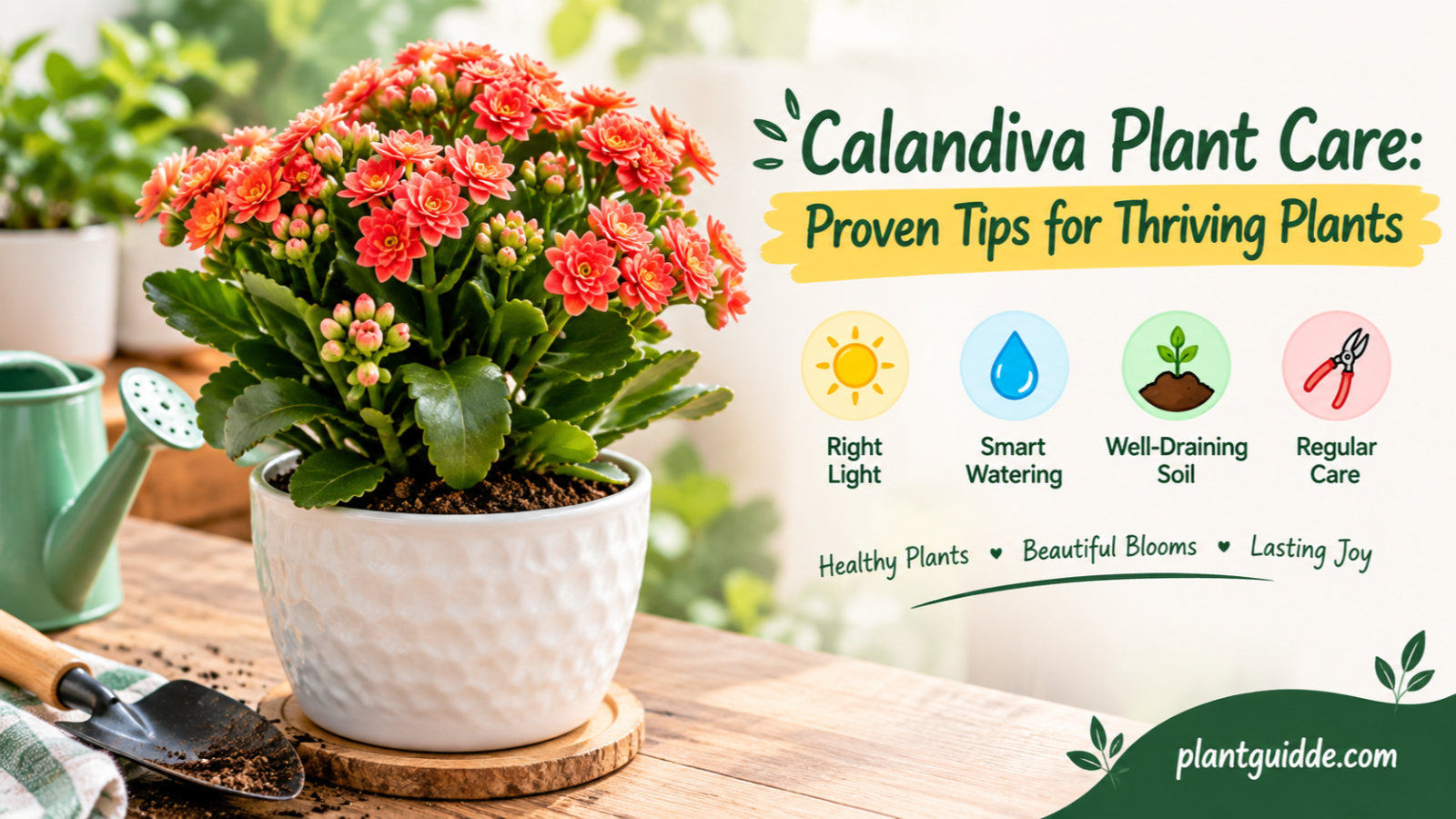
Calandiva plant care is surprisingly simple when you understand what this colorful flowering succulent actually needs. Known for its clusters of long-lasting blooms and thick, glossy leaves, Calandiva can brighten a windowsill, desk, or indoor garden for weeks.
However, poor lighting, frequent watering, or soggy soil can quickly lead to yellow leaves, root problems, and fading flowers. With the right balance of sunlight, watering, soil, and temperature, calandiva plant care becomes an easy routine even for beginners.
The key to successful calandiva plant care is avoiding the common mistake of treating it like a typical tropical houseplant. Calandiva stores moisture in its leaves, so it prefers thorough watering followed by a period of drying rather than constantly wet soil.
Good calandiva plant care also means providing bright light, excellent drainage, moderate temperatures, and removing faded flowers to encourage a healthier appearance. In this guide, you’ll learn practical calandiva plant care tips, how to keep your plant blooming, and how to recognize and fix the most common problems.
Quick Answer
Calandiva plant care is relatively simple because Calandiva is a double-flowered form of Kalanchoe blossfeldiana, a succulent that stores water in its fleshy leaves. Give it bright light, fast-draining soil, thorough but infrequent watering, and good airflow. Let the soil dry between waterings rather than keeping it constantly wet. After flowering, prune spent blooms and provide long, uninterrupted nights if you want to encourage reblooming.
What Is a Calandiva Plant?
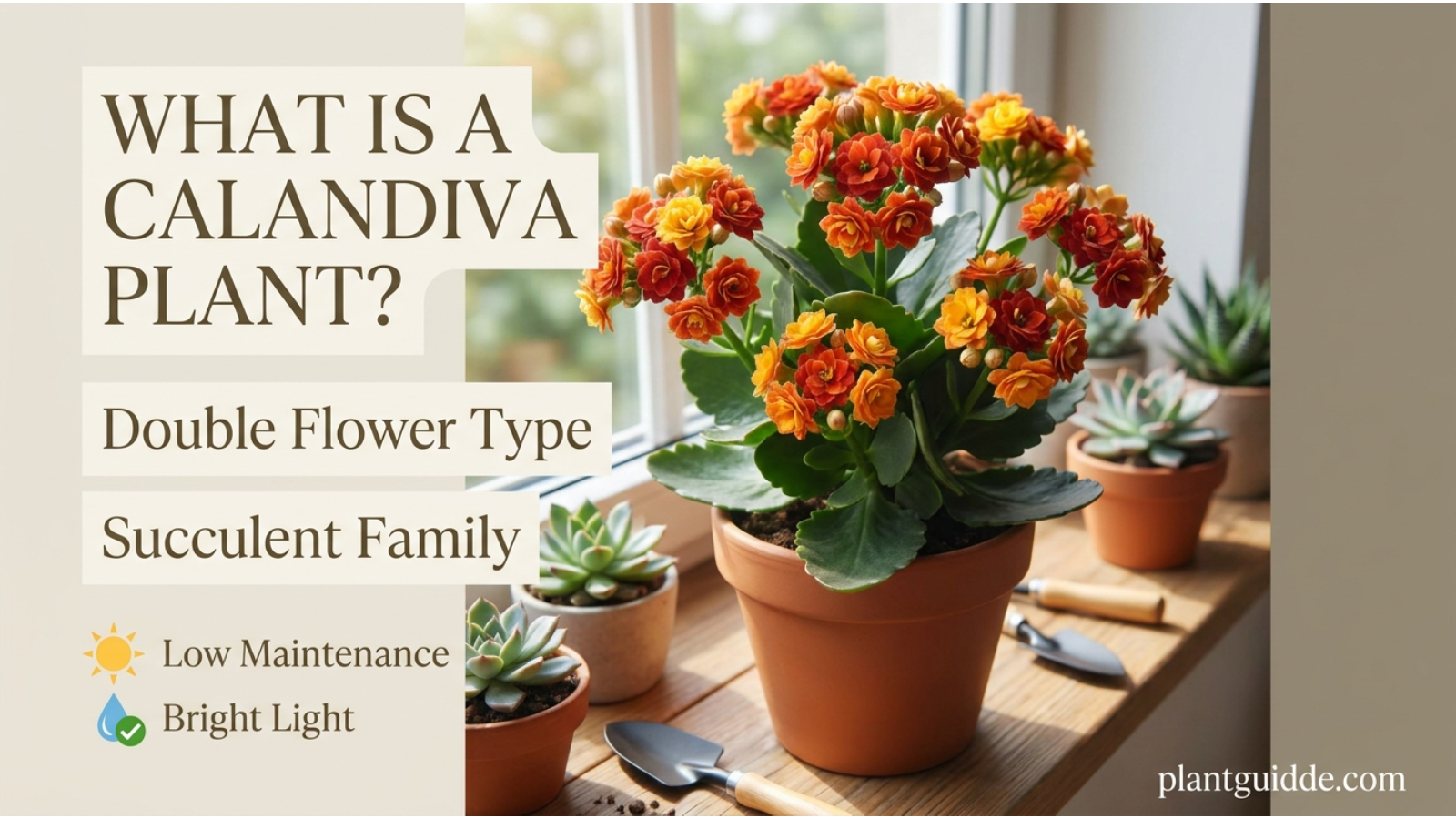
Calandiva is a commercial series of double-flowered Kalanchoe blossfeldiana. It belongs to the Crassulaceae, or stonecrop, family.
Unlike traditional single-flowered kalanchoes, Calandiva produces dense, multi-petaled flowers that resemble miniature roses. It is available in numerous flower colors and is commonly sold as a compact flowering houseplant.
Calandiva at a glance
| Care factor | What Calandiva prefers |
|---|---|
| Light | Bright light; some gentle direct sun can be beneficial |
| Water | Thorough watering followed by drying |
| Soil | Fast-draining succulent or cactus mix |
| Humidity | Average household humidity is usually adequate |
| Temperature | Moderate, stable indoor temperatures |
| Fertilizer | Light feeding during active growth |
| Pruning | Remove spent flower clusters and leggy growth |
| Flowering | Requires appropriate light and long, uninterrupted nights for reblooming |
| Propagation | Stem cuttings are practical |
| Pet safety | Kalanchoe is toxic to dogs and cats if eaten |
Extension sources consistently recommend well-drained soil and allowing the growing medium to dry between waterings.
Image Suggestion: A labeled botanical-style image showing a Calandiva plant, its fleshy leaves, flower clusters, stem, and drainage pot.
Give Calandiva Bright Light
Light is one of the most important factors in successful Calandiva plant care.
Place your plant near a bright window where it receives plenty of natural light. A bright east- or south-facing location can work well, although intense afternoon sun through glass may need to be filtered depending on your climate and window exposure.
Calandiva can tolerate bright indoor conditions well, while inadequate light can cause weak, stretched growth.
What happens when light is too low?
You may notice:
- Long gaps between leaves
- Thin or weak stems
- Fewer flowers
- A plant that leans toward the window
- Slow recovery after flowering
- New growth that looks less compact
A common mistake is moving a struggling Calandiva into a dark corner because the plant is flowering. That may preserve the flowers temporarily, but it doesn’t provide the conditions needed for strong long-term growth.
Can Calandiva receive direct sunlight?
Yes, but introduce stronger sunlight gradually.
A plant that has spent weeks under indoor retail lighting can scorch if suddenly placed against intense afternoon sun. Acclimate it over several days or weeks rather than changing exposure abruptly.
Practical tip: calandiva plant care the foliage becomes pale, stretched, or unusually sparse, think light first. If leaves develop bleached or crispy patches after a sudden move into harsh sun, reduce the intensity and acclimate more gradually.
Water Calandiva Only When the Soil Has Dried
Overwatering is probably the easiest way to turn an otherwise healthy Calandiva into a declining plant.
Because Calandiva is a succulent, its fleshy leaves hold moisture. The roots don’t need permanently wet soil to stay hydrated.
Instead of watering according to a strict calendar, check the soil.
A better watering routine
- Push your finger into the upper portion of the potting mix.
- Check whether the soil has dried noticeably.
- If it is still damp, wait.
- When the mix has dried sufficiently, water thoroughly.
- Allow excess water to drain completely.
- Empty any water sitting in the saucer or decorative container.
Iowa State University specifically recommends allowing kalanchoe soil to dry between waterings and warns against leaving the container sitting in water.
Don’t confuse dry soil with dehydration
A Calandiva doesn’t need to be kept bone-dry for weeks.
There is a useful middle ground:
Drying between waterings = good.
Staying wet for prolonged periods = risky.
Remaining severely dry until the plant repeatedly wilts = also undesirable.
The exact interval depends on pot size, soil, temperature, light, humidity, and season.
A small plant in a bright, warm room may dry much faster than a larger plant sitting in a cool room.
Use Fast-Draining Calandiva Soil
The best soil for Calandiva is one that allows water to move through the root zone rather than remaining compacted around the roots.
A commercial cactus or succulent potting mix is a convenient starting point.
You can also improve a regular indoor potting mix by incorporating a substantial amount of an aerating material such as perlite or pumice.
The important characteristic isn’t a particular brand or exact recipe.
It’s drainage and aeration.
Clemson Extension notes that kalanchoes are succulents and perform well in well-drained, well-aerated growing media.
Why heavy soil causes problems
Imagine watering two identical plants.
One is planted in an airy succulent mix. The other is planted in dense soil that holds moisture for a long time.
The first plant may dry at a healthy rate.
The second may remain wet for days.
That’s why increasing the time between waterings isn’t always enough. If the soil drains poorly, the roots may still spend too much time surrounded by moisture.
Choose a Pot With Drainage Holes
A drainage hole is not a minor convenience for Calandiva.
It is one of the simplest protections against accidental overwatering.
Choose a pot that allows excess water to escape freely. If you place the nursery pot inside a decorative cover pot, check it after watering and empty accumulated water.
Avoid choosing a very large container simply because you expect the plant to grow.
An oversized pot holds more wet soil around a relatively small root system, which can slow drying.
Practical rule: Move up only when the plant actually needs more root space or the current pot has become unsuitable.
Calandiva Temperature and Humidity
Calandiva generally performs well under normal indoor temperatures, provided conditions are reasonably stable.
Extension guidance for Kalanchoe blossfeldiana commonly places daytime temperatures around 70°F (21°C) and nighttime temperatures around 60–65°F (16–18°C), with cooler conditions helping prolong flowers.
Avoid placing the plant directly beside:
- Cold drafts
- Air-conditioning vents
- Heating vents
- Frequently opened exterior doors
- Very hot windows during extreme weather
Does Calandiva need high humidity?
Usually, no.
This is an important difference between Calandiva and many tropical foliage plants.
You generally don’t need to create a humidifier-heavy environment just to keep Calandiva healthy. Its succulent nature means it is better suited to relatively moderate indoor humidity.
Constantly misting the foliage is also unnecessary.
Instead, prioritize:
Good light + proper drying + drainage + stable temperatures.
Those factors usually matter far more than chasing a particular humidity percentage.
How to Fertilize Calandiva
Calandiva does not need heavy feeding.
During active growth, a balanced houseplant fertilizer can be applied according to the product’s directions. Avoid repeatedly applying concentrated fertilizer to dry soil because this can stress roots.
Clemson Extension recommends feeding actively growing kalanchoes with houseplant fertilizer approximately once a month, while other extension guidance recommends relatively light fertilization.
A simple approach
- Fertilize during active growth.
- Follow the fertilizer label.
- Avoid excessive feeding.
- Reduce or stop routine fertilizing when the plant is not actively growing.
- Water normally rather than trying to compensate for fertilizer with excessive irrigation.
More fertilizer will not automatically produce more flowers.
If your Calandiva has weak, stretched growth, solve the light problem before increasing fertilizer.
How to Keep Calandiva Blooming Longer
One reason Calandiva is so popular is its long-lasting display of flowers. Individual flowering displays can remain attractive for weeks when conditions are favorable.
Once the plant is flowering, focus on stability.
During flowering:
- Keep the plant in bright light.
- Avoid unnecessary repotting.
- Don’t dramatically change its environment.
- Water when the soil has dried appropriately.
- Keep it away from temperature extremes.
- Remove flowers that have completely faded.
Cooler indoor conditions can also help extend the life of kalanchoe flowers.
Should you remove dead Calandiva flowers?
Yes.
Deadheading removes spent flower clusters and improves the plant’s appearance. It can also redirect the plant away from maintaining old flower structures.
Use clean scissors or pruners and cut the spent flower stem back neatly without damaging healthy foliage.
How to Prune Calandiva After Flowering
Pruning is especially useful when a Calandiva begins looking uneven or stretched after its flowering period.
Remove:
- Dead flower clusters
- Yellow or damaged leaves
- Weak stems
- Excessively long growth
Don’t remove large amounts of healthy foliage without a reason.
A compact pruning session after flowering can help maintain a more attractive shape and encourage branching.
Clemson Extension also recommends cutting back tall growth and old flower stems when maintaining kalanchoe after flowering.
Image Suggestion: Step-by-step pruning diagram showing a flowering Calandiva, spent flower stem, correct cut point, and new branching growth.
How to Get Calandiva to Rebloom
This is where Calandiva care becomes more interesting.
Getting a plant to survive is relatively easy.
Getting it to flower again requires understanding its response to day length.
Kalanchoe is a short-day plant, meaning flower initiation is encouraged by sufficiently long, uninterrupted periods of darkness. Extension guidance commonly recommends approximately 14 hours of uninterrupted darkness for around six weeks to initiate flower buds.
A practical reblooming routine
After the previous flowers have faded:
- Remove spent blooms.
- Keep the plant growing in a bright location.
- Maintain appropriate watering.
- Allow the plant to develop healthy foliage.
- In the appropriate season, provide long, uninterrupted nights.
- Keep the plant in darkness for roughly 14 hours each night.
- Continue the routine for approximately six weeks.
- Return it to bright light during the daytime.
The critical word is uninterrupted.
A plant sitting in a bright room may not receive the dark period required if lamps, televisions, or other artificial lights illuminate it during the night.
Iowa State University recommends beginning this treatment around October and providing approximately 14-hour nights for six weeks.
Why your Calandiva may not rebloom
The most common reasons include:
- Insufficient bright light during the day
- Nighttime light interrupting the dark period
- Incorrect timing
- Weak growth after the previous flowering cycle
- Excessive watering
- Poor overall plant health
This is why simply putting a nonflowering Calandiva near a sunny window isn’t always enough.
Image Suggestion: Infographic showing the Calandiva rebloom cycle: bright daytime light → 14-hour uninterrupted darkness → six-week cycle → flower buds.
Calandiva Plant Care Through the Seasons
Spring
Spring is often a good time for active growth.
Provide:
- Bright light
- Moderate watering as the soil dries
- Light fertilization during active growth
- Pruning if the plant has become leggy
If moving Calandiva outdoors, acclimate it gradually rather than placing it immediately into strong sunlight.
Summer
Watch watering more closely because heat and bright light can increase evaporation.
However, don’t interpret hot weather as permission to water automatically every day.
Check the soil.
A plant in a hot, bright location may dry quickly, while one in an air-conditioned room may remain wet much longer.
Fall
Fall is particularly important if you want to encourage flowering.
This is the time to pay attention to the plant’s light-dark cycle. Long, uninterrupted nights can help trigger flowering.
Winter
Keep Calandiva in a bright location and protect it from cold drafts.
Watering usually needs to be adjusted according to how quickly the soil dries rather than following a summer schedule.
Cooler conditions can help prolong existing flowers, but avoid freezing temperatures. Kalanchoe blossfeldiana is not frost tolerant.
Common Calandiva Problems and What They Mean
Calandiva Leaves Turning Yellow
Yellow leaves can have several causes, but consistently wet soil is one of the first things to investigate.
Check:
- How often you water
- Whether the soil remains wet for days
- Whether the pot has drainage
- Whether the container is excessively large
- Whether the plant is receiving adequate light
Don’t automatically water a yellowing plant because it looks stressed.
That can make a moisture problem worse.
Calandiva Leaves Becoming Soft or Mushy
Soft, waterlogged foliage is a warning sign.
If the soil is also staying wet, inspect the roots and growing medium.
Healthy roots should not be surrounded by persistently saturated soil.
Reduce unnecessary watering and improve drainage. If root damage is advanced, affected roots may need to be removed and the plant repotted into fresh, well-draining media.
Calandiva Leaves Wrinkling
Wrinkled leaves can indicate that the plant is running low on available water, but the solution isn’t always “water immediately.”
First check the soil.
If the soil is very dry:
Water thoroughly and allow excess water to drain.
If the soil is already wet:
Do not add more water.
Investigate root health, drainage, temperature, and light instead.
This distinction is extremely important because both underwatering and root problems can produce stressed-looking foliage.
Calandiva Not Flowering
If your plant grows leaves but refuses to produce flowers, evaluate the entire environment.
The most important questions are:
- Is it receiving enough bright light?
- Has it recently been pruned heavily?
- Is it healthy and actively growing?
- Does it receive sufficiently long, uninterrupted nights?
- Is artificial light reaching it after dark?
Kalanchoe’s short-day flowering response means nighttime light can interfere with flower initiation.
Calandiva Becoming Leggy
Leggy growth is often a light problem.
Move the plant toward a brighter location and rotate it periodically so growth remains more balanced.
Pruning can improve the shape, but pruning alone won’t fix chronically inadequate light.
Think of pruning as the shape correction and better light as the underlying solution.
Calandiva Buds Dropping
Bud or flower loss can occur after environmental stress.
Possible triggers include:
- Sudden temperature changes
- Poor light
- Improper watering
- Moving the plant repeatedly
- Very dry or hot conditions
- General stress after purchase
When a flowering plant comes home from a greenhouse or retail environment, it is already experiencing a major environmental transition.
Give it time to acclimate instead of repeatedly moving it around the house.
Can You Propagate Calandiva?
Yes.
Calandiva can be propagated from stem cuttings.
A practical method is:
- Select a healthy stem.
- Take a clean cutting with several leaves.
- Remove lower leaves if necessary.
- Allow the cut surface to dry briefly.
- Place the cutting into a well-draining propagation medium.
- Keep the medium lightly managed rather than constantly saturated.
- Provide bright, indirect light.
- Once roots establish, gradually transition the new plant into normal Calandiva care.
Kalanchoe is commonly propagated from stem or leaf cuttings, although stem cuttings are particularly straightforward for maintaining the characteristics of a selected plant.
Do You Need to Repot a Calandiva?
Not immediately.
A newly purchased flowering Calandiva can often remain in its existing container while it is blooming.
Consider repotting when:
- The soil drains poorly.
- The container lacks drainage.
- Roots are severely crowded.
- The existing potting medium has deteriorated.
- The plant has outgrown its container.
When repotting, don’t jump to an enormous pot.
A modest increase in container size is generally easier to manage because it prevents an unnecessarily large volume of wet soil around the roots
Calandiva Care Mistakes to Avoid
1. Watering on a fixed weekly schedule
Calendar-based watering ignores temperature, light, pot size, and soil conditions.
Better: Check the soil before watering.
2. Using dense, moisture-retentive soil
A succulent doesn’t benefit from sitting in heavy, saturated soil.
Better: Use an airy, well-draining mix.
3. Putting it in a dark corner
Calandiva may survive for a while, but low light can produce weak growth and poor flowering.
Better: Give it a bright location.
4. Misting constantly
Calandiva doesn’t need tropical-level humidity.
Better: Concentrate on light, drainage, and watering.
5. Throwing the plant away after flowering
A finished flowering cycle doesn’t necessarily mean the plant is dead.
Better: Prune it, maintain healthy growth, and consider a controlled short-day treatment for reblooming.
6. Keeping the soil permanently damp
This is one of the most damaging habits for succulent kalanchoes.
Better: Let the soil dry between thorough waterings.
Is Calandiva Toxic to Cats and Dogs?
Yes.
The ASPCA lists Kalanchoe species as toxic to dogs and cats. Reported toxic principles are bufadienolides, and signs can include vomiting, diarrhea, and, rarely, abnormal heart rhythm.
If you have pets that chew plants, keep Calandiva out of reach.
If you suspect a pet has eaten part of the plant, contact your veterinarian or an appropriate animal poison-control service rather than waiting for symptoms to develop.
Image Suggestion: Pet-safety graphic showing Calandiva with a clear “keep away from cats and dogs” warning.
A Simple Calandiva Care Routine
If you want a straightforward routine without overthinking the plant, use this checklist:
Every few days
Check the plant for obvious changes:
- Wilting
- Yellowing
- Pests
- Damaged leaves
- Spent flowers
Before watering
Check the soil.
Don’t water simply because several days have passed.
Every few weeks
Inspect:
- Root-zone drainage
- Leaf condition
- Plant shape
- New growth
- Flower development
After flowering
- Remove spent flowers.
- Prune weak or excessive growth.
- Continue bright-light care.
- Adjust watering to the plant’s drying rate.
- Decide whether you want to attempt reblooming.
This simple observation-based approach is more reliable than following a rigid watering calendar.
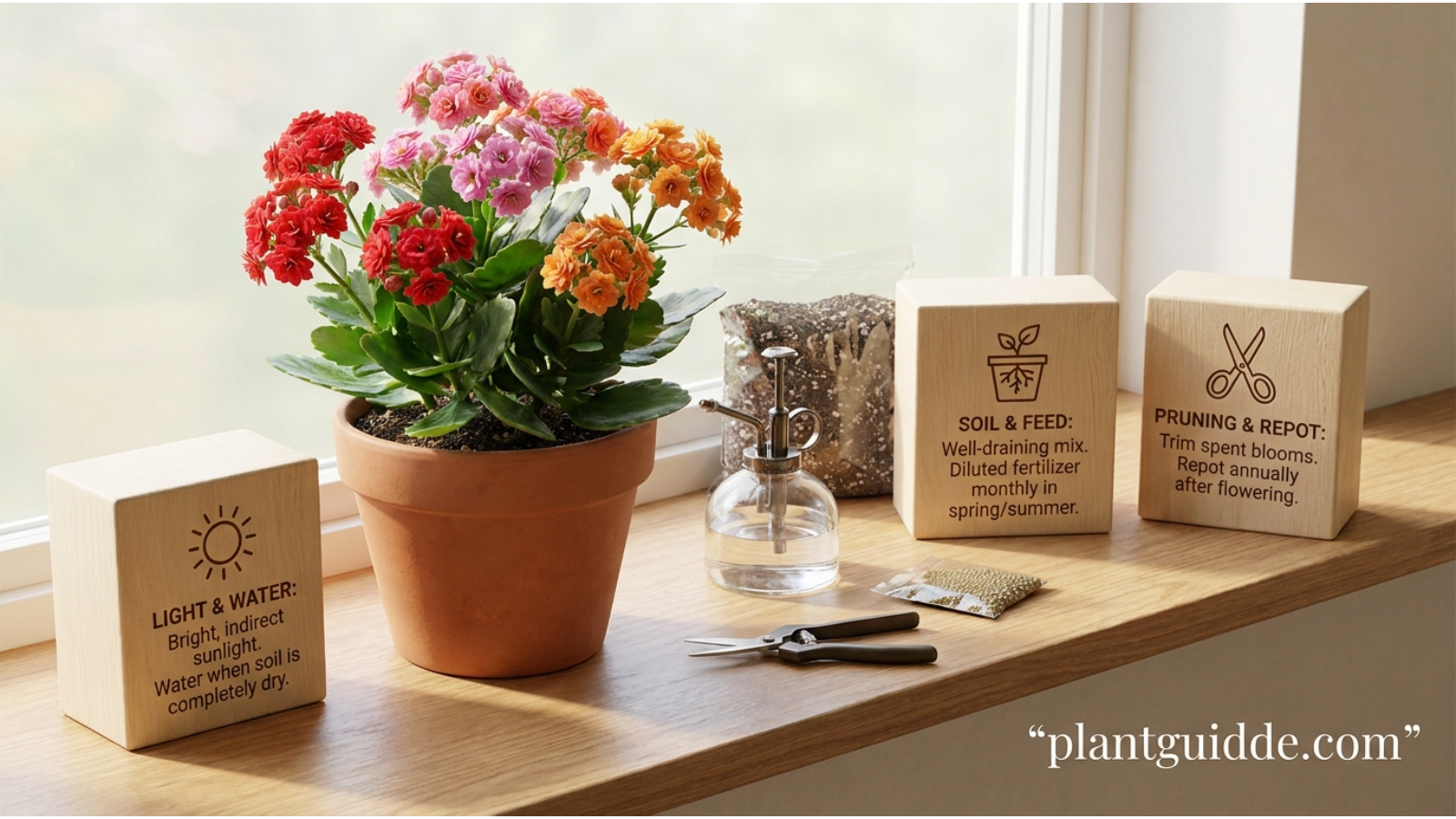
Calandiva Care Cheat Sheet
| Problem | First thing to check | Likely adjustment |
|---|---|---|
| Yellow leaves | Soil moisture | Reduce unnecessary watering |
| Soft leaves | Wet soil | Improve drainage and watering |
| Wrinkled leaves | Soil moisture | Water if genuinely dry |
| Leggy growth | Light | Move to brighter location |
| No flowers | Light and darkness | Improve daytime light and night darkness |
| Brown/crispy patches | Sun and moisture | Check sudden sun exposure and watering |
| Flowers fading quickly | Temperature/light | Provide stable, bright conditions |
| Constantly wet soil | Pot and mix | Repot into better-draining medium |
| Weak new growth | Light/nutrition | Improve light and review feeding |
| Bud drop | Environmental stress | Stabilize light, temperature, and watering |
FAQs:
How often should I water a Calandiva?
Water when the soil has dried sufficiently rather than following a strict schedule. When watering, soak the root zone thoroughly and let excess water drain away. The interval can vary substantially depending on light, temperature, soil, and pot size.
Does Calandiva need direct sunlight?
Calandiva needs bright light and can tolerate significant sunlight, but intense direct afternoon sun can scorch foliage, particularly when the plant has not been acclimated. Bright light with some protection during the harshest part of the day is a practical indoor approach.
Why is my Calandiva not blooming?
Insufficient light and an inadequate dark period are two major factors. Kalanchoe requires long, uninterrupted nights to initiate flowers, commonly around 14 hours of darkness for approximately six weeks under controlled conditions.
Can Calandiva grow indoors?
Yes. Calandiva is particularly well suited to indoor growing when placed in a bright location with well-draining soil and controlled watering.
Should I mist my Calandiva?
Misting isn’t necessary for routine Calandiva care. The plant is a succulent and generally handles average indoor humidity well. Focus on light, drainage, and appropriate watering instead.
Should I cut off dead Calandiva flowers?
Yes. Removing spent flower clusters improves the plant’s appearance and is a useful part of post-flowering maintenance.
Can Calandiva bloom again?
Yes, although reblooming can require more deliberate care than simply keeping the plant alive. Kalanchoe responds to long, uninterrupted nights, so controlling nighttime light is important when encouraging new flower buds.
Is Calandiva a succulent?
Yes. Calandiva belongs to the Kalanchoe blossfeldiana group, and its fleshy leaves are adapted to store water. This is one reason it tolerates drying better than many common tropical houseplants.
Can Calandiva live outside?
It can be grown outdoors in suitable warm conditions, but it should be protected from frost and acclimated gradually when moved from indoor conditions to stronger outdoor light.
Final Thoughts
Successful calandiva plant care isn’t about watering frequently or creating a complicated indoor growing system. It comes down to understanding what this succulent actually needs.
Give it bright light, fast-draining soil, a pot with drainage, and thorough watering only after the growing medium has dried appropriately. Keep temperatures reasonably stable, avoid unnecessary humidity tricks, and remove spent flowers after blooming. If your goal is simply to keep the plant attractive, those fundamentals are usually enough.
If your goal is to make it flower again, pay closer attention to its light cycle. Kalanchoe’s response to long, uninterrupted nights is the key detail that many casual care guides leave out.
And when something goes wrong, don’t treat every symptom as a watering problem. A yellow leaf, wrinkled leaf, leggy stem, and missing flowers can have very different causes.
Observe the soil, light, roots, temperature, and growth pattern before changing anything. That habit will make your Calandiva easier to care for, and will help you diagnose problems before they become serious.

Asad Mumtaz is a dedicated plant enthusiast and gardening writer with a passion for helping people care for their plants successfully. He specializes in plant care guides, indoor gardening, and practical growing tips for all skill levels. His content focuses on making gardening simple, enjoyable, and rewarding. Through his work, Asad shares reliable advice to help readers create thriving green spaces.