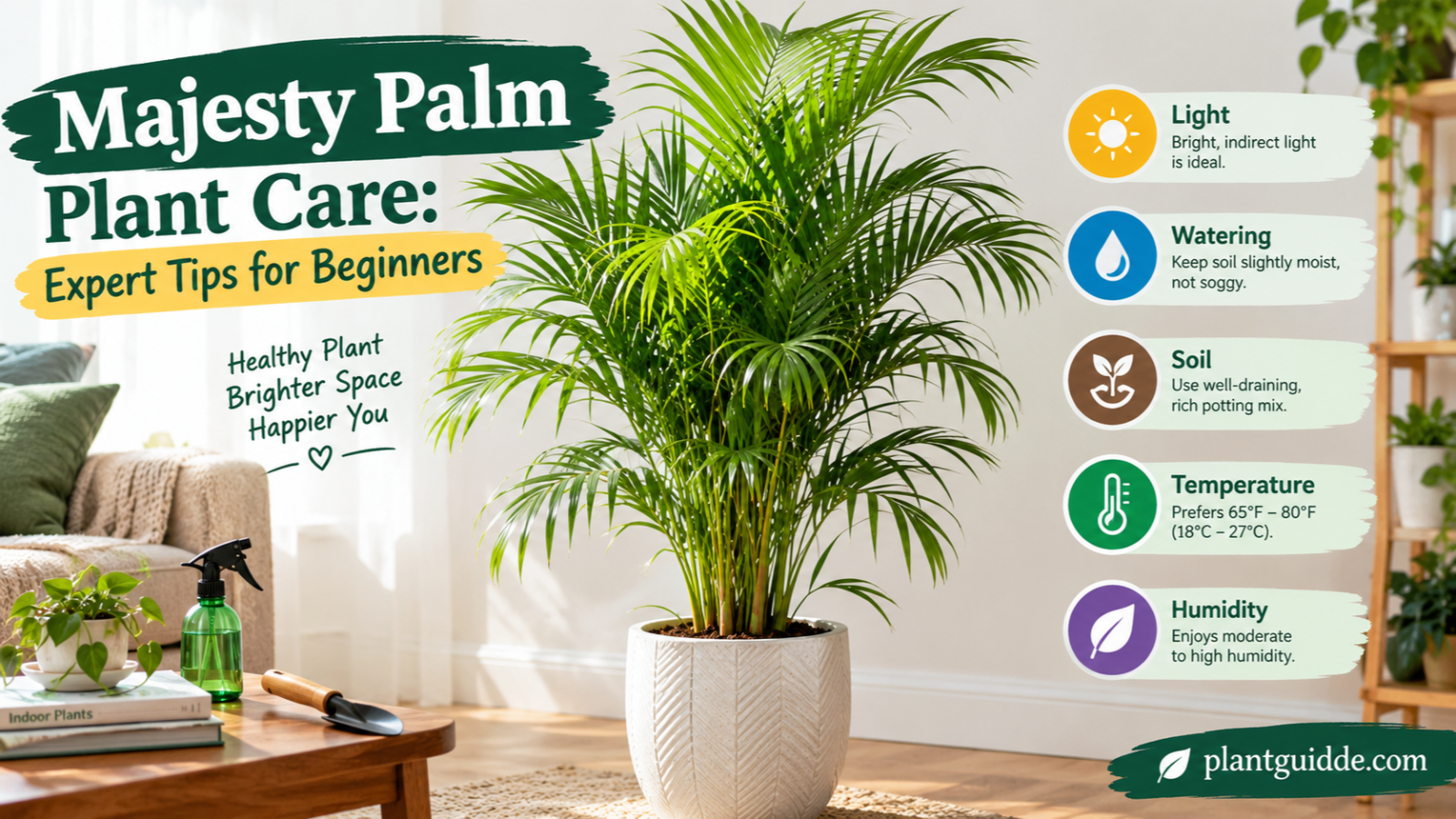
The majesty palm brings an instant tropical feel indoors with its long, arching fronds, graceful trunk, and lush green foliage. majesty palm plant care but keeping that tropical look healthy can be more challenging than it seems.
After moving indoors, majesty palms often develop brown leaf tips, yellow fronds, dry edges, drooping leaves, or slow growth. These problems are usually caused by low humidity, insufficient light, inconsistent watering, or poor root conditions.
The key to successful majesty palm plant care is creating a stable environment that closely meets the plant’s basic needs. Once you understand its light, watering, humidity, and soil requirements, common problems become much easier to prevent and fix.
This guide explains what your majesty palm needs to stay healthy, and how to recognize and correct problems before they get worse.
Quick Answer
Majesty palm plant care is easiest when you provide bright, indirect light, consistently moist but well-draining soil, moderate to high humidity, warm temperatures, and good airflow. Ravenea rivularis naturally grows in moist environments, so it generally needs more regular watering and humidity than drought-tolerant palms. Avoid both bone-dry soil and constantly saturated roots, and give the plant enough light to support healthy, green fronds.
What Is a Majesty Palm?
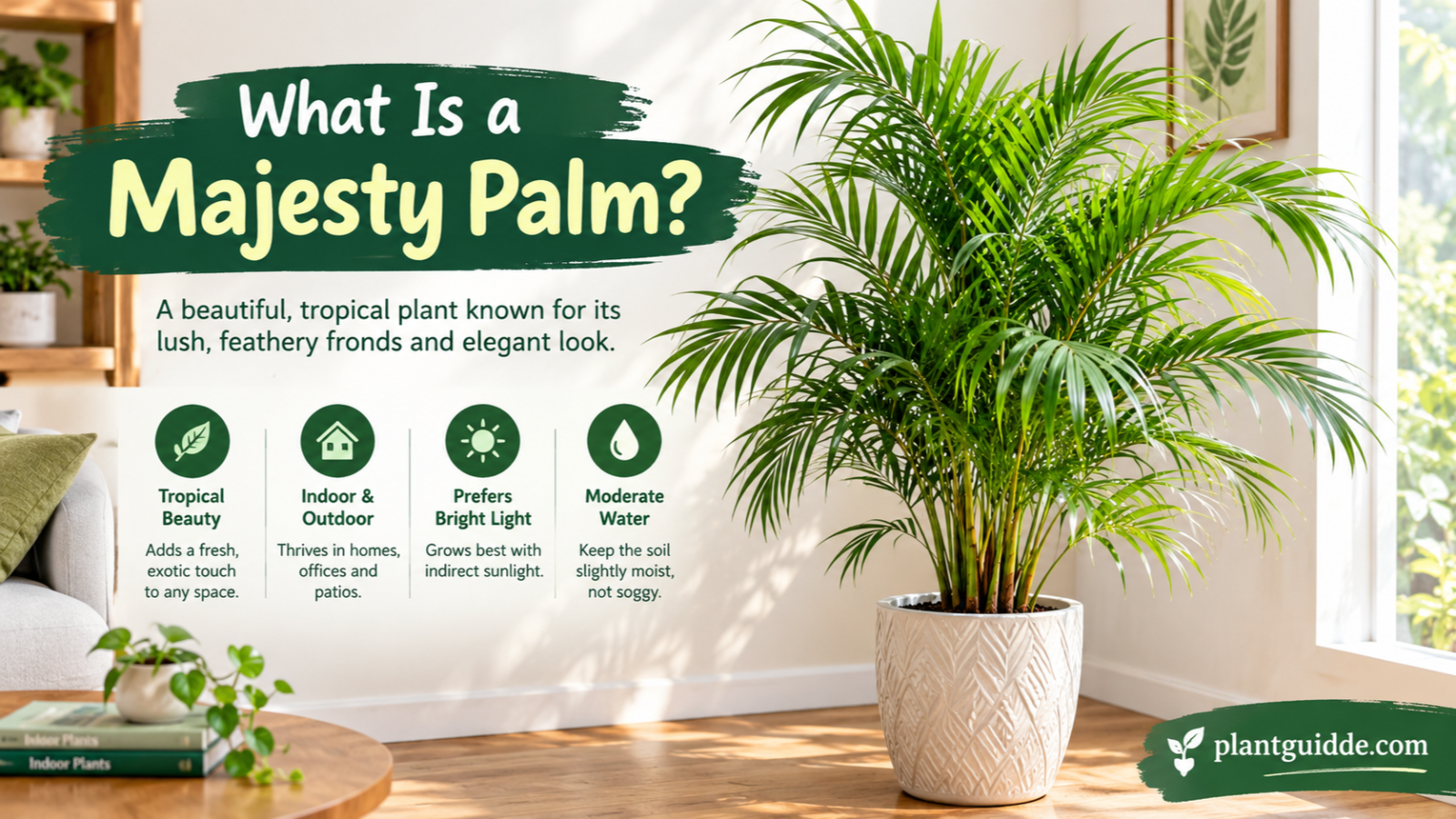
The majesty palm is commonly known by the scientific name Ravenea rivularis. It is a tropical palm native to Madagascar and is associated with moist habitats.
Its naturally moisture-loving growth habit explains an important difference between majesty palms and many popular houseplants: letting the soil become completely dry for long periods is usually not a good long-term strategy.
A healthy majesty palm typically produces long, feather-like fronds from a central growing point. As it matures, it can develop a more substantial trunk and a fuller tropical appearance.
Why Does a Majesty Palm Struggle Indoors?
The biggest indoor challenge is that the plant’s natural preferences can be difficult to reproduce inside a typical home.
Common indoor stress factors include:
- Insufficient light
- Very dry air
- Irregular watering
- Soil that drains too slowly
- Excessive fertilizer
- Cold drafts
- Sudden changes in location
- Poor airflow
- Root problems caused by prolonged saturation
This is why a majesty palm may survive for months while gradually looking worse rather than suddenly dying.
Image Suggestion: A labeled botanical illustration of Ravenea rivularis showing its trunk, fronds, growing point, and root zone.
Majesty Palm Light Requirements
Light is one of the most important factors in successful majesty palm care.
A majesty palm generally performs best in bright, indirect light. It needs considerably more usable light than many people expect from a plant marketed as an indoor palm.
What Does Bright, Indirect Light Mean?
Place the palm near a bright window where it receives plenty of ambient daylight without being exposed to intense, scorching sunlight for hours.
A few feet away from a bright window can work well, depending on the direction of the window, climate, season, and whether anything blocks the light.
Can Majesty Palms Take Direct Sun?
They can tolerate some direct sunlight when gradually acclimated, particularly weaker morning sunlight. However, suddenly placing an indoor-grown palm in intense afternoon sun can cause leaf scorch.
Signs of excessive direct light can include:
- Bleached-looking patches
- Pale or scorched foliage
- Crispy brown areas
- Dry leaf surfaces
At the same time, moving a majesty palm too far from the window can be equally problematic.
Low-light conditions can contribute to:
- Slow growth
- Thin or weak fronds
- Smaller new leaves
- Pale foliage
- Greater difficulty maintaining older fronds
The Practical Test
Majesty palm plant care you are unsure whether the location is bright enough, don’t judge the room by how bright it looks to your eyes. Human vision adapts extremely well to indoor lighting, while plants respond to the actual amount of usable light reaching their leaves.
A palm sitting in a dim corner may look attractive initially but struggle over time.
Expert Tip: If your home has limited natural light, a suitable grow light can make majesty palm care much more manageable. Keep the light positioned according to the manufacturer’s recommended distance rather than assuming closer is always better.
Image Suggestion: Diagram comparing a majesty palm in a bright window, a moderately lit interior position, and a dark corner.
How Often Should You Water a Majesty Palm?
There is no reliable universal watering schedule for a majesty palm.
Instead of watering every fixed number of days, check the soil moisture and the plant’s environment.
A majesty palm generally prefers soil that remains evenly moist but not waterlogged.
The Right Watering Method
- Check the upper portion of the soil with your finger or a moisture meter.
- If the surface has started to dry but the root zone is still reasonably moist, monitor it rather than automatically watering.
- When the plant needs water, water thoroughly until excess moisture drains from the bottom of the pot.
- Empty excess water collected in a saucer or decorative container.
- Check the soil again before the next watering.
The objective is to rehydrate the root ball thoroughly without leaving the roots sitting in stagnant water.
Why Overwatering Happens
Many people hear that majesty palms like moisture and interpret that as “keep the soil wet.”
That is a mistake.
Moist soil and saturated soil are not the same thing.
Roots require oxygen as well as water. When a poorly draining pot remains saturated, air spaces in the growing medium can become limited, creating conditions that can contribute to root damage.
Why Underwatering Also Causes Problems
A palm that repeatedly becomes extremely dry can develop:
- Brown tips
- Crispy leaf margins
- Curling foliage
- Drooping
- Premature loss of older fronds
Severe or repeated drying can be particularly stressful for a plant that prefers consistent moisture.
Expert Tip: Pay attention to the speed at which the soil dries. A majesty palm in a small pot near a bright, warm window may need water much more frequently than one in a larger container in a cooler room.
Majesty Palm Soil Requirements
Good majesty palm soil needs to perform two jobs at the same time:
Hold enough moisture for the palm while allowing excess water and air to move through the root zone.
A basic indoor palm mix can be improved by combining:
- Quality indoor potting mix
- A moisture-retentive component such as coco coir
- An aerating component such as perlite, pumice, or coarse material
The exact recipe is less important than the resulting structure.
What Good Soil Should Feel Like
After watering, the mix should absorb moisture rather than immediately repel it, while excess water should still drain freely.
After several days, the soil should not remain a heavy, muddy mass.
Avoid Extremely Dense Soil
Heavy garden soil or compacted potting mix can create a difficult root environment in containers.
Majesty palm plant care water takes a long time to drain and the soil remains wet for an unusually long period, don’t automatically conclude that the plant needs less water.
The real problem may be the growing medium or container drainage.
Humidity: One of the Most Important Majesty Palm Care Factors
Majesty palm plant care your majesty palm repeatedly develops brown tips and crispy edges, humidity deserves serious attention.
Majesty palms naturally come from a moist environment, while many homes have relatively dry air, particularly when heating or air conditioning is running.
Signs That Dry Air May Be Contributing
Look for:
- Brown leaf tips
- Crispy margins
- Dry-looking new growth
- Curling leaflets
- Increased sensitivity after watering
- Fronds that look dull rather than lush
Humidity is not always the only cause of these symptoms. Salt accumulation, inconsistent watering, root stress, and excessive fertilizer can produce similar problems.
How to Increase Humidity
Practical options include:
- Running a humidifier near the plant
- Grouping compatible plants together
- Moving the palm away from strong heating or cooling vents
- Keeping it in a naturally more humid room when light is adequate
- Monitoring indoor humidity with a hygrometer
A humidifier is generally more predictable than occasional misting.
Does Misting Fix Brown Tips?
Usually, misting should not be treated as a complete humidity solution.
The moisture from misting evaporates relatively quickly, and it does not necessarily raise the surrounding humidity for long enough to change the plant’s growing environment.
Majesty palm plant care dry air is a persistent problem, changing the ambient environment is more useful than repeatedly spraying the leaves.
Image Suggestion: Infographic showing three approaches to humidity: humidifier, plant grouping, and dry heating vent, ith a clear “best long-term approach” comparison.
Temperature and Airflow
Majesty palms prefer warm, stable conditions.
Avoid placing the plant directly beside:
- Cold drafts
- Frequently opened exterior doors
- Strong heating vents
- Air-conditioning outlets
- Very hot radiators
Sudden temperature fluctuations can stress the foliage even when the average room temperature seems acceptable.
Why Airflow Matters
Humidity and airflow need to be balanced.
Very dry, forceful airflow can increase moisture loss from leaves. On the other hand, stagnant, overly humid air can create an environment where foliage stays wet for too long.
Gentle air movement is preferable to strong air blowing directly across the plant.
Fertilizing a Majesty Palm
Majesty palms can benefit from regular feeding during active growth, but fertilizer should support healthy conditions rather than compensate for poor light or damaged roots.
Use a balanced fertilizer formulated for indoor or tropical foliage plants according to the product’s directions.
Avoid the “More Fertilizer = More Growth” Trap
Overfertilizing can cause problems such as:
- Salt accumulation in the soil
- Brown leaf margins
- Root stress
- Nutrient imbalance
A struggling palm does not necessarily need more fertilizer.
Majesty palm plant care the plant has poor light, damaged roots, or inconsistent watering, correcting those conditions should come first.
A Frequently Overlooked Issue: Fertilizer Salts
Majesty palm plant care you regularly fertilize a container plant but rarely allow the potting medium to be thoroughly flushed with water, soluble salts can accumulate.
When appropriate for the pot and soil structure, periodically watering thoroughly enough for substantial drainage can help move accumulated soluble salts out of the growing medium.
Repotting a Majesty Palm
Majesty palms do not need to be repotted simply because you have owned them for a certain amount of time.
Instead, look for signs that the current container or root environment has become limiting.
Signs It May Need Repotting
Consider inspecting the roots if:
- Roots are densely circling the container
- The root ball dries unusually quickly
- Water runs straight through without wetting the soil
- Growth has slowed despite good light and appropriate care
- The container has become unstable because of the plant’s size
- The potting mix has broken down or become compacted
Don’t Automatically Choose a Huge Pot
A dramatically oversized container can hold more wet soil around the roots for longer periods.
When repotting, generally choose a container only moderately larger than the existing root system and make sure it has proper drainage.
Expert Tip: If the plant is already stressed, avoid combining every possible intervention at once. Repotting, moving it to a different window, dramatically changing watering, and adding fertilizer simultaneously can make it difficult to determine what actually helped.
Why Are My Majesty Palm Leaves Turning Brown?
Brown leaves are among the most common reasons people search for majesty palm plant care.
But “brown leaves” is a symptom, not a diagnosis.
The location and pattern of the browning provide useful clues.
| Symptom | Possible Cause | What to Check First |
|---|---|---|
| Brown tips | Dry air, inconsistent moisture, salt buildup | Humidity and watering consistency |
| Crispy brown edges | Dry conditions or excessive moisture loss | Humidity, drafts, soil moisture |
| Yellow lower fronds | Natural aging or root/watering stress | Whether only older leaves are affected |
| Widespread yellowing | Excess moisture, root problems, nutrient issues | Soil drainage and root condition |
| Pale foliage | Insufficient light or nutritional issues | Light level first |
| Curling leaflets | Dryness, heat, low humidity, stress | Soil and surrounding air |
| Sudden decline | Root damage or environmental shock | Roots, soil, temperature, recent changes |
Should You Cut Off Brown Leaves?
You can remove severely damaged fronds, but pruning will not correct the underlying cause.
If only the tips are brown, you can trim the damaged portions for appearance. Follow the natural shape of the leaf rather than cutting healthy green tissue unnecessarily.
If an entire frond has become yellow or brown and is clearly declining, removing it can improve the plant’s appearance and redirect attention toward healthier growth.
Why Is My Majesty Palm Turning Yellow?
Yellowing can have several causes, so look at the whole plant and its soil before changing your routine.
If Only Older Fronds Are Yellow
Some yellowing of older foliage can be part of the normal aging process.
However, if yellowing is widespread or happening rapidly, investigate further.
If Many Fronds Are Yellow
Check:
- How wet the soil remains after watering.
- Whether the container has functional drainage holes.
- Whether the plant is receiving enough light.
- Whether the roots smell unpleasant or appear unhealthy.
- Whether fertilizer has been used excessively.
- Whether the plant recently experienced a major environmental change.
One of the most common mistakes is responding to yellow leaves by immediately adding more fertilizer.
Yellowing does not automatically mean a nutrient deficiency.
Majesty Palm Leaves Curling: What Does It Mean?
Curling leaves often indicate that the plant is under environmental stress.
Possible contributors include:
- Soil becoming too dry
- Low humidity
- Excessive heat
- Strong direct sunlight
- Root problems
- Sudden environmental changes
Check the soil before watering. If it is extremely dry, water thoroughly rather than giving the plant a small splash.
If the soil is already very wet, adding more water can make the problem worse.
This simple check prevents one of the most common houseplant-care mistakes: treating every wilted or curled leaf as a sign of thirst.
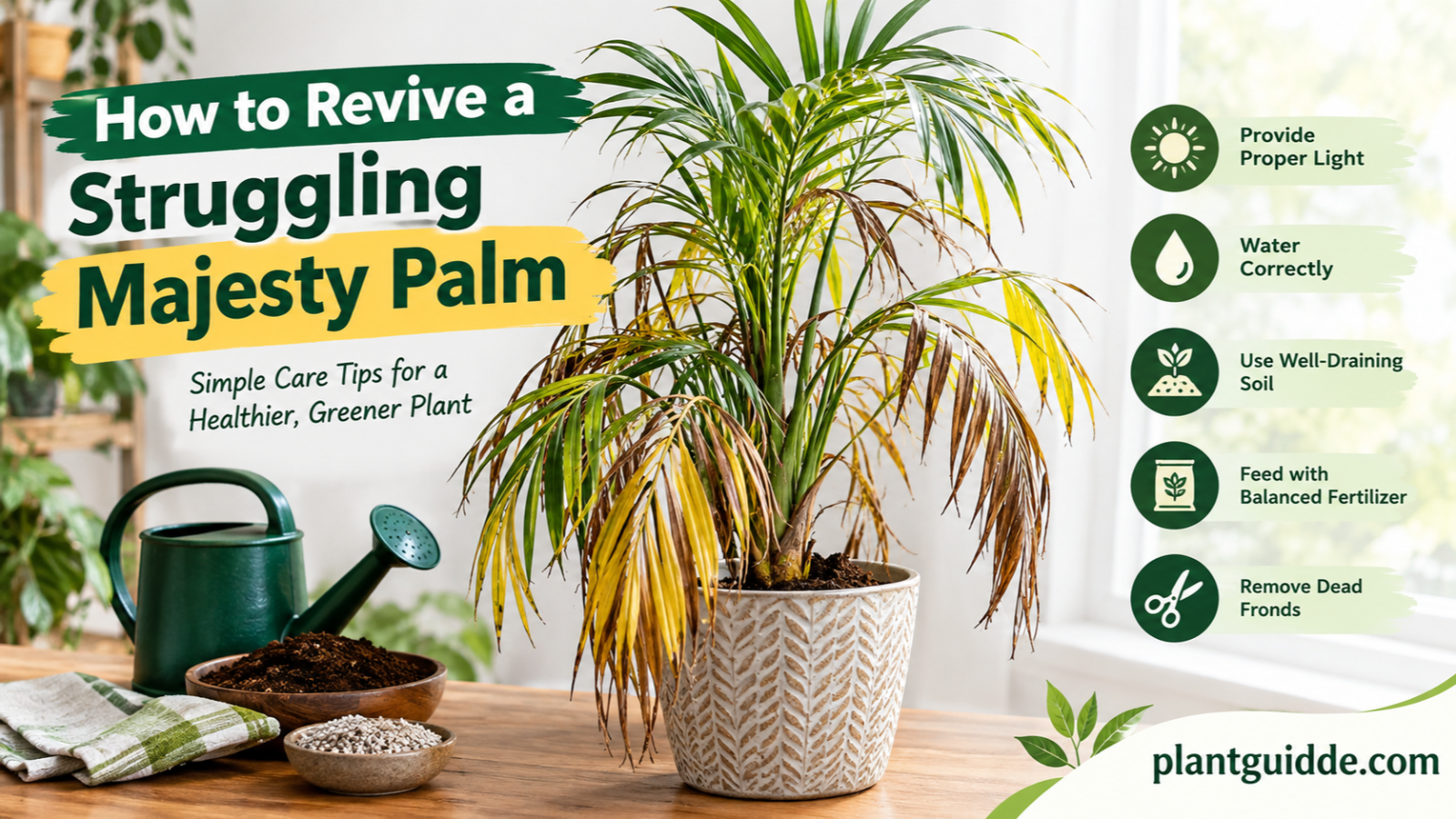
How to Revive a Struggling Majesty Palm
There is no single “revival trick.” The best approach is to diagnose the environment systematically.
Step 1: Check the Soil
Determine whether the root zone is:
- Bone dry
- Moderately moist
- Constantly wet
This immediately narrows down several possible causes.
Step 2: Inspect Drainage
Make sure the container has drainage holes and that water can actually escape.
If the pot sits inside a decorative cachepot, check whether water is accumulating at the bottom.
Step 3: Evaluate Light
Move the palm toward a brighter location if it is sitting in a dim room.
Make environmental changes gradually when possible, particularly if the plant has been growing in low light.
Step 4: Check Humidity
If the leaves are repeatedly developing crispy tips, measure the humidity rather than relying on how the room feels.
Step 5: Look for Pests
Inspect both sides of the leaflets and areas around the central growth.
Spider mites and other pests can become more problematic when indoor conditions are stressful.
Look for:
- Fine webbing
- Tiny moving dots
- Speckled or stippled foliage
- Sticky residue
- Unusual discoloration
Step 6: Inspect the Roots When Necessary
If the plant continues declining despite reasonable care, inspect the root system.
Healthy roots should generally be firm rather than mushy and should not have a strong rotting odor.
If there is significant root damage, remove compromised material with clean tools and repot into an appropriate, well-draining medium.
A Simple Majesty Palm Care Routine
For beginners, a repeatable routine is often more useful than memorizing dozens of rules.
Weekly Check
Once a week, inspect:
- Soil moisture
- Leaf color
- Brown tips
- New growth
- Pests
- Humidity
- General posture of the fronds
You may not need to water every week. The purpose of the weekly check is observation, not automatic watering.
Monthly Check
Look at:
- Drainage
- Soil condition
- Pest activity
- Overall growth
- Position relative to the window
- Whether the palm is becoming root-bound
Seasonal Adjustment
As light, temperature, humidity, and indoor heating or cooling change, watering frequency may also change.
A plant that needs frequent watering during bright summer growth may use considerably less water during a darker, cooler period.
Majesty Palm Care by Season
Spring and Summer
During brighter, warmer months, the plant may actively grow and use water more quickly.
Pay particular attention to:
- Soil moisture
- Bright but suitable light
- Humidity
- Fertilizer needs during active growth
- Pest activity
Avoid assuming that warmer weather means the plant should remain constantly wet.
Fall and Winter
Indoor conditions often change dramatically.
Heating systems can reduce humidity, while shorter days can reduce available light.
At the same time, cooler temperatures and lower light may slow water use.
This creates a dangerous combination: dry indoor air but slower soil drying.
Therefore, don’t simply increase watering because the leaves look dry. Check the soil and consider humidity separately.
Common Majesty Palm Care Mistakes
1. Keeping the Soil Permanently Wet
Majesty palms like moisture, but roots still need oxygen.
Better approach: Use a well-draining medium and water thoroughly when appropriate.
2. Letting the Plant Become Bone Dry
Repeated severe drying can lead to crispy tips, curling, and stress.
Better approach: Aim for consistent moisture rather than extreme wet-to-dry cycles.
3. Keeping It in a Dark Corner
A majesty palm can survive for some time in poor light while gradually declining.
Better approach: Give it a bright indoor position with suitable indirect light.
4. Assuming Brown Tips Always Mean Underwatering
Brown tips can also be related to dry air, salts, root stress, or environmental conditions.
Better approach: Diagnose the entire environment.
5. Relying on Misting Alone
Misting is not a substitute for maintaining appropriate ambient humidity.
Better approach: Use a humidifier or otherwise improve the surrounding environment when humidity is consistently low.
6. Fertilizing a Sick Plant
Fertilizer does not repair damaged roots or compensate for poor lighting.
Better approach: Stabilize the growing conditions first.
7. Moving the Palm Too Frequently
Constantly changing its location can introduce repeated changes in light, temperature, and humidity.
Better approach: Find a suitable location and allow the plant time to adjust.
Indoor Majesty Palm vs. Other Easy Houseplants
Majesty palms are attractive, but they are not always the easiest choice for beginners.
| Plant | Watering Tolerance | Light Tolerance | Humidity Preference | Beginner Difficulty |
|---|---|---|---|---|
| Majesty palm | Moderate | Moderate to bright | Higher | Moderate |
| Snake plant | High drought tolerance | Low to bright | Low to moderate | Easy |
| ZZ plant | High drought tolerance | Low to bright | Low to moderate | Easy |
| Pothos | Moderate | Low to bright | Moderate | Easy |
| Areca palm | Moderate | Bright indirect | Moderate to high | Moderate |
If your priority is a dramatic tropical appearance and you can provide adequate light and humidity, a majesty palm can be rewarding.
If you frequently forget to water or your home is naturally dry and dim, a more drought-tolerant houseplant may be a better fit.
How to Make a Majesty Palm Look Fuller
A majesty palm naturally develops its characteristic arching form, but its appearance depends heavily on light and overall health.
To encourage attractive growth:
- Provide adequate light.
- Maintain consistent soil moisture.
- Avoid severe environmental fluctuations.
- Keep humidity reasonable.
- Rotate the container occasionally if the plant is leaning toward the light.
- Remove completely dead fronds when appropriate.
Don’t expect pruning to create new branches like it would with some shrubs. Palms have a different growth pattern, with new foliage emerging from the central growing point.
Important: Never cut the central growing point simply to make the palm shorter. Damage to the growing point can seriously harm the plant.
Pest Problems to Watch For
Majesty palms can experience common indoor plant pests, particularly when growing conditions are stressful.
Spider Mites
These tiny pests can cause stippled or dull foliage and may produce fine webbing.
Dry indoor conditions can make spider mite problems particularly troublesome.
Scale
Scale insects can appear as small, fixed bumps on stems or foliage.
Mealybugs
These may appear as small, cottony clusters around leaf bases or other protected areas.
What to Do
Early detection is much easier than dealing with a severe infestation.
Inspect the plant regularly, isolate an affected plant from other houseplants when practical, and use an appropriate treatment according to the pest and product label.
When Should You Move or Repot a Majesty Palm?
Not every problem requires repotting.
Before disturbing the roots, ask:
Is the problem actually occurring below the soil?
If the plant has brown tips but the soil drains normally, roots look healthy, and the main issue is very dry indoor air, repotting may accomplish very little.
Likewise, a palm in a dim location will not suddenly become healthy because it receives fresh potting soil.
Repot when the root environment is the problem—not simply because the foliage looks imperfect.
This distinction can prevent unnecessary stress.
Image Suggestion: Side-by-side visual showing a healthy majesty palm root ball, a severely root-bound root ball, and roots affected by excessive moisture.
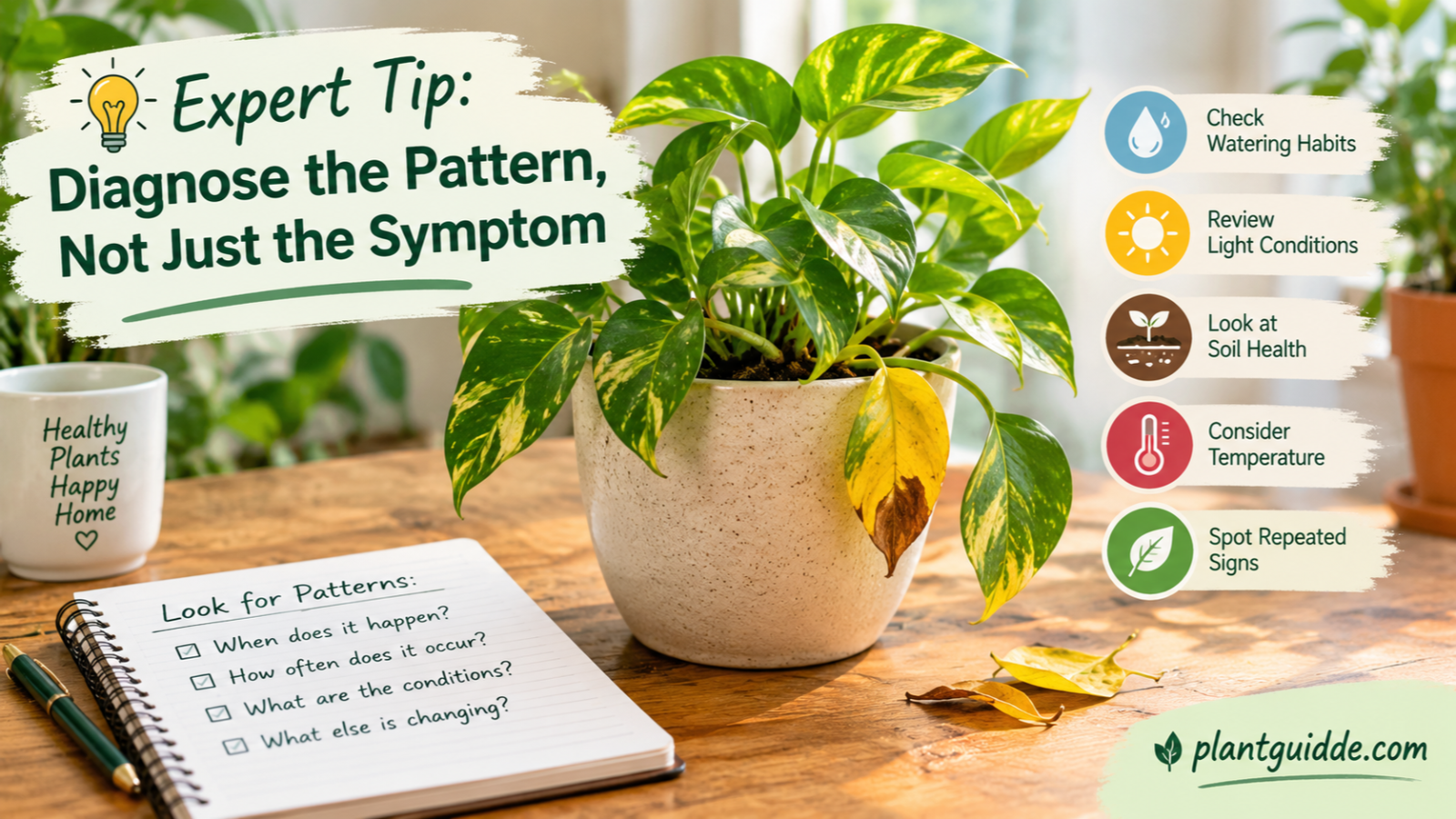
Expert Tip: Diagnose the Pattern, Not Just the Symptom
One of the most useful habits in plant care is learning to look for patterns.
For example:
Brown tips + very dry soil + dry indoor air
→ Investigate moisture consistency and humidity.
Yellow leaves + soil remaining wet for a long time
→ Investigate drainage and root health.
Pale growth + dark room
→ Investigate light before adding fertilizer.
Curling leaves + dry soil + hot airflow
→ Investigate moisture loss and the surrounding environment.
Decline shortly after repotting
→ Consider root disturbance, new soil moisture behavior, and changes in light or location.
This approach is much more reliable than searching for a single “best fertilizer” or “best watering schedule.”
FAQs:
Is a majesty palm easy to care for indoors?
It can be grown indoors successfully, but it is generally more demanding than highly drought-tolerant houseplants. Bright light, consistent moisture, and adequate humidity are especially important.
How much light does a majesty palm need?
Bright, indirect light is generally a good starting point. It can tolerate some direct sunlight when properly acclimated, but sudden exposure to intense sunlight can scorch indoor-grown foliage.
How often should I water my majesty palm?
Water when the soil has begun to dry appropriately rather than following a rigid calendar. Water thoroughly and allow excess water to drain. The frequency depends on light, temperature, humidity, pot size, and soil composition.
Why does my majesty palm have brown tips?
Brown tips can result from low humidity, inconsistent watering, excessive drying, salt accumulation, root stress, or other environmental factors. Check the soil and growing conditions before assuming the plant simply needs more water.
Can a majesty palm grow in low light?
It may tolerate lower light temporarily, but sustained low light is usually not ideal for vigorous growth. A brighter location is generally preferable.
Does a majesty palm need high humidity?
It generally performs better with moderate to high humidity than in very dry indoor air. If brown, crispy tips persist, measure the room’s humidity and consider improving the surrounding environment.
Can I put my majesty palm outside?
In suitable warm conditions, a majesty palm can benefit from outdoor conditions, but an indoor-grown plant should be acclimated gradually. Sudden exposure to intense sun, wind, or temperature changes can damage foliage.
Should I mist my majesty palm?
Misting can temporarily wet the foliage, but it is not a dependable long-term solution for low ambient humidity. A humidifier is generally more effective when the surrounding air is consistently dry.
Why is my majesty palm drooping?
Drooping can occur because of underwatering, root problems, temperature stress, low humidity, insufficient light, or other environmental issues. Check the soil first rather than assuming drooping automatically means thirst.
Can I cut brown leaves off my majesty palm?
Yes. Severely damaged or dead fronds can be removed. Brown tips can also be trimmed for appearance, but pruning will not prevent new damage unless the underlying cause is corrected.
How do I know if my majesty palm is dying?
A severely declining palm may show widespread yellowing or browning, persistent wilting, extensive leaf loss, weak new growth, or root deterioration. Before giving up on it, inspect its soil, roots, light, humidity, temperature, and pest situation.
A Practical Majesty Palm Care Checklist
Use this quick checklist when evaluating your plant:
Light
- Bright indoor location
- Plenty of indirect daylight
- Avoid sudden exposure to intense direct sun
Water
- Keep moisture relatively consistent
- Don’t allow prolonged saturation
- Don’t repeatedly let the root ball become completely dry
Soil
- Moisture-retentive but well draining
- Good aeration
- Container must have drainage holes
Humidity
- Avoid extremely dry air
- Monitor humidity when brown tips persist
- Keep away from strong heating or cooling airflow
Temperature
- Warm and relatively stable
- Avoid cold drafts and sudden temperature changes
Feeding
- Fertilize during appropriate active growth periods
- Follow product directions
- Don’t use fertilizer as a cure for environmental stress
Maintenance
- Inspect regularly for pests
- Remove dead foliage
- Check drainage
- Watch new growth for clues
Related Plant Care Topics
If you are building a tropical indoor plant collection, these topics are also useful:
- How to care for a prayer plant
- Snake plant care for beginners
- Golden pothos plant care
- ZZ plant care indoors
- Peace lily watering and light requirements
- How to increase humidity for indoor plants
Conclusion
Successful majesty palm plant care comes down to consistency rather than complicated techniques.
Give Ravenea rivularis enough bright light, keep its soil reasonably moist without creating a permanently saturated root zone, provide suitable humidity, maintain warm and stable conditions, and pay attention to changes in the foliage.
Most importantly, don’t diagnose the plant from one symptom alone. Brown tips do not automatically mean underwatering, yellow leaves do not automatically mean fertilizer deficiency, and drooping does not always mean the plant needs another drink.
Look at the soil, roots, light, humidity, temperature, and recent changes together. Once you learn to read those clues, a majesty palm becomes much easier to understand,and much more likely to stay lush and healthy indoors.

Asad Mumtaz is a dedicated plant enthusiast and gardening writer with a passion for helping people care for their plants successfully. He specializes in plant care guides, indoor gardening, and practical growing tips for all skill levels. His content focuses on making gardening simple, enjoyable, and rewarding. Through his work, Asad shares reliable advice to help readers create thriving green spaces.