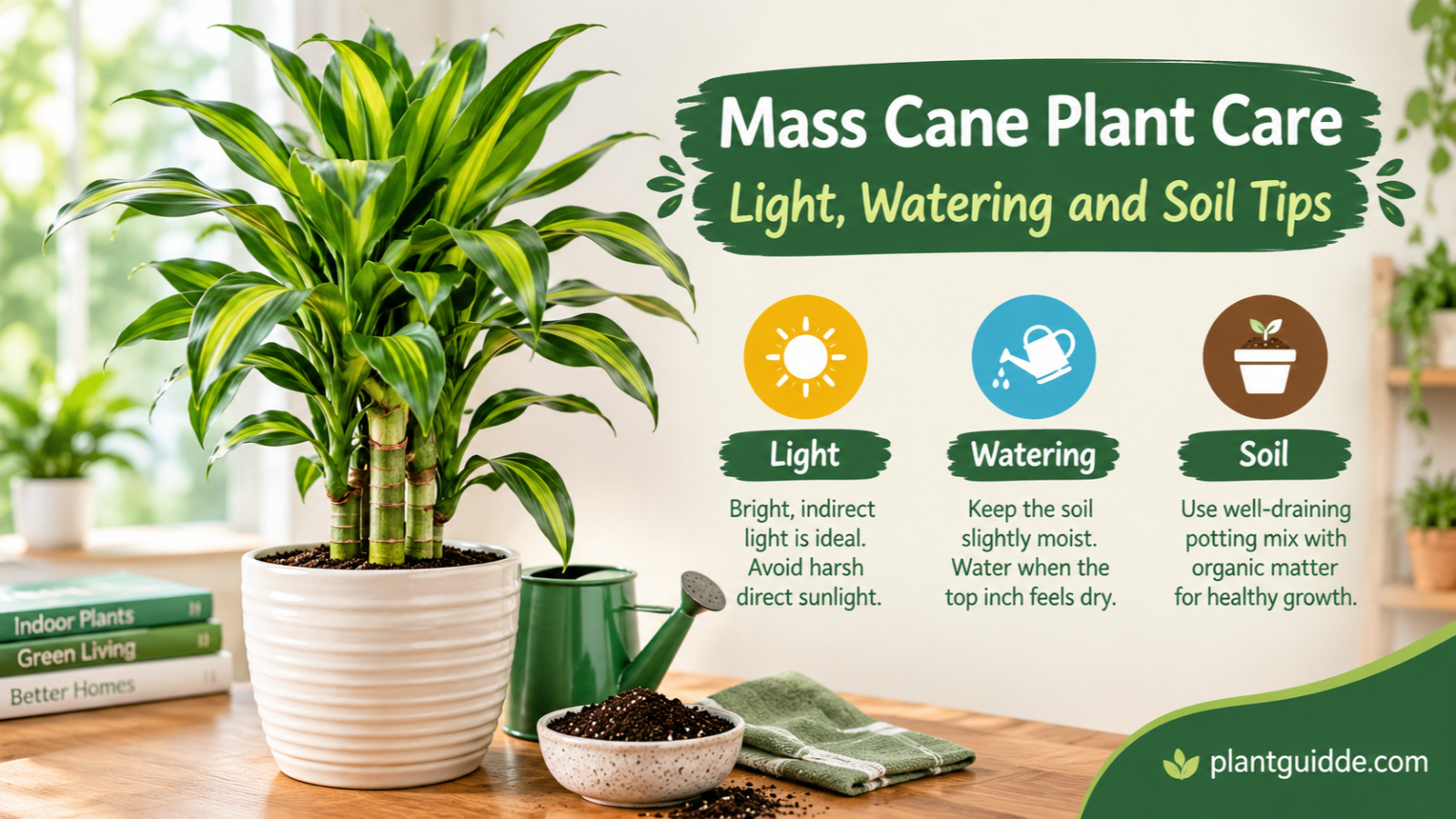
The Mass Cane plant is loved for its tall, tropical appearance and easygoing nature. mass cane plant care Its thick cane-like stems and long, arching leaves make it a striking choice for corners, offices, entryways, and other indoor spaces.
However, even this low-maintenance plant can develop yellow leaves, brown tips, drooping foliage, or slow growth when its environment is not right. The key to successful mass cane plant care is finding the right balance of light, watering, drainage, temperature, and humidity, not simply giving it more water or placing it in the brightest window.
Commonly known as the Mass Cane or Corn Plant, Dracaena fragrans ‘Massangeana’ is a tropical evergreen recognized by its long, strap-shaped leaves with a yellow-green stripe.
In this guide, you’ll learn how to water, place, prune, and repot a Mass Cane, along with simple ways to identify and fix common problems before they become serious.
Quick Answer
Mass cane plant care is mainly about providing bright, indirect light, well-draining soil, moderate watering, warmth, and reasonable humidity. The Mass Cane, usually sold as Dracaena fragrans ‘Massangeana’, tolerates lower light but grows better with brighter filtered light. Allow the soil to partially dry before watering, and never leave the roots sitting in water.
What Is a Mass Cane Plant?
Mass Cane is a common name for Dracaena fragrans ‘Massangeana’, also known as the Corn Plant or Cornstalk Plant.
It belongs to the Dracaena group and is native to tropical Africa. Mature plants develop woody stems or canes with rosettes of long, arching leaves at the top. The ‘Massangeana’ form is especially recognizable because of its yellow-green stripe running through the center of each leaf.
Despite its tropical appearance, it is relatively forgiving indoors.
That does not mean it can survive anything, however. Its biggest indoor enemies are usually:
- Constantly wet soil
- Poor drainage
- Very low light combined with frequent watering
- Harsh direct sunlight
- Cold drafts
- Sudden environmental changes
- Mineral or fluoride buildup from unsuitable water
Image Suggestion: Close-up botanical image of a healthy Mass Cane showing its striped leaves, woody canes, and overall growth habit.
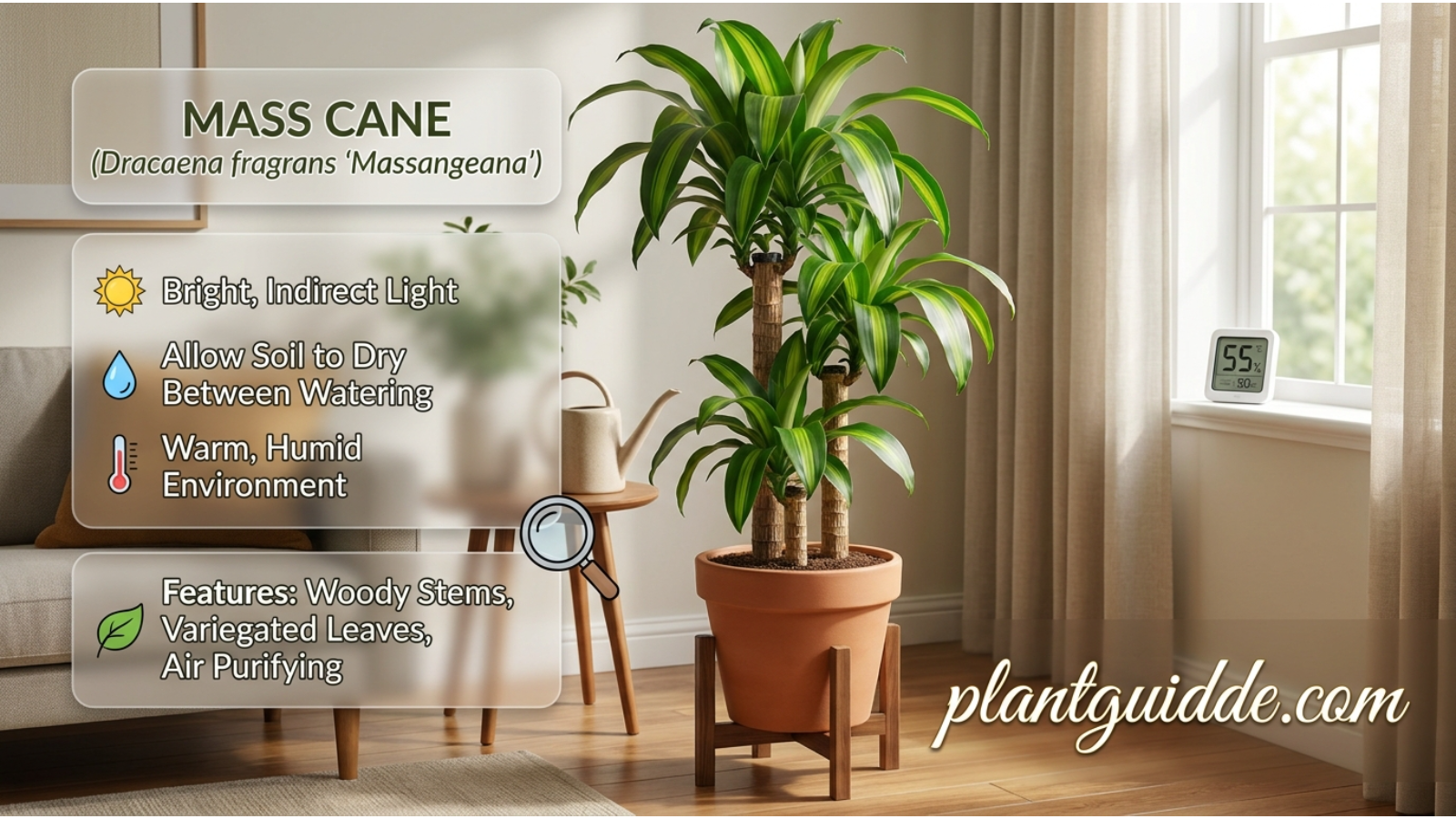
Mass Cane Plant Care Requirements at a Glance
| Care factor | What your Mass Cane needs |
|---|---|
| Light | Bright, indirect light is ideal |
| Low light | Tolerated, but growth may become slower |
| Water | Moderate; allow some soil to dry between waterings |
| Soil | Loose, well-draining potting mix |
| Humidity | Moderate to moderately high humidity is beneficial |
| Temperature | Warm, stable indoor conditions |
| Fertilizer | Balanced fertilizer during active growth |
| Repotting | When roots become crowded or soil drainage declines |
| Pruning | Remove damaged growth or shorten weak/tall canes |
| Pet safety | Toxic if eaten by cats and dogs |
RHS guidance for Dracaena fragrans recommends full light with protection from hot sun, moderate watering during active growth, and less watering during winter. Its broader Dracaena guidance also emphasizes warmth, indirect light, and protection from cold drafts.
Give Your Mass Cane the Right Light
Light is one of the most important parts of Mass Cane plant care.
The ideal location is usually bright, indirect light. An east- or west-facing window can work well, while a south-facing location may need a sheer curtain to reduce intense direct sunlight.
Mass Cane can tolerate lower light, which is one reason it performs well in offices and rooms that are not extremely bright. However, tolerance is not the same as preference.
In very low light, you may notice:
- Slower growth
- Smaller or less vigorous new leaves
- Weaker-looking foliage
- Soil staying wet for longer
- More problems when the plant is watered too frequently
On the other hand, intense direct sunlight through glass can scorch the leaves.
A useful rule
If the room feels comfortably bright but the plant is not receiving strong, hot afternoon sun directly on its leaves, the location may be suitable.
If you are moving a Mass Cane from a dim room to a much brighter location, do it gradually rather than suddenly exposing it to intense sunlight.
Image Suggestion: Diagram showing three Mass Cane locations: ideal bright indirect light, acceptable lower light, and excessive direct sun.
How Often Should You Water a Mass Cane?
There is no reliable calendar such as “water every seven days.”
The better approach is to check the soil before watering.
Mass Cane stores some moisture in its thick stems, so it generally does not appreciate constantly saturated soil. Watering too often can leave the roots in an oxygen-poor environment and eventually contribute to root problems.
How to water correctly
- Check the upper portion of the soil with your finger.
- If it is still noticeably wet, wait.
- When the soil has partially dried, water thoroughly.
- Allow excess water to drain from the bottom of the pot.
- Empty any standing water collected in the saucer or decorative container.
The exact interval depends on your plant’s environment.
A Mass Cane in bright light, warm temperatures, and a small pot may dry considerably faster than one sitting in a cool, dim room.
The most common beginner mistake
A beginner sees a drooping leaf and assumes the plant needs water.
But drooping can occur for different reasons, including overwatering, root stress, underwatering, temperature stress, or poor light.
Always check the soil before reaching for the watering can.
RHS recommends moderate watering for Dracaena fragrans during active growth and sparing watering during winter.
Use Well-Draining Soil
Mass Cane does not need heavy, constantly wet soil.
A good indoor potting mix should retain enough moisture for the roots while allowing excess water to escape.
A practical mix can include:
- Quality indoor potting mix
- Perlite or pumice for additional aeration
- A small amount of coarse material such as orchid bark if the existing mix is particularly dense
The goal is not to create extremely dry soil. The goal is to prevent the root zone from remaining saturated for long periods.
Why drainage matters
Consider two plants receiving the same amount of water.
One is planted in an airy mix inside a pot with drainage holes.
The other is planted in dense, poorly draining soil inside a container with no drainage.
The second plant can develop root problems much sooner—even though both received the same amount of water.
Good watering cannot compensate for poor drainage.
Choose a Pot With Drainage Holes
A decorative container can make a Mass Cane look attractive, but it should not trap excess water around the roots.
Your main growing pot should have drainage holes.
If you use a decorative cachepot without drainage, remove the plant’s nursery pot when watering and allow excess water to drain before putting it back.
When is the pot too large?
Avoid automatically moving a Mass Cane into a huge container.
An oversized pot holds more unused soil, which can stay wet for longer after watering. A modest increase in pot size is usually more sensible when repotting.
Keep Temperatures Warm and Stable
Mass Cane is a tropical plant and performs best in warm indoor conditions.
RHS recommends keeping Dracaena plants in consistently warm conditions, with a general range of about 18–30°C (65–86°F) for best growth. Cold drafts and sudden temperature changes can cause stress.
Keep your plant away from:
- Cold exterior doors
- Drafty windows during cold weather
- Strong air-conditioning vents
- Heating vents
- Radiators
- Sudden temperature swings
A warm room with stable conditions is generally more suitable than a location that repeatedly swings from hot to cold.
Does Mass Cane Need High Humidity?
Mass Cane can tolerate ordinary indoor conditions, but it generally appreciates moderate humidity.
Very dry air may contribute to:
- Brown leaf tips
- Crispy edges
- Increased spider mite activity
- Faster moisture loss from foliage
If your home is particularly dry, you can improve the environment by:
- Grouping plants together
- Using a humidifier
- Keeping plants away from heating vents
- Maintaining a more stable room environment
Misting is often suggested as a cure-all, but it is not a substitute for proper watering, humidity management, or good airflow.
RHS recommends moderate humidity for Dracaena and suggests methods such as grouping plants or using a moist-gravel setup to increase local humidity.
Fertilizing a Mass Cane
Mass Cane does not need aggressive feeding.
During active growth, a balanced liquid houseplant fertilizer used according to its label directions can support healthy foliage and new growth. RHS specifically recommends balanced liquid feeding for Dracaena during the growing season.
Do not assume that more fertilizer means faster growth.
Excess fertilizer can contribute to salt accumulation in the soil and damage roots.
A better approach is:
- Fertilize during active growth.
- Follow the product’s dilution instructions.
- Avoid heavy feeding when growth has slowed substantially.
- Water appropriately rather than using fertilizer to compensate for poor growing conditions.
If the plant is struggling because of low light or root problems, fertilizer is unlikely to solve the underlying issue.
How to Repot a Mass Cane
Mass Cane is relatively slow-growing indoors, so repotting every year is not automatically necessary.
Consider repotting when:
- Roots are becoming tightly crowded.
- Water runs through unusually quickly because the root mass has filled the pot.
- The soil has broken down and drains poorly.
- The plant is becoming unstable.
- The current container no longer supports the plant properly.
Repotting steps
- Choose a container only moderately larger than the current one.
- Make sure it has drainage holes.
- Prepare a loose, well-draining potting mix.
- Remove the plant carefully.
- Inspect the roots for obvious damage or decay.
- Place the plant at approximately the same depth.
- Fill around the root ball without tightly compacting the mix.
- Water appropriately and allow excess water to drain.
Avoid repeatedly disturbing healthy roots simply because the calendar says it is time to repot.
Image Suggestion: Step-by-step illustration showing Mass Cane being removed from an old pot, root inspection, fresh soil, and repotting into a slightly larger container.
Pruning and Controlling Mass Cane Height
One reason Mass Cane works well as a floor plant is its upright, cane-forming structure.
But indoor plants can eventually become too tall or develop bare sections of stem.
If a cane becomes excessively tall, pruning can encourage new shoots lower on the stem. RHS notes that weak Dracaena stems can be shortened significantly, with new growth developing afterward.
How to prune
Use clean, sharp pruning shears and make a clean cut through the cane.
Do not repeatedly remove tiny pieces from the tip when the plant needs a substantial height reduction. A deliberate cut at the appropriate height is usually more effective.
The remaining cane can produce new shoots under suitable conditions.
Pruning is also useful for:
- Removing damaged stems
- Balancing an uneven plant
- Reducing excessive height
- Encouraging a fuller appearance
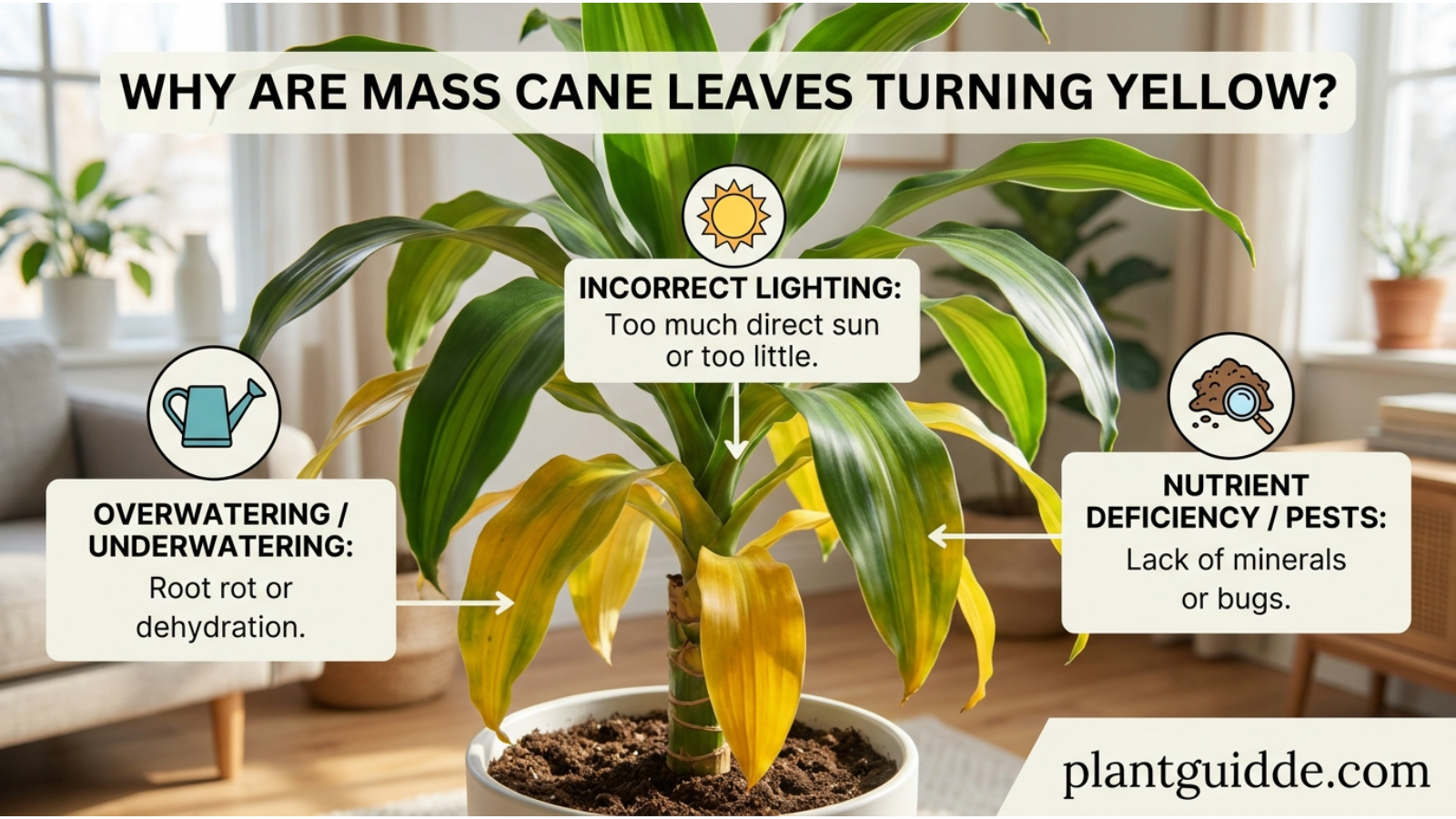
Why Are Mass Cane Leaves Turning Yellow?
Yellow leaves are one of the most common Mass Cane problems, but the color alone does not identify the cause.
Possible causes include:
Overwatering:
If several leaves are yellowing while the soil remains wet for extended periods, excessive moisture is a major suspect.
Natural aging:
An occasional older leaf turning yellow and declining can simply be part of normal plant development.
Poor light:
Low light can slow growth and change how quickly the soil dries.
Root problems:
Damaged roots cannot support healthy foliage effectively.
What to check first
Instead of immediately adding fertilizer, inspect:
- Soil moisture
- Drainage
- Light level
- Root condition if the problem is persistent
- Recent environmental changes
This diagnostic approach is more useful than treating every yellow leaf as a nutrient deficiency.
Why Are Mass Cane Leaves Turning Brown?
Brown tips are especially common in indoor Dracaenas.
Possible contributors include:
- Dry indoor air
- Inconsistent watering
- Excess fertilizer or mineral accumulation
- Water quality
- Root stress
- Excessive direct sunlight
RHS specifically notes that fluoride in tap water can damage Dracaena foliage and recommends rainwater or filtered water where possible.
Brown tips vs brown patches
Brown tips: often point toward environmental stress, dry conditions, or water-quality/mineral issues.
Large bleached or scorched patches: may indicate excessive direct sunlight.
Dark, soft areas combined with persistently wet soil: raise more concern about root or moisture problems.
Do not focus only on the damaged leaf. Look at the plant’s growing conditions.
Why Is My Mass Cane Drooping?
Drooping does not automatically mean underwatering.
Check the soil first.
If the soil is very dry
Underwatering may be contributing to the drooping.
If the soil is wet
Do not immediately add more water.
The plant may be experiencing root stress from excessive moisture.
If the soil is appropriate
Look at environmental factors such as:
- Sudden temperature changes
- Cold drafts
- Heat from vents
- Poor light
- Recent repotting
The important lesson is that the symptom and the cause are not always the same thing.
Why Is My Mass Cane Not Growing?
Mass Cane is not a rapid-growth houseplant, especially under indoor conditions.
Slow growth can be normal, but a plant that has completely stalled may be telling you something.
Check these factors:
Light
Low light is one of the first things to investigate.
Root health
Poor roots cannot support strong new growth.
Temperature
Cold conditions can slow physiological activity.
Nutrition
A plant that has been growing actively for a long time without nutrients may eventually benefit from balanced feeding.
Season
Growth naturally changes with seasonal light and temperature.
Do not expect a Mass Cane kept several feet from a dim window to grow at the same rate as one receiving substantially brighter indirect light.
Common Mass Cane Care Mistakes
Watering on a fixed schedule
Problem: You water every Sunday regardless of soil moisture.
Better approach: Check the soil and adjust watering to the plant’s actual environment.
Putting it in direct afternoon sun
Problem: Strong sunlight through glass can scorch foliage.
Better approach: Use bright filtered or indirect light.
Keeping the soil constantly damp
Problem: Roots need access to oxygen as well as water.
Better approach: Let the soil partially dry between waterings.
Using a pot without drainage
Problem: Excess water has nowhere to go.
Better approach: Use a container with drainage holes.
Fertilizing a stressed plant
Problem: Fertilizer does not correct root rot, poor lighting, or overwatering.
Better approach: Fix the environmental problem first.
Moving the plant constantly
Problem: Repeated environmental changes can create unnecessary stress.
Better approach: Find a suitable location and keep conditions relatively stable.
Mass Cane Plant Care: A Simple Weekly Routine
You do not need to spend hours caring for a Mass Cane.
A simple routine is enough.
Once a week
Check:
- Soil moisture
- Leaf condition
- New growth
- Pest activity
- Whether the plant is receiving appropriate light
Every few weeks
Rotate the pot if necessary so growth remains reasonably balanced.
Wipe dusty leaves gently with a clean, damp cloth when needed. Clean foliage can also make it easier to notice pests and damage.
During active growth
Monitor whether the plant needs feeding and watch how quickly the soil dries.
During winter or slower growth
Reduce watering as needed rather than continuing a summer watering routine automatically. RHS recommends more sparing watering during winter.
Mass Cane Pests and Problems
Mass Cane can encounter common indoor plant pests, particularly when plants are stressed.
RHS lists pests including scale insects, spider mites, thrips, and mealybugs among those that may affect Dracaena.
Inspect:
- Leaf undersides
- Leaf joints
- Cane surfaces
- New growth
Look for:
- Fine webbing
- Sticky residue
- Cotton-like clusters
- Small moving insects
- Brown or scale-like bumps
Early detection makes pest management much easier.
Image Suggestion: Macro infographic identifying scale, mealybugs, spider mites, and thrips on Mass Cane foliage.
Can Mass Cane Grow in Low Light?
Yes—but there is an important distinction between surviving in low light and thriving in low light.
Dracaena is known for tolerating lower indoor light levels, but brighter indirect light generally provides better conditions for active growth. RHS specifically describes Dracaena as tolerant of low light while recommending bright indirect light for strong indoor cultivation.
If your Mass Cane is in a dim office, reduce watering frequency if the soil remains wet for longer.
This is an often-overlooked connection:
Less light usually means slower growth and slower water use.
Therefore, watering should respond to the plant’s environment rather than the calendar.
Does Mass Cane Need Filtered Water?
It can be helpful.
Dracaena plants may be sensitive to fluoride and mineral buildup in water. RHS recommends rainwater or filtered water where possible, particularly because fluoride can damage foliage.
mass cane plant care you repeatedly notice brown tips despite otherwise good care, water quality is worth considering.
This does not mean every brown leaf tip is caused by tap water. It is simply one potential factor that is often overlooked.
Is Mass Cane Toxic to Cats and Dogs?
Yes.
The ASPCA lists Dracaena fragrans and Dracaena species as toxic to cats and dogs. The toxic principles include saponins, and reported signs can include vomiting, depression, loss of appetite, drooling, and—in cats—dilated pupils.
mass cane plant care you have pets that chew plants, keep Mass Cane somewhere they cannot access it.
mass cane plant care you suspect your pet has eaten part of the plant, contact a veterinarian or an appropriate animal poison-control service promptly.
How to Make a Mass Cane Look Fuller
A Mass Cane’s appearance depends partly on how its canes are arranged.
If the plant has become tall and sparse, pruning can be used to encourage branching from remaining cane sections.
For a fuller display:
- Provide adequate indirect light.
- Avoid severe underwatering.
- Keep roots healthy.
- Prune excessively tall or weak canes strategically.
- Rotate the plant periodically.
- Give new shoots time to develop.
Do not expect an immediate transformation after pruning. New growth takes time.
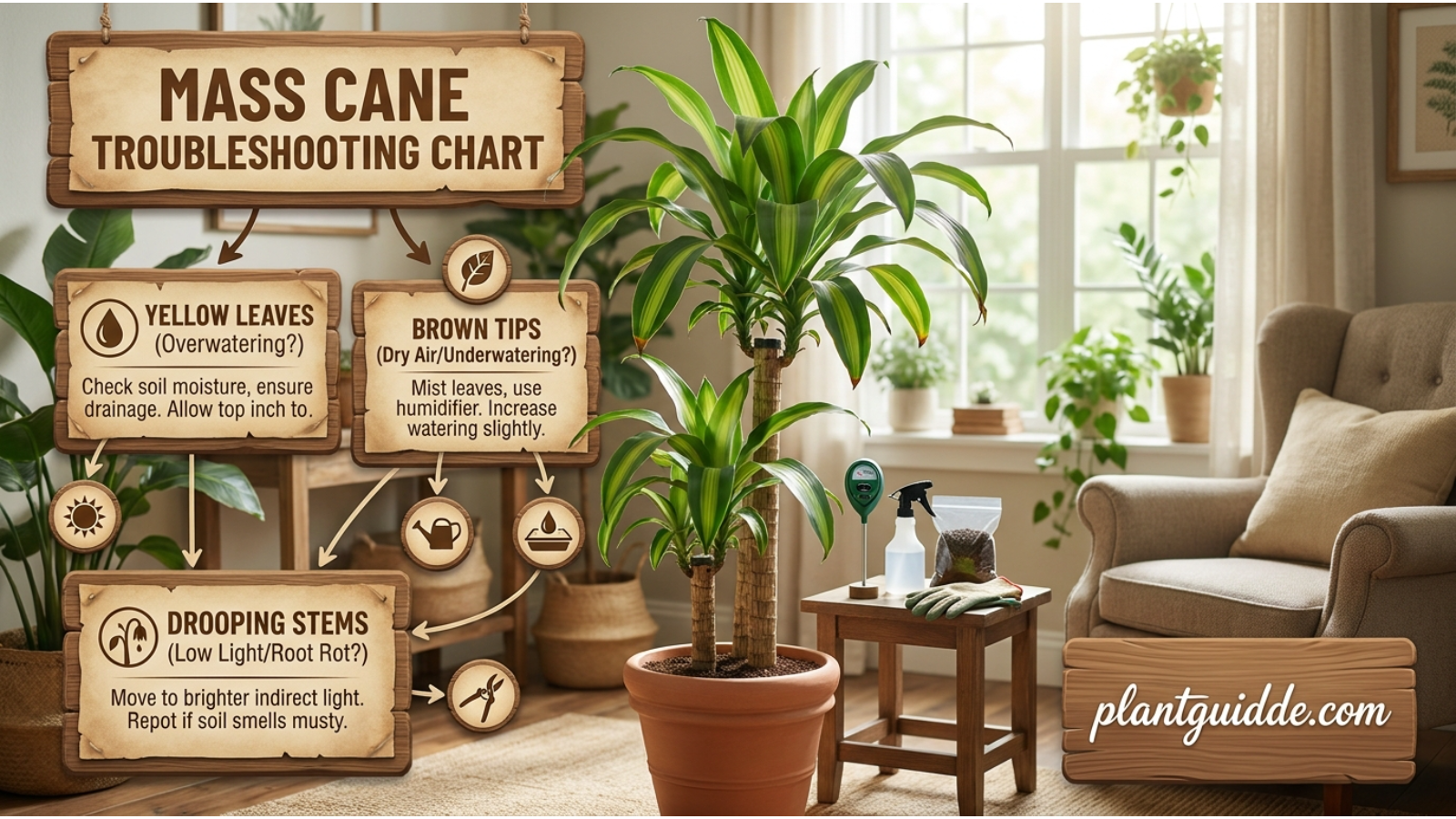
Mass Cane Troubleshooting Chart
| Problem | Likely causes | What to check first |
|---|---|---|
| Yellow leaves | Overwatering, low light, aging leaves | Soil moisture and drainage |
| Brown tips | Dry air, water quality, inconsistent moisture | Water and humidity |
| Crispy patches | Excessive direct sun | Window exposure |
| Drooping | Dry soil, root stress, temperature changes | Soil moisture |
| Slow growth | Low light, cool conditions, nutrition | Light and temperature |
| Soft or declining roots | Excess moisture | Drainage and soil |
| Tiny insects/webbing | Spider mites or other pests | Leaf undersides |
| White cottony insects | Mealybugs | Leaf joints and stems |
| Brown bumps | Scale | Cane and leaf surfaces |
The chart is a starting point, not a substitute for examining the entire growing environment.
When Should You Worry About a Mass Cane?
One yellow leaf is usually not an emergency.
A pattern is more informative than a single damaged leaf.
Pay closer attention when you see:
- Several leaves yellowing rapidly
- Persistent wet soil
- A soft or unstable cane
- Widespread leaf browning
- Repeated leaf drop
- Strong unpleasant odor from the soil
- Rapid decline after a watering change
- Visible pests spreading across the plant
When several symptoms appear together, investigate the roots, drainage, light, and watering habits rather than treating individual leaves.
FAQs:
How often should I water a Mass Cane?
Water when the soil has partially dried rather than following a strict calendar. The exact frequency depends on light, temperature, pot size, soil, and season.
Does Mass Cane need direct sunlight?
No. Bright indirect or filtered light is generally a better indoor choice. Strong direct sunlight, particularly through hot glass, can scorch the foliage.
Why are my Mass Cane leaves turning yellow?
Overwatering is a common possibility, particularly when the soil stays wet for long periods. However, natural aging, low light, and root problems can also cause yellowing.
Why does my Mass Cane have brown leaf tips?
Brown tips can be associated with dry conditions, inconsistent watering, mineral or fluoride exposure, fertilizer buildup, and other environmental stresses.
Can Mass Cane survive low light?
Yes. Dracaenas tolerate lower light, but growth is generally better under brighter indirect conditions. Remember that a low-light plant usually uses water more slowly.
Should I mist my Mass Cane?
Occasional misting is not essential to successful care. If your home is very dry, improving overall humidity with a humidifier or grouping plants is generally more dependable.
What soil is best for Mass Cane?
Use a loose, well-draining indoor potting mix that does not remain saturated after watering.
How tall can a Mass Cane become?
Mass Cane can become a substantial floor plant indoors. Mature Dracaena fragrans can reach several metres under suitable growing conditions, although indoor plants generally remain much smaller.
Can I cut a Mass Cane if it gets too tall?
Yes. Dracaena can be pruned by cutting the cane, and new shoots may develop under suitable conditions.
Is Mass Cane safe for cats?
No. The ASPCA lists Dracaena fragrans as toxic to cats and dogs.
Final Thoughts
Successful mass cane plant care is less about complicated routines and more about avoiding extremes.
Give the plant bright but filtered light, moderate watering, well-draining soil, a pot with drainage, warmth, and reasonably stable conditions. Most problems become easier to solve when you stop treating symptoms in isolation and look at the entire growing environment.
If the leaves are yellow, check the soil. If the tips are brown, consider moisture, humidity, and water quality.
A Mass Cane that is allowed to dry appropriately between waterings, protected from harsh sunlight and cold drafts, and kept in a stable indoor environment can remain an attractive, long-lived houseplant for years.

Asad Mumtaz is a dedicated plant enthusiast and gardening writer with a passion for helping people care for their plants successfully. He specializes in plant care guides, indoor gardening, and practical growing tips for all skill levels. His content focuses on making gardening simple, enjoyable, and rewarding. Through his work, Asad shares reliable advice to help readers create thriving green spaces.