
Black eyed susan plant care is one of those flowering plants that can look effortless in a garden once its basic preferences are understood. Its bright yellow or orange daisy-like flowers and dark central cones bring a long season of color while also providing resources for pollinators and other wildlife.
But there is an important detail behind successful black eyed Susan plant care: the common name does not always refer to one exact species. Rudbeckia hirta is one of the most commonly recognized black-eyed Susans, but Rudbeckia fulgida is also sold or described by the same common name. In addition, Thunbergia alata, a completely different climbing plant, is sometimes called black-eyed Susan vine.
For this guide, the main focus is Rudbeckia hirta, while noting where care can differ among Rudbeckia species.
Quick Answer
Black eyed Susan (Rudbeckia hirta) grows best in full sun, moderately fertile, well-drained soil, and consistent moisture without soggy roots. Water when the soil begins to dry rather than following a rigid schedule, and deadhead spent flowers to encourage continued blooming. Although often grown as an annual, Rudbeckia hirta is technically a biennial or short-lived perennial and can readily reseed itself.
What Is Black Eyed Susan?
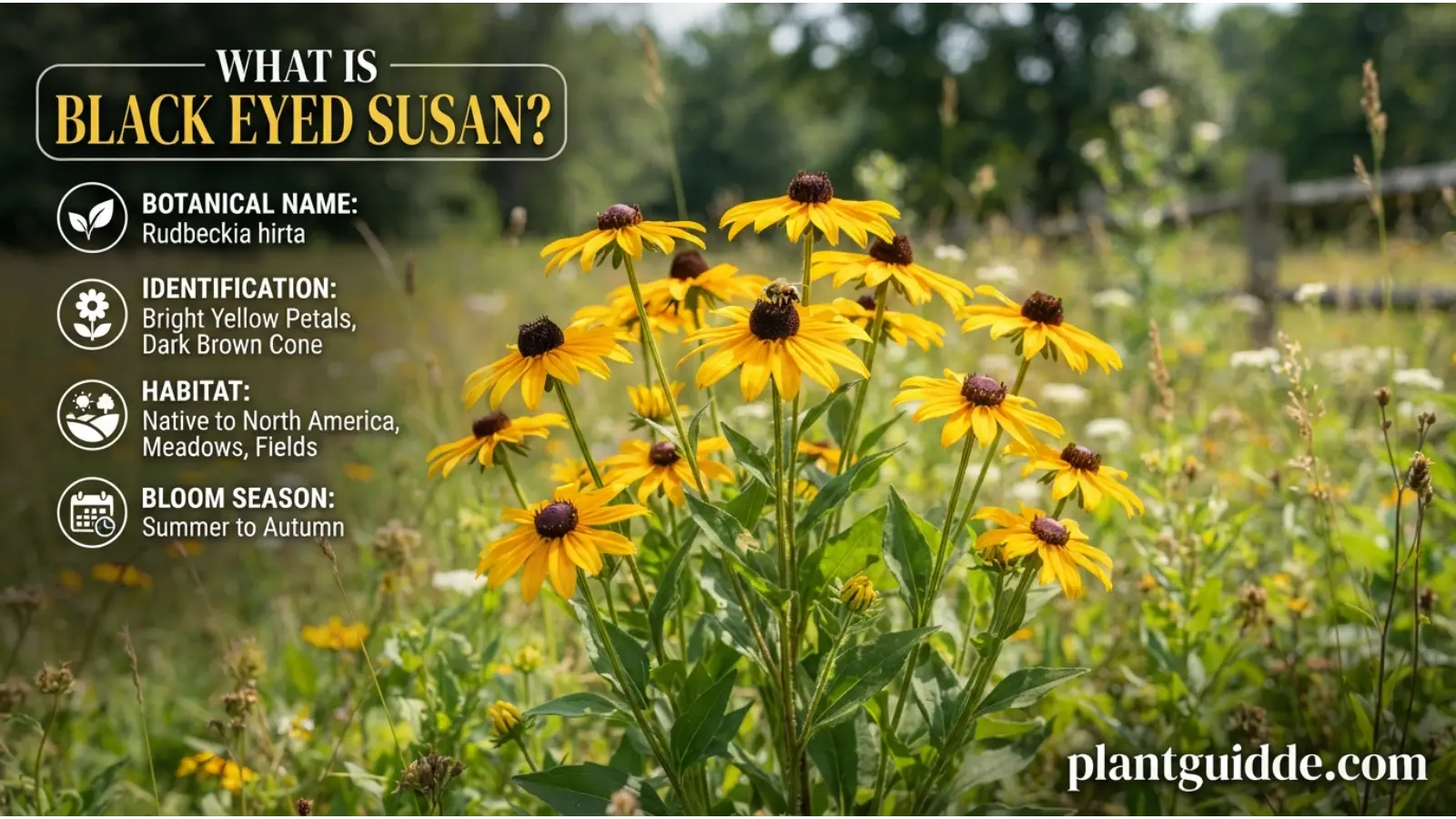
Black eyed Susan (Rudbeckia hirta) belongs to the Asteraceae, or daisy, family. It is native to much of North America and is naturally found in open habitats such as fields, prairies, roadsides, pastures, and disturbed areas.
The plant typically forms upright, branching stems with rough or bristly foliage. Its familiar flowers have yellow or orange ray petals surrounding a raised brown or sometimes greenish central disk.
Unlike many plants that are clearly classified as either annuals or perennials, Rudbeckia hirta can behave differently depending on growing conditions and cultivar. It is generally described as a biennial or short-lived perennial, although gardeners frequently grow it as an annual because plants started from seed in spring can flower during their first year.
This explains why one gardener may see a black eyed Susan return for another season while another sees the original plant disappear but finds new seedlings appearing nearby.
Black Eyed Susan at a Glance
| Feature | Typical requirement |
|---|---|
| Botanical name | Rudbeckia hirta |
| Family | Asteraceae |
| Common names | Black-eyed Susan, gloriosa daisy |
| Light | Full sun is preferred; partial shade is tolerated |
| Soil | Clay, loam, or sandy soil with good drainage |
| Moisture | Moist but well-drained; established plants tolerate some dryness |
| Flowering | Mainly summer into fall |
| Height | Often about 2–4 feet, depending on cultivar and conditions |
| Life cycle | Biennial or short-lived perennial; often grown as an annual |
| Propagation | Seed; self-seeding is common |
| Main problems | Powdery mildew, slugs, snails, and some insect pests |
These characteristics describe Rudbeckia hirta generally; individual cultivars can vary considerably in size, flower color, and growth habit.
How Much Sun Does Black Eyed Susan Need?
Full sun is the best choice for black eyed Susan. Aim for at least six hours of direct sunlight a day when possible. The plant can tolerate partial shade, but insufficient light can reduce flowering and make the plant less compact.
Black eyed susan plant care you are deciding between two planting locations, choose the one that receives stronger direct sunlight for most of the day.
A little afternoon shade can be useful in exceptionally hot climates, particularly where intense heat combines with dry soil. However, moving the plant into deep shade simply to protect it from heat can create a different problem: fewer flowers and weaker growth.
Signs the plant is not getting enough light
Watch for:
- Fewer flowers than expected
- Long, stretched stems
- Growth leaning toward the brightest direction
- A generally loose or floppy appearance
- Healthy foliage but disappointing flowering
Black eyed susan plant care the soil and watering are reasonable but flowering remains poor, light should be one of the first things you investigate.
The Best Soil for Black Eyed Susan
Black eyed Susan is adaptable and can grow in clay, loam, and sandy soils. The important factor is drainage rather than creating a highly specialized soil mixture.
The roots should have access to moisture without sitting in saturated soil for prolonged periods.
A practical planting mix for containers can include:
- Quality potting mix
- Compost in moderation
- Perlite, pumice, or another material that improves drainage
In garden beds, avoid automatically adding large amounts of fertilizer or rich organic material simply because you want more flowers. Black eyed Susan generally performs well with moderate fertility, and excessive nitrogen can encourage leafy growth at the expense of the flower display. North Carolina Extension specifically recommends avoiding locations receiving excess lawn fertilizer for this reason.
Does black eyed Susan need acidic soil?
It is not necessary to obsess over a narrow soil-pH target. Rudbeckia hirta can grow across a relatively broad soil range, provided the soil has suitable drainage and moisture conditions.
Black eyed susan plant care your garden soil is extremely poor or has a known pH problem, a soil test is more useful than guessing and adding amendments.
How to Water Black Eyed Susan
The goal is consistent moisture without constantly wet soil.
Newly planted black eyed Susans need more regular watering while their roots establish. Once established, they can tolerate periods of dryness, but prolonged drought can cause wilting and reduce flowering.
Instead of watering automatically on a fixed calendar, check the soil.
A practical watering method
- Feel the soil a short distance below the surface.
- If it is still noticeably moist, wait.
- If the upper layer has begun to dry and the plant is approaching a dry period, water thoroughly.
- Allow excess water to drain away.
- During extended hot or dry weather, check more frequently.
The exact frequency depends on temperature, rainfall, soil type, container size, and plant maturity.
A black eyed Susan growing in fast-draining sandy soil during hot weather may need water much sooner than one growing in heavier garden soil after regular rainfall.
Avoid two common watering mistakes
Mistake 1: Treating drought tolerance as drought immunity
A plant that tolerates dry conditions can still become stressed during prolonged heat and drought.
Mistake 2: Keeping the soil constantly wet
Poor drainage can create unhealthy root conditions and may contribute to general decline. Good drainage remains important even though the plant appreciates moisture.
How to Plant Black Eyed Susan
Choose a location with good sunlight and soil that drains reasonably well.
For garden planting:
- Prepare the soil by loosening the planting area.
- Remove competing weeds and grass.
- Dig a hole slightly wider than the root ball.
- Place the plant at approximately the same depth at which it was growing in its container.
- Backfill with the existing soil.
- Water thoroughly after planting.
- Keep the soil reasonably moist while the plant establishes.
Spacing depends on the mature size of the cultivar. Many Rudbeckia hirta plants reach roughly 2–4 feet in height, but compact cultivars can be substantially smaller. Check the plant label before deciding how closely to plant them.
Avoid packing plants tightly together simply to create an immediate full-looking bed. Adequate space improves airflow and makes it easier to water, deadhead, inspect foliage, and manage disease problems.
How to Fertilize Black Eyed Susan
Black eyed Susan generally does not require heavy feeding.
Black eyed susan plant care the soil is reasonably fertile, adding excessive nitrogen can produce plenty of green growth without delivering the flower display you expected. Moderate fertility is recommended for Rudbeckia hirta.
Black eyed susan plant care plants are growing poorly in genuinely depleted soil, improve the soil based on a soil test rather than repeatedly applying fertilizer.
For container-grown plants, a balanced, diluted fertilizer used according to its label may be appropriate during active growth, particularly when nutrients are gradually depleted through repeated watering.
The important point is simple: more fertilizer does not automatically mean more flowers.
Should You Deadhead Black Eyed Susan?
Yes, deadheading can be useful if your priority is encouraging additional flowers and maintaining a tidy appearance. Extension and horticultural sources note that removing spent flowers can encourage continued blooming.
To deadhead:
- Wait until a flower has faded.
- Follow its stem downward.
- Cut just above a healthy leaf or branching point.
- Continue checking the plant throughout the flowering period.
However, you do not have to remove every spent flower.
Black eyed susan plant care you want the plant to produce seeds for natural reseeding or you enjoy the appearance of dried seedheads, leave some flowers in place. The persistent seedheads can also provide seasonal wildlife value, including food for birds.
This creates a useful choice:
- More tidy flowers: deadhead regularly.
- More natural garden appearance: leave some seedheads.
- Encourage self-seeding: allow mature flowers to produce and drop seed.
How to Grow Black Eyed Susan From Seed
Growing Rudbeckia hirta from seed is one of the easiest ways to establish a larger planting.
The species naturally reproduces by seed and can self-seed in suitable garden conditions.
RHS guidance recommends sowing seed in spring with gentle heat and notes that light is needed for germination. Seedlings should be hardened off before planting outdoors.
For home gardeners:
- Sow seeds in a suitable seed-starting medium.
- Do not bury them deeply.
- Provide appropriate warmth and light.
- Keep the growing medium evenly moist rather than saturated.
- Give seedlings strong light after emergence.
- Gradually acclimate young plants to outdoor conditions.
- Plant them into their final location once conditions are suitable.
One advantage of Rudbeckia hirta is that early-spring sowing can result in flowering during the first year, which is one reason the plant is frequently treated as an annual.
Does Black Eyed Susan Come Back Every Year?
It can, but this is where the plant’s life cycle causes confusion.
Rudbeckia hirta is generally a biennial or short-lived perennial, yet many cultivated plants flower in their first year and may not persist for many years. At the same time, mature plants can produce abundant seed, allowing new plants to appear in subsequent seasons.
So if your original plant disappears after flowering, that does not necessarily mean black eyed Susan has failed in your garden.
Look around the surrounding soil in spring for young seedlings.
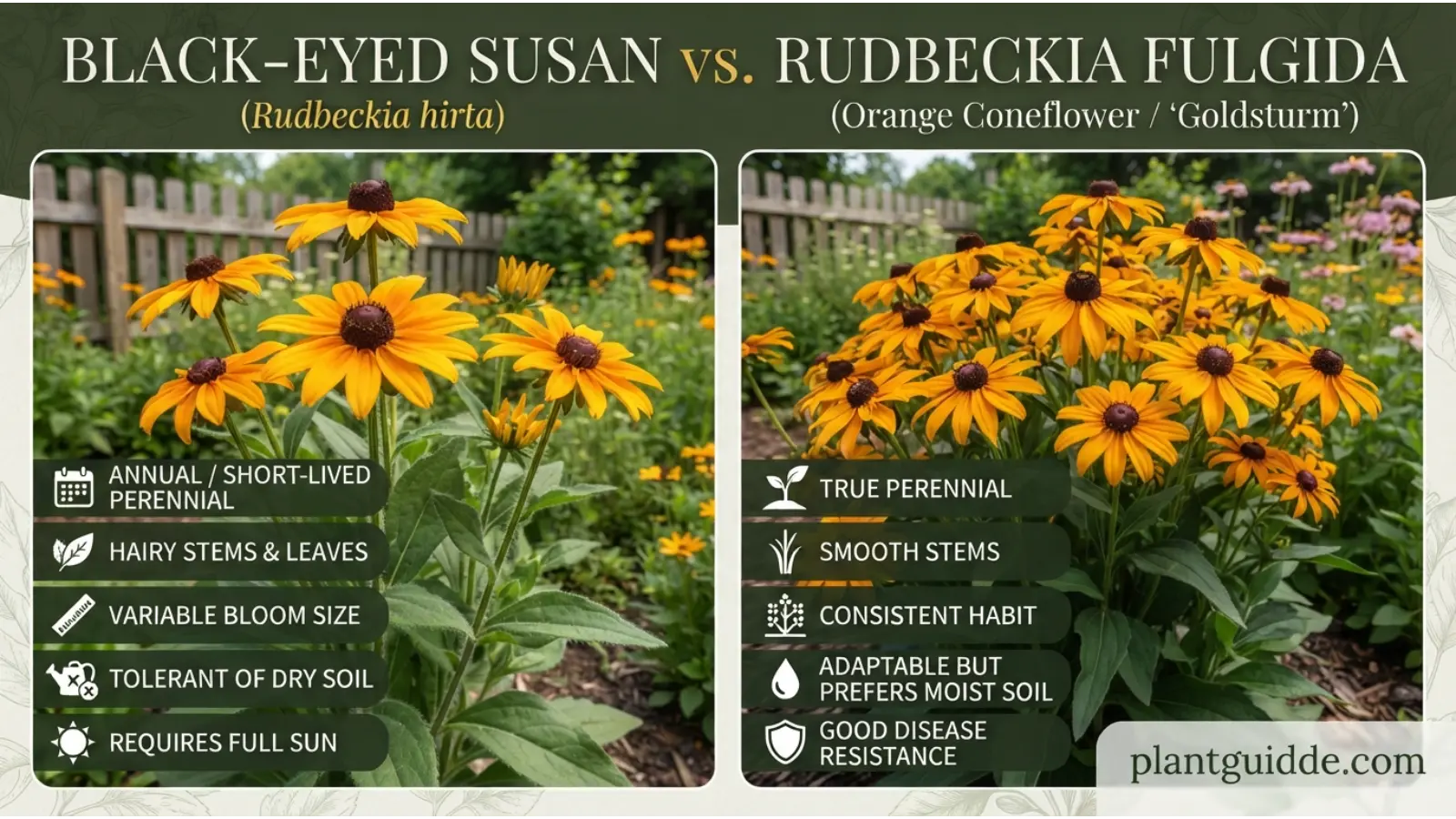
Another species commonly called black eyed Susan, Rudbeckia fulgida, behaves differently. It is a true herbaceous perennial that can spread through underground rhizomes and form larger clumps.
When buying plants, check the botanical name on the label rather than relying solely on the common name.
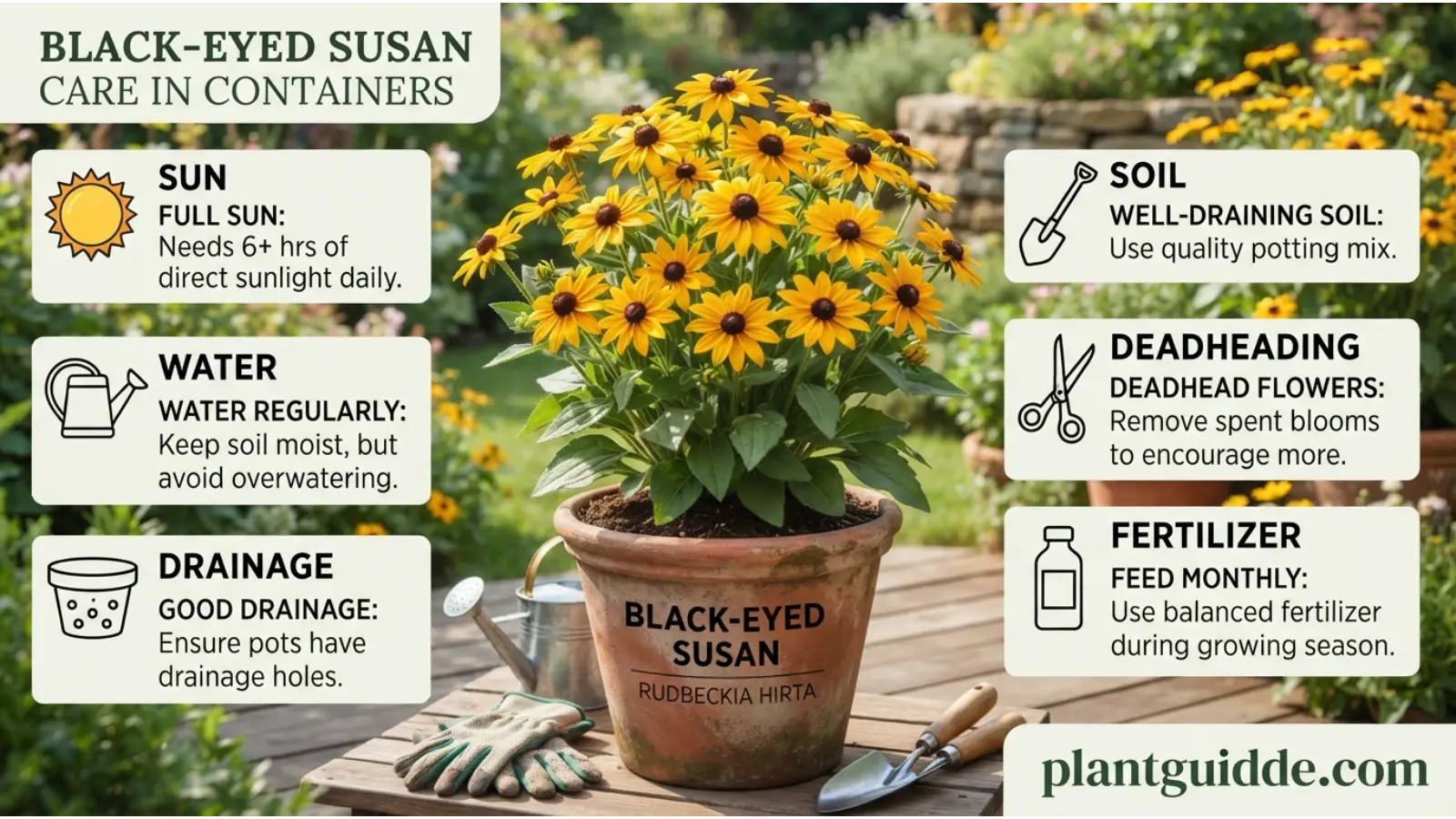
Black Eyed Susan Care in Containers
Black eyed Susan can be grown in containers, particularly compact cultivars.
The main difference is that container soil dries more quickly and provides a smaller root environment than garden soil.
Use a container with drainage holes and a well-drained potting mix. Choose a container large enough for the cultivar’s expected size and avoid leaving the pot sitting permanently in a saucer of water.
Container plants may need more frequent watering during hot weather, but the same principle applies: check the growing medium rather than watering simply because a particular number of days has passed.
A sunny balcony, patio, or entrance area can work well if the plant receives sufficient direct light.
Black Eyed Susan Care in Winter
Winter behavior depends on the species, cultivar, climate, and whether you are growing Rudbeckia hirta or another Rudbeckia sold under the same common name.
For Rudbeckia hirta, you should not assume that cutting everything back guarantees the plant will return. Since the species can be short-lived and often regenerates through seed, allowing some mature seedheads to remain can help maintain the planting naturally.
For established perennial Rudbeckias such as Rudbeckia fulgida, dormant stems can provide winter structure and wildlife value. The old growth can be removed when appropriate in late winter or early spring rather than treating the plant like an annual bedding plant.
Common Black Eyed Susan Problems
Black eyed Susan is generally considered an easy, low-maintenance plant, but problems can still appear when growing conditions are unsuitable.
Yellowing leaves
Yellow leaves can have several causes, so avoid assuming that fertilizer is automatically needed.
Check:
- Soil moisture
- Drainage
- Recent rainfall
- Light levels
- Overall plant vigor
- Whether older or newer leaves are affected
If the soil stays wet for extended periods, improve drainage and review your watering routine before adding fertilizer.
Drooping or wilting
Wilting during prolonged hot, dry weather can indicate water stress. Established Rudbeckias tolerate some dryness, but tolerance does not mean the plant never needs water.
Check the soil before watering. If it is dry and the plant is wilted, provide a thorough watering.
If the soil is already wet, adding more water may make the situation worse.
Powdery mildew
Powdery mildew can affect Rudbeckia. RHS notes that powdery mildews can occur, while North Carolina Extension also identifies powdery mildew as a disease problem for Rudbeckia hirta.
Good cultural practices can reduce stress:
- Avoid unnecessarily crowding plants.
- Improve airflow where possible.
- Water the soil rather than repeatedly wetting the foliage.
- Remove severely affected leaves when appropriate.
- Avoid excessive nitrogen fertilization.
Do not diagnose every white marking as powdery mildew without inspecting it closely.
Slugs and snails
Young growth can be vulnerable to slugs and snails, and both North Carolina Extension and RHS list them among potential problems.
Inspect plants in the evening or early morning when slug activity is easier to detect, particularly after wet weather.
Aphids
Aphids can occasionally appear on Rudbeckia. A small population may be controlled naturally by predators such as lady beetles and other beneficial insects.
Before reaching for an insecticide, inspect whether the insects are actually causing meaningful damage and whether natural predators are already present.
Why Is My Black Eyed Susan Not Flowering?
If your plant has lots of foliage but few flowers, work through the growing conditions instead of immediately applying fertilizer.
1. Not enough sunlight
This is one of the first things to check. Rudbeckia generally flowers best in full sun.
2. Excessive nitrogen
Heavy nitrogen feeding can encourage vigorous foliage. Moderate fertility is generally more appropriate for Rudbeckia hirta.
3. Immature plants
A young plant may simply need time to establish, depending on the species and cultivar.
4. Excessive competition
Nearby plants, shrubs, or trees may be competing for light, moisture, and root space.
5. Water stress
Extended dry periods can cause wilting and may interfere with the plant’s ability to maintain strong flowering.
Why Is My Black Eyed Susan Getting Tall and Floppy?
Tall growth is not automatically a sign that something is wrong. Some Rudbeckia naturally become fairly tall.
However, unusually weak or stretched growth can result from insufficient light, overcrowding, or excessive nitrogen.
If plants consistently flop, consider:
- Moving them to a sunnier location.
- Giving tall cultivars adequate space.
- Avoiding excessive nitrogen.
- Using a discreet support when necessary.
- Choosing a more compact cultivar for exposed containers or small beds.
A useful preventative strategy is to select the cultivar according to the planting location rather than expecting every black eyed Susan to remain short.
Are Black Eyed Susans Good for Pollinators?
Yes. Rudbeckia flowers attract a variety of insect visitors and can contribute to pollinator-friendly gardens. Rudbeckia hirta also serves as a host plant for the larvae of certain butterflies and moths.
This is one reason not to treat the garden purely as a display that must remain perfectly manicured.
Leaving some flowers to mature into seedheads can add winter interest and provide additional wildlife value.
For a more wildlife-friendly planting, combine black eyed Susan with other regionally appropriate flowering plants that provide different flower shapes and bloom periods.
Black Eyed Susan vs. Rudbeckia Fulgida
The common name can make these plants seem interchangeable, but their growth habits are different.
| Feature | Rudbeckia hirta | Rudbeckia fulgida |
|---|---|---|
| Common name | Black-eyed Susan | Black-eyed Susan / orange coneflower |
| Life cycle | Biennial or short-lived perennial | Herbaceous perennial |
| Typical habit | Often grown as an annual | More reliably perennial |
| Spread | Frequently self-seeds | Spreads by underground rhizomes |
| Flowering | Summer into fall | Early summer into fall, depending on conditions |
| Light | Full sun to partial shade | Full sun preferred; partial shade tolerated |
| Drought tolerance | Moderate once established | Good once established |
| Main distinction | Often regenerates through seed | Forms perennial clumps |
Both species prefer well-drained growing conditions and can be valuable additions to wildlife-friendly gardens.
If long-term perennial performance is your main concern, identify the species or cultivar before purchasing rather than relying on the common name.
Common Black Eyed Susan Care Mistakes
Avoiding a few simple mistakes can make the difference between a struggling plant and a reliable summer bloomer.
Watering by calendar instead of soil condition: Weather and soil type change how quickly the plant uses water.
Planting in deep shade: Rudbeckia may tolerate partial shade, but it generally flowers best with plenty of sun.
Overfertilizing: Excess nitrogen can encourage foliage instead of the flower display you want.
Ignoring drainage: Moist soil is useful; permanently saturated soil is a different situation.
Cutting off every seedhead immediately: Deadheading can extend flowering, but allowing some seedheads to mature can encourage natural reseeding and provide wildlife value.
Assuming every black eyed Susan is the same plant: Rudbeckia hirta and Rudbeckia fulgida have different growth habits, while black-eyed Susan vine is an entirely different species.
A Simple Black Eyed Susan Care Routine
For gardeners who want a straightforward routine, focus on these tasks:
Spring: Plant new specimens after suitable conditions arrive, sow seeds if desired, remove unwanted competing growth, and begin monitoring moisture.
Early summer: Check soil moisture regularly, watch for pests, and make sure surrounding plants are not blocking sunlight.
During flowering: Deadhead faded flowers if you want to encourage additional blooms. Water during prolonged dry periods.
Late summer and fall: Decide whether you want a tidy appearance or natural seed production. Leave selected seedheads if you want self-seeding and winter structure.
Late fall and winter: Do not assume every Rudbeckia hirta plant will behave like a long-lived perennial. Allowing some seed to mature can help maintain the population naturally.
FAQs:
Does black eyed Susan need full sun?
Black eyed Susan grows best in full sun, generally meaning about six or more hours of direct sunlight daily. It can tolerate partial shade, but reduced sunlight may lead to fewer flowers and weaker growth.
How often should I water black eyed Susan?
There is no single watering schedule that works for every garden. Check the soil and water when it begins to dry, giving newly planted plants more consistent moisture while they establish. Established plants can tolerate some dryness but may need supplemental water during prolonged hot or dry weather.
Does black eyed Susan come back every year?
Rudbeckia hirta can return, but it is a biennial or short-lived perennial that is often grown as an annual. It also readily self-seeds, so new plants may appear even when the original plant does not survive another season.
Should I cut back black eyed Susans in the fall?
You do not have to remove every stem immediately after flowering. Leaving some seedheads can support natural reseeding and provide winter interest and wildlife value. The best timing for cutting back depends on the species and the appearance or wildlife goals of your garden.
Why are my black eyed Susan leaves turning brown?
Brown leaves or edges can result from drought stress, environmental stress, disease, or other growing problems. Check soil moisture, sunlight, airflow, and drainage first. If you see a powdery coating or widespread leaf spotting, inspect the plant more closely for disease rather than assuming it simply needs water.
Conclusion
Successful black eyed Susan plant care is mostly about getting the basics right: strong sunlight, well-drained soil, appropriate moisture, moderate fertility, and enough space for healthy airflow. The plant is adaptable, but it still responds poorly to extremes such as deep shade, constantly saturated soil, or excessive fertilizer.
Most importantly, identify the Rudbeckia you are growing. Rudbeckia hirta may behave as a short-lived perennial or reseeding annual, while Rudbeckia fulgida is a more reliably perennial species. Once you understand that difference, choose a sunny location, monitor the soil instead of following a rigid watering calendar, and deadhead selectively according to whether you prioritize continued flowers or natural seed production.

Asad Mumtaz is a dedicated plant enthusiast and gardening writer with a passion for helping people care for their plants successfully. He specializes in plant care guides, indoor gardening, and practical growing tips for all skill levels. His content focuses on making gardening simple, enjoyable, and rewarding. Through his work, Asad shares reliable advice to help readers create thriving green spaces.