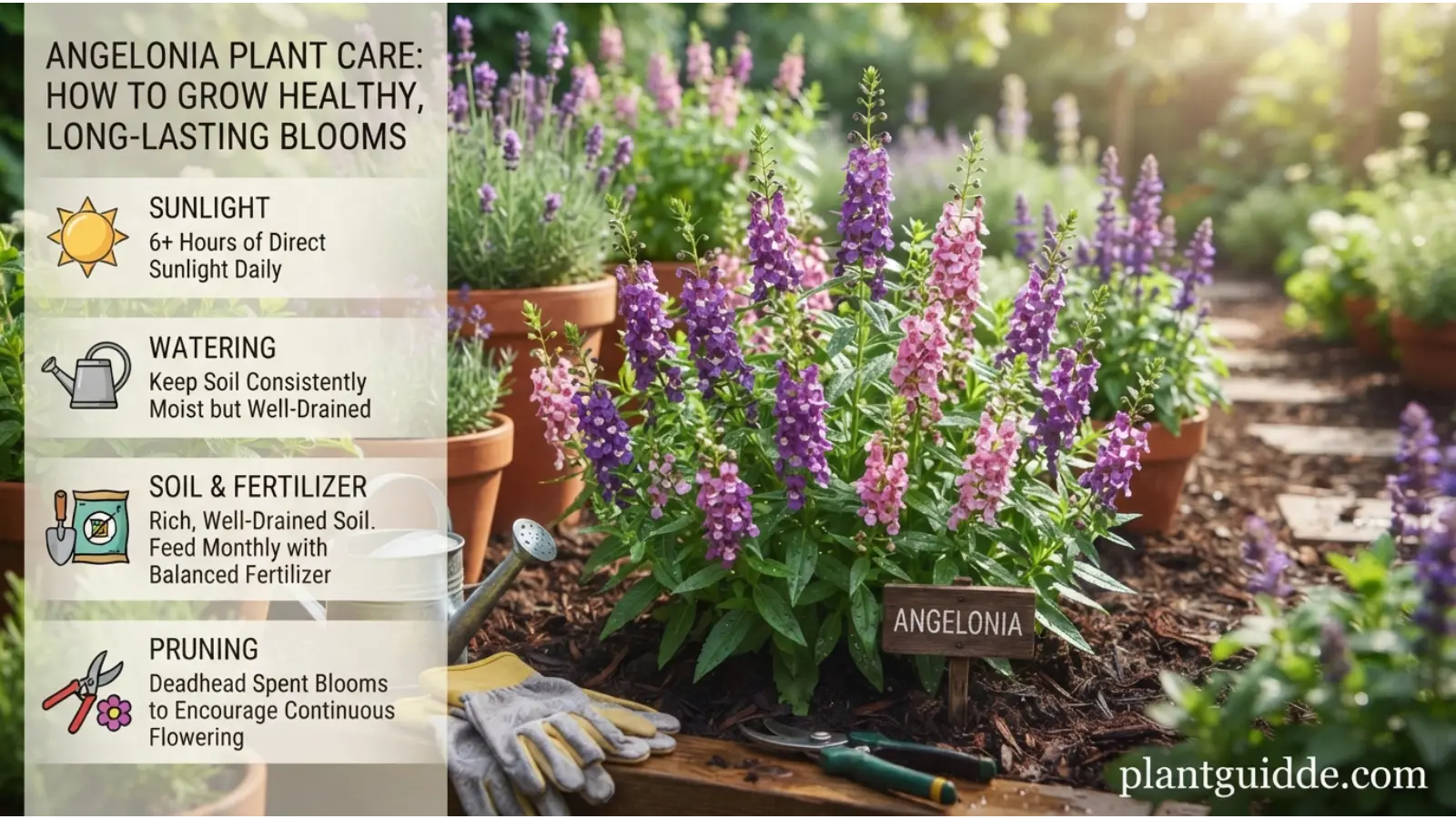
Angelonia plant care often called summer snapdragon, is a warm-season flowering plant valued for its upright flower spikes, long blooming period, and ability to perform well during hot weather. Its flowers can appear in shades of purple, pink, white, blue, and related tones, depending on the variety.
What makes angelonia especially useful for gardeners is its combination of attractive flowers and heat tolerance. However, “low maintenance” does not mean it can be planted anywhere and ignored. The biggest differences between a strong, heavily flowering plant and a weak, stretched one usually come down to sunlight, watering, drainage, and feeding.
Angelonia plant care your angelonia is producing lots of leaves but few flowers, wilting despite regular watering, becoming leggy, or developing yellow foliage, the problem is often related to its growing conditions rather than the plant itself.
Quick Answer
Angelonia plant care is relatively easy when the plant receives full sun, fertile well-draining soil, consistent moisture during establishment, and enough warmth.
Once established, angelonia can tolerate short dry periods and continues flowering through hot weather. Avoid constantly soggy soil and excessive fertilizer, which can encourage foliage at the expense of flowers. Light pruning or removing spent blooms can help maintain a neat, productive plant.
What Is Angelonia?
Angelonia is a flowering plant in the Plantaginaceae family. The species most commonly grown in gardens is Angelonia angustifolia, although many modern garden varieties and hybrids are available.
Its common name, summer snapdragon, comes from the resemblance of its flower spikes to snapdragons. Despite the similar appearance, angelonia is not a true snapdragon.
Depending on the cultivar, plants may have an upright, compact, spreading, or trailing habit. Some varieties remain relatively short and work well in containers, while taller types make useful additions to borders and flower beds.
Angelonia is particularly valuable in warm climates because it can continue flowering when some cool-season flowering plants begin to struggle.
Why Grow Angelonia?
Angelonia has several qualities that make it a practical choice for summer gardens.
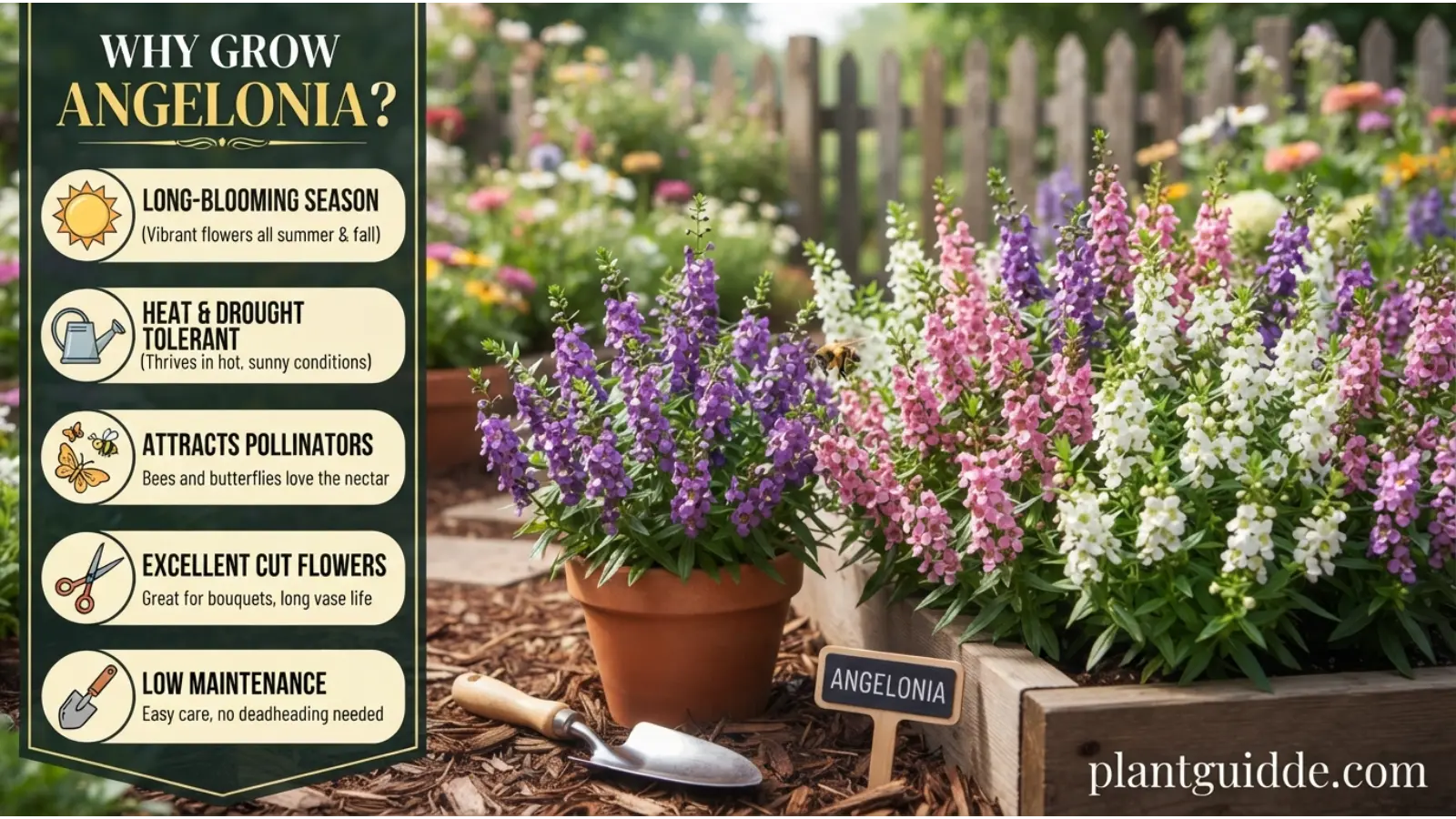
- Long flowering season: Many varieties flower from late spring through summer and can continue toward fall under suitable conditions.
- Heat tolerance: Established plants perform particularly well during warm weather.
- Good container performance: Compact cultivars can work well in pots and mixed containers.
- Pollinator appeal: The flowers can attract bees, butterflies, hummingbirds, and other garden visitors.
- Cut flowers: Upright flower spikes can be used as cut flowers.
- Relatively low maintenance: Many cultivars do not require frequent deadheading.
- Attractive foliage: The green foliage provides structure even when individual flowers are not at peak bloom.
The exact height, spread, flowering behavior, and pruning requirements depend on the cultivar, so check the plant label rather than assuming every angelonia grows the same way.
Angelonia Plant Care Requirements at a Glance
| Care factor | What angelonia prefers |
|---|---|
| Light | Full sun |
| Soil | Fertile, loose, well-draining soil |
| Water | Regular moisture while establishing; moderate drying between waterings |
| Established drought tolerance | Moderate to good |
| Fertilizer | Light, regular feeding rather than excessive fertilizer |
| Bloom season | Generally late spring through summer, often extending into fall |
| Pruning | Light trimming can maintain shape and encourage new flowering |
| Containers | Excellent, especially with suitable compact cultivars |
| Cold | Sensitive to freezing temperatures |
| Common problems | Overwatering, insufficient light, excessive fertilizer, aphids, powdery mildew |
How Much Sun Does Angelonia Need?
Full sun is one of the most important requirements for good angelonia growth and flowering.
Aim for roughly 6 or more hours of direct sunlight per day when possible. Strong light helps maintain compact growth and supports abundant flowering.
A plant receiving too little light may show several warning signs:
- Stretched or floppy stems
- Wider gaps between leaves
- Fewer flower spikes
- Weak growth
- Reduced branching
- A generally thin appearance
This is one reason angelonia can disappoint when grown in a bright room but without enough direct sunlight. It is primarily a warm-season outdoor flowering plant, not a low-light houseplant.
Can Angelonia Handle Hot Sun?
Yes. Heat tolerance is one of angelonia’s major strengths.
Established plants can perform well in hot, sunny conditions, provided they have adequate moisture and their roots are growing in well-drained soil. However, heat tolerance should not be confused with the ability to survive severe drought indefinitely.
Angelonia plant care a container becomes extremely hot and dries rapidly, the plant may still need frequent watering even though angelonia growing in the ground can tolerate somewhat drier conditions.
The Best Soil for Angelonia
Angelonia grows best in fertile, well-draining soil.
The ideal soil should hold enough moisture to support active growth while allowing excess water to drain away quickly. Heavy, compacted soil that stays saturated can create problems even though angelonia appreciates moisture during establishment.
For garden beds, improve poor soil with organic matter before planting. If the native soil is dense clay, improving drainage is more important than simply adding fertilizer.
For containers, use a quality potting mix rather than ordinary garden soil. Garden soil can become compacted inside pots and restrict drainage and root development.
Why Drainage Matters
Angelonia likes moisture, but its roots should not remain in stagnant water.
Angelonia plant care the soil stays wet for long periods, you may notice:
- Yellowing leaves
- Slow growth
- Weak or declining plants
- Wilting even though the soil is wet
- Root-related problems
A useful rule is to think about moisture plus drainage, rather than moisture alone.
How to Water Angelonia
Water newly planted angelonia regularly while it establishes a strong root system.
After establishment, the plant becomes more tolerant of short dry periods, particularly when grown in fertile soil with organic matter and mulch. However, watering requirements still depend on temperature, soil type, rainfall, plant size, and whether the plant is growing in the ground or in a container.
A Practical Watering Method
Instead of watering according to a rigid calendar, check the growing conditions.
- Feel the soil several inches below the surface.
- If the soil is still noticeably moist, wait before watering.
- If the upper soil has dried and the plant is approaching mild water stress, water thoroughly.
- Allow excess water to drain away.
- Check container-grown plants more frequently during hot weather.
Newly planted angelonia generally needs more attention than an established plant.
How Often Should You Water Angelonia?
There is no single correct number of days between waterings.
A plant growing in a sunny container during extreme summer heat may need water much more often than one planted in an established garden bed after rainfall.
The better approach is to respond to the soil and weather.
Too little water: wilting, dry soil, reduced flowering, and stressed foliage.
Too much water: persistently wet soil, yellowing leaves, weak growth, and possible root problems.
The goal is consistent moisture without keeping the root zone permanently saturated.
How to Fertilize Angelonia
Angelonia benefits from nutrients during active growth and flowering, but more fertilizer is not necessarily better.
A light monthly feeding is commonly recommended for garden-grown angelonia. Excessive fertilization, particularly excessive nitrogen, can encourage lush foliage while reducing the emphasis on flowers.
A balanced fertilizer used according to its label directions is usually more appropriate than repeatedly applying large amounts.
Signs You May Be Overfertilizing
Watch for:
- Extremely lush foliage with relatively few flowers
- Rapid, soft growth
- Weak or overly tall stems
- Fertilizer buildup on the soil surface in containers
- Leaf-edge or tip damage associated with excessive salts
If the plant already has vigorous green foliage but is reluctant to flower, adding more fertilizer is not necessarily the answer. First check sunlight and pruning practices.
How to Prune Angelonia
One advantage of modern angelonia cultivars is that many are naturally tidy and may not require extensive pruning or deadheading.
Still, pruning can be useful when the plant becomes:
- Too tall
- Uneven
- Leggy
- Overgrown
- Less productive in the middle of the season
A light trim can encourage fresh growth and help restore a compact shape.
For older or stretched plants, avoid cutting everything back indiscriminately. Instead, remove weak or overly long stems and allow healthy new shoots to develop.
Some cultivars are specifically bred to flower continuously without deadheading, while others can benefit from removing spent flower spikes. Follow the recommendations for your particular variety when available.
How to Keep Angelonia Blooming
Angelonia plant care your main goal is abundant flowers, focus on the fundamentals before reaching for additional fertilizer.
1. Give It Enough Sun
Insufficient sunlight is one of the easiest ways to reduce flowering.
2. Avoid Constantly Wet Soil
Healthy roots support healthy flowering. Improve drainage if the soil remains wet for extended periods.
3. Avoid Excess Nitrogen
Too much nitrogen can shift growth toward foliage rather than flowers.
4. Keep Moisture Consistent
Severe repeated wilting can stress the plant, particularly during establishment and extreme heat.
5. Trim When Growth Becomes Excessive
A light midseason trim can help some plants branch and produce fresh flowering growth.
6. Give Containers Extra Attention
Container plants have a smaller root volume and can dry much faster than plants growing in the ground.
Growing Angelonia in Containers
Angelonia is an excellent container plant, particularly when you choose a cultivar with a growth habit appropriate for the pot.
A successful container should have:
- Drainage holes
- Quality potting mix
- Enough root space
- Good air circulation
- A sunny location
Containers require closer monitoring because the potting mix can dry rapidly during hot weather.
Container Watering Tip
Do not assume that a plant needing full sun should also be allowed to become completely dry every day.
Instead, check the actual moisture level. In very hot weather, a small pot may dry quickly even when the plant itself is considered drought tolerant.
Moving to a slightly larger container can also reduce extreme moisture fluctuations when a plant has become severely root-bound.
Angelonia in Garden Beds
For landscape planting, choose a sunny location with good drainage.
Space plants according to the mature width of the specific cultivar. Many upright varieties are commonly spaced around 9–12 inches apart, while larger or spreading types may need more room.
Avoid planting too closely simply to create an instant full appearance. Crowded plants have less airflow and may compete for light and moisture.
A layer of mulch can help moderate soil temperature and reduce moisture loss, but keep mulch away from direct contact with the stems.
When to Plant Angelonia
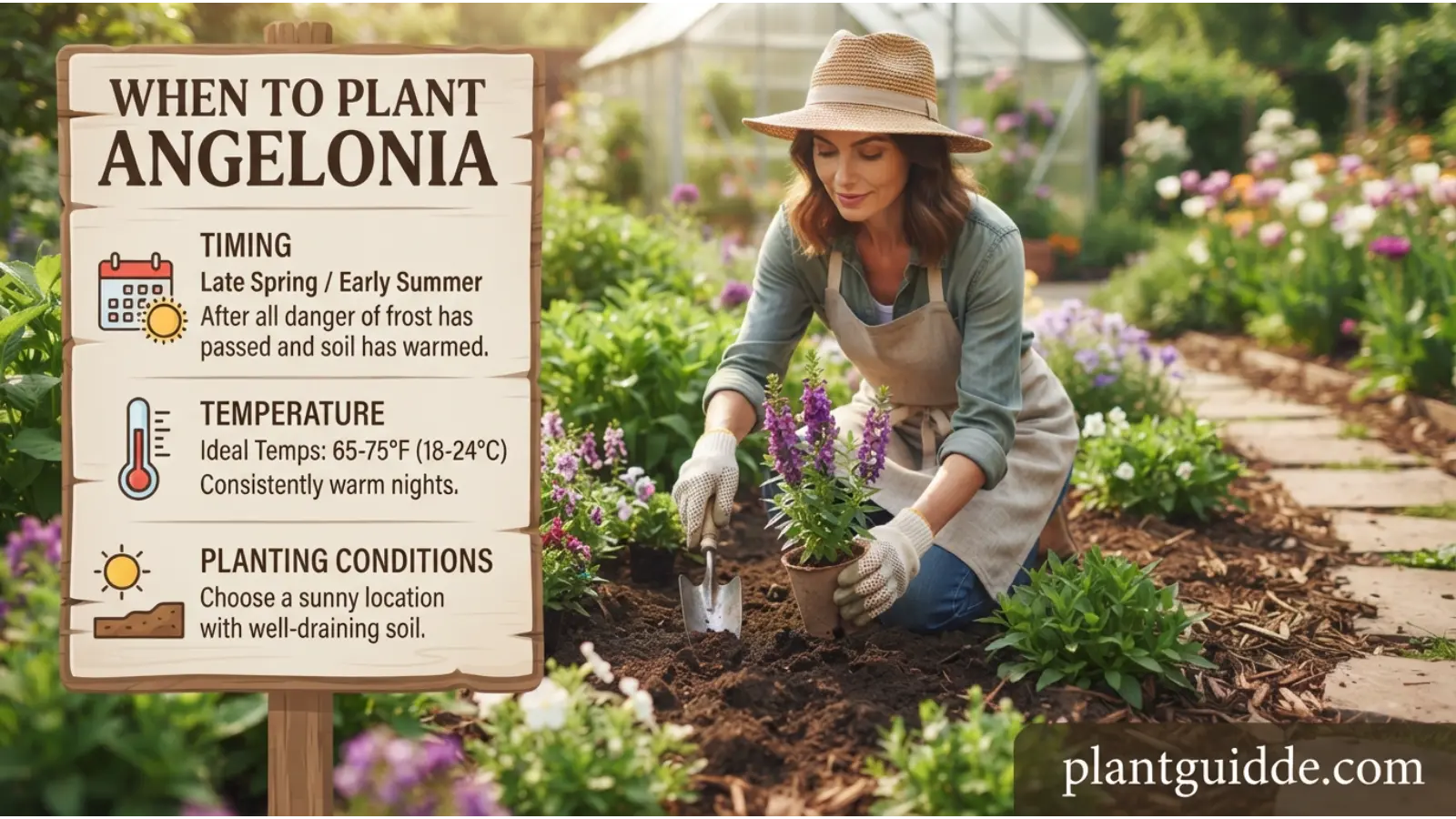
Angelonia is a warm-season plant and performs best when planted after the danger of freezing temperatures has passed.
In cooler climates, it is generally treated as an annual. In warm regions without damaging winter freezes, it can behave more like a perennial.
The exact planting time therefore depends heavily on your climate.
In Cold Climates
Wait until the soil and air have warmed and freezing weather has passed.
In Warm Climates
Angelonia can have a much longer growing and flowering season. In sufficiently warm areas, established plants may continue performing well for an extended period.
Because cultivar hardiness varies, always check the specific variety when planning overwintering.
Can Angelonia Survive Winter?
Angelonia is sensitive to freezing temperatures.
In warm climates, plants may survive winter and behave as perennials when temperatures remain sufficiently mild. In colder regions, freezing weather can kill the plant, so it is commonly grown as a seasonal annual.
If you are growing angelonia in a region with occasional cold nights, protecting the plant from frost may extend its season, but this should not be confused with true winter hardiness.
For container plants, moving them to a protected warm location may help during short periods of cold, provided the cultivar and growing conditions make this practical.
Common Angelonia Problems and How to Fix Them
Angelonia Is Not Flowering
The first things to check are sunlight, fertilizer, and plant maturity.
Likely causes:
- Not enough direct sunlight
- Excessive nitrogen
- Recent transplanting
- Overly vigorous vegetative growth
- Stress from inconsistent watering
What to do: Move or plant it in a sunnier position if necessary, avoid excessive fertilizer, and maintain consistent moisture while the plant establishes.
Angelonia Is Getting Leggy
Leggy growth usually indicates that the plant is not receiving enough light or has developed excessive, weak growth.
What to do: Increase sunlight where possible and trim overly long stems to encourage a more compact shape.
Angelonia Leaves Are Turning Yellow
Yellow foliage can have several causes, so do not automatically assume the plant needs fertilizer.
Check:
- Soil moisture
- Drainage
- Recent rainfall
- Light exposure
- Root condition
- Fertilizer history
If the soil remains wet for long periods, excessive moisture is a more useful suspect than nutrient deficiency.
Angelonia Is Wilting Even Though the Soil Is Wet
This is an important warning sign.
A wilted plant with dry soil obviously needs water, but a wilted plant sitting in saturated soil may have a root-zone problem.
Check the drainage and roots rather than watering again automatically.
Angelonia Has Brown or Crispy Leaves
Brown edges or crispy foliage can result from severe dryness, repeated wilting, excessive fertilizer salts, or environmental stress.
Check the soil first. Then consider whether the container is drying too rapidly or whether fertilizer has been applied too heavily.
Angelonia Has Few Flowers but Lots of Leaves
This combination often points toward insufficient light or excessive fertility.
Before increasing fertilizer, make sure the plant receives strong sunlight and is not being fed too heavily.
Angelonia Pests and Diseases
Angelonia is generally considered a relatively trouble-free flowering plant, but pests and diseases can still appear when conditions are unfavorable.
Aphids
Aphids may gather around tender shoots, young leaves, or flower growth.
Look for:
- Small insects clustered on new growth
- Distorted young leaves
- Sticky honeydew
- Ant activity around affected areas
Small infestations can sometimes be managed by washing pests from the plant with a strong but non-damaging stream of water. Larger or persistent infestations require accurate identification and an appropriate treatment labeled for the plant and pest.
Powdery Mildew
Powdery mildew can appear as a white, powder-like coating on leaves.
Poor airflow and environmental conditions that favor prolonged foliage moisture can contribute to disease development.
Improve spacing and airflow, avoid unnecessarily wetting foliage, and remove badly affected plant material where appropriate.
Prevention Is Better Than Rescue
Good cultural care is often the first line of defense:
- Start with healthy plants.
- Provide adequate sunlight.
- Avoid excessive watering.
- Do not overcrowd plants.
- Remove severely damaged foliage.
- Monitor plants regularly.
A healthy plant growing under appropriate conditions is generally better positioned to tolerate pest and disease pressure.
Common Angelonia Care Mistakes
Treating It Like a Shade Plant
Angelonia needs strong sunlight for compact growth and good flowering. A location that is merely bright may not provide enough direct light.
Watering on a Fixed Schedule
“Water every day” or “water every three days” is unreliable because weather and soil conditions change.
Check the soil instead.
Overfertilizing to Produce More Flowers
More fertilizer does not automatically mean more blooms. Excess nutrition can produce excessive foliage.
Ignoring Drainage
Angelonia appreciates moisture but does not benefit from permanently saturated roots.
Planting Too Closely
Crowding may reduce airflow and create a more favorable environment for disease.
Assuming Every Angelonia Cultivar Behaves the Same
Modern cultivars vary significantly in height, width, flower size, spreading habit, and pruning requirements.
Always consider the cultivar when making decisions about spacing and maintenance.
Angelonia vs. Snapdragon: Are They the Same?
No. Angelonia and snapdragons have similar-looking flower spikes, which explains the common name summer snapdragon, but they are different plants.
Traditional snapdragons are generally associated with Antirrhinum, while commonly cultivated angelonia belongs to Angelonia.
The practical difference for gardeners is that angelonia is particularly valued for warm-weather performance, while traditional snapdragons are generally better associated with cooler growing conditions.
Angelonia plant care your garden becomes extremely hot during summer, angelonia can be a useful alternative to plants that decline in intense heat.
Is Angelonia a Good Plant for Beginners?
Yes, particularly for gardeners who can provide plenty of sunlight.
It is relatively forgiving once established because of its heat tolerance and ability to handle short dry periods. The main beginner mistake is usually not underwatering but creating an unsuitable root environment through excessive watering or poor drainage.
A simple beginner setup is:
- Choose a sunny location.
- Use fertile, well-draining soil.
- Water consistently while the plant establishes.
- Let excess water drain away.
- Feed lightly during active growth.
- Monitor flowering and foliage rather than following a rigid care calendar.
- Trim lightly if the plant becomes overly tall or untidy.
How to Get Better Results in Very Hot Weather
Angelonia is well suited to heat, but extremely hot conditions still change its water requirements.
During heat waves:
- Check container moisture more frequently.
- Water deeply rather than giving tiny amounts that barely reach the root zone.
- Use mulch around garden-grown plants to reduce evaporation.
- Avoid excessive fertilizer during severe stress.
- Check plants in the morning and again during prolonged extreme heat if necessary.
- Make sure containers have adequate drainage.
A plant can be drought tolerant and still require additional water during prolonged extreme heat, especially when grown in a small container.
Practical Angelonia Care Routine
A simple routine can prevent most common problems.
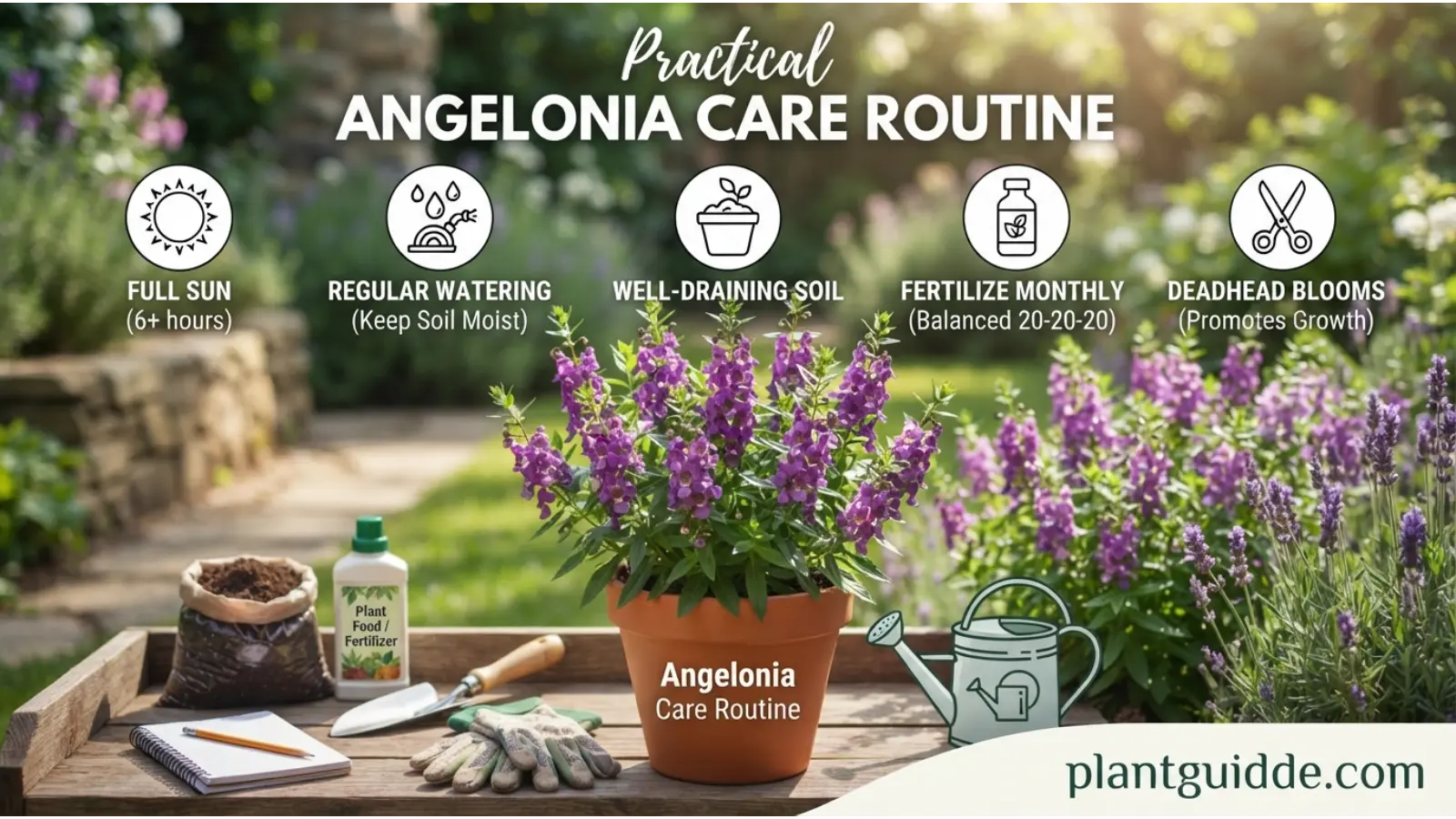
Weekly: Inspect leaves, flower spikes, stems, and soil moisture. Look for aphids, disease symptoms, or unusual wilting.
During hot weather: Check containers more frequently because they can dry rapidly.
Monthly during active growth: Apply a light fertilizer according to the product label if the plant needs supplemental nutrition.
As needed: Remove damaged growth and trim overly long stems.
After heavy rain: Check whether the planting area drains properly rather than immediately watering again.
At the end of the growing season: In cold climates, decide whether to replace the plant next season or attempt to protect a container-grown specimen from freezing temperatures.
FAQs:
How much sun does angelonia need?
Angelonia performs best in full sun, with around six or more hours of direct sunlight being a useful target. Strong light encourages compact growth and better flowering.
How often should I water angelonia?
Water regularly while the plant is establishing, then adjust according to soil moisture, temperature, rainfall, and whether it is planted in the ground or a container. Established plants tolerate some drying between waterings, but they should not repeatedly suffer severe drought.
Does angelonia need deadheading?
Not always. Many modern varieties are bred to flower continuously without frequent deadheading. Removing spent flower spikes can still improve appearance and may encourage additional flowering in some cultivars.
Why is my angelonia not blooming?
Insufficient sunlight and excessive fertilizer are two important possibilities. Check that the plant receives strong direct light and avoid overfeeding, especially with high-nitrogen fertilizer.
Can angelonia grow in pots?
Yes. Angelonia is well suited to containers. Use a pot with drainage holes and quality potting mix, and monitor moisture more frequently during hot weather because containers dry faster than garden soil.
Final Thoughts
Successful angelonia plant care is less about constant maintenance and more about giving the plant the conditions it naturally prefers. Start with full sun, fertile well-draining soil, reliable moisture during establishment, and moderate feeding. Once the roots are established, angelonia can handle heat and short dry periods while continuing to produce attractive flowers.
Angelonia plant care your plant is struggling, resist the temptation to immediately add more water or fertilizer. Check the basics first: light, soil drainage, moisture, and nutrition. Those four factors explain many of the most common angelonia problems and are usually the best place to begin.

Asad Mumtaz is a dedicated plant enthusiast and gardening writer with a passion for helping people care for their plants successfully. He specializes in plant care guides, indoor gardening, and practical growing tips for all skill levels. His content focuses on making gardening simple, enjoyable, and rewarding. Through his work, Asad shares reliable advice to help readers create thriving green spaces.