Kalanchoe is an easy-care houseplant, but its succulent nature means it needs a different approach from typical leafy indoor plants. With thick, water-storing leaves, it handles dry conditions well but can struggle when its roots stay wet for too long. how to care for a kalanchoe plant indoors.
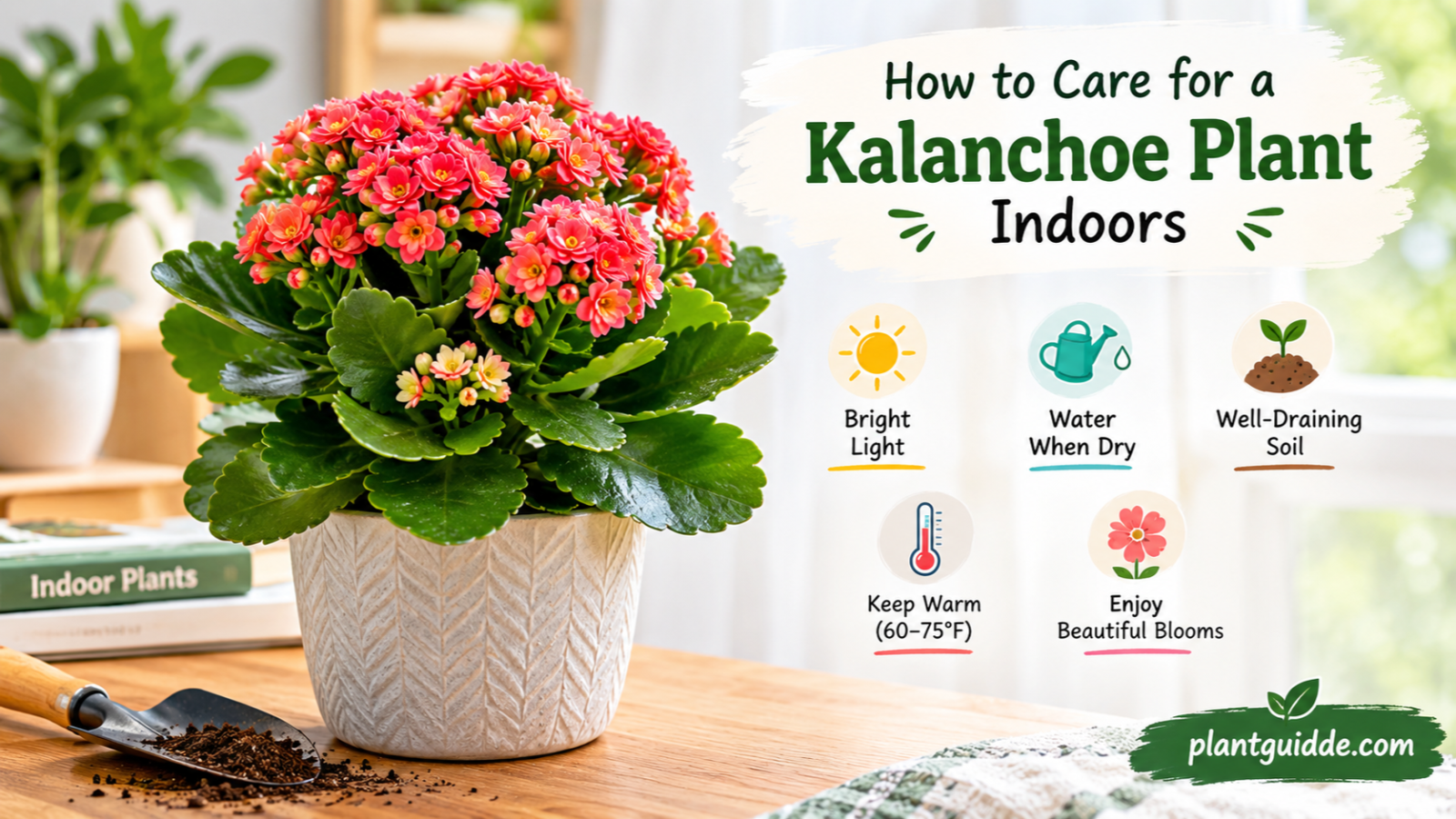
If you’re learning how to care for a kalanchoe plant indoors, focus on three essentials: bright light, well-draining soil, and thorough watering only after the soil has dried. Getting these basics right can help prevent yellow leaves, soft stems, root problems, and poor flowering.
This guide explains what your kalanchoe needs to stay healthy and how to spot common problems before they become serious.
Quick Answer
To care for a kalanchoe plant indoors, place it in bright light, preferably near an east- or south-facing window where it receives several hours of strong light without harsh afternoon sun. Use a fast-draining succulent or cactus mix in a pot with drainage holes. Water thoroughly only after the soil has dried significantly, then empty excess water. Keep it warm, provide good airflow, fertilize lightly during active growth, and remove spent flowers to encourage a tidy, healthy plant.
Understanding Kalanchoe Before You Start
The name kalanchoe covers a large group of succulent plants, but the flowering houseplant most commonly sold indoors is Kalanchoe blossfeldiana, also known as florist kalanchoe or flaming Katy.
It belongs to the Crassulaceae family and is native to northeastern Madagascar. Its thick, fleshy leaves are adapted to storing water, which explains why it responds differently to watering than moisture-loving tropical houseplants.
A typical flowering kalanchoe can produce clusters of red, pink, orange, yellow, or white flowers. Compact cultivars are particularly popular as indoor container plants.
Understanding this succulent growth habit makes the rest of kalanchoe care indoors much easier.
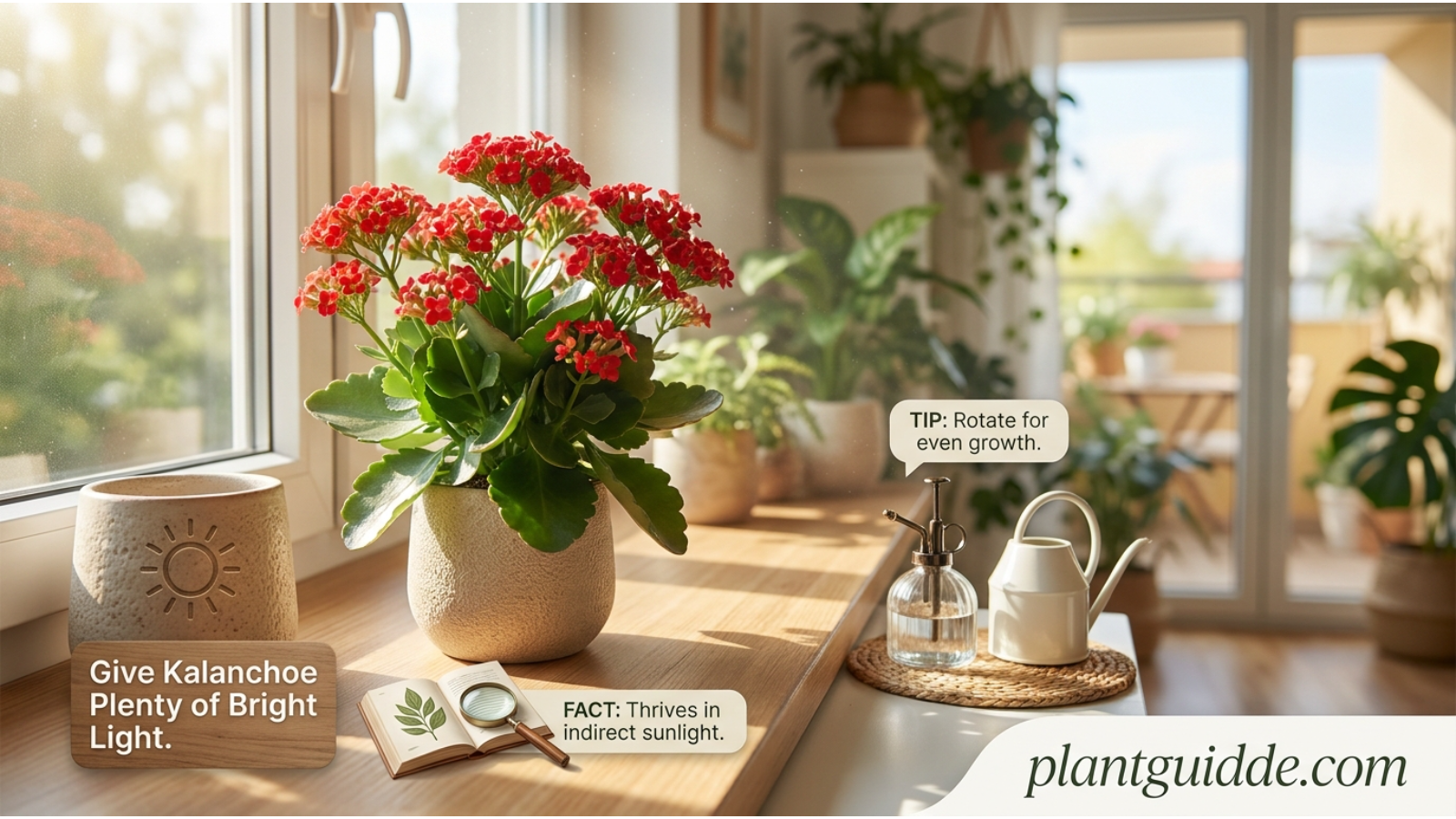
Give Kalanchoe Plenty of Bright Light
Light is one of the most important factors in successful kalanchoe care.
Kalanchoe prefers bright light and can tolerate some direct sunlight, but prolonged intense afternoon sun through glass can scorch the leaves. North Carolina Extension recommends bright indirect light or partial shade and notes that prolonged direct sun can cause leaf scorching.
Where should you place a kalanchoe indoors?
Good locations include:
- Near an east-facing window
- Near a bright south-facing window with some protection from intense afternoon sun
- Near a west-facing window if harsh afternoon rays are filtered
- A bright room supplemented with a grow light when natural light is inadequate
The goal isn’t simply to find the brightest window in your home. You want strong usable light without excessive heat and leaf scorch.
Signs your kalanchoe needs more light
Watch for:
- Long, weak stems
- Large gaps between leaves
- Pale or dull foliage
- Leaning toward the window
- Reduced flowering
- New growth that looks thin
If the plant is becoming stretched, gradually move it toward a brighter location rather than suddenly placing it in intense direct sun.
What if the leaves develop brown or bleached patches?
That can indicate excessive direct sunlight, particularly Kalanchoe Plant Indoors the damage appears on the side facing the window.
Move the plant slightly farther from the glass or filter the strongest afternoon sunlight.
Image Suggestion: Diagram showing ideal kalanchoe placement near east, south, and west windows, including examples of too little light and excessive direct afternoon sun.
Water Kalanchoe Only When the Soil Has Dried
Watering is where many indoor kalanchoes fail.
Because kalanchoe stores water in its leaves, it does not need consistently damp soil. Allowing the growing medium to dry between waterings helps reduce the risk of root and stem rot. Both North Carolina Extension and Missouri Botanical Garden identify kalanchoe as a plant that benefits from drying between waterings.
How to know when your kalanchoe needs water
Don’t rely entirely on a calendar.
Instead:
- Push your finger into the soil.
- Check whether the upper and middle portion of the potting mix feels dry.
- Lift the pot if possible and notice whether it feels unusually light.
- Check the leaves for overall firmness.
- If the soil is still damp, wait.
The exact interval can vary dramatically depending on pot size, light, temperature, soil composition, and season.
A kalanchoe in a small porous pot near a sunny window may dry much faster than one sitting in a large plastic pot in a dim room.
How to water kalanchoe correctly
When the soil has dried sufficiently:
- Water slowly and thoroughly.
- Continue until water begins draining from the bottom.
- Allow excess water to leave the pot completely.
- Empty the saucer or decorative cover pot.
- Do not allow the container to sit in standing water.
The important distinction is deep watering followed by drying, rather than giving the plant tiny amounts of water every few days.
A common mistake
Many beginners see slightly wrinkled leaves and immediately add water.
Sometimes that is appropriate. But if the soil is already wet, adding more water can make the underlying problem worse.
Check the soil before diagnosing the leaves.
Use Fast-Draining Kalanchoe Soil
Kalanchoe needs a growing medium that allows water to move through the root zone rather than remaining trapped around the roots.
A commercial cactus or succulent potting mix is a convenient starting point. North Carolina Extension recommends a well-drained potting mix suitable for cactus or succulents, while the RHS recommends a well-drained, gritty growing medium for Kalanchoe blossfeldiana.
What makes good kalanchoe soil?
Look for a mix that:
- Drains quickly
- Contains plenty of mineral or coarse material
- Doesn’t remain muddy after watering
- Allows air to reach the roots
- Doesn’t compact easily
If your current mix stays wet for many days, changing the watering schedule alone may not solve the problem.
The soil itself may be holding too much moisture.
Can you use ordinary houseplant soil?
You can, but straight houseplant soil is often too moisture-retentive for a succulent such as kalanchoe.
A better approach is to improve drainage by incorporating suitable gritty or mineral material or using a purpose-made succulent mix.
Choose a Pot With Drainage Holes
A drainage hole is not a minor feature for kalanchoe. It is one of the most useful protections against chronic overwatering.
The container should allow excess water to escape freely.
Avoid
- Pots with no drainage hole
- Oversized containers
- Decorative cachepots that trap water
- Containers where the drainage hole is blocked
A large pot can also create problems because a greater volume of soil may stay wet around the roots for too long.
Choose a pot that is only modestly larger than the existing root system when repotting.
Expert Tip: Kalanchoe Plant Indoors you use a decorative cover pot, remove the nursery pot when watering, let it drain completely, and then return it to the cover pot.
Keep Kalanchoe Warm and Away From Drafts
Kalanchoe is a warm-climate plant and does not appreciate frost or sudden cold conditions.
North Carolina Extension lists approximately 60°F (16°C) at night and 70°F (21°C) during the day as preferred temperatures for Kalanchoe blossfeldiana and notes that it is intolerant of frost.
Indoors, the bigger concern is often temperature fluctuation.
Keep the plant away from:
- Cold drafts
- Frequently opened exterior doors
- Very cold windows in winter
- Heating vents
- Radiators
- Strong air-conditioning airflow
You don’t need to create a tropical greenhouse environment. A stable indoor location is usually more valuable than constantly changing the plant’s surroundings.
Don’t Overcomplicate Humidity
Unlike many tropical houseplants, kalanchoe does not require extremely humid air.
Its succulent leaves are designed to conserve water, so increasing humidity isn’t usually the first solution when a kalanchoe looks stressed.
Instead, prioritize:
- Bright light
- Appropriate watering
- Fast drainage
- Good airflow
- Stable temperature
Kalanchoe Plant Indoors the plant is sitting in a poorly ventilated, constantly damp environment, increasing humidity may actually create more problems rather than solving them.
Fertilize Kalanchoe Lightly
Kalanchoe doesn’t require heavy feeding.
The RHS recommends applying a balanced liquid fertilizer two or three times during the growing season for Kalanchoe blossfeldiana.
A practical approach is to use a balanced houseplant or succulent fertilizer at the label-recommended diluted rate during active growth.
Avoid the temptation to fertilize every time you water.
Why too much fertilizer can be a problem
Excess fertilizer can contribute to salt buildup in the potting medium and may damage roots. It also doesn’t compensate for inadequate light.
If your kalanchoe is weak and pale, check its light before assuming it needs more fertilizer.
Prune and Deadhead Spent Flowers
Once the flowers fade, remove the spent flower clusters.
Deadheading improves the plant’s appearance and prevents old flower clusters from dominating the plant.
You can also remove damaged, dead, or badly declining leaves with clean scissors.
Kalanchoe Plant Indoors the plant has become stretched or uneven, light pruning after flowering can help encourage a more compact appearance.
Don’t remove large amounts of healthy foliage simply because you want the plant to look smaller. The leaves are important energy-producing structures.
How to Get Kalanchoe to Bloom Again
One of the most common questions after purchasing a flowering kalanchoe is:
“Why won’t my kalanchoe bloom again?”
The answer is often related to light and the plant’s flowering cycle.
Kalanchoe blossfeldiana is a short-day plant, meaning flowering is influenced by the length of the uninterrupted dark period. North Carolina Extension recommends approximately 6–8 hours of bright light daily for growth and notes that flowering can be encouraged by providing about 14 hours of darkness per day for at least six weeks during the appropriate period.
Kalanchoe Plant Indoors is one reason a kalanchoe may bloom beautifully when purchased but fail to rebloom naturally in a living room.
A practical reblooming routine
After flowering:
- Continue providing strong daytime light.
- Keep the plant healthy rather than heavily fertilizing it.
- Maintain consistent watering without keeping the soil wet.
- Provide long, uninterrupted nights when encouraging flowering.
- Continue the dark-period routine consistently for several weeks.
- Return to normal bright-light conditions when flower buds begin developing.
Even a room light left on late at night can interfere with the uninterrupted-darkness requirement.
Expert Tip: Kalanchoe Plant Indoors your kalanchoe sits in a room where lights remain on every evening, inconsistent darkness may be the reason it grows well but refuses to flower.
Common Kalanchoe Problems and What They Mean
Kalanchoe Leaves Turning Yellow
Yellow leaves are not automatically a sign that the plant needs more water.
Possible causes include:
- Overwatering
- Poor drainage
- Low light
- Natural aging of older leaves
- Root damage
What to check first
Feel the soil.
If it is consistently wet, stop watering and investigate the drainage and potting mix.
If the soil is dry but the plant is also receiving very little light, move it gradually to a brighter location.
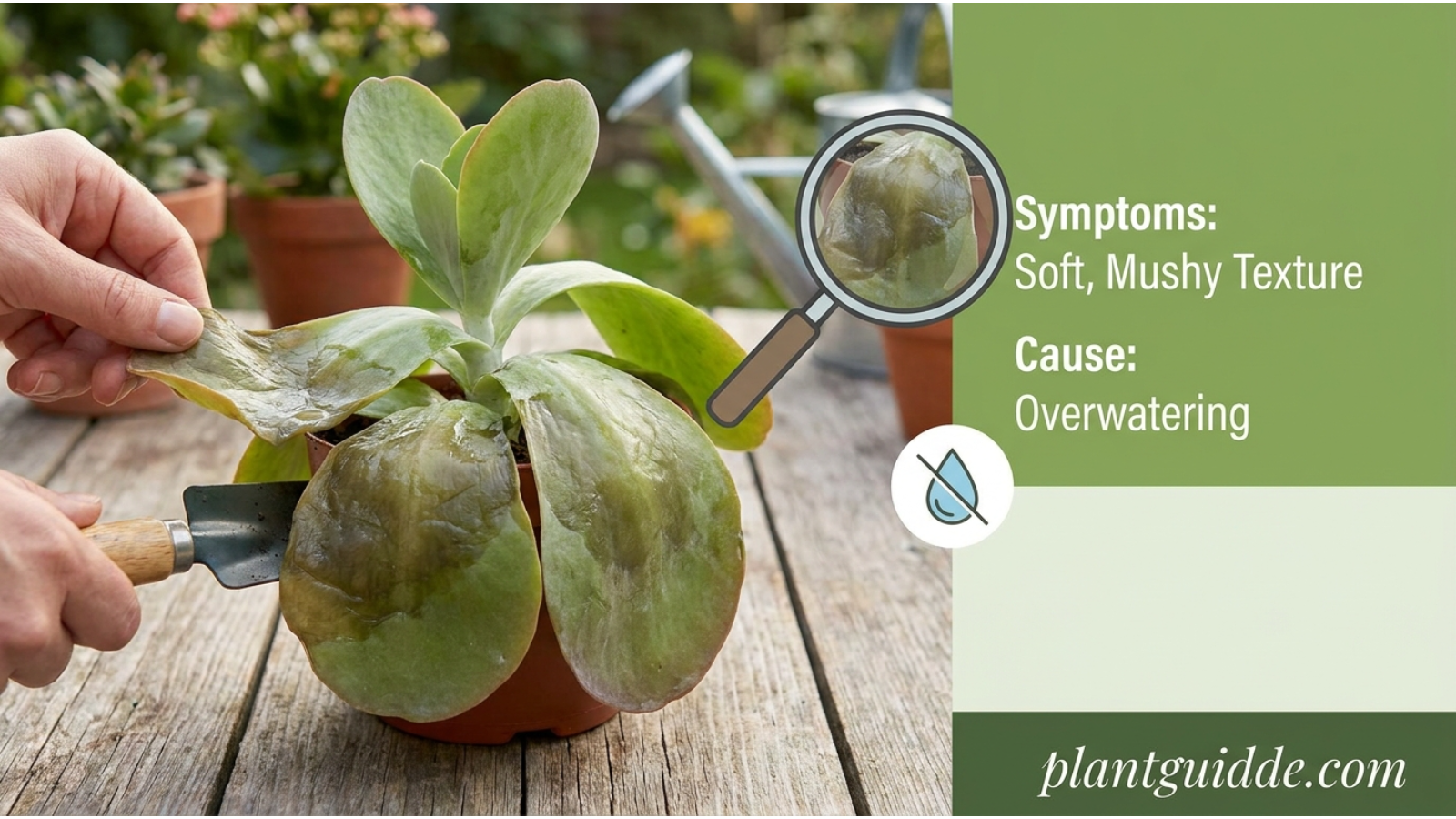
Kalanchoe Leaves Are Soft or Mushy
Soft, mushy leaves are more concerning than slightly wrinkled leaves.
They can indicate excessive moisture or tissue damage.
Check:
- Soil moisture
- Drainage
- Stem firmness
- Root condition
- Whether water has been collecting in the saucer
Overwatering can contribute to root and stem rot in kalanchoe.
Kalanchoe Plant Indoors the base of the plant is becoming soft or dark, act quickly rather than continuing the normal watering routine.
Kalanchoe Leaves Are Wrinkled
Wrinkled or slightly shriveled leaves can indicate that the plant is using its stored water.
Check the soil before watering.
If the soil is dry:
Give the plant a thorough watering and allow the excess to drain.
If the soil is wet:
Don’t automatically add more water.
Wet soil combined with wrinkled leaves can indicate damaged roots that are no longer functioning properly.
This distinction is easy to overlook.
Kalanchoe Leaves Are Drooping
Drooping can result from several different conditions.
Possible causes include:
- Underwatering
- Root damage
- Excessive heat
- Sudden environmental change
- Poor light combined with watering problems
The fastest way to narrow down the cause is to inspect the soil and roots rather than treating the symptom blindly.
Kalanchoe Has Brown or Crispy Leaves
Brown, crispy areas may result from:
- Excessive direct sunlight
- Severe dryness
- Heat stress
- Physical damage
- Root problems affecting water uptake
Look at the location of the damage.
If only the window-facing side is developing bleached or brown patches, excessive sunlight is worth investigating.
Kalanchoe Is Not Flowering
Kalanchoe Plant Indoors the plant is healthy but produces foliage without flowers, consider:
- Insufficient light
- Lack of an appropriate dark period
- Recent changes in the environment
- Excessive nitrogen fertilization
- The plant simply being between flowering cycles
Don’t respond by automatically increasing fertilizer.
Light and photoperiod are usually more important factors to investigate.
Kalanchoe Has Small Bugs
Kalanchoe can be affected by pests including aphids, mealybugs, and spider mites.
Inspect:
- Leaf undersides
- Stem joints
- New growth
- Areas where leaves meet stems
Mealybugs often appear as small cottony masses, while spider mite activity may produce fine webbing and stippled or dull-looking foliage.
Isolate an affected plant from nearby houseplants while you identify and address the infestation.
A Simple Kalanchoe Care Schedule
Instead of following a rigid weekly watering calendar, use the plant’s conditions as your guide.
| Task | What to Do |
|---|---|
| Light | Keep in a bright location with strong indirect light or suitable direct morning light |
| Watering | Allow the soil to dry significantly before watering thoroughly |
| Soil | Use a fast-draining cactus or succulent mix |
| Pot | Always use drainage holes |
| Temperature | Keep conditions warm and stable; protect from frost |
| Fertilizer | Feed lightly during active growth |
| Pruning | Remove dead leaves and spent flowers |
| Flowering | Provide strong light and appropriate uninterrupted darkness |
| Pest checks | Inspect leaves and stems regularly |
| Repotting | Repot when the existing medium has degraded or the plant has outgrown its container |
The schedule should change with your home’s conditions.
A plant in bright summer light may use water much faster than the same plant during a darker winter period.
Seasonal Kalanchoe Care
Spring
Spring is often a good time for active growth and maintenance.
- Increase watering only as the plant begins using water more quickly.
- Resume or increase light feeding during active growth.
- Prune after flowering if necessary.
- Consider repotting if the growing medium has become compacted or drainage has deteriorated.
Summer
Bright light and heat can increase water use.
Check the soil more frequently, but don’t water simply because the weather is hot.
Kalanchoe Plant Indoors the plant sits directly against hot glass, move it back slightly or filter intense afternoon sunlight.
Fall
Fall is an important period if you want to encourage flowering.
Maintain good light while paying attention to the plant’s dark period.
Reduce watering if the plant’s soil is drying more slowly.
Winter
Winter usually means slower growth and lower water consumption indoors.
Do not maintain a summer watering routine automatically.
If the plant is receiving less light and the soil stays wet for longer, increase the interval between waterings.
How to Repot a Kalanchoe
You don’t need to repot kalanchoe every year simply because a calendar says so.
Consider repotting when:
- The soil drains poorly
- The potting mix has broken down
- Roots are severely crowded
- The plant repeatedly stays wet for too long
- The container has become unstable
- The plant has clearly outgrown its current pot
Step-by-step
- Choose a container with drainage holes.
- Select a pot only modestly larger than the existing root ball.
- Prepare a fast-draining succulent mix.
- Remove the plant carefully.
- Inspect the roots for obvious damage.
- Remove severely damaged material with clean tools if necessary.
- Place the plant at approximately the same depth as before.
- Fill around the root ball with fresh mix.
- Avoid compacting the soil excessively.
- Give the plant time to settle into its new container.
Avoid placing a small kalanchoe into a huge pot “so it has room to grow.” The extra wet soil can stay moist longer than the roots can use it.
Can You Propagate Kalanchoe?
Yes. Many kalanchoes can be propagated from stem or leaf cuttings, and some species also produce offsets or plantlets. Kalanchoe blossfeldiana can be propagated using stem or leaf cuttings.
For a simple stem-cutting method:
- Select a healthy stem.
- Cut it with a clean, sharp tool.
- Allow the cut end to dry and callus briefly.
- Place it into a suitable, well-draining propagation medium.
- Keep moisture controlled rather than keeping the medium saturated.
- Provide bright, indirect light.
- Wait for rooting before treating the cutting like an established plant.
Propagation is especially useful when pruning a leggy plant because healthy cuttings can become new plants.
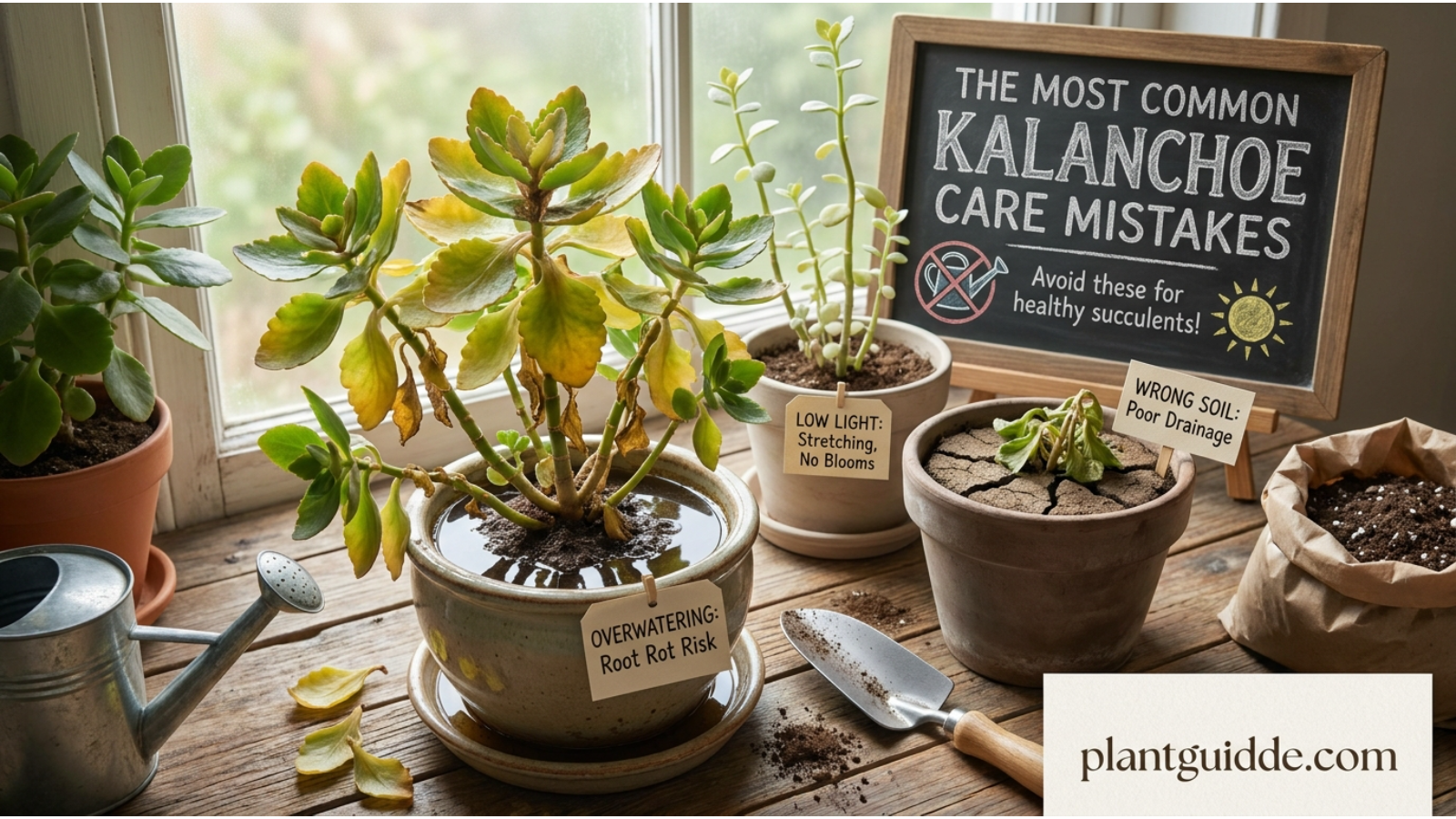
The Most Common Kalanchoe Care Mistakes
1. Watering on a fixed schedule
“Every Sunday” is not a reliable watering rule.
Your plant doesn’t know what day it is. Its water requirements change with light, temperature, pot size, soil, and season.
2. Using a pot without drainage
This creates unnecessary risk for a succulent that already dislikes prolonged wet soil.
3. Keeping the soil constantly damp
Kalanchoe stores water in its leaves. Constantly wet roots are not an advantage.
4. Putting it in a dark room
The plant may survive for some time, but poor light can lead to weak growth and reduced flowering.
5. Moving it suddenly into intense sunlight
A plant accustomed to indoor filtered light can suffer leaf scorch when abruptly exposed to strong direct sun.
6. Fertilizing to fix every problem
Fertilizer cannot compensate for poor light, damaged roots, or inappropriate watering.
7. Ignoring the plant after flowering
Flowering is not the end of the plant’s useful life. With proper light, watering, and photoperiod management, kalanchoe can continue growing and potentially rebloom.
A Better Way to Diagnose Kalanchoe Problems
Instead of asking only, “What is wrong with my kalanchoe?”, work through the environment in this order:
Step 1: Check the light
Is the plant actually receiving bright enough light?
Step 2: Check the soil
Is it dry, slightly moist, or staying wet for an unusually long time?
Step 3: Check the pot
Does excess water have somewhere to escape?
Step 4: Check the roots and stem
If the plant looks dehydrated despite wet soil, root damage may be involved.
Step 5: Check temperature
Has the plant recently experienced a cold draft, intense heat, or a major location change?
Step 6: Check for pests
Look closely at the undersides of leaves and stem joints.
Step 7: Change one major factor at a time
This is an overlooked but valuable habit.
If you simultaneously move the plant, repot it, fertilize it, increase watering, and change the light, you won’t know which change helped or hurt.
Kalanchoe Care: What Healthy Growth Looks Like
A healthy indoor kalanchoe generally has:
- Firm, fleshy leaves
- Strong green foliage
- Compact growth
- New growth at the tips
- A firm stem
- Drying soil between thorough waterings
- No persistent standing water
- Healthy roots
- Flowers when environmental and seasonal conditions support blooming
Remember that a kalanchoe doesn’t need to look perfectly lush every day.
A slight reduction in growth during a darker season can be normal. The more useful question is whether the plant’s overall condition is stable and whether new growth looks healthy.
FAQs:
How often should I water a kalanchoe indoors?
Water when the soil has dried significantly rather than following a fixed weekly schedule. Then water thoroughly and allow excess water to drain completely. The interval can vary considerably depending on light, temperature, pot size, and soil.
Does kalanchoe need direct sunlight?
Kalanchoe needs bright light, but it does not necessarily need intense all-day direct sun. Bright indirect light or suitable morning sun can work well. Strong afternoon sunlight through glass may scorch the leaves.
Why are my kalanchoe leaves turning yellow?
Overwatering and poor drainage are common possibilities, but low light and natural aging of older leaves can also contribute. Check the soil before changing your watering routine.
Should I mist my kalanchoe?
Usually, misting isn’t necessary. Kalanchoe is a succulent and generally benefits more from good drainage, appropriate watering, bright light, and airflow than from increased humidity.
What is the best soil for kalanchoe?
Use a fast-draining cactus or succulent potting mix. The goal is to prevent water from remaining around the roots for extended periods.
Can kalanchoe grow in low light?
It may survive in lower light for a period, but bright light is much better for strong growth and flowering. Insufficient light can contribute to weak, stretched growth and poor blooming.
Why is my kalanchoe not flowering again?
Insufficient light and an inconsistent dark period are common factors. Kalanchoe blossfeldiana responds to photoperiod, and North Carolina Extension recommends a prolonged period of approximately 14 hours of uninterrupted darkness to help initiate flowering.
Should I cut off dead kalanchoe flowers?
Yes. Removing spent flower clusters improves appearance and helps redirect the plant’s energy toward continued growth rather than leaving old flower heads attached.
Can kalanchoe survive being underwatered?
Yes, kalanchoe is relatively drought tolerant because its succulent leaves store water. However, prolonged severe dryness can eventually cause shriveling, stress, and leaf loss.
Is kalanchoe poisonous to pets?
Yes. Kalanchoe can be harmful if eaten by pets. The RHS lists Kalanchoe blossfeldiana as potentially harmful to dogs, cats, rabbits, rodents, and caged birds, while North Carolina Extension also advises keeping the plant away from children, dogs, and cats because of toxicity if ingested.
Final Takeaways
Learning how to care for a kalanchoe plant indoors becomes much easier once you treat it like the succulent it is.
Give it bright light, fast-draining soil, a container with drainage, and thorough but infrequent watering. Let the soil dry between waterings instead of keeping it constantly damp. Keep temperatures reasonably stable, fertilize modestly during active growth, remove spent flowers, and pay attention to the plant’s light and dark cycles if you want it to bloom again.
The biggest mistake is usually not forgetting to water. It is watering before the plant actually needs it.
When something goes wrong, don’t immediately add fertilizer or more water. Check the light, soil, drainage, roots, and temperature first. Once those fundamentals are right, kalanchoe is one of the more forgiving flowering succulents you can grow indoors.

Asad Mumtaz is a dedicated plant enthusiast and gardening writer with a passion for helping people care for their plants successfully. He specializes in plant care guides, indoor gardening, and practical growing tips for all skill levels. His content focuses on making gardening simple, enjoyable, and rewarding. Through his work, Asad shares reliable advice to help readers create thriving green spaces.