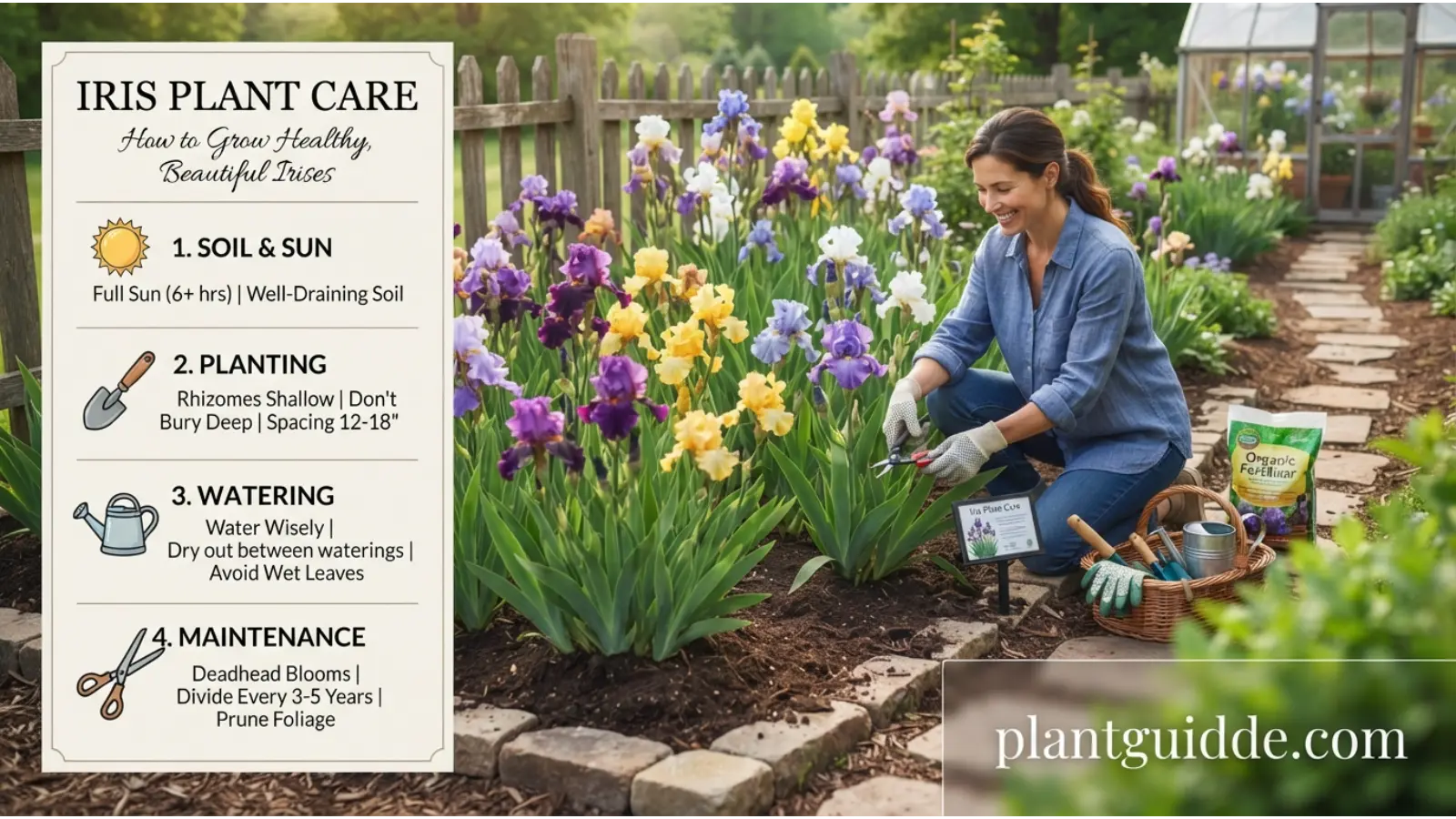
Irises are among the most rewarding flowering plants for gardeners because their flowers can be striking while their foliage remains attractive after blooming. However, successful iris plant care is not simply a matter of planting them and watering regularly.
The biggest problems usually begin when an iris is planted too deeply, grown in poorly drained soil, given insufficient sunlight, or kept consistently wet. Bearded irises are especially sensitive to buried or waterlogged rhizomes, while moisture-loving types such as Japanese iris have different requirements.
The key is to identify the type of iris you have and then match its growing conditions to its natural preferences.
Quick Answer
Iris plant care is mainly about giving irises the right balance of sunlight, well-draining soil, moisture, and airflow. Most garden irises grow best in full sun and soil that does not remain soggy.
Water deeply when needed, avoid constantly wet roots, remove spent flowers, and divide crowded rhizomes every few years. The exact care routine depends on whether you are growing bearded iris, Siberian iris, Japanese iris, or another type.
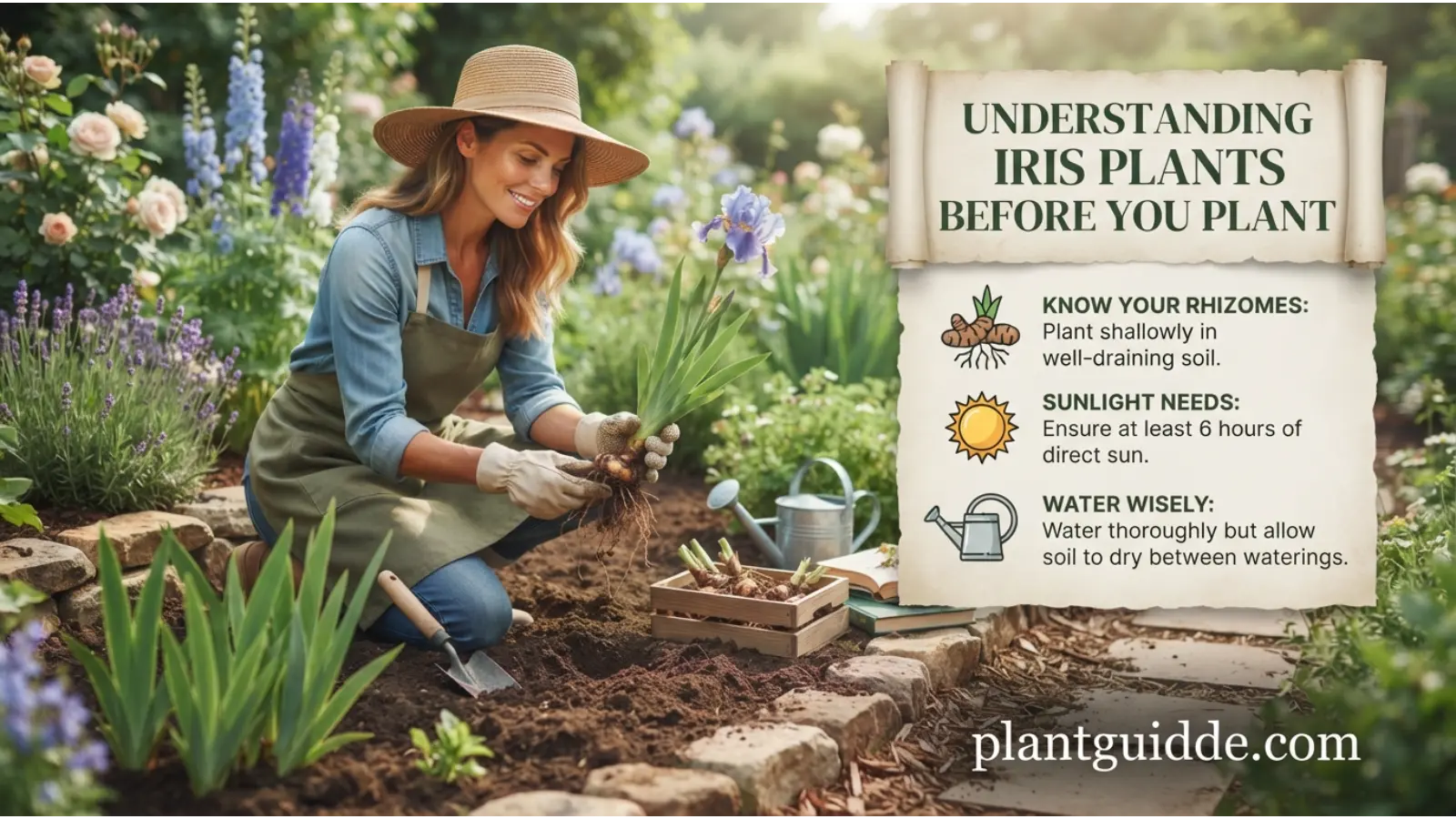
Understanding Iris Plants Before You Plant
Iris is a large genus containing many different species and garden types. They do not all want exactly the same conditions.
Common garden irises include:
- Bearded iris: Often grown from thick underground rhizomes and known for large flowers with fuzzy “beards” on their falls.
- Siberian iris: Generally more tolerant of consistently moist soil than bearded iris.
- Japanese iris: Prefers more moisture and performs particularly well where soil remains evenly moist.
- Dutch iris: Usually grown from bulbs and commonly used for spring flowers.
- Louisiana iris: Adapted to moist conditions and often performs well near water gardens.
This distinction matters because advice that works for a bearded iris can be unsuitable for a Japanese iris.
For example, keeping a bearded iris constantly wet can encourage rhizome problems, whereas allowing a moisture-loving Japanese iris to become excessively dry can reduce its performance.
Where Should You Plant an Iris?
Most commonly grown garden irises perform best in a location with plenty of sunlight and good air circulation.
Light requirements
For many iris varieties, full sun is the safest starting point. Aim for around six or more hours of direct sunlight when the specific variety permits it.
Adequate sunlight supports:
- Stronger flowering
- More compact growth
- Healthier foliage
- Better air circulation around the plant
- Reduced risk of overly weak, stretched growth
Some irises can tolerate partial shade, particularly in hot climates, but heavy shade can reduce flowering.
Iris plant care your iris produces lots of leaves but very few flowers, insufficient sunlight is one of the first conditions worth checking.
Practical tip: Morning sun is particularly useful in warm climates because it helps dry foliage after overnight moisture while avoiding some of the harshest afternoon heat.
The Best Soil for Iris Plants
Good drainage is one of the most important parts of iris plant care.
For bearded irises especially, heavy soil that remains wet for long periods can create serious problems. Water should move away from the root zone rather than remaining trapped around the rhizomes.
An ideal growing medium should:
- Drain excess water efficiently
- Hold enough moisture for healthy roots
- Contain organic matter without becoming waterlogged
- Resist severe compaction
If your garden has heavy clay soil, improve the planting area with appropriate organic matter and consider growing irises in a raised bed or another location with better drainage.
Avoid choosing a low spot where rainwater naturally collects.
Should you use compost?
Compost can improve soil structure and fertility, but more is not always better. Excessively rich soil combined with poor drainage can create lush foliage without solving the underlying growing problem.
For irises, healthy drainage is generally more important than creating extremely fertile soil.
How to Plant Iris Rhizomes Correctly
Planting depth is particularly important for bearded irises.
Unlike many bulbs and perennial roots that benefit from being planted deeply, a bearded iris rhizome generally performs best when it is positioned close to the soil surface.
Step-by-step planting
- Choose a sunny location with good drainage.
- Loosen the soil before planting.
- Make a shallow planting area for the rhizome.
- Position the roots downward and outward into the soil.
- Keep the upper surface of a bearded iris rhizome exposed or only lightly covered according to the variety and local conditions.
- Firm the soil gently around the roots.
- Water thoroughly after planting.
- Allow excess water to drain away.
One common beginner mistake is burying the rhizome deeply because it seems logical that deeper planting provides greater protection. For bearded iris, this can instead create conditions that encourage rhizome deterioration and poor flowering.
Image Suggestion: Close-up garden illustration showing the correct planting depth of a bearded iris rhizome compared with an incorrectly buried rhizome.
How Often Should You Water Iris Plants?
Iris watering depends on the species, weather, soil, plant age, and growing location.
Rather than following a rigid calendar, check the soil and observe the plant.
Newly planted irises need enough moisture to establish their roots. Once established, many garden irises can tolerate periods of relatively dry soil better than constantly saturated conditions.
A practical approach is:
- Water deeply after planting.
- Monitor newly planted irises more closely during establishment.
- Water during prolonged dry periods.
- Allow the soil to dry appropriately between watering for types that dislike wet conditions.
- Increase attention during periods of extreme heat.
- Reduce unnecessary watering during rainy weather.
How do you know an iris needs water?
Look at the soil several inches below the surface rather than judging only from the surface appearance.
Dry, hot weather can make the upper layer look dry even when moisture remains available deeper in the soil.
Conversely, constantly wet soil may look harmless while roots or rhizomes are already under stress.
The goal is not to keep the soil permanently wet. It is to provide moisture when the plant actually needs it while maintaining sufficient oxygen around the roots.
Fertilizing Iris Plants
Irises generally do not need aggressive fertilization to produce attractive growth.
A soil test can be useful when plants repeatedly perform poorly despite appropriate light, watering, planting depth, and drainage.
When fertilizer is needed, avoid applying excessive nitrogen simply to encourage more foliage. Too much nitrogen can promote lush vegetative growth at the expense of balanced flowering and may make some plants more susceptible to certain problems.
A sensible approach is to:
- Start with reasonably fertile soil.
- Use a balanced or iris-appropriate fertilizer when necessary.
- Follow the product’s application rate.
- Avoid placing concentrated fertilizer directly against rhizomes.
- Do not assume poor flowering automatically means the plant needs more fertilizer.
If an iris has abundant healthy leaves but refuses to flower, check sunlight, overcrowding, planting depth, and recent division before reaching for more fertilizer.
How to Care for Iris During Flowering
When irises begin blooming, a little maintenance can help keep the plant attractive and redirect energy toward future growth.
Remove spent flowers
Once individual flowers fade, remove them carefully.
This prevents the plant from spending unnecessary energy on seed production when seed development is not your goal.
After the flowering period ends, leave healthy foliage in place rather than cutting it down immediately.
Why should iris leaves be left alone?
Iris foliage continues photosynthesizing after flowering. Those leaves help the plant store energy for future growth and flowering.
Cutting healthy leaves down too early can weaken the plant over time.
Instead, remove foliage when it has naturally declined or when seasonal conditions make pruning appropriate for your specific iris type.
When and How to Divide Iris Plants
Crowded irises often benefit from division.
Over time, rhizomes can become tightly packed, and flowering may decline as plants compete for space and resources.
Signs that division may be useful include:
- Fewer flowers than in previous years
- A dense, crowded clump
- Rhizomes pushing into one another
- Flowers appearing mainly around the outer edges
- Plants becoming congested
- A noticeable decline in vigor despite otherwise good care
For many bearded irises, division is commonly performed after flowering when the plants have time to establish before colder weather.
Basic iris division process
- Dig around the clump carefully.
- Lift the rhizomes from the soil.
- Separate healthy sections using a clean, sharp knife if necessary.
- Discard damaged, severely diseased, or soft sections.
- Trim excessive foliage if appropriate.
- Replant healthy divisions at the correct depth.
- Water them thoroughly after planting.
- Give the new divisions time to establish.
Avoid keeping every small or damaged piece simply because it is part of the original plant. Healthy planting material gives you a much better starting point.
Iris Plant Care in Containers
Irises can be grown in containers, but container requirements differ from garden beds.
Choose a pot with:
- Drainage holes
- Enough depth for the particular iris
- Sufficient width for mature growth
- A quality, well-draining growing medium
Avoid using a container with no drainage holes.
Because containers can dry faster than garden soil, monitor moisture more frequently during hot weather. At the same time, do not compensate by keeping the soil constantly saturated.
Bearded irises can be particularly attractive in containers when their rhizomes are positioned correctly and the container receives enough sunlight.
Iris Plant Care in Different Seasons
Spring
Spring is an important period for monitoring new growth and flowering.
Check for:
- Emerging leaves
- Flower buds
- Crowded growth
- Signs of pests or disease
- Waterlogged soil after heavy rain
Avoid unnecessary disturbance while plants are actively developing.
Summer
After flowering, continue caring for the foliage.
In hot weather, monitor plants for prolonged drought, but do not automatically increase watering if the soil is already moist.
Good airflow becomes especially valuable when warm, humid conditions combine with wet foliage.
Fall
Depending on your iris type and climate, fall can be a useful period for planting or dividing.
Remove declining or diseased foliage according to the plant’s needs and local gardening conditions.
Do not confuse naturally aging leaves with disease. Healthy foliage can gradually change as the growing season ends.
Winter
Many iris types tolerate cold conditions well, particularly when planted in suitable climates.
The main concern is often not cold itself but poor winter drainage. Waterlogged soil can remain a problem when plants are dormant.
In colder regions, use winter protection only when appropriate for the specific variety and climate rather than automatically covering every iris.
Common Iris Problems and What They Mean
An unhealthy iris often gives useful clues through changes in its leaves, flowers, and rhizomes.
| Problem | Possible cause | What to check |
|---|---|---|
| Few or no flowers | Too much shade, overcrowding, immature plant, planting issues | Sunlight, spacing, rhizome depth |
| Yellowing leaves | Natural aging, watering problems, stress, disease | Soil moisture and foliage condition |
| Soft or rotting rhizome | Excess moisture, poor drainage, disease | Drainage and planting depth |
| Brown leaf tips | Heat, drought, salt buildup, environmental stress | Soil moisture and growing conditions |
| Weak, floppy growth | Insufficient light or environmental stress | Sun exposure and plant competition |
| Flowers damaged or distorted | Weather, insects, disease | Buds, petals, and nearby foliage |
| Dense overcrowded clump | Natural rhizome multiplication | Division and spacing |
The important point is not to treat every symptom with the same solution.
For example, yellow leaves do not automatically mean an iris needs more water. If the soil is already wet, additional watering could make the problem worse.
Iris Pests and Diseases
Irises can experience several pest and disease problems, and symptoms vary according to the species and growing conditions.
Potential problems include:
- Aphids
- Thrips
- Caterpillars
- Iris borers in regions where they occur
- Fungal leaf diseases
- Bacterial soft rot
- Rhizome rot
Good cultural care is an important first line of defense.
Keep plants appropriately spaced, avoid unnecessary overhead watering, remove seriously diseased plant material, and maintain good sanitation around crowded clumps.
What does iris rhizome rot look like?
A rotting rhizome may become soft, discolored, foul-smelling, or structurally degraded rather than firm and healthy.
If a bearded iris repeatedly develops soft rhizomes, investigate drainage and planting depth before simply replacing the plant.
A damaged rhizome should not be treated as though it were a normal watering problem.
Why Is My Iris Not Blooming?
This is one of the most common iris-growing questions.
If an iris produces healthy foliage but few flowers, investigate the following in order:
- Sunlight: Is it receiving enough direct light?
- Crowding: Has the clump become congested?
- Planting depth: Is a bearded iris rhizome buried too deeply?
- Plant age: Was it recently planted or divided?
- Watering: Is the plant repeatedly stressed by drought or excess moisture?
- Nutrition: Is the soil severely deficient or receiving excessive nitrogen?
- Seasonal conditions: Was the plant affected by unusual weather?
This approach is more useful than immediately adding fertilizer because flowering problems often originate from environmental conditions rather than a simple nutrient deficiency.
Common Iris Care Mistakes to Avoid
Planting bearded iris rhizomes too deeply
This is one of the easiest mistakes to make. Follow the planting requirements of your particular iris rather than treating every underground structure like a bulb.
Keeping the soil constantly wet
Regular watering does not necessarily mean healthy watering. Many irises prefer adequate moisture with periods of appropriate drying rather than permanently saturated soil.
Growing irises in heavy shade
A plant may survive in shade while flowering poorly. Survival and good performance are not the same thing.
Cutting healthy foliage too early
The leaves continue contributing energy after flowering. Removing them prematurely can reduce the plant’s ability to prepare for the next growing season.
Ignoring overcrowding
An iris clump that has become extremely congested may flower less effectively. Division can restore space and improve long-term performance.
Treating every iris the same
This is perhaps the most important mistake. A moisture-loving iris and a bearded iris should not automatically receive the same watering and planting routine.
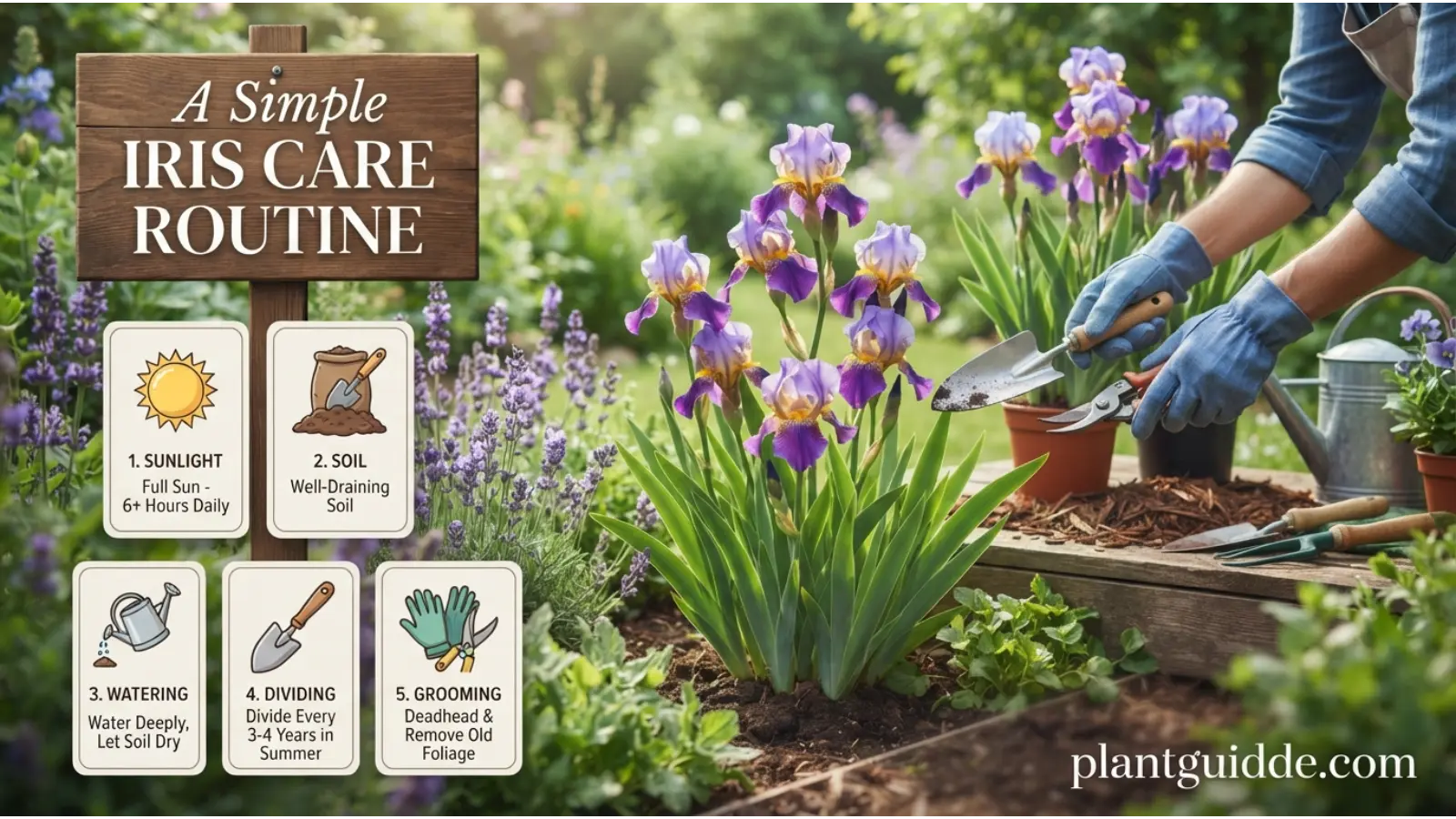
A Simple Iris Care Routine
If you want a practical routine without overcomplicating iris plant care, use this checklist:
When planting: Choose the right location, provide good drainage, and follow the planting depth required by your iris type.
During active growth: Give the plant sufficient sunlight and monitor soil moisture rather than watering automatically.
During flowering: Remove spent flowers and watch for pest or disease symptoms.
After flowering: Keep healthy foliage intact and continue appropriate watering.
When clumps become crowded: Divide them at the suitable time for the variety and climate.
Throughout the growing season: Check the plant itself. Yellow leaves, poor flowering, soft rhizomes, and weak growth are clues that something in the environment may need adjustment.
FAQs:
How much sun does an iris need?
Many garden irises perform best in full sun, commonly receiving around six or more hours of direct sunlight. Some varieties tolerate partial shade, but insufficient light can reduce flowering and produce weaker growth.
How often should I water iris plants?
Watering frequency depends on the iris type, soil, temperature, rainfall, and stage of growth. Water newly planted plants consistently during establishment, then adjust according to soil moisture. Avoid keeping varieties such as bearded iris in continuously soggy soil.
Can iris plants grow in pots?
Yes. Many irises can grow successfully in containers when the pot provides adequate drainage, sufficient space, and suitable growing conditions. Monitor container moisture more closely because pots can dry faster than garden soil.
Why are my iris leaves turning yellow?
Yellowing can result from natural leaf aging, excessive moisture, drought stress, poor drainage, pests, or disease. Check the soil and examine the foliage and rhizomes before changing your watering routine.
When should iris plants be divided?
Division timing varies by iris type and climate, but many bearded irises are divided after flowering when the plants have time to establish before colder weather. Divide overcrowded clumps using healthy rhizome sections and replant them at the appropriate depth.
Final Thoughts on Iris Plant Care
Successful iris plant care comes down to matching the growing conditions to the type of iris you have. Start with adequate sunlight, suitable soil, good drainage, and correct planting depth. Then adjust watering according to the plant and its environment rather than following an inflexible schedule.
If an iris is struggling, look at the growing conditions before adding more fertilizer or water. In many cases, the most useful solution is correcting sunlight, drainage, overcrowding, or planting depth.
For your next step, identify your iris type and check its planting depth, sunlight, and soil moisture. Those three observations can reveal more about its health than a complicated care schedule.

Asad Mumtaz is a dedicated plant enthusiast and gardening writer with a passion for helping people care for their plants successfully. He specializes in plant care guides, indoor gardening, and practical growing tips for all skill levels. His content focuses on making gardening simple, enjoyable, and rewarding. Through his work, Asad shares reliable advice to help readers create thriving green spaces.