Few houseplants can transform an indoor space as quickly as a healthy Monstera. Its large, glossy leaves, natural splits, and tropical appearance make it a favorite among beginners and experienced plant lovers. How to Care for Monstera Plant But keeping those impressive leaves healthy requires more than occasional watering.
Learning How to Care for Monstera Plant starts with creating the right balance of light, water, soil, humidity, temperature, and support. When these conditions are right, Monsteras can produce lush foliage and healthy new growth. When something is off, the plant often shows it through yellow leaves, brown edges, curling foliage, or slow growth.
The good news is that How to Care for Monstera Plant does not have to be complicated. This guide covers everything you need to know, from light and watering to soil, humidity, fertilizing, repotting, pruning, and troubleshooting common problems.
Quick Answer
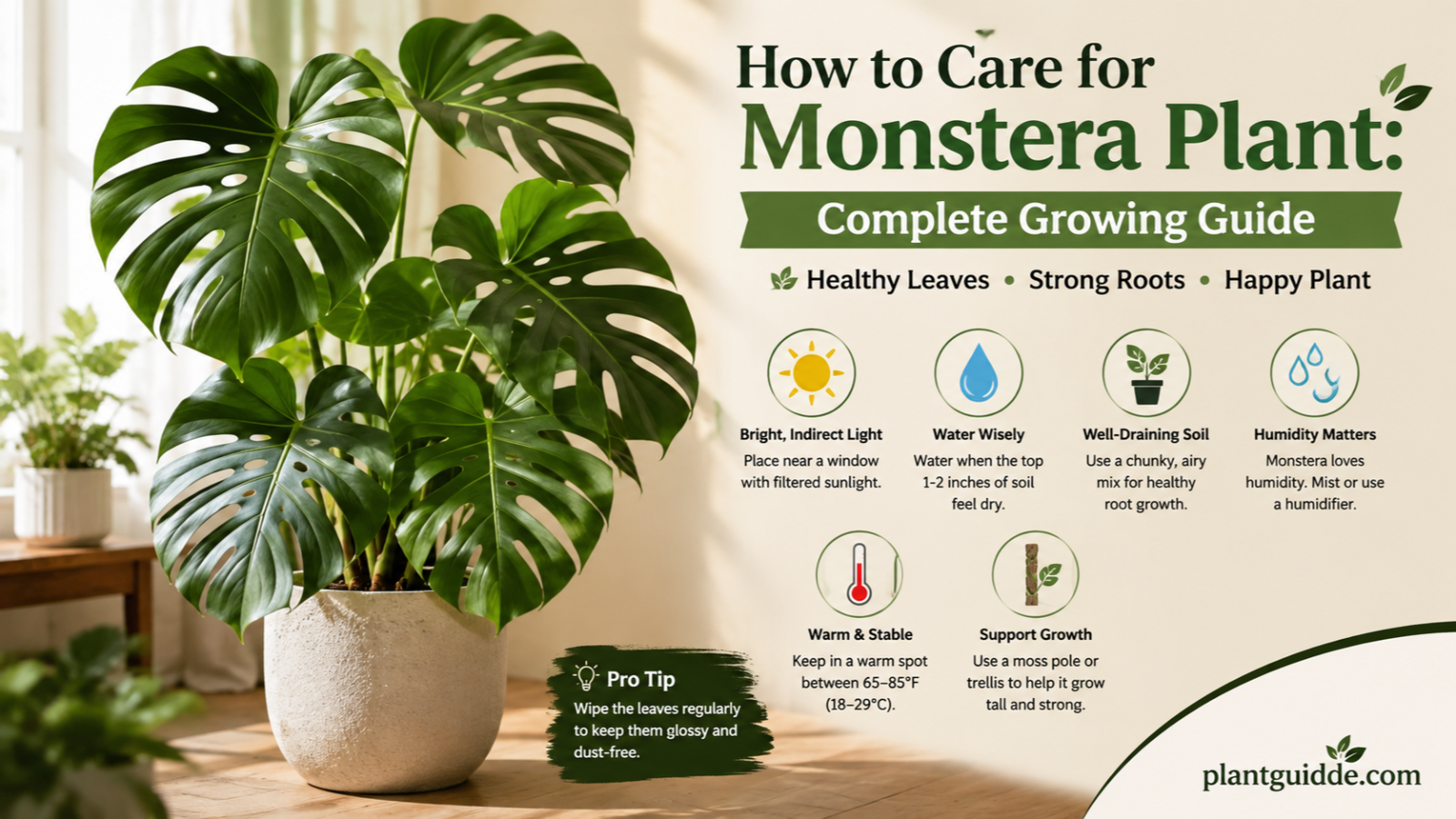
To learn how to care for a Monstera plant, place it in bright, indirect light and use a loose, well-draining potting mix. Water thoroughly when the top few inches of soil have dried, but never leave the roots sitting in water. Keep temperatures stable, provide moderate-to-high humidity, and fertilize during active growth. Give mature plants a sturdy support such as a moss pole, and regularly check the leaves and roots for signs of pests, overwatering, or inadequate light.
Understanding Your Monstera Before You Start
“Monstera” usually refers to a group of tropical plants in the genus Monstera. The most familiar houseplant is Monstera deliciosa, which is prized for its large leaves and characteristic fenestrations.
In its natural environment, Monstera is a climbing tropical plant. It uses aerial roots and surrounding vegetation to climb toward brighter conditions. This growth habit explains several things that sometimes surprise beginners:
- A mature Monstera often wants to climb rather than simply grow outward.
- Aerial roots are normal and useful.
- Larger leaves generally develop as the plant matures.
- Fenestrations become more pronounced under appropriate growing conditions.
- A plant receiving inadequate light may survive but produce weaker, smaller growth.
Image Suggestion: Botanical-style illustration showing Monstera deliciosa with leaves, aerial roots, node, petiole, and stem labeled.
Monstera Plant Care Requirements at a Glance
| Care factor | What Monstera generally prefers | What to watch for |
|---|---|---|
| Light | Bright, indirect light | Scorched leaves or weak, stretched growth |
| Water | Thorough watering after partial drying | Constantly wet or bone-dry soil |
| Soil | Airy, well-draining mix | Compacted soil that stays wet |
| Humidity | Moderate to high humidity | Persistent crispy edges |
| Temperature | Warm, stable conditions | Cold drafts and sudden temperature changes |
| Fertilizer | Regular feeding during active growth | Pale growth or fertilizer buildup |
| Support | Stake, trellis, or moss pole as needed | Flopping or sprawling stems |
| Pot | Drainage hole essential | Water collecting around roots |
The important point is that these factors work together. Increasing humidity will not compensate for severely poor lighting, and fertilizing a plant with damaged roots will not solve an overwatering problem.
Give Your Monstera the Right Light
Light is one of the biggest factors determining how successfully a Monstera grows indoors.
Monstera generally performs best in bright, indirect light. A location near a bright window can work extremely well, particularly when intense direct afternoon sun is filtered through a sheer curtain.
Why light matters
Light provides the energy the plant uses for photosynthesis. When a Monstera receives enough usable light, it has a better chance of producing vigorous new leaves and maintaining healthy foliage.
Too little light can result in:
- Slow growth
- Long gaps between leaves
- Smaller new leaves
- Weak or leaning growth
- Reduced development of fenestrations
On the other hand, suddenly placing a plant that has adapted to lower indoor light directly into intense sunlight can cause leaf scorching.
The practical approach
Rather than asking whether Monstera can tolerate “direct sunlight,” consider how intense the sunlight is and how long the plant receives it.
A bright east-facing window can be an excellent starting point. A very bright south- or west-facing window may require some filtering, especially during intense afternoon sun.
Expert tip: How to Care for Monstera Plant your Monstera is growing slowly and the soil remains wet for a long time, don’t automatically water less frequently as the only solution. Insufficient light can reduce water use, leaving the soil wet longer than expected.

How Often Should You Water a Monstera?
There is no universal watering schedule that works for every Monstera.
Instead, check the soil and plant conditions before watering.
A useful approach is to allow the upper portion of the potting mix to dry between waterings, while avoiding prolonged complete dryness.
When it is time to water:
- Check the soil with your finger or a moisture meter.
- If the upper layer has dried sufficiently, water thoroughly.
- Allow excess water to drain from the bottom.
- Empty standing water from a saucer or cachepot.
- Wait until the plant reaches the appropriate level of dryness again before watering.
Why overwatering causes problems
Overwatering is frequently misunderstood. It doesn’t simply mean giving the plant a large amount of water once.
The bigger problem is often keeping the root zone wet for too long.
Roots need access to oxygen as well as moisture. In a poorly draining pot, constantly saturated soil can create conditions in which roots become stressed and vulnerable to rot.
What about underwatering?
A severely dry Monstera may show:
- Drooping leaves
- Curling foliage
- Dry or crispy edges
- Very dry soil pulling away from the pot
- Slower growth
However, curling leaves don’t automatically mean the plant needs water. Environmental stress, excessive light, low humidity, and root problems can produce similar symptoms.
Best practice: Diagnose the soil and growing environment before watering based solely on leaf appearance.
Choose an Airy, Well-Draining Soil Mix
Monstera roots benefit from a growing medium that holds enough moisture while still allowing air movement.
A practical indoor mix can include:
- Quality indoor potting mix
- Orchid bark
- Perlite or another aerating component
The exact ratio does not need to be treated as a strict formula. The goal is a medium that doesn’t collapse into dense, soggy soil after repeated watering.
Why soil structure matters
Two plants can receive the same amount of water but respond completely differently because their potting mixes drain differently.
How to Care for Monstera Plant your soil remains wet for many days, the solution may not be “water less.” You may need to address:
- Soil compaction
- Container size
- Drainage
- Light levels
- Root health
How to Care for Monstera Plant is one of the most useful distinctions for beginners.
Use a Pot With Drainage
A drainage hole is one of the simplest ways to reduce watering mistakes.
When water can escape freely from the bottom of the container, you can thoroughly saturate the potting mix without leaving the roots permanently submerged.
Avoid choosing an oversized pot simply because you want your Monstera to grow faster.
Why oversized pots can cause trouble
A very large container can hold more wet soil around a relatively small root system. If the plant cannot use that moisture quickly, the growing medium may remain wet longer than desirable.
A new pot should generally provide enough room for root growth without dramatically increasing the volume of unused wet soil.
Humidity: What Does a Monstera Actually Need?
Monsteras come from tropical environments, so they generally appreciate moderate to high humidity indoors.
But you don’t need to create a rainforest in your living room.
A plant can often adapt to ordinary household conditions if its other needs are being met.
If your home is very dry
You can improve the environment by:
- Running a humidifier
- Grouping plants together
- Keeping the plant away from strong heating or cooling vents
- Maintaining appropriate watering practices
- Improving overall room conditions
A humidifier is usually more reliable than repeatedly misting leaves.
Does misting increase humidity?
Misting can temporarily wet the leaf surface, but it does not provide the same sustained humidity control as a humidifier.
More importantly, constantly wet foliage combined with poor airflow can create an unfavorable environment.
Expert tip: How to Care for Monstera Plant brown tips are appearing, don’t assume humidity is the only cause. Check watering consistency, root condition, fertilizer buildup, light intensity, and air movement too.
Keep Temperatures Warm and Stable
Monstera generally prefers warm indoor temperatures and dislikes sudden cold exposure.
Keep it away from:
- Cold drafts
- Frequently opened exterior doors during cold weather
- Strong air-conditioning vents
- Heating vents
- Very cold windows
Stable conditions are often more useful than chasing an exact temperature number.
A plant that experiences repeated swings from warm to cold can become stressed even when the average room temperature seems acceptable.
How to Fertilize a Monstera
Fertilizer supports new growth, but more fertilizer does not automatically mean larger leaves.
During active growth, Monstera can benefit from a balanced houseplant fertilizer used according to the product’s directions.
A sensible feeding strategy
- Fertilize during periods of active growth.
- Follow the recommended dilution and frequency on the fertilizer label.
- Avoid repeatedly applying heavy doses.
- Reduce or stop routine feeding when growth naturally slows.
- Water appropriately rather than fertilizing a severely dry plant.
Why overfertilizing is a problem
Excess fertilizer can contribute to salt buildup in the growing medium and may damage roots.
If leaf edges become brown after a period of aggressive feeding, don’t immediately assume the plant needs more nutrients.
Sometimes the correct response is to stop adding fertilizer and evaluate the root zone and soil.
Support Your Monstera as It Gets Larger
A mature Monstera is not naturally designed to behave like a compact tabletop plant.
As it develops, it may begin to climb.
A moss pole, coir pole, trellis, or another sturdy support can help guide the plant upward.
Why support matters
Supporting the plant can:
- Encourage upright growth
- Keep leaves better positioned
- Reduce sprawling
- Give aerial roots something to interact with
- Help a mature plant develop a more natural climbing form
When attaching stems, avoid tying them so tightly that the growing stem becomes constricted.
Important: Aerial roots do not need to be cut simply because they look unusual. They are a normal part of Monstera’s climbing strategy.
How to Encourage Larger Monstera Leaves and Fenestrations
One of the most common questions about Monstera is how to make the leaves develop more splits.
The answer is more nuanced than simply “give it fertilizer.”
Fenestration is associated with plant maturity and growing conditions. A young Monstera may produce solid leaves before developing more dramatic openings as it matures.
To encourage stronger mature growth:
- Provide sufficient bright light.
- Maintain consistent care.
- Give the plant adequate nutrition during active growth.
- Allow it to climb.
- Avoid repeatedly stressing the plant.
- Give new growth enough time to mature.
A support structure can be particularly useful because climbing is part of the plant’s natural growth habit.
Why your Monstera may have no splits
How to Care for Monstera Plant your plant has healthy but completely solid leaves, it may simply be young.
If an older plant suddenly begins producing smaller, less developed leaves, investigate its environment rather than assuming it needs more fertilizer.
Check light first, then examine watering, roots, nutrition, and support.
Pruning and Cleaning Monstera Leaves
Pruning should have a purpose.
Remove leaves that are:
- Completely dead
- Severely damaged
- Diseased or clearly compromised
- Preventing healthy growth or creating an obvious structural problem
Don’t remove a mostly healthy leaf simply because it has a small brown edge.
That leaf is still contributing to photosynthesis.
Cleaning the leaves
Large Monstera leaves collect dust easily. Gently wiping them with a clean, damp cloth can improve their appearance and allow you to inspect the foliage more easily.
Avoid relying on oily leaf-shine products.
Clean leaves also make it easier to spot early signs of pests such as scale, mealybugs, or spider mites.
Repotting Monstera Without Causing Unnecessary Stress
You don’t need to repot a Monstera every year simply because the calendar says so.
Consider repotting when:
- Roots are densely circling the container.
- Roots are emerging significantly from drainage holes.
- Water runs through unusually quickly because the root mass has become extremely dense.
- The potting mix has significantly deteriorated.
- The plant has outgrown its container.
How to repot
- Select a container with good drainage.
- Choose a size only moderately larger than the current pot.
- Prepare a fresh, airy potting mix.
- Carefully remove the plant.
- Inspect the roots.
- Remove clearly dead or rotten material with clean tools.
- Position the plant at an appropriate depth.
- Fill around the root ball with fresh mix.
- Water appropriately after repotting.
Don’t bury the main stem deeply in an attempt to make the plant more stable.
Why Are My Monstera Leaves Turning Yellow?
Yellow leaves can have several causes.
Potential causes include:
- Excessive moisture
- Poor drainage
- Root stress
- Natural aging of an older leaf
- Insufficient light
- Nutritional problems
The pattern matters.
If several leaves are yellowing while the soil stays wet for extended periods, investigate the root zone and drainage first.
If only an old lower leaf gradually yellows while the rest of the plant looks healthy, natural aging may be involved.
Why Are My Monstera Leaves Turning Brown?
Brown edges or tips can result from:
- Dry conditions
- Inconsistent watering
- Low humidity
- Excess fertilizer or salt buildup
- Root problems
- Excessive light or heat
Don’t treat every brown tip with more water.
Instead, examine the entire environment.
Why Are Monstera Leaves Curling?
Curling leaves can be a response to environmental stress.
Check:
- Soil moisture
- Recent changes in light
- Humidity
- Temperature
- Airflow
- Root health
- Pest activity
If the soil is completely dry, watering may help. If the soil is constantly saturated, adding more water can make the underlying problem worse.
Why Is My Monstera Not Growing?
Slow growth is especially common during low-light periods or when a plant has recently experienced stress.
Look at:
- Light intensity
- Root condition
- Soil quality
- Pot size
- Temperature
- Fertilizer
- Seasonal growth patterns
A common mistake: Increasing fertilizer before checking light.
If the plant does not receive enough light, adding more nutrients is unlikely to solve the fundamental problem.
Why Are My Monstera Leaves Not Splitting?
If the plant is young, solid leaves can be completely normal.
For a mature Monstera, insufficient light, lack of climbing support, stress, or generally weak growth may contribute to less impressive foliage.
Focus on creating conditions that support healthy mature growth, rather than trying to force individual leaves to split.
Why Is My Monstera Drooping?
First check the soil.
If it is very dry, underwatering may be responsible.
If it is wet and the plant continues to droop, investigate root health instead of adding more water.
Sudden drooping can also occur after:
- Repotting
- Temperature changes
- Transport
- Significant environmental changes
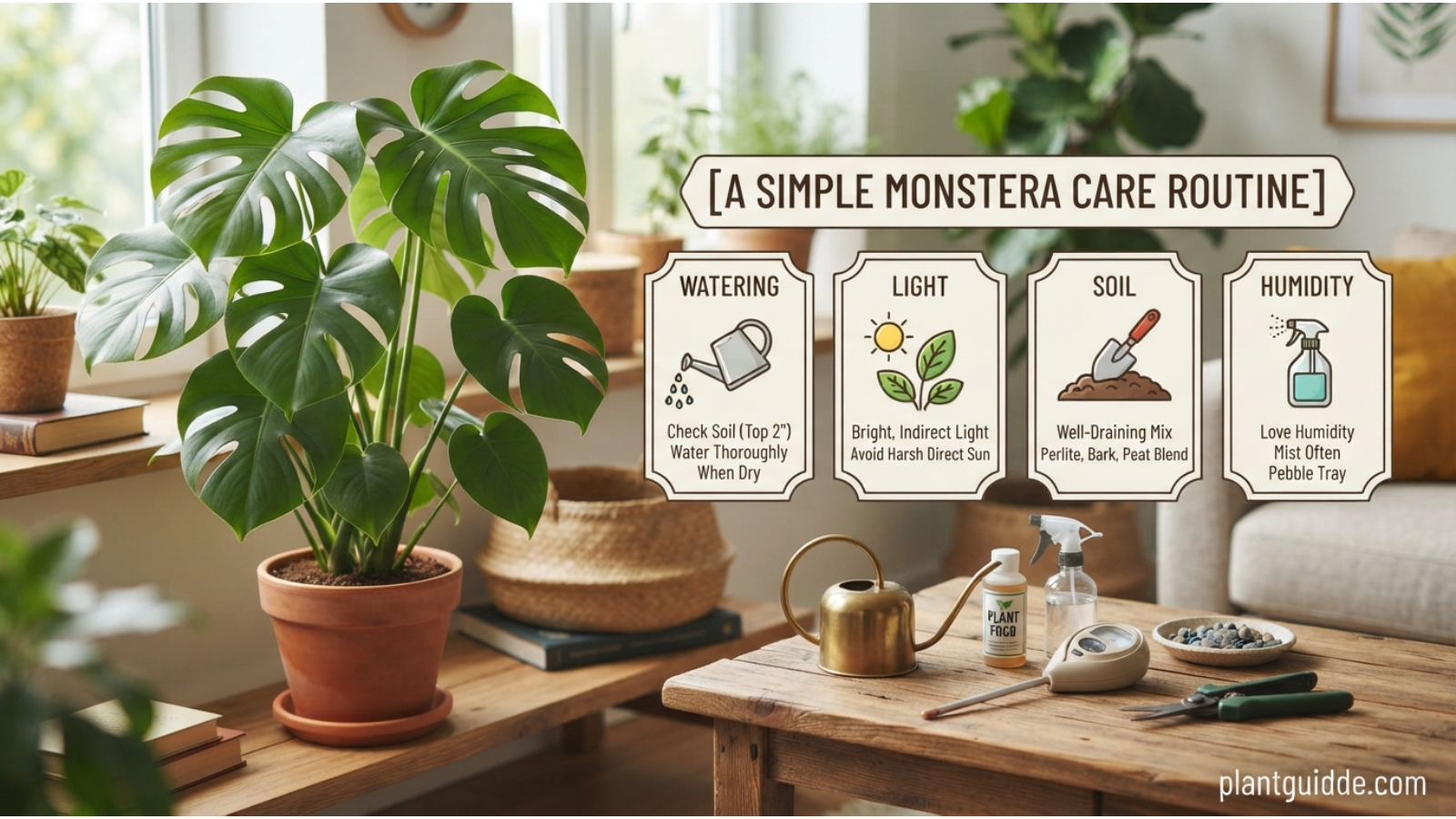
A Simple Monstera Care Routine
Instead of following a complicated schedule, use a short inspection routine.
Weekly
Check:
- Soil moisture
- Leaf condition
- Pest activity
- New growth
- Overall posture
- Whether the plant is receiving appropriate light
Monthly
Look more closely at:
- Root crowding
- Support structure
- Dust accumulation
- Fertilizer needs
- Soil condition
- New aerial roots
This approach is more reliable than putting every care task on a fixed calendar because indoor conditions change throughout the year.
Common Monstera Care Mistakes
1. Watering on a fixed schedule
“Every Sunday” may sound convenient, but plants don’t consume water at exactly the same rate every week.
2. Using a pot without drainage
This makes watering mistakes much harder to recover from.
3. Keeping the plant in deep shade
Monstera can tolerate lower light, but survival is different from vigorous growth.
4. Adding fertilizer whenever growth slows
Slow growth is often related to light, season, roots, or environmental stress.
5. Cutting every aerial root
Aerial roots are normal and useful structures.
6. Repotting into a huge container
More soil does not automatically mean faster growth.
7. Chasing humidity while ignoring light
Humidity matters, but it cannot replace adequate light.
8. Moving the plant constantly
Frequent environmental changes can make diagnosis more difficult and may stress the plant.
Seasonal Monstera Care
Spring and Summer
As growth becomes more active:
- Monitor soil moisture more frequently.
- Provide strong filtered light.
- Resume appropriate fertilization.
- Train new growth onto support.
- Watch for pests.
Fall and Winter
Growth may slow, particularly in cooler or darker homes.
Adjust accordingly:
- Don’t automatically maintain summer watering frequency.
- Check soil before watering.
- Keep the plant away from cold drafts.
- Be cautious with fertilizer when growth has slowed.
- Provide the brightest suitable indoor location.
The important seasonal rule: Change watering and feeding based on the plant’s actual growth and environmental conditions—not simply because the season changed on the calendar.
How to Read Your Monstera’s Signals
A useful way to care for Monstera is to stop looking at individual symptoms in isolation.
Think in terms of patterns.
| Symptom | First things to investigate |
|---|---|
| Yellow lower leaf | Natural aging, moisture, roots |
| Several yellow leaves | Watering, drainage, root health |
| Brown crispy edges | Moisture consistency, humidity, salts, light |
| Curling leaves | Water, heat, humidity, roots |
| Small new leaves | Light, maturity, nutrition, support |
| Long gaps between leaves | Insufficient light or growth conditions |
| Drooping with wet soil | Root problems |
| Drooping with dry soil | Underwatering |
| No fenestrations | Plant maturity and light |
| Sudden leaf damage | Environmental change, pests, physical damage |
This approach prevents one of the most common houseplant mistakes: treating every symptom with water.
FAQs
How often should I water a Monstera plant?
Water when the upper portion of the potting mix has dried sufficiently, then water thoroughly and allow excess water to drain. Frequency varies with light, temperature, humidity, pot size, and soil.
Does Monstera need direct sunlight?
Monstera generally prefers bright, indirect light. Some gentle direct morning sunlight may be tolerated, while intense afternoon sun can scorch leaves, particularly when the plant has not been acclimated.
How much humidity does a Monstera need?
Monstera appreciates moderate to high humidity, but it can often adapt to normal household conditions. Consistent watering, adequate light, and good airflow are also important.
Should I cut off Monstera aerial roots?
Usually, no. Aerial roots are normal structures that help the plant climb and access moisture and nutrients in its natural environment. They can be guided toward a support if desired.
Why does my Monstera have small leaves?
Small leaves can occur because the plant is young, light is inadequate, growth has slowed, or the plant is experiencing environmental stress. Evaluate the overall growing conditions before increasing fertilizer.
How do I make my Monstera grow faster?
Provide sufficient bright indirect light, an appropriate airy soil mix, proper watering, suitable nutrition during active growth, warm stable conditions, and support for climbing growth. Avoid trying to accelerate growth by simply watering or fertilizing more.
Can Monstera grow in low light?
It can survive in lower-light conditions, but growth is generally weaker and slower. If you want larger, healthier foliage and more mature-looking growth, brighter indirect light is preferable.
Should Monstera leaves be misted?
Misting is not essential for successful Monstera care. If indoor air is consistently dry, a humidifier provides more sustained humidity than occasional misting.
When should I repot my Monstera?
Repot when the plant has become significantly root-bound, the soil has deteriorated, or the container is no longer appropriate. Avoid automatically repotting every year.
Final Takeaway
The best way to master how to care for a Monstera plant is to think beyond individual tasks. Don’t simply water because it is a certain day, fertilize because growth looks slow, or mist because a leaf has a brown tip.
Instead, learn to read the relationship between light, soil moisture, drainage, roots, humidity, temperature, nutrition, and plant maturity.
Give your Monstera bright filtered light, an airy root environment, thorough but appropriately timed watering, stable warmth, reasonable humidity, and climbing support as it matures. Then observe the plant regularly.
That combination of consistent conditions and careful observation is what turns Monstera care from guesswork into a repeatable routine, and gives you the best chance of producing strong growth and those dramatic, mature fenestrated leaves.

Asad Mumtaz is a dedicated plant enthusiast and gardening writer with a passion for helping people care for their plants successfully. He specializes in plant care guides, indoor gardening, and practical growing tips for all skill levels. His content focuses on making gardening simple, enjoyable, and rewarding. Through his work, Asad shares reliable advice to help readers create thriving green spaces.