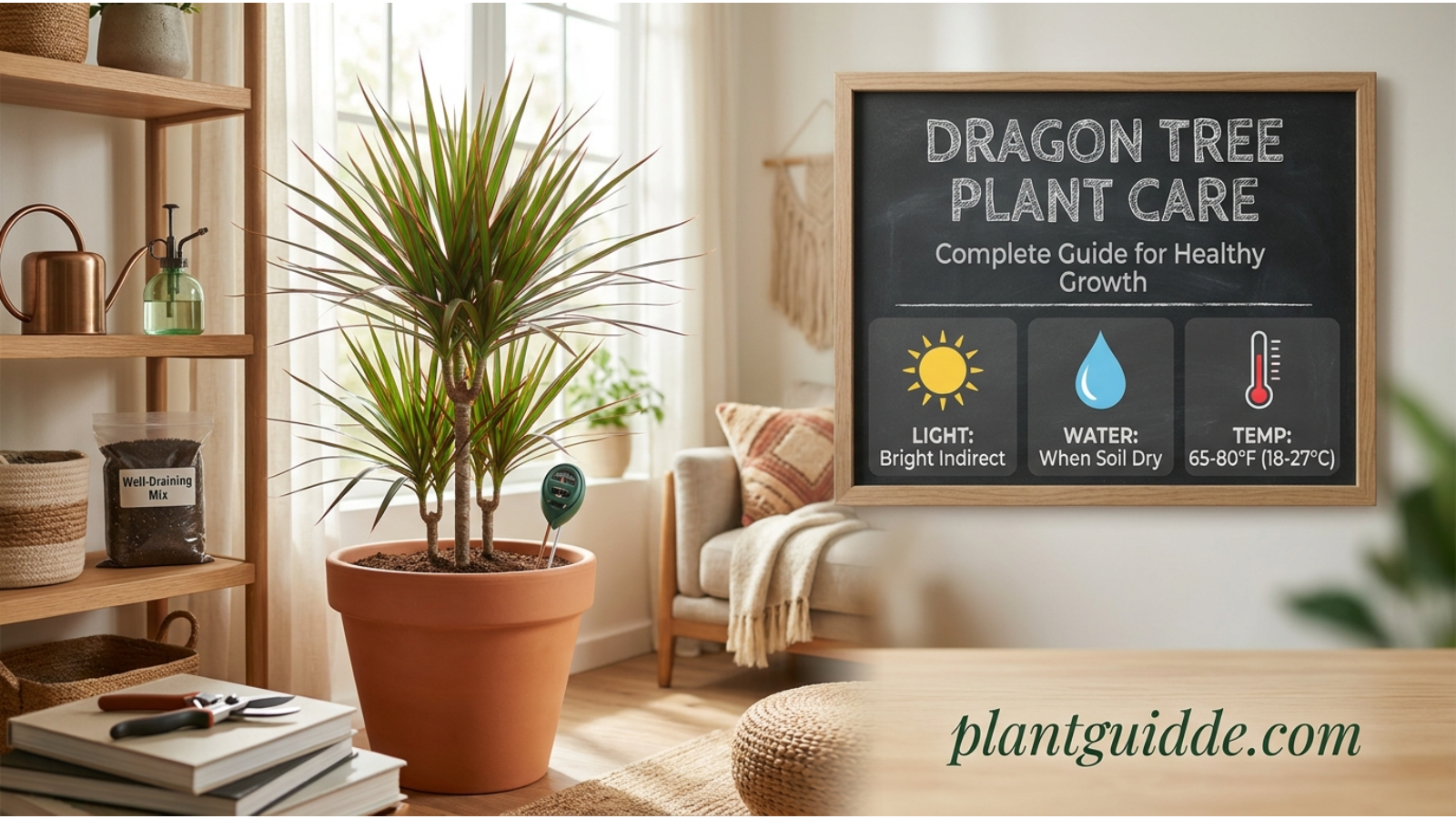
The dragon tree is one of those houseplants that looks almost effortless to grow. dragon tree plant care Its narrow, arching leaves and slender woody stems give it a striking architectural appearance, while its slow growth means it rarely demands constant attention.
But being tough does not mean it can thrive in any condition. A dragon tree may survive in a dark corner for months, but too little light can eventually lead to weak, unattractive growth. Similarly, it can handle missed watering far better than constantly wet soil. For most indoor growers, successful dragon tree plant care is less about doing more and more about avoiding the wrong conditions.
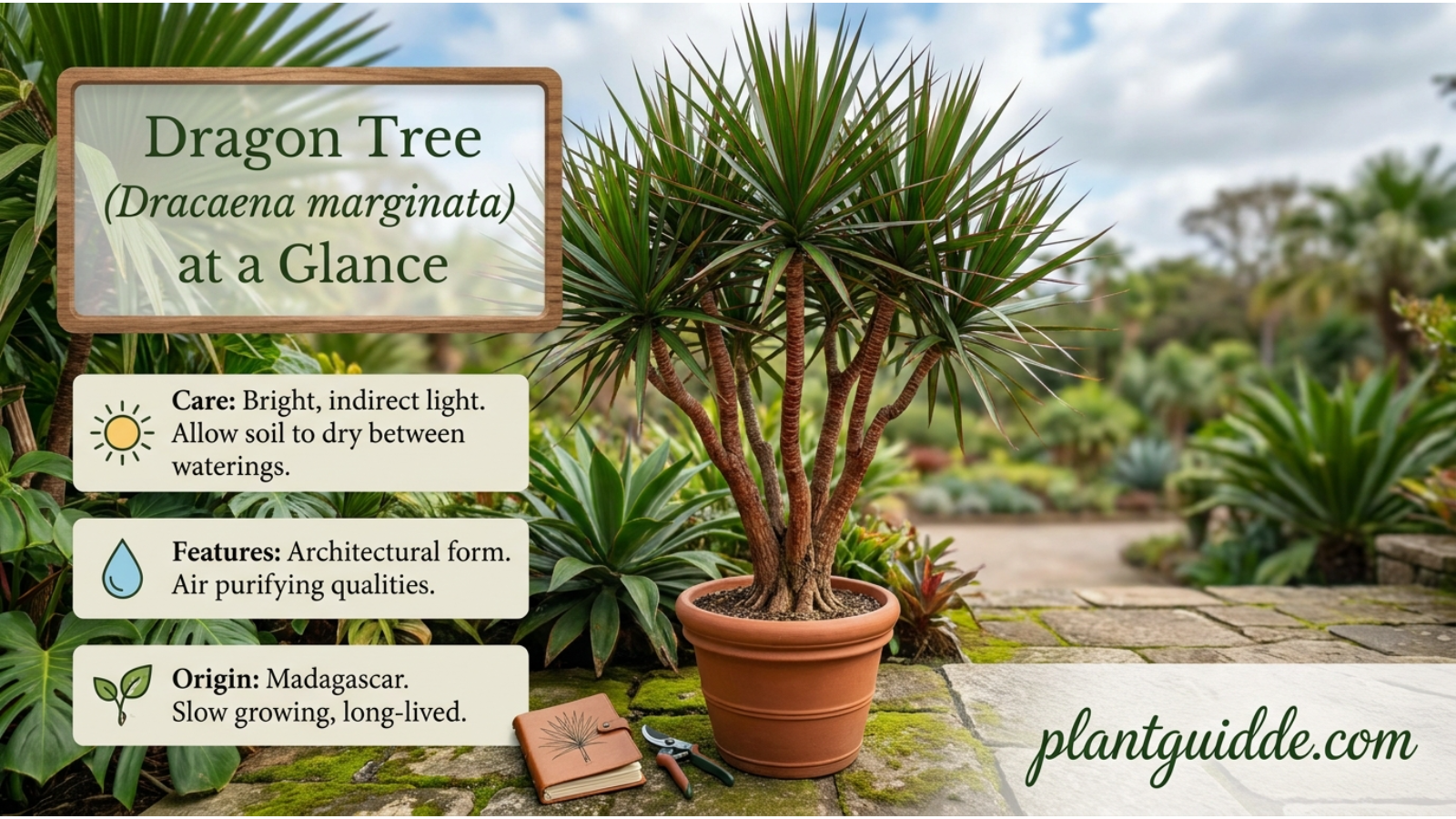
The plant commonly known as the Madagascar dragon tree is Dracaena marginata, a popular indoor plant valued for its upright growth and ability to adapt to typical household environments.
In this guide, you’ll learn how to provide the right light, water, soil, and humidity, and how to recognize early signs of trouble, including brown leaves, yellowing, and drooping, before they become serious.
Quick Answer
Dragon tree plant care is mainly about getting four things right: bright indirect light, careful watering, well-draining soil, and stable indoor temperatures. Let the upper layer of soil dry before watering again, keep the plant away from harsh afternoon sun and cold drafts, and use a pot with drainage holes. Dragon trees tolerate some neglect, but consistently wet soil and poor light are common causes of yellow leaves, root problems, and weak growth.
Dragon Tree at a Glance
| Care factor | What a dragon tree prefers |
|---|---|
| Light | Bright, indirect light; tolerates lower light |
| Water | Water thoroughly, then allow the upper soil to dry |
| Soil | Loose, well-draining potting mix |
| Humidity | Average household humidity is usually adequate |
| Temperature | Warm, stable indoor temperatures |
| Fertilizer | Light feeding during active growth |
| Repotting | When roots become crowded or soil breaks down |
| Pruning | Useful for controlling height and encouraging branching |
| Growth rate | Generally slow to moderate indoors |
| Common problems | Brown tips, yellow leaves, root rot, leaf drop |
Image Suggestion: A labeled dragon tree showing its trunk, leaf canopy, soil surface, drainage pot, and ideal indoor placement.
Understanding the Dragon Tree
The name “dragon tree” can refer to several plants in the Dracaena group, but the houseplant most commonly sold under this name is Dracaena marginata.
It typically develops narrow, strap-like leaves arranged in clusters at the ends of woody stems. With age, the stems can become tall and somewhat tree-like, which is why the plant works particularly well in corners, beside furniture, or in rooms with vertical space.
Some cultivars have green leaves, while others feature red, burgundy, or yellowish margins.
One important point for beginners is that a dragon tree is naturally slow-growing compared with many popular tropical houseplants. If you provide good conditions and see only modest new growth, that does not necessarily indicate a problem.
Trying to force faster growth with excessive fertilizer or frequent watering can actually damage the roots.
How Much Light Does a Dragon Tree Need?
The best location for a dragon tree is usually bright, indirect light.
A position near an east- or north-facing window can work well, while a bright spot near a south- or west-facing window may also be suitable if strong direct sunlight is filtered through a sheer curtain or the plant is positioned farther from the glass.
What happens in different light conditions?
Bright indirect light:
Usually produces the strongest, most attractive growth.
Moderate light:
The plant can remain healthy, although growth may be slower.
Low light:
A dragon tree may survive, but growth becomes slower and the soil can remain wet for longer because the plant uses less water.
Strong direct afternoon sun:
Can scorch or bleach foliage, particularly when the plant has been acclimated to lower indoor light.
A common mistake
One of the most overlooked problems is placing a dragon tree in a dark corner and then watering it on the same schedule as a plant receiving bright light.
That creates a double problem: the plant is not getting enough energy for strong growth, while the soil may stay wet for too long.
Practical tip: If your dragon tree is in low light, be especially conservative with watering.
Image Suggestion: Three dragon trees positioned in low, moderate, and bright indirect light, showing the difference in placement rather than relying on generic sun icons.
Dragon Tree Watering: The Most Important Skill to Get Right
Watering is where many dragon tree problems begin.
The goal is not to keep the soil permanently moist. Instead, water thoroughly when the plant actually needs it and allow excess water to drain away.
How to know when to water
Push your finger into the upper portion of the soil or use another reliable method to check moisture.
If the upper layer has dried and the pot feels noticeably lighter, it is generally time to water.
Do not rely entirely on a calendar.
A dragon tree growing in bright light during summer may need water considerably sooner than one growing in a cool, dim room during winter.
How to water correctly
- Check the soil before watering.
- If the upper layer has dried sufficiently, water slowly and evenly.
- Allow water to pass through the drainage holes.
- Empty excess water collected in the saucer or decorative container.
- Allow the soil to dry again before watering.
A small splash every few days can be less effective than a proper watering followed by an appropriate drying period.
Why overwatering is dangerous
Dragon trees do not need constantly saturated roots.
When soil stays wet for extended periods, air spaces in the root zone decrease. Roots can become stressed, and persistent moisture can contribute to root rot.
This is why a dragon tree with yellow leaves is not automatically asking for more water.
Sometimes it is asking for less.
How Often Should You Water a Dragon Tree?
There is no single correct schedule.
As a starting point, many indoor dragon trees may need watering roughly every 1–3 weeks, but this can vary substantially with light, temperature, pot size, soil, season, and humidity.
Use the plant and soil as your guide rather than treating the calendar as a rule.
Water less frequently when:
- The plant receives low light.
- The room is cool.
- The pot is large relative to the plant.
- The soil retains moisture for a long time.
- The container has poor evaporation.
Water more frequently when:
- The plant receives brighter light.
- Temperatures are warm.
- The container is relatively small.
- The soil drains quickly.
- The plant is actively growing.
Expert observation: A watering schedule that works perfectly for one dragon tree can cause another to decline. The difference is often the environment rather than the plant itself.
Best Soil for Dragon Trees
Dragon trees perform best in a well-draining potting mix that holds some moisture without remaining saturated.
A practical mixture can include:
- Quality indoor potting soil
- Perlite or pumice for extra aeration
- A modest amount of coarse material such as bark, depending on the base mix
The exact recipe is less important than the final structure.
You should be able to water the plant thoroughly without the soil remaining swampy for days.
Why drainage matters
Good drainage gives the roots access to both moisture and air.
Heavy soil can stay wet around the roots even when the surface appears dry. This is one reason simply checking the top of the pot is not always enough if the mix is poorly structured.
Always use a container with drainage holes.
A decorative pot without drainage should be treated as a cover pot rather than the plant’s primary growing container.
Image Suggestion: Cross-section diagram comparing well-draining dragon tree soil with compact, waterlogged soil around roots.
What Pot Size Is Best?
A dragon tree does not need an oversized container.
In fact, choosing a pot that is much larger than the existing root system can make watering more difficult because excess soil holds moisture around relatively few roots.
When repotting, move to a container only moderately larger than the current root ball.
A drainage hole is more important than an expensive or decorative container.
Signs the pot may be too small
- Roots are circling densely around the root ball.
- Water runs through unusually quickly because the root mass occupies most of the pot.
- Growth has slowed despite otherwise good conditions.
- The plant becomes unstable because the root system is crowded.
Do not repot simply because the plant has not produced new leaves recently. Slow growth is normal for dragon trees.
Dragon Tree Temperature and Humidity
Dragon trees generally perform well in comfortable indoor temperatures.
Keep them away from:
- Cold drafts
- Frequently opened exterior doors
- Very cold windows during winter
- Direct hot air from heating vents
- Strong blasts from air-conditioning units
Stable conditions are usually more useful than chasing a precise humidity percentage.
Does a dragon tree need high humidity?
Not necessarily.
Dragon trees can adapt to average household humidity better than many tropical houseplants. However, extremely dry air can contribute to brown leaf tips, especially when combined with inconsistent watering or other environmental stress.
Idragon tree plant care f your home is very dry, you can improve the environment by using a humidifier or grouping compatible plants together.
Misting leaves is not a substitute for maintaining appropriate root moisture and overall growing conditions.
Fertilizing a Dragon Tree
Dragon trees do not require heavy feeding.
During active growth, a balanced houseplant fertilizer used according to its label directions can support healthy foliage.
A conservative feeding approach is generally better than trying to accelerate growth with large amounts of fertilizer.
Avoid fertilizing when:
- The plant is severely stressed.
- The soil is extremely dry.
- The plant has recently been repotted into fresh, nutrient-rich soil.
- Growth has slowed because of poor environmental conditions.
Fertilizer cannot compensate for insufficient light, damaged roots, or improper watering.
A useful rule: Fix the growing environment first; feed the plant second.
How to Prune a Dragon Tree
Pruning is particularly useful when a dragon tree becomes too tall or develops a sparse, awkward shape.
You can cut back a stem to control height. New shoots can develop below the cut, potentially creating additional branching.
For a cleaner result:
- Use clean, sharp pruning tools.
- Decide where you want the new growth to develop.
- Make a clean cut through the stem.
- Continue normal care rather than dramatically increasing water or fertilizer.
- Give the plant suitable light while it produces new growth.
Do not remove large amounts of healthy foliage unnecessarily.
Pruning is a shaping technique, not a requirement for keeping every dragon tree healthy.
Why Is My Dragon Tree Getting Brown Tips?
Brown tips are one of the most common dragon tree complaints.
But “brown tips” are a symptom, not a diagnosis.
Possible causes include:
- Very dry indoor air
- Inconsistent watering
- Excessive fertilizer or salt buildup
- Fluoride sensitivity
- Root stress
- Excessive direct sunlight
- General environmental stress
What should you check first?
Start with the growing conditions rather than immediately cutting every brown leaf.
Ask:
Is the soil staying wet too long?
If yes, examine drainage and watering frequency.
Is the plant bone-dry for long periods?
dragon tree plant care yes, improve watering consistency.
Is the plant exposed to harsh direct sun?
Move or filter the light.
Does your water contain significant fluoride or dissolved salts?
Using filtered or distilled water can sometimes reduce recurring tip-burn problems in sensitive dragon trees.
Is the air extremely dry?
Improve room humidity if necessary.
Brown tissue will not turn green again. The goal is to prevent new damage.
Image Suggestion: Close-up comparison of healthy dragon tree leaf tips, mild brown-tip damage, and severe leaf-tip browning with likely causes.
Why Are Dragon Tree Leaves Turning Yellow?
Yellow leaves can have several causes, but watering and root conditions should be among the first things you investigate.
Possible causes
Too much water:
Persistent moisture can stress the root system.
Natural aging:
Older leaves can eventually yellow and decline as the plant replaces them.
Poor light:
Low light can slow growth and change how quickly the plant uses water.
Root problems:
Damaged roots may prevent the plant from maintaining healthy foliage.
Sudden environmental changes:
Moving the plant, temperature fluctuations, or major changes in light can cause stress.
Do not automatically respond to yellow leaves by adding more water.
Check the soil first.
Dragon Tree Leaves Drooping or Falling
A dragon tree may droop or lose leaves when its environment changes significantly.
Possible triggers include:
- Severe underwatering
- Excessive moisture
- Root damage
- Cold exposure
- Sudden changes in light
- Relocation stress
If leaves are dropping rapidly, inspect the root zone and growing conditions rather than focusing only on the leaves.
A useful diagnostic sequence
Check these in order:
- Soil moisture
- Root condition
- Light level
- Temperature
- Recent environmental changes
This approach is more useful than treating every symptom as a watering problem.
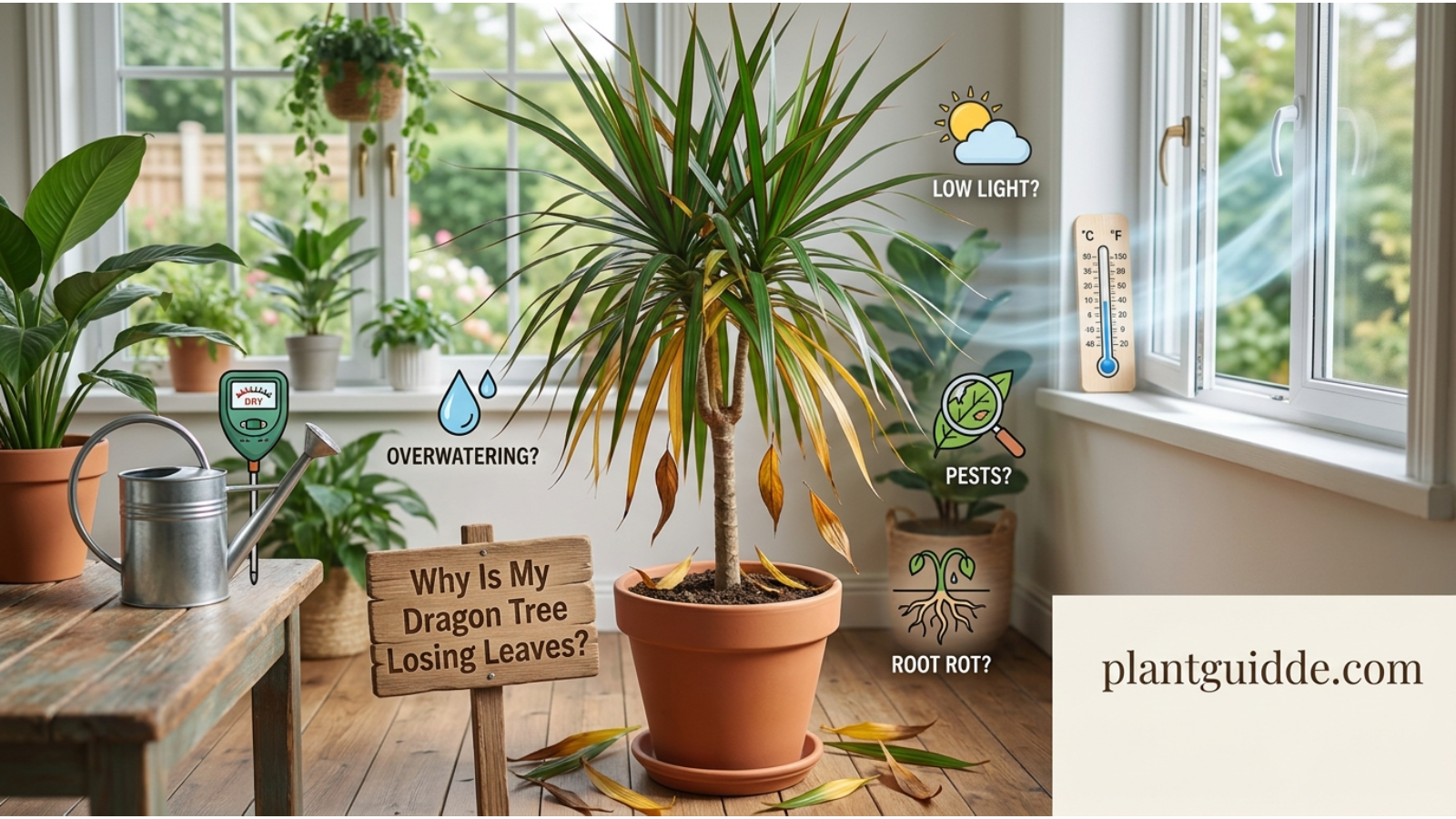
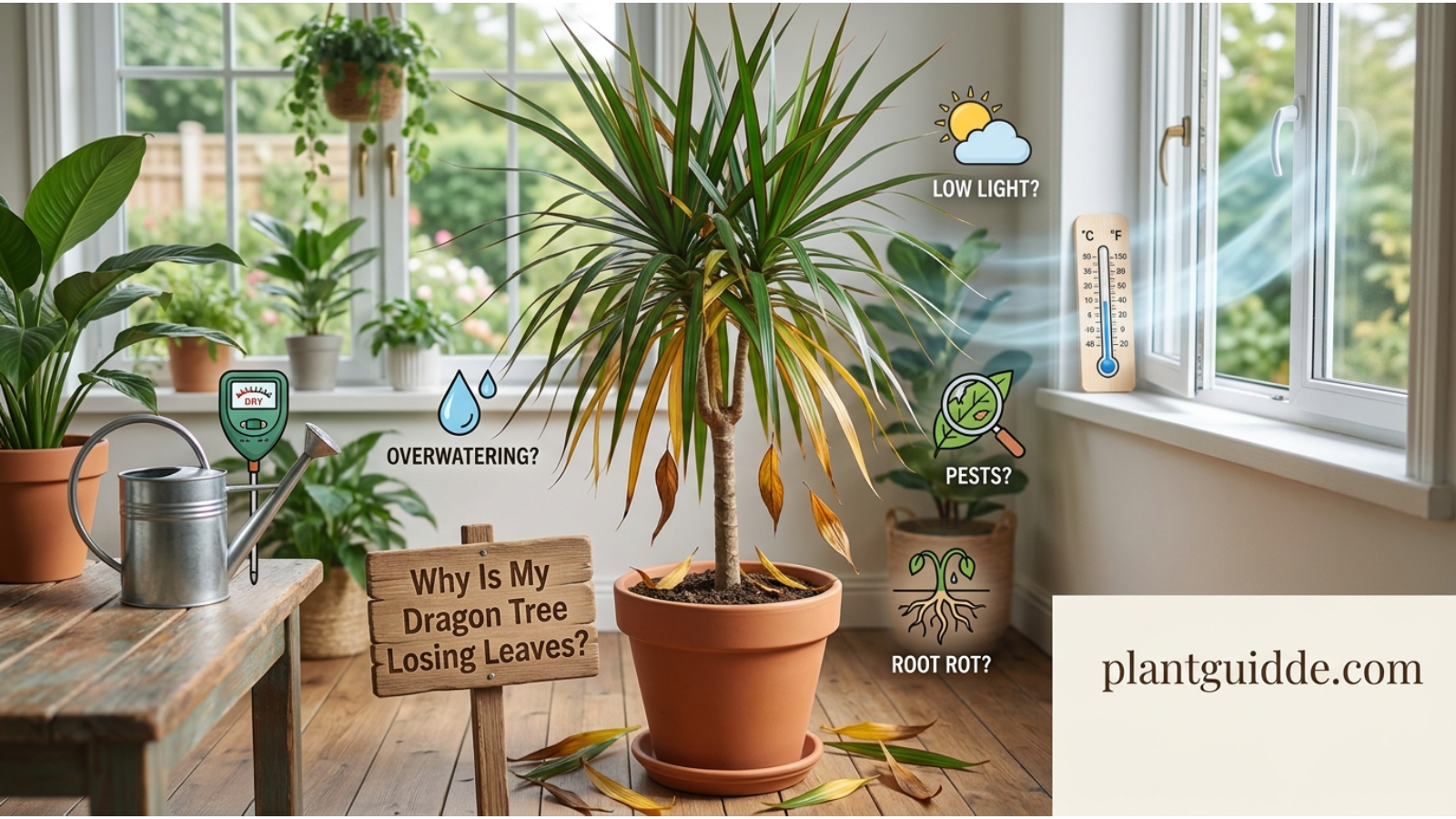
Why Is My Dragon Tree Losing Leaves?
Some leaf loss is normal, particularly when older lower leaves naturally age.
Concern is warranted when leaf loss is:
- Rapid
- Widespread
- Accompanied by yellowing
- Accompanied by soft or damaged stems
- Happening together with consistently wet soil
A dragon tree that loses one old lower leaf occasionally is very different from one losing several leaves every week.
Look for the pattern, not just the individual leaf.
Dragon Tree Pests
Dragon trees can occasionally experience common indoor plant pests such as:
- Spider mites
- Mealybugs
- Scale insects
- Aphids
Inspect both sides of leaves and check around stems, leaf joints, and newer growth.
Spider mites can be especially problematic when plants are kept in hot, very dry conditions.
Early detection is easier
dragon tree plant care you notice:
- Fine webbing
- Sticky residue
- Small insects
- Cotton-like clusters
- Raised bumps on stems or leaves
- Unusual speckling
Isolate the affected plant from other houseplants and inspect it carefully.
Treat the pest according to the severity and the product label, and repeat monitoring because a single treatment may not eliminate an entire pest population.
Repotting a Dragon Tree
Dragon trees generally do not need frequent repotting.
Consider repotting when:
- Roots are densely crowded.
- The pot has become unstable.
- The soil has deteriorated.
- Water management has become difficult.
- Roots are emerging substantially from drainage holes.
How to repot
- Choose a pot with drainage holes.
- Select a container only moderately larger than the existing one.
- Prepare a well-draining potting mix.
- Remove the plant carefully.
- Inspect the roots.
- Remove obviously dead or severely damaged material when appropriate.
- Place the plant at approximately the same depth.
- Fill around the root ball without heavily compacting the soil.
- Water appropriately and allow excess water to drain.
Avoid turning repotting into an unnecessarily aggressive root-pruning exercise.
Dragon Tree Care Through the Seasons
Spring
Spring often brings increasing light and renewed growth.
This is a good time to:
- Check whether the plant needs repotting.
- Begin or increase light fertilization if growth resumes.
- Prune overly tall stems.
- Inspect for pests.
Summer
Bright conditions can increase water use.
Monitor soil moisture rather than automatically increasing watering on a fixed schedule.
Protect the plant from intense direct sunlight, particularly behind hot glass.
Fall
As daylight decreases, the plant may use water more slowly.
Do not continue a summer watering schedule automatically.
Winter
Indoor heating can create dry air, while reduced light can make soil stay wet longer.
Winter care is often about watering less frequently, not watering more because the plant appears unhappy.
Keep the plant away from cold drafts and heating vents.
Common Dragon Tree Care Mistakes
1. Watering on a Fixed Schedule
“Water every Sunday” sounds simple but ignores changes in light, temperature, and soil moisture.
Better approach: Check the plant before watering.
2. Using a Pot Without Drainage
Even excellent soil cannot compensate for a container that traps excess water.
Better approach: Always provide a drainage route.
3. Putting the Plant in a Very Dark Corner
Dragon trees tolerate lower light, but tolerance does not mean optimal growth.
Better approach: Give the plant the brightest suitable indirect light available.
4. Overfertilizing a Slow-Growing Plant
More fertilizer does not automatically produce faster, healthier growth.
Better approach: Feed lightly during active growth.
5. Ignoring Water Quality
Recurring brown tips can sometimes be influenced by minerals or fluoride in household water.
Better approach: If environmental conditions are otherwise good but tip browning continues, experiment with filtered or distilled water.
6. Repotting Too Frequently
Constantly disturbing a slow-growing plant can create unnecessary stress.
Better approach: Repot when the root system or soil condition actually requires it.
7. Cutting Off Leaves Without Fixing the Cause
Pruning damaged foliage can improve appearance, but it does not correct the underlying problem.
Better approach: Treat the environment first.
A Simple Dragon Tree Troubleshooting Chart
| Symptom | Possible cause | What to check first |
|---|---|---|
| Brown leaf tips | Dry air, inconsistent moisture, water quality, salts | Soil, humidity, water source |
| Yellow leaves | Overwatering, aging, poor conditions | Soil moisture and roots |
| Soft stem | Severe moisture/root problems | Root zone immediately |
| Slow growth | Low light, season, normal growth habit | Light level |
| Leaf drop | Watering stress, cold, relocation, root problems | Recent changes |
| Pale/scorched foliage | Too much direct sun | Window exposure |
| Fine webbing | Spider mites | Undersides of leaves |
| Cottony insects | Mealybugs | Leaf joints and stems |
| Soil remains wet | Poor drainage, low light, oversized pot | Pot, soil, light |
How to Make a Dragon Tree Grow Fuller
A dragon tree naturally tends toward an upright, relatively narrow form.
If you want a fuller appearance, the most effective strategy is usually to encourage branching through appropriate pruning while providing sufficient light.
A heavily shaded plant may produce weak or sparse growth even if it receives enough water.
For a fuller-looking plant:
- Provide bright indirect light.
- Prune overly long stems strategically.
- Keep watering consistent.
- Avoid excessive fertilizer.
- Give new shoots time to develop.
Patience matters here. Dragon trees are not rapid growers, so a newly pruned stem may not transform overnight.
Can You Keep a Dragon Tree in Low Light?
Yes, but there is an important distinction between surviving and thriving.
Dragon trees are relatively adaptable and can remain alive in lower-light rooms. However, growth may become very slow, foliage can become less vigorous, and the soil may dry much more slowly.
This matters because lower light changes watering needs.
dragon tree plant care you move a dragon tree from a bright window to a dim office, do not continue watering it at the same frequency.
Can a Dragon Tree Grow Outdoors?
In suitable warm climates, some Dracaena species can be grown outdoors.
However, a plant accustomed to indoor light should not suddenly be placed in intense outdoor sunlight. It needs gradual acclimation.
Outdoor conditions also introduce additional variables:
- Stronger sunlight
- Wind
- Heavy rainfall
- Temperature fluctuations
- Different pest pressures
For indoor growers, keeping the plant in a stable environment is usually simpler.
Is a Dragon Tree Toxic to Pets?
Dracaena plants contain compounds that can cause illness if pets chew or ingest them.
For households with cats or dogs that like to nibble plants, keeping a dragon tree out of reach is a sensible precaution.
Dragon tree plant care a pet has eaten part of the plant and develops concerning symptoms, contact a veterinarian or an appropriate animal poison service for guidance.
What Makes Dragon Tree Plant Care Different From Other Houseplants?
One of the biggest advantages of a dragon tree is that it does not demand constant attention.
Compared with thirsty tropical foliage plants, it generally prefers allowing the soil to dry somewhat between waterings.
Compared with highly drought-tolerant plants such as snake plants or ZZ plants, however, it should not be treated as if it can remain completely dry for extended periods.
The sweet spot is moderate moisture with good drainage.
That distinction prevents two opposite mistakes:
“It is drought tolerant, so I never need to water it.”
and
“It is tropical, so the soil should always be wet.”
Neither approach is ideal.
An Easy Weekly Dragon Tree Care Routine
You do not need a complicated plant-care schedule.
Once a week, take a minute to inspect the plant.
Check:
Leaves:
Look for new browning, yellowing, pests, or unusual spots.
Soil:
Check whether the upper layer has dried sufficiently.
Pot:
Make sure drainage holes are not blocked.
Light:
Confirm that the plant has not been moved into a darker location.
Temperature:
Look for exposure to drafts, heating vents, or air-conditioning.
This quick inspection is often more useful than following a rigid care calendar.
Expert Tips for Healthier Dragon Trees
Let light influence your watering decisions
The brighter the growing environment, the more quickly the plant may use available moisture. Low light generally means slower water use.
Do not chase brown tips with more water
Brown tips can have several causes. Increasing watering without checking the soil can make the underlying problem worse.
Rotate the plant occasionally
Dragon tree plant care light comes primarily from one direction, gently rotating the pot every so often can help maintain more even growth.
Clean dusty leaves
A layer of dust can make foliage look dull and may interfere with the plant’s normal leaf function. Gently cleaning leaves with appropriate methods also gives you a chance to inspect for pests.
Give slow growth time
Dragon trees are not plants that need to produce new leaves constantly. Evaluate overall health rather than judging success by weekly growth.
Change one variable at a time
If a plant is struggling, moving it, repotting it, changing water, adding fertilizer, and increasing humidity simultaneously makes diagnosis difficult.
Make the most obvious correction first and observe the response.
FAQs:
How often should I water a dragon tree?
Water when the upper portion of the soil has dried rather than following a strict calendar. Indoor conditions can make watering intervals range from roughly one to several weeks.
Does a dragon tree need direct sunlight?
No. Bright indirect light is generally ideal. Some gentle direct sunlight may be tolerated, but intense afternoon sun can scorch foliage, particularly when the plant has not been acclimated.
Why are my dragon tree leaves turning brown?
Brown tips may result from inconsistent watering, dry air, mineral or fluoride exposure, excess fertilizer, root stress, or excessive sunlight. Check the growing conditions before deciding on a solution.
Why is my dragon tree turning yellow?
Overwatering is a common possibility, but older leaves can also yellow naturally. Check soil moisture, drainage, light, and the pattern of yellowing before changing your watering routine.
Can dragon trees grow in low light?
They can tolerate lower light, but growth will usually be slower. Because low-light plants use water more slowly, overwatering becomes an increased risk.
Should I mist my dragon tree?
Misting is not necessary for basic dragon tree care. If your indoor air is extremely dry, improving overall room humidity with a humidifier is generally more useful than relying on occasional misting.
What is the best soil for a dragon tree?
Use a loose, well-draining indoor potting mix that retains some moisture while allowing excess water to drain quickly. Adding perlite or pumice can improve aeration when the base mix is dense.
When should I repot my dragon tree?
Repot when roots become crowded, the soil has deteriorated, the plant becomes unstable, or water management becomes difficult. Dragon trees generally do not need annual repotting.
Can I cut the top off a dragon tree?
Yes. Strategic stem pruning can control height and encourage new shoots below the cut. Use clean, sharp tools and give the plant suitable light afterward.
How do I make my dragon tree grow faster?
Give it adequate bright indirect light, appropriate moisture, well-draining soil, and modest feeding during active growth. Avoid trying to force growth through excessive watering or fertilizer.
Final Takeaways
Successful dragon tree plant care does not require a complicated routine.
Focus on the fundamentals:
- Give it bright, indirect light whenever possible.
- Allow the soil to dry somewhat between thorough waterings.
- Use a well-draining pot and growing mix.
- Keep temperatures reasonably warm and stable.
- Fertilize conservatively during active growth.
- Prune when you need to control height or encourage branching.
- Treat brown and yellow leaves as clues, not automatic instructions to water.
- Check for pests regularly.
- Remember that slow growth is normal for this plant.
The most useful habit is to stop asking, “What day should I water my dragon tree?” and start asking, “What are the plant and soil telling me right now?”
Once you understand that relationship between light, soil moisture, roots, and growth, dragon tree care becomes much more predictable, and the plant can remain an attractive indoor feature for years.

Asad Mumtaz is a dedicated plant enthusiast and gardening writer with a passion for helping people care for their plants successfully. He specializes in plant care guides, indoor gardening, and practical growing tips for all skill levels. His content focuses on making gardening simple, enjoyable, and rewarding. Through his work, Asad shares reliable advice to help readers create thriving green spaces.