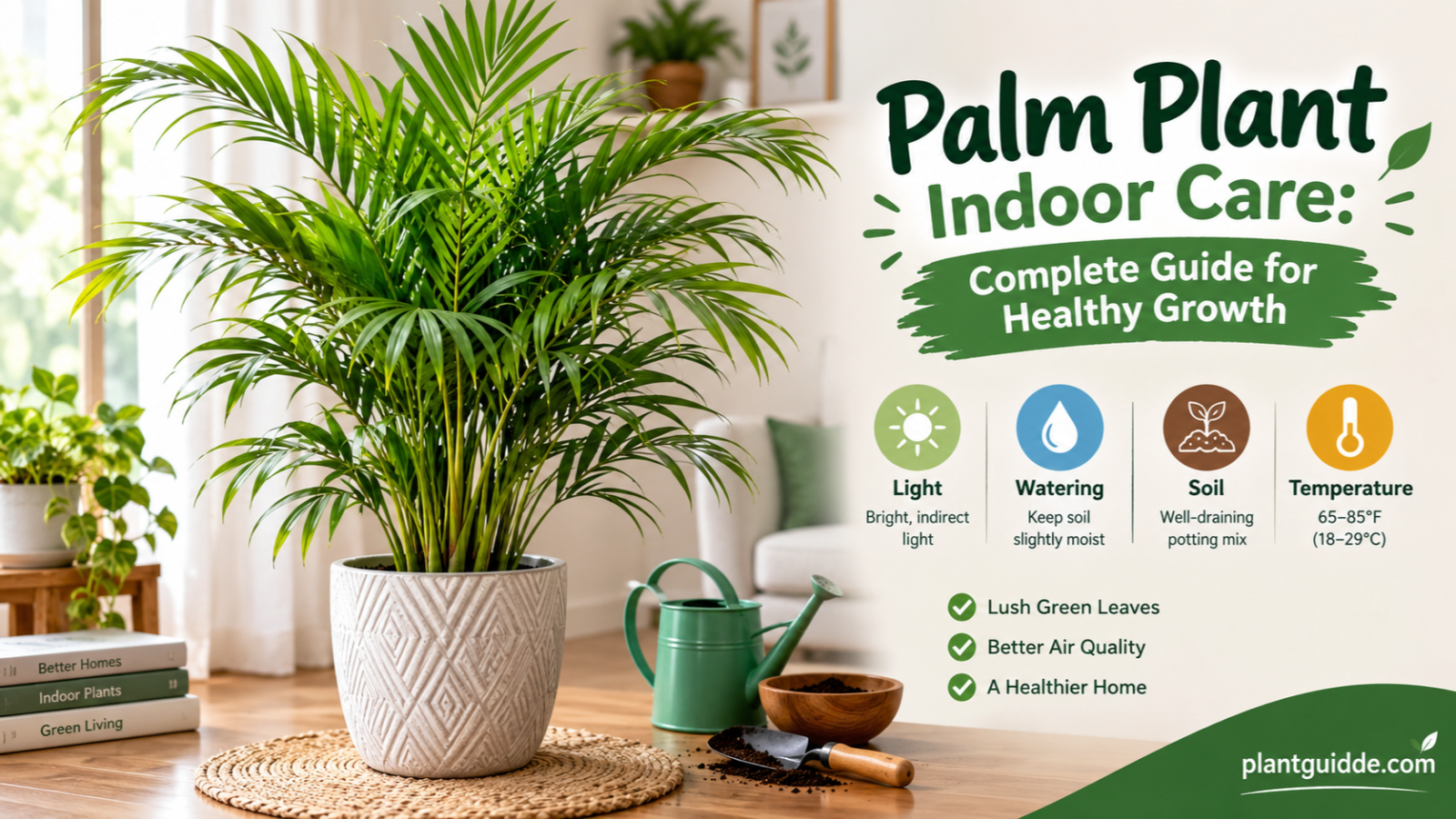
Palm plant indoor care can make a room feel noticeably greener and more tropical. Their long fronds, upright growth, and relatively slow development make them attractive choices for living rooms, bedrooms, offices, and other indoor spaces.
But there is an important catch: “palm” is not one specific houseplant. Areca palms, parlor palms, kentia palms, lady palms, and majesty palms can look similar at first glance, yet their tolerance for low light, dry air, watering mistakes, and indoor conditions can differ considerably.
That is why a palm that looks healthy when you bring it home may eventually develop brown leaf tips, yellow fronds, crispy edges, drooping leaves, or slow growth.
This guide explains how to care for indoor palms from the moment you bring one home, including watering, lighting, humidity, soil, fertilizing, repotting, pruning, seasonal adjustments, and troubleshooting.
Quick Answer
For successful palm plant indoor care, give your palm bright, indirect light, well-draining soil, moderate to high humidity, and consistent moisture without keeping the roots constantly wet. Water when the upper portion of the soil begins to dry, empty excess water from the saucer, and protect the plant from cold drafts and harsh afternoon sun. Adjust watering and light according to the specific palm variety and season.
What Does a Palm Need Indoors?
Before changing anything, understand the basic conditions that most indoor palms need.
| Care factor | What most indoor palms prefer | Why it matters |
|---|---|---|
| Light | Bright, indirect light | Supports healthy fronds and steady growth |
| Water | Even moisture with some drying between waterings | Prevents both drought stress and root problems |
| Soil | Airy, well-draining mix | Allows roots to receive oxygen |
| Humidity | Moderate to high humidity | Reduces dry, crispy leaf edges |
| Temperature | Stable, comfortably warm conditions | Protects foliage and roots from stress |
| Fertilizer | Moderate feeding during active growth | Supports new leaves and overall vigor |
| Pot | Drainage hole required | Prevents excess water from accumulating |
| Airflow | Gentle, consistent airflow | Helps reduce stagnant, overly wet conditions |
The exact requirements depend on the species, but these principles provide a reliable starting point for most palms grown indoors.
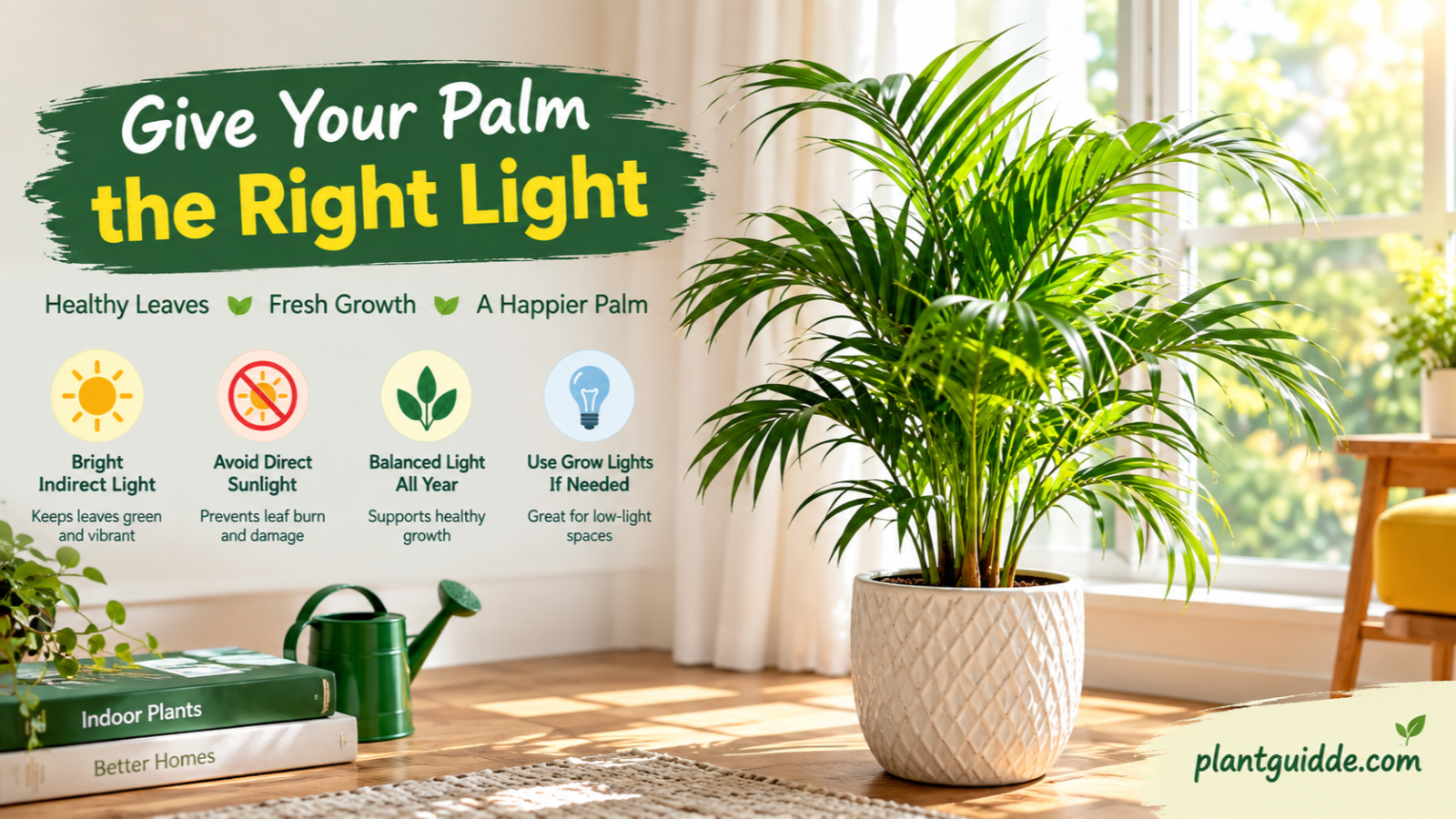
Give Your Palm the Right Light
Light is one of the most important parts of palm plant indoor care.
Most indoor palms perform best in bright, filtered or indirect light. A position near a bright window can work very well, particularly when direct sunlight is softened by a sheer curtain.
Too little light can cause slow growth and weaker foliage. On the other hand, placing a palm directly against a hot, intensely sunny window can cause leaf scorching, especially if the plant has been growing in lower light.
A useful way to judge the location
Instead of asking whether a room is “bright,” look at the plant itself.
A suitable location generally provides:
- Plenty of daylight during the day
- No prolonged exposure to intense hot afternoon sun
- Enough space for the fronds to spread
- Protection from heating and cooling vents
- Reasonably stable temperatures
If the palm is several feet away from a window, observe its growth over several weeks. A plant that remains healthy but barely produces new growth may simply need more light.
Expert tip: Rotate the pot occasionally so the plant does not grow heavily toward one direction. This also helps maintain a more balanced shape.
Image Suggestion
A simple visual showing a palm in bright indirect light near a window versus a palm exposed to harsh direct afternoon sunlight.
How Often Should You Water an Indoor Palm?
There is no universal watering schedule that works for every palm.
The common mistake is watering every Sunday—or every few days—regardless of the plant’s actual soil moisture.
Instead, check the soil before watering.
For many indoor palms, water when the upper part of the potting mix has started to dry while deeper soil still retains some moisture.
How to water correctly
- Check the soil with your finger or a moisture meter.
- If the surface and upper layer have dried noticeably, prepare to water.
- Pour water slowly and evenly over the soil.
- Continue until some water begins to drain from the bottom.
- Allow the excess water to escape completely.
- Empty the saucer or decorative cachepot if water remains.
The objective is to moisten the root zone thoroughly rather than repeatedly adding tiny amounts of water.
Why overwatering causes problems
Overwatering does not simply mean “giving too much water once.”
It often means watering again before the existing moisture has had enough time to leave the root zone.
Constantly saturated soil reduces air around the roots. Over time, stressed roots can lead to yellowing, wilting, poor growth, and other symptoms.
Why underwatering is also a problem
A severely dry palm may develop:
- Brown leaf tips
- Crispy margins
- Drooping fronds
- Curling leaves
- Premature yellowing
- Leaf drop in severe cases
The challenge is finding the middle ground: moist, but not permanently saturated.
Brown Tips on a Palm: What Usually Causes Them?
Brown tips are among the most common complaints in indoor palms.
However, brown tips do not automatically mean the plant needs more water.
Several factors can produce similar symptoms.
Common causes of brown palm leaves
| Possible cause | Typical clue | What to check |
|---|---|---|
| Dry air | Crispy tips and edges | Humidity and nearby heat sources |
| Underwatering | Dry soil and drooping | Soil moisture |
| Salt buildup | Browning despite adequate watering | Fertilizer and water quality |
| Excess fertilizer | Burned-looking leaf margins | Recent feeding |
| Excessive direct sun | Bleached or scorched areas | Window exposure |
| Root stress | Yellowing plus poor growth | Drainage and roots |
| Natural aging | Older frond gradually declining | Whether new growth is healthy |
The important point is to diagnose the environment rather than treating the symptom alone.
For example, misting a palm every day may temporarily wet the foliage, but it does not necessarily solve a room that is consistently dry.
If the palm sits next to a heater, receives harsh sun, and dries out rapidly, the underlying environment needs attention.
Humidity Matters More Than Many Beginners Expect
Many palms originate from warm environments where atmospheric humidity is higher than that of a heated or air-conditioned home.
Low humidity can contribute to:
- Brown tips
- Crispy leaf edges
- Dry-looking foliage
- Increased water loss
- General leaf stress
How to improve humidity
You can improve the surrounding environment by:
- Grouping compatible plants together
- Using a humidifier
- Keeping the plant away from heating vents
- Avoiding extremely dry locations
- Monitoring room conditions rather than relying solely on occasional misting
A humidifier is generally more effective for raising room humidity than repeatedly spraying individual leaves.
Important: Higher humidity does not compensate for poor drainage. A humid room with constantly saturated soil can still produce root problems.
Image Suggestion
Diagram showing three humidity setups: plant grouping, humidifier, and a dry location beside a heater.
Choose a Well-Draining Palm Soil
Indoor palms need a potting mix that holds enough moisture for the roots without becoming dense and waterlogged.
A suitable mix should:
- Retain some moisture
- Drain excess water
- Allow air to reach the roots
- Remain loose rather than becoming compacted
A general houseplant mix can work when amended with materials that improve drainage and aeration.
Avoid using heavy garden soil by itself in an indoor container. It can become compacted and may not provide the drainage conditions container-grown roots need.
The pot is just as important as the soil
Even excellent soil cannot compensate for a container with no drainage.
Always prefer a pot with a functional drainage hole.
If you place the nursery pot inside a decorative cover pot, check that water has not collected at the bottom after watering.
Keep Indoor Palms at Stable Temperatures
Palms generally prefer warm, stable indoor conditions.
Avoid placing them directly beside:
- Air-conditioning vents
- Space heaters
- Radiators
- Frequently opened exterior doors
- Very cold windows during winter
Sudden temperature changes can stress foliage even when the average room temperature seems comfortable.
A stable location is usually better than repeatedly moving the palm from one part of the house to another.
Fertilizing an Indoor Palm
Palms need nutrients to produce new foliage, but more fertilizer does not mean faster or healthier growth.
Excess fertilizer can contribute to salt accumulation in the soil and may damage roots.
During active growth, use a balanced fertilizer formulated for indoor plants or palms according to its label directions.
A sensible approach
- Feed during periods of active growth.
- Avoid excessive applications.
- Reduce or stop routine feeding when growth naturally slows.
- Water appropriately rather than using fertilizer to compensate for poor growing conditions.
If the plant is struggling because of low light, root problems, or poor watering, fertilizer is unlikely to fix the underlying issue.
Expert tip: A palm that suddenly looks weak is not automatically “hungry.” Check light, roots, soil moisture, and pests before increasing fertilizer.
Repotting an Indoor Palm
Indoor palms generally do not need to be repotted simply because a certain amount of time has passed.
Look at the plant and its root system.
Repotting may be appropriate when:
- Roots are densely circling the container
- Water runs through the pot unusually quickly
- The root ball has become severely crowded
- The soil has deteriorated or compacted
- The plant has clearly outgrown its container
Choose a new pot only modestly larger than the existing one.
A dramatically oversized pot can hold more moisture than the root system can use, increasing the risk of prolonged wet soil.
When to repot
For most indoor palms, repotting is easiest when the plant is actively growing and can recover more readily.
After repotting, avoid immediately compensating with excessive fertilizer or watering. Give the roots time to adjust.
How to Prune Palm Leaves
Do not remove a healthy green frond simply because it looks slightly imperfect.
Palm leaves contribute to photosynthesis, so removing healthy foliage unnecessarily can reduce the plant’s ability to support growth.
Instead:
- Remove completely dead fronds.
- Cut badly damaged leaves when necessary.
- Use clean, sharp pruning tools.
- Avoid cutting into the main stem or crown.
- Leave healthy green tissue whenever possible.
If only the tips are brown, you can trim the damaged portion for appearance, but do not expect the brown tissue to turn green again.
The goal of pruning is to remove genuinely damaged material—not to make the plant look perfect at the expense of healthy foliage.
Different Indoor Palms Need Different Care
One of the most overlooked parts of palm plant indoor care is identifying the palm you actually own.
Areca Palm
Areca palms are popular for their feathery foliage and tropical appearance. They generally appreciate bright filtered light and adequate humidity.
They can develop brown tips when indoor air is dry or watering is inconsistent.
Parlor Palm
Parlor palms are often more forgiving of typical indoor conditions and can tolerate lower light better than some other palms.
However, “low-light tolerant” does not mean “no-light.”
Very dim conditions can still result in weak growth.
Majesty Palm
Majesty palms can be considerably more demanding indoors. They generally prefer bright light, consistent moisture, and higher humidity.
They are particularly prone to developing unattractive brown tips and foliage problems when indoor conditions are too dry or inconsistent.
Kentia Palm
Kentia palms are valued for their elegant, arching growth and can adapt reasonably well to indoor environments.
They generally prefer bright indirect light but can tolerate somewhat lower light than many people expect.
Lady Palm
Lady palms have a different growth habit, with broader fan-like foliage. They can make excellent indoor specimens when given appropriate light, drainage, and watering.
Key takeaway: Do not apply exactly the same watering schedule or light expectations to every palm sold as a houseplant.
Palm Plant Indoor Care by Season
Your palm’s needs can change throughout the year because indoor environmental conditions change.
Spring and Summer
Growth may increase because of longer daylight hours.
You may notice:
- Faster soil drying
- More frequent new growth
- Greater water requirements
- Increased need for nutrients
Check the soil regularly rather than automatically increasing watering.
Fall and Winter
Growth often slows, while indoor heating can make the air significantly drier.
At the same time, lower light can reduce water consumption.
This creates an easy trap: the soil may stay wet longer even though the room feels dry.
Do not respond to dry indoor air by automatically watering more frequently.
Instead, assess both humidity and soil moisture separately.
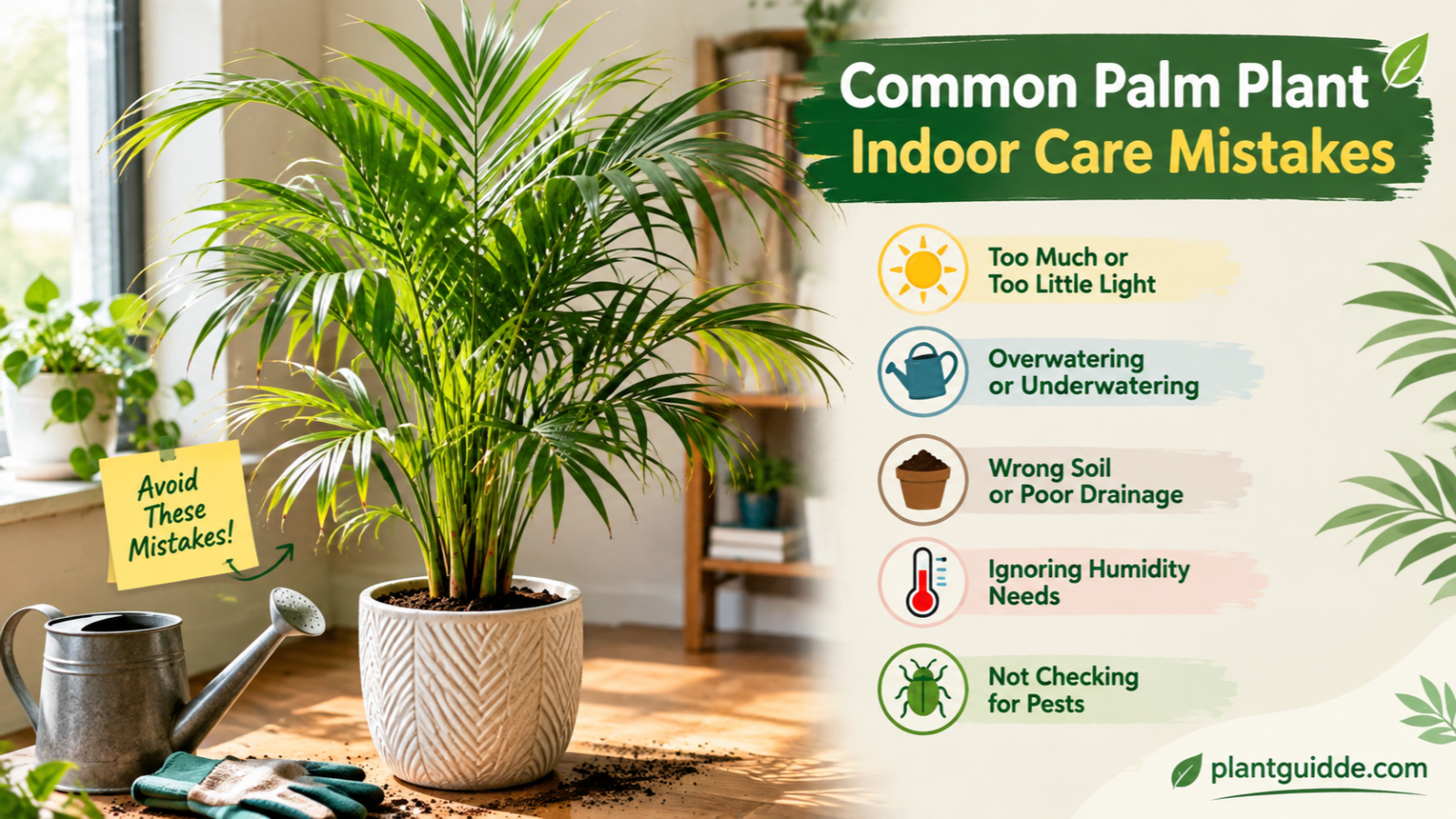
Common Palm Plant Indoor Care Mistakes
1. Following a Fixed Watering Calendar
“Water every seven days” sounds simple, but plants do not consume water at exactly the same rate every week.
Light, temperature, pot size, soil, humidity, and season all influence drying time.
Better approach: Check the soil before watering.
2. Keeping the Soil Constantly Wet
Palms need water, but roots also need oxygen.
Constantly wet soil can create unfavorable root conditions.
Better approach: Use a draining container and allow appropriate drying between waterings.
3. Assuming Brown Tips Always Mean Underwatering
Brown tips can result from dry air, salt buildup, fertilizer problems, excessive sun, inconsistent moisture, or root stress.
Better approach: Investigate the whole growing environment.
4. Putting the Palm in a Dark Corner
A palm may survive for some time in poor light without immediately collapsing.
That does not mean the location is ideal.
Better approach: Provide as much suitable filtered light as the particular palm can comfortably handle.
5. Fertilizing a Stressed Plant
Fertilizer is not medicine.
If roots are damaged or the plant is severely stressed, additional fertilizer can make matters worse.
Better approach: Correct light, moisture, drainage, and environmental conditions first.
6. Ignoring the Drainage Hole
A decorative container may look attractive while hiding standing water underneath the nursery pot.
Better approach: Always check where excess irrigation water goes.
How to Diagnose a Struggling Indoor Palm
When a palm suddenly looks unhealthy, resist the temptation to change everything at once.
Use a simple diagnostic process.
Step 1: Check the soil
Is it:
- Completely dry?
- Slightly dry?
- Still wet several days after watering?
This immediately narrows down potential causes.
Step 2: Examine the leaves
Look for:
- Brown tips
- Yellow older leaves
- Pale new growth
- Curling
- Crispy edges
- Spots
- Webbing or visible insects
Step 3: Check the light
Ask whether the plant receives meaningful daylight or is simply sitting in a bright-looking room.
Human eyes can perceive a room as bright even when the light available to a plant is relatively weak.
Step 4: Inspect the roots if necessary
If the soil remains wet for an unusually long time or the plant continues declining despite appropriate care, inspect the root system.
Healthy roots generally have a firm appearance. Soft, deteriorating roots indicate that the root environment needs attention.
Step 5: Look for pests
Indoor palms can attract pests such as spider mites, scale, and mealybugs.
Inspect both the upper and lower surfaces of leaves, particularly when foliage looks unusually speckled, dusty, sticky, or distorted.
Indoor Palm Troubleshooting Guide
| Problem | Likely causes | What to do first |
|---|---|---|
| Brown leaf tips | Dry air, inconsistent moisture, salts | Check humidity, soil, and fertilizer |
| Yellow leaves | Overwatering, aging foliage, stress | Check soil moisture and drainage |
| Drooping leaves | Dry roots or root stress | Check soil before watering |
| Crispy edges | Dry air or excessive dryness | Assess humidity and watering |
| Slow growth | Low light, cool conditions, nutrient shortage | Improve light and review conditions |
| Pale foliage | Insufficient light or nutritional issues | Check light first |
| Leaf spots | Water on foliage, pathogens, environmental stress | Improve airflow and avoid unnecessary leaf wetting |
| Webbing | Possible spider mites | Inspect leaves carefully |
| Sticky residue | Possible scale or other pests | Examine stems and leaf undersides |
| Soil stays wet | Poor drainage, oversized pot, low light | Check roots, pot, and soil |
Important: A symptom can have more than one cause. Diagnose the growing conditions rather than relying on a single symptom-to-cause chart.
What to Do If Your Palm Has Brown Leaves
If your palm has only a few brown tips but continues producing healthy new growth, the situation may not be severe.
Start by checking:
- How quickly the soil dries.
- Whether the plant receives adequate light.
- Whether indoor air is extremely dry.
- Whether fertilizer has been applied too heavily.
- Whether salts may have accumulated in the potting mix.
- Whether the roots are healthy.
- Whether pests are present.
Do not immediately cut off every affected leaf.
A mostly green frond can still contribute energy to the plant even if its tips are damaged.
Remove a frond when it is substantially dead or severely damaged rather than reacting to every brown spot.
Should You Mist an Indoor Palm?
Misting is often recommended as a quick humidity solution, but its effect on overall room humidity is usually limited and temporary.
Palm plant indoor care your home is consistently dry, a more reliable approach is to improve the surrounding humidity with a humidifier or another appropriate environmental adjustment.
Misting can also leave foliage wet for periods of time without solving the underlying humidity problem.
For a palm that repeatedly develops crispy tips, focus on room conditions, watering consistency, root health, and light rather than treating misting as the primary solution.
How to Keep an Indoor Palm Healthy Long-Term
The best palm care routine is simple enough to maintain consistently.
Every few days
Look at the plant.
You do not need to water it every time you inspect it.
Weekly
Check:
- Soil moisture
- Leaf condition
- New growth
- Signs of pests
Monthly
Consider:
- Whether the plant is receiving enough light
- Whether the pot drains properly
- Whether dust has accumulated on the foliage
- Whether growth has changed
Seasonally
Adjust your routine based on:
- Daylight
- Indoor temperature
- Heating or air-conditioning
- Plant growth rate
- Soil drying speed
This approach is more reliable than following a calendar because it responds to what the plant is actually experiencing.
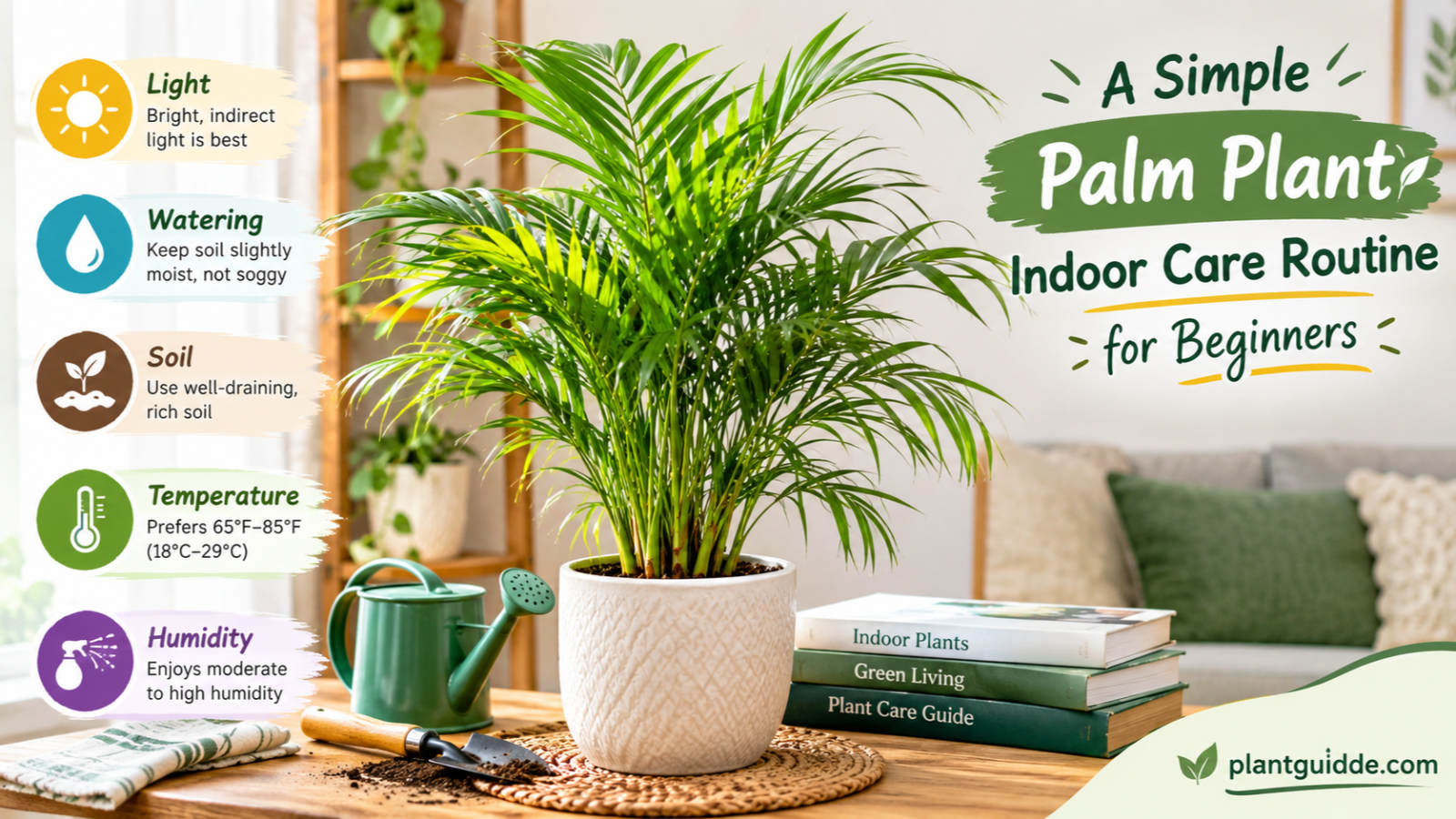
A Simple Palm Plant Indoor Care Routine for Beginners
Palm plant indoor care you want a straightforward routine, start here:
Place it: Near a bright window with filtered light.
Water it: When the upper soil begins to dry, then water thoroughly and allow excess water to drain.
Humidity: Keep it away from very dry heat sources and increase room humidity if necessary.
Soil: Use an airy, well-draining potting mix.
Pot: Choose a container with drainage.
Feed: Fertilize moderately during active growth according to the product label.
Prune: Remove dead or severely damaged fronds, but preserve healthy green foliage.
Inspect: Regularly check leaves and stems for pests.
Adjust: Change watering according to light, temperature, season, and drying speed.
FAQs:
How often should I water my indoor palm?
Water when the upper portion of the soil has begun to dry rather than following a fixed weekly schedule. The exact interval depends on the palm variety, pot size, soil, light, temperature, and season.
Why are my indoor palm leaves turning brown?
Brown leaves can result from dry air, inconsistent watering, excessive fertilizer, salt buildup, intense sunlight, or root problems. Check the plant’s overall environment before deciding on a treatment.
Do indoor palms need direct sunlight?
Not necessarily. Many indoor palms perform well in bright indirect or filtered light. Some can tolerate limited direct sunlight, but intense hot sun through glass can scorch foliage.
Why is my palm turning yellow?
Yellowing can be caused by excessive moisture, poor root conditions, natural aging, insufficient light, or other environmental stress. Check the soil and drainage first.
Can a palm survive in a low-light room?
Some palms tolerate lower light better than others, particularly certain parlor and kentia palms. However, extremely low light can lead to slow growth and weaker foliage.
How do I make my indoor palm grow faster?
Give it appropriate light, healthy roots, suitable moisture, adequate nutrition, and stable temperatures. Increasing fertilizer alone will not make a palm grow well if light or root conditions are poor.
Should I cut brown tips off palm leaves?
You can trim brown portions for appearance, but the damaged tissue will not turn green again. If most of the leaf remains healthy, keeping the leaf may be preferable.
Do indoor palms need humidity?
Many palms perform better with moderate to higher humidity, particularly in dry homes. If brown tips repeatedly appear while watering is appropriate, examine the humidity and nearby heat sources.
Can I keep an indoor palm in a bathroom?
A bright bathroom can be a good location because humidity may be higher than in other rooms. However, the room still needs sufficient natural or supplemental light and good airflow.
How do I know if my palm is overwatered?
Look for consistently wet soil, poor growth, yellowing, persistent drooping despite moist soil, unpleasant-smelling soil, or declining roots. These symptoms can overlap with other problems, so inspect the complete growing environment.
How long can an indoor palm live?
With appropriate conditions, many indoor palms can remain healthy for years. Longevity depends heavily on the species, light, root health, watering practices, and overall indoor environment.
Conclusion
Successful palm plant indoor care does not require a complicated routine. It requires paying attention to the conditions around the plant.
Start with appropriate light, well-draining soil, a container with drainage, consistent but controlled watering, reasonable humidity, and stable temperatures. Then adjust your routine according to how quickly the soil dries and how the plant responds.
Most problems become easier to solve when you stop treating individual symptoms in isolation. Brown tips, yellow leaves, drooping, and slow growth are signals that something in the growing environment may need attention.
The biggest improvement for most beginners is simple: check the soil before watering, observe the light, inspect the leaves regularly, and make one environmental change at a time. That approach gives your palm a much better chance of producing healthy, attractive foliage for years.

Asad Mumtaz is a dedicated plant enthusiast and gardening writer with a passion for helping people care for their plants successfully. He specializes in plant care guides, indoor gardening, and practical growing tips for all skill levels. His content focuses on making gardening simple, enjoyable, and rewarding. Through his work, Asad shares reliable advice to help readers create thriving green spaces.