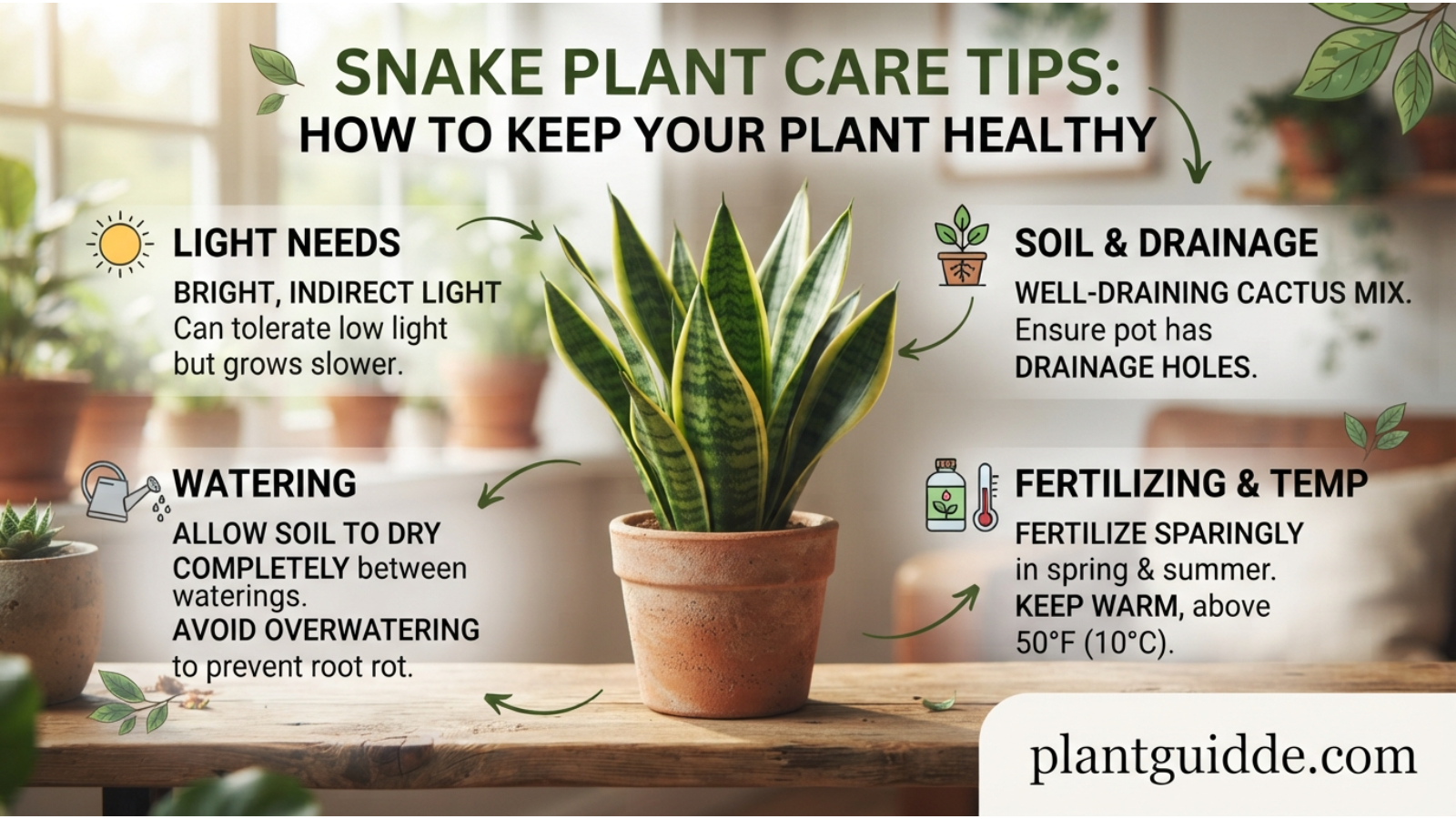
Snake plants are popular indoor plants for a good reason: they can tolerate conditions that cause many other houseplants to struggle. Their thick, fleshy leaves store water, allowing them to handle dry periods and relatively low light. Snake Plant Care Tips.
The real secret to successful snake plant care tips is not neglect. It is knowing when to leave the plant alone and when to intervene.
This guide focuses on the practical side of snake plant care: where to place it, when to water, what soil to use, how to recognize problems early, and what to change when your plant starts looking unhealthy.
Quick Answer
The best snake plant care tips are simple: provide bright, indirect light when possible, use fast-draining soil and a pot with drainage holes, and let the soil dry well between waterings. Snake plants tolerate low light and dry conditions, but consistently wet soil is one of their biggest problems. Water thoroughly only when the soil has dried, keep temperatures stable, and avoid unnecessary misting.
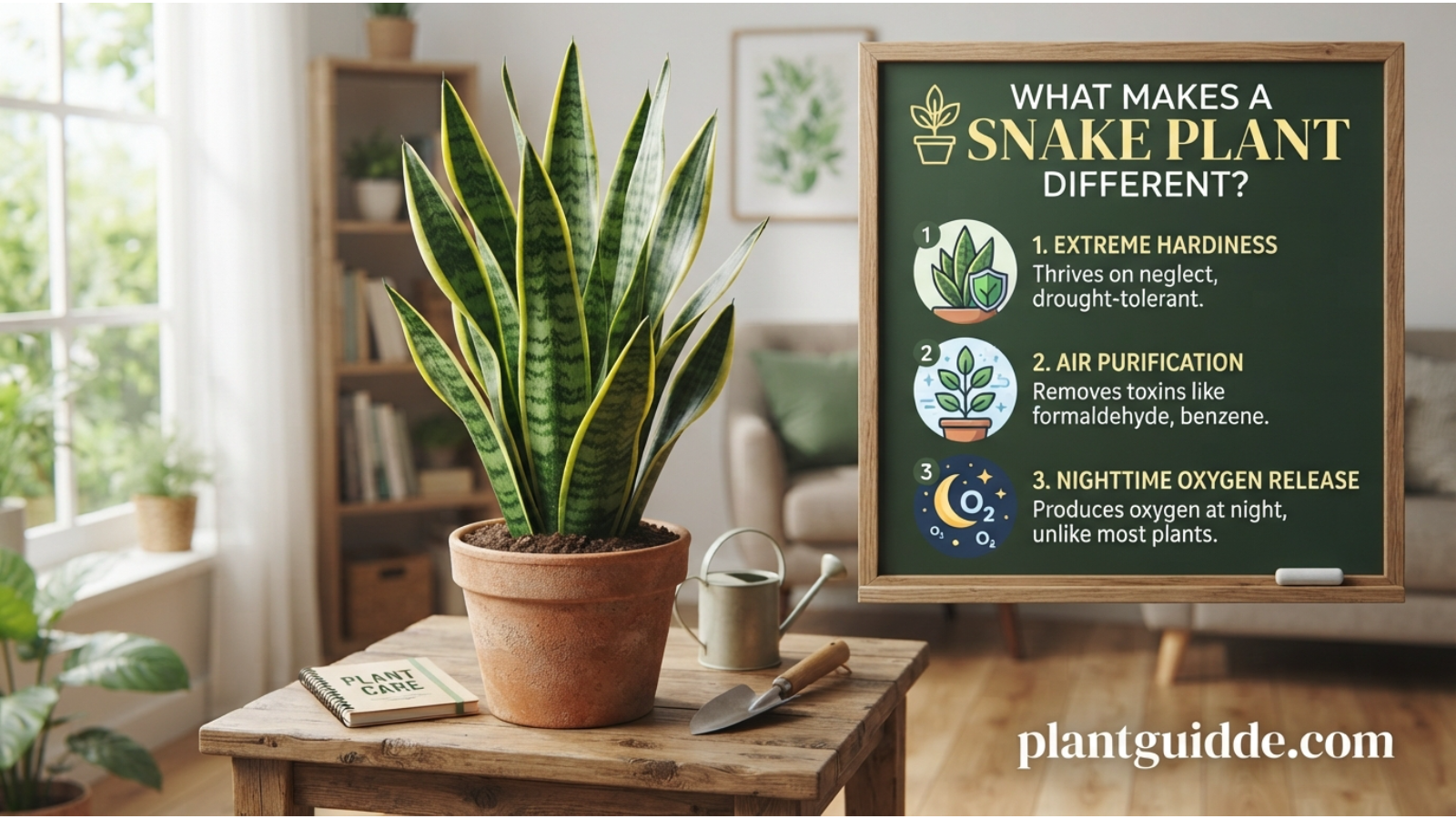
What Makes a Snake Plant Different?
The name “Snake Plant Care Tips” commonly refers to plants formerly classified in the genus Sansevieria. Many are now botanically placed in Dracaena, including Sansevieria trifasciata, now listed as Dracaena trifasciata. The older Sansevieria name remains extremely common in horticulture and among houseplant growers.
Snake plants have thick, succulent-like leaves and underground rhizomes that help them store water. This adaptation explains why they can survive periods of dryness better than many tropical houseplants.
The Royal Horticultural Society describes sansevierias as drought-tolerant, adaptable houseplants that can grow in conditions ranging from bright light to light shade. It also identifies overwatering and prolonged wet conditions as major causes of poor health.
That gives us a useful starting point:
Snake plants generally struggle more from excess water than from occasional dryness.
The Best Snake Plant Care Tips at a Glance
| Care factor | What your snake plant needs | Common mistake |
|---|---|---|
| Light | Bright filtered light is ideal; lower light is tolerated | Assuming low light means no light |
| Water | Allow soil to dry well between waterings | Watering on a fixed weekly schedule |
| Soil | Fast-draining, well-aerated mix | Heavy soil that stays wet |
| Pot | Drainage holes are essential | Decorative pot without drainage |
| Humidity | Normal household humidity is usually sufficient | Constant misting |
| Temperature | Stable, warm indoor conditions | Cold drafts or sudden temperature changes |
| Fertilizer | Light feeding during active growth | Overfertilizing |
| Repotting | Only when needed | Moving it into an oversized pot |
| Pruning | Remove damaged leaves at the base | Cutting healthy leaves unnecessarily |
Give Your Snake Plant the Right Light
One of the most useful snake plant care tips is to stop thinking of “low-light tolerant” as meaning “low-light dependent.”
Snake plants can survive in relatively dim areas, but survival and vigorous growth are not the same thing. The RHS notes that they tolerate low light while generally growing better in brighter locations.
The ideal location
A bright room with filtered or indirect light is an excellent choice.
Good locations include:
- Near an east-facing window
- A short distance from a bright south- or west-facing window
- A bright room where harsh afternoon sunlight is filtered
- A well-lit office or bedroom
Some snake plants can tolerate direct sun, particularly when gradually acclimated. However, intense summer sunlight through glass can scorch foliage.
What happens in too little light?
A snake plant in poor light may:
- Grow very slowly
- Produce fewer new leaves
- Develop weaker or stretched growth
- Lose some of its compact appearance
- Show slower soil drying, increasing the risk of overwatering
This last point is particularly important.
A plant sitting in low light uses water more slowly. If you continue watering it according to the same schedule you use for a brighter location, the soil can remain wet for too long.
Light and watering are connected.
Practical tip
If your Snake Plant Care Tips is in a dim corner, don’t automatically add more water because it looks like it is growing slowly. Improve the light first.
Image Suggestion: A comparison showing a snake plant in bright filtered light versus one in a very dark corner, with arrows explaining differences in growth.
Water Only When the Soil Has Dried
If you remember only one watering rule, make it this:
Do not water a snake plant simply because it has been seven days since the last watering.
There is no universal weekly watering schedule because the plant’s needs change with light, temperature, pot size, soil, season, and airflow.
The RHS recommends checking the compost and watering only after it has dried out, while emphasizing that overwatering is a common cause of root rot.
How to check the soil
Before watering:
- Push your finger several centimeters into the soil.
- Check whether the mix is still noticeably moist.
- If it remains damp, wait.
- If the soil has dried substantially, water thoroughly.
- Allow excess water to drain completely.
For a more precise approach, especially with large pots, use the weight of the pot as an additional clue. A freshly watered pot will feel substantially heavier than a dry one.
What does proper watering look like?
When watering is needed, do not give the plant a tiny splash and walk away.
Instead:
- Water the soil thoroughly.
- Allow excess water to escape through the drainage holes.
- Empty standing water from a saucer or outer container.
- Do not leave the pot sitting in water.
The goal is thorough watering followed by a period of drying, rather than constant small amounts of moisture.
Why overwatering is so dangerous
Snake plants store water in their leaves and underground structures. Their roots therefore do not need continuously wet soil.
When soil stays saturated for long periods, oxygen availability around the roots decreases and root tissues can deteriorate. By the time yellow leaves or soft stems appear, the root system may already be compromised.
Image Suggestion: A simple soil-moisture diagram showing “water → drain completely → dry → water again.”
Use Fast-Draining Snake Plant Soil
Good soil is one of the most overlooked snake plant care tips.
A snake plant does not need soil that holds moisture for a long time. It needs a mix that allows water to pass through while retaining enough moisture for the roots to use.
The RHS recommends free-draining compost suitable for cactus-type plants and warns that poorly draining soil can remain wet and encourage root problems.
What should snake plant soil be like?
Look for a mix that is:
- Well-draining
- Airy rather than compacted
- Structurally stable
- Appropriate for succulents or drought-tolerant plants
A commercial cactus or succulent potting mix is often an easy starting point.
If making your own mix, the goal is not simply to add as much grit or sand as possible. The important thing is creating a balanced medium that drains efficiently without becoming so coarse that water runs through immediately without adequately wetting the root zone.
Avoid heavy garden soil
Garden soil can compact inside containers and may retain too much moisture.
For indoor snake plants, a purpose-made potting mix is generally a better choice.
Choose a Pot With Drainage Holes
A good soil mix cannot fully compensate for a pot that traps water.
Your container should have at least one effective drainage hole at the bottom.
This allows excess water to escape after watering.
Why oversized pots can cause problems
A common beginner mistake is moving a small snake plant into a huge decorative pot because the plant is expected to grow into it.
The problem is that a large volume of soil can remain moist for much longer than a small root system can use.
Instead, choose a pot that is only modestly larger than the existing root system when repotting.
Decorative pots need special attention
If your snake plant sits inside a decorative cachepot, remove the inner pot when watering whenever practical. Allow it to drain completely before returning it.
Image Suggestion: Cross-section illustration comparing a snake plant in a drainage pot with one sitting in a water-filled decorative container.
Don’t Worry About High Humidity
Unlike many tropical houseplants, snake plants generally do not require high humidity.
The RHS specifically notes that sansevierias prefer relatively low humidity and advises against misting them or keeping them in excessively steamy conditions.
This makes them particularly convenient for ordinary indoor environments.
Do you need to mist a snake plant?
Usually, no.
Routine misting does not solve the main problems snake plants experience. If the roots are sitting in wet soil, spraying the leaves will not correct the underlying issue.
Instead, prioritize:
- Correct watering
- Good drainage
- Suitable light
- Air movement
- Stable temperature
This is a good example of an important plant-care principle:
Treat the cause rather than the symptom.
Keep Temperatures Stable
Snake plants prefer ordinary warm indoor conditions and should be protected from cold temperatures and drafts.
The RHS gives an ideal growing range of approximately 15–24°C (60–75°F) for sansevierias and recommends protecting them from cold drafts.
Avoid placing the plant:
- Directly beside an air-conditioning outlet
- Against a very cold window during winter
- Next to a strong heater
- In a location exposed to sudden temperature swings
A stable environment is generally more useful than trying to create an artificially tropical environment.
Fertilize Lightly Rather Than Frequently
Snake plants are relatively slow-growing compared with many foliage houseplants, so they do not need aggressive feeding.
During active growth, a diluted balanced houseplant fertilizer can be used according to the product’s instructions.
The RHS recommends monthly feeding during the growing season, while emphasizing that overfeeding can damage roots and reduce plant health.
A practical approach
If your plant is:
- Growing actively → occasional feeding can help
- Barely growing in low light → improve light before increasing fertilizer
- Newly repotted in fresh fertilized soil → additional fertilizer may not be necessary immediately
- Showing brown or damaged roots → do not assume fertilizer will fix it
More fertilizer does not compensate for poor light, bad soil, or overwatering.
Know When to Repot a Snake Plant
Snake plants do not need frequent repotting.
They can remain in the same container for quite some time, and the RHS recommends potting on when plants become pot-bound rather than repotting routinely.
Signs it may be time to repot
Look for:
- Roots filling the container
- Rhizomes becoming tightly crowded
- The plant repeatedly becoming unstable
- Water passing unusually quickly through a severely root-bound container
- The pot becoming visibly distorted or crowded
Repot during active growth when practical.
Do not automatically size up dramatically
Move to a slightly larger container rather than jumping several pot sizes.
This helps maintain a reasonable balance between the root system and the amount of soil surrounding it.
Rotate the Plant for More Even Growth
Snake plants naturally respond to the direction of available light.
If one side receives much more light than the other, the plant can gradually lean toward the brighter area.
A simple solution is to rotate the pot periodically.
The RHS specifically recommends turning the pot by about a quarter each time you water to help prevent leaning toward the light.
This is a small habit, but it can make a noticeable difference to the plant’s shape over time.
Prune Damaged Snake Plant Leaves Correctly
Snake plants generally require very little pruning.
If a leaf is completely damaged, dead, or badly affected, remove it cleanly near the base using a clean cutting tool.
Avoid repeatedly cutting healthy leaf tips simply to make the plant look symmetrical.
What about brown tips?
A brown tip does not automatically mean the entire leaf should be removed.
If the rest of the leaf is healthy, you can leave it alone. A damaged tip may be cosmetic rather than a sign that the entire leaf is dying.
When trimming, follow the natural shape of the leaf rather than making a blunt horizontal cut that looks unnatural.
Snake Plant Problems: What the Leaves Are Telling You
Snake plants often communicate stress through changes in their leaves. The trick is not simply identifying the symptom—it is identifying what happened before the symptom appeared.
Yellow Snake Plant Leaves
Yellow leaves can have several causes, but consistently wet soil should be one of the first things you investigate.
Check:
- How often you are watering.
- Whether the soil is still wet several days after watering.
- Whether the container has drainage holes.
- Whether the pot is much larger than the root system.
- Whether the roots smell unpleasant or appear soft.
If the soil is persistently wet, changing the watering routine and improving drainage should be a priority.
Brown Snake Plant Leaves
Brown areas can result from different forms of stress, so do not diagnose the problem from color alone.
Consider:
- Watering problems
- Root damage
- Intense direct sunlight
- Physical damage
- Environmental stress
Look at the location of the brown tissue.
Brown, crispy edges suggest a different problem from soft, dark, water-soaked tissue.
That distinction matters because the solutions are completely different.
Soft or Mushy Snake Plant Leaves
Soft leaves, particularly near the base, are a serious warning sign.
Check the roots and soil.
If the soil has remained wet and the lower plant tissue is soft, root or rhizome rot becomes a major concern.
Do not respond by watering again because the leaves appear limp.
Limp foliage does not always mean the plant needs water.
A plant with damaged roots may also wilt because it can no longer move water properly.
Curling Snake Plant Leaves
Curling can be associated with stress, including prolonged dryness or unfavorable environmental conditions.
Start with the simplest checks:
- Is the soil completely dry?
- Has the plant recently been moved?
- Is it receiving unusually intense sunlight?
- Is it exposed to hot or cold airflow?
- Are the roots healthy?
Avoid changing several variables at once. Diagnose first, then make one or two targeted adjustments.
Snake Plant Leaves Falling Over
If upright leaves suddenly become floppy, inspect the base of the plant.
Possible causes include:
- Excess moisture
- Root or rhizome problems
- Physical damage
- Very low light combined with weak growth
- Natural aging of individual leaves
If the leaf is soft at the base, investigate the roots rather than simply staking the plant upright.
How to Save an Overwatered Snake Plant
Overwatering is one of the most important problems to understand because simply “watering less next time” may not be enough once roots have started to rot.
Step 1: Stop watering
Allow the plant to dry while you assess the soil and root condition.
Step 2: Remove the plant if the soil stays saturated
If the pot remains wet for an unusually long time or the plant shows signs of rot, inspect the root system.
Step 3: Check the roots
Healthy roots should have reasonable firmness.
Soft, mushy, discolored tissue is concerning.
Step 4: Remove severely damaged tissue
Use a clean cutting tool to remove clearly rotten sections.
Step 5: Repot into fresh, well-draining soil
Use a clean container with effective drainage.
Step 6: Correct the environmental cause
Ask why the soil stayed wet:
- Too much water?
- Watering too frequently?
- Poor soil?
- No drainage?
- Oversized container?
- Very low light?
Fixing the underlying cause is more important than simply replacing the soil.
Image Suggestion: Step-by-step infographic showing an overwatered snake plant, root inspection, removal of damaged roots, and repotting.
Snake Plant Care Tips for Different Seasons
Your watering routine should change with the plant’s growing conditions rather than follow an inflexible calendar.
Spring
As light levels increase and growth becomes more active:
- Check the soil more frequently.
- Resume light fertilization if appropriate.
- Watch for new shoots.
- Rotate the plant regularly.
Summer
Summer may increase evaporation, but do not assume every snake plant needs frequent watering.
A plant in bright light and a warm room may dry faster than one in a cool, dim location.
Check the soil rather than relying on the season alone.
Also protect the plant from extreme midday sun if its leaves are not acclimated to strong direct light.
Autumn
As light levels decline, growth may slow.
Begin reducing watering frequency as the soil takes longer to dry.
Winter
Winter is often when overwatering becomes especially easy.
Lower light and slower growth mean the plant may use considerably less water. The RHS notes that snake plants may require very little water during winter unless they are kept in a particularly warm location.
The correct winter routine is therefore:
Check first. Water second.
Common Snake Plant Care Mistakes
1. Watering every week
A calendar cannot measure soil moisture.
Better approach: Check the soil before watering.
2. Keeping the plant in a dark corner
Snake plants tolerate low light, but that does not mean they thrive in complete darkness.
Better approach: Give the plant the brightest suitable location available without exposing it suddenly to harsh sunlight.
3. Using a pot without drainage
This creates a serious barrier to proper watering.
Better approach: Always use effective drainage.
4. Using heavy soil
Dense soil can remain wet for too long.
Better approach: Choose a free-draining mix.
5. Misting constantly
Snake plants do not need high humidity.
Better approach: Focus on roots, soil, light, and drainage.
6. Fertilizing a stressed plant
Fertilizer is not medicine.
Better approach: Correct environmental problems first.
7. Repotting too often
Constant repotting can create unnecessary stress.
Better approach: Repot when the plant genuinely needs more room or the growing medium has become unsuitable.
8. Assuming every yellow leaf means “underwatering”
Yellowing is not a diagnosis.
Better approach: Inspect the soil, roots, light, and recent watering history before making a change.
A Simple Snake Plant Care Routine
If you want a low-maintenance routine that is easy to remember, use this checklist.
Every few days
Look at the plant.
You do not need to water it—just observe.
Check for:
- New growth
- Damaged leaves
- Pests
- Sudden changes in color or firmness
Before watering
Check the soil.
If it is still damp, wait.
When watering
Water thoroughly and let the excess drain away.
Every few weeks
Rotate the pot and inspect the overall shape.
During active growth
Consider occasional fertilizer if the plant is growing actively and the potting mix does not already provide sufficient nutrients.
Every few months
Check:
- Root crowding
- Drainage
- Soil condition
- Light exposure
- Leaf health
This routine is more reliable than trying to memorize a rigid watering schedule.
Advanced Tip: Diagnose the Environment Before the Plant
One of the most useful habits experienced houseplant growers develop is looking at the whole growing environment instead of reacting to a single symptom.
For example, suppose a snake plant develops yellow leaves.
A beginner might immediately search for “yellow snake plant leaves” and choose one treatment.
A better diagnostic process asks:
What changed?
- Did watering frequency increase?
- Was the plant moved into a darker room?
- Was it recently repotted?
- Did the pot size change?
- Is the soil staying wet?
- Has the temperature changed?
- Is the yellowing occurring on old leaves or new growth?
This approach reduces unnecessary interventions.
Plant problems are often caused by combinations of conditions rather than one isolated mistake.
How to Tell Whether Your Snake Plant Is Healthy
A healthy snake plant generally has:
- Firm leaves
- Stable upright growth
- Strong natural coloration
- No persistent soft or mushy tissue
- A root system that is not constantly sitting in wet soil
- Gradual new growth when conditions are favorable
Do not judge health solely by growth speed.
Snake plants can grow slowly, particularly in lower light. Slow growth is not automatically a problem.
A stable plant that produces occasional healthy new leaves may be doing perfectly well.
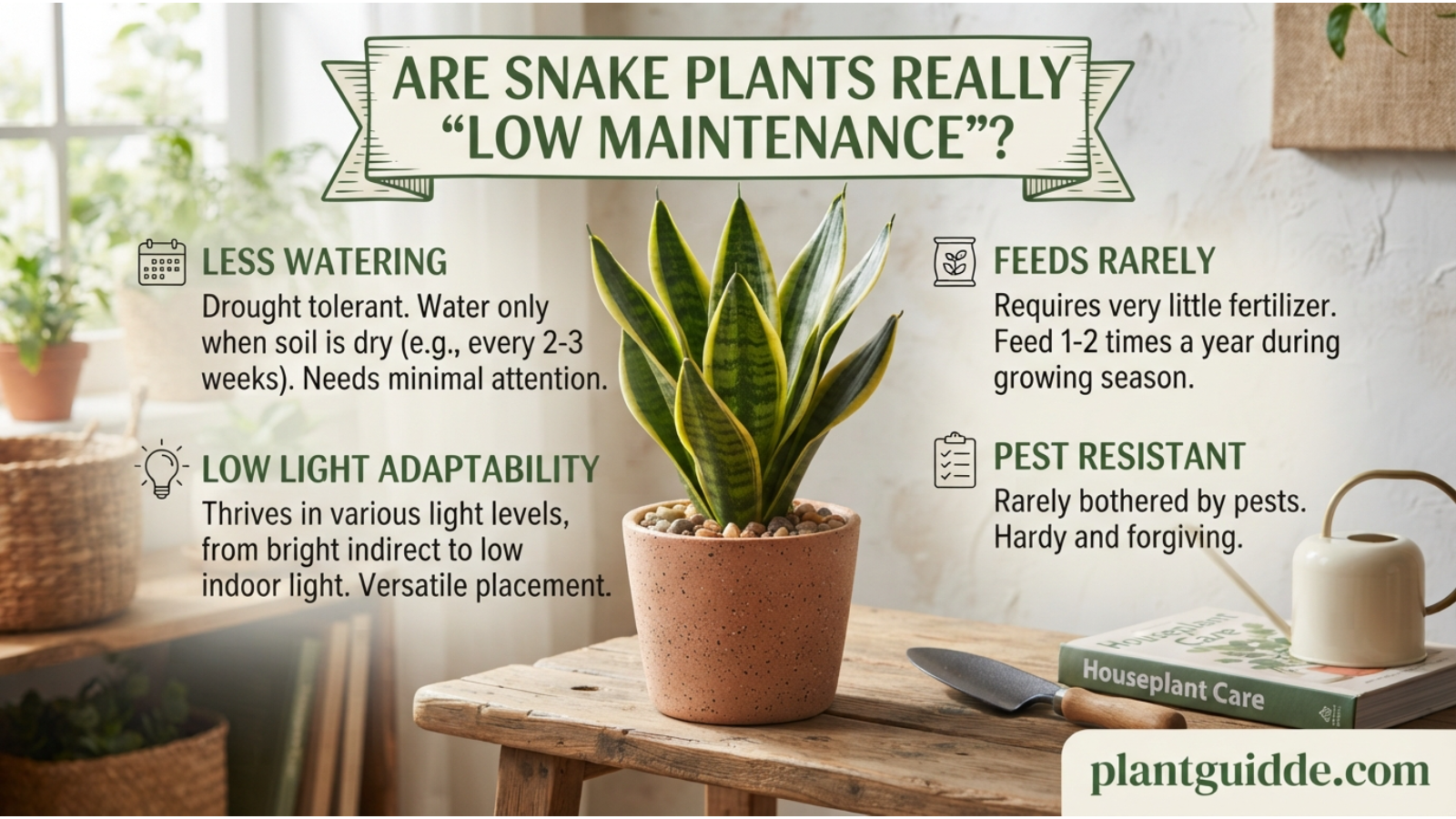
Are Snake Plants Really “Low Maintenance”?
Yes—but low maintenance does not mean maintenance-free.
The plant’s drought tolerance gives you a wider margin for error than many houseplants. The RHS describes sansevierias as robust, adaptable, and tolerant of neglect.
But that tolerance has a limit.
A snake plant can survive:
- A missed watering
- Relatively low humidity
- Lower light than many houseplants
- Periods of dry soil
It is much less forgiving of:
- Constantly wet soil
- Poor drainage
- Severe root damage
- Repeated environmental extremes
That distinction is what makes snake plant care easier to understand.
FAQs,
How often should I water a snake plant?
Water when the soil has dried substantially rather than following a fixed weekly schedule. The exact interval depends on light, temperature, pot size, soil, and season.
Does a snake plant need direct sunlight?
Not necessarily. Snake plants tolerate low light and can grow well in bright filtered light. Some can handle direct sun, but sudden exposure to intense sunlight can scorch leaves.
Can snake plants grow in low light?
Yes. They are among the houseplants known for tolerating lower-light conditions. However, lower light generally means slower growth, and the soil may dry more slowly.
Should I mist my snake plant?
Usually, no. Snake plants do not require high humidity, and the RHS specifically recommends avoiding misting them.
What is the best soil for a snake plant?
Use a fast-draining potting mix, such as a quality cactus or succulent mix. The important characteristic is good drainage rather than a particular brand.
Why are my snake plant leaves turning yellow?
Overwatering is one of the first things to investigate, especially if the soil stays wet for long periods. Also check drainage, pot size, light, and root health.
Why are my snake plant leaves soft?
Soft leaves can indicate serious moisture or root problems, particularly when the lower leaves or base become mushy. Check the soil and roots rather than assuming the plant simply needs more water.
Can snake plants live in a bathroom?
They can tolerate ordinary indoor conditions, but a constantly steamy, poorly ventilated bathroom is not necessary or ideal. Snake plants generally prefer lower humidity and good airflow.
When should I repot my snake plant?
Repot when the plant becomes genuinely root-bound or the growing medium no longer drains properly. Snake plants do not need frequent repotting.
Do snake plants need fertilizer?
They can benefit from light feeding during active growth, but heavy fertilization is unnecessary. Overfeeding can damage roots and create more problems than it solves.
Why is my snake plant leaning?
Uneven light can cause growth to lean toward the brighter side. Rotating the pot periodically can help maintain more balanced growth.
Are snake plants safe for pets?
Snake plants are considered harmful if eaten, so they should be kept away from pets and children who may chew plant material.
Final Snake Plant Care Tips to Remember
The best snake plant care tips are surprisingly simple once you understand how the plant is built.
Give it suitable light, use a draining pot and airy soil, and resist the temptation to water on a schedule. Let the soil dry between waterings, especially during periods of slower growth. Keep the plant away from extreme temperatures, fertilize lightly during active growth, and repot only when necessary.
Most importantly, learn to read the plant and its growing environment together.
Snake plants reward consistency more than constant attention. Once you provide the right balance of light, dry-down time, drainage, and stable conditions, they can remain attractive and healthy with remarkably little intervention.

Asad Mumtaz is a dedicated plant enthusiast and gardening writer with a passion for helping people care for their plants successfully. He specializes in plant care guides, indoor gardening, and practical growing tips for all skill levels. His content focuses on making gardening simple, enjoyable, and rewarding. Through his work, Asad shares reliable advice to help readers create thriving green spaces.