Bougainvillea plant care is one of those plants that can transform a sunny garden, patio, balcony, or wall with its colorful display. Its papery pink, purple, red, orange, white, or magenta bracts can look spectacular when the plant is growing under the right conditions.
However, bougainvillea plant care is often misunderstood. A plant may produce lots of leaves but very few flowers, develop yellow foliage, wilt despite having wet soil, or become tangled and overgrown when its basic needs are not balanced.
The good news is that bougainvillea generally responds well once you understand what it actually prefers: strong sunlight, warmth, excellent drainage, controlled watering, and timely pruning. This guide explains how to provide those conditions and how to troubleshoot the most common problems.
Quick Answer
Bougainvillea plant care is mainly about giving the plant plenty of direct sunlight, sharply draining soil, careful watering, and regular pruning. Bougainvillea blooms best when its roots are not kept constantly wet and when the plant receives enough warmth and sunlight. Avoid excessive fertilizer and frequent watering, especially when the plant is established.
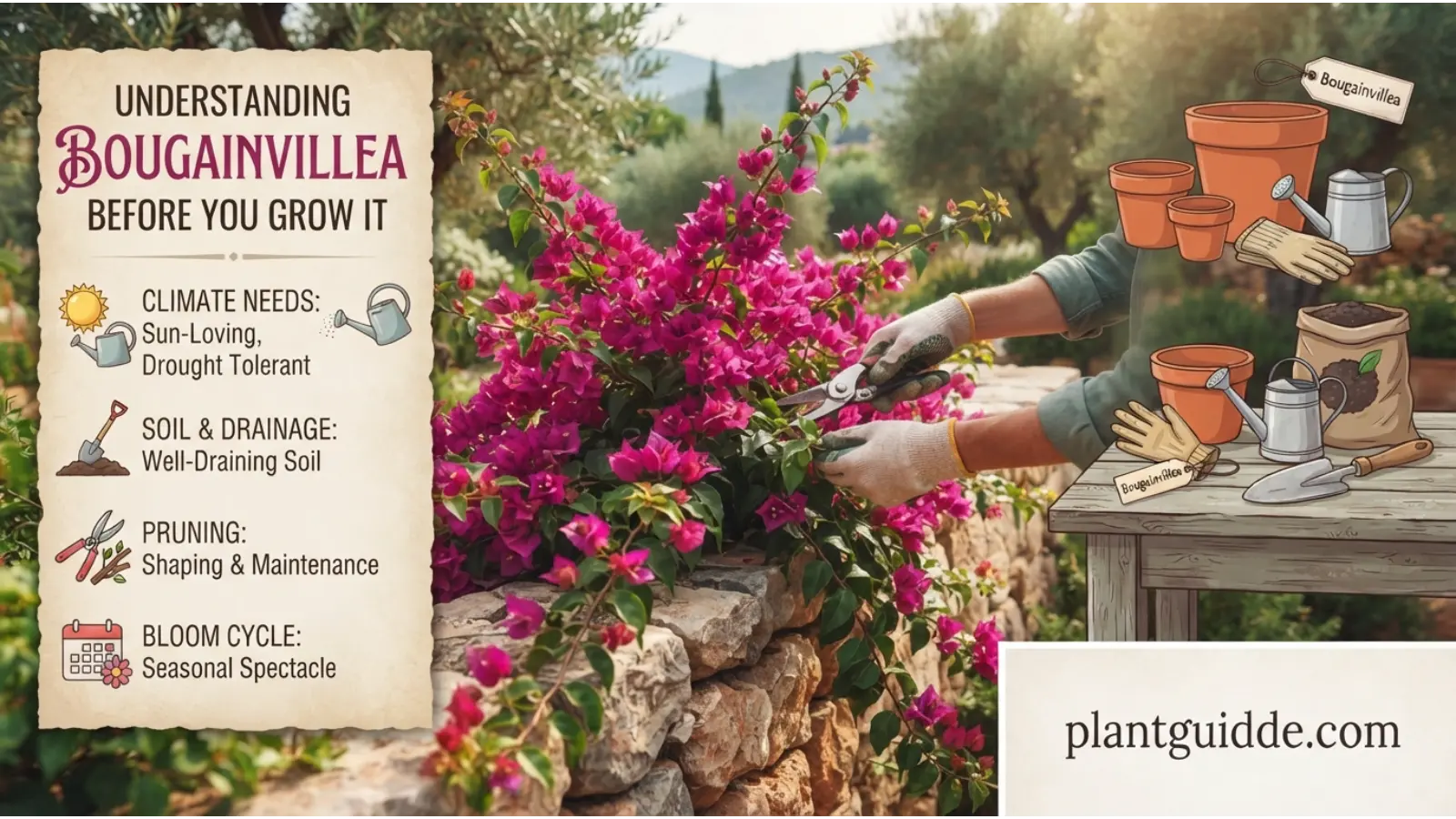
Understanding Bougainvillea Before You Grow It
Bougainvillea is a woody, vigorous climbing plant native to tropical and subtropical regions of South America. It is commonly grown as a climber, shrub, hedge, container plant, or trained specimen.
One important detail is often overlooked: the brightly colored parts that appear to be flowers are actually bracts, or modified leaves. The true flowers are the small flowers found among these colorful bracts.
This matters because a healthy-looking plant can have plenty of foliage without producing the colorful display gardeners expect. Flowering depends heavily on environmental conditions rather than simply adding more fertilizer.
Bougainvillea also has thorny stems on many varieties, so placement and pruning should be considered before allowing it to grow freely.
What Bougainvillea Needs to Thrive
The most important parts of bougainvillea plant care work together. Improving one factor while ignoring another may not solve the problem.
| Growing factor | What bougainvillea generally prefers |
|---|---|
| Light | Several hours of strong direct sunlight |
| Soil | Fast-draining soil |
| Water | Deep watering followed by drying |
| Temperature | Warm conditions |
| Humidity | Adaptable, provided roots are not kept wet |
| Fertilizer | Moderate feeding without excessive nitrogen |
| Pruning | Regular shaping and removal of unwanted growth |
| Support | Trellis, wall, fence, or other sturdy structure for climbers |
The goal is not to keep bougainvillea constantly comfortable in moist soil. It performs better when its roots have access to oxygen and the growing medium drains quickly.
How Much Sunlight Does Bougainvillea Need?
Full sun is one of the most important requirements for flowering bougainvillea.
Choose the brightest location available, preferably one that receives several hours of direct sunlight each day. A shaded or poorly lit position may keep the plant alive but often results in weak growth and reduced flowering.
Bougainvillea plant care your bougainvillea receives morning sun but spends most of the afternoon in deep shade, flowering may be disappointing.
Signs your bougainvillea needs more light
Watch for:
- Long, weak, or stretched growth
- Large amounts of green foliage with few bracts
- Reduced flowering
- Growth leaning toward a brighter area
- A generally sparse appearance
If a container-grown plant is in a low-light location, gradually move it toward stronger sunlight rather than suddenly exposing a previously shaded plant to intense sun.
Practical tip: If your main goal is flowers rather than simply foliage, prioritize sunlight before increasing fertilizer.
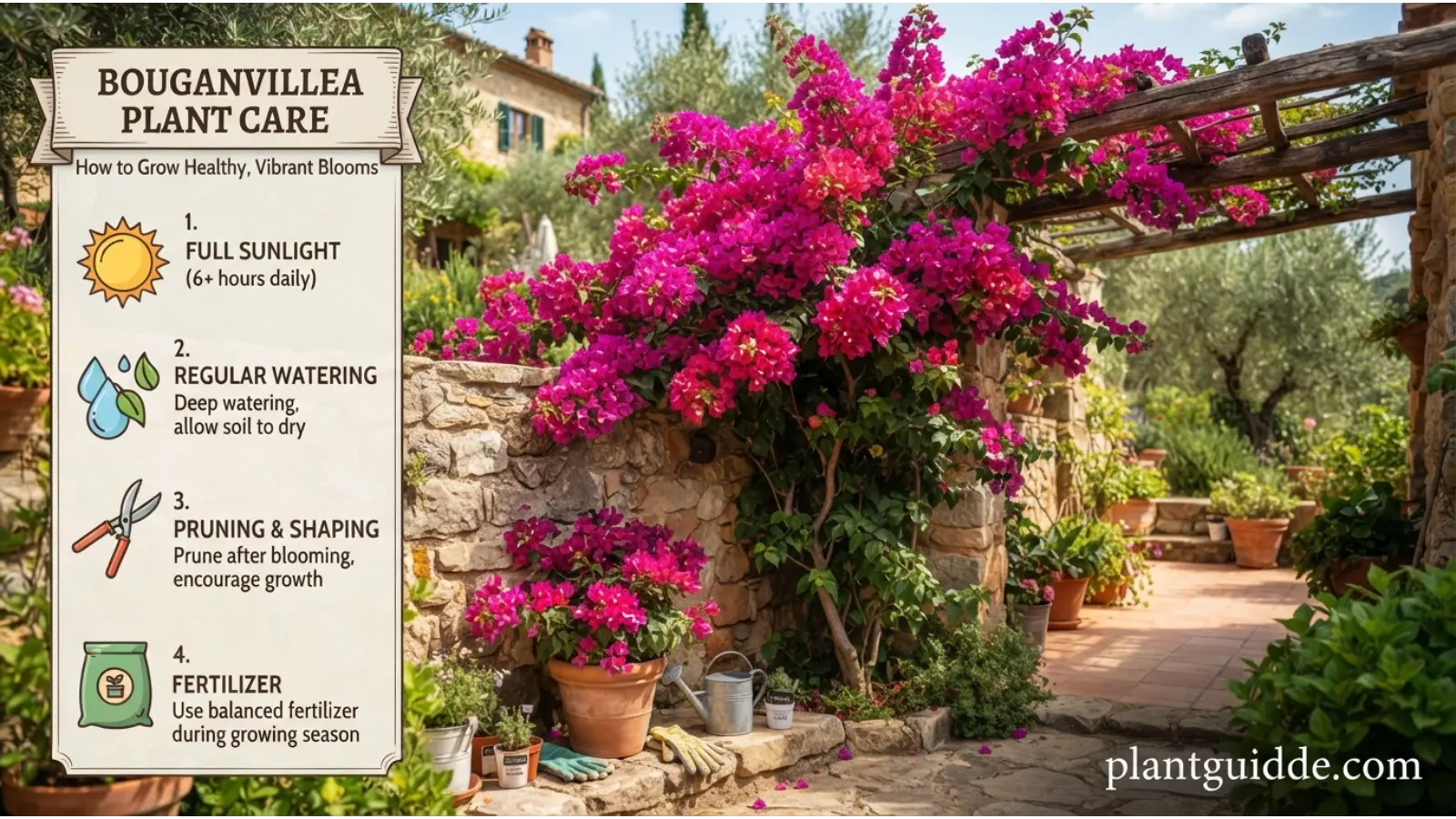
Image Suggestion: A mature bougainvillea growing against a sunny wall, showing dense colorful bracts and strong woody stems.
Choosing the Right Soil for Bougainvillea
Good drainage is essential. Bougainvillea does not perform well when its roots remain surrounded by water for long periods.
For containers, use a well-draining potting mix rather than heavy garden soil that becomes compacted and holds excessive moisture.
A useful mix should:
- Drain excess water quickly
- Maintain enough structure for the roots
- Avoid becoming dense and muddy
- Allow air to reach the root zone
Bougainvillea plant care water sits on the surface for a long time or the pot remains heavy and wet for days after watering, the growing medium may be too moisture-retentive.
Container drainage matters
Always use a container with adequate drainage holes. Decorative pots without drainage can trap water around the roots even when the soil itself seems appropriate.
Do not rely on a layer of gravel at the bottom of a pot to fix poor drainage. The more effective solution is using a properly draining growing medium and a container designed to release excess water.
How to Water Bougainvillea Correctly
Watering is one of the easiest areas to get wrong.
Bougainvillea needs water, but it does not need constantly wet roots. Instead of watering according to a rigid calendar, check the growing medium and consider the weather, plant size, container size, and season.
When the upper portion of the soil has dried and the plant needs water, water thoroughly enough to moisten the root zone. Then allow excess water to drain away.
Avoid giving a small splash of water every day simply because the surface looks dry.
A practical watering routine
- Check the soil before watering.
- Feel the growing medium several centimeters below the surface.
- If it is still noticeably moist, wait.
- When watering is needed, water thoroughly.
- Allow excess water to drain completely.
- Reduce watering during cool or unusually wet periods.
Container-grown bougainvillea may dry out faster than plants growing in the ground, particularly during hot weather.
On the other hand, a large container in a cooler location may remain wet much longer.
How to recognize watering problems
Too much water may cause:
- Yellowing leaves
- Persistent wilting despite wet soil
- Leaf drop
- Soft or declining growth
- Root problems
Too little water may cause:
- Drooping foliage
- Dry, brittle leaves
- Premature leaf drop
- Very dry potting mix
- Reduced growth
Remember that wilting alone does not always mean the plant needs more water. A plant with damaged roots can wilt because its roots are unable to absorb water efficiently even when the soil is wet.
Why Is My Bougainvillea Not Blooming?
Few bougainvillea problems are more frustrating than a vigorous plant that refuses to flower.
Before adding fertilizer, look at the growing conditions.
1. Insufficient sunlight
This is one of the first things to investigate. Bougainvillea needs strong light to produce an impressive flowering display.
2. Excessive nitrogen
A fertilizer high in nitrogen can encourage leafy growth at the expense of flowering when used excessively.
If your plant is producing lush green shoots but very few colorful bracts, reassess your fertilizer routine instead of automatically increasing feeding.
3. Constantly wet soil
Poor drainage and frequent watering can weaken the plant and interfere with healthy growth.
4. Excessive pruning
Bougainvillea often flowers on newer growth, but repeatedly cutting away developing shoots can reduce the growth available for flowering.
5. Insufficient warmth
Cold conditions can slow growth and flowering, particularly for plants grown outside their preferred warm-season conditions.
6. Recent transplanting or major disturbance
A plant that has recently been moved, heavily pruned, or subjected to major environmental changes may temporarily focus on establishing itself rather than producing a large flower display.
Best approach: Check light, drainage, watering, and pruning before reaching for additional fertilizer.
Fertilizing Bougainvillea
Bougainvillea can benefit from feeding during active growth, but more fertilizer does not necessarily mean more flowers.
Use a fertilizer appropriate for flowering plants and follow the product’s directions rather than applying concentrated fertilizer more frequently than recommended.
Avoid creating a routine where the plant receives heavy doses of nitrogen simply because its foliage looks pale or growth seems slow.
If the plant already has good sunlight, appropriate watering, and healthy roots, moderate fertilization can support continued growth without encouraging excessive soft foliage.
For container plants, nutrients can be depleted more quickly than in garden soil, so regular but controlled feeding may be useful during active growth.
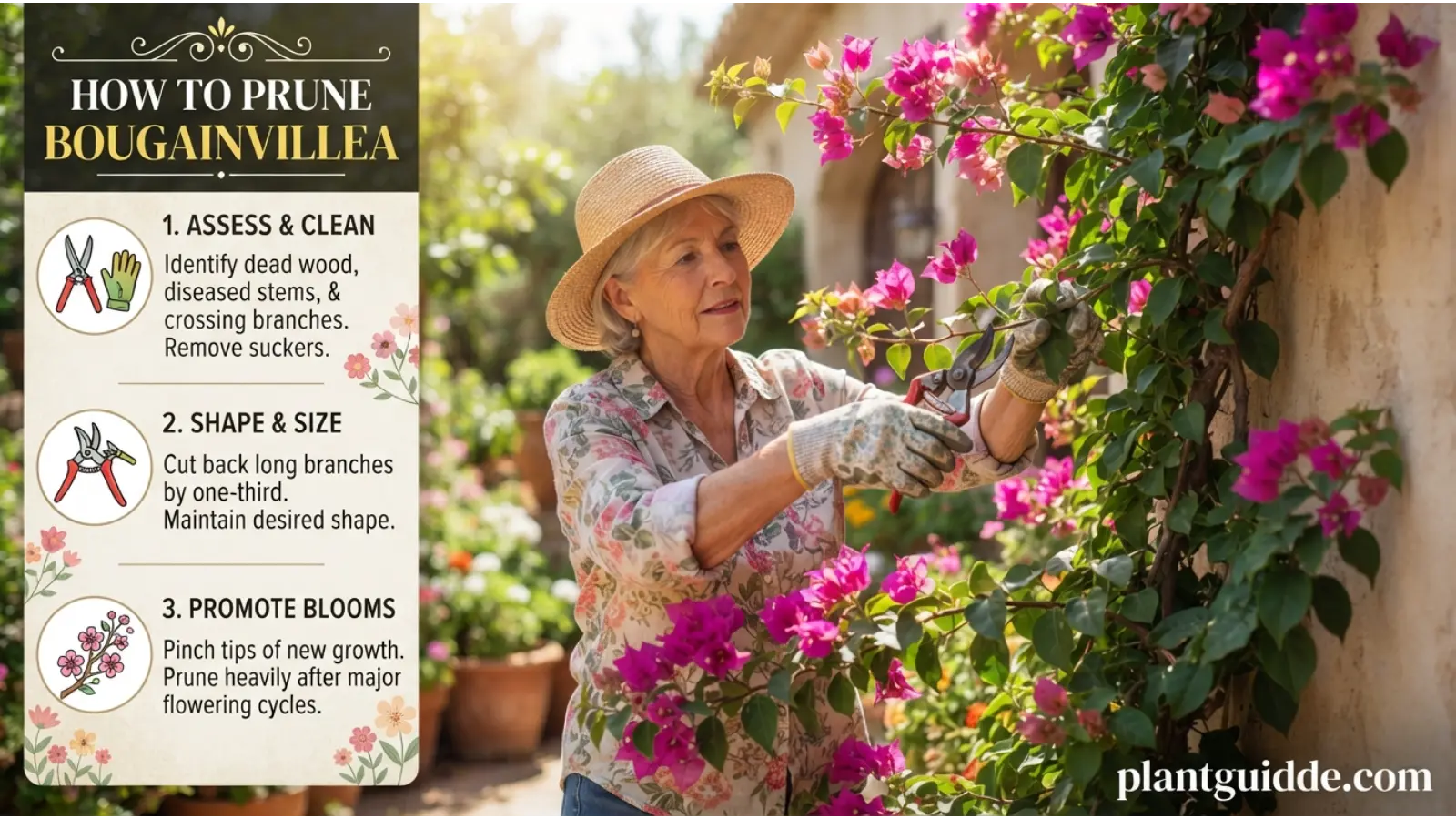
How to Prune Bougainvillea
Pruning helps control size, encourage branching, remove damaged growth, and keep the plant manageable.
Bougainvillea can grow aggressively when conditions are favorable, so allowing it to grow without direction can quickly result in tangled stems.
What to remove
Start with:
- Dead or damaged branches
- Weak growth
- Unwanted shoots
- Excessively tangled stems
- Growth extending into unwanted areas
Then shape the plant according to where you want it to grow.
Bougainvillea plant care you are training bougainvillea against a wall, fence, or trellis, guide suitable stems rather than allowing every shoot to grow in a different direction.
Avoid excessive pruning
Severe pruning at the wrong time can remove developing growth and temporarily reduce flowering.
Instead, think of pruning as guiding the plant, not constantly cutting it back.
Wear gloves and protective clothing when handling thorny varieties.
Training Bougainvillea on a Trellis or Wall
Bougainvillea naturally produces long, flexible growth that can be trained along a support.
When training a young plant:
- Select a strong support structure.
- Choose a few healthy main stems.
- Guide them toward the desired direction.
- Secure stems loosely with suitable plant ties.
- Remove competing growth when necessary.
- Continue redirecting new growth as the plant develops.
Do not tightly bind stems against a support because expanding stems can become damaged by restrictive ties.
A strong trellis is particularly important for mature plants because established bougainvillea can become surprisingly heavy.
Growing Bougainvillea in Containers
Bougainvillea can grow successfully in containers when the conditions are suitable.
Choose a container with:
- Good drainage holes
- Enough space for root development
- A stable base that will not easily tip
- A well-draining growing medium
Container-grown plants often need closer attention to watering because the root environment changes more rapidly than it does in the ground.
During hot, sunny weather, the pot may dry quickly. During cool or rainy periods, however, the same container may stay wet considerably longer.
This is why a fixed watering schedule is less reliable than checking the actual soil conditions.
Repotting considerations
Bougainvillea does not necessarily need frequent repotting. If the plant is growing well and the container is functioning properly, unnecessary disturbance can create additional stress.
Repot when the plant has clearly outgrown its container, the root system has become severely restricted, or the growing medium has deteriorated and drainage has become poor.
Bougainvillea Care in Winter
Bougainvillea is much more comfortable in warm conditions than in cold weather.
In regions where temperatures regularly become too cold for bougainvillea, container plants can be moved into a protected location when necessary.
During cooler conditions:
- Reduce watering as growth slows.
- Avoid keeping the soil continuously wet.
- Protect the plant from damaging cold.
- Provide as much available light as practical.
- Avoid encouraging soft new growth with excessive fertilizer.
The exact level of protection required depends on the variety, local climate, plant maturity, and exposure.
If your area experiences occasional cold spells rather than prolonged winter cold, temporary protection may be sufficient. In colder climates, growing bougainvillea in a movable container can make seasonal management easier.
Common Bougainvillea Plant Care Mistakes
Treating it like a thirsty tropical houseplant
Bougainvillea may look lush and tropical, but that does not mean its roots should remain constantly wet.
Giving it too little sunlight
A bright indoor room or shaded patio may not provide the intensity of light required for strong flowering.
Fertilizing every time it looks weak
Poor light, damaged roots, bad drainage, or incorrect watering can all cause weak growth. Fertilizer does not fix every problem.
Using heavy soil
Slow drainage can create persistent root-zone moisture and make watering problems worse.
Pruning without a purpose
Repeatedly cutting healthy new growth can work against the flowering and structure you are trying to develop.
Using a tiny support
A young bougainvillea may look manageable, but vigorous growth can quickly overwhelm a lightweight trellis or small structure.
Troubleshooting Common Bougainvillea Problems
| Problem | Likely causes | What to check |
|---|---|---|
| No flowers | Low light, excessive nitrogen, poor conditions | Increase sunlight and review feeding |
| Yellow leaves | Overwatering, root stress, natural aging | Check soil moisture and drainage |
| Wilting | Drought, heat stress, or root problems | Check both soil moisture and roots |
| Leaf drop | Environmental stress, watering issues, cold | Review recent changes and conditions |
| Lots of leaves, few flowers | Low light or excessive nitrogen | Improve light and moderate feeding |
| Weak, stretched growth | Insufficient light | Move toward stronger sunlight gradually |
| Slow growth | Cold, poor roots, inadequate light, stress | Examine temperature, roots, and light |
| Root problems | Waterlogged soil or poor drainage | Improve drainage and watering practices |
The key is to diagnose the growing environment rather than treating the visible symptom immediately.
For example, adding fertilizer to a plant suffering from chronically wet roots may make the situation worse rather than better.
How to Encourage More Bougainvillea Blooms
If your plant is healthy but flowering poorly, work through the basics in order:
- Maximize sunlight. Give the plant a bright, sunny location.
- Improve drainage. Make sure water does not remain around the roots.
- Avoid constant watering. Allow the growing medium to dry appropriately between thorough waterings.
- Control fertilizer. Avoid excessive nitrogen.
- Prune strategically. Shape the plant without repeatedly removing useful new growth.
- Keep it warm. Protect it from unsuitable cold.
- Give it time. Recently disturbed plants may need a period of adjustment.
This approach is usually more useful than trying to force flowering with a single product or trick.
Ground-Grown vs. Container-Grown Bougainvillea
| Feature | In the ground | In a container |
|---|---|---|
| Root space | Usually greater | Limited |
| Watering | Often less frequent once established | Can fluctuate quickly |
| Nutrients | Soil-dependent | Nutrients may deplete faster |
| Mobility | Fixed location | Can be moved |
| Winter protection | More difficult | Easier to relocate |
| Size control | Can become very vigorous | Easier to restrict |
| Drainage | Depends on site soil | Depends heavily on pot and mix |
Container growing can be particularly useful when you want greater control over the plant’s location or need to protect it from seasonal cold.
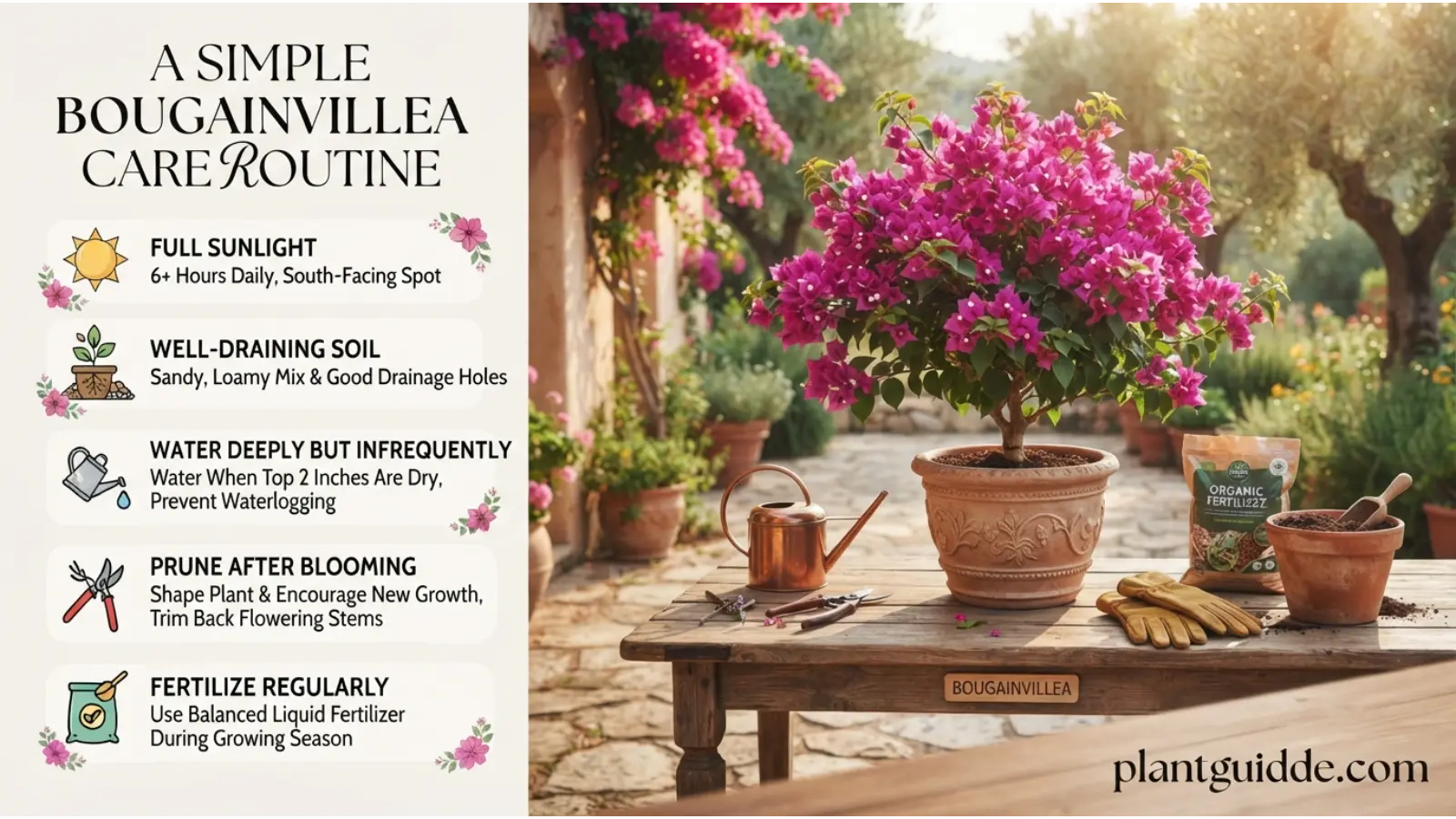
A Simple Bougainvillea Care Routine
For a healthy established plant, keep the routine straightforward:
Weekly: Check soil moisture, inspect new growth, and look for pests or signs of stress.
During active growth: Monitor watering more closely, especially during hot weather, and provide appropriate feeding when needed.
Throughout the growing season: Redirect unwanted shoots and remove dead or damaged growth.
Before colder weather: Reduce watering as growth slows and prepare container plants for protection if required.
After major weather changes: Reassess the plant rather than immediately returning to the previous watering schedule.
The plant’s condition should guide your care more than a calendar.
FAQs:
How often should I water bougainvillea?
Water when the soil has dried appropriately rather than following a strict daily schedule. When watering is necessary, water thoroughly and allow excess water to drain. Hot weather, container size, soil type, and plant maturity all affect how quickly the plant dries.
Why does my bougainvillea have lots of leaves but no flowers?
Insufficient sunlight is one of the first things to investigate. Excessive nitrogen, overwatering, excessive pruning, cold conditions, or recent stress can also reduce flowering. Start by improving light and reviewing watering and fertilizer practices.
Does bougainvillea need full sun?
Yes. Bougainvillea generally performs best with several hours of strong direct sunlight. More sunlight usually supports stronger growth and flowering, provided the plant is otherwise healthy and acclimated to the conditions.
Can bougainvillea grow in pots?
Yes. Bougainvillea can grow well in containers when the pot drains properly, the growing medium is well drained, and the plant receives sufficient sunlight. Container plants may require more careful monitoring because their soil can dry or become waterlogged more quickly.
Should I cut back my bougainvillea?
Pruning can help control size, remove damaged growth, encourage branching, and shape the plant. However, avoid repeatedly removing healthy developing growth without a clear reason, especially when you are trying to encourage flowering.
Final Thoughts
Successful bougainvillea plant care is less about complicated routines and more about getting a few fundamentals right. Give the plant plenty of sunlight, use sharply draining soil, water thoroughly but avoid constantly wet roots, feed moderately, and prune with a purpose.
If your bougainvillea is producing leaves but not flowers, do not immediately assume it needs more fertilizer. Start with the basics: light, drainage, watering, temperature, and pruning. Once those conditions are balanced, the plant has a much better opportunity to produce the colorful display that makes bougainvillea so distinctive.
The most useful next step is simple: inspect your plant today and check its sunlight exposure, soil moisture, and drainage before changing anything else.

Asad Mumtaz is a dedicated plant enthusiast and gardening writer with a passion for helping people care for their plants successfully. He specializes in plant care guides, indoor gardening, and practical growing tips for all skill levels. His content focuses on making gardening simple, enjoyable, and rewarding. Through his work, Asad shares reliable advice to help readers create thriving green spaces.