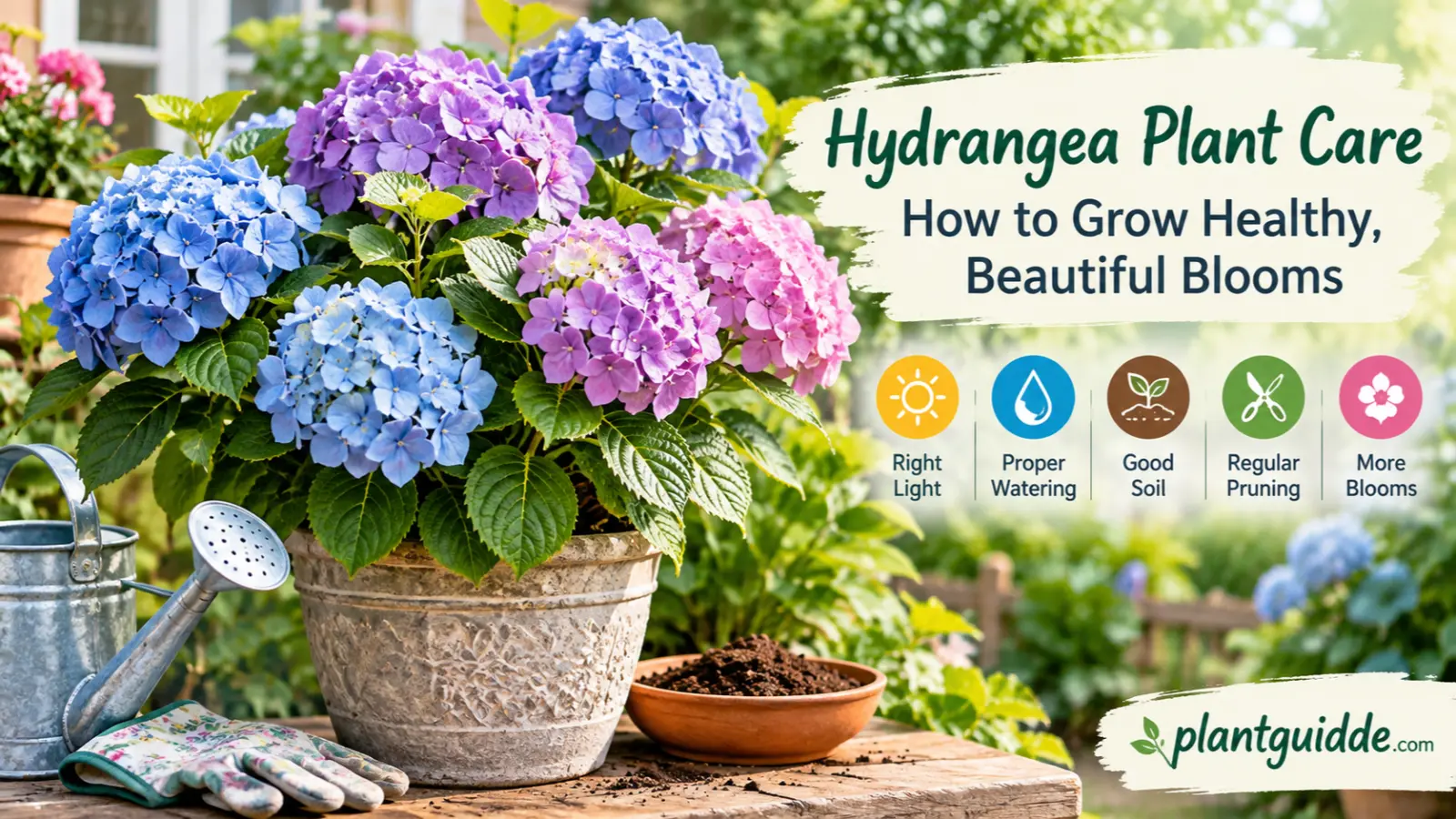
Hydrangea plant care are loved for their large flower clusters, attractive foliage, and long summer display, but their care is slightly more nuanced than simply watering them regularly. A plant can have plenty of leaves yet produce few flowers if it receives unsuitable light, is pruned at the wrong time, or experiences inconsistent moisture.
Good hydrangea plant care starts with understanding the type of hydrangea you have. Bigleaf, mountain, smooth, panicle, and oakleaf hydrangeas do not all respond to pruning, sunlight, cold, or soil conditions in exactly the same way.
The good news is that once those differences are understood, hydrangeas are much easier to manage. The goal is not to keep the soil constantly wet or follow a rigid watering schedule. Instead, provide suitable light, check the soil before watering, maintain drainage, and prune according to the plant’s flowering habit.
Quick Answer
Hydrangea plant care mainly depends on the variety, light, moisture, soil drainage, and pruning time. Most hydrangeas grow best in morning sun with afternoon protection, consistently moist but well-drained soil, and a layer of organic mulch. Avoid letting the roots stay soggy, and learn whether your hydrangea blooms on old or new wood before pruning.
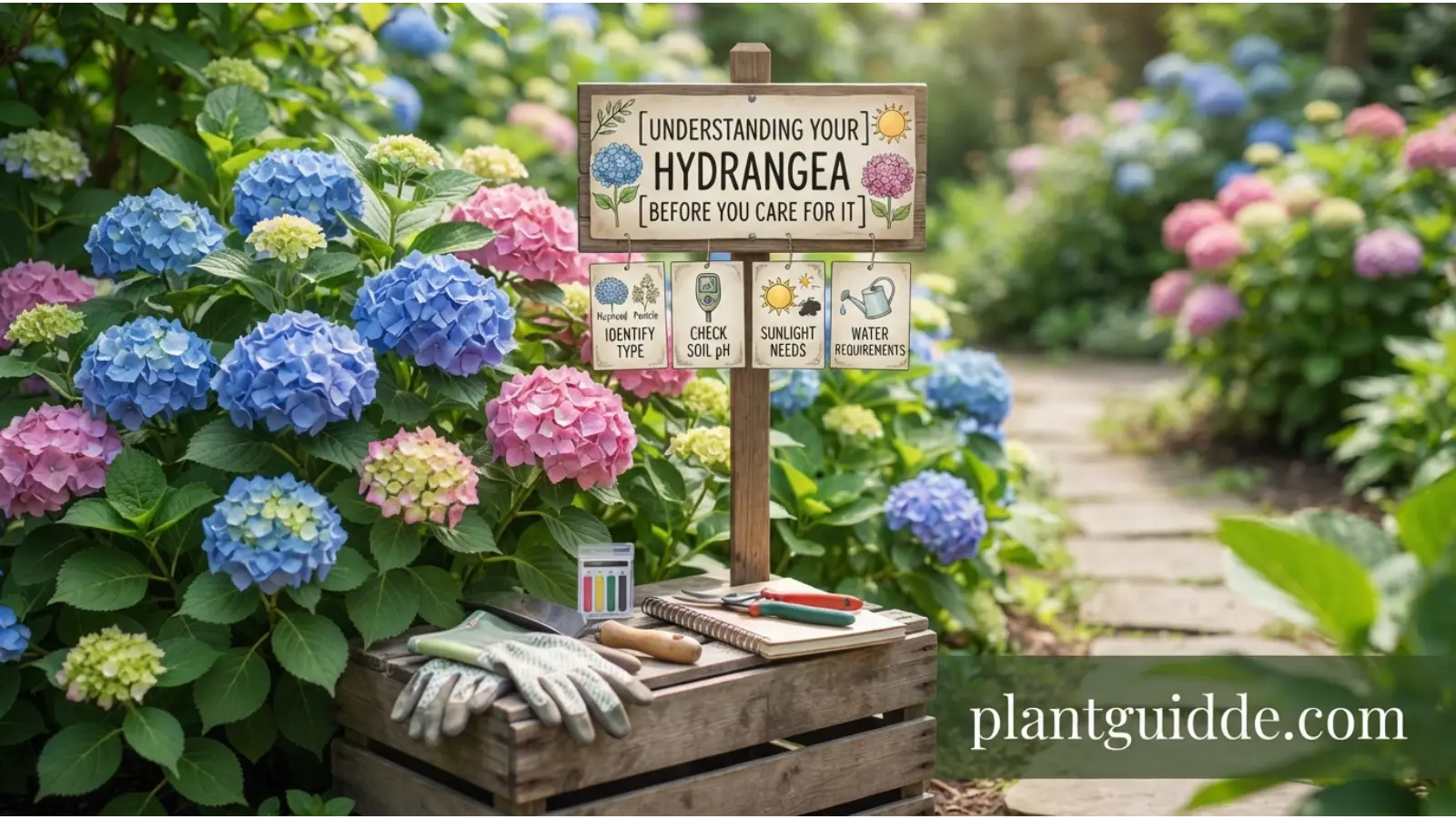
Understanding Your Hydrangea Before You Care for It
The word hydrangea covers several species and cultivated varieties with different growing habits. Identifying yours can prevent some of the most common care mistakes.
| Hydrangea type | Common characteristics | Important care point |
|---|---|---|
| Bigleaf hydrangea (Hydrangea macrophylla) | Large mophead or lacecap flowers | Pruning can remove next season’s flower buds |
| Mountain hydrangea (Hydrangea serrata) | Smaller leaves and lacecap-type flowers | Similar old-wood pruning considerations |
| Smooth hydrangea (Hydrangea arborescens) | Rounded flower clusters, often white | Flowers primarily on new growth |
| Panicle hydrangea (Hydrangea paniculata) | Cone-shaped flower clusters | Generally adaptable and blooms on new wood |
| Oakleaf hydrangea (Hydrangea quercifolia) | Oak-shaped leaves and cone-like flowers | Needs protection from excessively harsh conditions |
This distinction matters most when pruning. Cutting back a bigleaf hydrangea at the wrong time can remove flower buds that have already formed, while many panicle and smooth hydrangeas tolerate pruning much better because they flower on new growth.
How Much Light Do Hydrangeas Need?
Hydrangeas generally perform well with morning sunlight and afternoon protection, particularly in hot climates. Cooler regions may allow them to tolerate more direct sun.
Too little light can result in weak growth, fewer flowers, and stems that struggle to support large flower heads. On the other hand, intense afternoon sun combined with heat and inadequate moisture can cause leaves and flowers to wilt.
A useful approach is to observe the location rather than relying only on a fixed number of sunlight hours.
Look for a spot that provides:
- Bright morning light
- Some afternoon shade in hot areas
- Protection from intense reflected heat
- Good air circulation
- Enough space for mature growth
Hydrangea plant care your hydrangea repeatedly wilts during the hottest part of the afternoon but recovers in the evening, heat and water loss may be more important than a simple lack of water.
Practical tip: In a hot climate, a location receiving gentle morning sun followed by filtered or partial afternoon shade can be much easier to manage than an exposed position with intense afternoon sunlight.
Watering Hydrangeas the Right Way
Hydrangeas need consistent moisture, especially while establishing new roots and during hot or dry weather. However, consistently moist soil does not mean permanently wet soil.
Overwatering can create oxygen-poor conditions around the roots and may contribute to root problems. Hydrangeas growing in containers are particularly vulnerable because a pot can either dry out quickly or remain saturated depending on the potting mix and drainage.
Before watering, check the soil.
Hydrangea plant care the upper portion of the soil is beginning to dry and the plant is showing signs of increased water demand, water thoroughly. Apply water slowly enough that it penetrates the root zone rather than running off the surface.
Signs Your Hydrangea May Need Water
Look for:
- Leaves or flower heads drooping during dry conditions
- Soil becoming noticeably dry
- Newly planted plants wilting repeatedly
- Leaf edges becoming dry or crispy
- Slow growth during prolonged drought
Temporary afternoon drooping does not always mean the plant needs immediate watering. During extreme heat, hydrangea leaves can wilt as the plant temporarily loses water faster than its roots can replace it.
Check the soil before reaching for the hose.
How to Water More Effectively
Water deeply around the root zone rather than giving the plant frequent shallow splashes.
A thick organic mulch layer can also reduce evaporation and help moderate soil temperature. Keep mulch slightly away from direct contact with the stems.
The Best Soil for Hydrangeas
Hydrangeas generally prefer moisture-retentive but well-drained soil rich in organic matter.
The ideal soil should perform two jobs at once:
- Hold enough moisture for the plant.
- Allow excess water to drain away from the roots.
Heavy, poorly drained soil can remain saturated after watering, while extremely sandy soil may dry too quickly.
Adding organic matter can improve soil structure, but amendments should be used according to the existing soil rather than automatically adding large quantities.
For container-grown hydrangeas, use a quality potting mix that drains freely while retaining some moisture. Avoid using dense garden soil by itself in a container.
Does Soil pH Change Hydrangea Flower Color?
This is one of the most frequently misunderstood parts of hydrangea care.
Soil acidity can influence flower color in some hydrangeas, particularly certain bigleaf hydrangeas. Acidic conditions can make blue or purple shades more likely in suitable cultivars, while less acidic conditions may encourage pink or red shades.
However, not every hydrangea can change color in the same way.
White-flowered varieties generally should not be expected to turn blue simply because the soil is made more acidic. Flower color is also influenced by genetics and the availability of aluminum to the plant.
Therefore, do not automatically change soil pH just because you want a different flower color. Identify the variety first and understand whether it is capable of responding to pH changes.
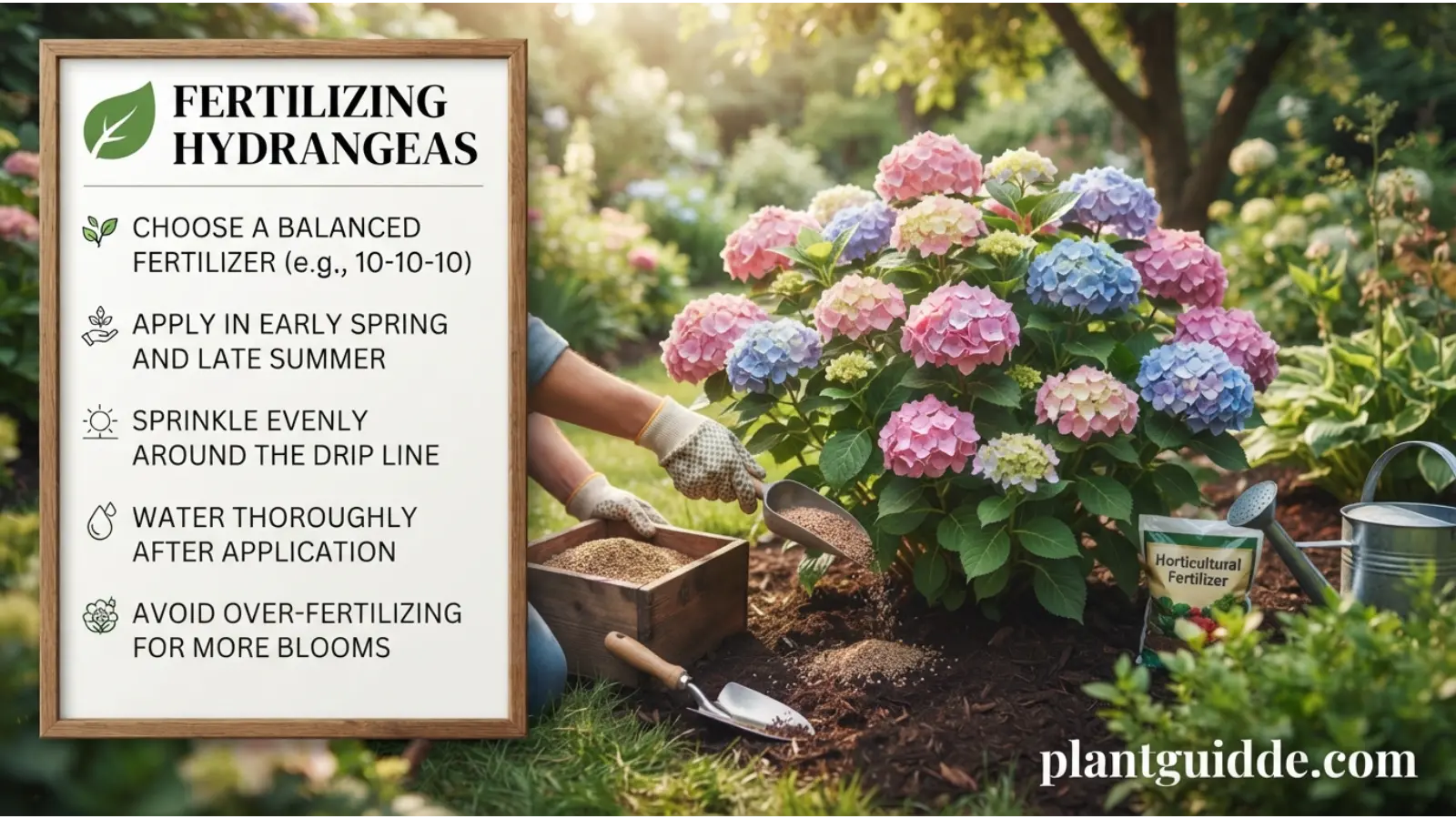
Fertilizing Hydrangeas
Hydrangeas can benefit from adequate nutrition, but excessive fertilizer is not a shortcut to more flowers.
Too much nitrogen may encourage lush leafy growth at the expense of flowering, while poorly timed or excessive feeding can create unnecessary stress.
A sensible fertilizing approach is:
- Start with healthy soil containing organic matter.
- Use a fertilizer appropriate for flowering shrubs when needed.
- Follow the product’s application rate.
- Avoid repeated heavy applications.
- Do not assume a struggling plant automatically needs fertilizer.
Hydrangea plant care a hydrangea has yellow leaves, poor flowering, or weak growth, first consider light, watering, drainage, root health, and pruning history before assuming fertilizer is the solution.
When and How to Prune Hydrangeas
Pruning is one of the areas where hydrangea owners most often make mistakes.
The key question is:
Does your hydrangea flower on old wood or new wood?
Old wood means the stems produced the flower buds during the previous growing season. Cutting those stems back heavily at the wrong time can remove the buds that would have produced flowers.
Many modern hydrangeas have been bred with different flowering characteristics, including varieties that can flower on both old and new growth. The plant label is therefore extremely useful.
Bigleaf and Mountain Hydrangeas
For many traditional bigleaf and mountain hydrangeas, major pruning should be avoided unless you know the specific variety and its flowering habit.
After flowering, remove spent blooms if appropriate and selectively remove damaged, dead, or weak stems.
If your plant has stopped flowering after being pruned aggressively in late winter or early spring, incorrect pruning may be part of the problem.
Smooth and Panicle Hydrangeas
Smooth and panicle hydrangeas generally flower on new growth, so they offer more flexibility with pruning.
They can often be pruned during dormancy or before active spring growth, depending on the variety and the desired shape.
Even here, avoid cutting blindly. Heavy pruning is not always necessary, particularly for naturally well-shaped plants.
Best practice: Identify the cultivar before making major cuts.
How to Prune Hydrangeas Step by Step
- Remove dead, damaged, or diseased-looking stems where appropriate.
- Identify the hydrangea type.
- Determine whether it flowers on old wood, new wood, or both.
- Remove weak or overcrowded growth selectively.
- Make clean cuts with sharp, sanitized pruning tools.
- Avoid removing large amounts of healthy growth simply to make the plant smaller.
- Step back periodically to maintain a natural shape.
Hydrangea plant care the plant is simply too large for its location, severe annual pruning may not be the best long-term solution. Choosing a cultivar that naturally fits the available space is often easier.
Mulching Hydrangeas
Mulch is particularly useful because hydrangea roots benefit from more consistent soil moisture and moderate soil temperatures.
Organic mulch options can include:
- Shredded bark
- Compost
- Leaf mold
- Other suitable organic materials
Apply a moderate layer around the root zone while keeping the material away from direct contact with the stems.
Mulch should complement good watering and drainage, not compensate for poor soil conditions.
Hydrangea Care in Containers
Hydrangeas can grow successfully in containers, but potted plants require more frequent observation than plants growing in the ground.
Choose a container with:
- Adequate drainage holes
- Enough volume for the root system
- A stable base for the mature plant
- A quality, well-draining potting mix
Container hydrangeas may dry out considerably faster during hot weather. At the same time, a poorly draining container can stay wet for too long.
Check the potting mix rather than watering automatically every day.
When roots have filled the container and water passes through extremely quickly, or growth becomes restricted, repotting into a somewhat larger container may be appropriate.
Seasonal Hydrangea Plant Care
Spring
Spring is a useful time to assess new growth, soil moisture, winter damage, and pruning needs.
Check:
- New shoots
- Dead or damaged stems
- Soil moisture
- Mulch condition
- Signs of emerging pests or disease
Be particularly careful with late pruning of hydrangeas that flower on old wood.
Summer
Summer is usually when moisture management becomes most important.
Monitor the plant during hot weather and pay attention to:
- Afternoon wilting
- Dry soil
- Scorched leaves
- Faded flowers
- Rapid moisture loss in containers
Mulching can help reduce evaporation, but plants in exposed hot locations may still require closer monitoring.
Fall
Avoid automatically cutting hydrangeas down simply because flowering has finished.
For some varieties, old flower heads can remain attractive through fall and winter. More importantly, removing stems at the wrong time may eliminate next year’s flowers.
Clean up obviously diseased plant material and maintain an appropriate mulch layer.
Winter
Winter care depends heavily on the species, cultivar, and local climate.
In colder regions, some hydrangeas can suffer bud damage even when the plant’s roots survive. Young plants may benefit from additional protection from severe cold and drying winds.
Avoid stimulating tender new growth with excessive late-season fertilizer.
Why Is My Hydrangea Not Blooming?
A hydrangea that grows plenty of leaves but produces few or no flowers usually requires investigation rather than simply more fertilizer.
Common causes include:
Pruning at the Wrong Time
This is especially important for hydrangeas that develop flower buds on old wood.
Insufficient Light
Deep shade can reduce flowering even when the plant appears healthy.
Excessive Nitrogen
Heavy nitrogen feeding can encourage foliage rather than flowers.
Winter Bud Damage
A plant may appear alive in spring while flower buds have been damaged by cold.
Excessive Shade From Nearby Growth
A location that was sunny when the hydrangea was planted may become much shadier as trees and shrubs mature.
Plant Variety
Some hydrangeas naturally have different flowering habits, and young plants may take time to establish.
Instead of immediately changing everything, identify the most likely limiting factor and correct it first.
Why Are Hydrangea Leaves Turning Yellow?
Yellow leaves can have several causes, so leaf color alone is not enough for diagnosis.
Consider:
- Soil remaining wet for too long
- Poor drainage
- Water stress
- Nutrient availability
- Natural aging of older leaves
- Root problems
- Environmental stress
Hydrangea plant care yellowing is accompanied by constantly wet soil and wilting, investigate the roots and drainage before adding fertilizer.
Hydrangea plant care only a few older leaves yellow while the plant is otherwise growing normally, the cause may be much less serious.
Why Are Hydrangea Leaves Drooping?
Drooping can be caused by both too little water and too much water.
That may sound contradictory, but the roots need access to both water and oxygen. A plant growing in very dry soil may wilt because it lacks water. A plant sitting in saturated soil can also wilt because damaged roots cannot function normally.
Check the soil before watering again.
If the soil is dry, provide a thorough watering. If it is saturated for extended periods, improving drainage is more important than adding more water.
Why Are Hydrangea Leaves Turning Brown?
Brown edges or patches may develop after:
- Extended drought
- Intense heat
- Strong direct afternoon sun
- Low soil moisture
- Root stress
- Environmental changes
Brown tissue will not become green again. Focus on preventing additional damage by improving moisture consistency and reducing environmental stress.
Do not automatically remove every leaf with a small brown section. If most of the leaf is healthy, it can continue contributing energy to the plant.
Common Hydrangea Care Mistakes
Watering on a Fixed Schedule
Weather, soil, pot size, plant maturity, and sunlight all affect water requirements.
Better approach: Check the soil and plant conditions before watering.
Treating Every Hydrangea the Same
A pruning method that works for a panicle hydrangea may be harmful to a traditional bigleaf hydrangea.
Better approach: Identify the species or cultivar first.
Pruning Because the Plant Looks Untidy
Removing healthy stems simply to make the shrub smaller can reduce flowering.
Better approach: Prune with a specific purpose and understand where the plant produces flowers.
Keeping the Soil Permanently Wet
Hydrangeas enjoy moisture but do not benefit from waterlogged roots.
Better approach: Improve drainage and water deeply when needed.
Changing Soil pH Without Identifying the Variety
Not every hydrangea responds to pH changes with dramatic flower-color changes.
Better approach: Check the cultivar and understand its natural flower color before attempting to manipulate pH.
Fertilizing Every Time the Plant Looks Unhealthy
Fertilizer cannot correct problems caused by poor light, waterlogged soil, root damage, or incorrect pruning.
Better approach: Diagnose the growing conditions first.
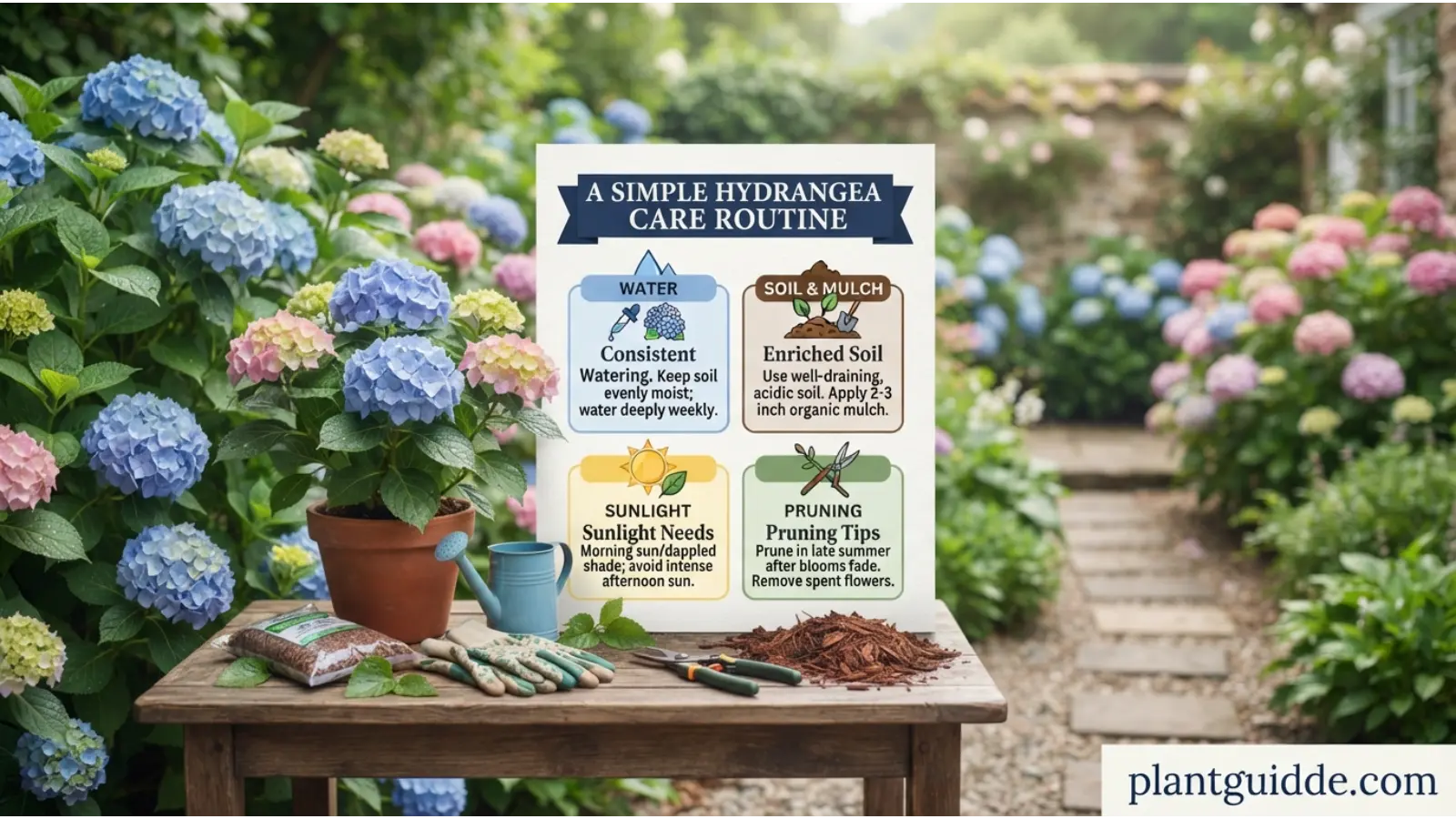
A Simple Hydrangea Care Routine
For beginners, a practical routine is more useful than trying to memorize dozens of rules.
Once a week during active growth:
- Check the soil moisture.
- Inspect leaves for unusual discoloration, spots, or pests.
- Look at new growth for signs of stress.
- Check whether mulch is still protecting the root zone.
- Examine the plant’s overall shape and flowering progress.
During hot or unusually dry weather, check more frequently.
During cooler, wet periods, the plant may need considerably less water.
This approach helps you respond to the plant’s actual conditions rather than following an artificial watering calendar.
FAQs:
How often should you water a hydrangea?
Water when the soil begins to dry rather than following a strict calendar. Hydrangeas prefer consistent moisture, but the roots should not remain in saturated soil. Hot, sunny weather and container growing can increase watering needs.
Do hydrangeas need full sun or shade?
Many hydrangeas perform well with morning sun and afternoon shade, particularly in hot climates. Some varieties tolerate more sun, especially where summers are mild. Excessive shade can reduce flowering, while intense afternoon heat can increase water stress.
What is the best fertilizer for hydrangeas?
There is no single fertilizer that is best for every hydrangea. Use a fertilizer appropriate for flowering shrubs when soil nutrition requires it and follow the label directions. Avoid excessive nitrogen, which can encourage foliage at the expense of flowers.
Should you cut hydrangea flowers off?
Spent flowers can be removed for appearance, but the timing and method depend on the hydrangea type. With varieties that flower on old wood, avoid cutting stems unnecessarily because next season’s flower buds may already be present.
Why does my hydrangea have leaves but no flowers?
Possible causes include incorrect pruning, insufficient light, winter damage to flower buds, excessive nitrogen, or the natural flowering characteristics of the cultivar. Identify the hydrangea type and review its pruning and growing conditions before making major changes.
Final Thoughts
Successful hydrangea plant care comes down to understanding the plant rather than following a rigid routine. Give it suitable light, maintain consistent but well-drained moisture, protect the root zone with mulch, and most importantly, identify its flowering habit before pruning.
If your hydrangea is struggling, start with the basics: check the soil, examine the light, look at the roots and drainage, and consider when the plant was last pruned. Small changes based on those observations are often more effective than adding more water or fertilizer.

Asad Mumtaz is a dedicated plant enthusiast and gardening writer with a passion for helping people care for their plants successfully. He specializes in plant care guides, indoor gardening, and practical growing tips for all skill levels. His content focuses on making gardening simple, enjoyable, and rewarding. Through his work, Asad shares reliable advice to help readers create thriving green spaces.