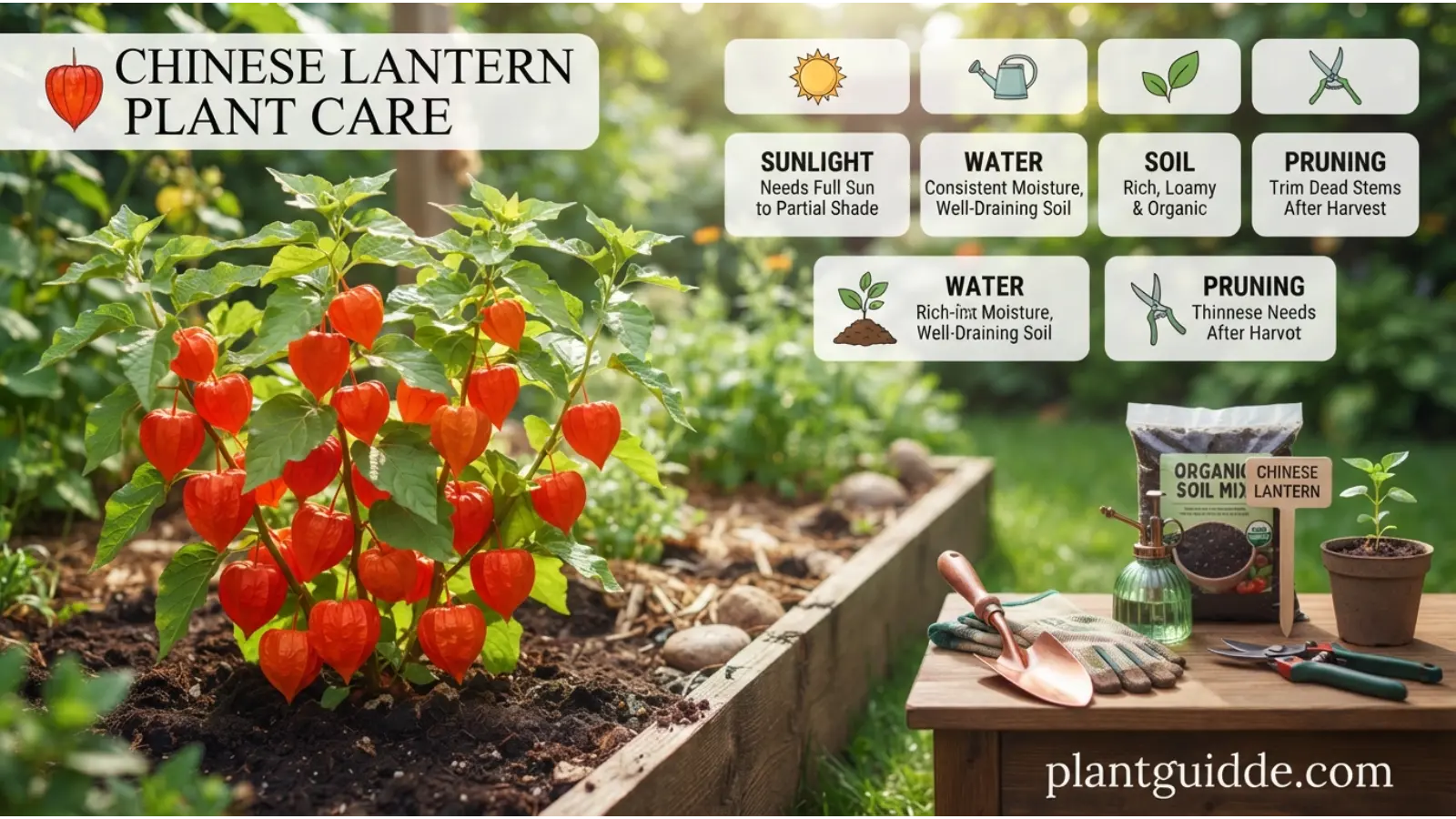
Chinese lantern plant care is less about constant maintenance and more about giving Physalis alkekengi the conditions it naturally prefers. Its small summer flowers are attractive, but the real feature appears later: inflated orange calyces that surround the fruit and resemble miniature paper lanterns.
This plant is often described as easy to grow, and that is generally true. The bigger challenge is controlling its vigorous spreading habit while avoiding the two problems that cause many garden plants to struggle: poor drainage and inconsistent moisture.
The name can also cause confusion. Chinese lantern plant most commonly refers to Physalis alkekengi, a herbaceous perennial in the nightshade family (Solanaceae). However, some plants in the Abutilon or Callianthe group are also sold under the common name Chinese lantern because of their hanging, lantern-shaped flowers. This guide focuses on Physalis alkekengi.
Quick Answer
Chinese lantern plant care is relatively easy when the plant gets full sun to partial shade, well-drained soil, and consistent moisture without becoming waterlogged. The common Chinese lantern, Physalis alkekengi, is a spreading perennial grown for its distinctive orange, papery lantern-like calyces. Because it can spread aggressively through underground growth, containers or controlled planting areas are often useful.
What Is a Chinese Lantern Plant?
Physalis alkekengi is a herbaceous perennial known for its bright orange, inflated fruiting calyces. It usually grows as a bushy plant around 0.5–1 metre tall and wide, although size varies with conditions and cultivar.
The plant produces small, creamy-yellow, bell-shaped flowers during summer. After flowering, the calyx surrounding the developing fruit expands into the characteristic lantern shape, eventually becoming deep orange.
Its ornamental value comes primarily from these papery structures rather than the flowers themselves. The dried lanterns can also be used in floral arrangements.
One important characteristic affects how you should grow it: Chinese lantern is a rhizomatous, spreading perennial. Under favorable conditions, it can move beyond the area where it was originally planted. The RHS specifically lists it among plants that can become a nuisance if not managed carefully.
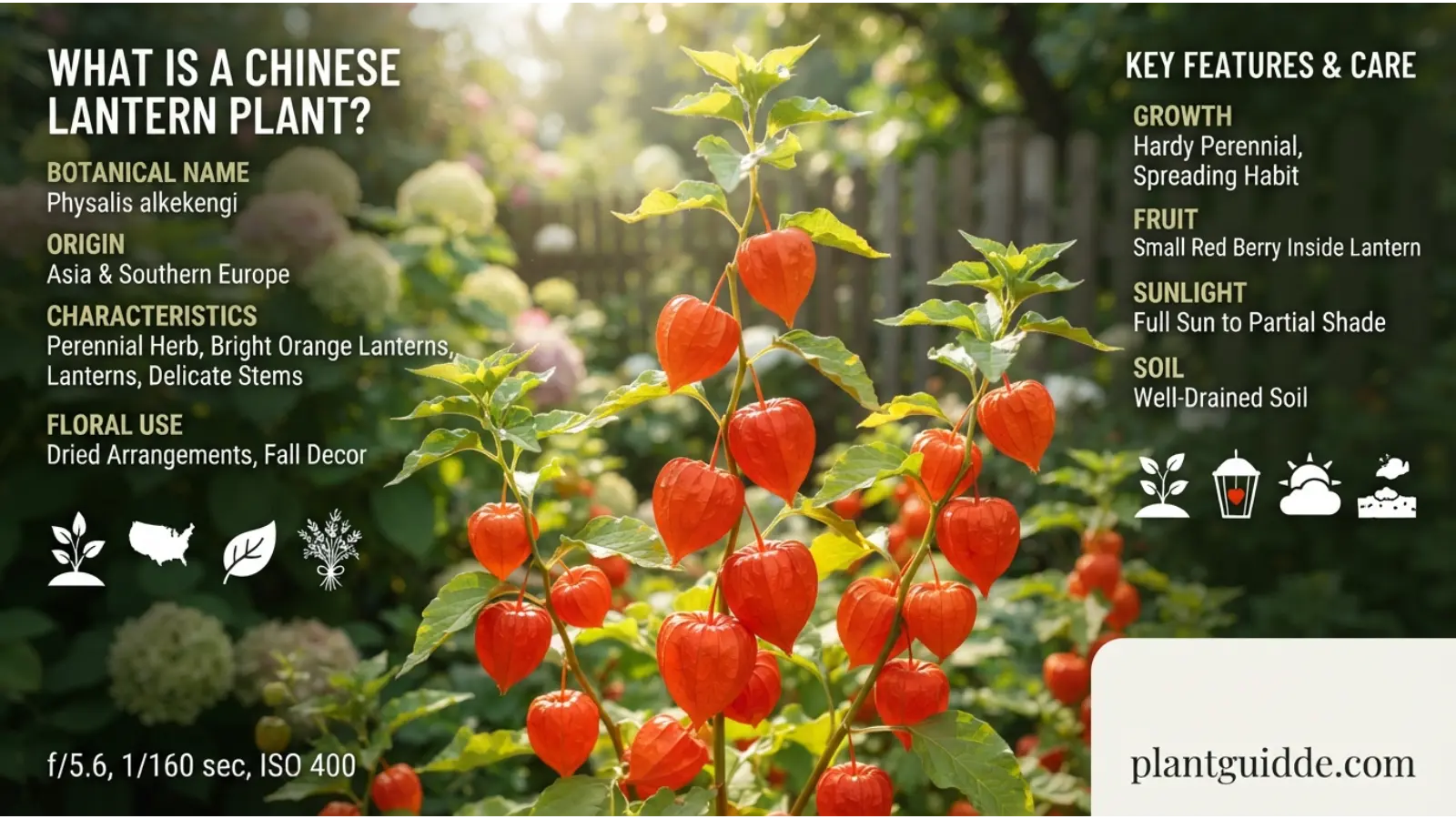
Chinese Lantern Plant Care at a Glance
| Care factor | What it needs |
|---|---|
| Botanical name | Physalis alkekengi |
| Family | Solanaceae |
| Light | Full sun to partial shade |
| Soil | Well-drained soil |
| Moisture | Even moisture without waterlogging |
| Growth habit | Spreading herbaceous perennial |
| Flowering | Mainly summer |
| Decorative feature | Orange lantern-like calyces |
| Pruning | Usually little or none required |
| Propagation | Seed or division |
| Best use | Borders, containers, cottage gardens, cut arrangements |
| Main concern | Vigorous spreading |
The RHS recommends growing Chinese lantern in well-drained soil in either full sun or partial shade.
How Much Light Does a Chinese Lantern Plant Need?
Chinese lantern plants grow well in full sun or partial shade.
For the strongest growth and good development of the characteristic orange lanterns, choose a location that receives several hours of direct sunlight. A site with morning and afternoon sun is generally preferable to a deeply shaded position.
Partial shade can be useful in hotter climates, particularly where intense afternoon heat quickly dries the soil.
Signs the plant may need more light
A Chinese lantern plant growing in insufficient light may become less vigorous and produce weaker, stretched growth. If the plant receives very little direct light, moving it gradually toward a brighter location can improve its growing conditions.
Avoid making a sudden change from deep shade to intense midday sun, especially for a container-grown plant. Gradual acclimation reduces the risk of leaf scorch.
Best Soil for Chinese Lantern Plants
The most important soil characteristic is good drainage.
Chinese lantern plants can tolerate different soil types, including loam, sand, and chalk, provided excess water can drain away. The RHS lists its preferred moisture condition as well-drained.
Heavy, compacted soil can create a problem because water remains around the roots for too long. This is particularly important in containers, where poor drainage can quickly turn an otherwise easy-care plant into a stressed one.
A practical soil mix
For containers, use a quality potting mix that drains freely rather than dense garden soil. You can improve drainage by incorporating suitable coarse material into an overly heavy mix.
The goal is not to make the soil bone dry. The goal is to allow excess water to escape while still providing enough moisture for active growth.
How to Water Chinese Lantern Plants
Water Chinese lantern plants when the soil begins to dry rather than following a rigid calendar.
Young plants and recently transplanted specimens generally need more consistent moisture while their roots establish. Established plants can become more resilient, but they still perform best when the root zone is not repeatedly allowed to swing between extremely dry and saturated conditions.
A useful routine is:
- Check the soil several centimetres below the surface.
- If it has started to dry, water thoroughly.
- Allow excess water to drain away.
- Check the soil again before watering.
- Reduce unnecessary watering during cool or rainy periods.
The most common watering mistake is not underwatering but keeping the root zone excessively wet.
If the soil remains soggy for long periods, improve drainage rather than simply adjusting the watering schedule.
How to Grow Chinese Lantern Plants in Containers
Growing Chinese lantern in a container can be a practical solution when you want the ornamental effect without allowing the plant to spread freely through a garden bed.
Choose a container with drainage holes and enough depth for a healthy root system. Use a free-draining potting mix and place the container where it receives full sun or partial shade.
Container growing also makes it easier to monitor moisture and move the plant when seasonal conditions change.
However, containers dry faster than garden soil, especially during hot weather. Check the soil regularly rather than assuming the plant needs water simply because the weather is warm.
Why containers can be useful
A container can help:
- Restrict unwanted spreading
- Make watering easier to monitor
- Provide control over soil quality
- Keep the plant in a defined ornamental area
- Make seasonal repositioning easier
If your main concern is the plant becoming invasive or difficult to control, container growing is worth considering.
How to Control Chinese Lantern Plant Spreading
This is one of the most important parts of Chinese lantern plant care.
Chinese lantern is a vigorous, spreading plant, and the RHS warns that it can become a nuisance if not properly managed.
If you plant it directly in the ground, choose its location carefully. Avoid placing it immediately beside delicate perennials or in a small bed where you expect every plant to remain in a fixed position.
Practical ways to manage it
Grow it in a container:
This is one of the simplest ways to keep its growth contained.
Inspect the surrounding area:
Watch for new shoots appearing beyond the original planting zone.
Divide established clumps:
Division can be used for propagation while also helping reduce overcrowding.
Remove unwanted growth early:
Young shoots are much easier to manage than an established spreading colony.
Avoid planting it where uncontrolled spreading would be a problem:
A large informal garden bed may tolerate its habit better than a small, tightly designed border.
This spreading behavior is not necessarily a sign that something is wrong with the plant. In fact, vigorous growth is part of its natural habit.
Does Chinese Lantern Plant Need Fertilizer?
Chinese lantern plants generally do not require an aggressive feeding program.
If the plant is growing in reasonably fertile soil, excessive fertilizer can be unnecessary. Focus first on light, drainage, moisture, and adequate growing space.
If growth is weak and the soil is poor, a balanced fertilizer can be considered according to the product label. Avoid using heavy doses simply to encourage faster growth, particularly because this plant is already capable of spreading vigorously.
Pruning Chinese Lantern Plants
Routine pruning is usually not necessary.
The RHS lists Chinese lantern as requiring no pruning under normal cultivation.
You can remove damaged, dead, or unwanted stems when needed. If you are growing the plant for its decorative lanterns, avoid cutting them away before they have developed fully.
After the growing season, spent stems can be tidied according to the appearance you want in the garden. In areas where the dried stems and lanterns provide winter interest, they can sometimes be left longer before cleanup.
How to Propagate Chinese Lantern Plants
Chinese lantern can be propagated by seed or division.
The RHS recommends propagation in spring, including sowing seed in containers and division of established plants.
Propagation by division
Division is particularly practical when an established plant has become crowded.
Carefully lift an established clump, separate suitable sections with healthy roots and shoots, and replant them promptly in prepared soil. Water after planting and keep the new divisions appropriately moist while they establish.
Division also has a useful management benefit: it lets you control the size and location of an established clump rather than allowing it to continue expanding indefinitely.
Chinese Lantern Plant Flowers and Lanterns
The small summer flowers are relatively modest compared with the colorful structures that follow them.
After flowering, the calyx enlarges around the developing fruit, forming the familiar orange, lantern-like structure. These lanterns can remain attractive into autumn and may persist beyond the main flowering period.
This is why Chinese lantern is often grown as an ornamental plant even though its flowers are not particularly showy.
Image Suggestion: A seasonal progression showing Chinese lantern from green foliage and summer flowers to mature orange lanterns in autumn.
Common Chinese Lantern Plant Problems
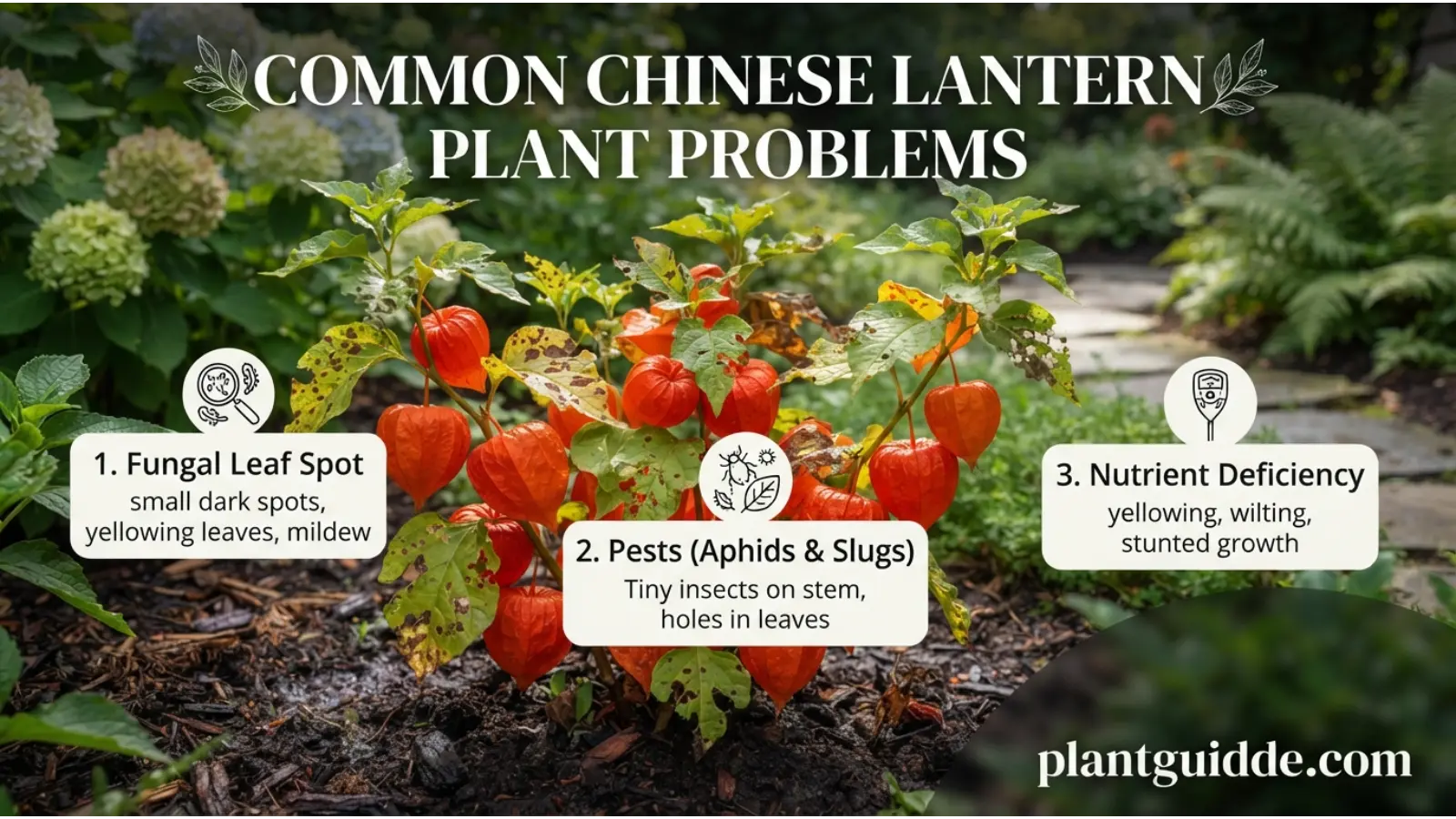
Chinese lantern is generally considered an easy plant, but several problems can occur when growing conditions are unsuitable.
Yellowing or weak foliage
Possible causes include:
- Excessively wet soil
- Poor drainage
- Insufficient light
- Root stress
- General environmental stress
Check the soil before increasing or decreasing watering. Yellow leaves alone do not tell you exactly what the problem is.
Wilting despite wet soil
This is an important warning sign.
If the plant is wilting while the soil is saturated, adding more water can make the underlying problem worse. Inspect drainage and root conditions instead.
Roots need access to both water and air. Waterlogged soil can interfere with healthy root function.
Poor flowering or lantern development
Insufficient light is one possibility. An overcrowded plant or excessive shade can reduce overall performance.
Move container plants to a brighter position if necessary, and make sure neighboring plants are not blocking available light.
Plant spreading farther than expected
This is a normal characteristic of vigorous Chinese lantern growth rather than a disease.
If spreading is becoming problematic, consider dividing the plant, removing unwanted shoots, or moving future plants into containers.
Is Chinese Lantern Plant Toxic?
This is an area where caution is worthwhile because Physalis species differ and the common name can create confusion.
The RHS lists Physalis alkekengi as harmful if eaten, except for ripe fruit, and also provides the same warning for dogs. It recommends appropriate protective equipment when handling the plant.
Do not assume that an unripe berry is safe simply because the plant produces fruit. Keep children and pets from eating unidentified berries or plant parts, and clearly identify the species before treating any fruit as edible.
Also avoid confusing Chinese lantern with other Physalis species grown specifically for edible fruit. For example, Physalis edulis (Cape gooseberry) is a different plant with edible berries when properly ripened.
Chinese Lantern Plant Care by Season
Spring
Spring is a good time to:
- Plant or transplant established specimens
- Divide crowded plants
- Start propagation
- Check soil drainage
- Remove unwanted spreading shoots
- Begin regular watering as active growth increases
Summer
During active growth:
- Maintain consistent moisture
- Monitor plants during hot, dry weather
- Watch for caterpillar damage
- Keep competing vegetation under control
- Provide adequate sunlight
The RHS notes that Chinese lantern can be susceptible to caterpillar damage but is generally disease-free.
Autumn
Autumn is when the characteristic lanterns become the main attraction.
This is also a useful time to assess how far the plant has spread and decide whether division or containment will be needed next season.
Winter
In climates where the plant naturally survives winter, growth may slow or the foliage may die back because Chinese lantern is deciduous. Avoid treating seasonal dieback as automatic evidence that the plant has died.
Common Chinese Lantern Plant Care Mistakes
Watering on a fixed schedule
A calendar cannot account for rain, temperature, soil type, container size, or sunlight.
Better approach: check the soil before watering.
Planting in constantly wet soil
Chinese lantern prefers well-drained conditions.
Better approach: improve drainage before increasing watering.
Ignoring its spreading habit
A small plant can become a much larger patch than expected.
Better approach: plan for containment from the beginning.
Planting it in deep shade
The plant tolerates partial shade, but that does not mean it performs equally well in very low light.
Better approach: choose a bright location with full sun or useful partial shade.
Assuming every Physalis is the same
Several Physalis species produce lantern-like husks, but their uses and growing characteristics can differ.
Better approach: check the botanical name on the plant label before following advice about fruit, hardiness, or cultivation.
Where Should You Plant Chinese Lantern?
Choose a location based on both the plant’s needs and its future growth.
A suitable site should have:
- Full sun or partial shade
- Well-drained soil
- Enough room for spreading
- Reasonable access for maintenance
- No immediate risk of crowding delicate neighboring plants
If your garden is small or highly structured, a large container may be more practical than planting directly in the ground.
If you have a spacious informal border and want a plant that provides distinctive autumn color, its spreading habit may be easier to accommodate.

Chinese Lantern Plant Care: A Simple Routine
If you want a straightforward maintenance routine, use this checklist:
- Give it good light — full sun or partial shade.
- Use well-drained soil — avoid permanently saturated ground.
- Check soil before watering — do not water automatically.
- Watch its spread — especially when planted in the ground.
- Remove damaged growth when needed — routine heavy pruning is unnecessary.
- Monitor for caterpillars — inspect foliage when damage appears.
- Handle berries responsibly — especially around children and pets.
- Divide crowded plants — use division both for propagation and control.
FAQs:
Is Chinese lantern plant easy to grow?
Yes. Physalis alkekengi is generally easy to grow when provided with adequate light, well-drained soil, and appropriate moisture. Its main management challenge is its vigorous spreading habit rather than demanding day-to-day care.
Does Chinese lantern plant need full sun?
Chinese lantern plants can grow in both full sun and partial shade. A bright location generally supports strong growth and good ornamental development, while partial shade can be useful in hot conditions.
Can Chinese lantern plants grow in pots?
Yes. Containers can be particularly useful because they provide control over soil conditions and help restrict the plant’s spreading habit. Make sure the container has adequate drainage.
Why is my Chinese lantern plant spreading everywhere?
Physalis alkekengi is a vigorous, spreading perennial. Its growth habit can allow it to move beyond its original planting area, so it should be monitored and managed. Container growing or regular division can make it easier to control.
Are Chinese lantern berries edible?
Do not assume that all Chinese lantern berries are edible. The RHS lists Physalis alkekengi as harmful if eaten except for ripe fruit, while other Physalis species are cultivated specifically for edible fruit. Correct plant identification and fruit maturity are therefore important.
Final Thoughts
Successful Chinese lantern plant care is straightforward once you understand the plant’s two main requirements: give it enough light and well-drained soil, while keeping its vigorous spreading habit under control.
Rather than watering by a fixed schedule, check the soil and respond to actual conditions. If you are planting Physalis alkekengi in a small garden, consider a container or another method of containment from the beginning. With those practical precautions, the plant can provide distinctive foliage, summer flowers, and its unmistakable orange lanterns later in the season.

Asad Mumtaz is a dedicated plant enthusiast and gardening writer with a passion for helping people care for their plants successfully. He specializes in plant care guides, indoor gardening, and practical growing tips for all skill levels. His content focuses on making gardening simple, enjoyable, and rewarding. Through his work, Asad shares reliable advice to help readers create thriving green spaces.