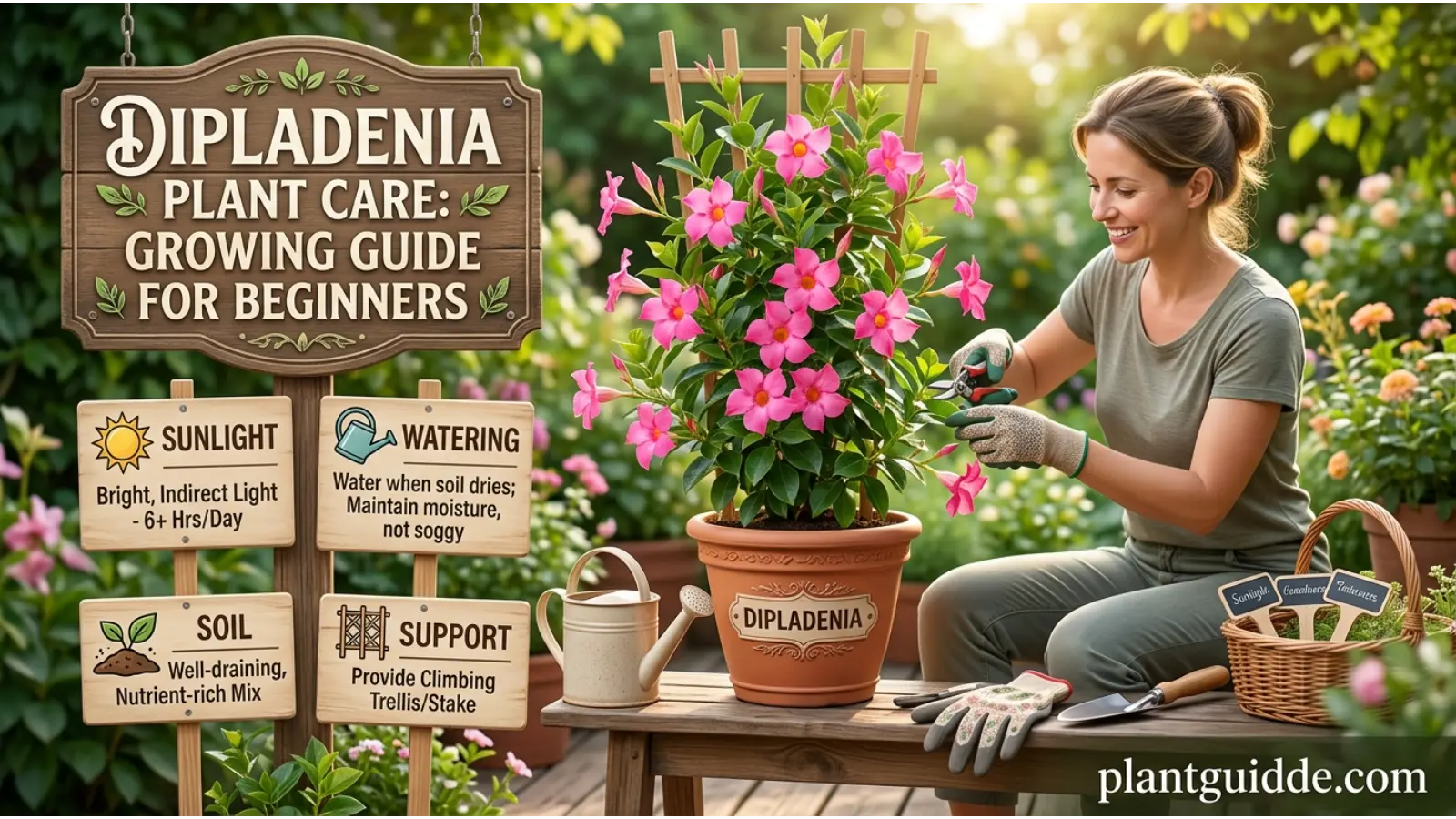
Dipladenia plant care is a popular flowering plant for patios, containers, balconies, hanging baskets, and warm indoor spaces. Its glossy foliage and trumpet-shaped flowers can create a striking display, but getting consistent blooms requires more than simply watering it whenever the soil looks dry.
The key to successful dipladenia plant care is understanding its tropical nature. It performs best with warmth, strong filtered or bright light, good humidity, and soil that holds some moisture without becoming soggy. Cold temperatures, poor drainage, insufficient light, and inconsistent watering are common reasons plants stop flowering or begin losing leaves.
Quick Answer
Dipladenia plant care is mainly about providing bright light, warmth, well-draining soil, consistent moisture, and regular feeding during active growth. Dipladenia is closely associated with Mandevilla, and plants sold under the Dipladenia name are often compact Mandevilla cultivars. Keep the soil moist but never waterlogged, protect the plant from cold temperatures, and prune lightly to maintain a bushy shape and encourage flowering.
What Is a Dipladenia Plant?
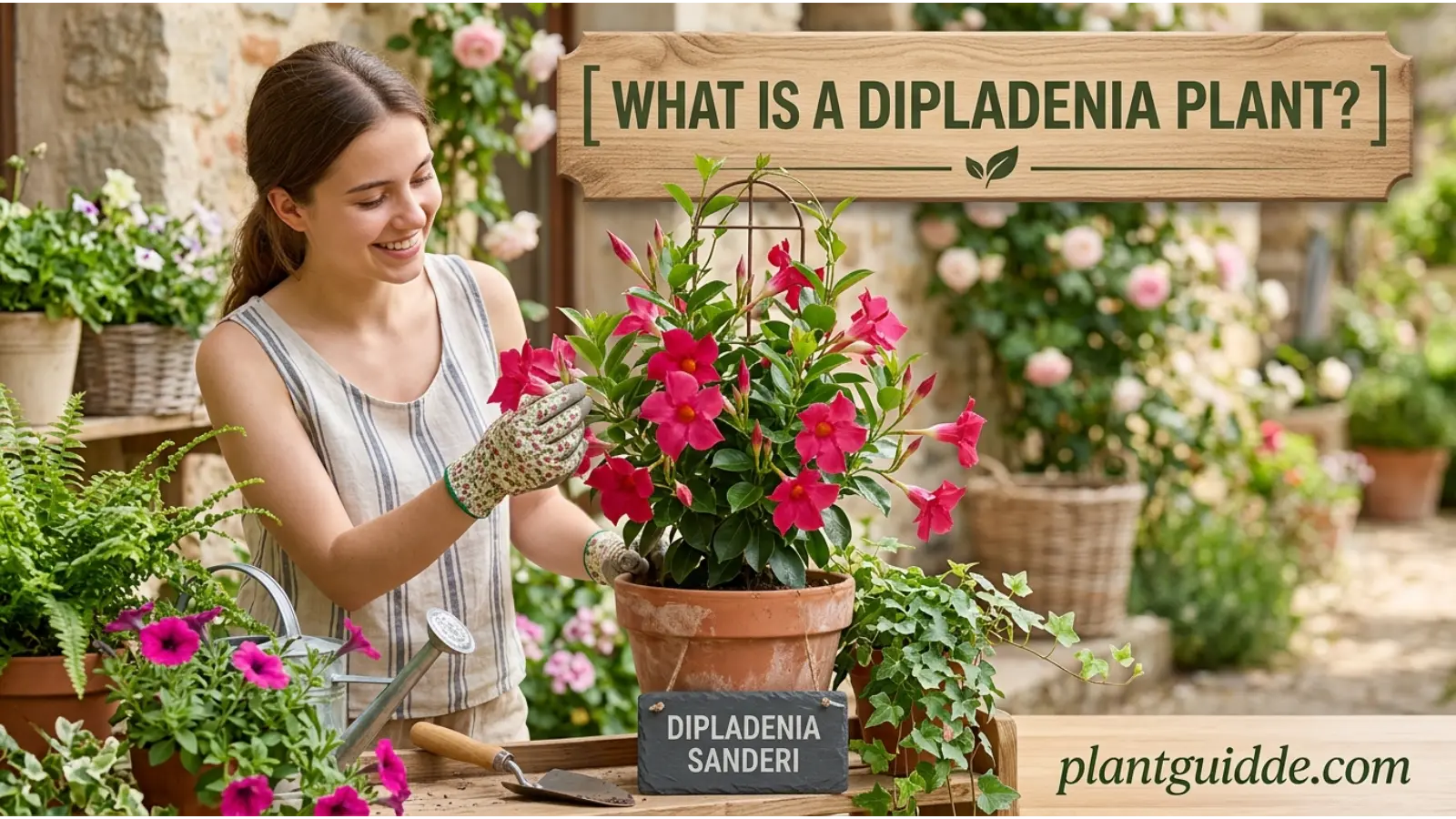
Dipladenia is a common horticultural name associated with plants in the Mandevilla group, a genus of tropical and subtropical flowering plants in the dogbane family, Apocynaceae. The RHS notes that Mandevillas are often still sold under the former name Dipladenia.
Depending on the cultivar, these plants may have a more compact, bushy habit or develop longer twining stems. Their flowers are typically trumpet or funnel-shaped and may appear in shades of pink, red, white, cream, or other colors depending on the cultivar.
Modern compact cultivars are particularly useful for containers and hanging baskets because they can remain more manageable than vigorous climbing types.
Dipladenia Plant Care Requirements at a Glance
| Care factor | What Dipladenia prefers |
|---|---|
| Light | Bright light; filtered light or protection from very hot sun may be needed |
| Temperature | Warm conditions, especially during active growth |
| Soil | Moisture-retentive but well-draining |
| Water | Regular during active growth; reduce in winter |
| Humidity | Moderate to high humidity |
| Fertilizer | Regular feeding during spring and summer |
| Pruning | Light pruning and pinching to maintain shape |
| Support | Useful for climbing or trailing varieties |
| Repotting | Only when roots become crowded |
| Winter care | Protect from cold and reduce watering |
The exact requirements can vary between cultivars, particularly because modern Dipladenia/Mandevilla hybrids differ considerably in growth habit and vigor.
How Much Light Does Dipladenia Need?
Light is one of the most important factors for healthy Dipladenia growth and flowering.
Give the plant bright light, with filtered or indirect light when intense sunlight could scorch the foliage. Some cultivars tolerate or prefer full sun, while RHS growing guidance recommends bright but indirect or filtered light for Mandevilla grown indoors, with protection from excessively hot summer sun.
For an indoor plant, place it near a bright window where it receives plenty of natural light without being exposed to extreme heat through the glass.
For outdoor container plants:
- Give them a bright, sheltered position.
- Provide strong morning or filtered light.
- Protect foliage from excessively intense afternoon heat if the leaves show signs of scorching.
- Avoid deep shade if you want reliable flowering.
Signs of insufficient light
A Dipladenia receiving too little light may develop:
- Long, weak stems
- Sparse foliage
- Fewer flowers
- Slow growth
- Smaller new leaves
Dipladenia plant care the plant is healthy but produces lots of leaves and very few flowers, inadequate light is one of the first environmental factors worth checking.
Best Soil for Dipladenia
Dipladenia needs soil that retains enough moisture for active growth while allowing excess water to drain quickly.
A heavy, compacted potting mix can stay wet around the roots for too long. Instead, use a high-quality container mix with good drainage. Adding materials that improve aeration can be useful if the existing mix is dense.
The RHS recommends a loam-based, peat-free compost with added grit for Mandevilla to improve drainage.
A practical container mix can contain:
- Quality potting compost
- Loam or composted organic material
- Perlite, pumice, or grit for aeration and drainage
The goal is not extremely dry soil. Dipladenia prefers moist but well-drained conditions, particularly during active growth.
How to Water Dipladenia
Watering is one of the easiest parts of Dipladenia care to get wrong.
During spring and summer, water when the upper portion of the potting mix has begun to dry, then water thoroughly so moisture reaches the root zone. Allow excess water to drain completely.
Do not allow the pot to sit in a saucer of standing water.
RHS guidance recommends regular watering during the growing season, keeping the compost moist but not waterlogged. In hot weather, container plants may require watering much more frequently because their soil dries rapidly.
A better approach than following a fixed schedule
Instead of watering every certain number of days, check:
- How dry the potting mix feels.
- How warm and bright the growing environment is.
- Whether the container is drying unusually quickly.
- Whether the plant is actively growing or resting during winter.
A small container sitting in intense summer light can dry much faster than a large container kept indoors.
Winter watering
Dipladenia generally needs less water during winter because growth slows and cooler conditions reduce water use.
Keep the soil from becoming completely dry for extended periods, but avoid keeping it constantly wet. RHS specifically recommends reducing watering in winter and keeping the compost only slightly damp.
Temperature and Humidity
Dipladenia is a warm-growing plant and does not handle cold conditions well.
During spring and summer, warm temperatures encourage active growth and flowering. RHS recommends around 21°C (70°F) or warmer during the day for Mandevilla during active growth, while North Carolina Extension describes approximately 65–70°F as favorable growing temperatures.
Cold temperatures can cause:
- Leaf yellowing
- Leaf drop
- Reduced growth
- Failure to flower
- General decline
For overwintering, keep the plant protected from cold. RHS recommends cooler winter conditions but ideally above approximately 15°C (60°F) at night for many Mandevilla, while some varieties tolerate somewhat lower temperatures.
Dipladenia also appreciates humid air. This becomes particularly important indoors where heating or air conditioning can create dry conditions.
How to Fertilize Dipladenia
Dipladenia grows actively and flowers heavily when environmental conditions are favorable, so it benefits from regular nutrition during the growing season.
RHS recommends applying a general-purpose liquid fertilizer approximately monthly from spring through autumn. A potassium-rich fertilizer can also be used during summer when flowering is the main goal, following the product’s application instructions.
Avoid the temptation to fertilize more frequently simply because the plant is not flowering.
Poor flowering may instead be related to:
- Insufficient light
- Cool temperatures
- Incorrect watering
- Root problems
- Excessive pruning
- Seasonal growth changes
Fertilizer cannot compensate for an unsuitable growing environment.
How to Prune Dipladenia
Pruning helps maintain a compact shape, control long growth, and encourage new flowering shoots.
For a bushier plant, pinch or trim overly long stems during active growth. This can encourage branching rather than allowing one stem to dominate.
Established Mandevilla plants can become considerably larger than expected. RHS recommends pruning in late winter or early spring by removing weak or overcrowded growth and shortening side shoots to encourage new flowering growth.
Pruning tips
Before pruning:
- Use clean, sharp pruning shears.
- Remove weak or damaged stems.
- Thin overcrowded growth.
- Avoid removing large amounts of healthy growth unnecessarily.
- Wear gloves because the plant produces milky sap that can irritate the skin.
Dipladenia plant care your plant is a compact Dipladenia cultivar, it may need less aggressive pruning than a vigorous climbing Mandevilla.
Does Dipladenia Need a Trellis?
It depends on the variety.
Some Dipladenia types are naturally compact and bushy, making them suitable for containers and hanging baskets. Others have twining stems and benefit from a trellis, stake, tripod, or other support.
Mandevilla can become several metres tall depending on the cultivar, so a small nursery support may eventually become inadequate.
Dipladenia plant care your plant is producing long flexible stems, gently guide them toward the support rather than waiting until the stems become tangled.
For hanging baskets, compact cultivars can also be allowed to trail naturally.
Repotting Dipladenia
Dipladenia does not need to be moved into a dramatically larger pot every year.
Repot when:
- Roots are becoming crowded.
- Water runs through the container unusually quickly.
- Growth has slowed despite good care.
- The potting mix has deteriorated.
- The plant has clearly outgrown its container.
Choose a container only slightly larger than the current one. An excessively large pot can hold more moisture around the roots and make watering more difficult.
RHS recommends moving Mandevilla into a slightly larger container when necessary and notes that overpotting can reduce flowering.
Always make sure the new container has adequate drainage holes.
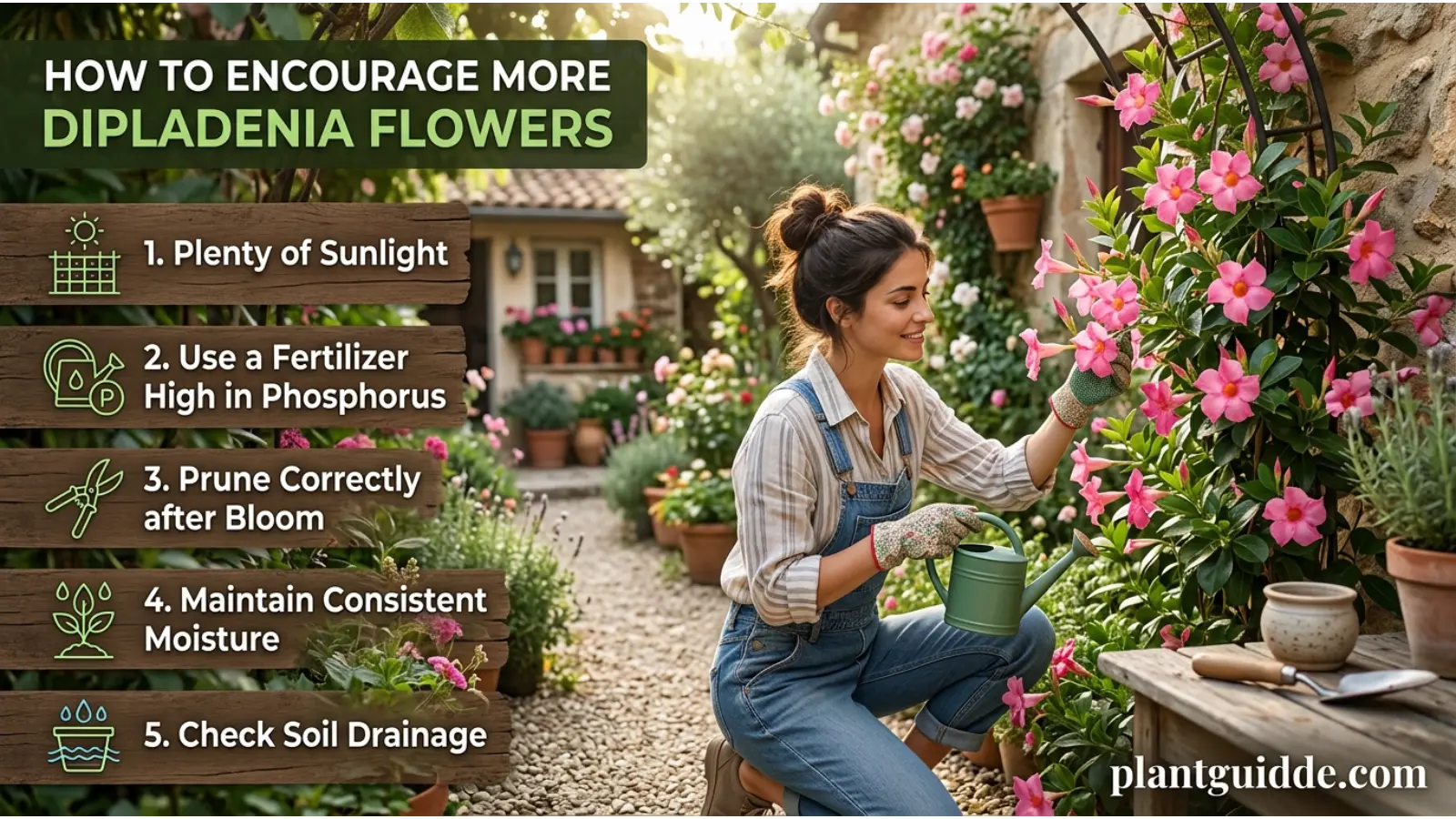
How to Encourage More Dipladenia Flowers
If your Dipladenia has healthy leaves but very few flowers, look at the growing conditions before adding more fertilizer.
1. Increase usable light
Flowering plants need sufficient light to produce strong flowering growth. Move the plant toward a brighter position while avoiding extreme heat or scorching.
2. Maintain warm conditions
Cool spring temperatures can delay flowering. RHS specifically identifies insufficient warmth as a common reason Mandevilla fails to flower.
3. Avoid waterlogged soil
Constantly wet roots can weaken the plant and interfere with healthy growth.
4. Feed during active growth
Use a suitable liquid fertilizer according to its label directions rather than applying concentrated fertilizer more frequently.
5. Prune appropriately
Moderate pruning can encourage new growth, but excessive pruning at the wrong time can remove developing flowering shoots.
Dipladenia Plant Care in Winter
Winter care is different from summer care.
If your climate experiences cold weather or frost, Dipladenia should be protected because it is a tender plant. North Carolina Extension recommends bringing container-grown Mandevilla indoors in areas with frost.
Before moving the plant indoors:
- Inspect the leaves and stems for pests.
- Remove dead or damaged growth.
- Reduce watering as growth slows.
- Place the plant in a bright location.
- Keep it away from cold drafts.
- Avoid placing it directly beside a heat source.
The plant may lose some leaves after being moved indoors or exposed to cooler conditions. Cold stress is a common reason for seasonal leaf drop.
Common Dipladenia Problems and Solutions
Yellow leaves
Yellow leaves can result from several different conditions, so do not assume that the plant simply needs fertilizer.
Check:
- Whether the soil stays wet for too long
- Drainage quality
- Recent changes in temperature
- Light levels
- Natural aging of older leaves
If several leaves are yellow while the soil remains constantly wet, reassess the watering and drainage first.
Dipladenia leaves turning brown
Brown edges or patches can occur when the plant experiences environmental stress.
Possible causes include:
- Excessive heat
- Very dry air
- Irregular watering
- Root problems
- Scorching from intense sunlight
Look at the entire growing environment rather than treating the brown leaf as an isolated problem.
Dipladenia dropping leaves
Leaf drop is particularly common when conditions change suddenly.
Cold temperatures are an important possibility, especially during autumn or winter. Mandevilla may also lose leaves when its environmental requirements are not being met.
If leaf drop happens after moving the plant indoors, check temperature, light, watering, and pests before making major changes.
Dipladenia not flowering
When a Dipladenia refuses to bloom, check these factors in order:
- Light
- Temperature
- Watering
- Nutrition
- Pruning
- Root health
Low temperatures during spring are specifically associated with poor flowering in Mandevilla because warm conditions help stimulate new flowering shoots.
Pests on Dipladenia
Dipladenia and Mandevilla can attract common sap-feeding pests, including:
- Aphids
- Mealybugs
- Thrips
- Whiteflies
- Spider mites
North Carolina Extension lists mites, aphids, thrips, and whiteflies among potential insect problems, while RHS also identifies mealybugs and red spider mites.
Inspect the undersides of leaves, leaf joints, and new growth regularly. Early detection is much easier to manage than a large infestation.
Common Dipladenia Care Mistakes
Watering by calendar
Watering every Monday or every three days sounds convenient, but plant water use changes with temperature, light, pot size, humidity, and season.
Check the soil instead.
Using a poorly draining pot
A decorative container without adequate drainage can keep roots wet even when your watering routine seems reasonable.
Keeping the plant too cool
Dipladenia is not a cold-tolerant houseplant. Moving it outdoors too early in spring or leaving it outside during cool autumn nights can cause stress.
Giving too little light
A bright room is not necessarily the same as a bright growing location. If flowering declines, evaluate how much usable light actually reaches the leaves.
Overfertilizing
More fertilizer does not automatically mean more flowers. Excess fertilizer can create additional stress and does not correct problems caused by insufficient light or poor root conditions.
Ignoring the plant’s growth habit
Some Dipladenia cultivars remain compact, while Mandevilla types can become vigorous climbers. Choose pruning and support methods according to the actual cultivar rather than treating every plant identically.
Dipladenia vs. Mandevilla: Are They the Same?
The names can be confusing because plant labels and nurseries may use Dipladenia and Mandevilla differently.
The RHS notes that plants sold as Mandevilla may still be marketed under the former name Dipladenia. North Carolina Extension likewise lists Dipladenia among the previous names associated with Mandevilla.
In practical gardening terms, this means you should pay close attention to the cultivar’s growth habit and care label, rather than relying only on the common name.
Some plants sold as Dipladenia are compact and bushy, while other Mandevilla types are vigorous climbers.
Can Dipladenia Grow Indoors?
Yes, but indoor Dipladenia needs the right environment.
The biggest indoor challenge is usually providing enough light, warmth, humidity, and space. RHS describes Mandevilla as potentially challenging as a long-term houseplant because of its tropical requirements and vigorous growth.
For indoor growing:
- Choose the brightest suitable location.
- Maintain warm temperatures.
- Provide good humidity.
- Use well-draining potting soil.
- Water according to soil moisture rather than a fixed calendar.
- Feed during active growth.
- Prune to control size.
- Monitor regularly for pests.
An indoor plant that receives inadequate light may survive but produce disappointing flowering.
Can Dipladenia Grow in Pots?
Dipladenia is well suited to container growing.
Containers make it easier to:
- Move the plant indoors during cold weather
- Control soil quality
- Manage drainage
- Position the plant for better light
- Train stems around a support
- Grow compact cultivars on patios or balconies
Choose a container with drainage holes and avoid moving immediately into an oversized pot.
For particularly vigorous varieties, provide a sturdy support before the stems become difficult to train.
Image Suggestion: A realistic container-grown Dipladenia showing glossy green leaves, trumpet-shaped flowers, a compact growth habit, and a small trellis, with labels identifying light, watering, soil, pruning, and temperature requirements.
How to Propagate Dipladenia
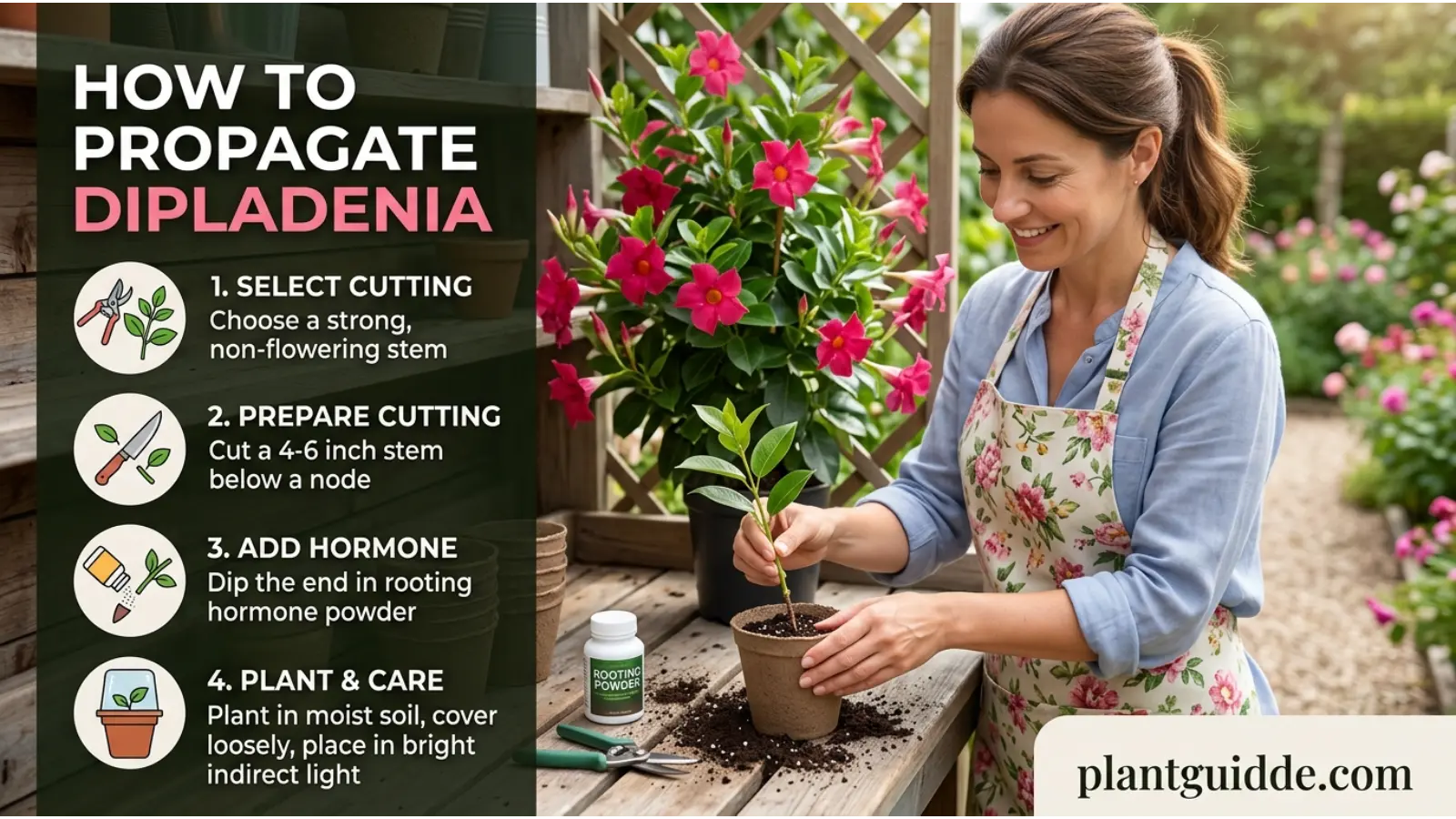
Dipladenia/ Mandevilla can be propagated from seed or stem cuttings.
RHS recommends softwood cuttings in early summer, with warm conditions helping the cuttings develop roots. Seeds can also be started in spring under warm conditions.
Because the plant produces irritating milky sap, wear gloves when taking cuttings and avoid getting sap on your skin or in your eyes.
For most home gardeners, propagation from a healthy cutting is more practical than growing a mature flowering plant from seed, particularly when maintaining the characteristics of a named cultivar matters.
FAQs:
How often should you water Dipladenia?
Water Dipladenia regularly during active growth, but let the potting mix begin to dry slightly before watering again. Hot weather can make container plants dry quickly, while winter conditions require substantially less water. The soil should remain moist but never waterlogged.
Does Dipladenia like full sun?
Many Dipladenia and Mandevilla cultivars can tolerate or prefer strong light, but extremely hot direct sunlight can scorch foliage. Provide bright light and protect the plant from excessive heat when necessary. Specific cultivars can differ, so check the plant label when available.
Why is my Dipladenia not blooming?
Insufficient light and cool temperatures are two important possibilities. Check whether the plant is receiving enough bright light and whether temperatures are warm enough during active growth. Also review watering, nutrition, pruning, and root health before adding more fertilizer.
Can Dipladenia survive winter?
Dipladenia is a tender plant and can be damaged by cold conditions. In climates with frost, container-grown plants should be protected indoors or in another suitable warm environment. Reduce watering as growth slows and keep the plant away from cold temperatures.
Should I cut back my Dipladenia?
Yes, moderate pruning can help maintain a manageable shape and encourage new flowering growth. Late winter or early spring is generally suitable for more substantial pruning of established Mandevilla, while light pinching can help maintain compact growth. Wear gloves because the milky sap can irritate skin.
Final Thoughts
Successful dipladenia plant care comes down to balancing warmth, bright light, moisture, drainage, and regular nutrition rather than following a rigid watering or feeding schedule.
If the plant is growing vigorously but not flowering, examine light and temperature first. If the leaves are yellowing while the soil stays wet, improve drainage and reconsider watering. If growth becomes long and untidy, pruning and appropriate support can restore its shape.
For the healthiest Dipladenia, focus on what the plant is showing you: bright light for flowering, consistently moist but well-drained soil, warmth for active growth, and less water when growth slows.

Asad Mumtaz is a dedicated plant enthusiast and gardening writer with a passion for helping people care for their plants successfully. He specializes in plant care guides, indoor gardening, and practical growing tips for all skill levels. His content focuses on making gardening simple, enjoyable, and rewarding. Through his work, Asad shares reliable advice to help readers create thriving green spaces.