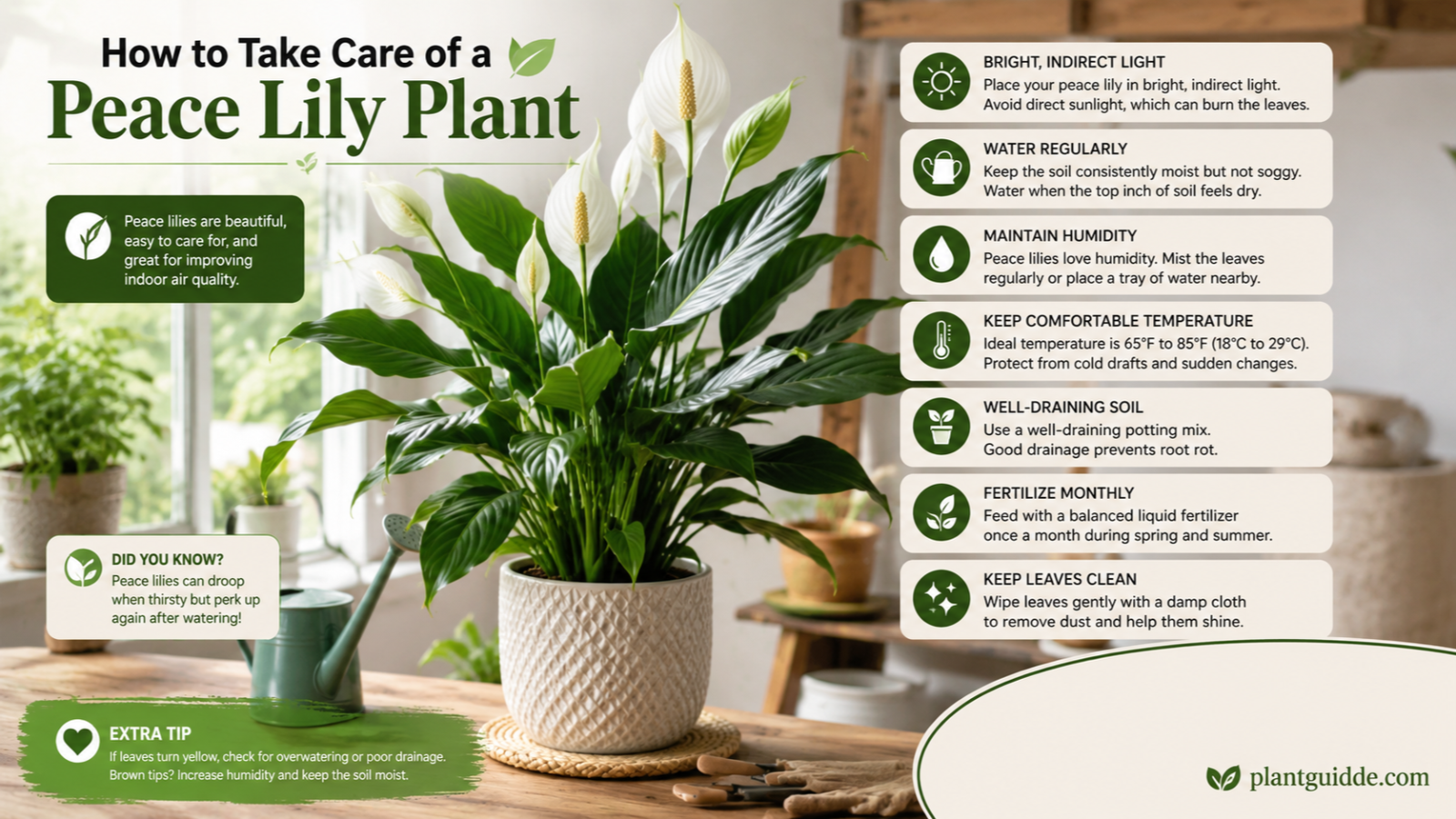
Peace lilies are popular houseplants because their glossy green leaves and elegant white flowers can instantly brighten an indoor space. But keeping a peace lily healthy takes more than occasional watering. How to Take Care of a Peace Lily Plant starts with providing the right light, consistent moisture, suitable soil, humidity, temperature, and proper drainage.
The good news is that How to Take Care of a Peace Lily Plant is simple, even for beginners. The key is to provide bright, indirect light, water when the soil begins to dry, maintain reasonable humidity, and avoid keeping the roots constantly soaked.
How to Take Care of a Peace Lily Plant you are growing your first peace lily or trying to revive a struggling plant, this guide covers How to Take Care of a Peace Lily Plant step by step, including watering, lighting, soil, fertilizing, repotting, pruning, and common problems.
Quick Answer
To take care of a peace lily plant, place it in bright, indirect light, water when the top few centimeters of soil become dry, and use a pot with good drainage. Keep the plant warm and moderately humid, fertilize lightly during active growth, and avoid leaving its roots sitting in water. Peace lilies can tolerate lower light, but adequate filtered light encourages stronger growth and better flowering.
Peace Lily Care at a Glance
| Care factor | What your peace lily prefers | What to watch for |
|---|---|---|
| Light | Bright, indirect or filtered light | Direct sun can scorch leaves |
| Water | Thorough watering after the upper soil dries | Constantly wet soil can cause root problems |
| Humidity | Moderate to high humidity | Dry air may cause brown edges |
| Temperature | Warm, stable indoor conditions | Cold drafts and heaters can cause stress |
| Soil | Moisture-retentive but well-draining mix | Heavy, soggy soil can suffocate roots |
| Fertilizer | Light feeding during active growth | Excess fertilizer can damage roots |
| Pot | Drainage hole and correctly sized container | Oversized pots stay wet too long |
| Pruning | Remove dead or damaged foliage | Avoid unnecessary heavy pruning |
| Repotting | Only when roots become crowded | Oversized containers increase moisture problems |
| Safety | Keep away from children and pets | Peace lilies contain insoluble calcium oxalates |
RHS guidance recommends bright, indirect light, moderate watering, adequate humidity, good drainage, and protection from temperature extremes.
Understand What a Peace Lily Needs
Before changing anything, it helps to understand the plant’s natural preferences.
Peace lilies belong to the genus Spathiphyllum and are members of the arum family, Araceae. They originate from tropical regions, including Central America and Colombia, so their indoor care should mimic a warm forest environment rather than a dry, sunny windowsill.
That means four things matter most:
- Filtered light
- Even but not excessive moisture
- Warm temperatures
- Reasonable humidity
The biggest beginner mistake is treating these four needs separately.
They actually interact.
For example, a peace lily sitting in a bright, warm room may use water faster than one sitting in a cool, dim corner. Likewise, a plant receiving little light will generally grow more slowly and may not need as much water.
So instead of asking, “How often should I water my peace lily?” ask:
“How quickly is the soil drying in its current location?”
That small change in thinking makes peace lily care much easier.
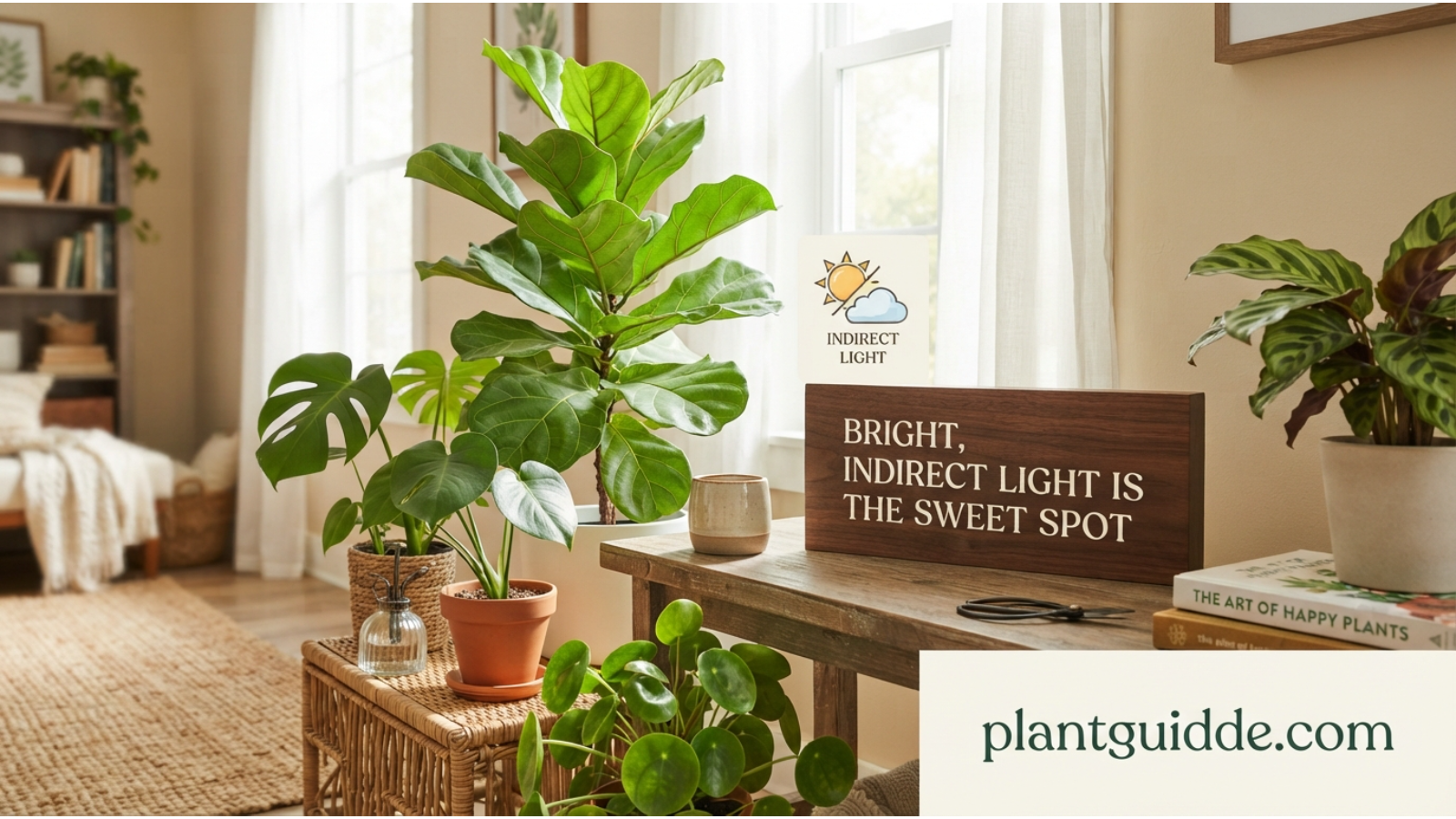
Bright, indirect light is the sweet spot
Place your peace lily somewhere that receives plenty of natural light without exposing the leaves to strong, direct midday or summer sunlight.
A bright room near a window can work extremely well if the sunlight is filtered through a sheer curtain or does not fall strongly onto the foliage.
Peace lilies can survive in lower light, but survival is different from thriving. In deeper shade, growth becomes slower and flowering may become limited.
Good locations include:
- Near an east-facing window
- A few feet from a bright south- or west-facing window
- Behind a sheer curtain
- In a bright bathroom
- In a naturally bright office
- Near a window where direct summer rays do not hit the leaves
Avoid:
- Harsh afternoon sun directly on the leaves
- Extremely dark corners
- Locations beside hot radiators
- Spots directly under strong heating or cooling airflow
Direct summer sunlight can scorch peace lily foliage, while insufficient light can reduce flowering.
An easy light test
Look at the shadow cast by your hand.
How to Take Care of a Peace Lily Plant the area is bright but the shadow is soft rather than sharply defined, the location may provide suitable filtered light.
How to Take Care of a Peace Lily Plant the room is so dark that you struggle to distinguish the plant’s leaf color clearly, it is probably too dim for strong growth.
Expert observation: Many people move a peace lily into a dark corner because it is labeled a “low-light plant.” It may survive there, but if your goal is dense growth and regular flowers, give it more useful indirect light.
Image Suggestion: A simple room diagram showing ideal peace lily placement near a window versus direct-sun and dark-corner locations.
How Often Should You Water a Peace Lily?
How to Take Care of a Peace Lily Plant is one of the most important parts of peace lily care.
There is no universally correct schedule such as “water every Monday.”
Your plant’s water requirement changes according to:
- Pot size
- Soil composition
- Room temperature
- Light intensity
- Humidity
- Season
- Root density
- Plant size
RHS recommends watering when the top few centimeters of compost have become dry and reducing watering somewhat during winter as growth slows.
The better watering method
Follow these steps:
Step 1: Check the soil
Push your finger a short distance into the upper soil.
How to Take Care of a Peace Lily Plant the surface is still noticeably moist, wait.
How to Take Care of a Peace Lily Plant the upper layer has dried, inspect deeper before watering.
Step 2: Check the pot
A dry pot is often noticeably lighter than a recently watered one.
Learning the weight of your pot after watering can become surprisingly useful.
Step 3: Water thoroughly
When the plant needs water, water the soil evenly rather than adding a tiny splash every day.
Allow excess water to escape through the drainage hole.
Step 4: Empty standing water
How to Take Care of a Peace Lily Plant the decorative outer container or saucer collects water, remove the excess rather than allowing the pot to sit in it for an extended period.
How to Take Care of a Peace Lily Plant is particularly important during cooler, darker periods when the plant uses water more slowly. RHS specifically warns against keeping houseplants sitting in excess water.
Should You Wait Until a Peace Lily Wilts?
Peace lilies have a famous dramatic response to thirst: their leaves can droop severely.
This makes them useful teachers for beginners, but you should not deliberately wait for extreme wilting every time.
A thirsty peace lily can often recover after proper watering, but repeatedly allowing the plant to become severely dehydrated places unnecessary stress on it.
RHS notes that peace lilies can droop dramatically when they need water and generally perk up after being watered.
Use wilting as a warning, not a watering schedule
A better routine is:
Check soil → decide whether it is dry enough → water thoroughly → drain excess water.
Do not simply see drooping leaves and automatically add water.
Why?
Because root problems caused by prolonged wet soil can also produce poor-looking foliage. Adding even more water in that situation can make the underlying problem worse.
What Type of Water Is Best?
Peace lilies can be sensitive to some components of tap water.
The RHS specifically recommends rainwater or filtered water where possible because fluoride in tap water can damage foliage.
If your tap water consistently seems to be associated with brown leaf tips or edges, consider experimenting with:
- Filtered water
- Rainwater collected safely
- Another suitable low-mineral water source
However, do not assume every brown leaf automatically means your tap water is the problem.
Brown tips can also result from dry air, watering inconsistency, salt buildup, or other environmental stress.
Practical approach: Change one variable at a time. If you change water, fertilizer, light, soil, and location simultaneously, you will not know which adjustment actually helped.
Choose Soil That Drains Well
Peace lily roots need both moisture and access to air.
This creates an important balance.
The soil should hold enough water to prevent the plant from drying immediately, but excess water should also move away from the root zone.
A heavy mixture that stays saturated for a long time can create conditions associated with root rot.
RHS recommends peat-free multipurpose compost with added perlite to improve drainage and warns that oversized pots can remain wet for too long.
A practical potting mix
A useful starting point is:
- Quality peat-free indoor potting mix
- Perlite or another drainage-improving component
- Enough organic material to retain moderate moisture
You do not need to obsess over an exact recipe.
The important characteristics are:
Moisture retention + aeration + drainage.
Why Drainage Holes Matter
A beautiful decorative container is not necessarily a good growing container.
Your peace lily’s main pot should have a drainage hole.
Without adequate drainage, water can accumulate around the roots even when the soil surface looks normal.
That creates a misleading situation: the top may appear somewhat dry while deeper soil remains saturated.
RHS houseplant guidance recommends containers with drainage holes so excess water can escape.
If you use a decorative cover pot without drainage, place the peace lily inside a removable nursery pot with drainage.
After watering, allow excess water to drain before returning it to the decorative container.
How to Maintain Humidity
Peace lilies are tropical plants, so they appreciate humid air.
Low humidity can contribute to brown leaf edges, especially when the plant is near heating equipment or in a particularly dry room.
Practical ways to increase humidity
Use a humidifier
A humidifier is often the most controllable solution when indoor air is consistently dry.
Group plants together
Several houseplants placed near each other can create a slightly more humid local environment.
Use a pebble tray carefully
Place pebbles in a tray, add water below the level of the pot base, and position the pot above the water.
The pot should not sit directly in standing water.
Choose a naturally humid room
A bright bathroom can be an excellent location if it has sufficient indirect light.
RHS specifically notes that bathrooms can be suitable for peace lilies because of their humidity.
What about misting?
Misting can temporarily increase moisture around the leaves, but it is not a substitute for maintaining suitable room humidity.
If your home is genuinely dry, improving the surrounding environment is usually more useful than repeatedly spraying the leaves.
Image Suggestion: Three-panel comparison showing a humidifier, pebble tray, and bright bathroom setup.
Keep Temperatures Stable
Peace lilies prefer warm indoor conditions and dislike sudden temperature stress.
RHS gives an average room-temperature range of about 12–24°C (55–75°F) for peace lilies and recommends keeping them away from hot radiators and cold drafts.
Avoid placing the plant:
- Directly beside a heater
- Against a cold drafty window
- Beside an air-conditioning outlet
- Near frequently opened exterior doors during cold weather
A stable environment is generally better than repeatedly moving the plant from one extreme to another.
How to Fertilize a Peace Lily
Peace lilies do not need heavy feeding.
During active growth, a balanced liquid houseplant fertilizer can support leaf production and flowering.
RHS recommends applying a general liquid fertilizer every few weeks during the growing season.
Follow the fertilizer manufacturer’s dilution instructions rather than assuming that more fertilizer will produce faster growth.
A common mistake
Some beginners see a weak or non-flowering peace lily and immediately add more fertilizer.
That can be the wrong solution.
If the plant lacks sufficient light, fertilizer cannot compensate for the missing light.
Likewise, if roots are damaged by chronically wet soil, additional fertilizer will not fix the underlying problem.
Before feeding, check:
- Is the plant receiving useful indirect light?
- Is the root zone draining properly?
- Is the plant actively growing?
- Is the soil reasonably healthy?
- Has the plant recently been repotted into fresh mix?
Solve environmental problems first.
How to Encourage a Peace Lily to Flower
One of the most common questions is:
“Why is my peace lily not flowering?”
The first thing to investigate is light.
Peace lilies tolerate lower light, but flowering can suffer in deep shade. RHS recommends moving plants toward brighter indirect light when flowering is poor.
If your peace lily is not flowering:
- Increase indirect light gradually.
- Avoid harsh direct sunlight.
- Check that the plant is actively growing.
- Avoid excessive watering.
- Provide appropriate nutrition during active growth.
- Make sure the plant is not severely stressed.
Do not immediately assume the plant needs a larger pot.
A peace lily does not need to be repotted simply because you want more flowers.
Expert insight: If a plant has healthy green leaves but refuses to flower, light is often a more logical first variable to investigate than fertilizer.
When and How to Repot a Peace Lily
Peace lilies do not require constant repotting.
RHS notes that newly purchased plants can often remain in their original container for a year or two, with repotting based on root crowding rather than an arbitrary calendar.
Signs your plant may need repotting
Look for:
- Roots densely filling the container
- Roots emerging from drainage holes
- Water passing through unusually quickly
- The plant drying out much faster than before
- Very little room for healthy root growth
- Growth slowing despite otherwise good care
Choose the new pot carefully
Use a container only a little larger than the current one.
A huge pot may look generous, but it can hold excess wet soil around a relatively small root system.
That increases the time the root zone remains saturated.
RHS specifically advises against overpotting for this reason.
A Simple Peace Lily Repotting Method
When repotting is necessary:
- Choose a container with drainage.
- Select a pot only slightly larger than the existing one.
- Prepare a well-draining indoor potting mix.
- Gently remove the plant from its old container.
- Inspect the root system.
- Remove obviously dead or severely damaged roots with clean tools.
- Place the plant at approximately the same depth.
- Fill around the roots without compacting the mix excessively.
- Water appropriately.
- Return the plant to suitable indirect light.
Repotting is not automatically an emergency.
If your peace lily is healthy and its roots are not crowded, leaving it alone may be better than disturbing it.
How to Prune a Peace Lily
Peace lilies generally need only light maintenance pruning.
Remove:
- Completely yellow leaves
- Brown or dead leaves
- Spent flower stalks
- Severely damaged foliage
Use clean, sharp scissors or pruning shears.
Cut damaged foliage close to its base without unnecessarily injuring healthy stems.
Do not remove healthy green leaves simply because they are older.
What about brown tips?
A brown tip will not turn green again.
You can trim the damaged portion for appearance, but the better goal is to identify why the browning occurred.
Potential causes include:
- Dry air
- Inconsistent watering
- Excessive fertilizer salts
- Water-quality sensitivity
- Environmental stress
Trimming treats the appearance, not the cause.
Why Are Peace Lily Leaves Turning Yellow?
Yellow leaves can have several causes, so diagnosis matters.
Possible causes include:
Overwatering
If soil remains wet for extended periods, roots may become stressed and the plant can develop yellowing foliage.
Natural aging
An occasional older leaf turning yellow is not automatically a crisis.
Plants naturally replace older foliage.
Poor drainage
Even if you are not watering frequently, a container or soil mix that drains poorly can keep roots too wet.
Too little light
Low light can contribute to weak, slow growth and may be associated with poor foliage performance.
Nutritional problems
Persistent yellowing accompanied by weak growth can sometimes involve nutrition, but fertilizing should not be the first response unless the growing conditions are otherwise appropriate.
How to investigate
Do not look only at the yellow leaf.
Check:
Soil moisture → roots → drainage → light → recent watering history → fertilizer use.
This sequence is more useful than randomly changing care.
Why Are Peace Lily Leaves Turning Brown?
Brown edges are especially common in indoor peace lilies.
Possible contributors include:
- Dry indoor air
- Inconsistent watering
- Water-quality sensitivity
- Excess fertilizer salts
- Environmental stress
- Excessive direct sunlight
RHS specifically associates dry air with brown leaf edges and recommends increasing humidity where necessary.
A practical diagnosis
If brown edges appear mostly during a dry winter, investigate humidity.
If they appear after moving the plant into strong sunlight, investigate light.
If they occur alongside consistently wet soil, investigate watering and drainage.
If browning appears soon after heavy fertilizing, review the fertilizer concentration and frequency.
The symptom is the clue; the surrounding conditions provide the diagnosis.
Why Is My Peace Lily Drooping?
Drooping is one of the most recognizable peace lily behaviors.
The first question should be:
Is the soil dry or wet?
If the soil is dry
The plant may simply need water.
Water thoroughly and allow excess moisture to drain.
If the soil is already wet
Do not automatically water again.
Investigate:
- Drainage
- Pot size
- Soil structure
- Root condition
- Recent watering frequency
A peace lily that remains droopy despite wet soil needs diagnosis rather than additional water.
This distinction can prevent a common cycle:
droop → water → droop → more water → increasingly stressed roots.
Peace Lily Root Rot: What to Watch For
Root problems are more difficult to diagnose because they begin below the soil.
Possible warning signs include:
- Persistent drooping despite moist soil
- Yellowing leaves
- Slow or declining growth
- Unpleasant-smelling soil
- Roots that appear dark, mushy, or severely damaged
Long periods of wet compost can lead to root rot, which is why drainage and allowing the upper soil to dry between waterings are so important.
If you suspect serious root damage, remove the plant carefully and inspect the root system.
Healthy roots generally have firm tissue. Severely rotten roots may be soft and deteriorated.
Do not automatically remove every dark root based on color alone; evaluate texture and condition.
Common Peace Lily Pests
Peace lilies are generally considered relatively trouble-free, but indoor plants can still encounter pests.
RHS lists common houseplant pests such as:
- Mealybugs
- Scale insects
- Spider mites
- Fungus gnats
What to inspect
Check:
- Undersides of leaves
- Leaf joints
- Stems
- New growth
- Soil surface
Mealybugs
Look for small white, cotton-like clusters.
Scale
Look for small, firm bumps attached to stems or leaves.
Spider mites
Fine webbing and pale speckling can be warning signs.
Fungus gnats
Small flying insects around the soil may indicate a moisture-related problem.
Important: Pest treatment should be based on correct identification. Spraying a plant with random products without identifying the pest can waste time and potentially damage foliage.
Seasonal Peace Lily Care
Your peace lily does not use water at the same rate all year.
Spring
Growth often increases as light levels improve.
Check soil more frequently and resume appropriate feeding during active growth.
Summer
Higher temperatures and brighter conditions can increase water use.
Protect the plant from harsh direct sunlight and monitor the soil rather than relying on a fixed watering schedule.
Autumn
As daylight decreases, growth may slow.
Do not continue increasing water simply because the plant was thirsty more frequently during summer.
Winter
This is a common danger period for overwatering.
Lower light, cooler conditions, and indoor heating can create a confusing combination of dry air above the soil and slow water use below it.
RHS recommends reducing watering as growth slows and warns against keeping houseplants in excess water during winter.
The Best Weekly Peace Lily Care Routine
You do not need to spend hours caring for a peace lily.
A simple weekly inspection can prevent many problems.
Once a week:
1. Look at the leaves
Check for yellowing, browning, drooping, spots, pests, or unusual growth.
2. Touch the soil
Do not water automatically.
Check whether the upper layer has dried sufficiently.
3. Inspect the location
Has the plant been exposed to stronger sunlight, a draft, heater, or air conditioner?
4. Rotate the pot
RHS recommends turning the pot by about a quarter when watering to prevent the plant from becoming lopsided as it grows toward light.
5. Inspect for pests
Look underneath leaves and around stems.
6. Clean dusty leaves
Wiping the leaves gently with a damp cloth can remove dust and improve their appearance. RHS also recommends leaf cleaning as part of peace lily care.
This five-minute routine is often more effective than complicated plant-care schedules.
Five Peace Lily Mistakes Beginners Should Avoid
Mistake 1: Watering on a fixed calendar
A plant does not know it is Tuesday.
Water according to soil conditions and environmental factors.
Mistake 2: Keeping the soil permanently wet
Peace lilies like moisture, but that does not mean permanently saturated roots.
Long periods of wet compost increase the risk of root problems.
Mistake 3: Putting it in deep darkness
Peace lilies tolerate lower light, but deep shade can limit growth and flowering.
Mistake 4: Giving it intense direct sunlight
Tropical does not mean full afternoon sun through glass.
Strong summer sunlight can scorch foliage.
Mistake 5: Repotting too aggressively
A dramatically larger pot is not necessarily an upgrade.
Too much surrounding soil can stay wet longer than the roots can use it.
What to Do If Your Peace Lily Looks Almost Dead
Do not immediately throw it away.
First determine whether the problem is:
- Underwatering
- Overwatering
- Root damage
- Poor light
- Temperature stress
- Dry air
- Pest infestation
If it is severely wilted and the soil is dry
Give it a thorough watering and allow excess water to drain.
Observe it over the following hours.
If it is wilted but the soil is soaked
Do not add more water.
Inspect drainage and consider checking the roots if the problem persists.
If many leaves are dead
Remove clearly dead material and focus on preserving healthy growth.
If the roots are severely damaged
Recovery depends on how much healthy root and crown tissue remains.
Do not expect an instant transformation. Plants often need time to produce new growth after environmental stress.
Expert perspective: Recovery is easier when you correct the cause instead of repeatedly treating symptoms.
Can a Peace Lily Grow in Low Light?
Yes, but there is an important distinction between tolerating low light and performing well in low light.
Peace lilies can survive in lower-light areas, but deeper shade can result in slower growth and fewer flowers.
If you want foliage only, a moderately low-light location may be acceptable.
If you want vigorous growth and flowering, provide brighter indirect light.
This is especially important for people who buy peace lilies for offices, hallways, or rooms with small windows.
Can You Grow a Peace Lily Under Artificial Light?
Artificial lighting can help when natural light is inadequate.
However, an ordinary household bulb is not necessarily an effective plant-growing light.
RHS recommends specialized horticultural lighting where artificial lighting is needed for plant growth.
If your peace lily lives in a very dark room, a suitable grow light can provide a practical solution.
The light should be positioned according to the manufacturer’s recommendations rather than placed extremely close to the leaves.
Should You Mist a Peace Lily?
Misting can provide temporary moisture around the foliage, but it should not be treated as a complete humidity solution.
If your home is consistently dry, consider improving the room’s overall humidity with a humidifier, plant grouping, or an appropriate humidity tray.
RHS lists misting and damp gravel trays among methods that can help increase humidity around houseplants.
The important distinction is:
Misting affects the immediate leaf environment temporarily; room humidity affects the plant’s environment more consistently.
Is a Peace Lily Safe Around Pets?
No.
Despite the name, a peace lily is not a true lily. It is a member of the arum family, but it is still potentially harmful if eaten.
The ASPCA identifies peace lilies as plants containing insoluble calcium oxalates. Chewing or ingesting them can irritate the mouth and gastrointestinal tract and may cause symptoms such as drooling, vomiting, or difficulty swallowing.
RHS likewise advises keeping peace lilies away from children and pets and notes that the plant can irritate skin and eyes when handled.
Safety rule
Keep the plant somewhere pets and young children cannot chew it.
Wear gloves if handling the plant causes irritation, and wash your hands afterward.
If a pet has eaten part of the plant and develops significant symptoms, contact a veterinarian or appropriate animal poison service.
Image Suggestion: Safety infographic showing a peace lily positioned on a high shelf away from pets and children.
How to Tell Whether Your Peace Lily Is Healthy
A healthy peace lily generally shows:
- Firm, glossy green foliage
- Regular production of new leaves
- Strong upright growth
- No persistent unexplained wilting
- Clean stems and leaves
- Healthy roots
- Appropriate soil moisture
- Occasional flowering when conditions support it
Do not judge health from flowers alone.
A peace lily can be healthy even when it is not currently blooming.
Likewise, a plant can have attractive green leaves while its roots are beginning to suffer from excessive moisture.
Look at the whole plant.
A Simple Peace Lily Problem-Solving Chart
| Symptom | First thing to check | Possible cause |
|---|---|---|
| Dramatic drooping | Soil moisture | Underwatering or root stress |
| Yellow leaves | Soil and drainage | Overwatering, aging, light or nutrition |
| Brown tips | Humidity and water quality | Dry air or environmental stress |
| No flowers | Light | Insufficient usable light |
| Slow growth | Light and roots | Low light or root crowding |
| Constantly wet soil | Drainage | Heavy mix, oversized pot or excess watering |
| White cottony spots | Leaves/stems | Mealybugs |
| Fine webbing | Leaf undersides | Spider mites |
| Small flies near soil | Soil moisture | Fungus gnats |
| Scorched patches | Window exposure | Excess direct sunlight |
This chart should be treated as a starting point rather than a definitive diagnosis.
The same symptom can have multiple causes.
An Advanced Tip: Change One Variable at a Time
When a peace lily looks unhealthy, beginners often make five changes at once.
They:
- Move it to another window
- Repot it
- Fertilize it
- Change the water
- Increase humidity
That makes diagnosis difficult.
Instead, identify the most likely problem and make the smallest sensible correction first.
For example:
Problem: Brown edges in a dry room.
First investigation: Humidity and watering consistency.
Problem: Plant constantly droops despite wet soil.
First investigation: Drainage and roots.
Problem: Healthy leaves but no flowers.
First investigation: Light.
This approach is slower than panic, but much faster than repeatedly damaging a plant with unnecessary changes.
The Ideal Peace Lily Setup for Beginners
If you are starting from scratch, aim for this setup:
Location
A bright room with filtered or indirect light.
Container
A pot with a drainage hole.
Soil
A quality indoor potting mix that drains freely while retaining moderate moisture.
Water
Water thoroughly when the upper soil has dried sufficiently, then allow excess water to drain.
Humidity
Moderate humidity is ideal; increase it if the air is consistently dry.
Temperature
Keep the plant warm and away from cold drafts, heaters, and strong air-conditioning airflow.
Fertilizer
Feed lightly during active growth according to the product directions.
Maintenance
Remove dead leaves, monitor for pests, clean dusty foliage, and rotate the plant periodically.
This simple system covers most of what a peace lily needs.
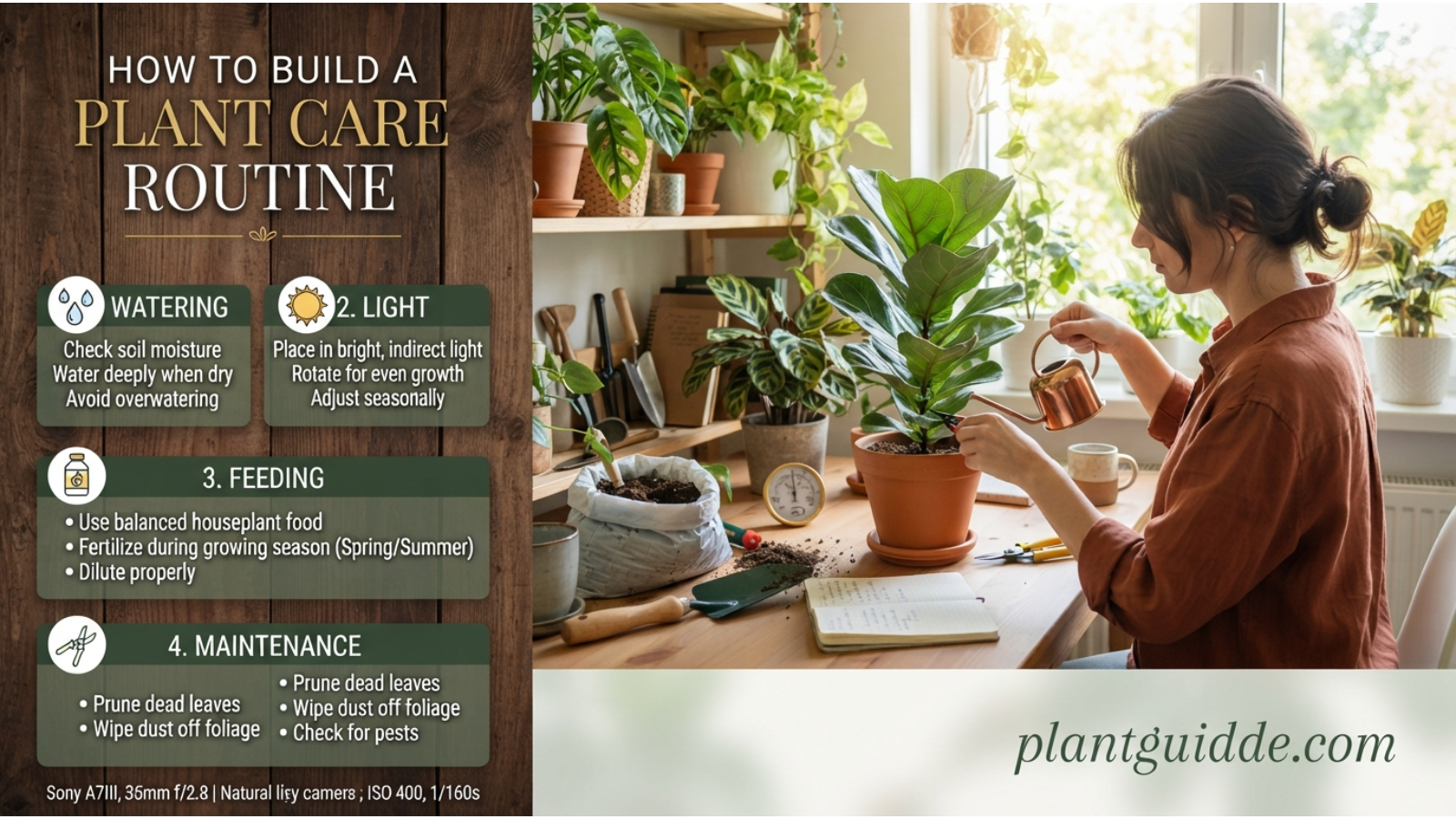
How to Build a Care Routine Around the Plant
Instead of creating a complicated calendar, use three checkpoints.
Checkpoint 1: Soil
Ask:
“Is the upper soil dry enough to water?”
If yes, water thoroughly.
If no, wait.
Checkpoint 2: Light
Ask:
“Is the plant receiving enough useful indirect light?”
If growth is weak or flowering is poor, consider whether the location is too dark.
Checkpoint 3: Leaves
Ask:
“What are the leaves telling me?”
- Drooping + dry soil → likely thirst
- Drooping + wet soil → investigate roots/drainage
- Brown edges + dry room → investigate humidity
- Scorched areas + sunny window → investigate excessive direct light
- No flowers + healthy foliage → investigate light first
This simple diagnostic system is far more reliable than memorizing dozens of rules.
FAQs,
How often should I water a peace lily?
Water when the upper few centimeters of soil have dried rather than following a fixed weekly schedule. Water thoroughly and allow excess water to drain. During winter or other periods of slow growth, the plant may require less frequent watering.
Why is my peace lily drooping?
A peace lily may droop when it needs water, but persistent drooping can also occur when the roots are stressed by excessively wet soil. Check the soil before watering rather than assuming every wilt means thirst.
How much sunlight does a peace lily need?
Peace lilies prefer bright, indirect or filtered light. They can tolerate lower light, but deep shade can reduce growth and flowering. Strong direct summer sunlight may scorch the leaves.
Why are my peace lily leaves turning brown?
Brown edges can be associated with dry air, inconsistent watering, water-quality sensitivity, fertilizer buildup, or environmental stress. Check the growing conditions rather than treating the brown edges alone.
Why isn’t my peace lily flowering?
Insufficient light is one of the first factors to investigate. Peace lilies can survive in lower light, but flowering often suffers when light is inadequate.
Should I cut off yellow peace lily leaves?
If a leaf is completely yellow or dying, removing it can improve the plant’s appearance and allow the plant to focus on healthy growth. However, investigate why the leaf became yellow if the problem is widespread.
Do peace lilies like humidity?
Yes. Peace lilies are tropical plants that prefer moderate humidity. Dry indoor air can contribute to brown leaf edges.
Can peace lilies live in bathrooms?
Yes, provided the bathroom receives adequate indirect light. Bathrooms can offer naturally higher humidity, which suits peace lilies well.
Do peace lilies need drainage holes?
Yes. Good drainage is essential because roots can suffer when the growing medium remains wet for extended periods.
Should I repot my peace lily every year?
Not necessarily. Repot when the roots have become crowded or the existing container is no longer suitable. RHS notes that newly purchased peace lilies can often remain in their original container for a year or two.
Can peace lilies grow in low light?
They can tolerate lower light, but very low light can lead to slow growth and fewer flowers. Bright indirect light is a better target for a thriving plant.
Are peace lilies poisonous to cats and dogs?
Peace lilies contain insoluble calcium oxalates and can irritate the mouth and gastrointestinal tract if chewed or swallowed by pets. Keep them out of reach of animals.
Final Peace Lily Care Checklist
Before you consider your care routine complete, check these points:
- The plant receives bright, indirect light.
- It is protected from harsh direct summer sunlight.
- The pot has a drainage hole.
- You check the soil before watering.
- You do not leave the roots sitting in water.
- The soil drains while retaining reasonable moisture.
- Humidity is not excessively low.
- The plant stays away from heaters and cold drafts.
- Fertilizer is used lightly during active growth.
- The plant is repotted only when necessary.
- Dead and severely damaged leaves are removed.
- Leaves are checked regularly for pests.
- Poor flowering is investigated through light and overall plant health.
- The plant is kept away from pets and young children.
Conclusion
The secret to learning how to take care of a peace lily plant is not creating a complicated care schedule. It is learning to balance light, moisture, drainage, humidity, temperature, and nutrition.
Give your peace lily bright indirect light rather than harsh sun. Check the soil before watering instead of following a rigid calendar. Water thoroughly when appropriate, but never allow the roots to remain saturated for long periods. Keep the plant comfortably warm, provide reasonable humidity, and feed lightly during active growth.
Most importantly, learn to interpret the plant’s symptoms. A drooping plant does not automatically need more water. Brown leaves do not automatically mean disease. A plant that is not flowering does not automatically need fertilizer.
Check the environment first, identify the most likely cause, and change one thing at a time. With that approach, peace lily care becomes much less about guessing and much more about understanding what your plant is telling you.

Asad Mumtaz is a dedicated plant enthusiast and gardening writer with a passion for helping people care for their plants successfully. He specializes in plant care guides, indoor gardening, and practical growing tips for all skill levels. His content focuses on making gardening simple, enjoyable, and rewarding. Through his work, Asad shares reliable advice to help readers create thriving green spaces.