Peace lilies are popular houseplants for a reason: their glossy green leaves and elegant white blooms can instantly brighten an indoor space. How to Care for a Peace Lily Plant. But keeping those leaves lush and flowers healthy requires more than occasional watering.
How to Care for a Peace Lily Plant starts with understanding its basic needs, including the right light, consistent moisture, suitable soil, humidity, and temperature. Peace Lily Plant you are growing your first peace lily or trying to revive a struggling plant, learning How to Care for a Peace Lily Plant can make a noticeable difference in its growth and appearance.
If your peace lily has yellow leaves, brown tips, drooping foliage, or refuses to bloom, the problem is often related to its growing conditions. Knowing How to Care for a Peace Lily Plant helps you recognize these warning signs and make the right adjustments before the plant becomes seriously stressed.
In this guide, you’ll learn How to Care for a Peace Lily Plant indoors, how often to water, where to place it for the best light, what soil works well, and how to maintain proper humidity. With the right approach to How to Care for a Peace Lily Plant, even beginners can keep this beautiful tropical houseplant healthy, green, and thriving.
Quick Answer
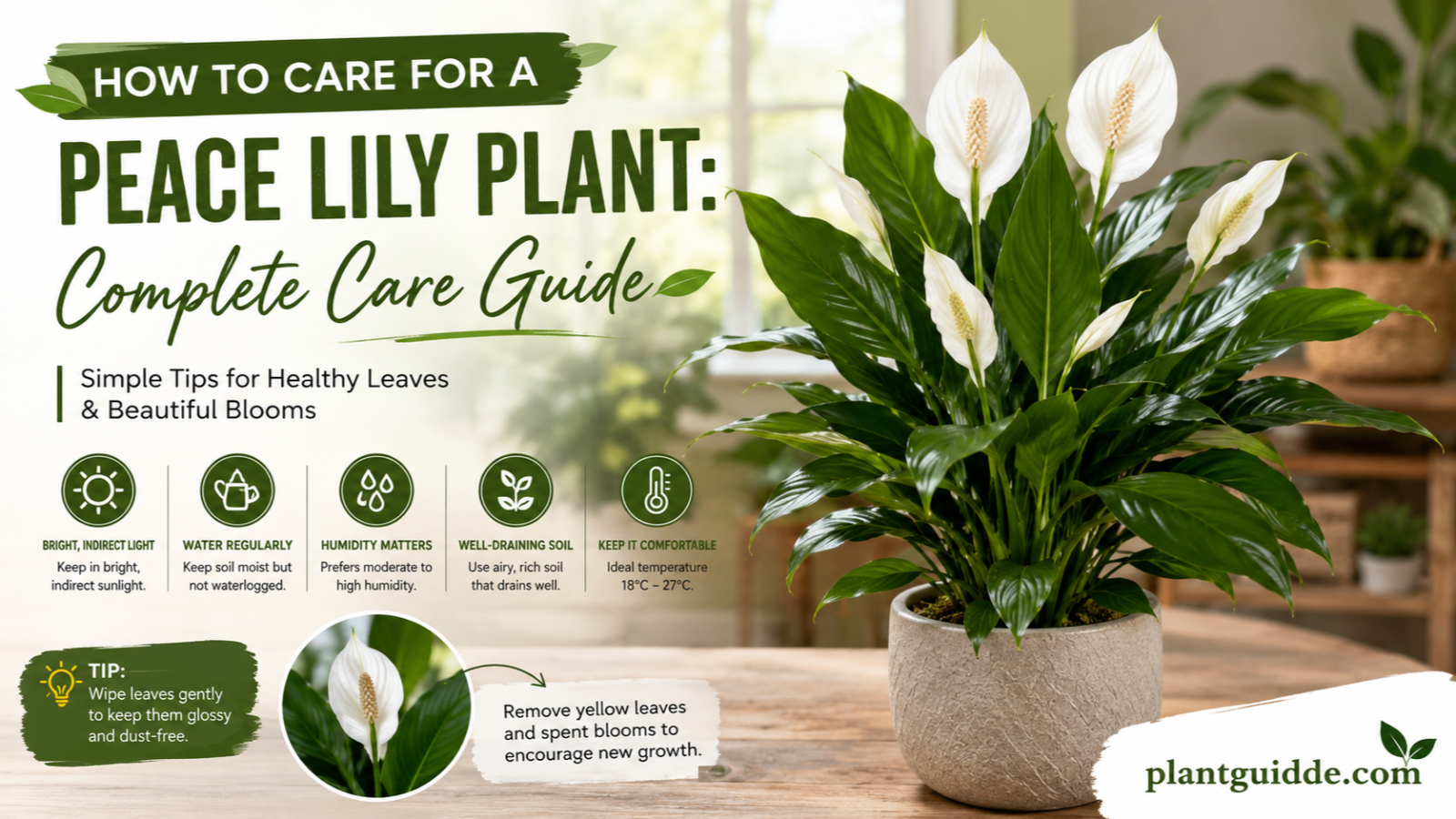
To care for a peace lily plant, place it in bright, indirect light, keep the soil lightly and consistently moist without leaving it waterlogged, provide moderate humidity, and maintain a warm, stable environment. Water when the upper layer of soil begins to dry, use a pot with drainage, and reduce watering when growth slows in winter. If the leaves droop, check the soil before watering rather than following a fixed schedule.
What Is a Peace Lily?
A peace lily belongs to the genus Spathiphyllum and the arum family, Araceae. Despite its common name, it is not a true lily. Its familiar white “flowers” are actually modified leaves called spathes, surrounding a central structure called a spadix.
One of the most commonly grown types is Spathiphyllum wallisii, although several cultivars are sold as houseplants. Some remain compact, while larger varieties can become substantial floor plants.
Peace lilies naturally come from tropical environments, which explains many of their indoor preferences:
- filtered or indirect light
- warmth
- moderate humidity
- evenly moist but well-drained growing conditions
- protection from temperature extremes
Understanding that background makes the care routine easier to remember. You are essentially trying to recreate the stable conditions of a warm, sheltered tropical environment without keeping the roots permanently saturated.
Peace Lily Care Requirements at a Glance
| Care factor | What a peace lily prefers | What to avoid |
|---|---|---|
| Light | Bright, indirect light | Harsh direct sun |
| Water | Moist soil with some drying between waterings | Constantly soggy soil |
| Soil | Moisture-retentive but well-draining mix | Heavy, poorly drained soil |
| Humidity | Moderate humidity | Very dry air |
| Temperature | Warm, stable indoor conditions | Cold drafts and heat sources |
| Fertilizer | Balanced fertilizer during active growth | Excessive feeding |
| Pot | Drainage holes and appropriate size | Oversized pot with wet soil |
| Cleaning | Dust-free leaves | Heavy dust buildup |
| Pruning | Remove yellowing leaves and spent flowers | Aggressive pruning |
RHS guidance similarly recommends bright indirect light, moderate watering, good drainage, warmth, and moderate humidity for healthy peace lilies.
Image Suggestion: Create a labeled infographic showing the ideal peace lily setup: indirect light, draining pot, moist soil, humidity, and warm location.
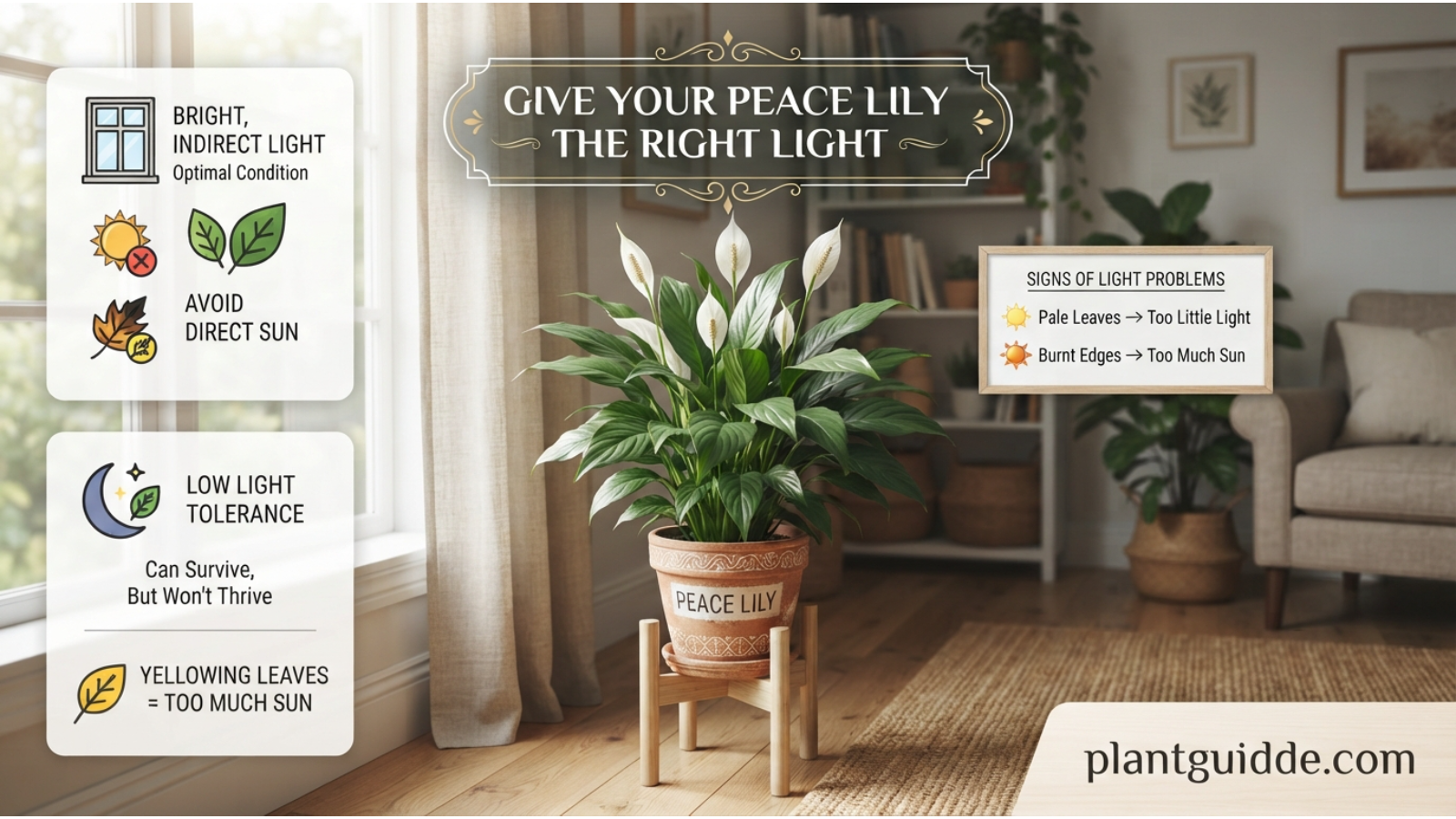
Give Your Peace Lily the Right Light
Light is one of the most misunderstood parts of peace lily care.
Peace lilies can survive in relatively low light, but surviving is not the same as thriving. In deep shade, the plant may remain green while producing slower growth and fewer flowers. Bright, indirect light is generally a better target when you want vigorous growth and flowering.
What does bright, indirect light mean?
Place the plant near a bright window where it receives plenty of ambient daylight without sitting directly in intense midday or summer sun.
Good locations can include:
- near an east-facing window
- a short distance from a bright south- or west-facing window
- beside a bright window filtered by a sheer curtain
- a well-lit room where direct rays do not hit the foliage for long periods
A useful practical rule is this:
Peace Lily Plant the room feels bright enough for you to read comfortably during the day but the leaves are protected from harsh direct sunlight, you are often close to the right range.
Direct hot sunlight can scorch peace lily foliage, while excessively dark locations can reduce flowering.
How to tell if light is too low
Watch the plant rather than judging the room by eye.
Possible signs include:
- very slow new growth
- long gaps between leaves
- smaller new leaves
- a plant that remains green but rarely flowers
- stems leaning strongly toward the window
A particularly important point: moving a peace lily farther from a window can reduce usable light much more than it appears to the human eye. University extension guidance notes that indoor light intensity can fall significantly as plants are moved away from windows.
How to tell if light is too strong
Look for:
- bleached patches
- pale or scorched areas
- crispy brown sections on leaves
- foliage becoming damaged shortly after strong direct exposure
If this happens, move the plant farther from the window or filter the sunlight rather than putting it into a dark corner.
How Often Should You Water a Peace Lily?
There is no universally correct watering schedule such as “every seven days.”
The right frequency depends on:
- pot size
- soil composition
- room temperature
- humidity
- season
- light exposure
- root development
- plant size
Instead of watering by the calendar, check the soil.
RHS recommends watering once the top few centimeters of compost have become dry, while extension guidance recommends checking the soil about an inch deep before watering.
A simple watering method
- Push your finger about 1–2 inches into the soil.
- If the surface is dry and the upper layer is beginning to dry, check the plant more closely.
- Peace Lily Plant the soil is still noticeably wet, wait.
- When watering is needed, water thoroughly.
- Allow excess water to drain through the bottom of the pot.
- Empty standing water from a saucer or decorative container.
The goal is moist soil, not permanently saturated soil.
Why overwatering is so dangerous
Many beginners assume a drooping peace lily automatically needs more water. That can be a costly mistake.
Roots need access to oxygen as well as moisture. When soil remains saturated for extended periods, root function can deteriorate and root rot can develop. RHS specifically warns that keeping peace lily compost too wet for long periods can result in root rot.
So before watering a drooping plant, check the soil first.
What if the peace lily is completely wilted?
Peace lilies are famous for dramatic wilting when they become too dry. Fortunately, a plant that is otherwise healthy can often recover after thorough watering.
If the soil is very dry:
- water slowly and thoroughly
- make sure water reaches the entire root ball
- allow excess water to drain
- return the plant to suitable indirect light
- monitor the soil over the next several days
Do not turn one dry spell into a week of constantly wet soil.
Use the Right Soil and Pot
A peace lily needs soil that can hold moisture while still allowing excess water and air to move through the root zone.
A practical indoor mix can contain:
- quality peat-free or general-purpose houseplant compost
- perlite or another drainage-enhancing material
- organic material that provides reasonable moisture retention
RHS recommends a free-draining mix and notes that adding perlite can improve drainage.
Why the pot size matters
A common mistake is moving a small peace lily into a huge decorative pot.
A much larger container holds more unused wet soil around a relatively small root system. That soil can remain wet for too long, increasing the risk of root problems.
When repotting, choose a container only modestly larger than the existing root ball. RHS specifically recommends avoiding oversized pots because excess compost can remain damp for too long.
Always use drainage
A pot with drainage holes gives excess water somewhere to escape.
If your decorative pot has no drainage hole, use it as an outer cover rather than planting the peace lily directly into it.
Image Suggestion: Diagram comparing a peace lily in a correctly sized draining pot with one sitting in an oversized, waterlogged container.
Maintain Moderate Humidity
Peace lilies are tropical plants, so they generally appreciate moderate humidity. Very dry indoor air can contribute to brown leaf edges and tips.
This becomes especially important when the plant is near:
- radiators
- heating vents
- strong air-conditioning
- constantly moving dry air
How to increase humidity
You can:
- move the plant away from heating or cooling vents
- group compatible houseplants together
- use a humidifier if the room is consistently dry
- place the plant in a naturally more humid room with suitable light
- use a pebble tray if practical
However, humidity should not be treated as a substitute for correct watering.
A plant sitting in bone-dry soil will not be fixed simply by misting its leaves.
Should you mist a peace lily?
Misting can temporarily increase moisture around the foliage, but it is not a reliable replacement for maintaining suitable room humidity.
If your home is consistently dry, a humidifier or better placement is generally a more dependable solution.
Keep the Temperature Stable
Peace lilies prefer warm indoor conditions and do not respond well to sudden cold exposure.
RHS lists approximately 12–24°C (55–75°F) as suitable average room temperatures and recommends keeping peace lilies away from cold drafts and hot radiators.
Avoid placing your plant directly beside:
- frequently opened cold windows
- exterior doors with drafts
- air-conditioning outlets
- heaters
- radiators
- other strong sources of hot or cold air
A stable location is often better than constantly moving the plant around to chase ideal conditions.
Feed Your Peace Lily Without Overdoing It
Peace lilies benefit from fertilizer during active growth because nutrients support new foliage and flowering.
RHS recommends a general liquid fertilizer every few weeks during the growing season, while its plant profile also describes monthly balanced feeding as an option.
For most indoor growers, the important principle is simple:
Follow the fertilizer label and avoid the temptation to feed more often because the plant is growing slowly.
Too much fertilizer can lead to salt accumulation and root stress.
If the plant has recently been repotted into fresh, nutrient-containing potting mix, you may not need to fertilize immediately.
Clean the Leaves Regularly
Peace lily leaves are broad and glossy, which means they can collect household dust.
A layer of dust can interfere with the clean surface of the foliage and makes the plant look dull.
Wipe the leaves gently with a clean, damp cloth when necessary. RHS also recommends wiping peace lily leaves to remove dust and help maintain healthy foliage.
Avoid aggressive rubbing or using unnecessary leaf-shine products.
When cleaning, inspect both sides of the leaves for:
- spider mites
- scale insects
- mealybugs
- sticky residue
- fine webbing
- unusual discoloration
Leaf cleaning can therefore double as a simple pest inspection.
How to Encourage a Peace Lily to Flower
A peace lily can stay healthy and leafy while producing few or no flowers.
The first thing to investigate is light.
Plants kept in deep shade may survive but often flower poorly. RHS recommends moving peace lilies into bright indirect light when flowering is weak.
Before immediately buying fertilizer or changing the soil, ask:
- Is the plant receiving enough usable daylight?
- Is it healthy enough to support new growth?
- Is the potting mix staying excessively wet?
- Has the plant been recently disturbed or repotted?
- Is the location too cold or unstable?
A common mistake is trying to solve every flowering problem with fertilizer when insufficient light is actually the limiting factor.
Image Suggestion: Side-by-side illustration of a flowering peace lily in bright indirect light versus a healthy but non-flowering plant kept in deep shade.
How to Prune a Peace Lily
Peace lilies do not require complicated pruning.
Remove:
- completely yellow leaves
- badly damaged leaves
- dead foliage
- spent flower stalks
Use clean, sharp scissors and cut unwanted stems close to their base.
When handling the plant, consider wearing gloves because peace lily sap can irritate the skin. RHS recommends gloves when handling peace lilies.
Do not remove healthy green leaves simply because they are older. Every healthy leaf contributes to photosynthesis.
Repotting a Peace Lily: When and How
Peace lilies do not need to be repotted on a strict annual schedule.
Instead, inspect the root system and the behavior of the plant.
Repotting may be appropriate when:
- roots have densely filled the container
- roots are emerging through drainage holes
- water passes through unusually quickly because the plant is severely rootbound
- growth has slowed despite appropriate light and care
- the existing potting mix has broken down or drains poorly
RHS recommends checking the roots and repotting when they have become densely packed, rather than automatically repotting every year.
How to repot
- Choose a container only slightly larger than the current one.
- Make sure it has drainage holes.
- Use a fresh, free-draining houseplant mix.
- Gently remove the plant from its existing pot.
- Inspect the roots.
- Loosen severely compacted roots carefully.
- Position the plant at approximately the same depth.
- Fill around the root ball with fresh mix.
- Water appropriately and allow excess water to drain.
Spring or the beginning of active growth is generally a convenient time for repotting.
How to Propagate a Peace Lily
The easiest way to produce new peace lilies is generally division rather than leaf or stem cuttings.
A mature plant develops a clumping growth habit, allowing established sections to be separated while retaining roots.
Basic division method
- Remove the mature plant from its container.
- Examine the root ball and natural clumps.
- Separate a section containing healthy roots and several shoots.
- Pot the division into an appropriately sized container.
- Use fresh, well-draining potting mix.
- Water appropriately after planting.
- Keep the new division in suitable indirect light while it establishes.
RHS recommends propagation by division in winter or immediately after flowering, depending on the growing situation.
Peace Lily Problems: What the Leaves Are Telling You
One of the most useful peace lily care skills is learning to diagnose symptoms rather than treating every problem as a watering problem.
Peace Lily Leaves Turning Yellow
Yellow leaves can have several causes.
Start by checking the soil.
If the soil is wet for long periods
Possible causes include:
- overwatering
- poor drainage
- an oversized pot
- compacted potting mix
- insufficient evaporation
Do not simply add fertilizer. First correct the root-zone conditions.
If the soil is extremely dry
The plant may be experiencing prolonged underwatering.
Check whether water is actually penetrating the root ball. Severely dry potting mix can sometimes repel water, causing water to run around the edges instead of thoroughly wetting the roots.
Why Are My Peace Lily Leaves Turning Brown?
Brown tips or edges are commonly associated with environmental stress.
Possible contributors include:
- dry indoor air
- inconsistent watering
- excessive fertilizer salts
- water-quality sensitivity
- excessive light or heat
RHS specifically notes that dry air can cause brown leaf edges and that fluoride in tap water can damage foliage, recommending rainwater or filtered water where possible.
Do not assume every brown leaf means the plant is thirsty.
Look at the pattern:
- crispy tips with otherwise healthy foliage → consider dry air or water quality
- widespread browning with very dry soil → investigate underwatering
- yellowing and browning with constantly wet soil → investigate root stress
- bleached or scorched patches → investigate excessive direct light
Why Is My Peace Lily Drooping?
Drooping is one of the most recognizable peace lily symptoms.
If the soil is dry, underwatering is an obvious possibility. Peace lilies can wilt dramatically when they need water and may recover after proper watering.
But if the soil is already wet, do not automatically water again.
Instead, investigate:
- poor drainage
- compacted soil
- root damage
- cold stress
- excessive heat
- recent environmental changes
This simple soil check prevents one of the most common peace lily care mistakes: adding water to a plant whose roots are already sitting in wet soil.
Why Are My Peace Lily Leaves Curling?
Curling or folding leaves can indicate environmental stress.
Check:
- Soil moisture
- Humidity
- Temperature
- Light exposure
- Recent changes in location
If the plant is next to a heater, air-conditioning vent, or draft, move it to a more stable location.
If the soil is dry, water thoroughly and observe whether the foliage begins to recover.
Why Is My Peace Lily Not Flowering?
If your peace lily has healthy green foliage but refuses to flower, insufficient light should be one of the first things you investigate.
A plant can tolerate low light without dying, but that does not mean it has enough energy or suitable conditions for abundant flowering. RHS specifically notes that deep shade can result in poor flowering.
Move the plant gradually toward a brighter location with indirect light.
Avoid putting it directly into intense sunlight simply because you want more flowers.
Peace Lily Root Rot: What to Look For
Root problems become more likely when the soil stays wet for extended periods.
Possible warning signs include:
- persistent yellow leaves
- soft or collapsing foliage
- unpleasant-smelling soil
- consistently wet potting mix
- roots that appear brown, dark, or mushy rather than firm
If root rot is suspected, remove the plant from the container and inspect the root system.
Healthy roots should generally feel firm. Severely damaged roots should be removed with clean tools, and the plant should be repotted into fresh, appropriately draining mix.
The most important treatment is not simply removing damaged roots. The watering and drainage problem that caused the root stress must also be corrected.
A Practical Peace Lily Care Routine
Instead of memorizing dozens of rules, use this simple routine.
Once or twice a week
Check:
- soil moisture
- leaf condition
- signs of pests
- whether the plant is receiving suitable light
When the soil begins to dry
Water thoroughly enough for excess water to drain from the pot.
Every few weeks
Check:
- whether leaves are dusty
- whether the plant is leaning toward the light
- whether new growth looks healthy
- whether fertilizer is appropriate for the current growing season
Every few months
Look at:
- root crowding
- pot drainage
- soil condition
- overall plant shape
- whether the location still provides suitable light
This observation-based routine is more reliable than a calendar because indoor conditions change throughout the year.
Peace Lily Care in Winter
Peace lilies generally grow more slowly when light levels and temperatures decrease.
During winter:
- reduce watering if the soil dries more slowly
- avoid keeping the roots constantly wet
- keep the plant away from cold drafts
- protect it from hot heating vents
- maintain reasonable humidity
- continue providing bright indirect light
Do not automatically continue a summer watering schedule during winter.
The plant’s soil tells you more than the calendar does.
Peace Lily Care in Summer
Summer can create the opposite problem.
Higher temperatures, stronger light, and increased evaporation can make the soil dry more quickly.
During hot weather:
- check soil moisture more frequently
- protect foliage from intense direct sun
- keep the plant away from hot windows
- watch for dry air from air-conditioning
- provide good airflow without exposing the plant to harsh drafts
A plant that needed watering every 10 days in a cool room may need attention considerably sooner in a bright, warm room.
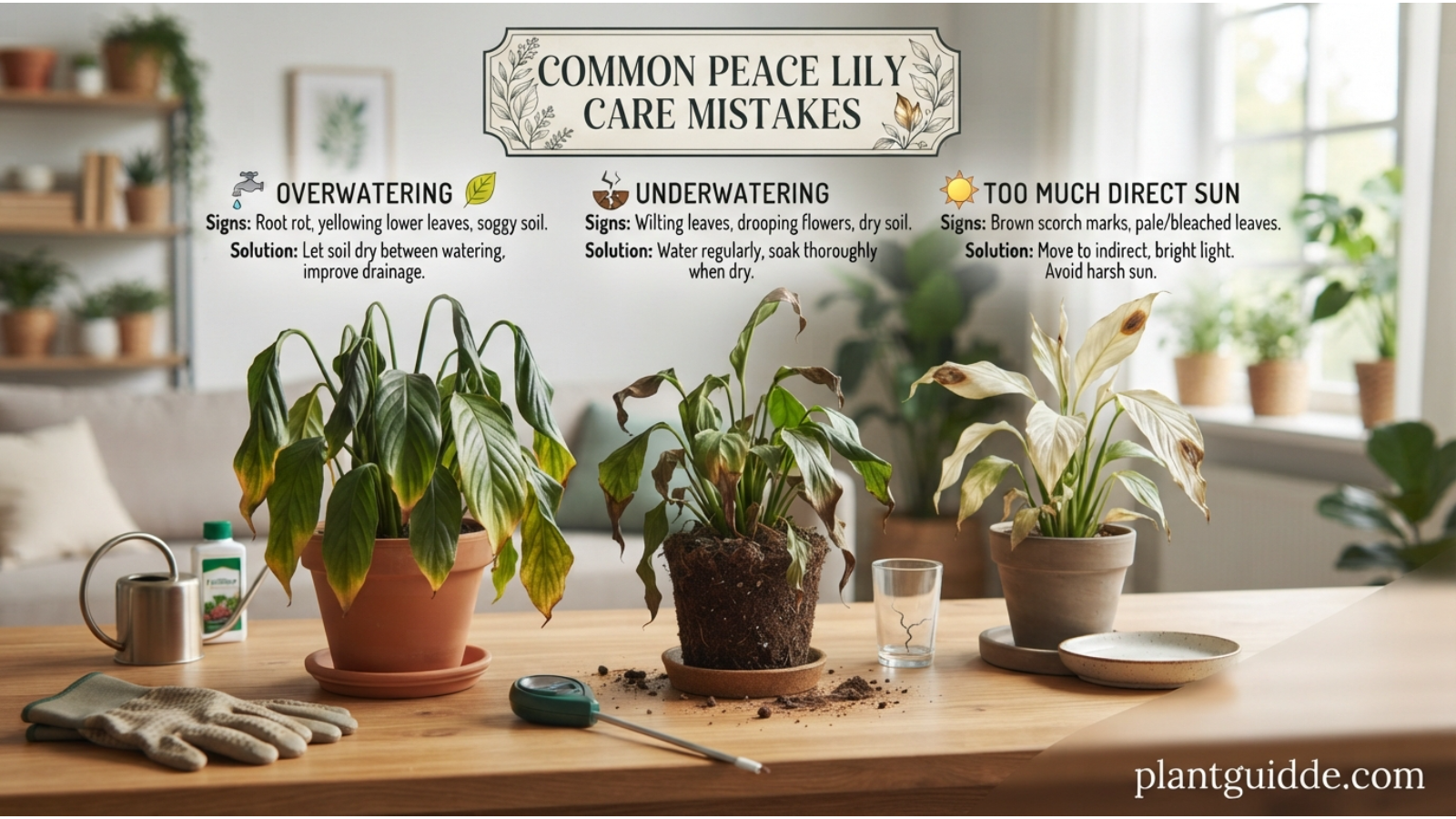
Common Peace Lily Care Mistakes
1. Watering on a fixed schedule
“Every Sunday” sounds simple, but plant water requirements change.
Better approach: check soil moisture first.
2. Keeping the soil permanently wet
Peace lilies like moisture, but their roots still need oxygen.
Better approach: allow the upper soil layer to begin drying before watering again.
3. Putting the plant in a dark corner
A peace lily may survive there but can become slow-growing and reluctant to flower.
Better approach: provide bright indirect light.
4. Putting it directly in harsh sunlight
More light is not always better.
Better approach: increase light without exposing foliage to intense direct sun.
5. Using an oversized pot
More soil means more moisture retention.
Better approach: choose a pot only moderately larger than the root system.
6. Fertilizing a struggling plant immediately
Fertilizer cannot solve root rot, severe underwatering, poor light, or cold stress.
Better approach: identify the environmental problem first.
7. Treating every brown leaf as underwatering
Brown tips can have multiple causes.
Better approach: examine moisture, humidity, light, temperature, and water quality together.
An Easy Troubleshooting Decision Tree
When something looks wrong, use this sequence:
Step 1: Check the soil.
- Very dry → investigate underwatering.
- Wet for a long time → investigate overwatering and drainage.
- Moderately moist → continue checking.
Step 2: Check the light.
- Dark room → move toward brighter indirect light.
- Strong direct sun → filter or reduce exposure.
Step 3: Check the environment.
Look for:
- heater
- air conditioner
- cold draft
- very dry air
- sudden temperature changes
Step 4: Inspect the leaves.
Look for:
- pests
- brown edges
- yellowing
- curling
- scorch marks
- damaged new growth
Step 5: Check the roots if problems persist.
If soil conditions remain suspicious despite reasonable watering, inspect the root system.
This approach is much more useful than changing five things at once because it allows you to identify which environmental factor is actually causing the problem.
Is a Peace Lily Safe Around Pets and Children?
This is an important consideration before bringing one into a home with pets or young children.
Peace lilies contain insoluble calcium oxalates and are toxic to cats and dogs. The ASPCA lists symptoms including oral irritation, intense burning or irritation of the mouth, excessive drooling, vomiting, and difficulty swallowing.
RHS also advises keeping peace lilies away from children and pets and recommends wearing gloves when handling them because the plant can irritate skin.
If a pet has chewed or swallowed part of a peace lily, contact a veterinarian promptly rather than waiting for symptoms to worsen.
FAQs,
How often should I water a peace lily?
Water when the upper layer of soil has begun to dry rather than following a fixed weekly schedule. Water thoroughly, then allow excess water to drain.
Do peace lilies need direct sunlight?
No. Bright, indirect light is generally preferable. Strong direct sunlight, especially through hot windows, can scorch the foliage.
Why does my peace lily droop even though it looks healthy?
First check the soil. If it is dry, the plant may simply need water. If the soil is already wet, investigate drainage, root health, temperature, and environmental stress instead of watering again.
Can a peace lily grow in low light?
Yes, peace lilies can tolerate relatively low light, but very low light can slow growth and reduce flowering. Brighter indirect light is generally better for vigorous growth and blooms.
Should I mist my peace lily?
Occasional misting can temporarily increase moisture around the leaves, but it is not a substitute for suitable room humidity. Consistent environmental conditions are more important.
Why are my peace lily leaves turning brown?
Possible causes include dry air, inconsistent watering, water-quality issues, excessive fertilizer, or excessive light and heat. Examine the whole growing environment before deciding on a treatment.
Why is my peace lily not flowering?
Insufficient light is one of the first things to check. A peace lily can remain green in deep shade while flowering poorly. Move it to brighter indirect light rather than direct hot sunlight.
Should I cut off yellow peace lily leaves?
Yes, completely yellow or badly damaged leaves can be removed at the base of their stem. But also investigate why they became yellow rather than simply removing the symptoms.
Do peace lilies like humidity?
Yes. They generally prefer moderate humidity, and very dry air can contribute to brown leaf edges.
When should I repot a peace lily?
Repot when the roots have densely filled the container or the existing soil and drainage have become unsuitable. Avoid automatically moving the plant into a much larger pot.
Final Takeaway
Learning how to care for a peace lily plant becomes much easier when you stop treating the plant as if it follows a fixed schedule.
Give it bright indirect light, keep its soil appropriately moist but never chronically waterlogged, provide moderate humidity, maintain stable temperatures, and use a well-draining potting mix in a container with drainage.
Most importantly, learn to diagnose before you act.
A drooping plant does not always need water. A brown leaf does not always mean underwatering. A plant that refuses to flower does not necessarily need more fertilizer. Check the soil, light, roots, and environment first.
That small change in approach can turn peace lily care from guesswork into a simple observation-based routine, and usually results in healthier foliage, stronger growth, and more reliable flowering.
Image Suggestion: Final infographic titled “Peace Lily Care Checklist” showing ideal light, watering, soil, humidity, temperature, feeding, and troubleshooting cues.

Asad Mumtaz is a dedicated plant enthusiast and gardening writer with a passion for helping people care for their plants successfully. He specializes in plant care guides, indoor gardening, and practical growing tips for all skill levels. His content focuses on making gardening simple, enjoyable, and rewarding. Through his work, Asad shares reliable advice to help readers create thriving green spaces.