Pothos is often recommended as one of the easiest houseplants to grow, and for good reason. It adapts well to indoor conditions, tolerates occasional neglect, and can produce long, attractive vines with surprisingly little effort. However, “easy” does not mean impossible to get wrong. Poor lighting, overwatering, or compact soil can still lead to yellow leaves, drooping, root problems, and slow growth.
Learning how to care for a pothos plant starts with understanding a few simple essentials: the right light, watering routine, well-draining soil, suitable humidity, and occasional pruning. If you grow a Golden Pothos, Marble Queen, or another popular variety, giving your plant consistent conditions can make a noticeable difference in its health and appearance.
The good news is that pothos does not need a complicated routine. Once you understand what your plant is telling you, it becomes much easier to prevent common problems and encourage fuller, healthier growth.
In this guide, you’ll learn how to care for a pothos plant step by step, including its light and water requirements, the best soil, pruning and repotting tips, and practical solutions to common pothos problems.
Quick Answer
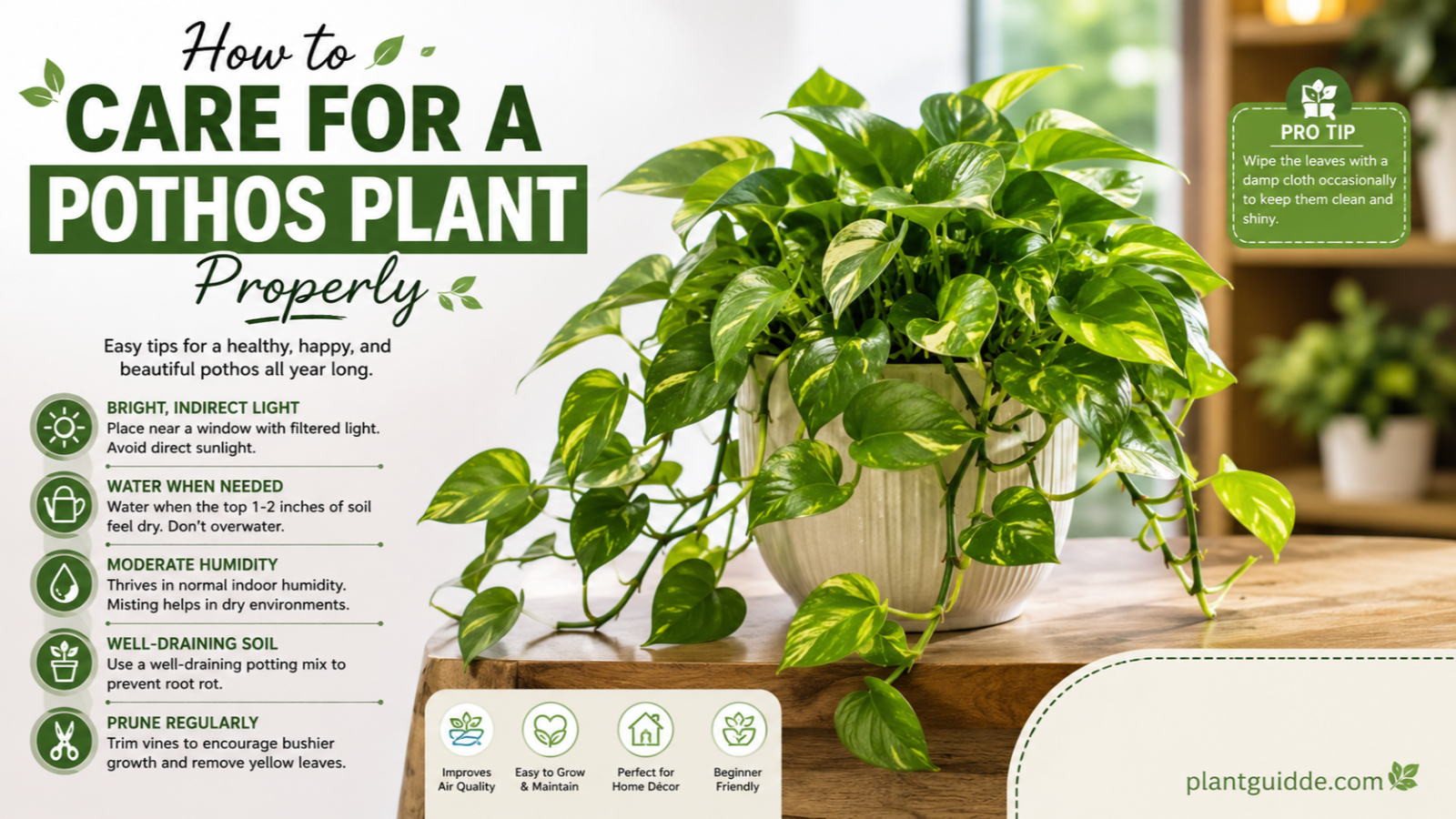
To care for a pothos plant, place it in bright, indirect light, water when the top 1–2 inches of soil feel dry, and use a well-draining potting mix with drainage holes. Keep it in a warm, moderately humid room and avoid constantly wet soil. Pothos tolerate lower light and occasional missed watering, but consistent conditions produce healthier, fuller growth.
Pothos Plant Care at a Glance
| Care factor | Best condition |
|---|---|
| Light | Bright, indirect light |
| Watering | When the upper 1–2 inches of soil dry |
| Soil | Loose, well-draining, moisture-retentive mix |
| Pot | Container with drainage holes |
| Temperature | Warm, stable indoor temperatures |
| Humidity | Average household humidity is usually adequate |
| Fertilizer | Balanced houseplant fertilizer during active growth |
| Pruning | Trim long or damaged vines to encourage fuller growth |
| Repotting | When roots become crowded or the soil dries unusually fast |
| Propagation | Stem cuttings rooted in water or growing medium |
The most important principle is simple: give pothos enough light to grow, enough water to stay hydrated, and enough drainage for its roots to breathe.
What Is a Pothos Plant?
Pothos commonly refers to Epipremnum aureum, a tropical aroid widely grown as a houseplant.
It is naturally a climbing or trailing plant, which explains why pothos can look very different depending on how it is grown. Let the stems hang from a shelf and they trail downward. Give them suitable support and they can climb.
Several popular cultivars are sold as pothos, including:
- Golden Pothos
- Marble Queen
- Jade Pothos
- Neon Pothos
- Manjula
- Pearls and Jade
- N’Joy
Their care is broadly similar, but variegated varieties usually benefit from brighter light to maintain attractive patterns.
A useful distinction
Pothos is sometimes confused with heartleaf philodendron because both have trailing stems and heart-shaped leaves. They are different plants, however, and their leaves, stems, and growth habits have noticeable differences.
Give Pothos the Right Light
Light is one of the biggest factors determining how a pothos actually looks.
Pothos can tolerate relatively low light, which is one reason it has become such a popular indoor plant. However, surviving in low light is different from growing vigorously in low light.
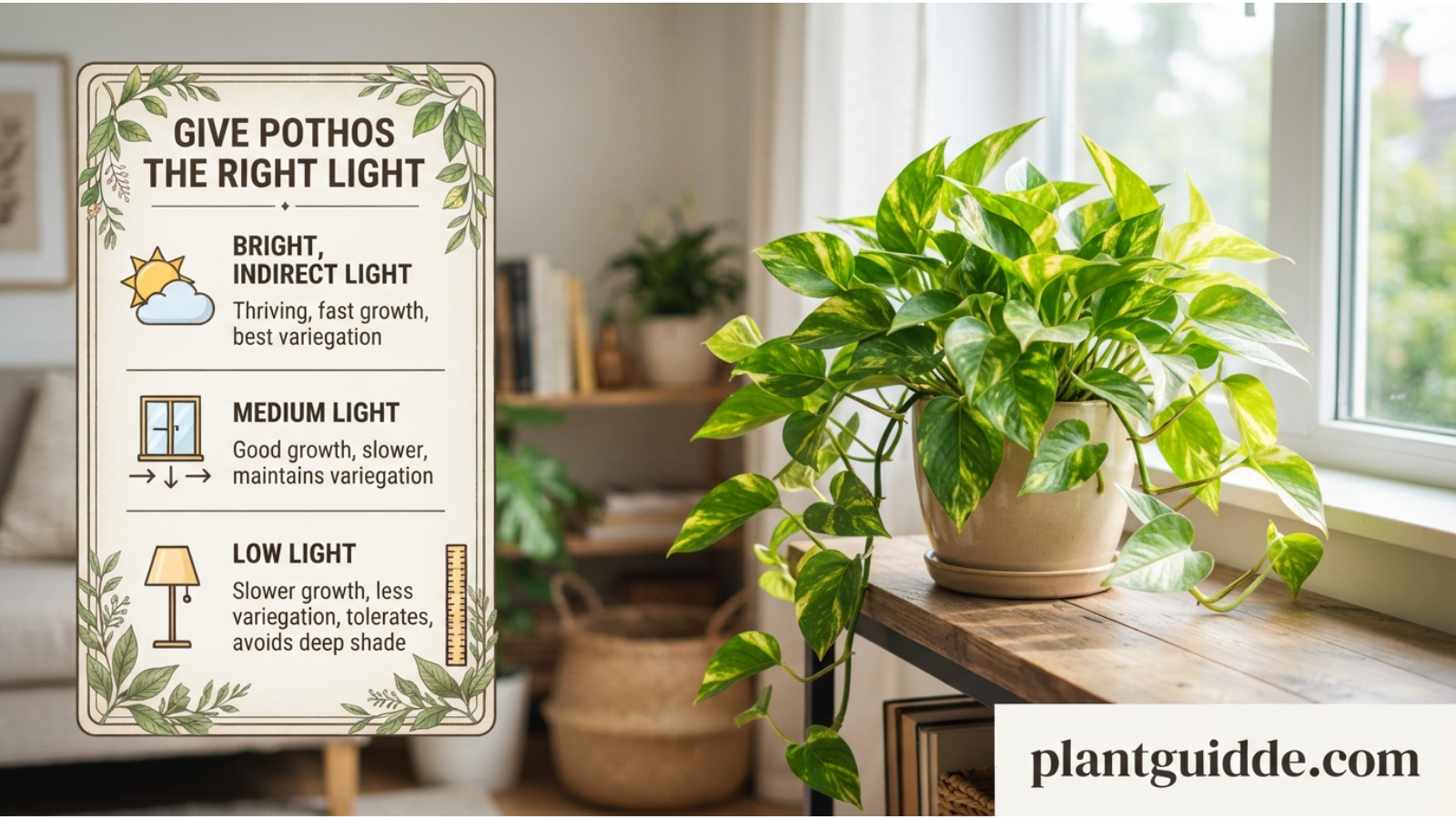
Best light for pothos
Aim for:
Bright, indirect light near an east- or north-facing window, or slightly back from a brighter south- or west-facing window.
The goal is plenty of ambient light without harsh, prolonged direct sunlight hitting the leaves.
A few hours of gentle morning sun can be fine. Strong afternoon sunlight through glass can be much more intense.
What happens in low light?
A pothos kept too far from a window may:
- Grow slowly
- Produce smaller leaves
- Develop longer spaces between leaves
- Lose some variegation
- Become thin and leggy
This is particularly noticeable with highly variegated cultivars.
What happens with excessive direct sun?
Too much intense sunlight can cause:
- Bleached-looking patches
- Brown or crispy areas
- Faded foliage
- Leaf scorch
Practical tip: How to Care for a Pothos Plant you are unsure whether your pothos receives enough light, don’t immediately move it into direct sun. Move it gradually closer to a bright window and watch how the plant responds.
Image Suggestion: Pothos positioned at different distances from a bright window, showing ideal indirect light versus excessive direct sunlight.
Water Pothos Based on the Soil, Not the Calendar
One of the most common pothos care mistakes is watering on a fixed schedule.
“Water every Sunday” sounds convenient, but indoor conditions change. A plant may need water much sooner in a warm, bright room than in a cool, dim room.
When should you water pothos?
Check the soil with your finger.
When the top 1–2 inches feel dry, it is generally time to water.
For a small pot, you may need to check more frequently because the soil volume is limited. A large container may stay wet much longer.
How to water correctly
When watering:
- Check the soil first.
- Water thoroughly rather than adding a tiny amount every day.
- Allow excess water to drain from the bottom.
- Empty any standing water collected in a saucer.
- Let the upper portion of the soil dry before watering again.
The objective is not to keep the soil permanently moist.
Why overwatering causes problems
Roots need both moisture and oxygen. Soil that remains saturated for too long limits the air available around the roots and can create conditions associated with root decline.
This is why a pothos can look wilted even though its soil is soaking wet.
A wilted plant does not automatically need more water.
Always check the soil before reaching for the watering can.
Choose a Well-Draining Pothos Soil Mix
Pothos is adaptable, but ordinary dense garden soil is generally a poor choice for indoor containers.
A good pothos soil should retain some moisture while allowing excess water and air to move through the root zone.
A practical homemade mix can include:
- Quality indoor potting mix
- Perlite or pumice
- A small amount of orchid bark or another chunky material
The exact ratio does not need to be perfect.
Why drainage matters more than a “special” recipe
Beginners sometimes spend too much time searching for a perfect pothos soil formula.
In reality, structure matters more than a magic ratio.
How to Care for a Pothos Plant water sits in the pot for a long time, improve drainage. If the mix becomes bone-dry almost immediately after watering, it may need greater moisture retention.
The right mix depends partly on your indoor environment and watering habits.
Use a Pot With Drainage Holes
A drainage hole is one of the simplest ways to reduce watering problems.
Without drainage, excess water has nowhere to go. Even an excellent potting mix can become problematic if the container traps water at the bottom.
Signs the pot may be too large
A very large container can hold considerably more wet soil than the plant’s root system can use.
This can cause the soil to remain wet for an unnecessarily long period.
When repotting, choose a container only modestly larger than the existing root ball rather than dramatically increasing the pot size.
Keep Pothos Warm and Away From Temperature Extremes
Pothos is a tropical plant, so it generally performs best in warm indoor conditions.
You do not need to create a greenhouse environment, but avoid placing it directly beside:
- Cold drafts
- Frequently opened exterior doors
- Heating vents
- Air-conditioning vents
- Very hot windows
Stable conditions are usually more helpful than constantly changing the plant’s environment.
If a pothos suddenly develops problems after being moved, consider what changed—not just how much you watered it.
Does Pothos Need High Humidity?
Pothos can tolerate ordinary household humidity surprisingly well.
You do not necessarily need a humidifier simply because you own a pothos.
Higher humidity can support comfortable growth, particularly in very dry indoor environments, but humidity is not a substitute for proper watering or healthy roots.
Avoid relying on misting
Misting the leaves may temporarily increase moisture around the foliage, but it does not provide the same long-term environmental effect as maintaining suitable room humidity.
If your home is consistently very dry, a humidifier can be more practical than repeatedly misting the plant.
Fertilize Pothos Without Overdoing It
Pothos does not need constant feeding.
During active growth, a balanced liquid houseplant fertilizer used according to its label directions can support continued growth.
When fertilizer is useful
Fertilizing can be particularly helpful when:
- The plant is actively producing new leaves
- The growing medium is relatively low in nutrients
- The plant has been growing for a long time without being repotted
When to hold back
Avoid automatically adding fertilizer when the plant is:
- Severely stressed
- Sitting in waterlogged soil
- Experiencing suspected root problems
- Newly repotted into nutrient-rich potting mix
More fertilizer does not equal faster growth. Excess fertilizer salts can damage roots and create additional problems.
Prune Pothos to Make It Fuller
Pothos naturally wants to trail, so a healthy plant can eventually become long and sparse.
If you want a fuller-looking plant, pruning is one of the most effective tools.
How to prune pothos
Use clean, sharp scissors or pruners.
Cut the vine near a node—the point where a leaf or aerial root emerges.
Pruning encourages the plant to produce new growth from appropriate points along the vine.
What about extremely long vines?
You do not need to throw them away.
Healthy cuttings can be propagated and replanted into the same pot, allowing you to create a denser arrangement over time.
Image Suggestion: Close-up diagram showing a pothos stem, node, leaf, correct cutting location, and new growth direction.
Propagate Pothos From Stem Cuttings
Pothos is one of the easiest houseplants to propagate.
A cutting needs at least one viable node because the node contains the tissue from which new roots can develop.
Simple water propagation
- Cut a healthy stem below a node.
- Remove lower leaves that would sit underwater.
- Place the node in clean water.
- Keep it in bright, indirect light.
- Change the water regularly.
- Once a useful root system develops, transfer it to a suitable growing medium.
Don’t judge success by the amount of leaf growth alone. Root development is the important first milestone.
Soil propagation
You can also place a node directly into a moist, airy growing medium.
This avoids the transition from water-grown roots to soil-grown roots, although water propagation makes root development easy to observe.
How to Make a Pothos Grow Faster
There is no reliable shortcut that forces a pothos to grow rapidly.
Instead, optimize the conditions that limit growth.
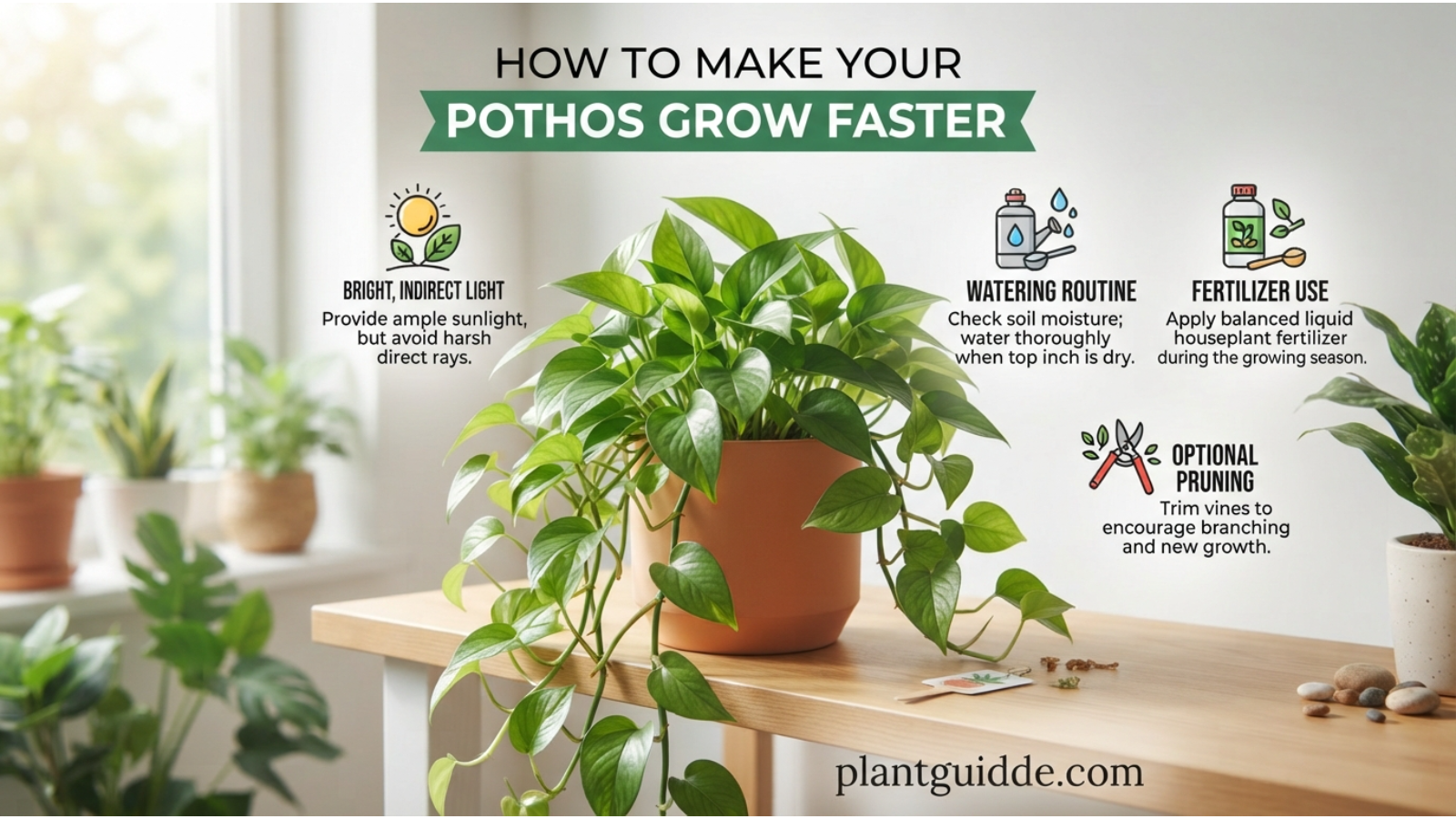
Focus on these five factors:
1. Light
Give the plant enough bright, indirect light.
2. Roots
Make sure the root system has healthy, well-aerated soil.
3. Water
Avoid both prolonged dryness and constantly wet soil.
4. Nutrition
Provide appropriate fertilizer during active growth when needed.
5. Temperature
Keep the plant comfortably warm and away from repeated environmental stress.
If your pothos has plenty of healthy roots but barely grows, light is one of the first things worth reassessing.
Why Are Pothos Leaves Turning Yellow?
Yellow leaves can have several causes, so avoid assuming that every yellow leaf means the same thing.
Common possibilities include:
- Overwatering
- Poor drainage
- Aging leaves
- Insufficient light
- Root stress
- Sudden environmental changes
One older leaf turning yellow occasionally is very different from multiple leaves turning yellow rapidly while the soil remains wet.
A useful diagnostic approach
Ask three questions:
Is the soil staying wet for a long time?
If yes, inspect drainage and watering frequency.
Are several leaves yellowing at once?
If yes, investigate the root environment and recent care changes.
Is the plant otherwise healthy and producing new growth?
If yes, an occasional older leaf may simply be reaching the end of its normal lifespan.
Why Are Pothos Leaves Turning Brown?
Brown leaves or tips can result from several environmental stresses.
Potential causes include:
- Very dry conditions
- Inconsistent watering
- Excessive direct sunlight
- Root problems
- Fertilizer buildup
- Physical damage
Look at where the browning occurs.
Crispy patches on the window-facing side can suggest excessive light. Brown tips combined with very dry soil may point toward moisture stress. Brown, soft tissue associated with persistently wet conditions deserves closer inspection of the roots.
Why Are Pothos Leaves Curling?
Curling is often a response to stress rather than a diagnosis by itself.
Check:
- Soil moisture
- Recent watering history
- Light intensity
- Temperature
- Humidity
- Drafts
- Root health
If the leaves are curling and the soil is extremely dry, watering may be appropriate.
If the leaves are curling while the soil is consistently wet, adding more water is likely to make the situation worse.
Why Is My Pothos Drooping?
Drooping does not always mean underwatering.
Underwatering
The soil is dry and the leaves or stems appear limp.
Response: Water thoroughly and monitor recovery.
Overwatering
The soil remains wet, while the plant may still appear limp or unhealthy.
Response: Stop watering temporarily and investigate drainage and root conditions.
Environmental stress
A sudden change in temperature, light, or location can also cause temporary drooping.
The soil test should therefore come before the watering can.
Why Is My Pothos Not Growing?
Slow growth is often caused by inadequate light.
Other possibilities include:
- Nutrient depletion
- Poor root health
- Cool conditions
- Small root system
- Seasonal slowdown
- Recent stress
If your pothos has long vines with large gaps between leaves, it may be stretching toward available light.
Moving it to a brighter location can help produce more compact growth, although already elongated sections will not magically shorten. Pruning and regrowth are usually needed for a fuller appearance.
Pothos Care by Season
Spring and Summer
Growth is often more active when conditions are favorable.
You may notice:
- Faster vine growth
- More frequent watering needs
- Greater fertilizer demand
- Increased need for pruning or training
Check the soil more frequently rather than automatically increasing watering.
Fall and Winter
Growth often slows indoors.
As light levels decline, the plant may use water more slowly.
This is where a common mistake occurs: continuing a summer watering routine when the plant is no longer growing as actively.
Instead, continue checking the soil and adjust watering according to actual conditions.
Common Pothos Care Mistakes
Mistake 1: Watering on a fixed schedule
Problem: Soil may remain wet longer than expected.
Better approach: Check soil moisture before watering.
Mistake 2: Keeping the plant in a dark corner
Problem: Pothos survives but becomes sparse and grows slowly.
Better approach: Provide brighter indirect light.
Mistake 3: Using a pot without drainage
Problem: Excess water becomes trapped around the roots.
Better approach: Use a container with drainage holes.
Mistake 4: Assuming drooping always means thirst
Problem: An already overwatered plant receives even more water.
Better approach: Check the soil first.
Mistake 5: Fertilizing a struggling plant
Problem: Fertilizer can add stress when the underlying problem is root or environmental damage.
Better approach: Fix the growing conditions before increasing feeding.
Mistake 6: Expecting pruning to hurt the plant
Problem: Owners leave long, bare vines because they are afraid to cut them.
Better approach: Prune strategically and propagate healthy cuttings.
A Simple Pothos Troubleshooting Guide
| Symptom | Likely possibilities | First thing to check |
|---|---|---|
| Yellow leaves | Overwatering, aging foliage, root stress | Soil moisture |
| Brown crispy tips | Dryness, low humidity, salt buildup | Soil + environment |
| Bleached patches | Excessive direct sunlight | Window exposure |
| Long bare vines | Insufficient light, lack of pruning | Light level |
| Drooping in dry soil | Underwatering | Water thoroughly |
| Drooping in wet soil | Root stress | Drainage and roots |
| Slow growth | Low light, cool conditions, root issues | Light first |
| Loss of variegation | Insufficient light or natural variation | Light level |
| Mushy roots | Excess moisture/root decline | Pot and soil drainage |
Image Suggestion: A diagnostic infographic matching common pothos symptoms—yellowing, browning, curling, drooping, and legginess—with their most likely causes.
How to Tell if Your Pothos Is Healthy
A healthy pothos doesn’t need to look perfect.
Look for:
- Firm stems
- Healthy leaves with normal coloration
- Regular production of new growth during active periods
- A functioning root system
- Soil that drains effectively
- No persistent foul odor from the root zone
- Leaves appropriate to the cultivar
For variegated pothos, some variation in leaf pattern is normal. A plant can also have an occasional yellow older leaf without being unhealthy.
Judge the overall trend rather than reacting to one imperfect leaf.
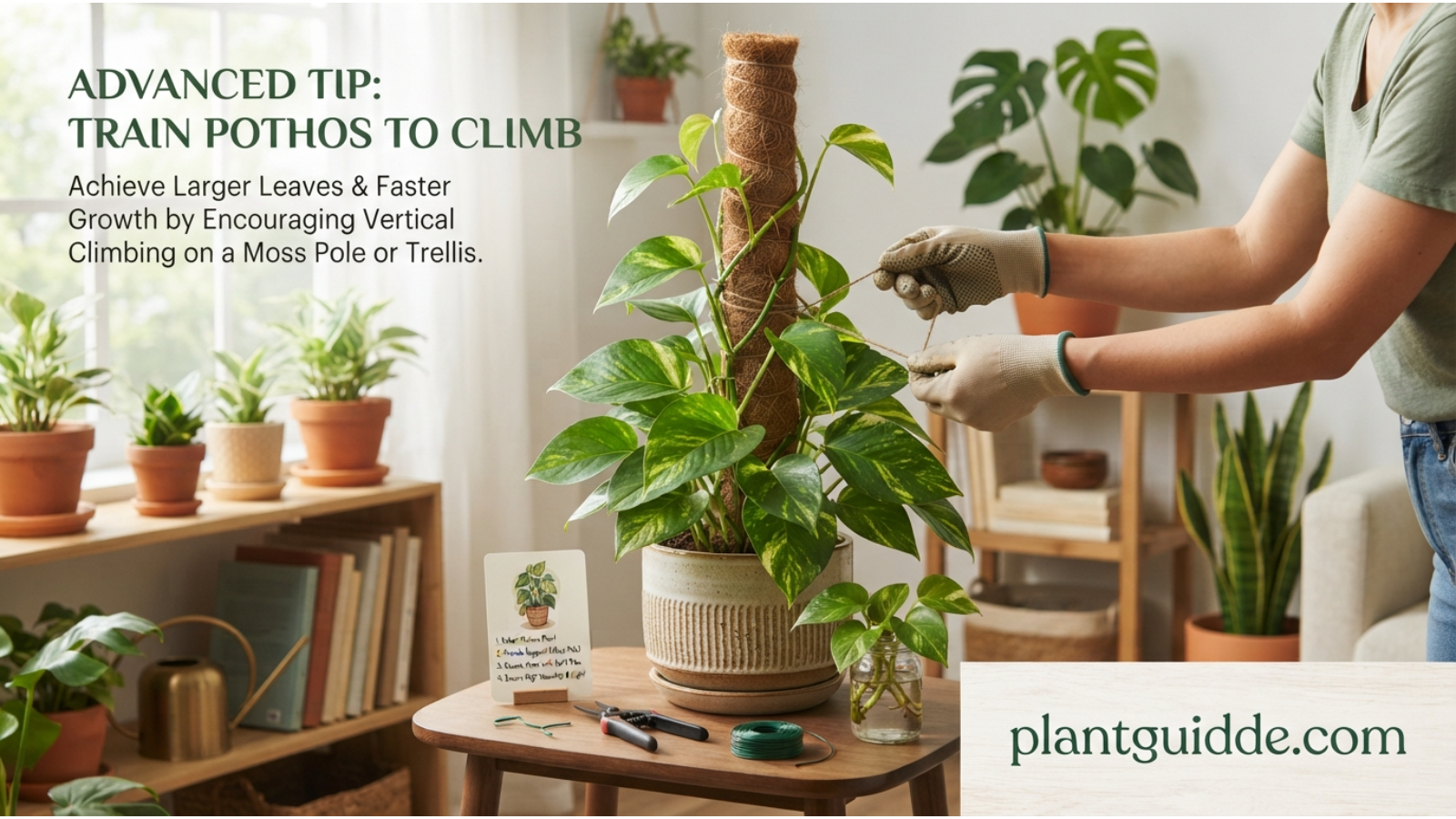
Advanced Tip: Train Pothos to Climb
Pothos is naturally capable of climbing.
If you provide a moss pole, trellis, or another suitable support and guide the vines upward, you can create a very different appearance from a hanging basket.
Climbing also changes how the plant occupies space. Instead of allowing every stem to trail downward, you can use vertical support to build a taller display.
For best results, attach stems gently rather than tightly binding them.
Should You Repot a Pothos?
Repotting is not automatically necessary every year.
Consider repotting when:
- Roots are becoming severely crowded
- Water runs through the pot unusually quickly
- The soil has broken down significantly
- The plant repeatedly dries out much faster than expected
- Roots are emerging extensively from drainage holes
- The existing potting mix has poor structure
If the plant is healthy and the soil still functions well, there is no need to repot simply because a certain amount of time has passed.
Pothos vs. Low-Light Reality
One of pothos’s greatest strengths is its tolerance.
But there is an important distinction:
Low-light tolerance does not mean low-light preference.
A pothos can survive in a darker room, but growth may become slower and less compact. Variegated cultivars may also show less pronounced coloration.
If your priority is simply keeping the plant alive, pothos gives you considerable flexibility.
If your goal is full, vigorous, attractive growth, brighter indirect light is usually the better strategy.
FAQs,
How often should I water a pothos plant?
Water when the upper 1–2 inches of soil have dried rather than following a fixed weekly schedule. The exact interval varies with light, temperature, pot size, soil, and season.
Does pothos need direct sunlight?
No. Bright, indirect light is generally preferable. Gentle morning sunlight may be tolerated, but strong direct afternoon sun can scorch foliage.
Can pothos grow in low light?
Yes. Pothos can tolerate relatively low light, but growth is usually slower and may become more sparse. Variegated varieties can also lose some of their patterning.
Should I mist my pothos?
Misting is not necessary for routine pothos care. If your indoor air is extremely dry, improving overall room humidity is generally more useful than repeatedly misting the leaves.
Why are my pothos leaves turning yellow?
Overwatering and poor drainage are common causes, but yellowing can also result from natural aging, insufficient light, or root stress. Check the soil and look at the pattern of yellowing before changing your care routine.
How do I make my pothos bushier?
Prune long vines near nodes and propagate healthy cuttings back into the pot. Adequate light is also essential for producing stronger, more compact growth.
Can pothos grow in water permanently?
Pothos can grow in water, but water propagation and long-term water culture are not exactly the same thing. A plant grown indefinitely in water needs an appropriate nutrient supply and oxygenated root environment.
How fast does pothos grow?
Growth varies substantially depending on light, temperature, nutrition, cultivar, pot conditions, and season. A healthy plant in favorable conditions can produce new growth regularly, while a plant in low light may grow much more slowly.
Does pothos need fertilizer?
Pothos can benefit from fertilizer during active growth, particularly when nutrients in the growing medium have become depleted. Follow the fertilizer label rather than assuming more fertilizer produces faster growth.
Is pothos toxic to pets?
Yes. Pothos contains insoluble calcium oxalate crystals and can cause irritation if chewed or swallowed. Keep it away from pets and children who may try to eat the foliage.
Final Takeaway
The easiest way to remember how to care for a pothos plant is to stop thinking in terms of a rigid schedule and start paying attention to the plant’s growing conditions.
Give it bright indirect light, well-draining soil, a pot with drainage, thorough watering when the upper soil dries, and a stable indoor environment. Then use the leaves and growth pattern as feedback.
If your pothos is struggling, don’t change everything at once. Check the soil moisture first, then light, drainage, roots, and recent environmental changes. That simple diagnostic approach can prevent many of the common care mistakes that turn an easy houseplant into a frustrating one.

Asad Mumtaz is a dedicated plant enthusiast and gardening writer with a passion for helping people care for their plants successfully. He specializes in plant care guides, indoor gardening, and practical growing tips for all skill levels. His content focuses on making gardening simple, enjoyable, and rewarding. Through his work, Asad shares reliable advice to help readers create thriving green spaces.