Begonia plant care popular because few plant groups offer such a wide combination of colorful flowers, patterned foliage, and interesting growth habits. Some are grown primarily for blooms, while others, such as rex begonias, are prized almost entirely for their leaves.
That variety is also what makes begonia plant care a little more complicated than the label “easy houseplant” suggests. A begonia sitting in wet soil may develop root problems, while one exposed to harsh afternoon sun can develop scorched or faded foliage. Dry indoor air, poor airflow, sudden temperature changes, and inconsistent watering can also show up quickly in the leaves.
The key is not to treat every begonia exactly the same. Start with the plant’s type, then create a growing environment that provides enough light for healthy growth without excessive heat or moisture around the roots.
Quick Answer
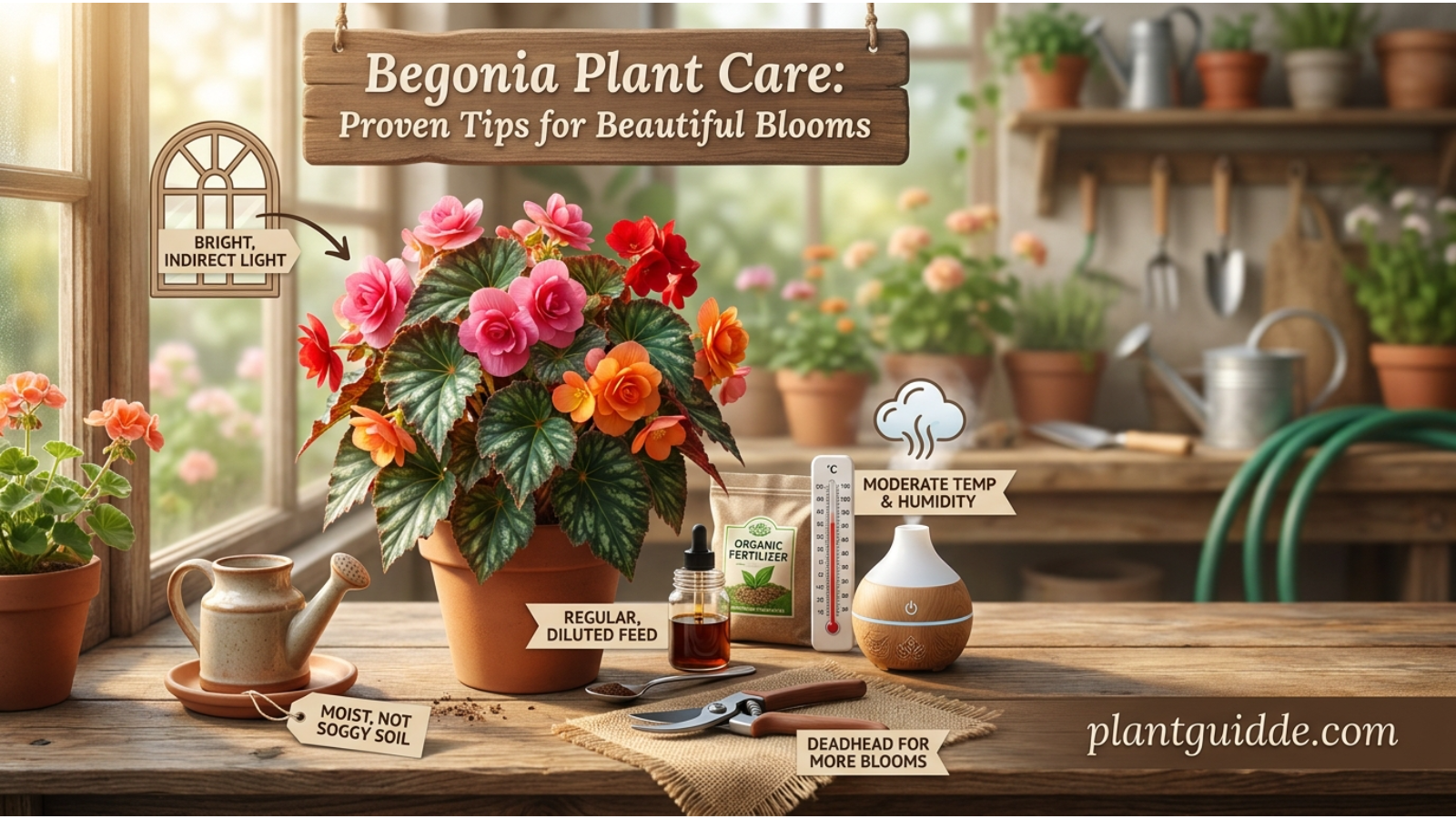
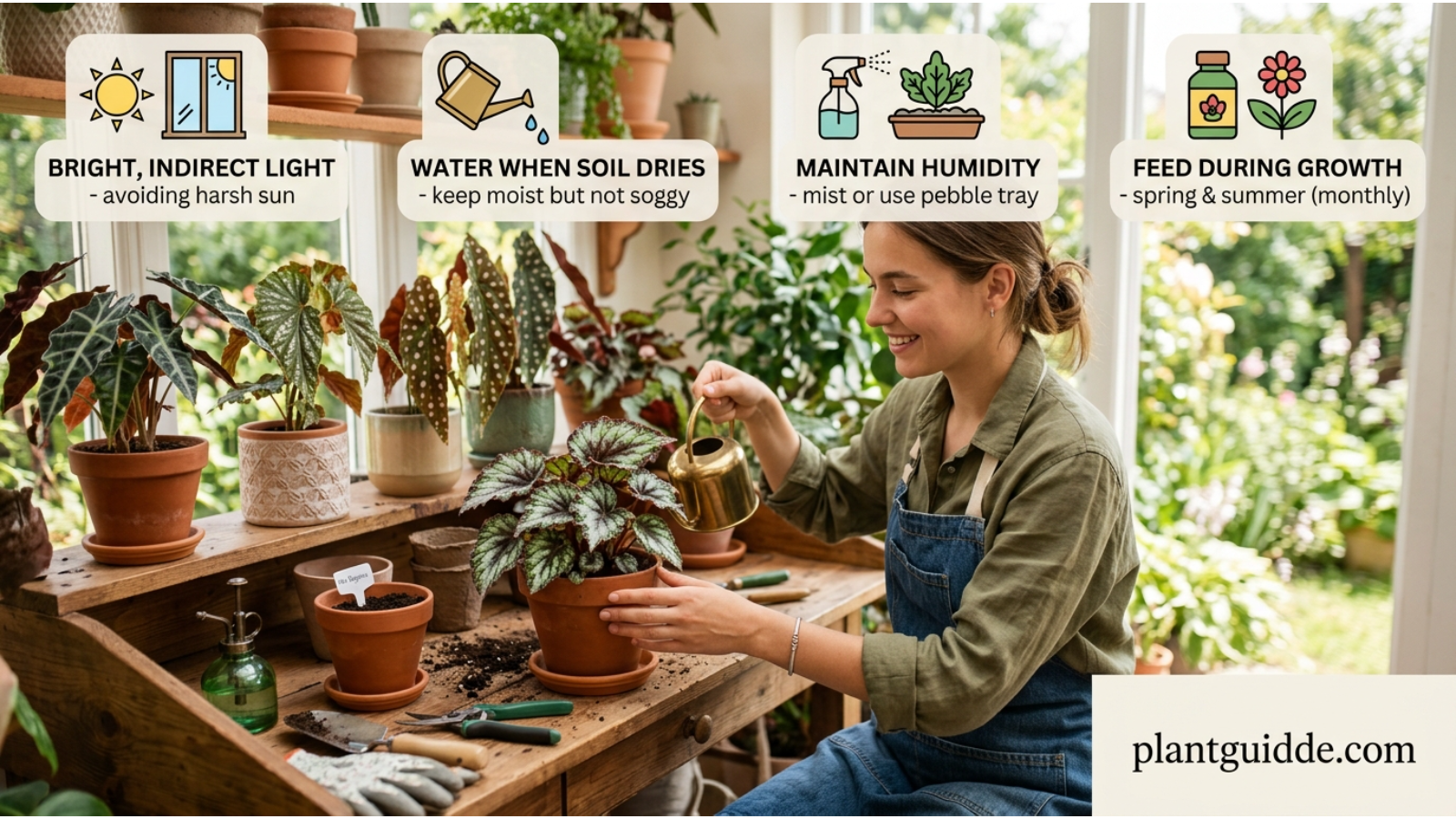
Begonia plant care is mainly about bright indirect light, well-draining soil, moderate watering, good humidity, and protection from temperature extremes. Let the top layer of soil dry slightly before watering, avoid keeping the roots soggy, and provide gentle airflow. Because begonias vary widely, adjust care according to whether you grow a wax begonia, rex begonia, cane begonia, tuberous begonia, or another type.
Understanding Begonias Before You Start
Begonia is a large and diverse genus containing many species and cultivated hybrids. Their care requirements can differ substantially.
For example:
- Rex begonias are primarily grown for decorative foliage and generally prefer bright, indirect light.
- Cane begonias, including angel-wing types, often appreciate brighter conditions and can become tall if light is insufficient.
- Wax begonias are commonly grown for their flowers and can tolerate more direct sunlight than many foliage-focused begonias.
- Tuberous begonias have specialized underground tubers and follow a somewhat different seasonal growth cycle.
- Rhizomatous begonias grow from rhizomes and are often cultivated for unusual foliage.
Begonia Plant Care matters because a care recommendation that works well for a wax begonia outdoors may be excessive for a delicate rex begonia growing beside an indoor window.
Practical tip: Begonia Plant Care you are unsure which begonia you have, identify its variety before making major changes to light, watering, or dormancy care.
Begonia Light Requirements
Light is one of the most important factors in successful begonia plant care.
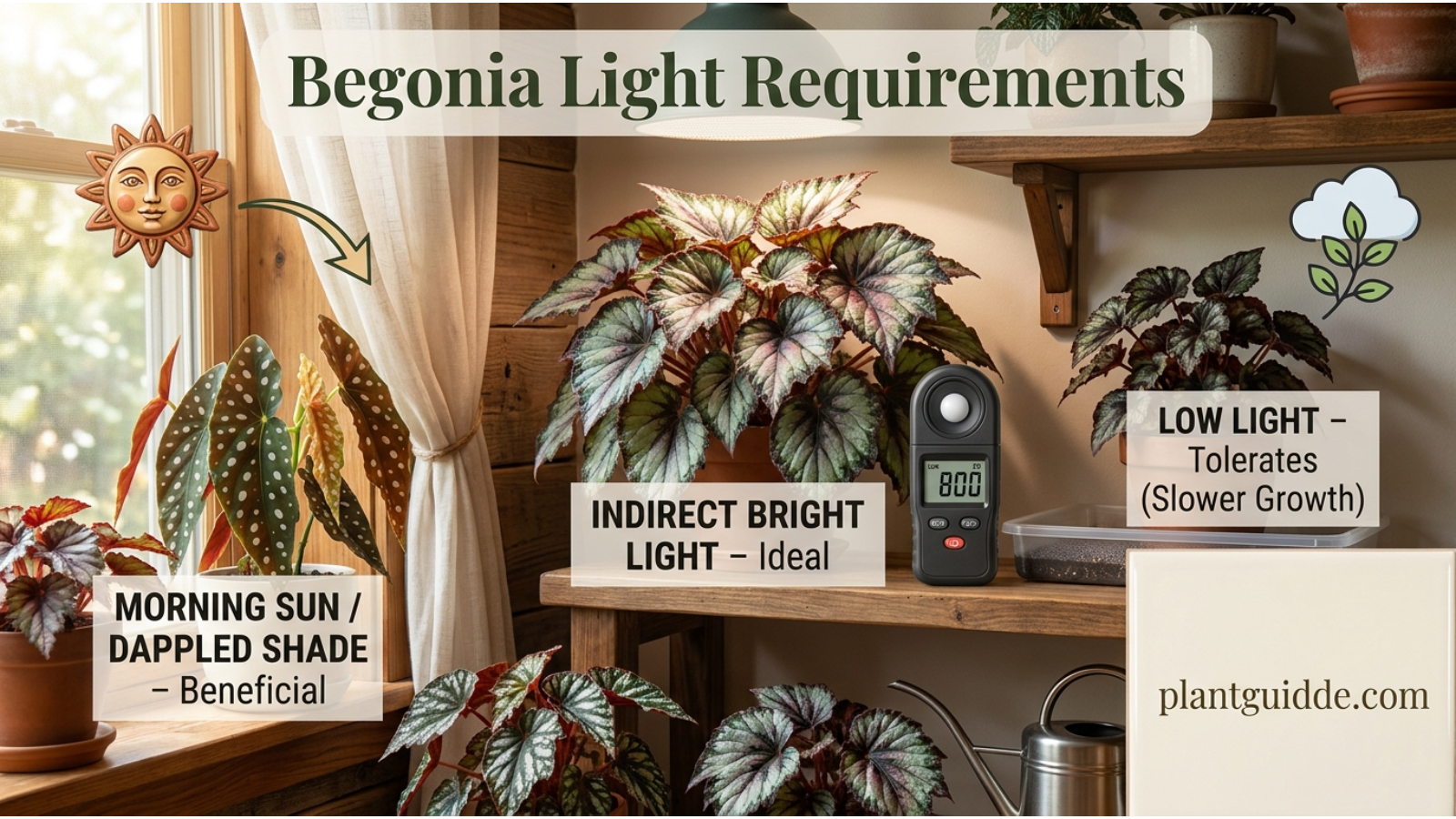
Most indoor begonias perform best in bright, filtered or indirect light. A location near an east- or west-facing window can work well, while a bright north-facing window may suit some varieties depending on your climate and indoor conditions.
Direct sunlight is not automatically harmful. The problem is intense, prolonged sunlight, particularly through hot glass during the strongest part of the day.
Watch the plant rather than relying only on a fixed rule.
Signs Your Begonia Needs More Light
A begonia receiving too little light may show:
- Slow or weak growth
- Long, stretched stems
- Smaller new leaves
- Fewer flowers
- Leaves turning toward the window
Move it gradually toward a brighter position rather than suddenly placing it in strong sun.
Signs of Excessive Light
Too much intense light can cause:
- Bleached-looking foliage
- Brown or crispy patches
- Scorched leaf edges
- Faded leaf coloration
- Wilting despite moist soil
For colorful rex begonias, excessive sunlight can be especially disappointing because it may reduce the intensity of the foliage patterns.
Best approach: Give the plant enough light to maintain compact growth and good color, but filter strong midday or afternoon sun when necessary.
How to Water a Begonia
Begonias generally prefer evenly available moisture but do not like sitting in waterlogged soil.
Instead of watering according to a strict weekly schedule, check the growing medium.
Insert your finger about an inch into the soil. If the upper layer feels slightly dry and the pot is noticeably lighter, it may be time to water. If the soil is still wet several inches down, wait.
When watering:
- Water thoroughly until excess moisture drains from the bottom.
- Allow the pot to drain completely.
- Empty standing water from a saucer or decorative container.
- Check the soil again before the next watering.
The biggest mistake is confusing moist soil with constantly wet soil.
Begonias need oxygen around their roots. Continuously saturated soil reduces air spaces and can encourage root deterioration.
How Often Should You Water a Begonia?
There is no reliable universal schedule because watering frequency depends on:
- Pot size
- Soil composition
- Plant size
- Temperature
- Humidity
- Light intensity
- Season
- Type of begonia
Begonia Plant Care in a small pot beside a warm, bright window may dry much faster than the same plant in a large plastic pot in a cool room.
Use the condition of the soil and plant as your guide rather than watering every Sunday simply because the calendar says so.
Choosing Soil for Begonias
Begonia Plant Care soil should hold enough moisture to prevent rapid drying while allowing excess water to escape.
A useful mix is one that contains components such as:
- Quality potting mix
- Perlite or another aerating material
- Fine bark or another structure-improving ingredient when appropriate
The exact recipe is less important than the final texture.
When you squeeze lightly hydrated soil, it should not remain a dense, muddy mass. Water should also be able to move through the container rather than pooling at the surface.
Why Heavy Soil Causes Problems
Dense garden soil or poorly aerated potting mix can stay wet for too long.
That can lead to:
- Poor root oxygenation
- Slow growth
- Yellowing leaves
- Persistent wet soil
- Root decline
For container-grown begonias, drainage and aeration are usually more important than chasing a perfect soil recipe.
Choosing the Right Begonia Pot
The container should have drainage holes.
This sounds obvious, but decorative pots without drainage are a common source of begonia problems. Even excellent soil cannot compensate for a container that traps excess water.
Choose a pot that is only moderately larger than the existing root system. Moving a small begonia into a huge container increases the amount of soil surrounding the roots and can make the mix stay wet for longer.
Terracotta vs. Plastic Pots
Both can work.
Terracotta:
- Dries more quickly
- Provides some additional evaporation through the pot walls
- Can be useful for growers who tend to overwater
Plastic:
- Retains moisture longer
- Often works well in dry indoor environments
- Requires closer attention to watering because the soil may remain moist longer
Choose based on your growing environment and watering habits rather than assuming one material is universally better.
Begonia Humidity Requirements
Many begonias appreciate moderate to higher humidity, particularly when grown indoors in heated or air-conditioned rooms.
However, increasing humidity does not mean keeping the foliage constantly wet.
A better strategy is to improve the surrounding environment:
- Group compatible plants together.
- Use a humidifier when indoor air is consistently dry.
- Keep plants away from strong heating or cooling vents.
- Maintain gentle air circulation.
- Avoid trapping wet foliage in stagnant air.
Misting is often overemphasized in houseplant care. A quick mist may temporarily wet the leaves, but it is not a dependable substitute for maintaining suitable ambient humidity.
Important: High humidity combined with stagnant air and constantly wet leaves can create its own problems. Humidity and airflow should be considered together.
Temperature and Airflow
Begonias generally prefer stable indoor conditions rather than sudden temperature swings.
Keep them away from:
- Cold drafts
- Exterior doors during cold weather
- Heating vents
- Strong air-conditioning streams
- Extremely hot windows
- Sudden changes between very warm and cold conditions
Gentle airflow is beneficial because it helps prevent the area immediately around the leaves from remaining stagnant.
You do not need a fan blowing directly at the plant all day. A mild circulation of air through the room is usually enough.
Fertilizing Begonias
During active growth, begonias can benefit from regular feeding.
Use a balanced, water-soluble fertilizer according to the manufacturer’s directions. Avoid assuming that more fertilizer produces faster or healthier growth.
Excess fertilizer can contribute to salt buildup and leaf-edge damage, especially when the plant is already stressed.
A sensible approach is to:
- Fertilize during active growth.
- Follow the product’s recommended dilution.
- Avoid feeding a severely stressed or recently repotted plant immediately.
- Reduce or pause feeding when growth naturally slows.
The goal is consistent nutrition, not maximum fertilizer exposure.
Pruning and Grooming Begonias
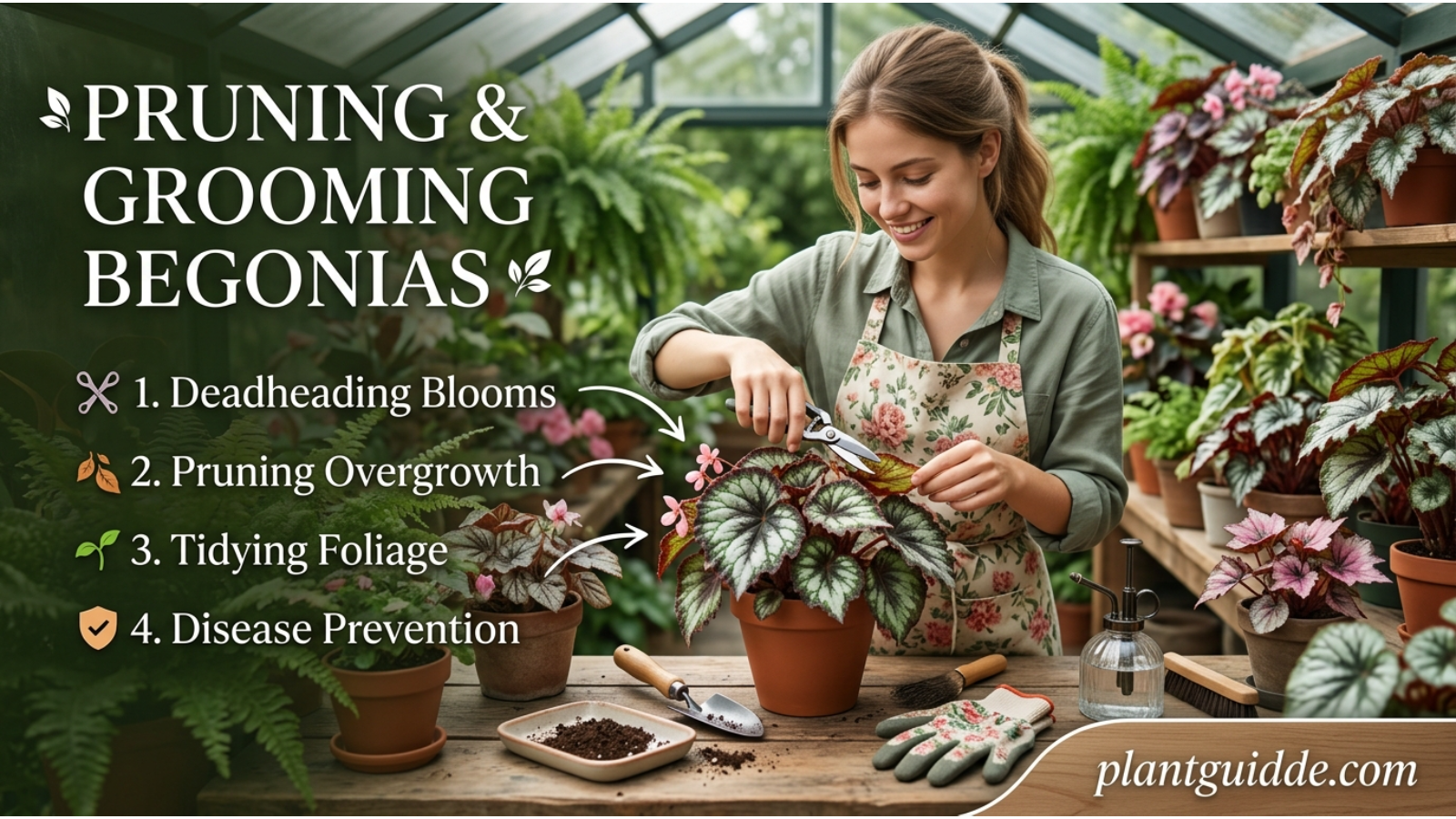
Regular grooming can improve appearance and encourage healthier growth.
Remove:
- Completely dead leaves
- Severely damaged foliage
- Spent flowers
- Weak or unwanted stems
Use clean, sharp scissors or pruning shears.
For cane begonias, pruning can also help prevent the plant from becoming excessively tall and sparse. Cutting above a suitable node can encourage branching, depending on the variety.
Avoid removing large amounts of healthy foliage simply to make the plant look smaller. Leaves are the plant’s energy-producing surfaces, so unnecessary pruning can slow recovery and growth.
Repotting Begonias
A begonia does not necessarily need repotting every year.
Repot when there is a genuine reason, such as:
- Roots filling the container
- Soil breaking down or becoming poorly draining
- Water running straight through because the root mass has become highly compacted
- Persistent problems caused by unsuitable soil
- The plant becoming unstable in its container
When repotting, move up only modestly in container size.
After repotting, place the begonia back into suitable light and avoid immediately compensating with excessive watering or fertilizer.
How to Propagate Begonias
Many begonias can be propagated through cuttings, although the best method depends on the type.
Stem Cuttings
For suitable cane and stem-forming begonias:
- Select a healthy stem.
- Take a cutting containing an appropriate node.
- Remove unnecessary lower foliage.
- Place it in a suitable propagation medium.
- Keep the medium lightly moist rather than saturated.
- Provide bright, indirect light.
- Maintain warmth and moderate humidity.
Leaf Propagation
Some foliage begonias, particularly certain rex and rhizomatous types, can be propagated from leaves or leaf sections.
The technique varies by variety, so identifying the begonia first is useful.
Image Suggestion: A step-by-step close-up showing a begonia stem cutting, node placement, propagation medium, and developing roots.
Begonia Care by Type
Because “begonia” covers many different plants, the following comparison can help you avoid applying the wrong care routine.
| Begonia type | Main attraction | Typical light preference | Main care concern |
|---|---|---|---|
| Rex begonia | Colorful patterned foliage | Bright indirect light | Excess moisture and harsh sun |
| Cane begonia | Upright stems and attractive leaves | Bright filtered light | Leggy growth and overwatering |
| Wax begonia | Flowers and compact growth | Bright light; some varieties tolerate sun | Heat and moisture balance |
| Tuberous begonia | Large showy flowers | Bright filtered conditions | Seasonal dormancy and watering |
| Rhizomatous begonia | Distinctive foliage | Bright indirect light | Wet soil and poor airflow |
Treat this as a starting point rather than a rigid formula because hybrids can behave differently.
Common Begonia Problems and What They Mean
Begonia problems are often symptoms of environmental stress rather than a single isolated disease.
Yellow Begonia Leaves
Yellow leaves can result from several causes.
Check:
- Is the soil staying wet for too long?
- Is the plant receiving enough light?
- Is an older leaf naturally reaching the end of its life?
- Has the watering routine recently changed?
If several leaves are turning yellow while the soil remains persistently wet, investigate the root environment first.
Brown Leaf Edges
Brown edges are commonly associated with environmental stress, but they do not point to one single cause.
Possible contributors include:
- Very dry air
- Inconsistent watering
- Excessive fertilizer salts
- Intense sunlight
- Root damage
Look at the entire growing environment rather than treating the brown edge alone.
Begonia Leaves Curling
Curling leaves may indicate:
- Excessive heat
- Water stress
- Very dry conditions
- Root problems
- Strong direct sunlight
- Pest activity
Check the underside of leaves for insects and inspect the soil before simply watering more.
Begonia Drooping
Drooping can happen when the plant needs water, but watering immediately is not always the correct solution.
If the soil is dry, watering may solve the problem.
If the soil is already saturated, additional water can make the underlying problem worse. In that situation, inspect drainage and the roots instead.
Leggy Begonia Growth
Long spaces between leaves usually indicate that the plant is not receiving enough usable light.
Move it gradually to a brighter location and prune excessively stretched growth if appropriate for the variety.
Begonia Losing Leaves
Sudden leaf drop can follow environmental changes such as:
- Moving the plant
- Temperature fluctuations
- Watering problems
- Low light
- Root stress
- Pest infestation
Consider what changed in the plant’s environment during the previous few weeks. That timeline often provides more useful information than the appearance of one leaf.
Pests to Watch For
Indoor begonias can occasionally attract pests such as:
- Spider mites
- Aphids
- Mealybugs
- Thrips
- Whiteflies
Inspect new growth and the undersides of leaves regularly.
Early detection makes management much easier. If you notice sticky residue, distorted new growth, fine webbing, tiny insects, or unusual stippling, isolate the affected plant from other houseplants and identify the pest before choosing a treatment.
Common Begonia Care Mistakes
Some of the most avoidable problems come from well-intentioned care.
Watering on a Fixed Schedule
A calendar cannot account for changes in temperature, sunlight, pot size, and humidity.
Better: Check the soil before watering.
Keeping the Soil Permanently Wet
Begonias need moisture, not saturated roots.
Better: Use an airy potting mix and allow appropriate drying between waterings.
Putting Every Begonia in Full Sun
Some begonias tolerate considerable light, but many foliage varieties can scorch under intense direct sunlight.
Better: Match light intensity to the variety.
Misting Instead of Fixing Dry Air
Misting is temporary and does not reliably maintain ambient humidity.
Better: Improve room humidity when genuinely necessary.
Using an Oversized Pot
More soil does not automatically mean more room for healthy growth.
Better: Increase pot size gradually as the root system develops.
Ignoring Airflow
Warm, humid, stagnant conditions can create an unfavorable environment around foliage.
Better: Provide gentle circulation without exposing the plant to harsh drafts.
A Simple Begonia Care Routine
If you want a straightforward routine, use this checklist.
Every few days:
Look at the leaves and check for pests, sudden wilting, or unusual discoloration.
Before watering:
Check the moisture level of the soil rather than following a fixed calendar.
During active growth:
Provide suitable light and fertilize according to the needs of your variety and fertilizer label.
Every few weeks:
Rotate the pot if growth is leaning toward the light and remove dead foliage.
Every few months:
Check whether the soil structure, roots, pot size, and location are still appropriate.
This approach is more reliable than constantly changing the plant’s conditions in response to every small change in a leaf.
FAQs:
How often should I water a begonia?
Water when the appropriate upper layer of soil has dried slightly, then water thoroughly and let excess water drain. Frequency varies with the plant, pot, soil, temperature, and light.
Do begonias need direct sunlight?
Some begonias tolerate or even benefit from some direct sun, but many indoor foliage varieties prefer bright indirect or filtered light. Protect sensitive foliage from intense midday and afternoon sun.
Why are my begonia leaves turning yellow?
Yellow leaves may result from overwatering, poor drainage, insufficient light, root stress, or natural aging. Check the soil moisture and growing conditions before changing your watering routine.
Can begonias grow indoors?
Yes. Many begonias grow well indoors when they receive adequate bright, indirect light, appropriate moisture, moderate humidity, good drainage, and stable temperatures.
Why are my begonia leaves turning brown?
Brown leaves or edges can be caused by dry conditions, inconsistent watering, intense sunlight, fertilizer buildup, or root problems. Examine the whole growing environment rather than assuming one cause.
Conclusion
Successful begonia plant care comes down to understanding the particular begonia you are growing and keeping its environment consistent. Give it appropriate light, use an airy well-draining growing medium, water according to soil moisture rather than a rigid schedule, and provide reasonable humidity with gentle airflow.
When problems appear, resist the urge to make several changes at once. Check the soil, roots, light, temperature, and leaves systematically. That simple diagnostic habit can prevent a minor watering or lighting issue from becoming a much larger plant-health problem.

Asad Mumtaz is a dedicated plant enthusiast and gardening writer with a passion for helping people care for their plants successfully. He specializes in plant care guides, indoor gardening, and practical growing tips for all skill levels. His content focuses on making gardening simple, enjoyable, and rewarding. Through his work, Asad shares reliable advice to help readers create thriving green spaces.