
Arabica coffee plant care (Coffea arabica) is an attractive tropical evergreen that brings glossy green leaves and a lush appearance to indoor spaces. With the right conditions, a mature plant can produce fragrant white flowers followed by small fruits commonly called coffee cherries.
Although Arabica coffee is grown commercially for its beans, it can also make a rewarding houseplant. The challenge is that its tropical growing preferences differ from those of drought-tolerant indoor plants. Extended dryness, harsh sunlight, cold drafts, and waterlogged roots can all cause problems.
Successful Arabica coffee plant care starts with understanding how to recreate its preferred environment at home. Arabica coffee plant care you have a young nursery plant or are growing coffee from seed, this guide explains the right lighting, watering, soil, humidity, fertilizing, pruning, repotting, and troubleshooting techniques.
Quick Answer
Arabica coffee plant care involves providing bright, indirect light, warm temperatures, consistent soil moisture, and a well-draining, slightly acidic potting mix. Coffea arabica grows best in humid conditions with protection from harsh direct sunlight. Water when the top layer of soil begins to dry, maintain good drainage, and feed lightly during active growth to encourage healthy foliage and steady development.
Understanding the Arabica Coffee Plant
Arabica coffee belongs to the Rubiaceae family and is native to the highland regions of Ethiopia. It is cultivated throughout suitable tropical and subtropical regions and is widely known for producing coffee beans used in brewed coffee.
As a houseplant, it typically develops upright stems, glossy oval leaves, and a bushy shape when pruned appropriately. Mature plants may flower and develop fruit if their growing conditions are suitable, although indoor flowering and fruit production are not guaranteed.
Here are a few characteristics to understand before growing one:
- Evergreen foliage: The plant can retain its leaves throughout the year when conditions remain favorable.
- Moisture preferences: It prefers evenly moist soil but does not tolerate prolonged waterlogging.
- Humidity needs: It generally performs better in moderate to high humidity than in very dry indoor air.
- Light sensitivity: Bright, filtered light supports growth, while intense direct sun may scorch the leaves.
- Slow development indoors: Growth and fruit production depend heavily on light, temperature, plant maturity, and overall care.
Understanding these traits helps you avoid treating an Arabica coffee plant like a succulent or another houseplant that prefers its soil to dry completely.

Best Growing Conditions for Arabica Coffee Plant Care
The following conditions provide a practical starting point for growing Arabica coffee indoors.
| Care factor | Recommended conditions | What to avoid |
|---|---|---|
| Light | Bright, indirect light | Strong, prolonged afternoon sun |
| Temperature | Approximately 65–80°F (18–27°C) | Frost, cold drafts, and sudden temperature changes |
| Water | Evenly moist soil with some surface drying | Waterlogged soil or prolonged dryness |
| Soil pH | Slightly acidic, approximately 5.5–6.5 | Highly alkaline or poorly draining soil |
| Humidity | Moderate to high humidity, ideally around 50–70% when practical | Very dry air combined with heat and drafts |
| Fertilizer | Balanced fertilizer during active growth | Excessive feeding or concentrated fertilizer |
| Pot | Container with drainage holes | Standing water around the roots |
These are general growing targets rather than rigid requirements. Your home’s light, temperature, and humidity will influence how quickly the soil dries and how actively the plant grows.
How Much Light Does an Arabica Coffee Plant Need?
Light is essential for healthy foliage and steady growth. Arabica coffee naturally grows in environments where developing plants often receive filtered light from surrounding vegetation. Indoors, bright, indirect light is usually the safest choice.
Best indoor location
Place the plant near an east-facing window or near a bright south- or west-facing window where a sheer curtain filters intense sunlight.
A spot with several hours of bright, indirect light generally works better than a dim corner. If natural light is limited, a suitable full-spectrum grow light can help support healthy growth.
Keep the plant away from glass that becomes extremely hot in direct afternoon sunlight. Leaves that have adapted to indoor conditions can develop pale, dry, or brown patches when suddenly exposed to intense rays.
Can Arabica coffee grow in low light?
It may survive in lower light, but growth usually slows. The plant may produce fewer new leaves, develop a thinner shape, or become more vulnerable to stress when other conditions are also unsuitable.
If the plant is near a window but continues producing weak growth, gradually move it to a brighter location. Avoid making a sudden change from deep shade to strong direct sunlight.
Signs of light problems
- Brown, scorched patches: Excessive direct sunlight may be responsible.
- Slow growth: The plant may need brighter light, although root or nutrient problems can also contribute.
- Pale foliage: Check light exposure, watering, and nutrient availability.
- Uneven growth: The plant may be receiving light mainly from one direction.
Rotate the pot occasionally to encourage balanced growth, but do not move it constantly between very different environments.
How Often Should You Water an Arabica Coffee Plant?
Arabica coffee prefers consistently moist soil, but its roots still need oxygen. The aim is to prevent the root ball from becoming completely dry for extended periods without leaving it saturated.
A fixed watering schedule is unreliable because a plant in a warm, bright room loses moisture faster than one in a cool, dim location.
Step-by-step watering method
- Check the soil: Feel the top inch of the potting mix. Water when the surface begins to dry while the deeper root zone remains slightly moist.
- Water thoroughly: Apply water evenly across the soil until it flows from the drainage holes.
- Let excess water escape: Empty the saucer or decorative outer pot after watering.
- Check moisture again: Wait until the upper layer begins to dry before watering again.
- Adjust seasonally: Reduce watering when growth slows and the soil dries more slowly, but do not allow the root ball to remain dry for long periods.
If your plant is growing in a warm room with low humidity, check the soil more frequently. In cooler conditions or during slower winter growth, watering may be needed less often.
Signs of overwatering
Excess moisture can reduce oxygen around the roots and encourage root rot. Common warning signs include:
- Yellowing leaves that continue to drop
- Soil that stays wet for unusually long periods
- Soft or dark roots
- An unpleasant smell from the potting mix
- General decline despite frequent watering
If you suspect root rot, remove the plant carefully from its pot and inspect the roots. Trim any soft, decaying sections with clean tools, then repot in fresh, airy soil and a container with drainage holes.
Signs of underwatering
An underwatered Arabica coffee plant may develop drooping leaves, dry leaf edges, or a dry root ball. If the soil is dry well below the surface, water thoroughly and allow excess water to drain.
Do not assume every drooping plant needs more water. Root rot can also cause wilting because damaged roots cannot absorb moisture effectively. Check the soil before deciding what to do.
Best Soil for Arabica Coffee Plants
Arabica coffee grows best in a moisture-retentive but well-aerated potting mix. It needs enough moisture to support its foliage without allowing water to collect around the roots.
A practical starting mix includes:
- Two parts quality indoor potting mix
- One part perlite or pumice
- A small amount of fine, composted organic material if the base mix drains too quickly
Choose materials that create a loose structure rather than a dense, muddy mixture. The ideal blend holds some water but allows excess moisture to drain freely.
Why soil acidity matters
Arabica coffee generally prefers slightly acidic soil, with a pH around 5.5–6.5. Soil that is too alkaline can make certain nutrients less available, potentially contributing to pale foliage or poor growth.
If your plant repeatedly develops unexplained yellowing despite suitable watering and light, consider checking soil pH and water quality before adding fertilizer.
Avoid attempting to lower soil pH with unmeasured household remedies. Use a potting mix suitable for acid-loving plants or an appropriate soil amendment when needed.
Choose the right pot
Select a pot with drainage holes that fits the root system comfortably. A container that is much larger than necessary can hold excess moisture around a relatively small root ball.
Terracotta pots allow moisture to evaporate through their walls, while plastic containers retain it longer. Either can work if you adjust watering to the material and growing conditions.
Ideal Temperature and Humidity
Arabica coffee is a tropical plant that generally grows well in warm, stable indoor conditions.
A temperature range of approximately 65–80°F (18–27°C) is suitable for many indoor plants. Protect it from frost, cold drafts, and sudden temperature changes. Avoid placing it directly beside an air conditioner or next to a cold window during winter.
How much humidity does it need?
Moderate to high humidity supports healthy foliage. A relative humidity of around 50–70% is a useful target when practical, although established plants can sometimes adapt to ordinary household conditions.
If the air is very dry, you may notice brown leaf edges or increased pest problems, particularly spider mites.
To improve humidity:
- Use a room humidifier when the air is consistently dry.
- Group plants together while maintaining enough airflow.
- Keep the plant away from heating vents.
- Monitor humidity with a small digital hygrometer if problems persist.
Misting the leaves is not a reliable long-term humidity solution because the effect is brief. Avoid leaving foliage constantly wet, particularly when airflow is poor.
How to Fertilize an Arabica Coffee Plant
Coffee plants need nutrients to support new leaves, root development, and overall growth. However, excess fertilizer can damage roots and cause salt accumulation.
During active growth in spring and summer, use a balanced liquid houseplant fertilizer according to the label. Depending on the product’s concentration and the plant’s growth rate, feeding every four to six weeks may be sufficient.
Follow these practices:
- Apply fertilizer at the recommended dilution.
- Avoid fertilizing a plant with severely dry soil or damaged roots.
- Reduce or stop feeding when growth slows during winter.
- Flush accumulated fertilizer salts from the potting mix occasionally if drainage is good.
- Avoid combining multiple fertilizers unless their nutrient contributions are understood.
What if the leaves turn yellow?
Yellow leaves do not automatically mean that the plant needs fertilizer. Overwatering, poor drainage, unsuitable soil pH, insufficient light, and nutrient deficiencies can produce similar symptoms.
Look for patterns. Yellowing that begins on older leaves may have different causes from yellowing on newly emerging foliage. Check the soil moisture, root health, light, and fertilizer history before deciding whether to add nutrients.

How to Prune an Arabica Coffee Plant
Pruning helps maintain a manageable shape, removes damaged growth, and can encourage branching. It is not necessary to prune a healthy coffee plant heavily just to keep it alive.
Use clean, sharp pruning shears and remove dead, diseased, or damaged branches first. If the plant has become too tall or sparse, shorten selected stems just above a healthy node to encourage branching.
For a young plant, light pruning is usually preferable to removing large amounts of foliage. Leaves are essential for photosynthesis, so excessive pruning can slow growth.
Inspect the plant before pruning and avoid removing healthy branches simply because they are growing naturally outward. Arabica coffee can develop an attractive, bushy form with adequate light and modest maintenance.
How to Repot an Arabica Coffee Plant
Repot when roots begin emerging from the drainage holes, the root ball becomes crowded, or the soil structure breaks down and no longer drains appropriately.
Spring is often a convenient time to repot because growth is beginning to increase.
Repotting steps
- Choose a pot one size larger than the current container.
- Gently remove the plant and inspect the roots.
- Loosen only the tightly packed outer roots; avoid unnecessary root damage.
- Remove any soft, decaying roots using clean tools.
- Add fresh, well-draining, slightly acidic potting mix.
- Position the plant at its original soil depth.
- Water appropriately and allow excess water to drain.
After repotting, keep the plant in bright, indirect light and avoid immediate heavy fertilizing. Give damaged roots time to recover before resuming a regular feeding routine.
How to Grow Arabica Coffee From Seed
Growing coffee from seed can be rewarding, but it requires patience. Coffee seeds lose viability as they dry and age, so fresh, viable seed is much more suitable than old roasted coffee beans or ordinary grocery-store coffee.
Basic seed-starting steps
- Obtain fresh, viable Arabica coffee seeds from a reliable plant or seed supplier.
- Prepare a clean, lightly moist, well-draining seed-starting medium.
- Sow the seeds according to the supplier’s guidance, using suitable depth and orientation.
- Keep the medium warm and evenly moist without waterlogging it.
- Provide bright, indirect light as seedlings develop.
- Transplant seedlings carefully once they are sufficiently established.
Germination can be slow and uneven, sometimes taking several weeks or longer depending on seed freshness and conditions.
Do not use roasted coffee beans for planting. Roasting destroys the seed’s ability to germinate.
Can an Indoor Arabica Coffee Plant Produce Coffee Beans?
Yes, an Arabica coffee plant can flower and produce fruit indoors, but it needs to reach sufficient maturity and receive suitable growing conditions. A young nursery plant may take several years to become capable of flowering.
Mature plants produce fragrant white flowers that can develop into green fruits and eventually red or red-purple coffee cherries. Each cherry commonly contains two seeds, which are processed as coffee beans.
Fruit production indoors depends on adequate light, temperature, humidity, nutrition, and plant maturity. Some plants remain healthy foliage specimens for years without producing flowers.
Arabica coffee plant care you want to encourage flowering, prioritize strong indirect light, stable warmth, suitable nutrition, and healthy root growth. Avoid overfertilizing in an attempt to force flowering.
Growing cherries does not automatically mean you will produce a worthwhile coffee harvest. Fruit development and seed processing require additional time and care.
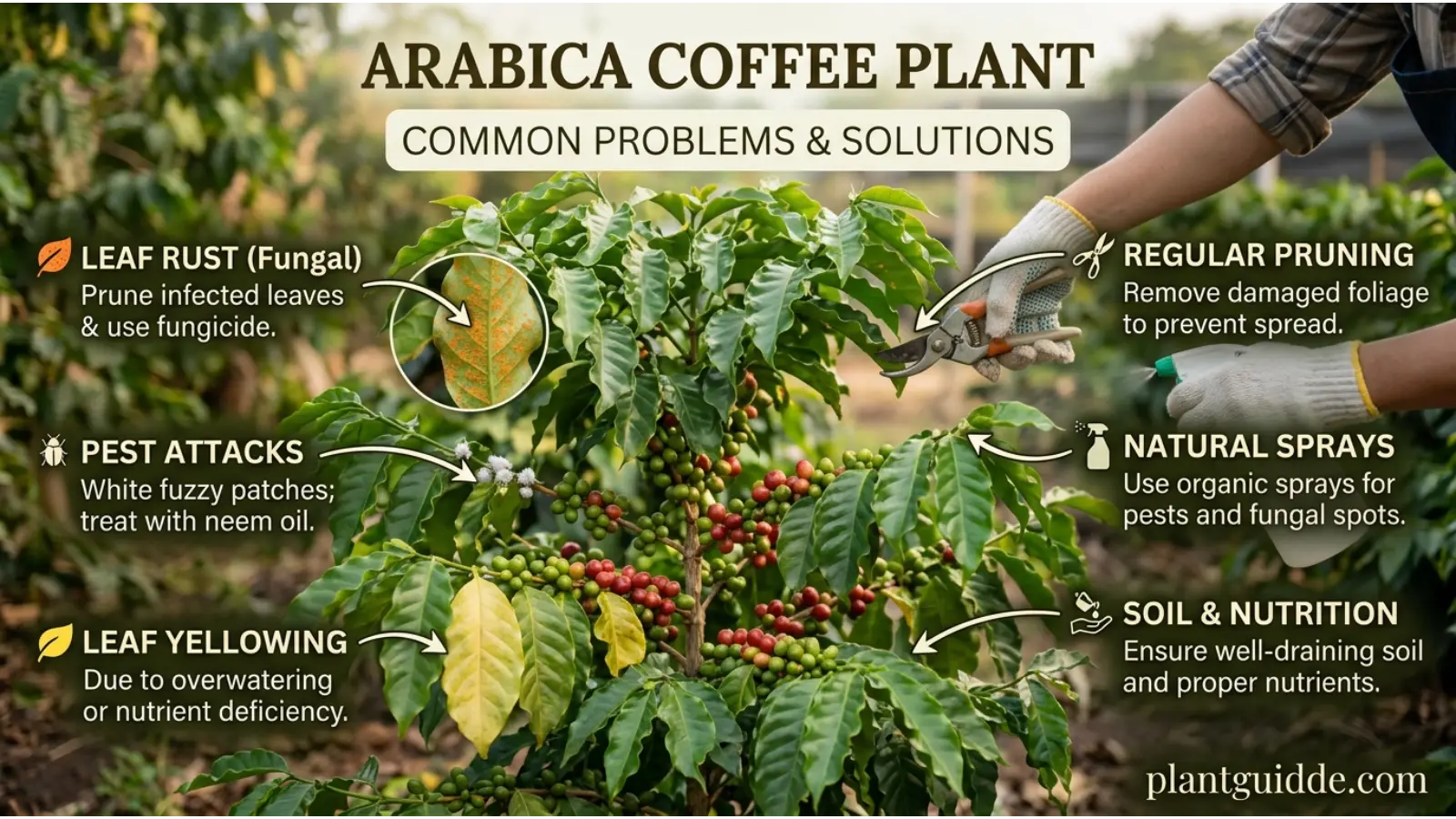
Common Arabica Coffee Plant Problems and Solutions
Changes in foliage often provide early clues about the plant’s growing conditions. Inspect both sides of the leaves, the stems, the soil, and the roots before choosing a treatment.
| Problem | Possible cause | What to do |
|---|---|---|
| Yellow leaves | Overwatering, nutrient issues, or unsuitable soil pH | Check soil moisture, roots, and growing conditions |
| Brown leaf tips | Dry air, inconsistent moisture, or fertilizer salts | Review humidity, watering, and feeding |
| Drooping leaves | Underwatering, root rot, or temperature stress | Check soil and roots before watering |
| Brown or scorched patches | Strong direct sunlight | Move to bright, indirect light |
| Slow growth | Insufficient light, low temperatures, or root problems | Improve conditions and inspect the root system |
| Leaf drop | Sudden environmental changes, cold, or watering stress | Stabilize the environment and correct moisture issues |
| Fine webbing or tiny specks | Possible spider mites | Isolate the plant and inspect leaf undersides |
| Persistent yellowing despite proper care | Potential nutrient deficiency or unsuitable pH | Check soil pH and fertilizer history |
Why are the leaves turning brown?
Brown leaf tips may result from low humidity, inconsistent watering, or salt buildup. Larger dry patches may indicate sun scorch or physical damage.
Look at where the damage appears and how it develops. If the brown areas occur mainly on the side facing a sunny window, excessive direct light may be responsible. If the tips become dry throughout the plant, review humidity, root health, and fertilizer use.
Trim damaged portions if desired, but avoid cutting healthy tissue unnecessarily. Correcting the underlying cause is more important than removing the visible damage.
Why is my coffee plant dropping leaves?
Leaf drop can follow sudden changes in temperature, lighting, watering, or location. A plant moved from a humid greenhouse to a dry home may need time to adjust.
Keep conditions as stable as possible. Check the soil before watering, protect the plant from drafts, and avoid repeatedly moving it between different environments.
How do you manage pests?
Arabica coffee can attract spider mites, mealybugs, and scale insects, particularly when growing conditions are stressful.
Inspect the undersides of leaves and the joints where leaves meet stems. Isolate an infested plant, remove visible pests where practical, and use a houseplant-labeled insecticidal soap or other appropriate treatment according to its instructions. Test sensitive foliage first.
Repeat inspections because some pests or their eggs may survive the initial treatment. Improving plant health can reduce stress, but it does not replace direct pest control.
Is the Arabica Coffee Plant Safe for Pets?
The ripe coffee fruit and seeds contain caffeine, and coffee plants should not be treated as pet-safe plants. Caffeine can be toxic to cats and dogs, with the level of risk depending on the material consumed and the amount.
Keep the plant, its fallen fruits, and any processed seeds out of reach of pets. If an animal chews the plant or consumes coffee cherries or seeds, contact a veterinarian or animal poison service for advice, especially if symptoms appear.
FAQs:
How often should I water an Arabica coffee plant?
Water when the top inch of soil begins to dry while the deeper root zone remains slightly moist. Water thoroughly and let excess moisture drain. The interval varies with light, temperature, humidity, pot size, and season, so checking the soil is more reliable than following a fixed schedule.
Can I grow an Arabica coffee plant indoors year-round?
Yes. Arabica coffee can grow indoors throughout the year if it receives sufficient bright, indirect light, warm temperatures, suitable humidity, and proper watering. Growth may slow during winter when daylight decreases.
Why is my Arabica coffee plant losing leaves?
Leaf drop can result from overwatering, underwatering, cold drafts, sudden changes in light, or other environmental stress. Check the soil and roots, review recent changes in the plant’s location, and keep its conditions stable while it recovers.
Does an Arabica coffee plant need direct sunlight?
No. Bright, indirect light is generally preferable indoors. Gentle morning sunlight may be tolerated after gradual acclimation, but intense afternoon sunlight can scorch the leaves. If natural light is insufficient, consider using a suitable grow light.
How long does an Arabica coffee plant take to produce coffee cherries?
A plant grown from seed may take several years to reach flowering maturity, often around three to five years under favorable conditions, though timing varies. Indoor plants may take longer or fail to fruit if light, temperature, maturity, or other growing conditions are unsuitable.
Conclusion
Successful Arabica coffee plant care depends on recreating a warm, bright, and moderately humid tropical environment while protecting the roots from excessive moisture. Provide bright, indirect light, a slightly acidic and well-draining potting mix, stable temperatures, and consistent but careful watering.
Start by checking your plant’s light exposure and soil moisture. Once those two factors are right, adjust humidity and feeding as needed. With steady care and patience, your Arabica coffee plant can develop into a healthy, attractive indoor shrub and may eventually reward you with fragrant flowers and coffee cherries.

Asad Mumtaz is a dedicated plant enthusiast and gardening writer with a passion for helping people care for their plants successfully. He specializes in plant care guides, indoor gardening, and practical growing tips for all skill levels. His content focuses on making gardening simple, enjoyable, and rewarding. Through his work, Asad shares reliable advice to help readers create thriving green spaces.