Aloe vera is one of the easiest succulents to grow indoors, but knowing How to Take Care of an Aloe Vera Plant properly can make the difference between healthy, firm leaves and a plant that becomes soft, yellow, or weak. If you are wondering How to Take Care of an Aloe Vera Plant, start by understanding that aloe stores water in its thick, fleshy leaves and therefore does not need frequent watering.
Learning How to Take Care of an Aloe Vera Plant means providing bright light, fast-draining soil, a pot with drainage holes, and enough time for the soil to dry between waterings. With the right routine, How to Take Care of an Aloe Vera Plant becomes simple and manageable, even for beginners.
The best way to understand How to Take Care of an Aloe Vera Plant is to pay attention to how the plant responds to its environment. When learning How to Take Care of an Aloe Vera Plant, you may notice that brown tips, yellow leaves, mushy roots, or stretched growth can point to problems with watering, light, soil, or temperature.
Care of an Aloe Vera Plant you are growing aloe on a sunny windowsill or caring for it as an indoor houseplant, this guide explains How to Take Care of an Aloe Vera Plant step by step so you can encourage strong growth and keep your aloe healthy for years.
Quick Answer
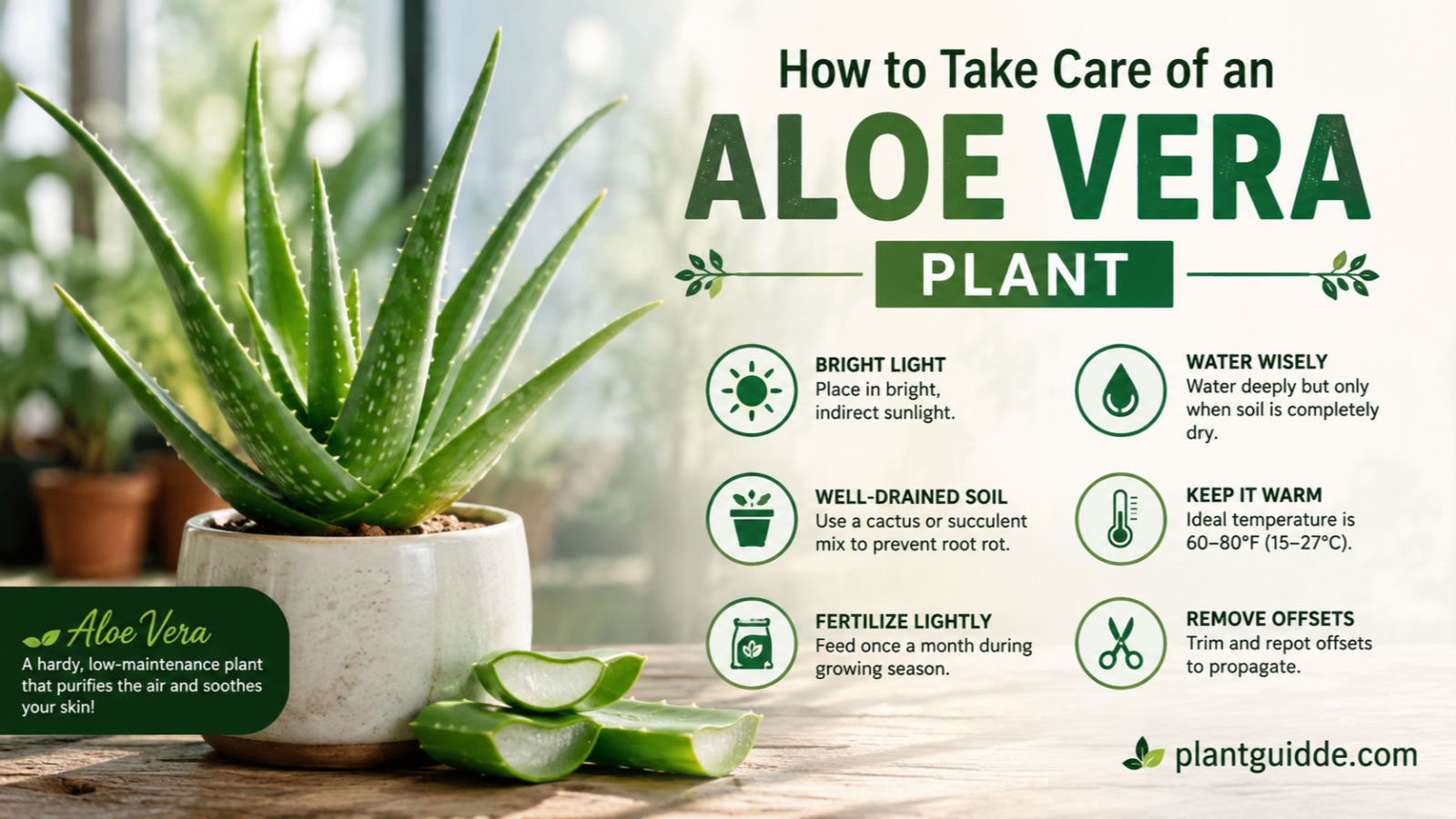
To take care of an aloe vera plant, place it in bright indirect or several hours of direct light, use fast-draining succulent soil, and water deeply only after the soil has dried out. Keep it in a pot with drainage holes and avoid letting water sit around the roots. Aloe vera grows best in warm conditions with good airflow and needs much less frequent watering than most tropical houseplants.
Aloe Vera Care at a Glance
| Care factor | What aloe vera prefers |
|---|---|
| Light | Bright light; several hours of direct sun can work |
| Soil | Fast-draining cactus or succulent mix |
| Water | Thoroughly, then allow soil to dry |
| Pot | Drainage hole strongly recommended |
| Temperature | Warm, stable indoor conditions |
| Humidity | Average household humidity is usually adequate |
| Fertilizer | Light feeding during active growth |
| Repotting | When crowded, root-bound, or soil has deteriorated |
| Growth habit | Succulent with water-storing leaves |
| Main risk | Overwatering and poor drainage |
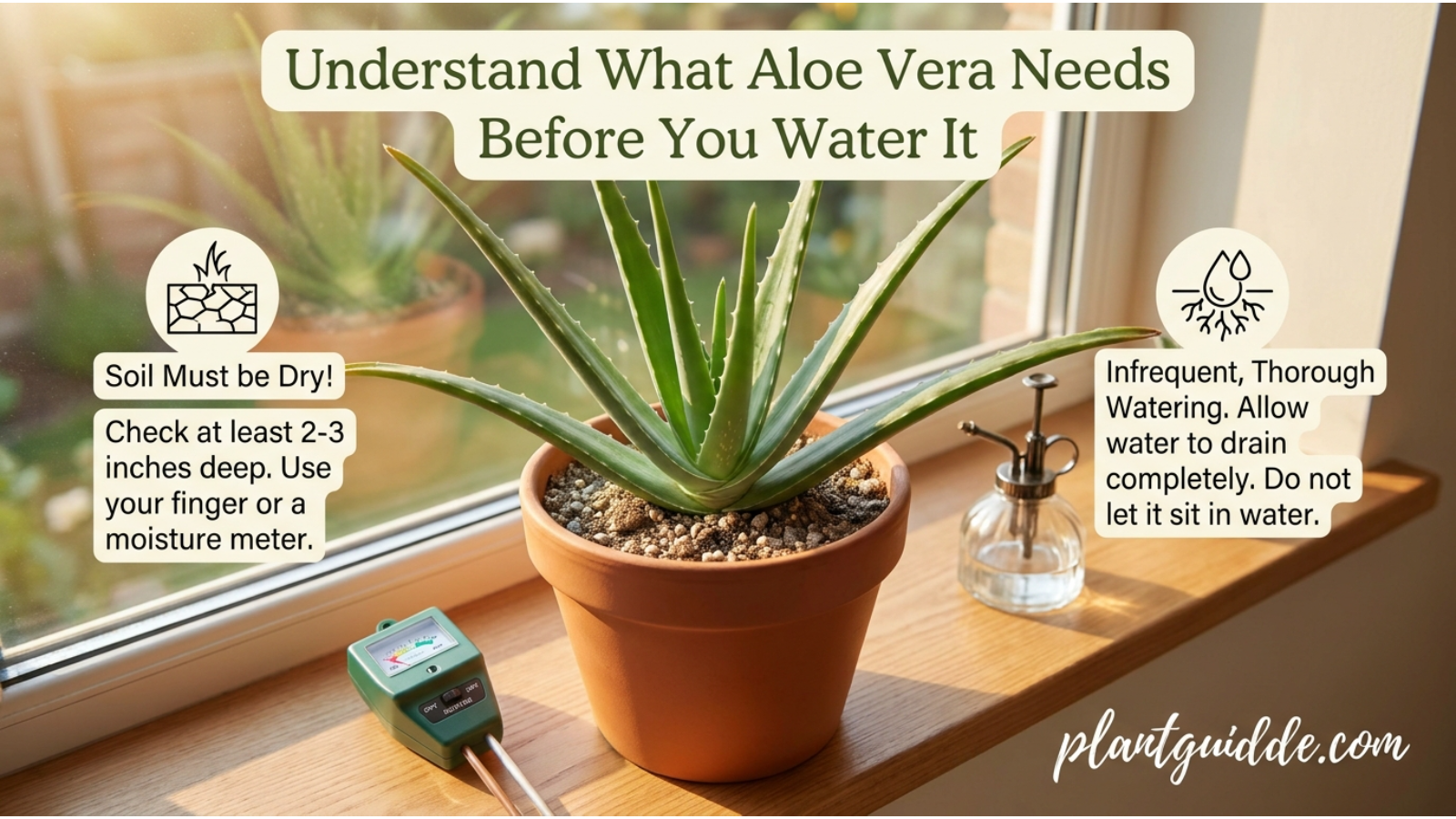
Understand What Aloe Vera Needs Before You Water It
Aloe vera (Aloe vera, also commonly treated botanically as Aloe barbadensis) is a succulent adapted to environments where water may be available intermittently.
Its fleshy leaves are essentially water-storage structures. This is why an aloe can remain healthy through periods when the potting mix is relatively dry.
The important distinction is that dry-tolerant does not mean neglect-tolerant.
Aloe still needs:
- sufficient light for strong growth
- oxygen around its roots
- well-draining soil
- a container that allows excess water to escape
- appropriate watering when the soil has dried
- protection from prolonged cold or unsuitable conditions
The biggest beginner mistake is often treating aloe like a tropical foliage plant. Watering it frequently because the surface looks dry can keep the lower part of the pot wet, eventually creating root problems.
Expert tip: Don’t judge watering needs from the top inch of soil alone. A small pot may dry quickly while a large, dense container remains wet much deeper down.
Give Aloe Vera the Right Amount of Light
Light is one of the most important factors in successful aloe vera care.
Aloe generally performs best in bright light, and a mature plant can often tolerate several hours of direct sunlight. Indoors, a bright south- or west-facing window can be suitable, depending on your climate and how intense the sunlight is.
Signs of insufficient light
An aloe receiving too little light may develop:
- elongated or stretched growth
- widely spaced leaves
- pale or less vibrant foliage
- leaves leaning strongly toward a window
- slow growth
- a loose, rather than compact, shape
When these symptoms appear, increasing light is usually more useful than adding fertilizer.
But can too much sun hurt aloe?
Yes. A plant that has been growing indoors in relatively low light can be damaged if suddenly placed in intense direct sunlight.
You may notice:
- bleached patches
- reddish or brown discoloration
- scorched-looking areas
- dry patches on exposed leaves
This doesn’t necessarily mean aloe cannot tolerate sunlight. It often means the plant wasn’t acclimated to the intensity of the new light.
How to increase sunlight safely
If your aloe has been in a dim room:
- Move it closer to a bright window.
- Start with gentler morning or filtered sunlight.
- Gradually increase direct exposure.
- Watch the leaves for signs of excessive stress.
- Adjust according to your local sunlight intensity.
Image Suggestion: A simple visual showing an aloe vera plant in low light, ideal bright light, and excessive direct sun, with the characteristic growth differences labeled.
Choose Fast-Draining Soil
The right soil is more important for aloe than soil that simply looks rich.
Aloe roots need moisture, but they also need air. Dense garden soil or a moisture-retaining houseplant mix can remain wet for too long, especially inside a large container.
A cactus or succulent potting mix is generally a better starting point.
For especially moisture-retentive mixes, growers often improve drainage by incorporating materials such as:
- perlite
- pumice
- coarse mineral material
The goal isn’t to create soil that contains absolutely no organic matter. The goal is to create a mix that drains rapidly and does not remain saturated for extended periods.
Why soil choice matters
Imagine watering two aloe plants:
- Aloe A is in a loose, fast-draining mix.
- Aloe B is in dense, water-retentive soil.
Both receive the same amount of water. Aloe A may dry at a reasonable rate, while Aloe B can remain damp around its roots for much longer.
That means watering frequency must always be considered together with soil type, pot size, temperature, and light.
Use a Pot With Drainage
A drainage hole is one of the simplest ways to reduce watering-related problems.
When you water aloe, excess water should have somewhere to go. A decorative container without drainage can trap water around the root system even when the plant’s upper soil appears reasonably dry.
A good container should:
- have at least one functional drainage hole
- be appropriately sized for the root system
- not be dramatically oversized
- allow excess water to leave freely
Should you put rocks at the bottom?
Adding a layer of gravel or rocks underneath the soil does not solve poor drainage. It can actually create a perched water zone above the coarse layer.
Instead, use a properly draining potting mix throughout the root zone and a container with a genuine drainage opening.
How to Water an Aloe Vera Plant Correctly
Watering is where most aloe vera problems begin.
The best approach is generally deep watering followed by a period of drying, rather than giving the plant tiny amounts every few days.
Step-by-step watering method
- Check the potting mix before watering.
- Make sure the soil has dried substantially.
- Water thoroughly until excess water drains from the bottom.
- Empty any water collected in the saucer or outer container.
- Allow the soil to dry again before watering.
The exact interval can vary considerably.
An aloe in a warm, bright room may need water much sooner than one sitting in a cool, dim room.
Don’t water by calendar alone
Avoid rules such as “water aloe every seven days” as though every home has identical conditions.
Instead ask:
Is the soil dry enough, and is the plant actively using water?
That’s a much more reliable question.
What happens if you underwater?
Aloe is relatively tolerant of short dry periods, but prolonged dehydration can eventually cause:
- thin or less-plump leaves
- curling or folding
- dry leaf tips
- reduced growth
- leaves becoming softer or less firm
What happens if you overwater?
Repeated overwatering can lead to:
- yellowing leaves
- soft or mushy leaves
- a consistently wet pot
- unpleasant-smelling soil
- root deterioration
- sudden collapse of the plant
Expert tip: A soft leaf doesn’t automatically mean the plant needs water. If the soil is already wet, adding more water can make the underlying problem worse.
How to Tell When Aloe Vera Needs Water
Instead of relying on the calendar, combine several observations.
Check the soil
Push a finger into the potting mix or use another reliable method to assess moisture deeper in the container.
For larger pots, the surface can be misleading.
Check the pot’s weight
After watering, notice how heavy the container feels. Once it becomes significantly lighter as the soil dries, that’s useful information for future watering decisions.
Observe the leaves
Healthy aloe leaves are usually:
- firm
- plump
- upright or naturally spreading
- free from widespread mushiness
Leaves becoming slightly thinner can indicate water stress, but leaf symptoms should always be interpreted alongside soil moisture.
Temperature and Humidity for Aloe Vera
Aloe vera generally prefers warm conditions and does not require the high humidity that many tropical houseplants do.
Normal indoor humidity is often sufficient if other conditions are appropriate.
Protect aloe from cold
Aloe can be damaged by cold temperatures, particularly when exposed to prolonged chill or frost.
Keep indoor plants away from:
- freezing temperatures
- cold drafts
- poorly insulated windows during severe cold
- sudden temperature changes
If you’re growing aloe outdoors, local climate matters considerably. In warm regions it may thrive outside year-round, while colder climates may require bringing containers indoors.
Does aloe need misting?
Usually, no.
Regular misting isn’t necessary to provide aloe with the humidity it needs. More importantly, keeping the foliage or surrounding environment persistently damp doesn’t compensate for poor soil drainage.
For aloe, good light and appropriate watering matter far more than routine misting.
Fertilizing Aloe Vera
Aloe doesn’t require heavy feeding.
During active growth, you can use a fertilizer formulated for succulents or another suitable balanced fertilizer at an appropriately diluted rate.
The key is moderation.
Too much fertilizer can contribute to:
- salt accumulation in the potting mix
- weak or abnormal growth
- root stress
- foliage damage
A plant struggling because of poor light, overwatering, or root problems should not automatically receive fertilizer as a “boost.”
Fix the growing conditions first.
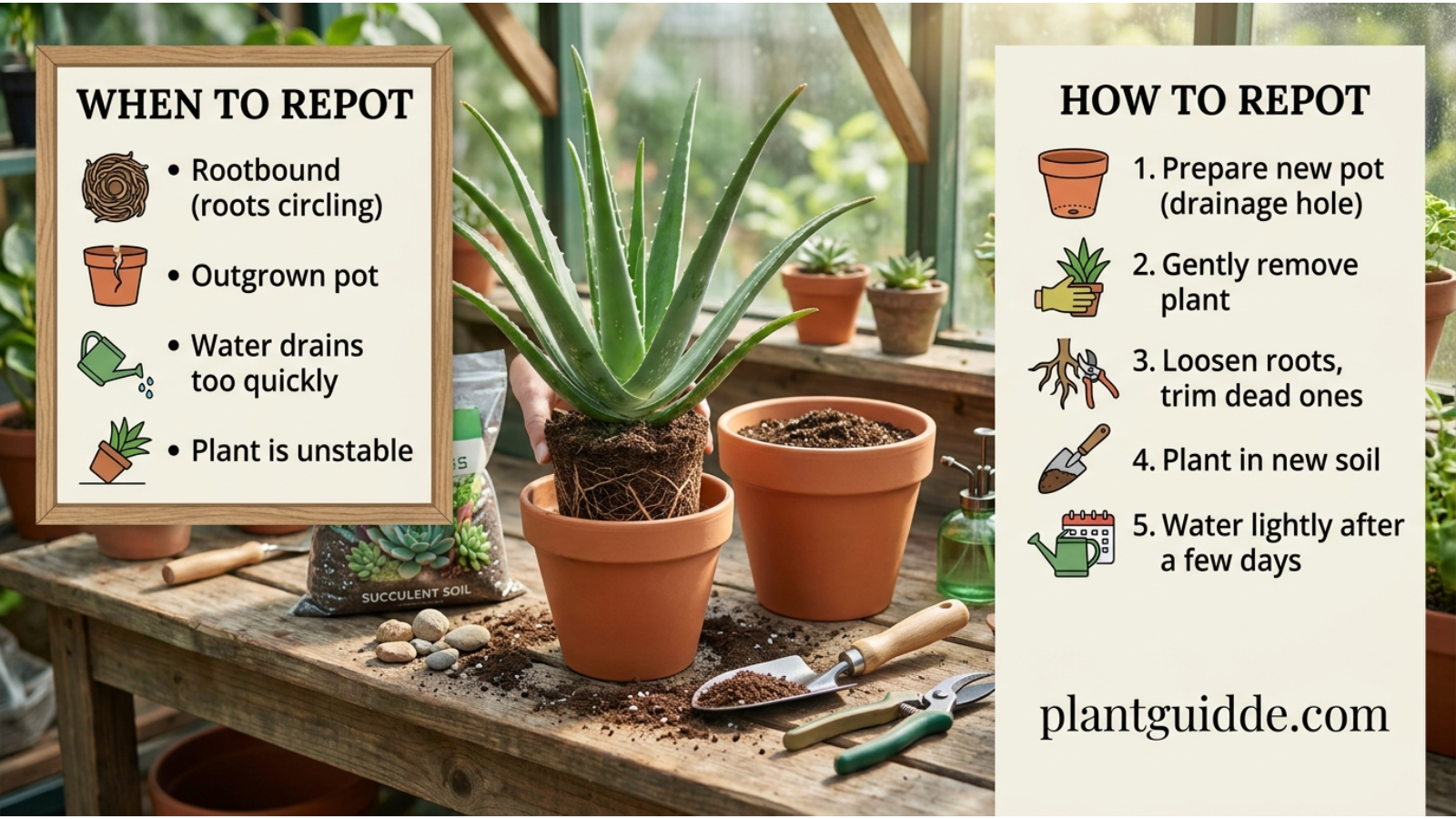
When and How to Repot Aloe Vera
Aloe doesn’t need frequent repotting simply because a certain amount of time has passed.
Repot when there is a practical reason, such as:
- roots filling the container
- poor or compacted soil
- drainage becoming inadequate
- the plant becoming unstable
- offsets crowding the pot
- roots emerging through the drainage hole
Choosing the next pot
Don’t automatically jump to a huge container.
A pot only modestly larger than the existing root system is often easier to manage because excessive soil can hold moisture for longer.
Repotting steps
- Allow the existing soil to dry.
- Remove the aloe carefully.
- Inspect the roots.
- Remove obviously damaged material when appropriate.
- Place the plant into fresh, well-draining mix.
- Position it at approximately the same depth.
- Use a container with drainage.
- Give the plant time to settle into its new environment.
Image Suggestion: Step-by-step diagram showing aloe removal, root inspection, fresh succulent soil, and placement into a new drainage pot.
How to Care for Aloe Vera Pups
Healthy aloe plants often produce offsets, commonly called pups, around the base.
These young plants can eventually be separated and grown independently.
When should you separate a pup?
Wait until the offset is reasonably developed and has enough structure to establish itself independently.
When separating:
- Remove the plant from the container if necessary.
- Locate where the pup connects to the parent.
- Separate it carefully with minimal unnecessary root damage.
- Allow damaged surfaces to dry when appropriate.
- Plant the offset in suitable succulent soil.
- Avoid immediately keeping the new plant constantly wet.
Not every pup needs to be removed. Leaving offsets together can create a fuller cluster if the container has enough room.
Why Are My Aloe Vera Leaves Turning Brown?
Brown leaves have several possible causes, so the color alone doesn’t provide a diagnosis.
Brown, dry tips
Possible causes include:
- inconsistent watering
- prolonged dryness
- very dry conditions
- salt accumulation
- environmental stress
Brown or bleached patches
These can occur after excessive sun exposure, particularly when a plant was moved abruptly from low light to intense sunlight.
Brown, soft, or collapsing tissue
This is more concerning when accompanied by wet soil or a failing root system. Overwatering and poor drainage should be investigated.
Don’t remove the entire leaf immediately. First determine why the tissue changed.
Why Are Aloe Vera Leaves Turning Yellow?
Yellow leaves are often associated with excess moisture, but again, context matters.
Consider:
- How wet is the soil?
- Does the pot drain properly?
- How much light does the plant receive?
- Is the yellowing limited to an older leaf?
- Are the leaves soft or mushy?
If several leaves are yellowing while the soil remains wet for long periods, excessive moisture becomes a strong possibility.
If only an older lower leaf gradually yellows while the plant continues producing healthy growth, natural aging may be involved.
Why Is My Aloe Vera Plant Drooping?
Drooping can be caused by either too little water or too much water, which is why immediately watering a drooping aloe isn’t always the correct response.
If the soil is bone dry
The plant may be experiencing dehydration.
If the soil is wet
The issue may be related to root stress rather than a lack of water.
Damaged roots cannot function normally, so the plant may appear thirsty even though the pot contains plenty of moisture.
This is one of the most important diagnostic principles in aloe care:
A wilted plant is not automatically a thirsty plant.
Check the roots’ environment before adding more water.
Aloe Vera Leaves Are Curling or Folding
Some leaf movement or slight folding can occur as the plant responds to environmental conditions.
If leaves are consistently curling inward, investigate:
- prolonged dryness
- intense heat
- root problems
- insufficient light
- abrupt environmental changes
Start with the simplest diagnosis: check the soil moisture and inspect the plant’s overall condition.
Avoid changing five things simultaneously. If you move the plant, change the soil, fertilize, increase watering, and alter the temperature all at once, it becomes difficult to determine what actually helped.
Common Aloe Vera Care Mistakes
1. Watering on a fixed schedule
A calendar doesn’t know whether your room is hot, cold, bright, dim, humid, or dry.
Better approach: Check the plant and soil before watering.
2. Using a pot without drainage
This makes excess moisture much harder to manage.
Better approach: Choose a container with a functional drainage hole.
3. Keeping aloe in a dark corner
Aloe may survive there for a while, but weak, stretched growth can develop.
Better approach: Provide much brighter light.
4. Using heavy garden soil indoors
Dense soil can retain moisture around the roots.
Better approach: Use a fast-draining succulent mix.
5. Assuming brown leaves always mean thirst
Brown tissue can have multiple causes.
Better approach: Diagnose the soil, roots, light, and recent environmental changes together.
6. Suddenly moving aloe into intense sunlight
Even sun-loving plants can suffer when their light exposure changes dramatically.
Better approach: Acclimate gradually.
7. Choosing an oversized pot
More soil means more potential moisture retention.
Better approach: Use a pot appropriate for the plant’s root system.
A Simple Aloe Vera Troubleshooting Guide
| Symptom | Possible cause | What to check first |
|---|---|---|
| Yellow, soft leaves | Excess moisture | Soil and drainage |
| Thin, curling leaves | Dryness or root stress | Soil moisture |
| Stretched growth | Insufficient light | Window/light exposure |
| Brown sun patches | Sudden intense sunlight | Recent light change |
| Brown dry tips | Dryness or environmental stress | Watering and conditions |
| Mushy leaves | Severe moisture stress | Roots and soil |
| Slow growth | Low light or unsuitable conditions | Light first |
| Plant leaning | Insufficient light | Light direction and intensity |
| Persistent wet soil | Poor drainage/overwatering | Pot and soil |
| Healthy pups around base | Normal propagation | Available space |
Seasonal Aloe Vera Care
Aloe’s watering requirements can change substantially throughout the year.
Spring and summer
With stronger light and active growth, the plant may use water more quickly.
Check the soil regularly, but don’t turn increased growth into a reason to water automatically.
Autumn
As light levels decrease, water consumption may decline.
Begin checking the soil more carefully before each watering.
Winter
Indoor aloe often needs significantly less water when growth slows and daylight decreases.
A common mistake is maintaining the same watering routine used during summer.
Winter rule: If the plant is using less water, your watering frequency should generally decrease too.
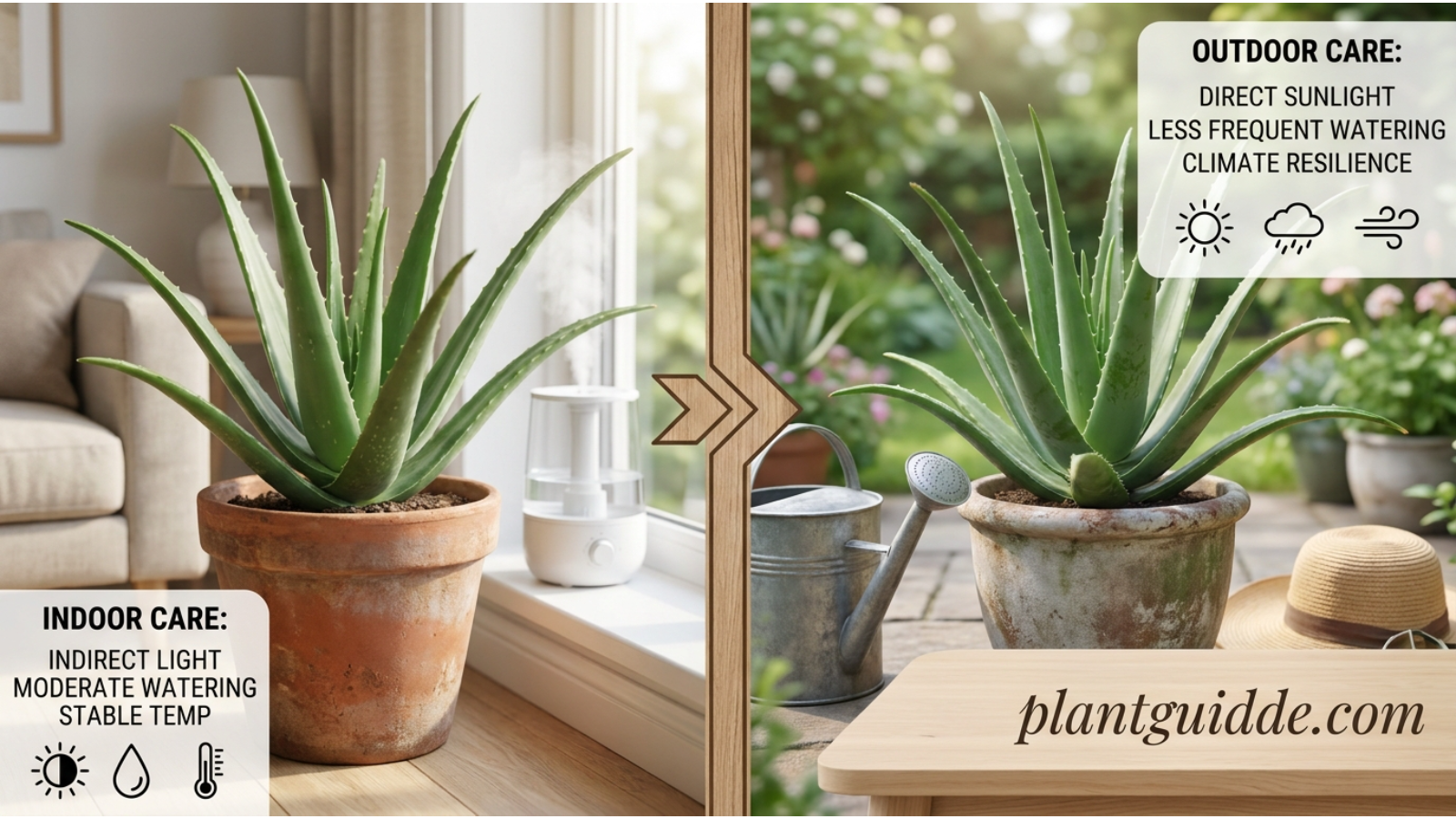
Indoor vs. Outdoor Aloe Vera Care
| Factor | Indoors | Outdoors |
|---|---|---|
| Light | Brightest available location | Often stronger natural light |
| Watering | Depends heavily on window and room conditions | Rain and heat affect moisture |
| Temperature | Easier to control | More exposed to extremes |
| Drainage | Entirely dependent on container setup | Depends on soil/container location |
| Sun exposure | May require acclimation | Can be intense |
| Cold protection | Usually easier | May require seasonal relocation |
Outdoor aloe can grow exceptionally well in an appropriate climate, but outdoor plants can also experience much stronger sunlight, heavy rainfall, temperature swings, and pests.
How to Keep Aloe Vera Healthy Long-Term
The easiest way to maintain aloe isn’t to constantly intervene.
Instead, create conditions that naturally reduce problems:
Bright light → appropriate drying → thorough watering → good drainage → repeat according to actual conditions.
A healthy routine might look like this:
- Check the plant weekly.
- Don’t water simply because you’ve checked it.
- Assess soil moisture.
- Look at the leaves.
- Confirm the pot drains freely.
- Adjust watering as seasons change.
- Rotate the pot occasionally if growth leans toward the light.
- Remove damaged material when necessary.
- Repot when the container or soil becomes unsuitable.
This observation-based approach is much more reliable than following a rigid watering chart.
FAQs:
How often should I water an aloe vera plant?
Water when the potting mix has dried substantially rather than following a fixed weekly schedule. Water thoroughly, allow excess water to drain, and then let the soil dry again.
Does aloe vera need direct sunlight?
Aloe generally benefits from bright light and can tolerate several hours of direct sunlight. Indoor plants should be acclimated gradually if they’re moving from low light into intense sun.
Why is my aloe vera turning yellow?
Yellow leaves can result from excessive moisture, poor drainage, low light, or natural aging of older leaves. Check the soil and roots before changing your watering routine.
Should I mist my aloe vera plant?
Usually, no. Aloe is a succulent and normally doesn’t require routine misting. Proper light, drainage, and watering are much more important.
What type of soil is best for aloe vera?
Use a fast-draining cactus or succulent potting mix. If the mix retains too much moisture, materials such as perlite or pumice can improve drainage and aeration.
Can aloe vera grow indoors?
Yes. Aloe vera can grow successfully indoors when given sufficient bright light, suitable soil, and careful watering.
Why are my aloe vera leaves soft?
Soft leaves can indicate dehydration, but they can also occur with serious excess moisture and root damage. Check the soil before watering.
How much light does an aloe vera plant need indoors?
Give it the brightest suitable location available. A bright window is often ideal, although the exact amount of direct sun it can tolerate depends on acclimation and local light intensity.
Can I cut off brown aloe vera leaves?
You can remove severely damaged leaves with a clean, sharp tool, but first determine why they became brown. Removing damaged tissue without correcting the underlying growing conditions won’t solve the problem.
How do I make my aloe vera grow faster?
Provide strong suitable light, well-draining soil, appropriate watering, and warm growing conditions. Avoid trying to accelerate growth through excessive watering or fertilizer.
Conclusion
Learning how to take care of an aloe vera plant is less about constant attention and more about understanding what the plant is telling you.
Give aloe plenty of suitable light, use fast-draining soil, keep it in a container with drainage, and water thoroughly only after the soil has had enough time to dry. Most importantly, don’t treat every drooping, brown, or yellow leaf as a signal to add more water.
The most useful habit is simple: check the soil, inspect the leaves, consider the light, and then decide what the plant actually needs. Once you stop watering by the calendar and start responding to the plant’s growing conditions, aloe vera becomes much easier to maintain, and far less likely to develop the problems that frustrate beginners.

Asad Mumtaz is a dedicated plant enthusiast and gardening writer with a passion for helping people care for their plants successfully. He specializes in plant care guides, indoor gardening, and practical growing tips for all skill levels. His content focuses on making gardening simple, enjoyable, and rewarding. Through his work, Asad shares reliable advice to help readers create thriving green spaces.