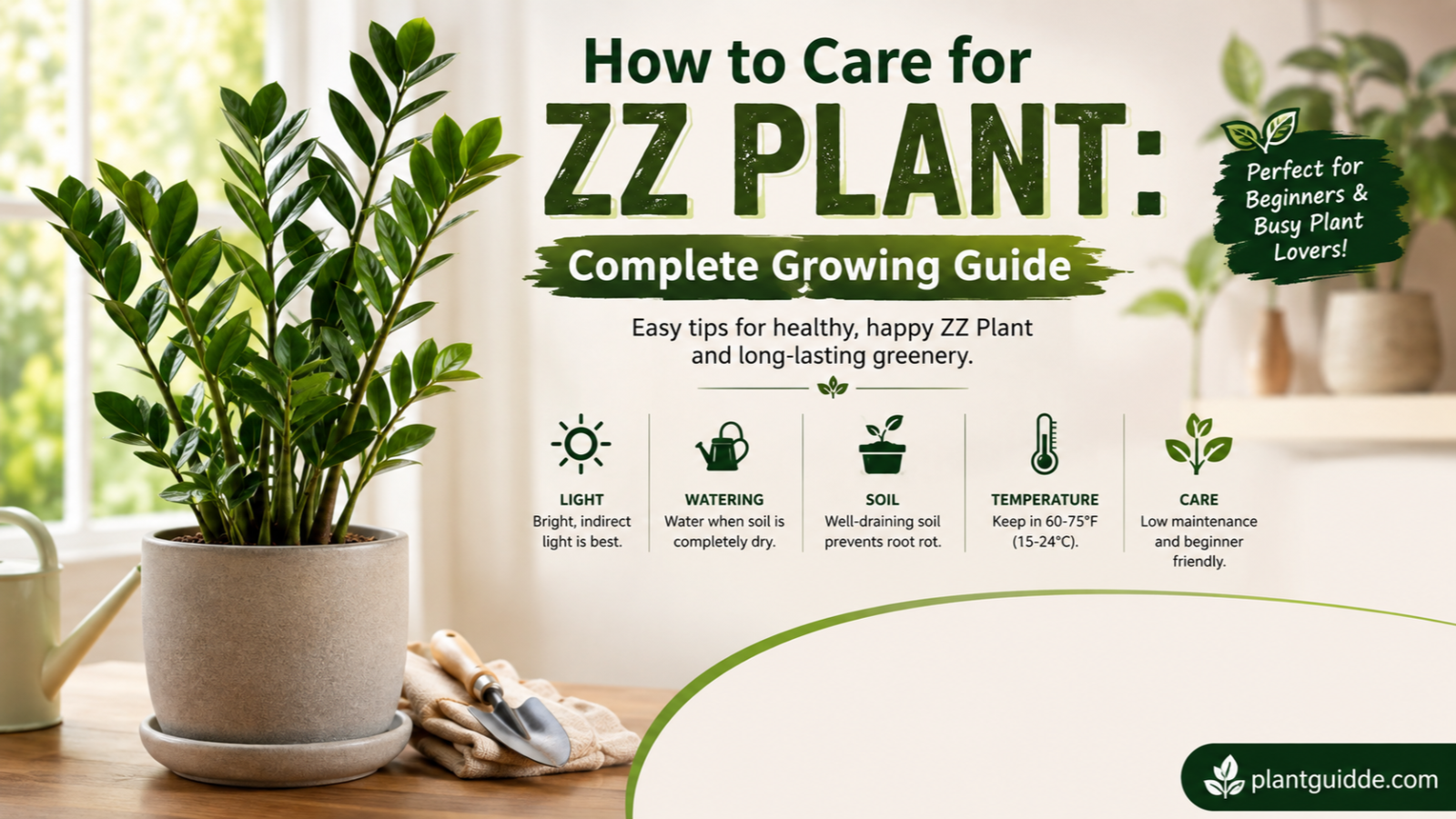
The ZZ plant (Zamioculcas zamiifolia) has a reputation for being nearly impossible to kill. That reputation is deserved to a point, but it can also lead to one of the most common mistakes in ZZ plant care: assuming a tough plant has no specific needs.
ZZ plants are remarkably tolerant of low light, missed waterings, and ordinary indoor conditions. But those same adaptations make them particularly vulnerable to excess moisture and poor drainage. If your ZZ plant has yellow leaves, soft stems, drooping growth, or a musty-smelling pot, simply adding more water can make the problem worse.
Learning how to care for ZZ plant is therefore less about following a rigid watering schedule and more about understanding how the plant stores water, how quickly your soil dries, and how your indoor environment affects its growth.
Quick Answer
To care for a ZZ plant, place it in bright, indirect light or lower light, use well-draining soil, and water only when the soil has dried substantially. Keep it in a warm, stable room and avoid leaving the roots in standing water. ZZ plants store water in their thick rhizomes, so underwatering is generally easier to recover from than frequent overwatering.
Understanding the ZZ Plant
The ZZ plant, Zamioculcas zamiifolia, is a tropical perennial grown widely as a houseplant. It produces upright stems covered with glossy, fleshy leaflets and develops thick underground rhizomes that function as water-storage organs.
These rhizomes explain much of the plant’s drought tolerance.
When the soil dries, the plant can draw on stored moisture. As a result, a ZZ plant may remain healthy even when you occasionally forget to water it. However, repeatedly keeping the potting mix wet can deprive the roots of oxygen and eventually lead to root or rhizome problems.
Practical takeaway: A ZZ plant doesn’t need frequent attention. It needs the right kind of neglect.
ZZ Plant Care Requirements at a Glance
| Care factor | What a ZZ plant prefers | What to avoid |
|---|---|---|
| Light | Bright, indirect light; tolerates lower light | Harsh direct afternoon sun |
| Water | Water thoroughly after soil has dried | Frequent small waterings |
| Soil | Loose, fast-draining mix | Heavy, compact soil |
| Pot | Drainage hole is strongly preferred | Pots that trap water |
| Humidity | Average household humidity is usually adequate | Constantly wet foliage |
| Temperature | Warm, stable indoor conditions | Cold drafts and sudden temperature changes |
| Fertilizer | Light feeding during active growth | Heavy or excessive fertilization |
| Growth rate | Naturally slow to moderate indoors | Expecting rapid growth in low light |
How to Care for a ZZ Plant Step by Step
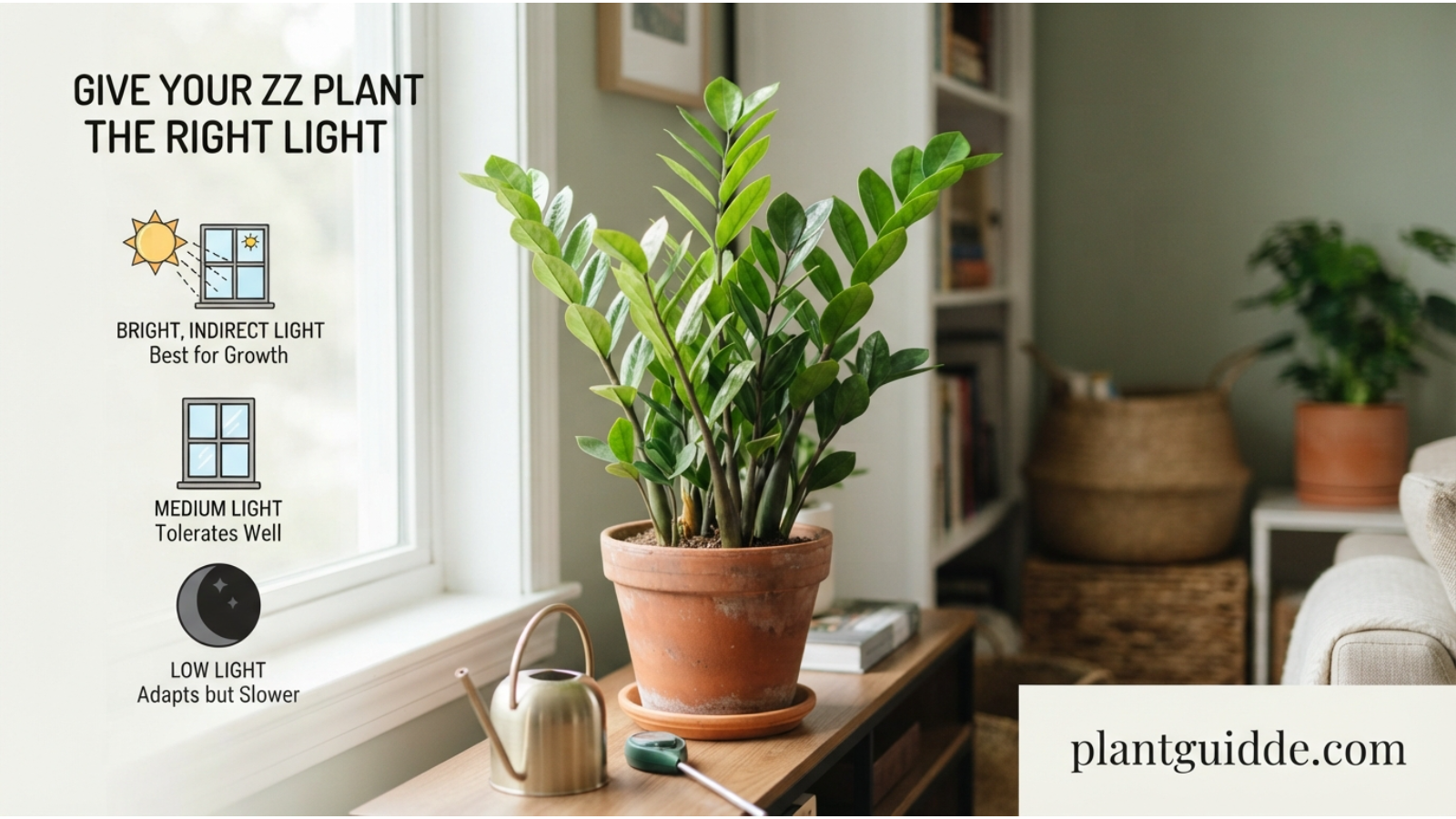
Give Your ZZ Plant the Right Light
ZZ plants are famous for tolerating low light, but tolerating low light is not the same as thriving in it.
The best location is usually somewhere with bright, indirect light. A few feet away from a bright window can work well, particularly when sunlight is filtered by a sheer curtain.
Lower-light conditions can keep a ZZ plant alive, but growth may become noticeably slower. New stems may also take longer to appear.
Watch for excessive light
Very intense direct sunlight, especially through hot glass, can scorch the foliage. You may notice:
- Pale or bleached-looking leaves
- Brown patches
- Crispy leaf edges
- Faded coloration
A useful placement rule
If the room is bright enough that you could comfortably read during the daytime without turning on a light, it may be suitable for a ZZ plant. Adjust based on how much direct sun actually reaches the foliage.
Expert tip: If you’re choosing between a dark corner and a bright window with harsh afternoon sun, don’t assume the ZZ plant automatically prefers the darker location. Often, the better solution is bright filtered light.
Image Suggestion: ZZ plant placement diagram showing low light, bright indirect light, and harsh direct sunlight.
Water Only When the Soil Has Dried
Watering is probably the most important part of ZZ plant care—and the easiest place to make a mistake.
There is no universal schedule such as “water every seven days.” Indoor conditions vary dramatically. A ZZ plant in a warm, bright room may dry faster than one sitting in a cool, dim corner.
Instead, check the soil.
When should you water a ZZ plant?
Allow the potting mix to dry substantially before watering again. Then:
- Check the upper portion of the soil with your finger.
- Push deeper if necessary rather than judging only the surface.
- If the mix is still noticeably moist, wait.
- When it has dried sufficiently, water thoroughly.
- Allow excess water to drain completely.
- Empty any water collecting in the saucer.
This approach is much more reliable than following a calendar.
Why overwatering is so dangerous
The plant’s ability to store water can fool beginners into thinking it needs regular moisture. In reality, frequent watering can keep the root zone wet for too long.
A ZZ plant sitting in constantly damp soil may develop:
- Yellowing leaves
- Soft or collapsing stems
- Darkened roots
- Unpleasant soil odor
- Rhizome rot
- Sudden decline despite apparently adequate watering
The important distinction: A ZZ plant can survive dry soil. It cannot indefinitely tolerate a poorly aerated root zone.
Use Fast-Draining ZZ Plant Soil
ZZ plants don’t require an exotic potting mixture. What matters most is drainage and aeration.
A quality indoor potting mix amended with a material that improves drainage can work well. Many growers use combinations containing materials such as:
- Perlite
- Pumice
- Coarse bark
- Other drainage-enhancing amendments
The exact recipe matters less than whether water can move through the root zone instead of remaining trapped around the roots.
What does bad soil look like?
If the soil stays wet for many days after watering, feels dense and muddy, or pulls away from the pot while remaining strangely wet inside, the problem may be the potting mix rather than your watering technique.
Practical insight: Before changing how often you water, consider how quickly the soil actually dries. A good watering habit cannot completely compensate for chronically waterlogged soil.
Choose a Pot With Drainage
A drainage hole isn’t a minor convenience. It gives excess water somewhere to go.
A decorative cachepot can still be used, but the ZZ plant should ideally remain in a nursery pot or inner container that allows water to escape.
Avoid routinely leaving the root ball sitting in collected water.
Don’t automatically choose a huge pot
A pot that is dramatically larger than the root system can hold more wet soil than the plant can use efficiently. This can slow drying and increase the risk of excessive moisture.
When repotting, moving into a somewhat larger container is generally more sensible than dramatically increasing pot size.
Keep the Temperature Stable
ZZ plants generally perform well under normal indoor temperatures.
They don’t need a greenhouse-like environment, but they can struggle when exposed to:
- Cold drafts
- Sudden temperature changes
- Very cold windows
- Direct blasts from heating or cooling equipment
A stable indoor location is usually better than repeatedly moving the plant between dramatically different environments.
Expert tip: If your ZZ plant looks fine but suddenly declines after being moved, consider the change in temperature, light, watering, and airflow—not just the plant itself.
Humidity Usually Doesn’t Need to Be Complicated
One advantage of ZZ plant care indoors is that the plant generally doesn’t require extremely high humidity.
Average household humidity is often adequate.
You usually don’t need to:
- Mist the plant constantly
- Keep a humidifier running solely for the ZZ plant
- Place it on a pebble tray just because it is a tropical species
If your home is exceptionally dry, especially during prolonged heating or cooling, increasing ambient humidity may help overall plant comfort. But humidity is rarely the first thing to troubleshoot when a ZZ plant is yellowing.
Prioritize light, watering, drainage, and roots first.
Fertilize Lightly
ZZ plants are naturally slow-growing, particularly in lower light. They therefore don’t need heavy feeding.
During active growth, a balanced houseplant fertilizer used according to its label directions can support new growth.
Avoid the temptation to fertilize repeatedly because the plant isn’t growing quickly.
Why excessive fertilizer can backfire
Too much fertilizer can cause salt accumulation in the potting mix and may damage roots.
If your ZZ plant is healthy but simply growing slowly, ask first:
Does it have enough light?
Increasing light appropriately is often more useful than adding more fertilizer.
Prune Damaged Growth
ZZ plants don’t need regular pruning to remain healthy.
Remove foliage or stems that are:
- Completely yellow or dead
- Severely damaged
- Diseased
- Visually unwanted
Use clean, sharp scissors or pruning shears and cut damaged growth cleanly.
Don’t remove healthy leaves simply because they are older. A healthy green leaf is still contributing energy to the plant.
How to Repot a ZZ Plant
ZZ plants generally don’t require frequent repotting. Their slow growth and compact root system mean they can remain in the same container for quite some time.
Consider repotting when:
- Roots are tightly filling the container
- The plant is becoming unstable
- Water runs through unusually quickly because the root mass has become dense
- The potting mix has deteriorated
- The plant has developed a significant root or rhizome problem
Repotting steps
- Choose a container with drainage.
- Select a pot only moderately larger than the current one.
- Prepare a loose, well-draining potting mix.
- Remove the plant carefully.
- Inspect the roots and rhizomes.
- Remove obviously rotten material with clean tools.
- Replant at approximately the same depth.
- Avoid packing the soil excessively tightly.
- Allow the plant to settle into its new environment.
Image Suggestion: Step-by-step ZZ plant repotting illustration showing healthy roots and damaged rhizomes.
ZZ Plant Problems: What the Symptoms Actually Mean
One of the biggest mistakes in plant care is treating every symptom as a watering problem.
Instead, look at the combination of symptoms.
ZZ Plant Leaves Turning Yellow
Yellow leaves can have several causes, but widespread yellowing accompanied by persistently wet soil should immediately make you investigate overwatering and drainage.
Ask yourself:
- Is the soil staying wet?
- Does the pot have drainage?
- Have I been watering on a fixed schedule?
- Is the plant sitting in collected water?
- Are stems or rhizomes becoming soft?
If yes, correct the moisture problem before adding fertilizer or other treatments.
ZZ Plant Leaves Turning Brown
Brown foliage may result from several environmental stresses.
Possible causes include:
- Excessive direct sunlight
- Severe dryness
- Physical damage
- Salt accumulation
- Root problems
Look at the location and pattern of the browning.
Crispy, bleached areas on the window-facing side suggest a different problem from soft, darkening tissue near a constantly wet base.
ZZ Plant Leaves Curling
Curling or folding leaves can occur when the plant is experiencing environmental stress.
Check:
- Soil moisture
- Recent changes in location
- Light intensity
- Temperature
- Airflow
Don’t automatically respond by watering.
If the soil is already wet, adding more water may make the underlying problem worse.
ZZ Plant Drooping
A drooping ZZ plant deserves a closer inspection.
If the soil is extremely dry, dehydration may be involved.
If the soil is wet and the stems feel unusually soft, excessive moisture or root damage is more concerning.
This is why checking the soil before watering is so important.
ZZ Plant Not Growing
Slow growth isn’t necessarily a problem.
ZZ plants are naturally slower growers than many popular tropical houseplants. Growth can become even slower in:
- Low light
- Cool conditions
- Winter
- Poor nutrition
- Recently repotted plants
If the foliage is healthy and firm, don’t assume something is wrong simply because you haven’t seen a new shoot recently.
Better strategy: Improve light gradually and maintain consistent care rather than forcing growth with excessive fertilizer or water.
How to Tell if Your ZZ Plant Is Overwatered
Overwatering is one of the most common issues with ZZ plants.
Look for a combination of:
- Soil remaining wet for an unusually long time
- Yellowing leaves
- Soft stems
- Dark or mushy roots
- A sour or musty smell
- Declining foliage despite frequent watering
What to do
If you suspect serious overwatering:
- Stop watering temporarily.
- Assess how wet the soil is.
- Check drainage.
- If the plant continues declining, remove it from the container.
- Inspect roots and rhizomes.
- Remove rotten tissue with a clean tool.
- Replant healthy material into fresh, well-draining mix.
- Correct the environmental conditions that caused the problem.
Simply letting a severely damaged root system “dry out” while leaving it in stagnant, decomposing soil may not solve the issue.
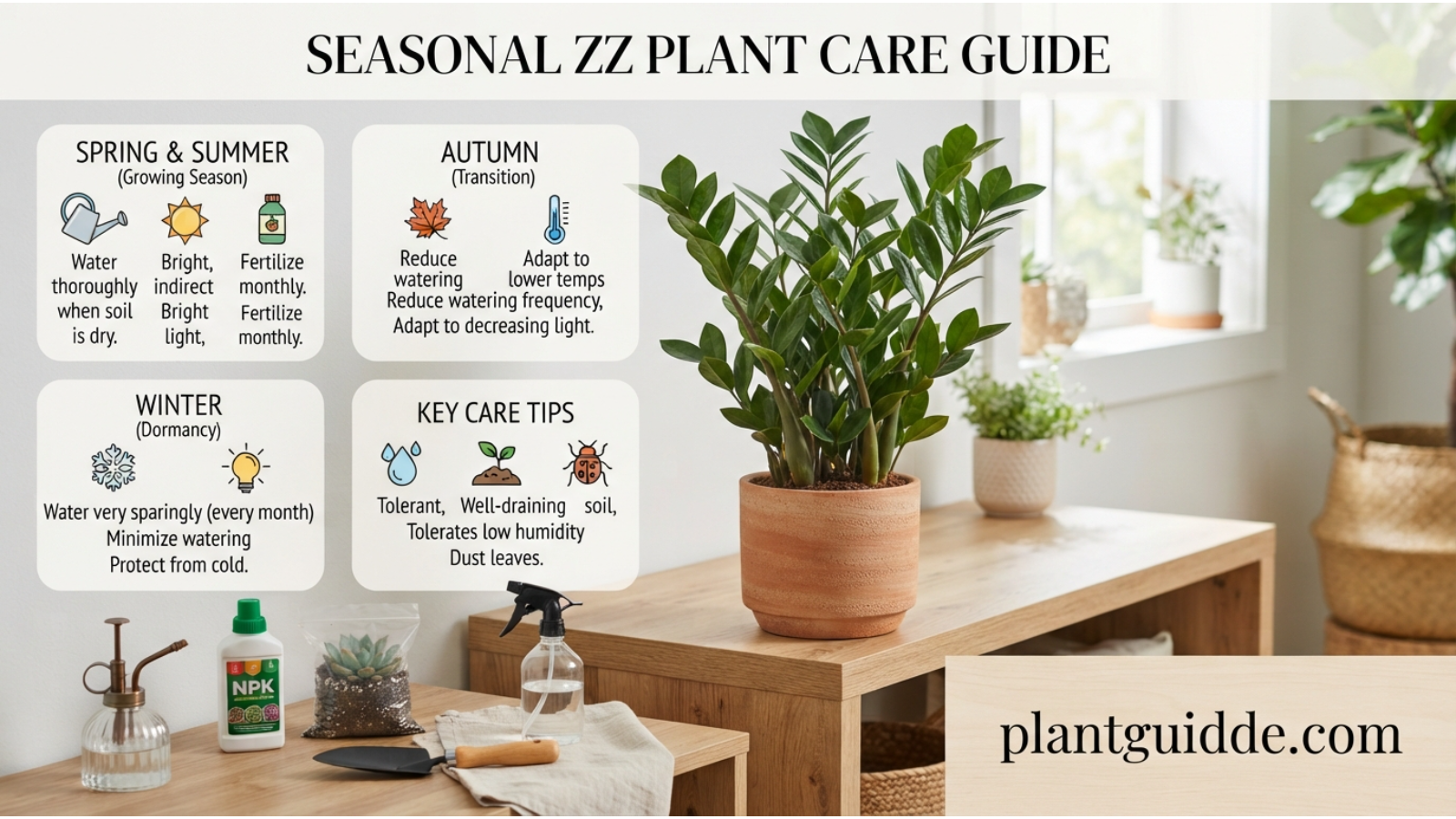
Seasonal ZZ Plant Care
Spring and Summer
As light levels and temperatures increase, ZZ plants may become more active.
You may need to:
- Check soil moisture more frequently
- Watch for new shoots
- Begin or increase appropriate fertilization
- Monitor strong window sunlight
But don’t automatically increase watering just because it’s summer. Check the soil first.
Fall and Winter
Growth often slows as light levels decrease.
During this period:
- Water less frequently if the soil takes longer to dry
- Avoid fertilizing heavily
- Keep the plant away from cold drafts
- Watch for excessively dry air near heating systems
- Maximize available bright, indirect light
The biggest seasonal mistake is maintaining a summer watering schedule when the plant’s water use has slowed.
Common ZZ Plant Care Mistakes
1. Watering on a fixed schedule
“Every Sunday” may sound organized, but the plant doesn’t know what day it is.
Better: Check soil moisture and environmental conditions.
2. Keeping the plant in darkness
ZZ plants tolerate low light, but very low light can dramatically reduce growth.
Better: Give it the brightest indirect light your space can reasonably provide.
3. Using a pot without drainage
Excess water has nowhere to escape.
Better: Use a container with drainage or keep the plant in a draining inner pot.
4. Fertilizing to force growth
Slow growth is often normal for ZZ plants.
Better: Improve light and overall conditions before increasing fertilizer.
5. Treating yellow leaves by watering more
Yellowing can be a sign of excessive moisture.
Better: Check the soil before reaching for the watering can.
6. Repotting unnecessarily
A ZZ plant doesn’t need to be repotted simply because it has been in the same pot for a year.
Better: Repot when the root system, soil condition, or container actually warrants it.
A Simple ZZ Plant Care Routine
You don’t need to spend much time maintaining a healthy ZZ plant.
Weekly
Quickly inspect:
- Foliage
- Soil moisture
- Signs of pests
- General plant stability
Every few weeks
Check whether the potting mix is drying at its usual rate.
This helps you notice environmental changes before they become serious.
During active growth
Watch for new shoots and consider appropriate fertilizer according to the product label.
Every few months
Rotate the plant if you want more even growth and inspect the foliage for dust or pests.
The goal isn’t constant intervention. The goal is noticing changes early.
Expert Tips for Healthier ZZ Plants
Let the plant tell you when it needs water
The calendar is less useful than the condition of the soil.
Treat low light as a growth limitation
A ZZ plant may survive in a dim room but produce very little new growth there.
Look at the entire plant before diagnosing a problem
One yellow leaf is very different from widespread yellowing with soft stems.
Don’t confuse resilience with immunity
ZZ plants are forgiving, but prolonged waterlogging, severe light problems, and poor drainage can still cause serious damage.
Change one major variable at a time
If your plant is struggling, don’t simultaneously change the pot, soil, light, fertilizer, and watering routine. Making several changes at once makes it difficult to determine what actually helped.
FAQs,
How often should you water a ZZ plant?
Water when the potting mix has dried substantially rather than according to a fixed weekly schedule. How quickly it dries depends on light, temperature, pot size, soil, and season.
Does a ZZ plant need direct sunlight?
No. Bright, indirect light is generally preferable. ZZ plants tolerate lower light, while intense direct sunlight can scorch the foliage.
Can a ZZ plant survive in low light?
Yes. ZZ plants are among the better houseplants for lower-light conditions, but growth will usually be slower than it would be in brighter indirect light.
Why is my ZZ plant turning yellow?
Overwatering is an important possibility, especially if the soil remains wet for long periods. Also consider natural aging, poor drainage, temperature stress, and other environmental factors.
Should I mist my ZZ plant?
Usually, no. Regular misting isn’t necessary for healthy ZZ plant growth under typical household conditions.
What is the best soil for a ZZ plant?
Use a loose, well-draining houseplant mix that doesn’t remain saturated for long periods. Adding an appropriate drainage amendment such as perlite or pumice can improve aeration.
Why is my ZZ plant not growing?
Low light is a common reason. ZZ plants are naturally slow-growing, and growth may slow further during winter or in dim locations.
Can you grow a ZZ plant in a bathroom?
Yes, provided the bathroom has enough usable light and isn’t excessively cold. Humidity itself is usually less important than adequate light and proper drainage.
Do ZZ plants need fertilizer?
They can benefit from light feeding during active growth, but they generally don’t require heavy fertilization. Excess fertilizer can create problems rather than accelerate growth dramatically.
Conclusion
The best way to care for a ZZ plant is surprisingly simple: give it suitable indirect light, let the soil dry substantially between waterings, use a well-draining pot and soil, and avoid unnecessary intervention.
Its ability to store water makes the ZZ plant forgiving, but that doesn’t mean more water is better. In fact, keeping the root zone constantly wet is one of the fastest ways to turn an otherwise resilient plant into a struggling one.
If your ZZ plant isn’t looking healthy, start with the basics: check the soil, inspect the roots if necessary, evaluate the light, and look for recent changes in its environment. Once those fundamentals are right, this slow-growing houseplant can remain attractive with remarkably little maintenance.

Asad Mumtaz is a dedicated plant enthusiast and gardening writer with a passion for helping people care for their plants successfully. He specializes in plant care guides, indoor gardening, and practical growing tips for all skill levels. His content focuses on making gardening simple, enjoyable, and rewarding. Through his work, Asad shares reliable advice to help readers create thriving green spaces.