Snake plants are popular indoor plants for a simple reason: they can tolerate conditions that cause many other houseplants to struggle. Their upright, fleshy leaves store water, allowing them to handle dry periods and relatively low light. How to Care for Snake Plant Indoor.
The most common problem with how to care for snake plant indoor is actually giving the plant too much attention, watering too frequently, using heavy soil, keeping it in a decorative pot with no drainage, or placing it in a dark corner and expecting rapid growth.
The better approach is to understand what the plant is naturally adapted to and reproduce those conditions indoors. Snake plants are drought-tolerant succulents that prefer well-drained soil, reasonable warmth, and drying periods between waterings.
Quick Answer
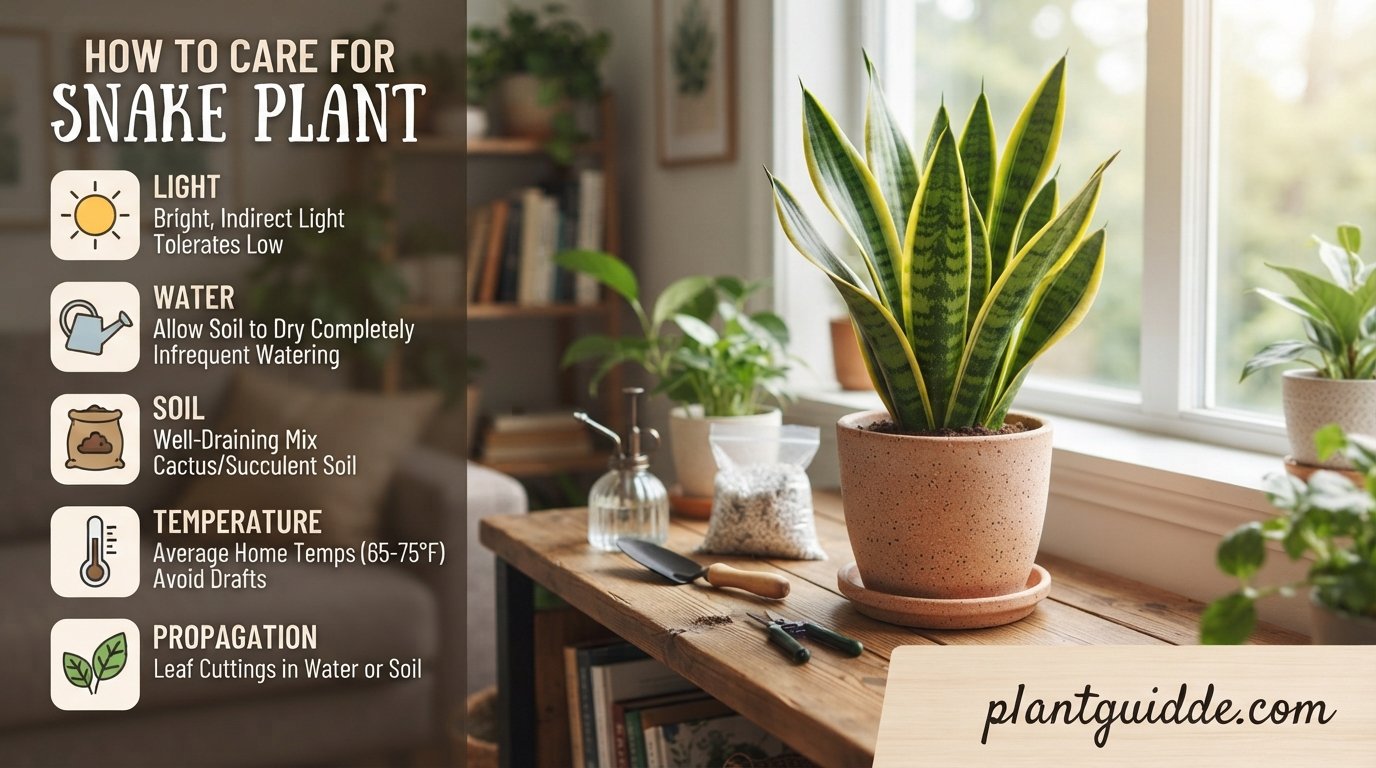
To care for a snake plant indoors, place it in bright indirect light or a lower-light location, use a fast-draining potting mix, and water only when the soil has mostly dried out. Keep the pot above standing water and avoid frequent misting. Snake plants tolerate normal household humidity and temperatures around 60–75°F (15–24°C), but overwatering is their biggest indoor-care mistake.
What Is a Snake Plant?
The plants commonly called snake plants or mother-in-law’s tongue are traditionally classified under Sansevieria, although they are now included botanically within Dracaena. Dracaena trifasciata is the currently accepted name for the species formerly known as Sansevieria trifasciata.
Snake plants have stiff, fleshy leaves that grow upward from underground rhizomes. Their water-storing foliage explains why they cope so well with occasional neglect. How to Care for Snake Plant Indoor.
Popular forms include:
- Dracaena trifasciata ‘Laurentii’ — green leaves with yellow margins
- ‘Hahnii’ — a compact bird’s-nest form
- Cylindrical-leaved snake plants
- Various green and variegated cultivars
RHS notes that snake plants are adaptable to conditions ranging from full sun to light shade, although brighter locations generally support better growth.
Image Suggestion: Show three snake plant varieties side by side, including a tall variegated type, compact ‘Hahnii’, and cylindrical-leaf variety.
Snake Plant Indoor Care at a Glance
| Care requirement | What your snake plant needs |
|---|---|
| Light | Bright indirect light is ideal; tolerates lower light |
| Water | Allow soil to dry substantially before watering |
| Soil | Fast-draining, well-aerated mix |
| Pot | Drainage hole strongly recommended |
| Humidity | Normal household humidity is usually sufficient |
| Temperature | Around 60–75°F (15–24°C) is ideal |
| Fertilizer | Light feeding during active growth |
| Repotting | Only when substantially root-bound |
| Pruning | Remove damaged or dead leaves |
| Biggest risk | Overwatering and poor drainage |
These recommendations align with RHS guidance that snake plants are drought-tolerant, adaptable houseplants that dislike wet conditions.
Give Your Snake Plant the Right Light
Light is one of the most misunderstood parts of snake plant care.
A snake plant can survive low light, but surviving is different from actively growing. How to Care for Snake Plant Indoor.
Best indoor location
For the best balance between growth and leaf quality, place your plant near:
- An east-facing window
- A bright north-facing window
- A few feet from a bright south- or west-facing window
- A bright room where direct midday sunlight does not hit the leaves for long periods
Snake plants can tolerate low-light conditions, but plants grown in brighter locations generally grow more vigorously. RHS also notes that plants in shade may develop taller leaves, while plants receiving more light can remain more compact.
Can snake plants tolerate direct sunlight?
Yes, but introduce stronger sunlight gradually.
A plant moved suddenly from a dim room to intense afternoon sun can develop scorched or bleached patches. This is particularly important with plants that have spent months indoors away from strong sunlight.
Practical tip: If your snake plant is healthy but has produced little new growth for months, light is one of the first things to evaluate before adding more fertilizer. How to Care for Snake Plant Indoor.
Image Suggestion: Create a simple indoor lighting diagram showing ideal placement near east, north, south, and west windows.

Water Your Snake Plant Less Often Than You Think
If there is one rule to remember from this entire guide, make it this:
Do not water your snake plant on a fixed weekly schedule.
A calendar cannot tell you how quickly your particular pot is drying.
A plant in a small terracotta pot near a bright window may dry much faster than a large snake plant sitting in a plastic pot in a dim room.
How to know when to water
Check the soil before watering.
You can:
- Push your finger several inches into the potting mix.
- Feel whether the soil is still noticeably moist.
- Check the weight of the pot if you know how it feels when dry.
- Water only when the mix has dried substantially.
When you do water, water thoroughly enough that some moisture drains from the bottom, then empty the saucer or outer container.
RHS specifically recommends allowing the compost to dry out between waterings and warns that standing water can contribute to root rot.
Why overwatering is so dangerous
Snake plants store water in their fleshy leaves. Their roots therefore do not need constantly wet soil.
When the root zone stays wet for too long, roots can lose access to adequate oxygen and begin to deteriorate. The result can be:
- Yellowing leaves
- Soft or collapsing leaves
- Brown, mushy roots
- An unpleasant smell from the soil
- Leaves falling over from the base
Ironically, a severely overwatered plant can eventually look dehydrated because damaged roots can no longer function properly. Snake Plant Indoor.
This is why adding more water to a struggling snake plant can make the problem worse.
Use Soil That Drains Quickly
The right soil is not simply “potting soil.”
A snake plant needs a growing medium that holds enough moisture for the roots while allowing excess water to escape quickly.
A cactus or succulent-style potting mix is a practical starting point. RHS recommends a free-draining cactus compost for sansevierias.
What good snake plant soil should do
It should:
- Drain excess water quickly
- Avoid becoming compacted
- Allow air around the roots
- Dry between waterings
- Remain structurally stable over time
A dense, moisture-retentive mix can become a problem even if you are reasonably careful with watering.
A simple approach
You can use a commercial cactus/succulent mix and improve drainage further with an appropriate coarse mineral component if needed.
The exact recipe matters less than the final behavior of the soil: water should not remain trapped around the roots for days.
Choose a Pot With Drainage
A drainage hole is one of the simplest ways to reduce watering mistakes.
A decorative container without drainage can hold excess water around the roots even when the surface looks dry.
Terracotta vs. plastic
Terracotta:
- Breathes more than plastic
- Usually dries faster
- Useful for people who tend to overwater
Plastic:
- Holds moisture longer
- Lightweight
- Useful when your indoor environment is very dry or the plant dries excessively quickly
Neither material is automatically better. Your watering habits and indoor conditions matter more.
Avoid oversized pots
A very large container holds more wet soil than a small root system can use efficiently.
This can leave the lower part of the pot wet for too long.
Repot when necessary rather than automatically moving the plant into a much larger container. RHS recommends potting on when snake plants become pot-bound.
Humidity: You Don’t Need to Mist a Snake Plant
This is where snake plant care differs from many tropical houseplants.
You generally do not need to create high humidity for a snake plant.
RHS specifically recommends low humidity and advises against misting snake plants.
So you can usually skip:
- Daily misting
- Humidity trays
- Constant humidifier use
- Keeping the plant in a steamy bathroom
Normal indoor humidity is generally sufficient.
Good airflow is useful, but avoid placing the plant directly in cold drafts.
Keep Temperatures Stable
Snake plants are comfortable in typical indoor temperatures.
A range around 60–75°F (15–24°C) is a useful target.
Avoid exposing them to:
- Freezing temperatures
- Cold drafts
- Very cold windows during winter
- Direct blasts from heaters
- Extreme temperature swings
The goal isn’t to create a tropical environment. Snake Plant Indoor. A stable household environment is usually much more appropriate.
Fertilize Carefully
Snake plants are relatively slow-growing, so they do not require aggressive feeding.
During active growth, a balanced liquid houseplant fertilizer used according to its label can support growth. RHS recommends feeding approximately monthly during the growing season.
A common beginner mistake
More fertilizer does not necessarily mean faster growth.
Excess fertilizer can build up salts in the growing medium and damage roots.
If your plant is sitting in low light and barely growing, increasing fertilizer is unlikely to solve the underlying problem. Improve the growing conditions first.
How to Repot a Snake Plant Indoors
Snake plants don’t need frequent repotting.
In fact, they often perform perfectly well when slightly root-bound.
Signs it may be time to repot
Look for:
- Roots filling most of the container
- Rhizomes becoming crowded
- The plant repeatedly drying extremely quickly
- The container becoming unstable
- Roots emerging through drainage holes
Repotting steps
- Choose a container only moderately larger than the current one.
- Make sure it has drainage.
- Prepare a fast-draining potting mix.
- Remove the plant carefully.
- Inspect the roots and remove clearly damaged or rotten material.
- Replant at approximately the same depth.
- Allow the plant to settle into its new container.
- Avoid turning the fresh repot into an excuse for repeated watering.
Image Suggestion: Step-by-step infographic showing snake plant removal, root inspection, new pot, soil placement, and final positioning.
Pruning and Cleaning Snake Plant Leaves
Snake plants require little pruning.
Remove leaves that are:
- Completely dead
- Severely damaged
- Rotten at the base
- Visually interfering with healthy growth
Use a clean, sharp tool and cut damaged foliage close to the soil line when necessary.
For dusty leaves, gently wipe them with a clean, slightly damp cloth.
Avoid aggressive polishing products designed to make leaves look artificially shiny.
Why Are My Snake Plant Leaves Turning Yellow?
Yellow leaves are a symptom, not a diagnosis.
One of the first things to investigate is excess moisture, particularly when several leaves are becoming yellow and the soil remains wet for long periods.
Ask yourself:
- How often have I been watering?
- Is the soil still wet several days after watering?
- Does the pot have a drainage hole?
- Is the container much larger than the root system?
- Is the plant sitting in water?
- Is the base of the affected leaf soft?
If several answers point toward excess moisture, correct the watering and drainage problem before adding anything else.
Why Are Snake Plant Leaves Curling?
Curling or folding leaves can have several causes.
Check:
- Whether the soil has become extremely dry
- Whether roots are damaged from prolonged wetness
- Whether the plant is exposed to excessive heat
- Whether it has recently been moved
- Whether there are visible pests
Do not automatically assume curling means “the plant needs water.”
If the soil is already wet, adding more water can compound the problem.
Best troubleshooting rule: diagnose the root environment before treating the leaves.
Why Are My Snake Plant Leaves Soft or Falling Over?
This is a particularly important warning sign.
Firm upright leaves are normal. Soft, collapsing leaves—especially when accompanied by wet soil—can indicate a root or base problem.
If the soil is wet
Inspect the roots and lower portions of the plant.
Healthy roots should not be mushy and decaying.
If the soil is extremely dry
A severely dehydrated plant may also show loss of firmness, although snake plants can tolerate substantial dryness.
The combination of soft leaves + consistently wet soil deserves much more concern than dry soil alone.
Brown Tips and Brown Spots
Brown tips can result from several environmental stresses, including inconsistent watering, physical damage, or unfavorable growing conditions.
Look at the pattern rather than treating every brown tip identically.
Brown tips with otherwise healthy foliage
If the plant is growing normally and only a few tips are brown, the damage may be cosmetic.
Brown, spreading, or soft areas
If discoloration is accompanied by soft tissue, persistent wetness, or deterioration near the base, investigate watering and root health.
Cutting off the brown section may improve appearance, but it does not fix the underlying cause.
Common Snake Plant Care Mistakes
The easiest way to improve your care routine is to eliminate the mistakes that repeatedly cause problems.
Mistake 1: Watering every week
Why it fails: Indoor drying rates vary dramatically.
Better approach: Check the soil before watering.
Mistake 2: Keeping the soil permanently moist
Why it fails: Snake plants are drought-tolerant and dislike prolonged wet conditions.
Better approach: Let the growing medium dry substantially between waterings.
Mistake 3: Putting the plant in complete darkness
Why it fails: Low light is tolerated, but growth becomes limited.
Better approach: Give it the brightest suitable indirect light available.
Mistake 4: Using a pot without drainage
Why it fails: Excess water has nowhere to escape.
Better approach: Use a drainage hole and empty excess water.
Mistake 5: Misting constantly
Why it fails: Snake plants do not require high humidity.
Better approach: Focus on drainage and airflow instead.
Mistake 6: Fertilizing a struggling plant immediately
Why it fails: Fertilizer cannot repair rotten roots or compensate for poor light.
Better approach: Identify the environmental problem first.
A Simple Snake Plant Care Routine
You do not need a complicated schedule.
Every few days
Look at the plant rather than automatically doing something to it.
Every week or two
Check soil moisture, especially during warmer periods.
Every few weeks
Inspect leaves for:
- Pests
- Dust
- New growth
- Discoloration
- Soft areas
During active growth
Consider light feeding if the plant is healthy and actively growing.
During winter
Reduce watering as growth slows and the plant uses less water. RHS notes that snake plants may require very little water in winter, particularly when kept in cooler conditions.
Seasonal Snake Plant Care
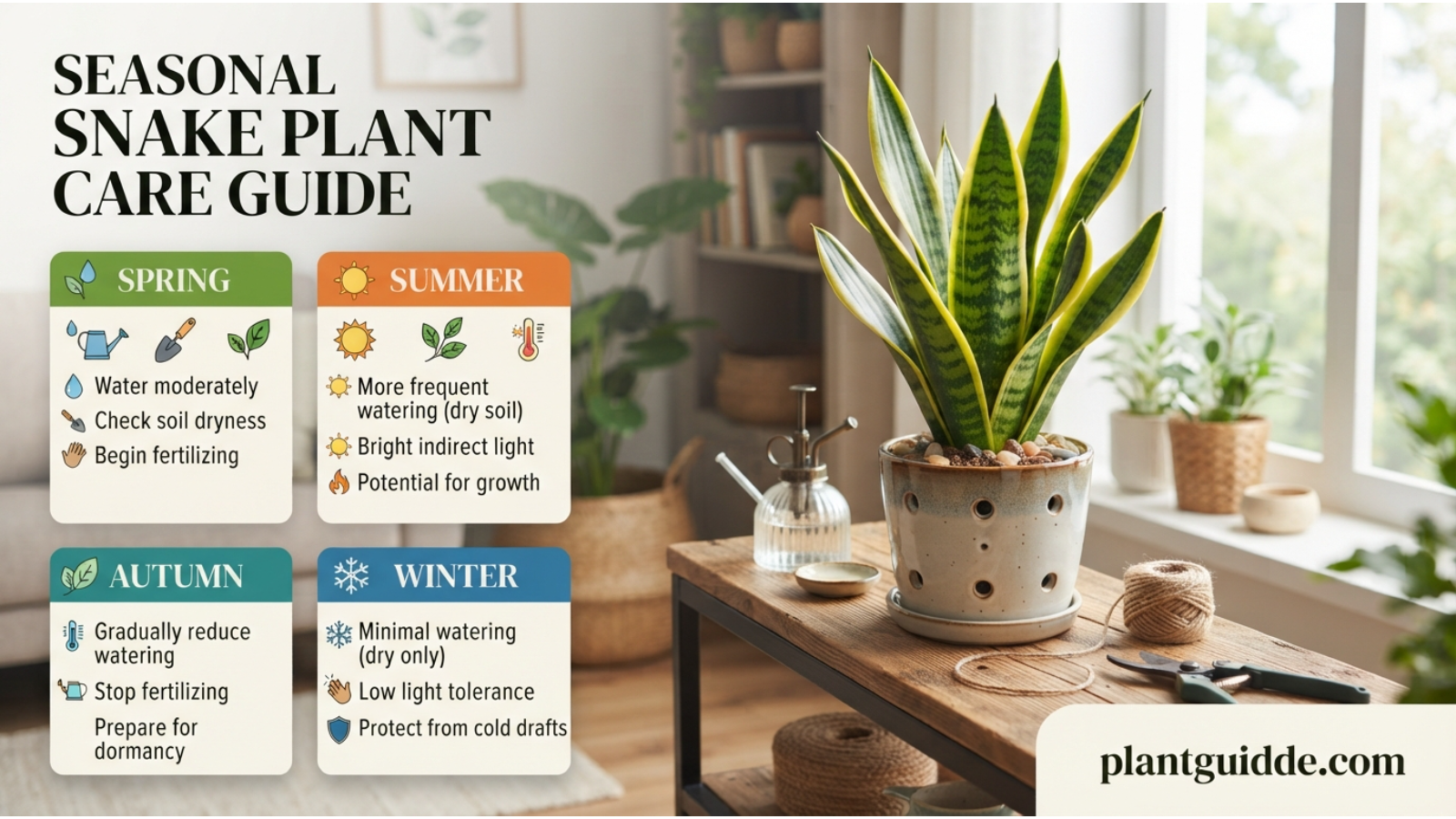
Spring and Summer
As light and temperatures increase:
- Growth may accelerate
- Soil may dry faster
- Watering may become more frequent
- Fertilizing can be more useful
But don’t increase watering simply because the calendar says summer. Check the soil.
Fall
Growth may begin slowing.
Start paying closer attention to how long the pot remains moist.
Winter
Indoor heating can make the air dry, but that does not automatically mean the soil needs more water.
Lower light and slower growth often mean less water demand, not more.
Can Snake Plants Grow in Low Light?
Yes—but there is an important distinction.
Low-light tolerance does not mean low-light preference.
A snake plant can remain alive in a dim office or hallway, but growth may be slower and the plant may become less vigorous.
If your goal is simply survival, low light may be acceptable.
If your goal is healthy growth and strong foliage, give the plant brighter indirect light whenever possible. RHS confirms that snake plants tolerate lower light but generally grow better in brighter positions.
How to Make a Snake Plant Grow Faster
There is no reliable shortcut.
Instead, optimize the conditions that control growth:
- Provide adequate light.
- Use fast-draining soil.
- Water when the soil has dried sufficiently.
- Avoid root damage from standing water.
- Keep temperatures reasonably stable.
- Feed moderately during active growth.
- Give the roots enough space without over-potting.
A plant receiving more light will generally have greater potential for active growth than the same plant kept in deep shade.
Can Snake Plants Be Grown in Bedrooms?
Yes. Snake plants are commonly grown indoors, including bedrooms, offices, living rooms, and other household spaces.
The plant’s care requirements do not change simply because it is placed in a bedroom.
The important factors remain:
- Available light
- Watering
- Drainage
- Temperature
- Air movement
One important consideration for pet owners is that snake plants are listed by the ASPCA as toxic to cats and dogs. Reported signs include nausea, vomiting, and diarrhea. Keep the plant inaccessible to pets that may chew it.
Can You Propagate a Snake Plant?
Yes.
Snake plants can be propagated through:
- Division
- Rhizome offsets
- Leaf cuttings, depending on the cultivar
Division is particularly straightforward when a mature plant has produced multiple shoots.
For variegated cultivars, propagation method matters because leaf cuttings may not always preserve the original variegation, whereas division can retain the characteristics of the parent plant.
Internal Link Opportunity: Link this section to a dedicated guide such as How to Propagate Snake Plants From Leaves and Pups.
The Most Important Rule for Diagnosing Problems
When your snake plant looks unhealthy, resist the urge to immediately add water, fertilizer, humidity, or another treatment.
Instead, follow this order:
Leaves → Soil → Roots → Light → Pot → Recent changes
For example:
Yellow + soft leaves + wet soil
→ investigate overwatering and root problems.
Slow growth + healthy firm leaves + dark location
→ investigate light.
Dry soil + wrinkled leaves
→ investigate dehydration.
Brown patches after moving into strong sunlight
→ investigate light stress.
This approach is much more reliable than treating symptoms individually.
FAQs,
How often should I water an indoor snake plant?
There is no universal weekly schedule. Check the soil and water when it has dried substantially. Your pot size, soil, light, temperature, and season all affect how quickly it dries.
Does a snake plant need direct sunlight?
Not necessarily. Bright indirect light is an excellent indoor option. Snake plants can tolerate lower light and can handle some direct sun when acclimated, but intense midday summer sun can scorch foliage.
Why is my snake plant turning yellow?
Overwatering is an important possibility, especially if the soil remains wet for long periods. Check drainage, watering frequency, and root condition before treating the leaves.
Should I mist my snake plant?
No. Snake plants generally prefer relatively low humidity, and RHS specifically advises against misting them.
What is the best soil for snake plants?
Use a fast-draining cactus or succulent-style mix. The key requirement is that excess water can escape rather than remaining around the roots.
How do I know if my snake plant is overwatered?
Watch for consistently wet soil, yellowing leaves, soft or collapsing foliage, and deteriorating roots. A plant can also appear wilted when its roots have been damaged by excessive moisture.
Do snake plants need fertilizer?
They can benefit from moderate feeding during active growth, but they are not heavy feeders. Avoid excessive fertilizer, particularly when the plant is not actively growing.
Can snake plants survive in a dark room?
They can tolerate low light, but growth will generally be slower. A brighter location is preferable when you want stronger growth.
Should I cut damaged snake plant leaves?
Remove severely damaged, dead, or rotten leaves with a clean, sharp tool. Minor cosmetic damage can often simply be left alone.
Are snake plants safe for cats and dogs?
No. The ASPCA lists snake plants as toxic to cats and dogs because they contain saponins; ingestion can cause gastrointestinal symptoms such as vomiting and diarrhea
Final Takeaway
Learning how to care for snake plant indoor is less about creating a complicated plant-care routine and more about avoiding the wrong conditions.
Give your plant suitable light, let the soil dry between waterings, use a well-draining mix and container, and resist the temptation to constantly mist, fertilize, or water it.
The biggest practical lesson is simple: a snake plant usually benefits more from restraint than attention.
Once you learn to read the soil, leaves, and growing conditions together, caring for a snake plant becomes remarkably straightforward, and problems become much easier to diagnose before they become serious.

Asad Mumtaz is a dedicated plant enthusiast and gardening writer with a passion for helping people care for their plants successfully. He specializes in plant care guides, indoor gardening, and practical growing tips for all skill levels. His content focuses on making gardening simple, enjoyable, and rewarding. Through his work, Asad shares reliable advice to help readers create thriving green spaces.