
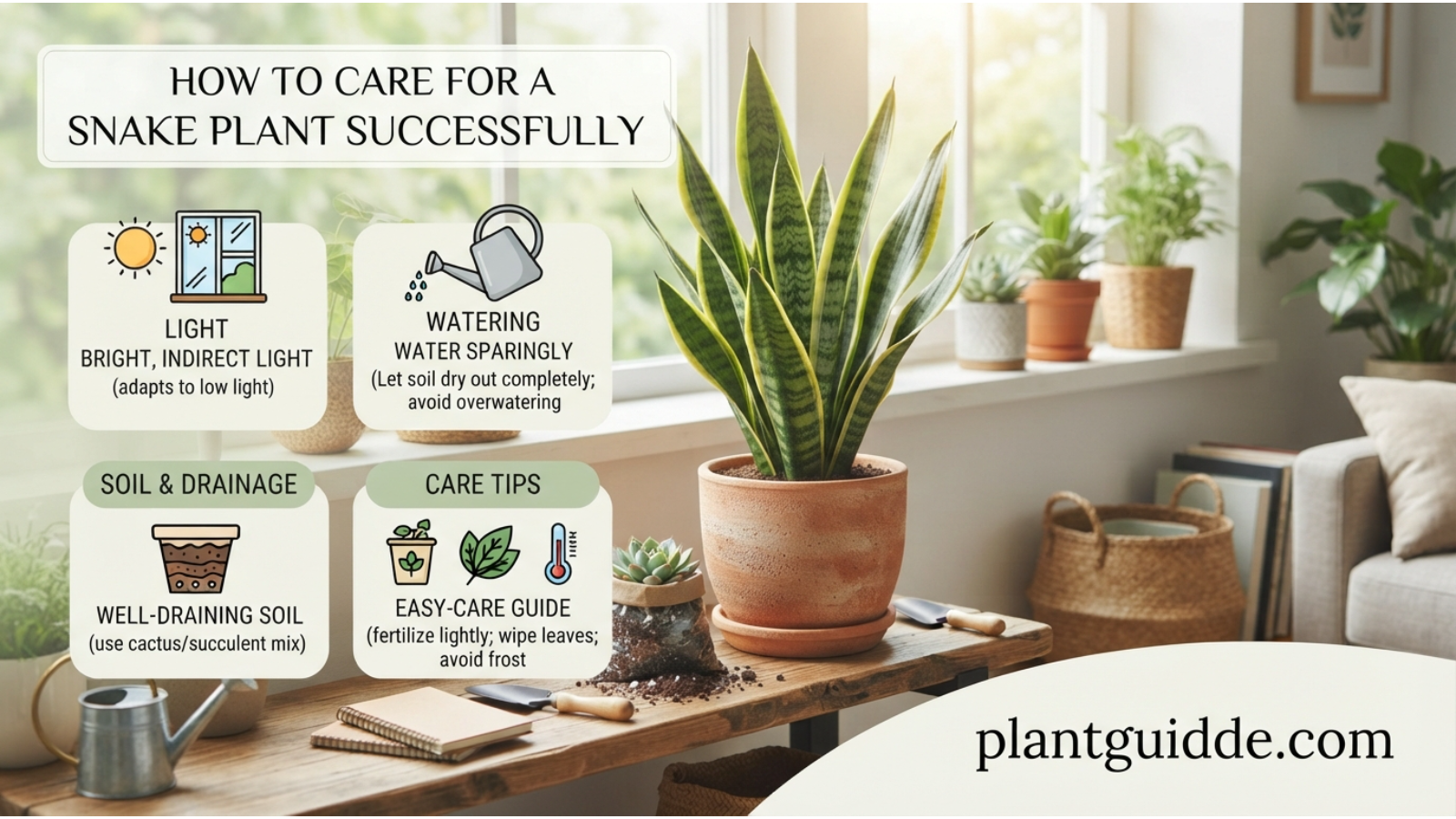
Snake plants are among the easiest houseplants to keep alive, but “easy” does not mean they can tolerate every mistake. Their thick, upright leaves store water, allowing them to handle dry conditions and periods of neglect. The real danger is usually the opposite: watering too often, using dense soil, or keeping the roots in a pot that drains poorly. How to Care for a Snake Plant.
That is why learning how to care for snake plant properly is less about following a strict watering calendar and more about understanding what the plant is telling you.
A healthy snake plant should have firm leaves, good color, and stable growth. If the leaves become soft, yellow, mushy, or start collapsing at the base, the problem is often related to excess moisture rather than a lack of water. The good news is that snake plants are remarkably forgiving when their basic needs are met.
Quick Answer
To care for a snake plant, place it in bright indirect light or a lower-light location, use a fast-draining potting mix, and let the soil dry thoroughly between waterings. Water deeply only when the soil is dry, then empty excess water from the saucer. Keep the plant in a warm, stable room, avoid constantly wet soil, and repot only when the roots have filled the container. Snake plants need less water than most houseplants.
What Is a Snake Plant?
The plant commonly called snake plant or mother-in-law’s tongue is most widely known botanically as Dracaena trifasciata. It was formerly classified as Sansevieria trifasciata, which is why both names still appear on plant labels and gardening websites. It belongs to the Asparagaceae family.
Snake plants have thick, fleshy leaves that grow upward from underground rhizomes. Their foliage may be green, gray-green, yellow-edged, striped, or patterned depending on the variety.
Common types include:
- Dracaena trifasciata ‘Laurentii’ – green leaves with yellow margins
- ‘Hahnii’ – a compact bird’s-nest form
- ‘Moonshine’ – silvery green foliage
- Dracaena cylindrica – cylindrical, upright leaves
- Whale-fin types – broad, paddle-shaped leaves
Although their appearance is tropical, their succulent leaves are adapted to storing water. That adaptation explains one of the most important rules of snake plant care: letting the soil dry is usually safer than keeping it constantly moist.
Image Suggestion: Create a labeled visual showing common snake plant varieties, including ‘Laurentii,’ ‘Hahnii,’ ‘Moonshine,’ and cylindrical forms.
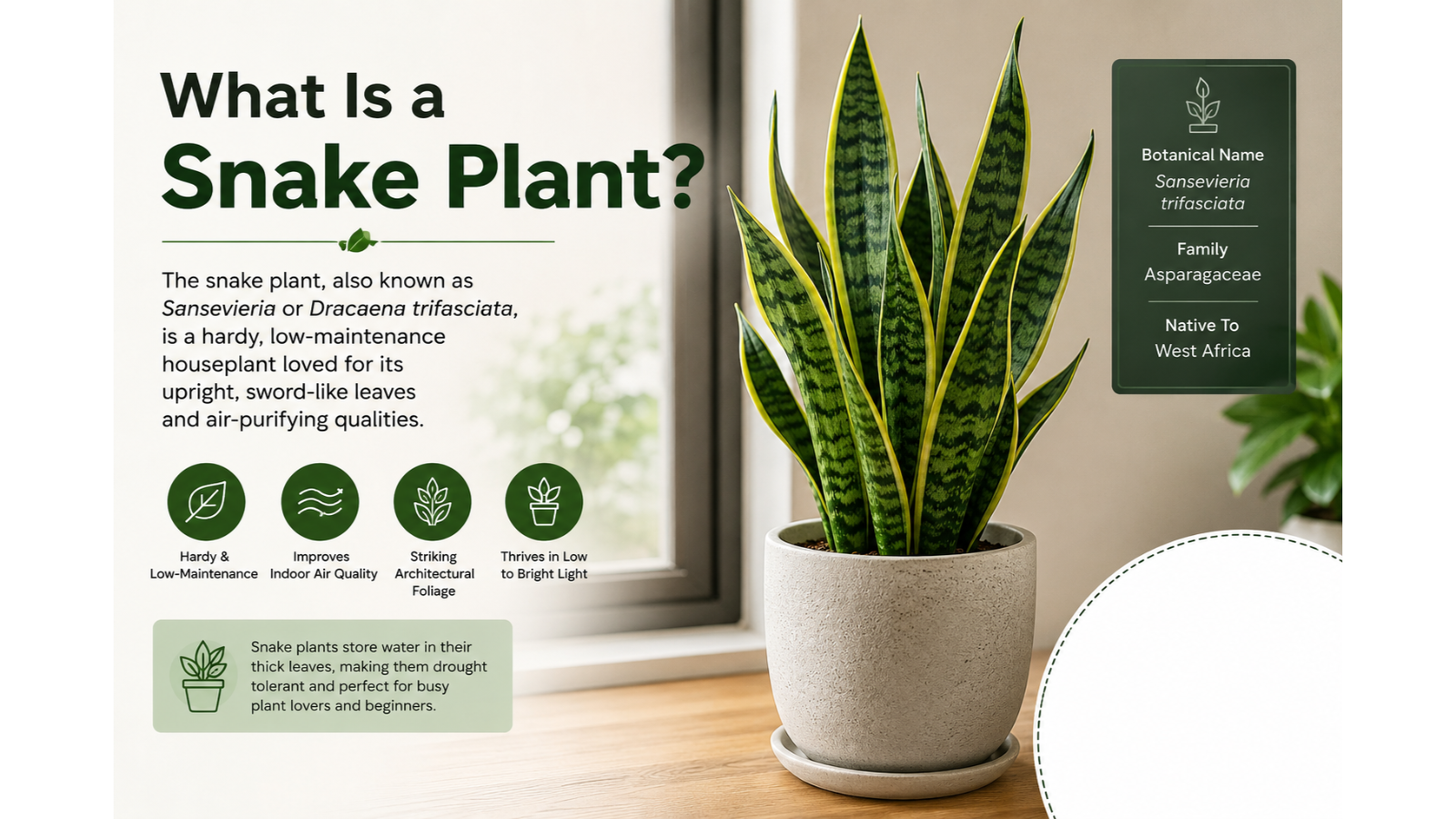
Snake Plant Care Requirements at a Glance
| Care factor | What a snake plant prefers |
|---|---|
| Light | Bright indirect light to lower light |
| Direct sun | Some direct sun is tolerated, but intense midday sun can scorch foliage |
| Water | Allow soil to dry thoroughly before watering |
| Soil | Fast-draining, well-aerated mix |
| Pot | Container with drainage holes |
| Humidity | Normal household humidity is generally sufficient |
| Temperature | Around 15–24°C (60–75°F) is ideal |
| Fertilizer | Light feeding during active growth |
| Repotting | Only when roots fill the container |
| Growth rate | Generally slow to moderate indoors |
The important point is that these are preferences, not rigid rules. A plant in a bright, warm room may use water much faster than the same plant sitting in a cool, dim corner.
Give Your Snake Plant the Right Light
Snake plants are unusually adaptable when it comes to light. They can survive in low-light interiors, but they generally grow better when given brighter conditions.
Best light for snake plants
A good starting point is:
- Bright indirect light near an east- or west-facing window
- Filtered light near a brighter south-facing window
- Lower light for varieties and situations where slower growth is acceptable
A common misconception is that a snake plant should be kept in a dark corner because it is advertised as a “low-light plant.”
It may survive there, but survival and healthy growth are not the same thing.
In low light, growth may become slower, and some plants can develop weaker or less compact growth. Brighter conditions generally support stronger growth.
Can snake plants tolerate direct sunlight?
Yes, but introduce stronger sunlight gradually.
A plant that has spent months in a dim room can develop leaf scorch if suddenly moved into intense afternoon sun. RHS recommends bright or lightly shaded conditions and warns that strong summer midday sun can scorch the foliage.
Practical tip: If you want to move your snake plant from low light to a sunny window, increase its exposure gradually rather than changing its location overnight.
Image Suggestion: Show three snake plants positioned in low, medium, and bright indirect light, with visual indicators of expected growth.
Water a Snake Plant Less Often Than You Think
If there is one part of snake plant care that deserves the most attention, it is watering.
Snake plants have fleshy leaves that store water. Because of this, they do not need the frequent watering routine used for plants such as ferns or many tropical foliage plants. Overwatering is one of the most common causes of poor health and root rot.
When should you water a snake plant?
Do not water simply because a certain number of days has passed.
Instead:
- Push your finger into the soil.
- Check whether the soil is still damp below the surface.
- If it remains moist, wait.
- If the soil has dried thoroughly, water the plant.
- Water until some moisture drains from the bottom.
- Empty the saucer or outer container afterward.
RHS specifically recommends checking the compost rather than watering according to a fixed routine.
Why a calendar can fail
Imagine two identical snake plants:
- Plant A sits beside a bright window in a warm room.
- Plant B sits several feet from a window in a cooler room.
The first may dry substantially faster than the second.
Therefore, “water every seven days” is not a reliable universal rule.
What happens if you overwater?
Constantly wet soil reduces the air available around the roots and creates conditions that encourage root problems.
Warning signs can include:
- Yellowing leaves
- Soft or mushy leaves
- Brown or collapsing areas near the base
- A plant that becomes loose in the pot
- Unpleasant-smelling soil
- Sudden leaf collapse
The key distinction is important: a thirsty snake plant is usually easier to recover than a snake plant with severely damaged roots.
Use Fast-Draining Snake Plant Soil
Snake plant soil should hold enough moisture to support the plant while allowing excess water to escape quickly.
A heavy, compacted potting mix can remain wet for too long, particularly in a large container or low-light room.
A suitable starting point is a commercial cactus or succulent mix, provided it drains well. RHS recommends free-draining peat-free cactus compost for sansevierias.
What makes good snake plant soil?
Look for a mix that is:
- Fast draining
- Well aerated
- Not easily compacted
- Appropriate for succulent-type plants
The exact recipe is less important than the result.
If water sits in the pot for a long time after watering, investigate the soil, container, and drainage before simply reducing the amount of water.
Expert tip: A drainage hole cannot compensate for soil that stays saturated for too long. The container and potting mix need to work together.
Choose the Right Pot
The best snake plant pot is not necessarily the largest one.
Snake plants generally prefer being somewhat snug in their containers. RHS recommends repotting when roots and leaves have filled the existing container and advises choosing a pot only slightly larger than the previous one.
Always prioritize drainage
Choose a container with:
- At least one drainage hole
- Enough stability to support upright foliage
- A size appropriate for the existing root system
Avoid placing a drainage-less decorative pot directly around a nursery pot and forgetting to empty the outer container after watering.
Why oversized pots cause problems
A much larger pot contains more soil than the roots currently need. That extra soil can remain wet longer after watering, increasing the risk of root problems.
This is one reason “more room for the roots” is not always better.
Keep Temperature Reasonably Stable
Snake plants do well in normal indoor temperatures.
RHS recommends approximately 15–24°C (60–75°F) and advises protecting them from cold drafts and radiators.
Avoid placing the plant:
- Directly against a very cold window during winter
- Beside an intense heater
- In a constantly cold draft
- Outdoors where freezing temperatures are possible
The goal is not to maintain a laboratory-perfect temperature. A reasonably stable indoor environment is usually enough.
Do Snake Plants Need High Humidity?
No.
This is one area where snake plants differ from many popular tropical houseplants.
Snake plants generally tolerate normal household humidity and do not require regular misting. RHS specifically recommends low humidity and advises against misting or placing sansevierias in a steamy bathroom.
That means you usually do not need:
- Daily misting
- A humidifier specifically for the snake plant
- Pebble trays
- A steamy bathroom
Good airflow is useful, but avoid cold drafts.
How to Fertilize a Snake Plant
Snake plants are not heavy feeders.
If your plant is growing actively, a balanced liquid houseplant fertilizer can be used according to the product’s instructions. RHS recommends feeding about once a month during the growing season.
However, fertilizer should not be used as a cure for every growth problem.
If a snake plant is sitting in poor light or waterlogged soil, adding more fertilizer will not fix the underlying problem.
A better approach
Before fertilizing, ask:
- Is the plant receiving adequate light?
- Does the pot drain properly?
- Does the soil dry between waterings?
- Is the plant actively growing?
If the answer to these questions is mostly yes, occasional feeding can support growth.
How to Repot a Snake Plant
Snake plants generally do not need frequent repotting.
Repot when:
- Roots have filled the container
- The pot is becoming unstable
- The root mass is severely crowded
- The existing potting mix has deteriorated
- The container is buckling or restricting the plant
RHS notes that newly purchased sansevierias can often remain in their original containers for years and recommends repotting only when the plant becomes pot-bound or the container is no longer suitable.
Step-by-step repotting
- Choose a pot only slightly larger than the current one.
- Make sure it has drainage holes.
- Prepare a fast-draining potting mix.
- Carefully remove the plant.
- Inspect the roots for damage or rot.
- Remove clearly damaged roots with a clean tool.
- Place the plant at approximately the same depth as before.
- Fill around the roots with fresh mix.
- Allow the plant to settle into its new container.
- Avoid creating a constantly wet environment after repotting.
Image Suggestion: A step-by-step repotting diagram showing the root ball, drainage hole, fresh soil, and correct planting depth.
How to Prune a Snake Plant
Snake plants rarely require routine pruning.
Remove individual leaves when they are:
- Completely damaged
- Dead
- Severely diseased
- Visually distracting
Cut damaged leaves near the base using a clean, sharp tool.
Avoid repeatedly cutting healthy leaf tips simply to make the plant shorter. Snake plant leaves do not regrow from a cut tip in the same way a new leaf emerges from the growing point.
RHS also notes that damaged leaves can be removed at the base and recommends wearing gloves because the sap can irritate skin.
How to Propagate a Snake Plant
Snake plants can be propagated through several methods, including division and leaf cuttings. Established plants also produce offsets that can be separated and replanted.
Propagating by division
Division is often the easiest choice when the plant has multiple shoots or crowded growth.
- Remove the plant from its pot.
- Identify natural sections connected by rhizomes.
- Separate a healthy section carefully.
- Ensure the division has appropriate roots and foliage.
- Plant it in a small, well-draining container.
- Avoid excessive watering while it establishes.
Propagating from leaf cuttings
Leaf propagation is another option, although results can vary by cultivar.
This is particularly important with variegated snake plants: some leaf-cutting methods may produce offspring that do not retain the exact variegation of the parent plant.
Expert tip: If preserving the characteristics of a variegated cultivar matters to you, division or offsets are generally preferable to relying on leaf cuttings.
Snake Plant Problems: What the Leaves Are Telling You
One of the most useful skills in houseplant care is learning to diagnose symptoms rather than treating every problem with more water or fertilizer.
Yellow Snake Plant Leaves
Yellow leaves can have several causes, but persistent wet soil should be one of the first things you investigate.
Check:
- Soil moisture
- Drainage
- Pot size
- Root condition
- Recent watering frequency
If the soil is staying wet for long periods, correcting the moisture problem is more important than adding fertilizer.
Snake Plant Leaves Turning Brown
Brown areas may result from environmental stress, physical damage, intense sunlight, or watering-related problems.
Look at the pattern:
- Crispy patches after sudden strong sunlight → possible sun damage
- Soft brown areas near the base → investigate excess moisture and root problems
- Dry damaged tips → inspect watering consistency and environmental conditions
Do not diagnose the problem from color alone.
Snake Plant Leaves Curling
Curling or folding leaves can indicate stress, but the surrounding conditions matter.
Check:
- Is the soil extremely dry?
- Has the plant recently been moved?
- Is it exposed to excessive heat?
- Is the root system healthy?
- Is the plant receiving appropriate light?
A curled leaf is a symptom, not a diagnosis.
Snake Plant Leaves Becoming Soft
Softness is more concerning than ordinary dryness.
If several leaves become soft or collapse, inspect the soil and lower part of the plant. A combination of soft leaves and persistently wet soil is a strong reason to investigate possible root or rhizome damage.
Snake Plant Falling Over
If individual leaves lean, check whether the plant is receiving light mainly from one direction.
Rotate the pot periodically so growth is more even.
If the entire plant becomes unstable or collapses at the base, however, investigate the roots and rhizomes rather than assuming the plant simply needs support. RHS notes that whole-plant leaning can be associated with root rot.
The Most Common Snake Plant Care Mistakes
1. Watering on a schedule
A weekly reminder is convenient, but the plant’s soil condition matters more than the calendar.
2. Using a huge decorative pot
More soil can mean more retained moisture.
3. Keeping the plant in darkness
Snake plants tolerate low light, but that does not mean they prefer complete darkness.
4. Misting constantly
Snake plants generally do not need high humidity or regular misting.
5. Fertilizing a stressed plant
Fertilizer cannot compensate for poor drainage, insufficient light, or root damage.
6. Watering into the leaf rosette
When watering, direct water toward the soil rather than repeatedly allowing it to sit in the center of the plant.
7. Repotting too frequently
A snake plant does not need to be moved into a larger pot every year simply because time has passed.
A Simple Snake Plant Care Routine
If you want a practical routine rather than a complicated schedule, use this:
Every few days
Look at the plant.
You are checking for obvious changes such as:
- New yellow leaves
- Sudden drooping
- Physical damage
- Pests
- Leaning
You do not necessarily need to water.
Before watering
Check the soil moisture.
If it is still damp, wait.
If it has dried thoroughly, water.
During watering
Water thoroughly enough to moisten the root zone, allow excess water to drain, and empty standing water.
Every month during active growth
Evaluate:
- New growth
- Light exposure
- Soil condition
- Whether fertilizer is appropriate
Every few months
Rotate the pot and inspect the plant more closely.
This simple observation-based approach is more reliable than treating snake plant care as a fixed calendar.
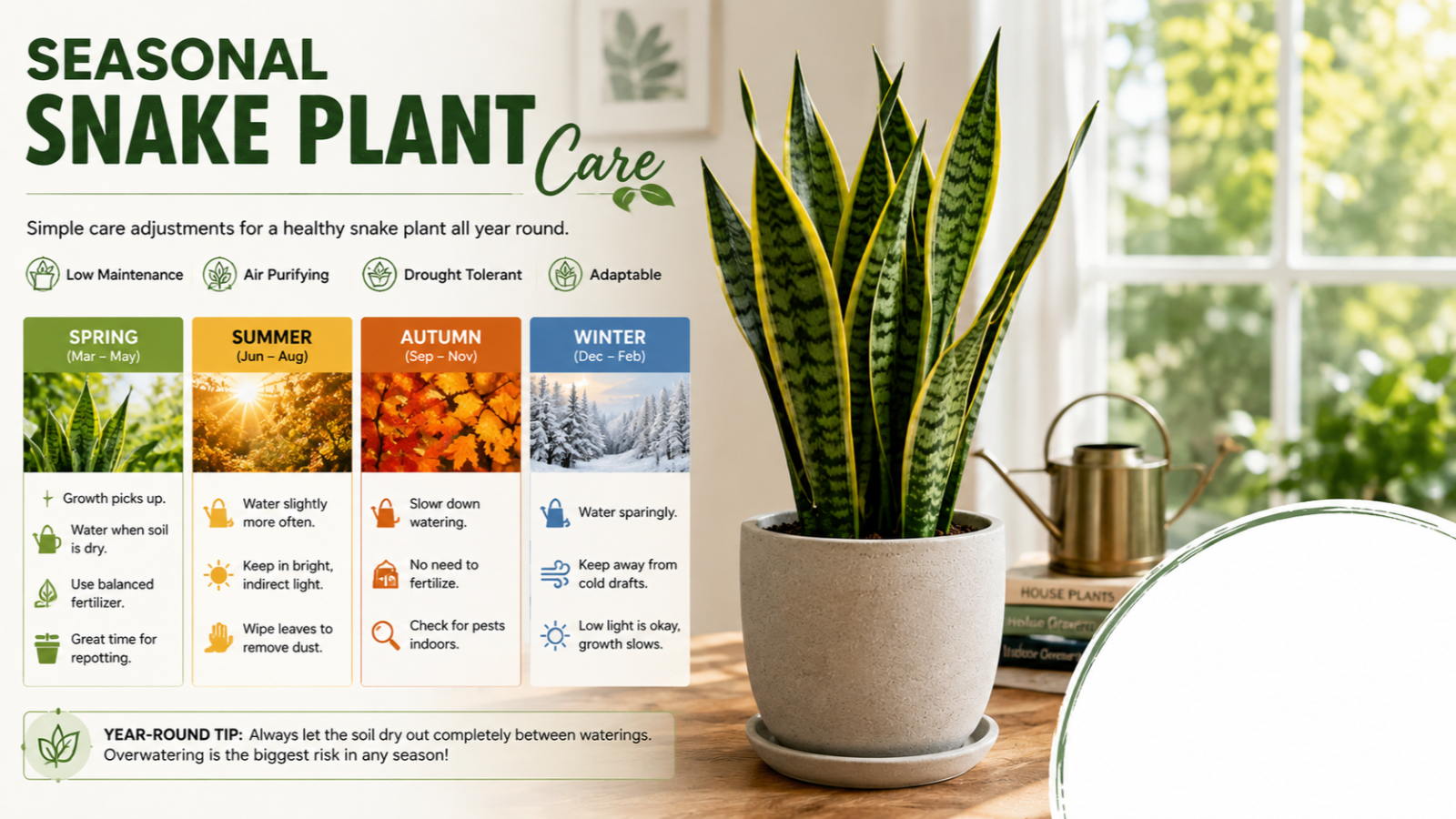
Seasonal Snake Plant Care
Spring
As light and growth increase, the plant may begin using water more quickly.
Check the soil more regularly, but do not automatically increase watering.
This can also be a good time for propagation or repotting if the plant genuinely needs it.
Summer
Bright light can increase water use, but hot weather does not mean the plant should sit in constantly wet soil.
Protect it from sudden exposure to intense midday sunlight, particularly if it has been growing indoors under lower light.
Autumn
As growth slows, the plant may require less water.
Start paying more attention to how quickly the soil dries.
Winter
Indoor heating can make rooms warm while the plant’s light levels decline. This combination can be misleading: the room may feel dry, but the soil may still remain wet for a long time.
Reduce watering according to actual soil moisture and growth rather than continuing a summer routine.
North Carolina Extension specifically notes substantially reduced winter watering for snake plants.
How to Care for a Snake Plant Indoors
For most indoor growers, the ideal setup is surprisingly simple:
Place it near a reasonably bright window, use a fast-draining mix, choose a pot with drainage, and wait for the soil to dry before watering again.
You do not need to recreate a tropical greenhouse.
Snake plants are adapted to storing water and are comfortable with the relatively dry conditions found in many homes.
If your plant is in a dark room, moving it closer to a source of natural light may improve growth. If it is in intense afternoon sun, filtered light may prevent scorching.
The best location is therefore not necessarily “the brightest possible window.” It is the location that provides suitable light without creating excessive heat or leaf scorch.
Snake Plant Care: What Matters Most?
If you remember only five things, remember these:
- Light: Give it bright indirect light when possible, although it can tolerate lower light.
- Water: Let the soil dry thoroughly between waterings.
- Soil: Use a fast-draining mix.
- Pot: Always provide drainage and avoid unnecessarily large containers.
- Observation: Check the plant and soil before changing the care routine.
These five habits prevent many of the problems beginners encounter.
FAQs:
How often should I water a snake plant?
There is no universal number of days. Water when the soil has dried thoroughly rather than following a fixed calendar. Bright, warm conditions may require more frequent watering than a cool, dim location.
Do snake plants need direct sunlight?
They can tolerate some direct sunlight, but intense midday sun can scorch leaves, especially when a plant has not been acclimated. Bright filtered or indirect light is a safe general choice.
Can a snake plant survive in a dark room?
It can tolerate low light, but very low light usually means slower growth. If possible, provide a brighter location without exposing the plant abruptly to harsh direct sunlight.
Why are my snake plant leaves turning yellow?
Overwatering and poorly draining conditions are important possibilities. Check whether the soil stays wet for long periods and inspect the roots if the plant is deteriorating.
Should I mist my snake plant?
Usually, no. Snake plants tolerate low humidity and generally do not require misting.
What is the best soil for snake plants?
Use a fast-draining, well-aerated potting mix. A suitable cactus or succulent mix is a practical choice.
Do snake plants need fertilizer?
They can benefit from occasional fertilizer during active growth, but they are not heavy feeders. Fix light, drainage, and watering problems before relying on fertilizer to improve growth.
When should I repot my snake plant?
Repot when the plant has genuinely outgrown its container, rather than automatically repotting every year. Choose a container only slightly larger than the existing one.
Why is my snake plant falling over?
Check whether individual leaves are simply leaning toward the light. If the entire plant is becoming unstable or collapsing near the base, inspect the roots and rhizomes for possible rot or other damage.
Can snake plants grow in low light?
Yes. Snake plants are among the houseplants that tolerate low-light interiors, although brighter suitable light generally supports better growth.
Are snake plants safe around pets and children?
Snake plants are considered harmful if eaten. Keep them away from children and pets who may chew on the leaves. RHS also advises wearing gloves when handling the plant because its sap can irritate skin.
Conclusion
Successful snake plant care is not about giving the plant constant attention. It is about avoiding the conditions that cause the most trouble.
Give your plant suitable light, plant it in well-draining soil, use a container with drainage, and let the soil dry between waterings. Then pay attention to changes in the leaves and soil instead of automatically adding more water, fertilizer, or humidity.
The biggest shift for beginners is simple: treat a snake plant more like a drought-tolerant succulent than a thirsty tropical houseplant.
Once you understand that, caring for one becomes much easier, and problems such as yellow leaves, soft foliage, root rot, and repeated watering mistakes become far easier to prevent.

Asad Mumtaz is a dedicated plant enthusiast and gardening writer with a passion for helping people care for their plants successfully. He specializes in plant care guides, indoor gardening, and practical growing tips for all skill levels. His content focuses on making gardening simple, enjoyable, and rewarding. Through his work, Asad shares reliable advice to help readers create thriving green spaces.