Basil is one of the most rewarding herbs to grow at home. Learning how to care for a basil plant can help you enjoy fresh leaves for pesto, pasta, salads, sauces, and more. However, basil can quickly go from healthy to stressed. Yellow leaves, wilting, weak growth, and early flowering are common signs that something is wrong.
The good news is that basil is easy to care for when you provide the right conditions. Warm temperatures, plenty of sunlight, consistent moisture, and good drainage are the keys to healthy growth. In this guide, you’ll learn how to care for a basil plant indoors or outdoors, along with simple tips for watering, pruning, harvesting, and fixing common problems.
Quick Answer
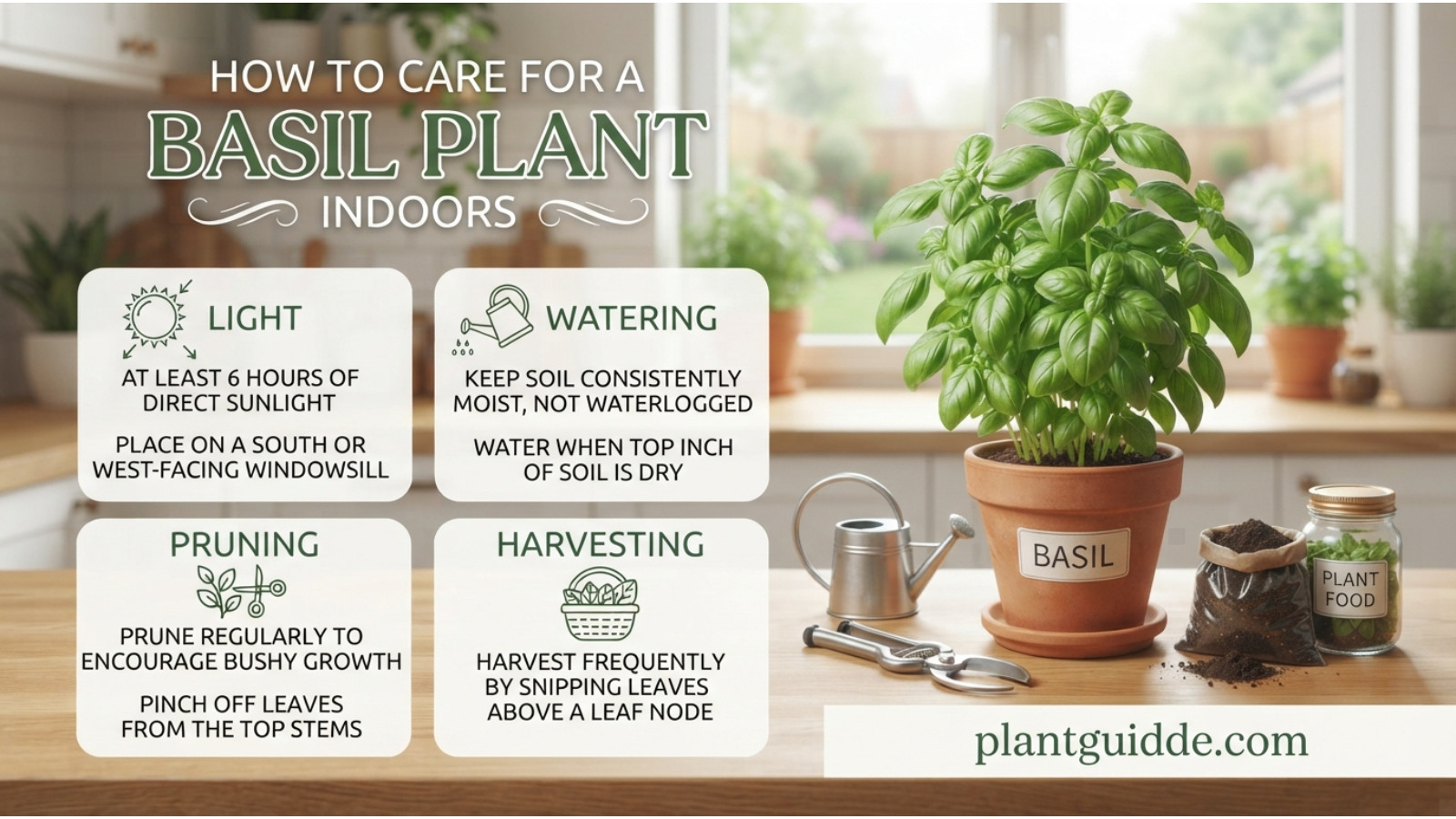
To care for a basil plant, give it 6–8 hours of bright light, warm temperatures, well-draining soil, and consistent moisture without keeping the roots soggy. Water when the soil begins to dry, provide good airflow, and regularly pinch growing tips to encourage bushy growth. Harvest stems above a pair of leaves and remove flower buds if you want to keep producing tender, flavorful leaves.
Basil Plant Care at a Glance
| Care requirement | What basil prefers |
|---|---|
| Light | 6–8 hours of bright light daily |
| Temperature | Warm conditions; protect from cold |
| Soil | Fertile, loose, well-draining soil |
| Water | Keep soil consistently moist but not soggy |
| Pot | Container with drainage holes |
| Humidity | Average household humidity is generally adequate |
| Fertilizer | Light, regular feeding is useful for container plants |
| Pruning | Pinch growing tips regularly |
| Harvesting | Harvest young leaves and stems frequently |
| Flowering | Remove flower buds if maximum leaf production is the goal |
| Airflow | Good circulation helps reduce disease problems |
Basil is a warm-season herb. Traditional sweet basil, Ocimum basilicum, performs best with plenty of light, warmth and well-drained growing conditions.
What Does a Basil Plant Need to Grow Well?
Basil’s requirements are fairly simple, but they work together.
Think of healthy basil as a balance between light + warmth + water + roots + regular harvesting. How to Care for a Basil Plant.
If one of those factors is seriously out of balance, growth usually slows or the leaves begin showing symptoms.
For example:
- Too little light can produce thin, stretched stems.
- Too much water can leave roots deprived of oxygen.
- Too little water can cause wilting and premature flowering.
- Cold conditions can stall growth.
- Crowded plants can develop poor airflow and greater disease pressure.
- Never pruning the plant can result in a tall, sparse plant that flowers early.
The goal is not simply to make basil grow. The goal is to keep it producing healthy, leafy, harvestable growth. How to Care for a Basil Plant.
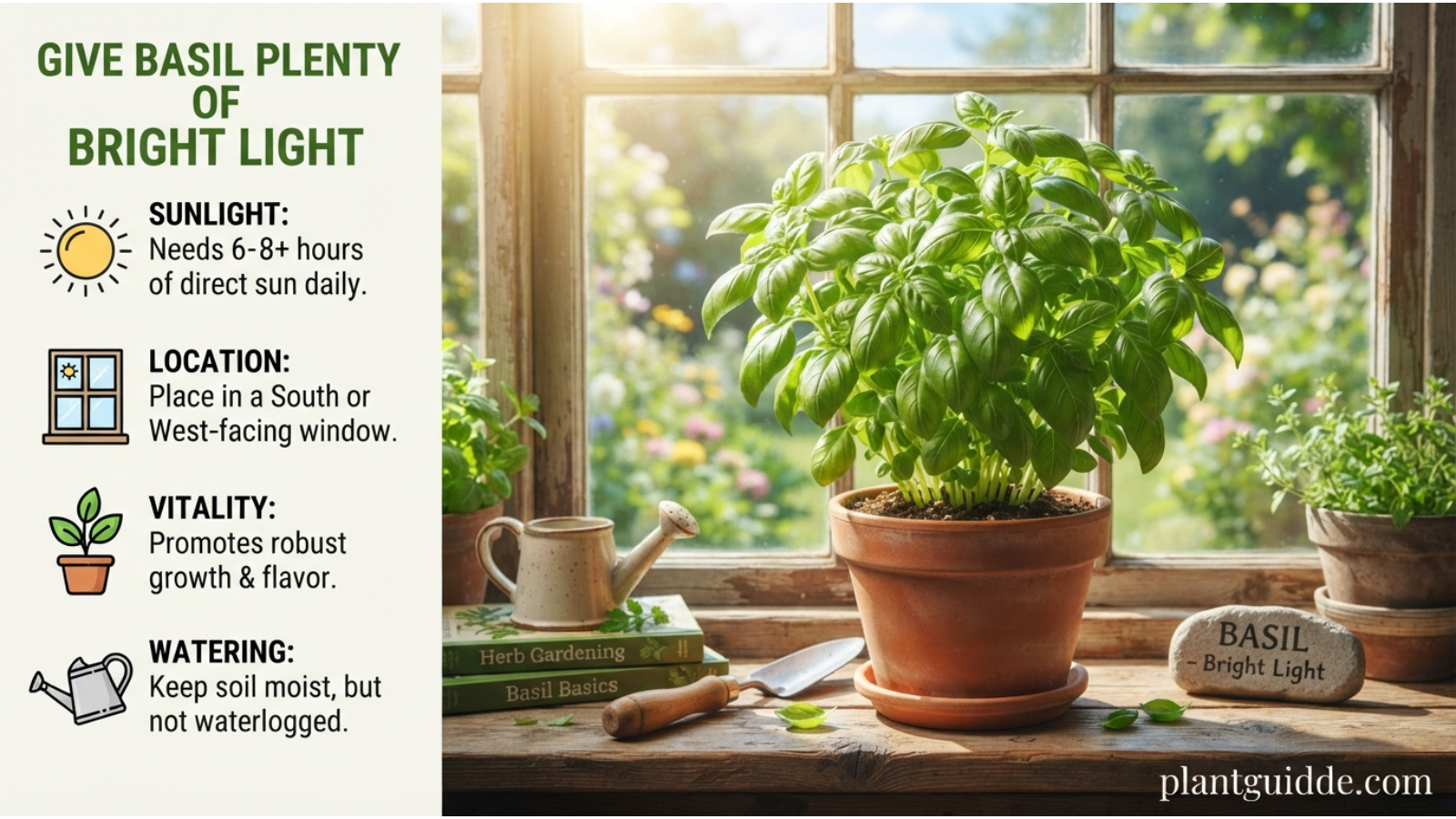
Give Basil Plenty of Bright Light
Light is one of the most important parts of basil plant care.
Basil generally performs best with around 6–8 hours of bright light each day. A sunny outdoor location or a bright indoor window can work well.
Growing basil indoors
Place the plant close to your brightest window.
A south-facing window can be particularly useful where available, although the exact window that works best depends on your home’s orientation and local sunlight.
Watch the plant rather than relying only on the clock.
If the stems become unusually long and thin and the leaves are spaced far apart, the plant may be stretching toward insufficient light. How to Care for a Basil Plant.
What if your home doesn’t get enough sunlight?
A grow light can make indoor basil much easier to maintain, particularly during darker months. University of Minnesota Extension notes that basil overwintered indoors may need artificial lighting for approximately 10–12 hours daily when natural winter light is inadequate.
Image Suggestion: Healthy compact basil beside a bright window compared with leggy basil growing in insufficient light.
Keep Basil Warm
Basil is a warm-loving herb, and cold temperatures can quickly reduce its performance.
Do not treat basil like a cold-tolerant herb such as parsley.
Penn State recommends waiting until outdoor night temperatures are above about 60°F (16°C) before moving young basil outdoors, while the RHS recommends protecting basil from cold conditions and notes that it thrives in warmth and sunshine. How to Care for a Basil Plant.
For indoor plants, keep basil away from:
- Cold drafts
- Very cold windows
- Air-conditioning vents
- Sudden temperature changes
- Unheated outdoor areas during cold weather
Warmth is particularly important when growing basil from seed because germination and early growth are much more reliable under warm conditions.
Use Well-Draining Soil
Basil likes moisture, but its roots should not sit in stagnant water.
Use a fertile, loose, well-draining potting mix for container-grown basil. The container must also have drainage holes. How to Care for a Basil Plant.
This distinction is important:
Moist soil is not the same thing as waterlogged soil.
When excess water remains around the roots for too long, root health can deteriorate. Basil also becomes more vulnerable to disease when environmental conditions remain excessively wet.
For garden basil, choose soil that drains reasonably well. The University of Minnesota recommends well-drained soil and gives a preferred soil pH range of approximately 6.0–7.5.
The easiest soil test
Stick your finger into the top portion of the soil.
If it feels dry and the pot feels noticeably lighter, it is usually time to check whether the plant needs watering.
If the soil is still wet several centimeters below the surface, don’t automatically add more water simply because it is your usual watering day.
Water Basil Consistently—but Don’t Drown It
Watering is where many basil problems begin.
Basil prefers relatively consistent moisture, especially while actively growing, but it does not need permanently saturated soil. RHS guidance recommends keeping the growing medium evenly moist and avoiding wet roots overnight.
How to water basil correctly
- Check the soil before watering.
- If the upper layer has begun to dry, water thoroughly.
- Allow excess water to drain from the bottom.
- Empty standing water from a saucer rather than leaving the pot sitting in it.
- Check the plant more frequently during hot, bright weather.
Container basil usually needs more frequent attention than basil growing in the ground because containers can dry out faster.
Should you water basil every day?
Not necessarily.
A fixed schedule such as “water every Monday and Thursday” can fail because evaporation changes with:
- Temperature
- Sunlight
- Pot size
- Plant size
- Wind
- Humidity
- Soil composition
Instead, check the soil and plant conditions.
A small pot sitting in intense summer sunlight may need water much more frequently than a large container in mild weather.
Best watering technique
Water the soil around the base of the plant rather than repeatedly wetting the foliage.
Morning watering is particularly useful because it gives excess moisture more opportunity to evaporate during the day. Avoiding overhead watering also helps reduce leaf-wetness-related disease problems.
Choose the Right Pot
A basil plant can grow successfully in containers, but the container should support healthy roots.
Choose a pot with:
- Drainage holes
- Enough volume for the root system
- A stable base
- Fresh, well-draining potting mix
The RHS recommends a container at least approximately 20 cm (8 inches) wide and deep for planting basil outdoors.
Don’t overlook supermarket basil
This is one of the most useful basil-growing tips for beginners.
Supermarket basil pots are often filled with numerous closely packed plants intended for short-term harvesting. That can create overcrowding and make long-term growth more difficult.
The RHS specifically notes that supermarket basil often contains many thin, crowded plants and recommends dividing and repotting promptly if you want to grow them on.
If you buy one of these pots, don’t assume the entire dense clump is one plant.
You may actually be looking at many seedlings growing together.
Image Suggestion: Supermarket basil pot showing crowded stems versus a properly separated and repotted basil plant.
Feed Basil When It Needs Extra Nutrition
Basil growing in fertile garden soil may not require frequent feeding.
Container plants are different.
Repeated watering gradually moves nutrients through the pot, and a fast-growing basil plant can use available nutrients relatively quickly. The RHS notes that container basil can run short of nutrients and benefit from feeding during active growth.
A general-purpose liquid fertilizer used according to its label directions can be appropriate during vigorous growth.
Avoid the temptation to assume that more fertilizer automatically means more basil.
Excess fertilizer can create unnecessary problems, while poor light cannot be fixed with fertilizer.
Practical rule: If your basil has good light, appropriate watering, healthy roots and fresh potting mix, address those fundamentals before increasing fertilizer.
Prune Basil to Make It Bushier
If you want a large, productive basil plant, harvesting is part of the care routine.
Basil responds well to pinching or cutting growing tips, which encourages branching and creates a bushier plant.
Once the plant has developed several sets of true leaves, pinch the stem just above a pair of leaves.
New branches can develop from the nodes below the cut.
Penn State and the RHS both recommend regular pinching to encourage branching and delay flowering.
How to prune basil
Look for a stem with a healthy pair of leaves.
Cut or pinch the stem immediately above that pair.
Instead of having one long central stem, the plant can then produce additional side shoots.
Repeat this process as the new branches develop.
The common pruning mistake
Don’t wait until the basil has become tall, woody and covered in flower spikes before you start harvesting.
Regular small harvests are generally much more useful than one massive harvest followed by neglect.
Remove Flower Buds If You Want More Leaves
Eventually, basil wants to reproduce.
It begins producing flower buds and flower spikes.
Flowering is completely natural, but if your primary goal is maximum tender foliage, allowing the plant to flower heavily is usually counterproductive.
Penn State notes that leaf flavor declines after flowering, while the University of Minnesota explains that flowering can lead to more bitter flavor and reduced yields.
What to do when basil starts flowering
Pinch or cut off the developing flower spike.
Ideally, remove it while it is still developing rather than waiting for a large flower cluster.
However, there is an important exception.
If you are growing ornamental or pollinator-friendly basil varieties, flowers can be valuable. Some basil flowers attract bees and other beneficial insects.
So the “remove every flower” rule depends on your goal:
| Your goal | What to do |
|---|---|
| Maximum leaves | Remove flower buds |
| Strong leafy harvest | Pinch regularly |
| Attract pollinators | Allow selected flowers to develop |
| Save seeds | Let flowers mature |
| Decorative basil | Keep attractive flower spikes |
Harvest Basil the Right Way
Harvesting isn’t just about taking leaves for dinner.
Done correctly, it also helps shape the plant.
You can harvest individual leaves when needed, but taking shoot tips is particularly useful for maintaining a compact, branching plant.
The University of Minnesota recommends cutting whole stems just above a pair of leaves so that new growth develops from the cut point.
A simple harvesting method
- Find a healthy stem.
- Identify a pair of leaves below the growing tip.
- Cut immediately above that pair.
- Use the harvested leaves fresh or preserve them.
Regular harvesting can keep basil productive through the warm growing season.
When is the best time to harvest?
For the strongest harvest quality, Penn State recommends harvesting before flowering and preferably in the morning.
Give Basil Good Airflow
Air circulation is an underrated part of basil care.
Dense foliage, crowded containers and constantly wet leaves create an environment where disease problems can become more likely.
Give plants enough space for air to move around them.
Avoid packing several basil plants into a tiny container simply because they initially look attractive together.
Penn State recommends good air circulation, sanitation and avoiding overhead watering as part of basil disease prevention.
This becomes particularly important in humid conditions.
Image Suggestion: Diagram showing airflow around a properly spaced basil plant versus a dense, overcrowded basil container.
How to Care for Basil Indoors
Growing basil indoors is absolutely possible, but the biggest challenge is usually light, not watering.
Place the plant in the brightest practical location available.
A sunny window can work well, while a grow light becomes useful when natural light is weak.
Indoor basil care checklist
- Give it strong light.
- Keep it warm.
- Use a pot with drainage.
- Don’t leave roots sitting in water.
- Check soil moisture regularly.
- Rotate the pot if growth becomes one-sided.
- Pinch growing tips regularly.
- Remove flower buds if leaf production is the priority.
- Provide airflow around the foliage.
- Watch carefully for aphids and whiteflies.
RHS guidance lists aphids and whiteflies among pests that can affect basil, while Penn State also identifies several pest and disease problems that can occur under unfavorable conditions.
How to Care for Basil Outdoors
Outdoor basil can grow extremely quickly when warmth, sunlight and moisture are adequate.
Choose a:
- Sunny location
- Warm, sheltered position
- Well-draining soil
- Container or garden bed with sufficient space
- Location with good air movement
Basil is sensitive to cold and frost, so don’t move young plants outside prematurely.
The RHS recommends planting outdoors after conditions have warmed sufficiently, while Penn State advises waiting until nighttime temperatures are consistently warm.
Container basil outdoors
Containers can actually be advantageous because they allow you to:
- Move basil into better light
- Protect it from cold
- Control the growing medium
- Bring plants indoors when necessary
- Adjust watering more easily
But containers also dry out faster, particularly during hot weather.
Check them frequently rather than assuming yesterday’s watering will still be sufficient today.
Basil Care by Season
Spring
Spring is a good time to start basil from seed indoors or prepare young plants for outdoor growing.
Focus on:
- Warm conditions
- Strong light
- Consistent moisture
- Gradual acclimation before outdoor planting
Basil seeds generally germinate quickly under suitable warm conditions. Penn State reports germination in roughly one to two weeks, while the RHS notes that temperatures around 20°C (68°F) support good germination.
Summer
This is usually basil’s strongest growing period.
Expect to:
- Water more frequently
- Harvest regularly
- Pinch growing tips
- Remove unwanted flower buds
- Monitor pests
- Maintain airflow
Once warm temperatures arrive, basil can produce foliage rapidly.
Autumn
Watch nighttime temperatures carefully.
If cold weather approaches, harvest heavily before the plant is damaged.
Basil is tender, and cold temperatures can discolor or damage the foliage.
Winter
Keeping basil alive indoors through winter can be challenging because light levels are usually lower.
If you want to keep a plant going, provide strong artificial light when necessary and avoid placing it in a cold location.
Remember that many commonly grown basil types are treated as annuals, so starting new plants from seed can be easier than forcing an old plant through an unfavorable season.
Basil Plant Troubleshooting: What the Leaves Are Telling You
Basil often communicates problems through its leaves before the entire plant declines.
Why are my basil leaves turning yellow?
Yellow leaves can have several causes.
Possible causes include:
- Excessive moisture
- Poor drainage
- Root stress
- Insufficient light
- Natural aging of older leaves
- Disease
Don’t immediately assume yellow leaves mean the plant needs fertilizer.
First inspect the roots’ environment.
If the soil is constantly wet, adding fertilizer may make the situation worse rather than better.
Basil downy mildew is another important possibility, particularly when yellowing occurs alongside gray or downy growth on the underside of leaves.
Why is my basil wilting?
Wilting can result from either too little water or problems caused by too much water.
That sounds contradictory, but the roots explain why.
A severely dry plant may wilt because it lacks sufficient water.
A waterlogged plant can also wilt because damaged roots cannot function normally.
Check the soil before watering again.
If it is dry, water thoroughly.
If it is saturated and remains wet for extended periods, investigate drainage and root health instead.
Wh is my basil growing tall and thin?
This is commonly associated with insufficient light.
A basil plant naturally grows toward available light. When light is inadequate, stems can become elongated and leaves may be spaced farther apart.
Move the plant to a brighter location or supplement natural light with a grow light.
Then begin regular pinching to encourage branching.
Why are my basil leaves curling?
Curling leaves can result from environmental stress, including:
- Water stress
- Excessive heat
- Poor light
- Pest activity
- Sudden environmental changes
Inspect both sides of the leaves carefully.
Look for insects, stippling, distorted new growth or sticky residue.
Don’t diagnose the problem from leaf shape alone. Check the plant’s environment first.
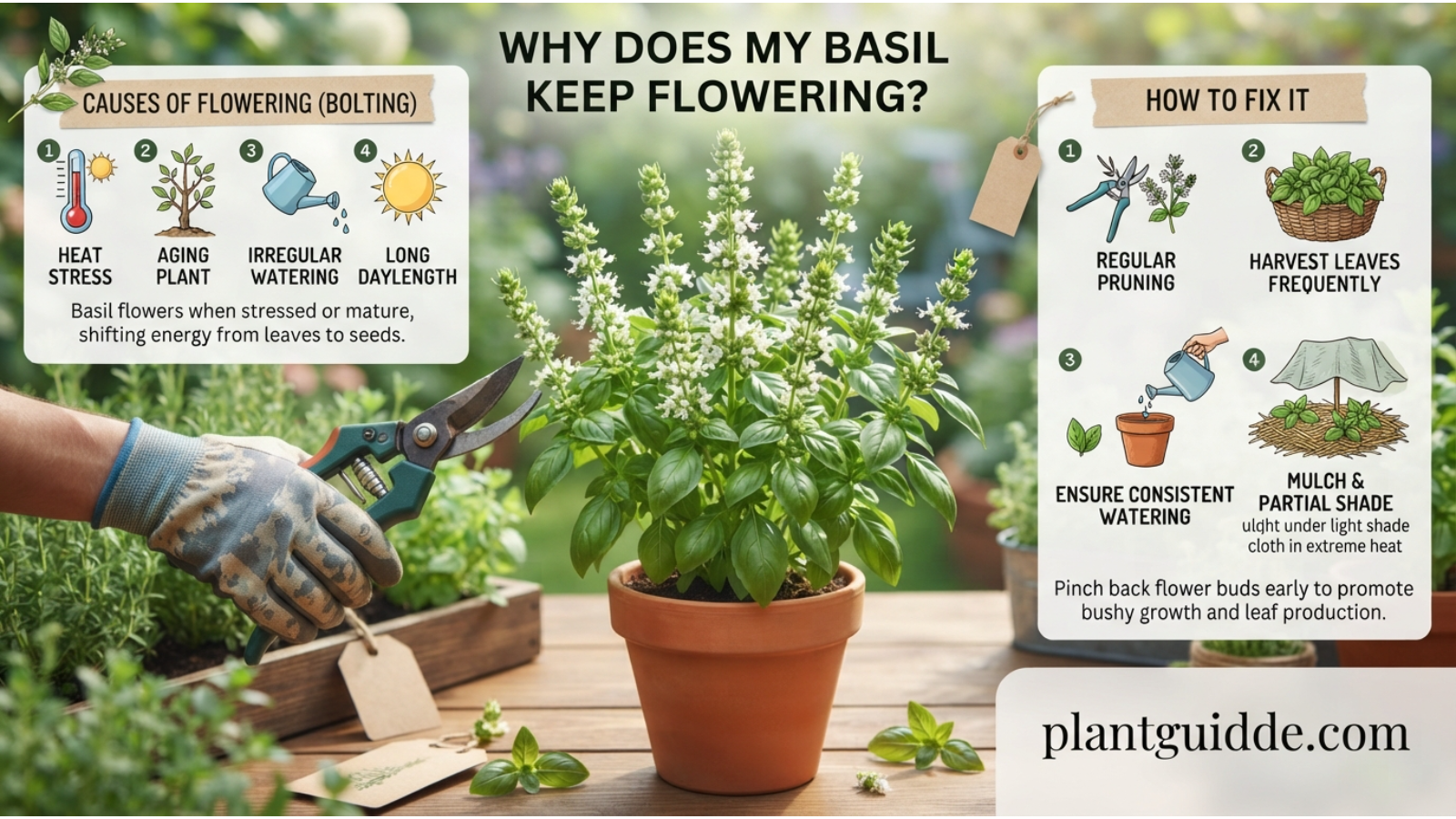
Why does my basil keep flowering?
Basil flowers because it is reaching its reproductive stage.
Flowering can become more noticeable when the plant is mature, stressed, crowded or exposed to conditions that encourage rapid reproductive development.
Regular harvesting and pinching can delay flowering and keep the plant producing leafy shoots.
If the plant has already developed flowers, simply remove the flower spikes if your goal is foliage.
Why does my basil have brown or black leaves?
Check the pattern before taking action.
Possible causes include:
- Cold exposure
- Water stress
- Leaf disease
- Root problems
- Physical damage
- Sudden environmental changes
Cold is especially important because basil is a warm-season herb and can suffer damage when temperatures drop.
If damaged leaves are clearly dead, remove them and correct the underlying environmental problem rather than treating the symptoms alone.
Common Basil-Care Mistakes to Avoid
1. Watering on a rigid schedule
Your basil doesn’t know what day of the week it is.
Check the soil and environmental conditions instead.
2. Keeping the soil permanently wet
Basil needs moisture, but the roots also need oxygen.
Good drainage is essential.
3. Growing basil in weak light
Fertilizer cannot compensate for insufficient light.
Move the plant closer to a strong light source first.
4. Never pruning the plant
A basil plant left untouched can become tall and sparse.
Regular pinching encourages branching.
5. Letting flower spikes take over
If your goal is tender foliage, remove developing flower buds.
6. Overcrowding supermarket basil
A small grocery-store pot may contain many individual plants.
Separating and repotting them can dramatically improve their chances of becoming long-term plants.
7. Ignoring airflow
Dense foliage and wet leaves can encourage disease problems.
8. Moving basil outdoors too early
Cold temperatures can quickly damage a warm-season herb.
Basil Propagation: How to Grow More Plants
Basil is easy to propagate from seed, but stem cuttings can also be useful.
Growing basil from seed
Sow seeds in a warm, bright environment and keep the growing medium appropriately moist.
Once seedlings develop several true leaves, they can be transplanted into individual containers or spaced appropriately.
Starting multiple batches of seed at different times can provide a longer supply of young, productive plants. The RHS recommends successive sowings as one way to extend the harvest.
Propagating basil from cuttings
Healthy basil stems can root readily in water.
Choose a healthy non-flowering stem, remove the lower leaves and place the stem in clean water.
Once roots develop, transfer the cutting into an appropriate growing medium.
This is particularly useful when you have a favorite basil plant and want to create additional plants without buying new seed.
How to Preserve Fresh Basil
Even a single healthy basil plant can eventually produce more leaves than you can eat immediately.
Freezing is one of the easiest preservation methods.
You can:
- Freeze whole leaves in a freezer bag.
- Chop leaves and freeze them in ice-cube trays.
- Freeze basil with a little water or oil depending on the intended use.
- Make pesto and freeze it in small portions.
Penn State recommends freezing whole leaves or using ice-cube trays for chopped basil and pesto.
Drying is another option, although fresh basil generally has a more vibrant texture and aroma.
The Best Basil Care Routine for Busy Gardeners
If you don’t want to overthink basil care, use this simple routine.
Every few days
Check:
- Soil moisture
- Leaf condition
- New growth
- Pests
- Light exposure
Once a week
Look closely at:
- Flower buds
- Leggy growth
- Yellowing leaves
- Crowded stems
- Drainage
During active growth
Regularly:
- Harvest shoot tips
- Pinch branches
- Remove unwanted flower buds
- Adjust watering as temperatures change
This routine is more reliable than blindly following a fixed watering calendar because basil’s needs change with weather and growth rate.
How to Tell If Your Basil Is Healthy
A healthy basil plant generally shows:
- Strong, upright stems
- Richly colored foliage appropriate to the variety
- Compact or branching growth
- Regular production of new leaves
- No persistent wilting
- No widespread yellowing
- No obvious pest infestation
- Healthy roots in well-draining soil
The most useful sign isn’t simply how large the plant is.
Look at new growth.
If fresh leaves are developing normally and the plant is branching after harvest, your growing conditions are probably working.
FAQs,
How often should I water a basil plant?
Water when the growing medium begins to dry rather than following a rigid calendar. Container basil may need more frequent watering than garden-grown plants, especially during hot weather. Keep the soil moist but avoid leaving the roots waterlogged.
Does basil need full sun?
Basil needs strong light and generally performs best with around six to eight hours of bright light each day. Indoor plants should be placed near a bright window or supplemented with a grow light when necessary.
Can basil grow indoors?
Yes. Basil can grow indoors successfully when it receives enough light, warmth, moisture and airflow. Poor indoor light is one of the most common reasons plants become thin and leggy.
Should I remove basil flowers?
If your goal is maximum leaf production, yes. Pinching flower buds helps keep the plant focused on leafy growth and delays the decline in leaf quality associated with flowering.
Why is my basil wilting even though I watered it?
Check whether the soil is actually dry. If it is already saturated, wilting may indicate root stress rather than a lack of water. Also inspect the plant for heat stress, pests and disease.
How do I make basil bushier?
Pinch the growing tip just above a pair of leaves. This encourages side branches to develop. Continue harvesting and pinching new growth rather than allowing one central stem to dominate.
Can basil survive winter?
It depends on the variety and growing conditions, but common basil is generally treated as a tender annual. You can bring plants indoors, but they need sufficient warmth and strong light. Starting new plants from seed is often easier when winter conditions are unfavorable.
Can I grow basil from supermarket basil?
Yes, but supermarket pots are often densely planted. Separating the individual plants and repotting them into suitable containers can give them a much better chance of long-term growth.
What is the best soil for basil?
Use fertile, loose, well-draining soil or potting mix. Avoid heavy, poorly draining soil that stays saturated for long periods. Basil performs well in soil around pH 6.0–7.5.
How do I harvest basil without killing the plant?
Cut stems just above a healthy pair of leaves. This allows new growth to develop from the nodes below the cut and encourages a bushier plant.
Final Thoughts
Learning how to care for a basil plant becomes much easier when you stop treating every problem as a watering problem.
Give basil the fundamentals first: strong light, warmth, well-draining soil, consistent moisture, good airflow and regular harvesting.
Then watch the plant.
Leggy growth can point toward insufficient light. Persistent wet soil can signal a drainage problem. Flower buds tell you the plant is moving toward reproduction. Wilting requires you to check both moisture and root conditions rather than automatically adding more water.
And perhaps the most useful habit of all is to harvest regularly. Pinching healthy growing tips gives you fresh basil for the kitchen while simultaneously encouraging the plant to branch and produce more foliage.
With those habits in place, basil stops being a short-lived grocery-store herb and becomes a productive plant you can harvest again and again throughout the warm growing season.

Asad Mumtaz is a dedicated plant enthusiast and gardening writer with a passion for helping people care for their plants successfully. He specializes in plant care guides, indoor gardening, and practical growing tips for all skill levels. His content focuses on making gardening simple, enjoyable, and rewarding. Through his work, Asad shares reliable advice to help readers create thriving green spaces.