The red prayer plant is one of those houseplants that can look spectacular when its growing conditions are right. and surprisingly unhappy when they are not. Red Prayer Plant Care: Light, Watering & Soil.
Its green leaves are decorated with prominent red or pink veins, giving the plant its distinctive herringbone appearance. Even more interesting, the leaves move throughout the day, rising upward as darkness arrives and opening again in brighter conditions. This natural movement is one reason Maranta has earned the common name “prayer plant.”
But that beautiful foliage also makes problems easy to notice. Brown tips, curling leaves, faded markings, drooping stems, and crispy edges are common complaints from new growers.
The good news is that red prayer plant care is less about following a rigid watering schedule and more about creating a stable environment. Once you understand what the plant is responding to, troubleshooting becomes much easier.
Related keywords: red prayer plant care indoors, red prayer plant watering, red prayer plant light requirements, Maranta leuconeura care, red-veined prayer plant, Maranta erythroneura care, prayer plant brown leaves, prayer plant humidity, prayer plant soil, prayer plant leaves curling.
Quick Answer
For successful red prayer plant care, grow Maranta leuconeura in bright, indirect light, keep its potting mix consistently moist but never waterlogged, and provide warm temperatures and high humidity. Protect it from direct afternoon sun, cold drafts, and dry air. If the leaves develop brown edges, curl tightly, or lose their vivid red markings, check humidity, watering, light, and water quality before adding more fertilizer.
What Is a Red Prayer Plant?
The red prayer plant generally refers to a red-veined form of Maranta leuconeura, particularly plants historically identified as Maranta leuconeura var. erythroneura. It belongs to the Marantaceae family and originates from tropical Brazil.
You may also see it sold under names such as:
- Red-veined prayer plant
- Herringbone plant
- Red prayer plant
- Maranta leuconeura ‘Erythroneura’
- Maranta leuconeura ‘Tricolor’
- Maranta ‘Fascinator’
Plant naming can vary between nurseries and references, so the appearance is often more useful for identification than the label alone. The characteristic red midrib and branching red veins are strong clues that you are looking at the red-veined type. RHS lists Maranta leuconeura var. erythroneura as a herringbone plant with bright red veins.
Why are its leaves called “prayer” leaves?
The leaves change position in response to the day-night cycle. During darkness they can fold upward, creating the appearance of hands raised in prayer. This movement is a normal characteristic of the plant rather than a sign that something is wrong.
Image Suggestion: Close-up botanical illustration showing a red prayer plant leaf during the day versus its raised position at night.
Red Prayer Plant Care Requirements
The easiest way to care for a red prayer plant is to think in terms of five environmental needs:
| Care factor | What your plant needs |
|---|---|
| Light | Bright, indirect or filtered light |
| Water | Consistently moist soil without standing water |
| Humidity | High humidity is preferred |
| Temperature | Warm, stable conditions |
| Soil | Moisture-retentive but well-draining mix |
| Fertilizer | Moderate feeding during active growth |
| Pot | Drainage holes are essential |
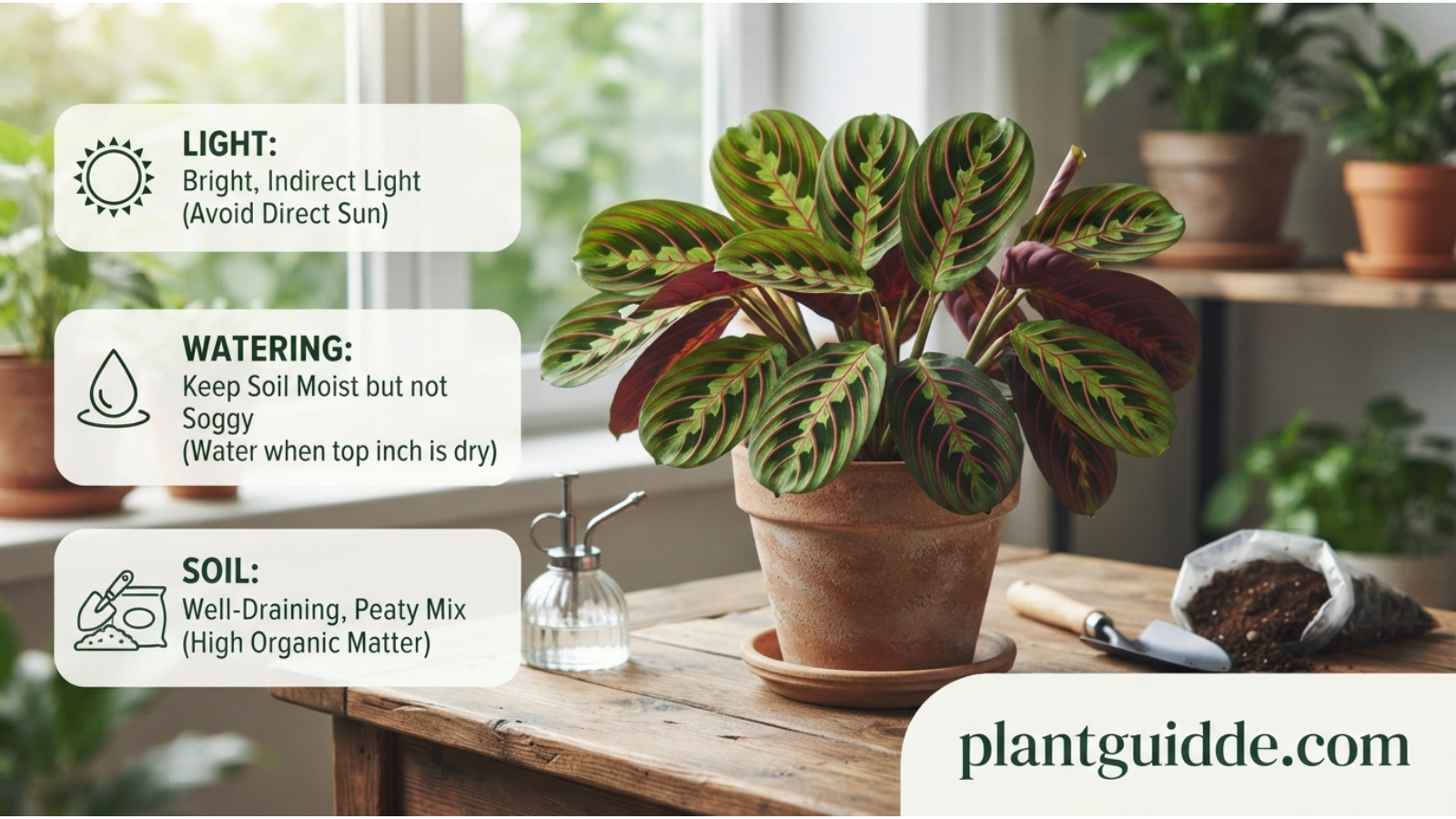
The plant naturally grows in warm, humid environments, so conditions that are comfortable for people are not always enough. Both Missouri Botanical Garden and NC State Extension recommend bright indoor light without strong direct sun, consistent moisture during active growth, and high humidity.
Give Your Red Prayer Plant the Right Light
Light is one of the biggest factors affecting the appearance of a red prayer plant.
Best light
Place it somewhere with:
- Bright, indirect light
- Filtered sunlight
- Gentle morning light
- Protection from intense direct afternoon sun
A few feet from a bright window can work well, especially when a sheer curtain filters the sunlight.
RHS recommends bright filtered or indirect light, while Missouri Botanical Garden specifically warns that strong direct sunlight can bleach the plant’s attractive leaf colors.
What happens with too much light?
Excessive direct sun can cause:
- Faded leaf markings
- Bleached-looking foliage
- Brown or scorched patches
- Crispy leaf edges
The mistake many beginners make is assuming that a tropical plant automatically wants strong sunlight. In nature, prayer plants are adapted to shaded or filtered environments rather than sitting beneath intense, unobstructed midday sun.
What happens with too little light?
Very low light can lead to:
- Slower growth
- Less vibrant foliage
- Longer gaps between leaves
- Weaker overall growth
Practical test: If the room feels bright enough to read comfortably without turning on a lamp, but the plant is not receiving harsh direct rays, you are usually closer to the right environment.
Image Suggestion: Diagram showing three positions—direct afternoon sun, bright indirect light, and deep shade—with the middle position labeled as ideal.

How Often Should You Water a Red Prayer Plant?
There is no universally correct “water every X days” schedule.
Instead, monitor the soil and the plant’s environment.
During active growth, red prayer plants prefer soil that stays evenly moist but not saturated. Missouri Botanical Garden and NC State Extension both recommend maintaining consistent moisture during the growing season while reducing watering in winter.
A practical watering method
- Check the potting mix with your finger.
- If the surface has begun to dry, assess the moisture farther down.
- Water thoroughly when the plant needs it.
- Allow excess water to drain completely.
- Empty water collected in the saucer or decorative container.
- Check the soil again before watering next time.
Do not water simply because it is “watering day.”
A plant in a warm, bright room may use water much faster than one sitting in a cool, dim corner.
Should the soil completely dry out?
Generally, no.
Red prayer plants are not drought-tolerant succulents. Allowing the root ball to become extremely dry can contribute to curling and crispy foliage.
At the same time, constantly saturated soil is dangerous. Poor drainage and excessive moisture can contribute to root rot.
One important detail: don’t leave water around the crown
Illinois Extension specifically advises avoiding standing water around the crown because the stems can rot.
This is especially important when watering a dense plant from above.
What Water Is Best for a Red Prayer Plant?
Water quality is an often-overlooked part of red prayer plant care.
If your plant repeatedly develops brown or crispy leaf tips despite appropriate watering and humidity, consider whether the water itself could be contributing to the problem.
Some prayer plants can be sensitive to salts and fluoride. NC State Extension notes that high fluoride levels and over-fertilization can burn leaves.
Depending on your local water supply, you can consider:
- Filtered water
- Rainwater where safely collected
- Distilled water when appropriate
- Regular tap water if your plant tolerates it well
You do not automatically need expensive specialty water. Start by observing whether your plant consistently reacts poorly to your household water.
Expert tip: If the plant grows well but repeatedly develops brown tips while the rest of the plant looks healthy, don’t immediately assume you are underwatering it. Investigate humidity, mineral buildup, fertilizer concentration, and water quality first.
Humidity: The Secret to Better-Looking Leaves
If there is one environmental factor that frequently separates a beautiful prayer plant from a crispy one, it is humidity.
Red prayer plants prefer humid conditions because they originate from tropical environments. RHS recommends maintaining high humidity, while Missouri Botanical Garden suggests a humidified room or a tray of wet pebbles.
Signs your air may be too dry
You may notice:
- Brown leaf tips
- Crispy margins
- Curling leaves
- New leaves failing to unfurl properly
- Increased sensitivity to inconsistent watering
How to increase humidity
You can:
- Use a room humidifier
- Group several plants together
- Place the plant in a naturally humid room
- Use a pebble tray with the pot positioned above the water level
A humidifier is usually more predictable than occasional misting because it actually changes the surrounding air humidity.
Don’t confuse humidity with wet soil
This is an important distinction:
High humidity does not mean the soil should stay soaked.
You want humid air around the foliage and oxygen available around the roots.
Keep Temperatures Warm and Stable
Red prayer plants are tropical plants and do not appreciate cold conditions.
Missouri Botanical Garden recommends temperatures that do not fall below approximately 60°F (16°C), while NC State Extension notes that the plant is intolerant of low temperatures and cold drafts.
Keep your plant away from:
- Cold windows in winter
- Air-conditioning vents
- Drafty doors
- Heaters and radiators
- Sudden temperature changes
A warm room is good; a plant directly beside a heater is not.
Hot, dry air blowing continuously across the foliage can quickly create crispy edges even when the room itself feels comfortable.
Choose the Right Soil
The ideal soil for a red prayer plant needs to balance two seemingly opposite requirements:
It should hold moisture while still draining efficiently.
RHS recommends moist but well-drained growing conditions, and Missouri Botanical Garden notes that the plant performs well in a soil-based potting mix.
A practical indoor mix can include:
- Quality houseplant potting mix
- Perlite or another aerating component
- A small amount of moisture-retentive organic material
The goal is not to create the “perfect recipe.” The goal is to prevent two extremes:
Too dense: roots stay wet and poorly aerated.
Too coarse: water runs through rapidly and the plant repeatedly dries out.
Avoid heavy garden soil
Garden soil can become compacted in a container and may not provide the aeration needed by a houseplant.
Choosing a Pot for a Red Prayer Plant
A decorative pot is fine, but the functional pot should have drainage holes.
Prayer plants have relatively shallow, spreading growth habits, so a wide, shallow container can sometimes be more practical than an extremely deep pot. RHS describes Maranta as a clump-forming plant reaching roughly 30 cm under suitable conditions.
Don’t make this common mistake
Moving a struggling plant into a dramatically larger pot can actually make watering more difficult.
More soil around a small root system can remain wet for a long time.
When repotting, choose a container only modestly larger than the existing root system unless the plant is severely root-bound.
Fertilizing Red Prayer Plants
Red prayer plants benefit from feeding during active growth, but more fertilizer does not mean more growth.
Missouri Botanical Garden recommends monthly fertilization during the growing season and substantially reducing fertilizer applications from autumn through late winter. RHS similarly recommends monthly feeding during growth.
A balanced houseplant fertilizer, diluted according to its instructions, is generally a practical choice.
Avoid overfertilizing
Excess fertilizer salts can damage foliage. NC State Extension specifically notes that over-fertilization can cause leaf burn.
If the plant is stressed, severely dry, recently repotted, or experiencing root problems, feeding it more fertilizer is unlikely to solve the underlying issue.
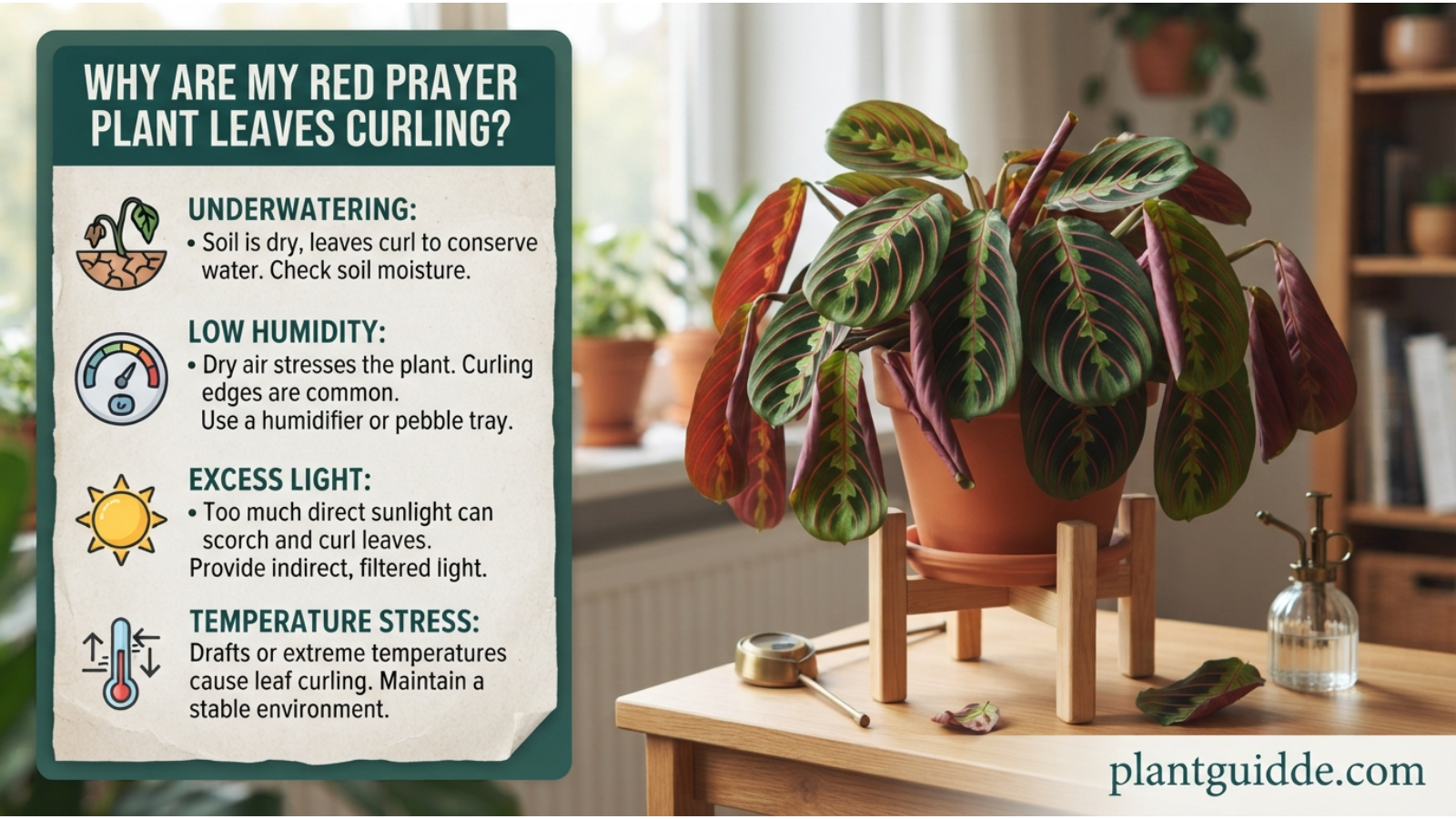
Why Are My Red Prayer Plant Leaves Curling?
Curling leaves are one of the most common red prayer plant problems.
But curling is a symptom, not a diagnosis.
Check these factors before deciding what went wrong:
| Possible cause | What to check |
|---|---|
| Dry soil | Is the root ball becoming very dry? |
| Low humidity | Is the air unusually dry? |
| Too much direct sun | Are leaves exposed to harsh sunlight? |
| Cold stress | Is the plant near a cold window or draft? |
| Root problems | Is the soil staying wet for too long? |
| Water quality | Are brown edges appearing repeatedly? |
| Normal movement | Is it simply changing position at night? |
The last point is particularly important.
If the leaves rise in the evening and open again with light, that is normal prayer-plant behavior—not curling caused by stress.
Why Does My Red Prayer Plant Have Brown Tips?
Brown tips usually indicate that something about the plant’s environment needs attention.
Potential causes include:
- Low humidity
- Inconsistent watering
- Excess fertilizer
- Mineral or fluoride sensitivity
- Root stress
- Excessive direct light
Do not automatically respond by watering more.
Instead, examine the entire environment.
A useful troubleshooting sequence
First: Check the soil moisture.
Second: Check humidity.
Third: Look at the light.
Fourth: Check recent fertilizer use.
Fifth: Consider water quality.
This approach is much more reliable than changing five variables simultaneously.
Why Are the Red Veins Fading?
The vivid red veins are one of the plant’s main attractions.
If the foliage becomes noticeably less colorful, look first at its growing conditions.
Insufficient light can reduce the intensity of the foliage, while excessive direct sunlight can bleach attractive leaf colors. Missouri Botanical Garden specifically notes that too much sun can bleach the plant’s foliage, and NC State Extension also identifies low light and low fertility as factors affecting leaf coloration.
The solution is not necessarily “more sunlight.”
Instead, aim for bright filtered or indirect light.
Why Is My Prayer Plant Drooping?
Drooping can occur after the soil becomes too dry, but it can also happen when the roots are stressed by excessively wet conditions.
That is why simply adding water can sometimes make the problem worse.
Check:
- Soil moisture.
- Drainage.
- Root condition if the problem persists.
- Temperature and drafts.
- Recent changes in light or location.
If the soil is wet for many days and the plant continues to decline, investigate the root system rather than watering again.
Red Prayer Plant Care in Winter
Winter changes the plant’s environment even if your home stays warm.
Indoor heating can lower humidity, while shorter days reduce light intensity. At the same time, the plant may use water more slowly.
RHS and Missouri Botanical Garden both recommend reducing watering during winter compared with active growth.
Winter checklist
- Move the plant away from cold drafts.
- Keep it away from direct heater airflow.
- Monitor humidity.
- Reduce watering as growth slows.
- Avoid heavy fertilization.
- Keep providing good indirect light.
A common mistake is maintaining a summer watering routine through winter.
Should You Mist a Red Prayer Plant?
Misting can temporarily add moisture directly to leaf surfaces, but it is not a reliable substitute for maintaining appropriate room humidity.
For more consistent results, use:
- A humidifier
- Plant grouping
- A naturally humid room
- A suitable pebble tray
RHS specifically recommends high humidity through methods such as misting or a gravel tray.
If you mist, avoid keeping the foliage continuously wet with poor air circulation.
Pruning and Cleaning
Red prayer plants generally do not require heavy pruning. RHS lists pruning as unnecessary for Maranta leuconeura.
However, removing damaged leaves can improve the plant’s appearance.
Use clean scissors to remove:
- Completely dead leaves
- Severely damaged foliage
- Yellowing leaves that are clearly declining
If only the tip is brown, you can trim the damaged portion for cosmetic reasons, following the natural shape of the leaf.
Do not repeatedly cut healthy foliage simply because individual leaves have minor imperfections.
Repotting a Red Prayer Plant
Repot when the plant has genuinely outgrown its container or the growing medium has deteriorated.
Signs can include:
- Roots densely filling the pot
- Water running through unusually quickly
- Repeated difficulty maintaining appropriate moisture
- The plant becoming unstable in its container
When repotting:
- Choose a pot with drainage holes.
- Select a container only somewhat larger than the existing one.
- Use fresh, well-draining potting mix.
- Avoid burying the crown deeply.
- Water appropriately after repotting.
- Keep the plant away from harsh environmental changes while it settles.
RHS recommends peat-free potting compost for plants grown under glass and notes that prayer plants can be propagated by division or basal cuttings.
Image Suggestion: Step-by-step illustration of repotting a red prayer plant, emphasizing drainage holes and shallow root placement.
How to Propagate a Red Prayer Plant
The most practical home propagation method is division.
Because Maranta is a rhizomatous, clump-forming plant, established plants can be divided when repotting. Both RHS and Missouri Botanical Garden list division as a propagation method.
Basic division method
- Remove the plant from its container.
- Gently loosen the growing medium around the roots.
- Identify naturally separate sections of the clump.
- Divide the plant while keeping healthy roots attached to each section.
- Plant each division into an appropriately sized container.
- Keep the new plants warm, humid, and evenly moist while they establish.
Avoid creating tiny divisions with very few roots. Larger, healthy divisions generally have a better starting point.
Common Red Prayer Plant Care Mistakes
Mistake 1: Putting it in direct sunlight
More sunlight is not automatically better.
Better approach: Use bright filtered or indirect light.
Mistake 2: Watering on a fixed calendar
Your plant’s water use changes with temperature, light, humidity, season, and pot size.
Better approach: Check the growing medium.
Mistake 3: Keeping the soil permanently soaked
Moist does not mean waterlogged.
Better approach: Use a well-draining container and potting mix.
Mistake 4: Ignoring humidity
A plant can have adequate water in its pot while still suffering from very dry air.
Better approach: Look at both root-zone moisture and surrounding humidity.
Mistake 5: Fertilizing a stressed plant
Brown leaves are not necessarily a sign of nutrient deficiency.
Better approach: Diagnose environmental problems before feeding.
Mistake 6: Repotting into an oversized container
Extra soil can retain excess moisture around a small root system.
Better approach: Increase pot size gradually.
Mistake 7: Treating nighttime leaf movement as a problem
The leaves naturally change position.
Better approach: Learn the plant’s normal daily rhythm before troubleshooting it.
A Simple Weekly Red Prayer Plant Care Routine
You do not need to spend hours caring for this plant.
Once a week, perform a quick inspection:
Check the leaves
Look underneath and across the foliage for:
- Pests
- Brown spots
- Crispy edges
- Yellowing
- Unusual curling
Check the soil
Feel the growing medium rather than watering automatically.
Check the location
Make sure the plant has not gradually been exposed to stronger sunlight or a new draft.
Check humidity
If the air is dry, adjust the room environment rather than simply increasing watering.
Rotate the plant
A gentle rotation can help the plant receive more even light and maintain balanced growth.
This small routine can catch problems before a minor environmental issue becomes severe.
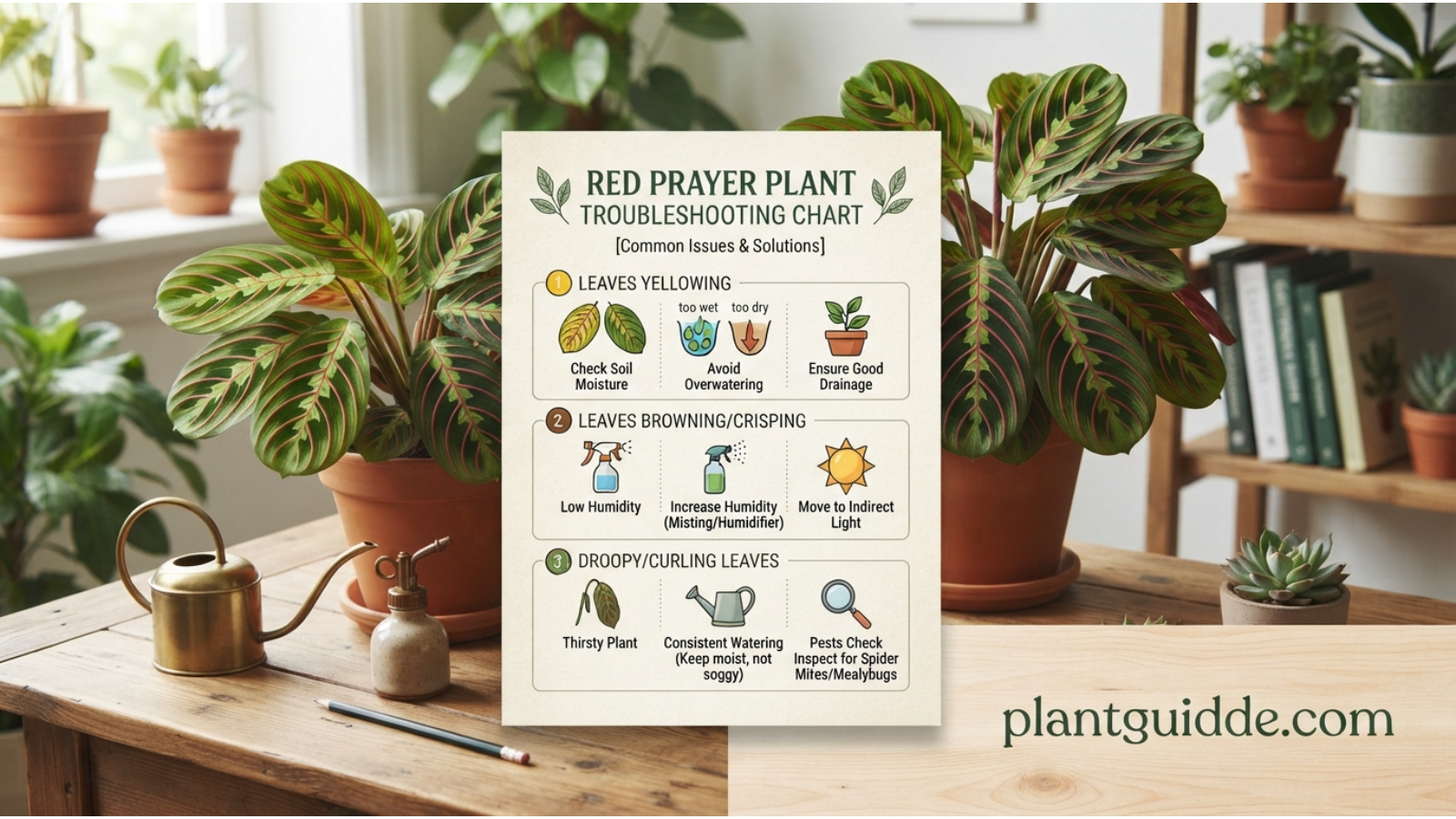
Red Prayer Plant Troubleshooting Chart
| Problem | Most likely areas to investigate | First action |
|---|---|---|
| Brown leaf tips | Humidity, water quality, inconsistent moisture | Check humidity and soil |
| Crispy leaves | Dry air, direct sun, underwatering | Move from harsh sun and assess moisture |
| Yellow leaves | Excess moisture, root stress, aging leaves | Check drainage and soil |
| Curling leaves | Dryness, humidity, temperature, light | Inspect soil and environment |
| Faded red veins | Light conditions | Provide brighter filtered light |
| Drooping | Dryness or root stress | Check soil before watering |
| Soft/stem rot | Excess moisture | Improve drainage and inspect roots |
| Slow growth | Low light, poor conditions, nutrition | Improve light and overall care |
| Tiny webbing or stippling | Possible spider mites | Inspect leaves closely |
| Cotton-like clusters | Possible mealybugs | Isolate and inspect plant |
Missouri Botanical Garden lists spider mites, mealybugs, thrips, root rot, leaf spot, and tip browning among potential problems, while RHS also identifies spider mites and mealybugs as pests that may affect Maranta.
Image Suggestion: Troubleshooting infographic showing brown tips, curling leaves, yellow leaves, and healthy red-veined foliage with likely causes.
Red Prayer Plant vs. Other Prayer Plants
The term “prayer plant” covers several Maranta forms, so different varieties can have noticeably different markings.
The red-veined type is particularly recognizable because of its red midrib and branching red veins. RHS describes M. leuconeura var. erythroneura as having bright red main veins and a herringbone-like pattern.
Don’t assume that every plant sold as a “prayer plant” will have exactly the same leaf pattern or color.
If you’re buying one specifically for red foliage, inspect the actual plant rather than relying solely on a nursery label.
When Should You Move a Red Prayer Plant?
Location matters more than frequent rearranging.
A good permanent position usually provides:
- Bright filtered light
- No harsh afternoon sun
- Stable warmth
- Good humidity
- Protection from drafts
- Easy access for watering
If your plant is repeatedly showing stress, moving it once to a significantly better environment is preferable to shifting it around the room every few days.
Plants need time to respond to environmental changes.
Expert Tip: Diagnose Patterns, Not Individual Leaves
One damaged leaf does not necessarily mean the entire care routine is wrong.
Older leaves naturally age, and occasional imperfections happen.
Look for patterns.
For example:
- One brown leaf → possibly normal aging or isolated damage.
- Many leaves developing brown edges → environmental issue deserves investigation.
- Brown edges plus very dry soil → moisture/humidity problem becomes more likely.
- Brown edges plus wet soil → root stress and drainage deserve attention.
- Faded leaves on the sunny side → excessive light may be involved.
This approach prevents the common mistake of changing everything at once.
FAQs,
How much sunlight does a red prayer plant need?
Red prayer plants do best in bright, indirect or filtered light. Strong direct sunlight can bleach or damage their patterned foliage. A bright room away from harsh afternoon rays is generally a good choice.
How often should I water a red prayer plant?
Water when the growing medium begins to dry rather than following a strict calendar. Keep it consistently moist during active growth, but never leave the roots sitting in standing water. Reduce watering as growth slows in winter.
Why are my red prayer plant leaves turning brown?
Brown tips can be associated with dry air, inconsistent moisture, excessive fertilizer, water-quality issues, or other environmental stress. Check humidity, soil moisture, light, and recent fertilizer use before changing your watering routine.
Why are my red prayer plant leaves curling?
Curling may result from dry soil, low humidity, temperature stress, excessive light, or root problems. However, remember that prayer plants naturally raise and reposition their leaves at night.
Does a red prayer plant need high humidity?
Yes. High humidity is preferred, particularly in dry indoor environments. A humidifier, plant grouping, or naturally humid room can help create a more suitable environment.
Can a red prayer plant grow in low light?
It can tolerate lower light, but bright indirect light is generally better for maintaining healthy growth and attractive foliage. Avoid interpreting “low-light tolerant” as meaning that a dark room is ideal.
Can I keep a red prayer plant in a bathroom?
A bright bathroom can be an excellent location if it receives suitable indirect light. The naturally higher humidity can also benefit the plant.
Should I mist my red prayer plant?
Misting can temporarily wet the foliage, but maintaining appropriate ambient humidity is more dependable. A humidifier or suitable humid location provides more consistent conditions.
Can I grow a red prayer plant outdoors?
In warm, frost-free climates it can be grown outdoors in sheltered, shaded conditions. It is tropical and sensitive to cold, so outdoor growing is unsuitable where temperatures regularly become too low. Missouri Botanical Garden lists it for USDA Zones 11–12 outdoors.
How do I make the red veins more vibrant?
Provide good bright indirect light without exposing the leaves to intense direct sun. Healthy growth, appropriate nutrition, and stable environmental conditions also help maintain attractive foliage.
Is a red prayer plant difficult to care for?
It is generally more particular than very forgiving houseplants because it responds noticeably to dry air, inconsistent moisture, cold drafts, and unsuitable light. Once humidity, moisture, and indirect light are kept stable, care becomes much easier.
Final Takeaway
Successful red prayer plant care comes down to environmental balance rather than complicated techniques.
Give your Maranta bright filtered light, moist but well-drained soil, warm temperatures, and consistently humid air. Avoid harsh direct sunlight, cold drafts, waterlogged roots, and excessive fertilizer.
Most importantly, learn to read the plant before reacting to a symptom. Brown tips do not always mean “water more,” and curling leaves do not always mean something is wrong. Check the soil, humidity, light, temperature, and drainage together.
Once those conditions become stable, the red veins can remain striking, new leaves can develop normally, and the plant’s characteristic evening leaf movement becomes one of the most enjoyable parts of growing it.

Asad Mumtaz is a dedicated plant enthusiast and gardening writer with a passion for helping people care for their plants successfully. He specializes in plant care guides, indoor gardening, and practical growing tips for all skill levels. His content focuses on making gardening simple, enjoyable, and rewarding. Through his work, Asad shares reliable advice to help readers create thriving green spaces.