Prayer plants are popular houseplants for good reason. Best Care for Prayer Plant Healthy Growth. Their patterned leaves can bring color and texture to a room, while their unusual habit of folding their leaves upward at night gives them a distinctive appearance.
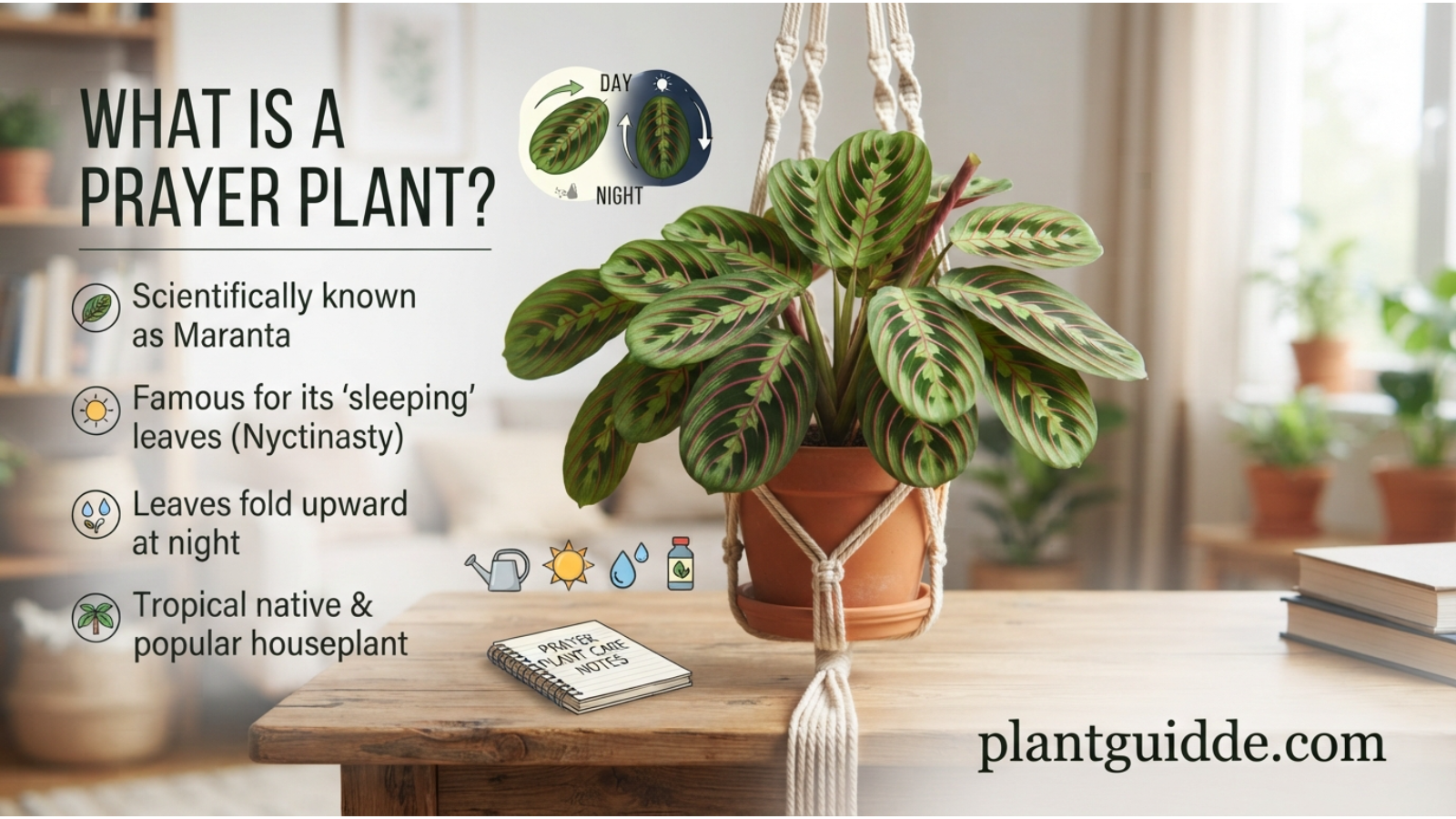
The name “prayer plant” most commonly refers to Maranta, particularly Maranta leuconeura. It belongs to the Marantaceae family and is native to tropical regions of Brazil. The leaves naturally change position between day and night, a movement sometimes called nyctinasty.
But attractive foliage does not necessarily mean an easy-care plant.
Prayer plants are much less forgiving of extremely dry air, irregular watering, harsh sunlight, and poor drainage than many drought-tolerant houseplants. A plant can look healthy when you first bring it home and then develop curled leaves or brown tips after a few weeks because the conditions in your home are very different from those in a nursery or greenhouse.
The good news is that prayer plant care becomes much easier once you understand what the leaves are telling you.
Quick Answer
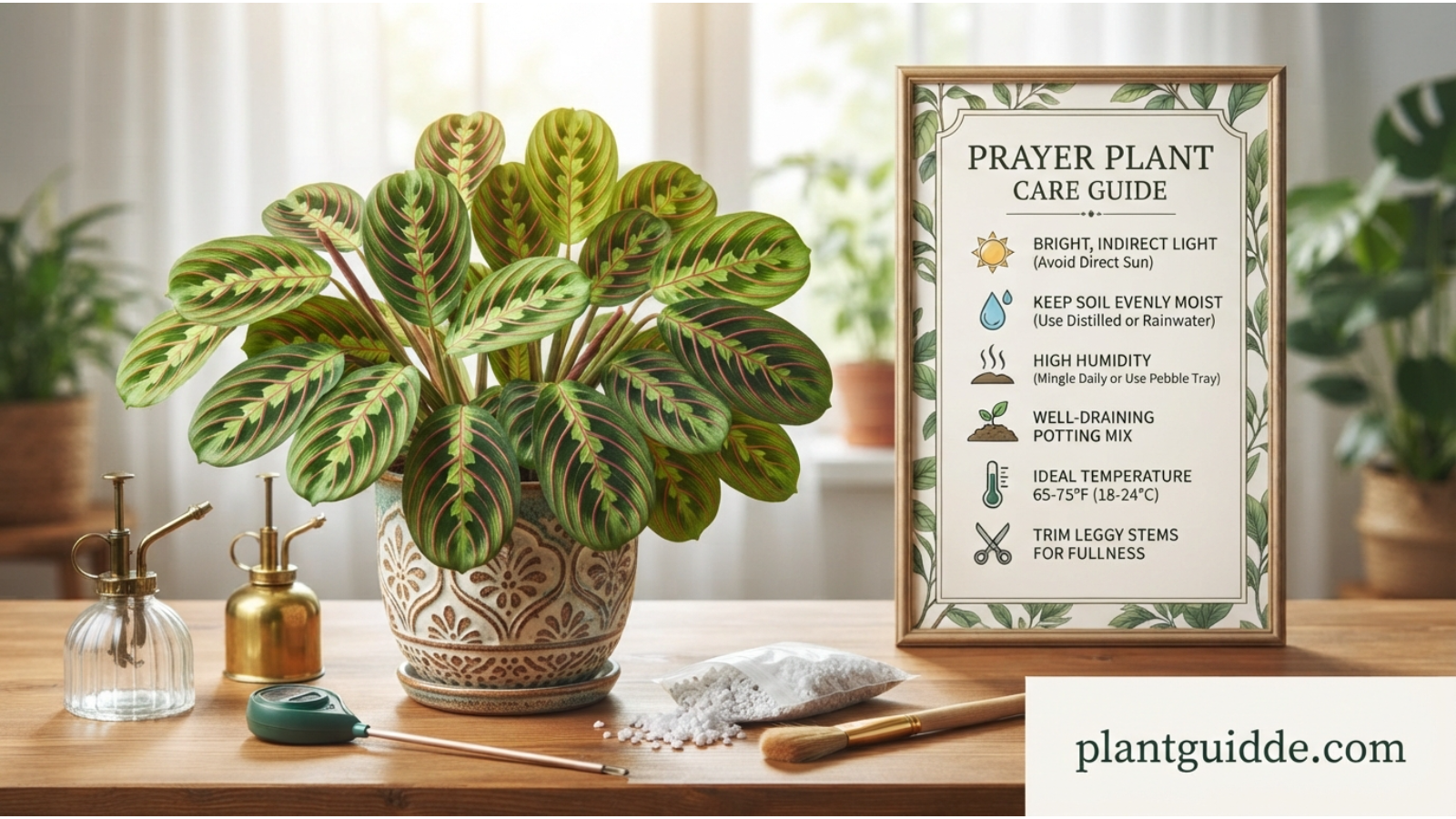
To care for a prayer plant, give it bright, indirect light, consistently moist but well-draining soil, warm temperatures, and relatively high humidity. Water when the upper layer of soil begins to dry rather than following a rigid schedule. Keep it away from harsh direct sunlight, cold drafts, and heating or air-conditioning vents. If the leaves curl, develop brown edges, or turn yellow, check moisture, humidity, light, and drainage before assuming the plant needs more fertilizer.
What Is a Prayer Plant?
A prayer plant is a tropical, rhizomatous perennial in the Marantaceae family. Maranta leuconeura is one of the best-known species grown as a houseplant.
Its oval leaves may feature contrasting veins, spots, or feather-like patterns, depending on the variety. Some varieties have red or pink veins, while others have distinctive dark markings.
The plant’s evening leaf movement is one of its most recognizable characteristics. Rather than indicating that something is wrong, this movement is a normal part of its growth habit.
Prayer plant vs. Calathea: Are they the same?
Not exactly.
“Prayer plant” is most strongly associated with Maranta, while plants such as Calathea and Goeppertia are related members of the same broader family and are sometimes casually called prayer plants.
This distinction matters when researching care because different species and cultivars can have slightly different requirements.
For a typical Maranta leuconeura, the safest starting point is:
- Bright, filtered or indirect light
- Moist but well-draining growing medium
- High humidity
- Warm, stable conditions
- Regular but controlled watering
- Protection from harsh direct sun and drafts
The Royal Horticultural Society recommends bright filtered light, moderate watering, high humidity, and well-drained growing conditions for Maranta leuconeura.
Image Suggestion: Close-up botanical illustration showing Maranta leaves during the daytime and folded upward in the evening.
How to Care for a Prayer Plant
The most important part of prayer plant care is not following an exact watering calendar. It is creating a stable environment in which the soil does not repeatedly swing between bone-dry and waterlogged.
Here are the major conditions to get right.
Give Your Prayer Plant the Right Light
Prayer plants prefer bright indirect or filtered light rather than strong direct sunlight.
A location near an east- or north-facing window can work well, provided the plant receives plenty of ambient light without being exposed to intense midday sun.
Direct sunlight through glass can be particularly problematic. It may fade the attractive patterns on the leaves and contribute to scorching.
What happens with too much light?
You may notice:
- Faded leaf markings
- Bleached-looking foliage
- Brown or crispy patches
- Leaves curling away from intense light
- Faster drying of the potting mix
What happens with too little light?
Growth may become slower and the plant may produce smaller or less vigorous new leaves.
A useful practical test is to look at the quality of light, not simply whether the room appears bright to you. A room can feel bright while providing relatively little useful light for a plant.
Expert tip: If the plant is sitting directly against a sunny window and developing crispy patches, moving it farther into bright filtered light may solve the problem more effectively than increasing watering.
Image Suggestion: Diagram comparing harsh direct sunlight, bright indirect light, and low light for a prayer plant.
Water a Prayer Plant Correctly
Watering is one of the most important—and most misunderstood—parts of care for prayer plant routines.
Prayer plants prefer soil that remains evenly moist but not saturated. The goal is to avoid both extremes: allowing the root zone to become completely dry and keeping it constantly waterlogged.
The RHS recommends keeping Maranta leuconeura moist but well-drained and watering moderately, with reduced watering during winter.
When should you water a prayer plant?
Don’t automatically water every Monday or every three days.
Instead:
- Check the upper part of the potting mix with your finger.
- If it has begun to dry, check deeper into the root zone.
- Feel the weight of the pot.
- If the mix is noticeably dry and the pot feels lighter, water thoroughly.
- Allow excess water to drain away completely.
Houseplant watering frequency depends on light, temperature, humidity, pot material, and soil type. Missouri Botanical Garden specifically recommends considering the plant’s environment rather than relying on a universal watering schedule.
How much water should you give?
Water slowly and thoroughly enough to moisten the root ball. If the container has drainage holes, excess water should be able to escape from the bottom.
Do not leave the pot sitting in standing water.
The purpose of drainage is not to make the plant dry out quickly. It is to prevent excess water from remaining around the roots for prolonged periods.
Why overwatering is dangerous
Beginners sometimes assume that a plant with drooping leaves must need more water.
That can be a mistake.
Overwatering can reduce oxygen around the roots and contribute to root rot. Yellowing and wilting can occur with either too much or too little water, which is why the symptom needs to be considered alongside the condition of the soil.
Image Suggestion: Three-panel infographic showing underwatered, correctly watered, and overwatered prayer plant soil.
Use the Right Water
Prayer plants can be sensitive to water quality, particularly when tap water contains significant levels of minerals or chemicals.
If you repeatedly notice brown leaf tips despite otherwise good care, water quality is worth investigating.
Depending on your local water supply, alternatives may include:
- Filtered water
- Distilled water
- Rainwater where safely collected
The RHS notes that some prayer-plant relatives, including Calathea, can be sensitive to fluoride and chlorine and recommends filtered, distilled, or rainwater where appropriate.
This does not mean every prayer plant will immediately fail when given tap water. Water chemistry varies considerably by location. If your plant consistently develops tip burn despite appropriate moisture and humidity, however, water quality is one variable worth testing.
Keep Humidity High
If there is one environmental factor that separates a thriving prayer plant from a struggling one in many homes, it is humidity.
Prayer plants come from humid tropical environments. Dry indoor air can cause leaves to curl and edges to become brown or crispy.
The RHS recommends high humidity for Maranta leuconeura and suggests methods such as misting or using a gravel tray.
How to increase humidity
You can:
- Use a room humidifier.
- Group several plants together.
- Place the plant in a naturally humid room.
- Use a pebble or gravel tray.
- Keep it away from heating and air-conditioning vents.
A humidifier is generally the most controllable option because it raises ambient humidity without requiring you to repeatedly wet the foliage.
Is misting enough?
Misting may temporarily increase moisture around the leaves, but it is not a substitute for maintaining appropriate room humidity.
If your home is consistently dry, improving the surrounding environment is usually more useful than repeatedly spraying the leaves.
RHS guidance also emphasizes that humidity affects transpiration—the rate at which plants lose water through their leaves.
Image Suggestion: Photo showing a healthy prayer plant beside a small humidifier, with a humidity meter visible nearby.
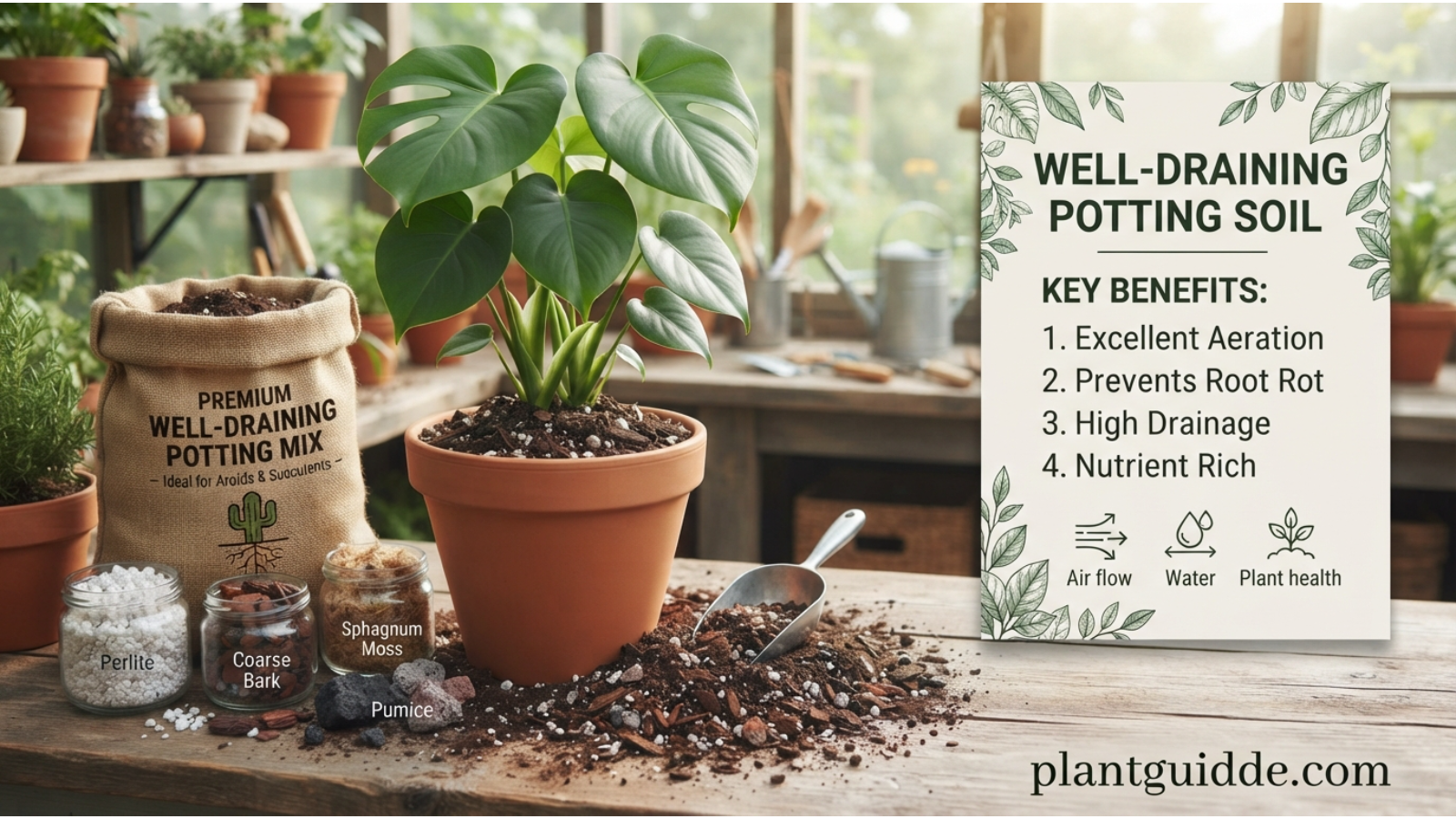
Choose a Well-Draining Potting Mix
Prayer plants like moisture, but that does not mean they should sit in dense, waterlogged soil.
A good growing medium should retain enough moisture for the roots while still allowing excess water and air movement through the root zone.
A practical houseplant mix can be based on:
- Quality peat-free houseplant compost
- Coco coir or another moisture-retentive component
- Perlite or another aerating material
The exact recipe is less important than the result: the mix should stay lightly moist without becoming a compact, soggy mass.
The RHS recommends peat-free compost for Maranta leuconeura grown under glass and emphasizes well-drained conditions.
The pot matters too
Always use a container with drainage holes.
A decorative outer pot can be used, but excess water should not remain trapped around the nursery pot indefinitely.
Common mistake: Choosing a very large pot because you want the plant to “grow into it.”
A disproportionately large container can hold moisture for a long time after watering, increasing the risk of root problems.
Maintain Warm, Stable Temperatures
Prayer plants prefer warm indoor conditions and generally dislike sudden temperature changes.
Keep the plant away from:
- Cold drafts
- Frequently opened exterior doors
- Air-conditioning vents
- Heaters
- Radiators
- Very cold window glass
The issue is not simply whether the average room temperature is comfortable. Rapid fluctuations can also stress sensitive houseplants.
Missouri Botanical Garden notes that drafts, hot or cold air, and large temperature fluctuations can contribute to foliage problems.
A stable room with moderate warmth is usually better than a location that repeatedly swings from hot to cold.
Fertilize During Active Growth
Prayer plants do not need to be heavily fertilized.
During active growth, a balanced liquid houseplant fertilizer can be applied according to the product’s directions. The RHS recommends monthly feeding for Maranta leuconeura during its growing period.
Avoid the temptation to add extra fertilizer whenever growth seems slow.
Slow growth can result from:
- Insufficient light
- Cool temperatures
- Low humidity
- Root problems
- Seasonal dormancy
Adding more fertilizer cannot correct all of these problems and may contribute to fertilizer salt buildup.
If the plant has been neglected for a long time, correct its environmental conditions first.
Prune Damaged Leaves Properly
Prayer plants generally do not require heavy pruning.
However, removing badly damaged leaves can improve appearance and allow you to monitor new growth more easily.
Use clean, sharp scissors and cut damaged foliage near its base without unnecessarily cutting healthy stems.
Do not remove every leaf simply because it has a small brown edge.
A leaf with minor cosmetic damage can still contribute to photosynthesis.
Repot Only When Necessary
Prayer plants do not need to be moved into a much larger container every year.
Repot when the existing container is becoming restrictive, the growing medium has deteriorated, or drainage has become problematic.
When moving to a larger container, choose only a modest increase in pot size.
A useful rule for many houseplants is to increase the container by roughly one size rather than jumping into a dramatically larger pot. Missouri Botanical Garden similarly recommends choosing a container about an inch larger when a larger pot is actually needed.
Signs your prayer plant may need repotting
Look for:
- Roots emerging from drainage holes
- Soil drying unusually quickly
- Severely compacted growing medium
- A root-bound plant with little room for new roots
- Poor drainage despite otherwise appropriate watering
Repotting should solve a problem—not become a routine that repeatedly disturbs the plant.
Prayer Plant Care at a Glance
| Care factor | What a prayer plant prefers | Common problem |
|---|---|---|
| Light | Bright, indirect or filtered | Direct sun causes fading or scorch |
| Water | Evenly moist, not soggy | Root problems from excessive moisture |
| Humidity | Relatively high | Brown tips and curling |
| Soil | Moisture-retentive but well-draining | Compacted or waterlogged roots |
| Temperature | Warm and stable | Draft-related stress |
| Fertilizer | Moderate feeding during growth | Salt buildup from overfertilizing |
| Pot | Drainage hole required | Water trapped around roots |
| Pruning | Minimal | Removing healthy foliage unnecessarily |
Why Are My Prayer Plant Leaves Curling?
Curling leaves are among the most common prayer plant problems.
But “curled leaves” is a symptom, not a diagnosis.
Check these conditions before doing anything drastic.
1. The soil is too dry
If the potting mix has become very dry and the leaves are curling, underwatering may be involved.
Water thoroughly and then monitor how quickly the plant recovers.
2. Humidity is too low
A dry room can cause prayer-plant leaves to curl inward.
This is particularly common during periods when indoor heating or air-conditioning reduces humidity.
RHS guidance specifically identifies inward leaf curling in Maranta as a possible response to bright light and dry conditions.
3. The plant receives too much light
Very bright direct sunlight can increase stress and water loss while damaging foliage.
Move the plant to bright filtered light rather than simply watering it more often.
4. Temperature is fluctuating
Cold drafts or sudden changes between day and night temperatures can contribute to leaf deformation and curling.
5. The roots are unhealthy
If the soil stays wet for extended periods and the plant continues to wilt or deteriorate, inspect the root system rather than assuming it needs additional water.
Why Are My Prayer Plant Leaves Turning Brown?
Brown tips do not automatically mean your plant needs more water.
Possible causes include:
- Low humidity
- Irregular watering
- Excessive direct sunlight
- Water-quality issues
- Fertilizer salt buildup
- Hot or cold drafts
- Root stress
Missouri Botanical Garden notes that low humidity, direct sun, watering issues, and drafts can all contribute to brown foliage tips in indoor plants.
A practical way to diagnose brown tips
Ask four questions:
Is the soil dry?
If yes, improve watering consistency.
Is the room very dry?
If yes, increase ambient humidity.
Is the plant receiving direct sun?
If yes, provide filtered light.
Are the roots constantly wet?
If yes, investigate drainage and the potting mix.
Do not change all four factors simultaneously. Changing one or two likely causes at a time makes it easier to determine what actually helped.
Image Suggestion: Labeled close-up of prayer plant brown tips showing likely causes and diagnostic clues.
Why Are Prayer Plant Leaves Turning Yellow?
Yellow leaves can result from several different problems, so context matters.
Possible causes include:
Overwatering
Constantly wet soil can deprive roots of oxygen and contribute to root rot.
Underwatering
Severe or repeated dryness can also cause foliage stress.
Poor light
Insufficient light can reduce vigor and slow growth.
Natural aging
An occasional older leaf turning yellow is not necessarily a serious problem.
Nutrient or root problems
If multiple leaves are deteriorating and growth has stalled, investigate the root environment before adding fertilizer.
The Missouri Botanical Garden emphasizes that yellowing and wilting can occur from both excessive and insufficient watering, making the soil and environmental conditions important diagnostic clues.
Why Is My Prayer Plant Drooping?
Drooping can occur after the soil becomes too dry, but it can also appear when roots are damaged by excessive moisture.
Before watering, check the soil.
If the soil is dry
Water thoroughly and allow excess water to drain.
If the soil is wet
Do not automatically add more water.
Check:
- Drainage holes
- Soil texture
- Pot size
- Root condition
- How long the soil has remained wet
This is one of the most important lessons in prayer plant care: the same visual symptom can have completely different causes.
How to Fix an Overwatered Prayer Plant
If you suspect overwatering, stop watering until the growing medium has had a chance to drain and partially dry.
Then inspect the plant.
If the soil remains saturated for an unusually long time:
- Remove the plant carefully from its pot.
- Examine the roots.
- Look for soft, dark, or deteriorating roots.
- Remove severely damaged material with clean tools.
- Repot into fresh, appropriately draining mix if necessary.
- Use a container with drainage.
- Adjust future watering based on soil moisture rather than a calendar.
Do not move an overwatered plant immediately into a huge container.
The objective is to restore a healthy balance between moisture and air around the roots.
How to Make a Prayer Plant Fuller
If your prayer plant is healthy but looks sparse, focus on the growing conditions rather than simply adding fertilizer.
Improve light
Bright filtered light supports stronger growth without the risks associated with intense direct sun.
Maintain consistent moisture
Repeatedly allowing the plant to become extremely dry can interfere with healthy new growth.
Increase humidity
A stable, humid environment can help sensitive tropical foliage look healthier.
Rotate the pot
If light comes strongly from one direction, rotating the plant periodically can encourage more balanced growth.
Propagate and replant
Healthy prayer plants can be propagated by division, allowing multiple sections to be grown together for a fuller appearance. The RHS lists division and basal cuttings among propagation methods for Maranta.
How to Propagate a Prayer Plant
Division is one of the practical ways to propagate an established prayer plant.
When repotting a mature plant:
- Remove it carefully from its container.
- Examine the rhizomes and root system.
- Identify naturally separate sections with healthy roots and shoots.
- Divide carefully.
- Plant each division in an appropriately sized container.
- Keep the new plants warm and evenly moist while they establish.
Propagation works best when the plant is actively growing and healthy.
Avoid dividing a plant that is already severely stressed, dehydrated, or suffering from major root damage.
Common Prayer Plant Care Mistakes
Mistake 1: Watering on a fixed schedule
A calendar cannot account for changes in temperature, humidity, light, pot size, and soil.
Better approach: Check the plant and soil before watering.
Mistake 2: Putting it in direct sunlight
A bright room does not mean the plant needs direct sun.
Better approach: Choose bright filtered or indirect light.
Mistake 3: Keeping the soil permanently wet
Prayer plants like moisture, but their roots still require oxygen.
Better approach: Keep the soil moist but well-drained.
Mistake 4: Ignoring humidity
A plant can receive perfect light and still develop brown, curling leaves if the surrounding air is extremely dry.
Better approach: Improve ambient humidity, especially in dry indoor environments.
Mistake 5: Treating every yellow leaf as a fertilizer deficiency
Yellowing has many potential causes.
Better approach: Check moisture, roots, light, and environmental stability before feeding.
Mistake 6: Using an oversized pot
More soil means more moisture retention.
Better approach: Use a container appropriate for the existing root system.
Mistake 7: Moving the plant constantly
Frequent changes make it difficult to determine what conditions the plant actually prefers.
Better approach: Make one sensible adjustment and observe the plant over time.
Seasonal Prayer Plant Care
Spring and Summer
During active growth, your prayer plant may use water more quickly.
Check soil moisture regularly and provide adequate indirect light.
This is also a suitable period for:
- Repotting when necessary
- Propagation
- Regular feeding
- Removing damaged foliage
Autumn
As daylight decreases, the plant may begin using water more slowly.
Do not continue watering at exactly the same frequency simply because you did so during summer.
Winter
Lower light and cooler conditions can reduce water consumption.
The RHS recommends reducing watering during winter for Maranta leuconeura.
If indoor heating makes the air extremely dry, however, humidity can become a larger concern.
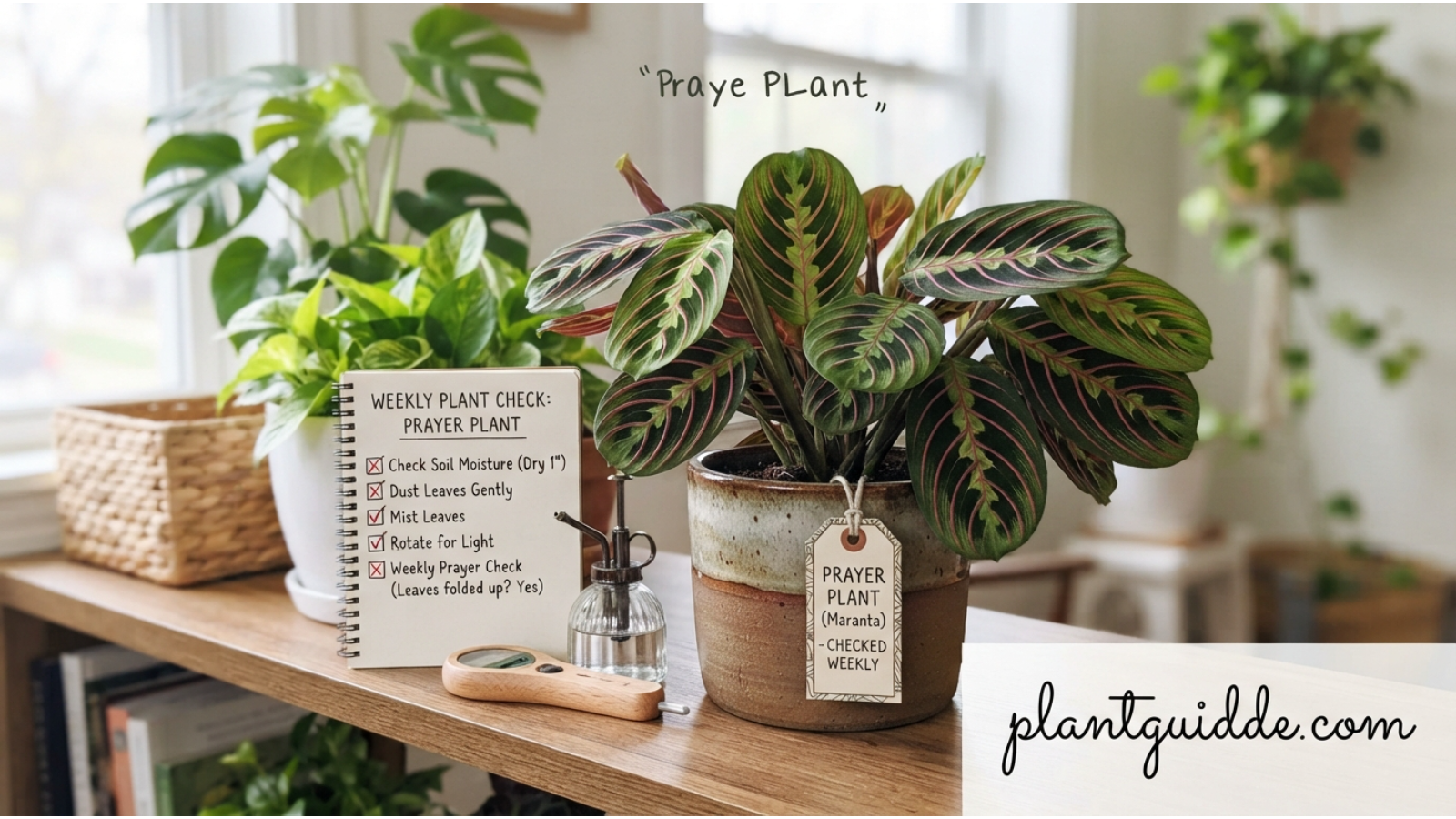
A Simple Weekly Prayer Plant Check
You do not need to perform a complicated maintenance routine.
Once a week, inspect:
Leaves
Look for:
- Curling
- Brown tips
- Yellowing
- Pests
- New growth
Soil
Check whether it is:
- Moist
- Beginning to dry
- Completely dry
- Staying wet for too long
Environment
Ask:
- Has the plant been moved?
- Is it receiving stronger sunlight?
- Has the room become unusually dry?
- Is an air conditioner or heater blowing directly onto it?
Roots and pot
Occasionally check:
- Drainage
- Root crowding
- Soil condition
- Standing water
This simple inspection can catch problems before widespread leaf damage develops.
When Should You Move Your Prayer Plant?
Move it when its current position is causing a clear problem—not simply because another location looks nicer.
Consider moving it if:
- Leaves are being scorched by direct sun.
- The plant is consistently exposed to a heater or AC vent.
- The air is extremely dry.
- The soil dries out abnormally quickly.
- Growth has become weak because light is insufficient.
RHS guidance emphasizes choosing a houseplant’s location based on its actual growing requirements rather than placing it somewhere solely for decoration.
The Best Environment for a Prayer Plant
If you want a simple mental picture, imagine the conditions beneath a tropical forest canopy.
Your indoor prayer plant does not need an exact rainforest replica. Instead, aim for the same basic pattern:
Filtered light + warmth + moisture + humidity + good drainage + stability
That combination is more important than any individual care trick.
A humidifier will not compensate for waterlogged soil.
Perfect watering will not fix intense direct sunlight.
Fertilizer will not repair damaged roots.
Successful care for prayer plant comes from balancing the whole environment.
FAQs,
How often should I water a prayer plant?
There is no reliable universal schedule. Check the soil regularly and water when the upper portion has begun to dry while the root zone is not completely dry. Environmental conditions such as light, temperature, humidity, pot size, and soil composition affect how frequently watering is needed.
Does a prayer plant need direct sunlight?
No. Prayer plants generally perform best in bright filtered or indirect light. Strong direct sunlight can fade foliage and cause scorching.
Why does my prayer plant curl its leaves?
Curling can be associated with dry soil, low humidity, bright light, or temperature fluctuations. Check the growing conditions before deciding on a single cause.
Should I mist my prayer plant?
Misting can temporarily increase moisture around the foliage, but it should not be considered a complete solution for consistently dry indoor air. A humidifier or naturally humid room provides more sustained environmental control.
Why are the tips of my prayer plant turning brown?
Low humidity, irregular watering, excessive direct light, water quality, fertilizer buildup, and drafts can all contribute to brown tips. Examine the entire growing environment rather than assuming the plant simply needs more water.
Can a prayer plant recover from overwatering?
It can recover if the problem is identified early and the root environment is corrected. Improve drainage, allow excessive moisture to leave the pot, and inspect the roots if the plant continues to decline.
Does a prayer plant need high humidity?
Yes. Prayer plants generally perform better in relatively humid conditions. High humidity is particularly helpful when indoor air becomes dry.
Can prayer plants grow in low light?
They can tolerate lower light than many sun-loving plants, but very low light is not ideal for vigorous growth. Bright indirect or filtered light is a better target.
Should I cut off brown prayer plant leaves?
Remove severely damaged leaves if necessary, but a leaf with only a small brown edge can usually remain. Correct the underlying environmental problem before repeatedly removing foliage.
Why is my prayer plant not growing?
Insufficient light, cool conditions, low humidity, poor root health, inadequate nutrition, or seasonal slowdown can all reduce growth. Check the basic environment before adding more fertilizer.
How do I make my prayer plant grow faster?
Do not try to force growth with excessive fertilizer. Provide appropriate indirect light, stable warmth, consistent moisture, good drainage, and adequate humidity. Healthy growth is more important than rapid growth.
Final Takeaway
The easiest way to care for prayer plant successfully is to stop thinking of watering, light, humidity, and soil as separate tasks.
They interact.
Bright light can increase water use.
Dry air can increase water loss through the leaves.
Poor drainage can keep roots wet even when the leaves appear thirsty.
Cold or drafty conditions can cause foliage problems even when the soil is adequately watered.
For most Maranta leuconeura, the reliable foundation is bright indirect light, evenly moist but well-drained soil, high humidity, warm stable conditions, and careful observation.
Most importantly, learn to diagnose the plant before reacting to a symptom. A curled leaf does not automatically mean “water it.” A yellow leaf does not automatically mean “fertilize it.” Brown tips do not automatically mean “give it more water.”
Look at the soil, roots, light, humidity, temperature, and recent changes together.
That habit will make prayer plant care far more predictable. and give your plant a much better chance of producing healthy, beautifully patterned foliage for years.

Asad Mumtaz is a dedicated plant enthusiast and gardening writer with a passion for helping people care for their plants successfully. He specializes in plant care guides, indoor gardening, and practical growing tips for all skill levels. His content focuses on making gardening simple, enjoyable, and rewarding. Through his work, Asad shares reliable advice to help readers create thriving green spaces.