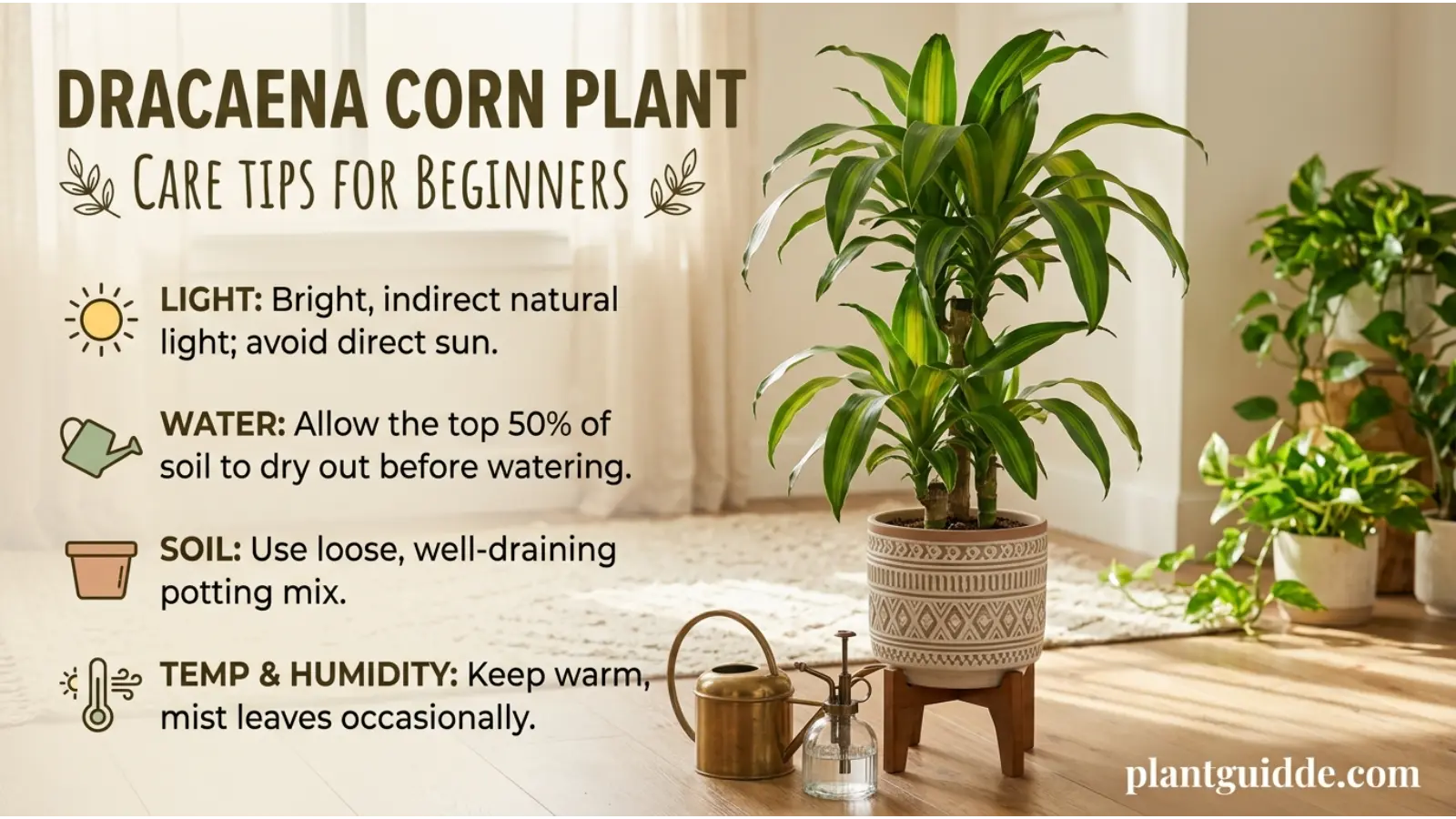
Dracaena corn plant care (Dracaena fragrans) is a popular indoor foliage plant known for its thick, cane-like stems and long, arching leaves. Many varieties feature rich green foliage, while cultivars such as ‘Massangeana’ have a distinctive yellow stripe running through the center of each leaf.
These symptoms often result from watering problems, poor drainage, insufficient light, or mineral buildup in the soil.
Successful dracaena corn plant care depends on understanding how this tropical plant responds to its surroundings. With the right light, careful watering, and occasional maintenance, you can keep a corn plant healthy and attractive for years.
Quick Answer
Dracaena corn plant care involves providing bright, indirect light, well-draining soil, moderate watering, and warm indoor temperatures. Water when the top 1–2 inches of soil feel dry, and empty excess water from the pot’s saucer. Keep the plant away from cold drafts and intense direct sunlight, and fertilize lightly during active growth to maintain healthy, arching green leaves.
Understanding the Dracaena Corn Plant
The corn plant belongs to the Asparagaceae family and originates from tropical Africa. Its common name comes from the resemblance of its long, narrow leaves to corn foliage.
Unlike true corn, which is a grass grown for its edible grain, Dracaena fragrans is an ornamental plant grown primarily for its foliage and upright growth.
Several features make it suitable for indoor spaces:
- Architectural appearance: Thick canes and leafy crowns add height to living rooms, offices, and other interiors.
- Adaptability: It tolerates typical household conditions and can grow under bright, indirect light.
- Moderate growth: It usually does not require frequent pruning or repotting.
- Varied foliage: Different cultivars offer solid green, striped, or variegated leaves.
Corn plants are often sold with one or more canes of different heights in a single pot. Each cane can produce a crown of leaves, creating a layered appearance as the plant matures.
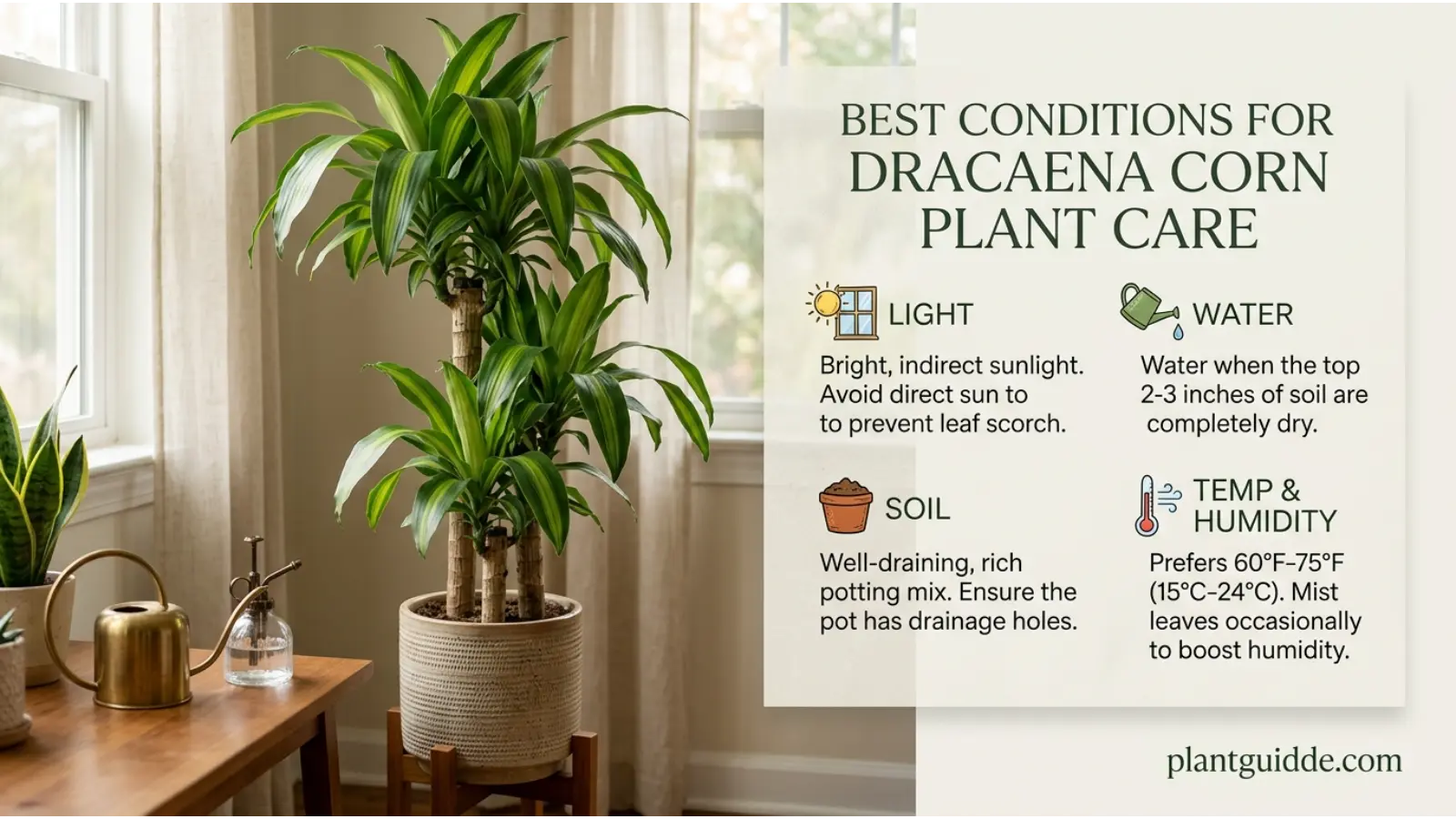
Best Conditions for Dracaena Corn Plant Care
The most reliable way to maintain a healthy corn plant is to provide consistent growing conditions without keeping the roots continuously wet.
| Care factor | Recommended conditions | What to avoid |
|---|---|---|
| Light | Bright, indirect light | Harsh direct sunlight for extended periods |
| Water | Water when the upper 1–2 inches of soil dry | Constantly soggy soil |
| Soil | Loose, well-draining potting mix | Dense soil that retains excess water |
| Temperature | Approximately 65–80°F (18–27°C) | Cold drafts and sudden temperature changes |
| Humidity | Average indoor humidity; moderate humidity is beneficial | Very dry air combined with other stress |
| Fertilizer | Balanced houseplant fertilizer during active growth | Excessive feeding |
| Pot | Container with drainage holes | Standing water around the roots |
These recommendations are a starting point. A corn plant in a bright, warm room may use water more quickly than one in a cool room with limited natural light.
How Much Light Does a Corn Plant Need?
Light influences the plant’s growth rate, leaf color, and overall appearance. Corn plants generally grow well in bright, indirect light, such as near a window with filtered sunlight.
Bright, indirect light
Place your corn plant near an east-facing window or a suitable distance from a bright south- or west-facing window. A sheer curtain can soften intense sunlight.
Variegated varieties often maintain stronger leaf patterns in brighter conditions. Adequate light also helps the plant produce healthy new growth.
Can a corn plant grow in low light?
Yes, a corn plant can tolerate lower indoor light, but growth usually slows. The plant may produce fewer leaves, and variegated foliage may become less pronounced.
Low light also means the soil dries more slowly. If you move your plant to a darker corner, reduce watering according to the soil’s drying rate rather than following your previous routine.
Signs of incorrect light exposure
- Brown, scorched patches: Strong direct sunlight may be damaging the leaves.
- Slow growth: The plant may not be receiving enough light, although other conditions can contribute.
- Fading leaf patterns: Some variegated cultivars need brighter indirect light to maintain their markings.
- Uneven growth: The crown may lean toward the strongest light source.
Rotate the pot occasionally to encourage balanced growth. Avoid moving a plant that has adapted to indoor light directly into intense sunlight.
How Often Should You Water a Dracaena Corn Plant?
Watering requires particular attention because corn plants prefer evenly managed moisture rather than continuously wet soil. Their roots need oxygen, and prolonged saturation can lead to root rot.
Instead of watering on a fixed schedule, check the soil before each watering.
Step-by-step watering method
- Check the soil: Insert your finger about 1–2 inches into the potting mix.
- Assess moisture: If the upper layer is still wet, wait before watering. For a large pot, check deeper as well.
- Water thoroughly: When the soil has dried sufficiently, water evenly until excess water flows from the drainage holes.
- Empty the saucer: Do not allow the pot to stand in collected water.
- Check again later: Let the upper soil dry before watering again.
The time between waterings varies with the plant’s size, pot material, temperature, light exposure, and soil composition. During winter, growth often slows, so the plant may need water less frequently.
Why overwatering is harmful
Excess moisture limits oxygen around the roots and can cause them to deteriorate. Early warning signs include yellowing leaves, persistently wet soil, and a general decline in the plant’s condition.
Dracaena corn plant carethe base of the plant becomes soft or the soil develops an unpleasant smell, inspect the roots. Remove rotting roots with clean tools and repot the plant in fresh, well-draining soil.
How to recognize un erwatering
An underwatered corn plant may have drooping leaves, dry soil, or leaves with curled edges. Check the root zone before adding water because damaged roots can also cause wilting.
Dracaena corn plant care the soil is dry and the roots are healthy, water thoroughly and allow excess moisture to drain.
Best Soil and Pot for Corn Plants
Corn plants need a potting mix that holds some moisture but drains freely. A good-quality indoor potting mix can work well if it does not become compacted.
For better aeration, consider combining:
- Two parts general-purpose indoor potting mix
- One part perlite or pumice
Adjust the proportions according to how quickly the mix dries in your home. The goal is to maintain enough moisture for the roots without allowing water to remain trapped around them.
Choose a pot with drainage holes
Drainage holes allow excess water to escape after watering. Without them, water can collect at the bottom of the container even when the surface soil appears dry.
Choose a pot that fits the root system without leaving a large volume of unused, wet soil around it. Dracaena corn plant care you prefer a decorative container without holes, keep the plant in a separate nursery pot and drain it thoroughly after watering.
Terracotta pots lose moisture faster than many plastic containers, so the soil may dry more quickly in terracotta.
Ideal Temperature and Humidity
Corn plants prefer warm, stable indoor conditions. Temperatures around 65–80°F (18–27°C) are suitable for typical household growing.
Protect your plant from cold windows, air-conditioning drafts, heating vents, and sudden temperature fluctuations. Cold exposure can cause leaf damage, especially when combined with wet soil.
Average household humidity is usually acceptable. However, very dry indoor air may contribute to dry leaf edges, particularly when the plant is also exposed to heat or inconsistent watering.
If the air is extremely dry, a room humidifier can help. Regular misting is not essential and provides only a temporary increase in moisture around the leaves.
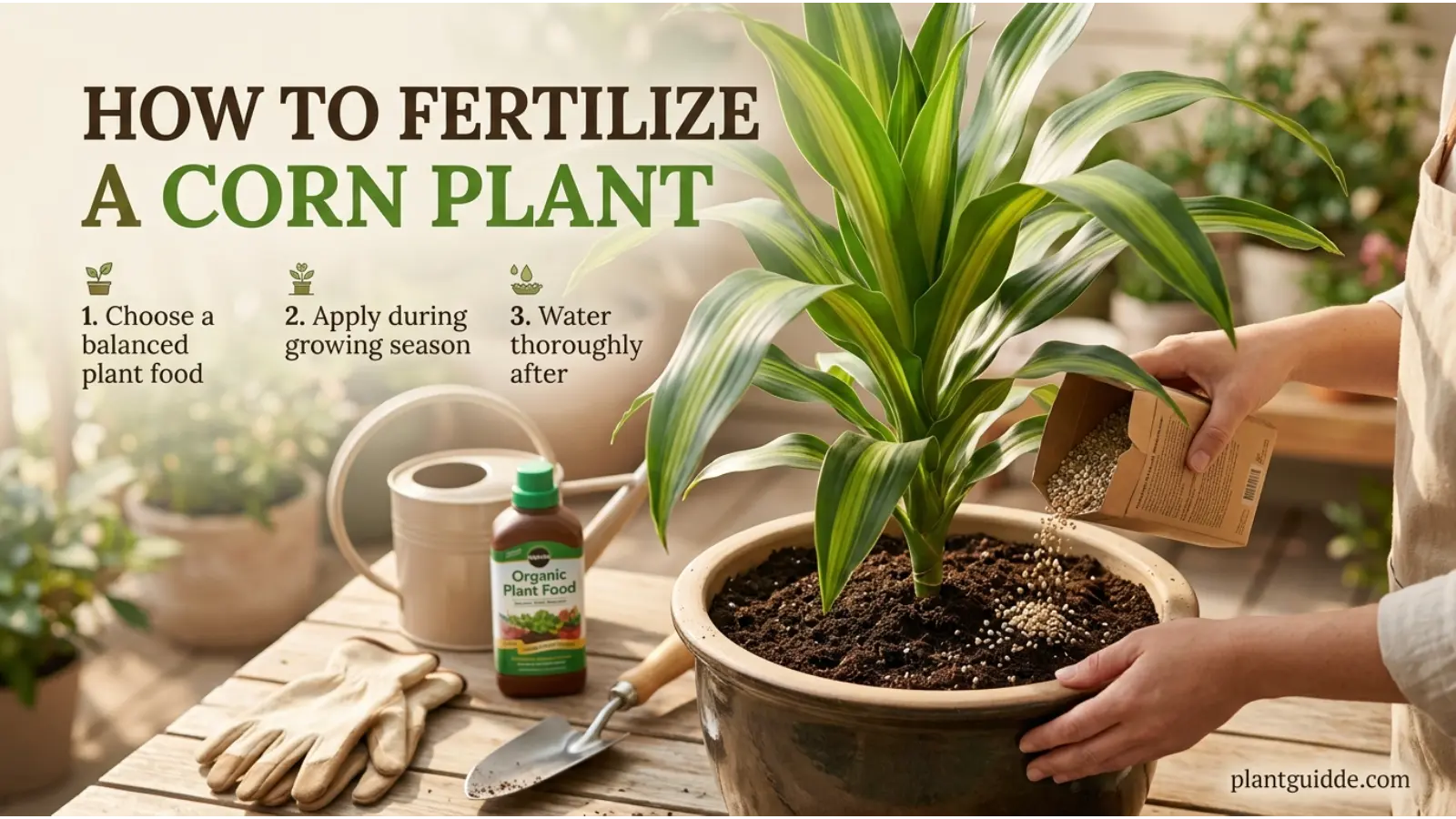
How to Fertilize a Corn Plant
Dracaena corn plants are not heavy feeders. They benefit from moderate nutrition during active growth, but excessive fertilizer can cause salt accumulation and damage the roots or leaf tips.
During spring and summer, use a balanced liquid houseplant fertilizer according to the label. Feeding every four to eight weeks may be sufficient, depending on the fertilizer strength and the plant’s growth.
Follow these practical guidelines:
- Apply fertilizer at the recommended dilution.
- Avoid fertilizing a plant with severely damaged or rotting roots.
- Reduce or stop feeding during winter if growth slows.
- Avoid applying additional fertilizer simply because leaves turn yellow.
- If mineral salts accumulate, flush the potting mix with water when drainage is good.
Corn plants can grow slowly indoors, so a lack of rapid new growth does not automatically indicate a nutrient deficiency. Check light, watering, and seasonal growth patterns before increasing fertilizer.
How to Prune and Maintain a Corn Plant
Corn plants naturally develop leafy crowns at the tops of their canes. Older leaves may gradually yellow and die, while new leaves emerge from the growing points.
Remove completely yellow or damaged leaves with clean, sharp scissors. Cut close to the stem without injuring the surrounding healthy tissue.
If a cane becomes too tall, you can cut it back with a clean pruning tool. New shoots may develop below the cut, often producing a fuller, branched appearance over time.
Keep these points in mind:
- Prune during active growth when possible.
- Remove dead foliage to keep the plant tidy.
- Avoid removing too many healthy leaves at once.
- Use clean tools to reduce the risk of spreading disease.
- Wear gloves if you are sensitive to plant sap.
A cut cane may produce new shoots, but the timing and number of shoots vary with the plant’s health, growing conditions, and the position of the cut.
How to Repot a Dracaena Corn Plant
Corn plants do not need frequent repotting. Repot when roots crowd the container, emerge through drainage holes, or the potting mix deteriorates and drains poorly.
Spring and early summer are convenient times because the plant is often growing more actively.
Repotting steps
- Choose a container slightly larger than the current pot, with drainage holes.
- Gently remove the plant and loosen the outer root ball.
- Inspect the roots for dark, soft, or damaged sections.
- Trim unhealthy roots using clean tools.
- Place the plant at the same depth it was growing previously.
- Fill around the roots with fresh, well-draining potting mix.
- Water appropriately and allow excess water to drain.
Avoid placing a small root system into a very large pot. Excess soil can remain wet for too long, especially when the plant is growing slowly.
If the plant has root rot, address the damaged roots and replace unhealthy soil promptly rather than waiting for a particular season.
Common Dracaena Corn Plant Problems and Solutions
Corn plants often show visible symptoms when their growing conditions are unsuitable. However, the same symptom can have several causes, so inspect the soil, roots, light exposure, and recent changes before choosing a solution.
| Problem | Possible cause | What to do |
|---|---|---|
| Brown leaf tips | Mineral buildup, inconsistent watering, or dry conditions | Review water quality and watering habits |
| Yellow leaves | Overwatering, root stress, or normal aging | Check soil moisture and inspect roots if symptoms spread |
| Drooping foliage | Water stress, root damage, or temperature changes | Check the soil and inspect the root system if needed |
| Brown patches | Sun scorch, cold injury, or physical damage | Review light exposure and temperature |
| Slow growth | Low light, seasonal slowdown, or root restrictions | Improve suitable light and assess the roots |
| Soft stem or cane | Serious tissue damage or rot | Inspect the affected cane and roots promptly |
| Crispy leaf edges | Dry air, mineral salts, or inconsistent moisture | Check environmental conditions and soil quality |
Why are the leaf tips turning brown?
Brown tips are common on dracaena plants. They may result from mineral salts in the water or fertilizer, inconsistent moisture, or dry environmental conditions.
If your tap water contains high levels of dissolved minerals or fluoride, consider using rainwater, filtered water, or another suitable low-mineral water source. Check the fertilizer concentration and avoid letting salts accumulate in the potting mix.
Trim brown tips for appearance if desired, following the natural shape of the leaf. However, trimming alone will not correct the underlying cause.
Why are the leaves turning yellow?
Yellowing can indicate overwatering, root problems, or normal aging of older leaves. If one lower leaf yellows while the rest of the plant looks healthy, it may simply be aging.
If several leaves turn yellow at once and the soil stays wet, check the drainage and roots. Do not respond automatically by adding fertilizer or more water.
Why is the corn plant drooping?
Drooping may occur when the soil becomes too dry, roots deteriorate from excess moisture, or the plant experiences a sudden environmental change.
Check soil moisture first. If the soil is dry, water thoroughly. If it is wet and the plant continues to decline, inspect the roots before watering again.
Common Corn Plant Care Mistakes
Even a relatively forgiving houseplant can struggle when basic growing conditions are overlooked.
Watering too frequently: Corn plants do not need constantly wet soil. Check moisture before watering.
Ignoring drainage: A decorative pot without drainage can trap excess water and damage the roots.
Placing the plant in intense direct sunlight: Strong sunlight can scorch leaves that have adapted to indoor conditions.
Using too much fertilizer: Excess nutrients can cause salt buildup and brown leaf tips.
Assuming every brown tip indicates underwatering: Mineral buildup, dry air, and root problems can produce similar symptoms.
Repotting into an oversized container: Too much wet soil around the roots can increase the risk of root rot.
Ignoring water quality: Sensitive dracaena foliage may develop brown tips when exposed to certain dissolved minerals over time.
A practical approach is to make one adjustment at a time and observe the response. For example, if brown tips appear while the soil stays wet, investigate drainage and watering before changing the humidity, fertilizer, and light simultaneously.
Is the Dracaena Corn Plant Toxic to Pets?
Yes. Dracaena fragrans is considered toxic to cats and dogs if ingested. The plant contains compounds called saponins that can cause symptoms such as vomiting, drooling, reduced appetite, and gastrointestinal upset.
Place the plant where pets cannot chew the leaves. If a pet eats part of the plant or develops symptoms, contact a veterinarian for advice.
Although corn plants are commonly used in homes and offices, they are not a pet-safe choice for households where animals can reach and chew the foliage.

FAQs:
How often should I water a dracaena corn plant?
Water when the upper 1–2 inches of soil feel dry, then allow excess water to drain completely. The interval varies according to light, temperature, pot size, and season. Always check the soil rather than following a strict weekly schedule.
Can a corn plant grow indoors without direct sunlight?
Yes. Corn plants grow well in bright, indirect light and can tolerate lower-light indoor spaces. However, very dim conditions may slow growth and reduce the vigor of the foliage. Place the plant near a suitable window without exposing it to harsh sunlight.
Why does my dracaena corn plant have brown tips?
Brown tips may result from mineral buildup, fertilizer salts, inconsistent watering, or dry indoor conditions. Check the quality of your water, avoid excessive feeding, and ensure the soil drains properly. Remove damaged tips if desired, but correct the underlying cause to prevent further damage.
How do I make my corn plant grow taller?
Provide suitable indirect light, healthy roots, and consistent care. Corn plants generally grow upward by extending their canes and producing new leaves. Growth is usually gradual indoors, and pruning the top will encourage branching rather than simply making the existing cane taller.
How long can a dracaena corn plant live indoors?
A well-maintained corn plant can live for many years indoors. Its longevity depends on suitable light, careful watering, healthy roots, and protection from cold or other environmental stress. Older plants may develop taller canes and need occasional pruning or repotting.
Conclusion
Successful dracaena corn plant care comes down to suitable indirect light, well-draining soil, careful watering, and stable indoor temperatures. Avoid keeping the roots constantly wet, use fertilizer sparingly, and investigate brown tips or yellow leaves before changing your entire care routine.
Start by checking your plant’s soil moisture, drainage holes, and light exposure. These three factors often reveal the most important adjustments needed to maintain healthy foliage and encourage steady growth.

Asad Mumtaz is a dedicated plant enthusiast and gardening writer with a passion for helping people care for their plants successfully. He specializes in plant care guides, indoor gardening, and practical growing tips for all skill levels. His content focuses on making gardening simple, enjoyable, and rewarding. Through his work, Asad shares reliable advice to help readers create thriving green spaces.