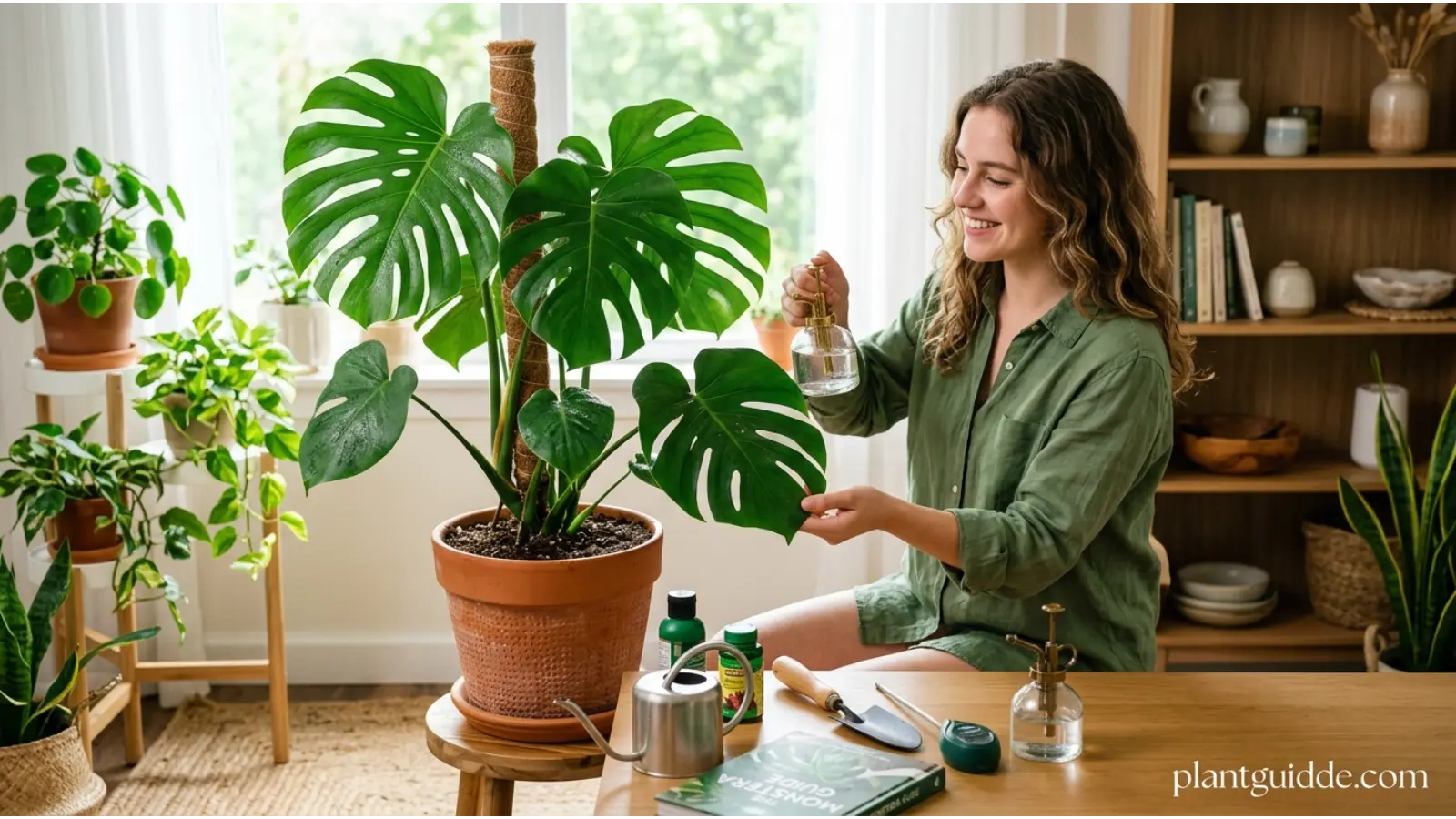
Care for monstera plant are popular indoor favorites because of their large, glossy leaves and distinctive natural splits and holes. Care for monstera plant you grow a young Monstera deliciosa on a table or a mature plant beside a bright window, it can become an impressive feature in your home when its growing needs are understood.
However, caring for a Monstera involves more than occasional watering. Brown leaf edges, yellowing foliage, small leaves, and a lack of splits can indicate problems with light, moisture, nutrition, or support.
Understanding these signs helps you correct the underlying cause rather than changing several care habits at once.
This guide explains how to care for Monstera plants indoors, including light requirements, watering, soil, humidity, fertilizing, pruning, propagation, repotting, and solutions to common problems.
Quick Answer
To care for a Monstera plant, provide bright, indirect light, well-draining soil, and water when the top 1–2 inches of soil feel dry. Keep it in a warm environment with moderate to high humidity, and provide a moss pole or sturdy support as it grows. Avoid overwatering, protect leaves from harsh direct sunlight, and give the roots enough space to develop.
Understanding the Monstera Plant
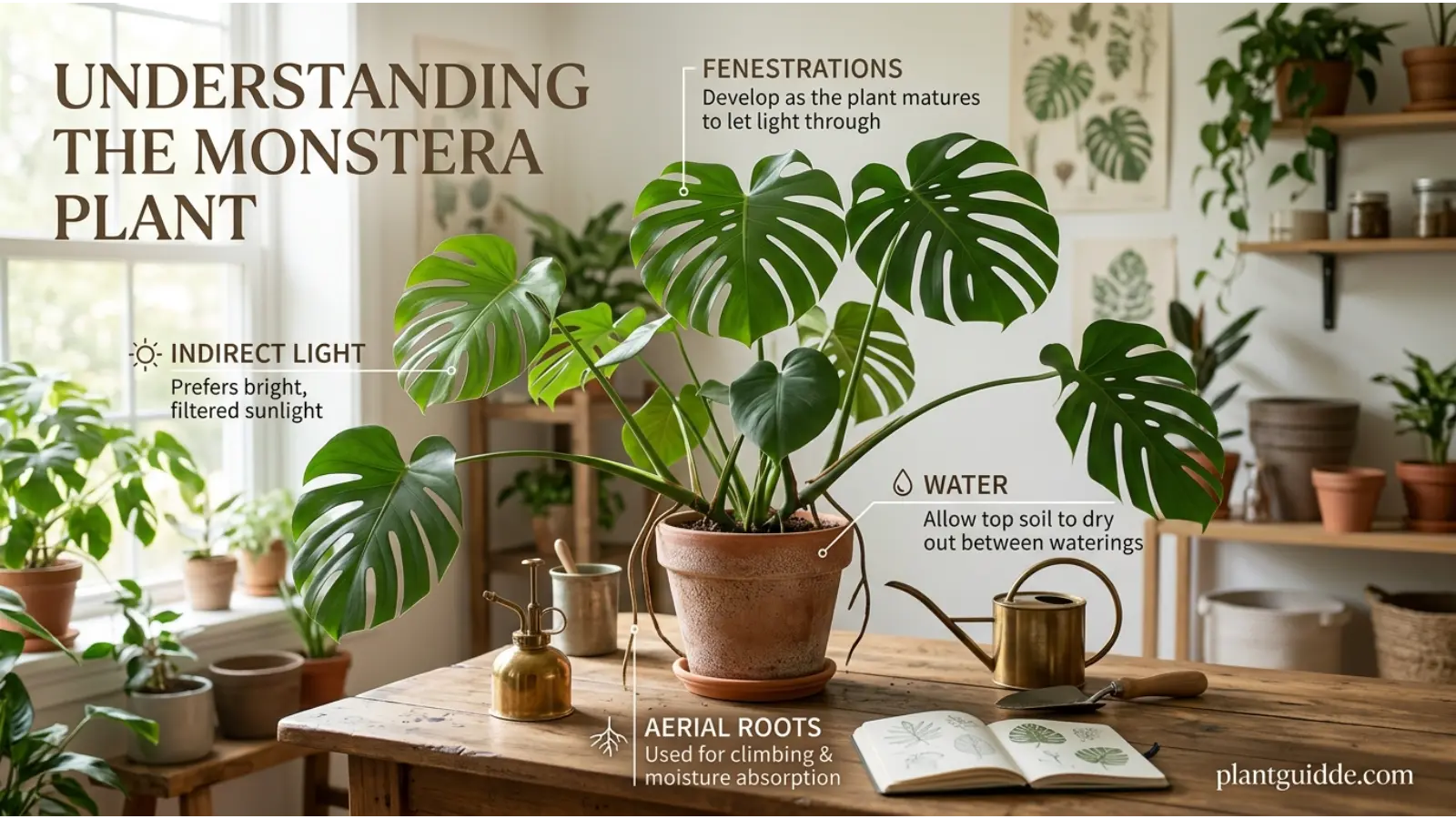
The name Monstera refers to a genus of tropical plants in the arum family, Araceae. The most widely grown indoor species is Monstera deliciosa, which develops large green leaves with characteristic splits and holes as it matures.
Monstera plants are climbing aroids. In nature, they use trees and other structures for support, and their growth changes as they climb toward brighter conditions. Indoors, a suitable support can help the plant grow more upright and produce larger leaves over time.
Popular types include:
- Monstera deliciosa: Known for its large leaves and deep splits.
- Monstera adansonii: Often called the Swiss cheese vine, with numerous holes in its smaller leaves.
- Thai Constellation: A variegated form of Monstera deliciosa with creamy markings.
- Monstera albo: A variegated form with white sections that require careful light and watering management.
Different species and cultivars can have different growth habits, but most benefit from suitable indirect light, an airy potting mix, and careful watering.
Best Conditions for Monstera Plant Care
Healthy Monstera growth depends on balancing light, moisture, warmth, and root aeration.
| Care factor | Recommended conditions | What to avoid |
|---|---|---|
| Light | Bright, indirect light | Deep shade or sudden exposure to intense sun |
| Water | Water when the upper 1–2 inches of soil dry | Constantly wet soil |
| Soil | Airy, well-draining aroid mix | Dense soil that remains saturated |
| Temperature | Approximately 65–85°F (18–29°C) | Frost and cold drafts |
| Humidity | Moderate to high humidity; average indoor levels can work | Extremely dry air combined with other stress |
| Fertilizer | Balanced houseplant fertilizer during active growth | Excessive feeding |
| Support | Moss pole, coir pole, or sturdy trellis as needed | Allowing a large climbing plant to become unstable |
These conditions are a starting point. A plant in a warm, bright room may use water faster than one in a cool space with limited light.
How Much Light Does a Monstera Need?
Light affects leaf size, growth speed, and the development of splits and holes. Monstera generally performs best in bright, indirect light.
Bright, indirect light
Place your Monstera near a bright window where it receives plenty of filtered daylight without prolonged exposure to harsh midday or afternoon sun.
An east-facing window may provide suitable morning light. Near a south- or west-facing window, a sheer curtain or additional distance may help prevent leaf scorch.
Good lighting supports stronger stems, larger new leaves, and more vigorous growth.
Can Monstera grow in low light?
Monstera can survive in lower light, but growth often slows. New leaves may remain smaller, stems may stretch toward the nearest window, and the plant may take longer to develop mature foliage.
Low light also reduces water use, so the soil may remain wet for longer. If your Monstera is in a dim room, check the soil before watering rather than following a fixed schedule.
Why are my Monstera leaves turning brown?
Brown patches can develop when leaves receive too much direct sunlight, particularly after a sudden move to a brighter location. Dry air, inconsistent watering, root damage, and physical injury can also cause browning.
Examine where the damage appears and whether it affects old or new leaves. Scorched areas often occur on the side facing strong sunlight, while root-related stress may affect several leaves at once.
How Often Should You Water a Monstera?
Monstera likes some soil moisture, but its roots also need oxygen. Keeping the potting mix continuously wet can lead to root rot, especially in cool conditions or low light.
A practical watering routine
- Check the soil: Feel the top 1–2 inches with your finger. For a large pot, check deeper if the surface dries quickly.
- Assess the root zone: If the soil below the surface is still wet, wait before watering.
- Water thoroughly: When the upper layer has dried and the mix is ready for watering, apply water evenly until it drains from the bottom.
- Empty the saucer: Do not leave the pot standing in collected water.
- Recheck later: Let the upper layer dry again before watering.
The time between waterings varies with pot size, temperature, humidity, soil composition, and light exposure. During active growth in warm weather, a Monstera may need water more often. In winter, water use commonly decreases.
Signs of overwatering
Common warning signs include:
- Yellowing leaves while the soil remains wet.
- Soft or blackened roots.
- A sour smell coming from the potting mix.
- Persistent drooping despite moist soil.
- Soft stems or rapidly worsening leaf damage.
care for monstera plant you suspect root rot, remove the plant from its pot and inspect the roots. Healthy roots are generally firm, while rotten roots may be dark, mushy, or slimy. Trim damaged sections with clean tools and repot the plant in fresh, airy soil.
Signs of underwatering
Underwatered Monstera plants may develop drooping leaves, dry soil, curling edges, or crispy brown patches.
Care for monstera plant the root zone is dry, water thoroughly and allow the excess to drain. If the leaves do not recover, check the roots and stems because severe root damage can prevent the plant from absorbing water properly.
Best Soil for Monstera Plants
Monstera roots need both moisture and airflow. Dense potting soil that stays wet for long periods can restrict oxygen and increase the risk of root problems.
An airy aroid mix is usually a better choice than heavy garden soil.
How to make a well-draining Monstera mix
A practical starting mixture is:
- Two parts quality indoor potting mix or coco-coir-based mix.
- One part orchid bark.
- One part perlite or pumice.
This combination provides a balance of moisture retention, drainage, and air spaces. Adjust the proportions according to your climate, pot, and how quickly the mix dries.
In a warm, dry room, you may need a mix that retains slightly more moisture. In a humid room or a location with limited light, a more open mix may be preferable.
Why pot drainage matters
Even a suitable soil mix can become problematic if the container has no drainage holes. Excess water needs a way to escape, or the lower portion of the pot may remain saturated.
Use a pot with drainage holes and select a size that comfortably accommodates the roots without leaving a large volume of unused, wet soil.
Ideal Temperature and Humidity for Monstera
Monstera grows well in warm indoor environments. Temperatures around 65–85°F (18–29°C) generally support healthy growth.
Protect the plant from frost, cold drafts, and sudden temperature changes. Avoid placing it directly beside a cold window in winter or near an air-conditioning vent that blows cold air onto the foliage.
Does Monstera need high humidity?
Monstera generally benefits from moderate to high humidity, especially when producing new leaves. However, many plants adapt to ordinary household humidity when watering, light, and root health are suitable.
care for monstera plant the air is very dry, you may notice crispy leaf edges or new leaves that struggle to unfurl. Consider using a room humidifier or grouping plants with enough airflow between them.
Misting is not a reliable long-term way to increase humidity. Repeatedly wetting foliage without adequate airflow can leave leaves damp without solving the underlying problem.
How to Fertilize a Monstera Plant
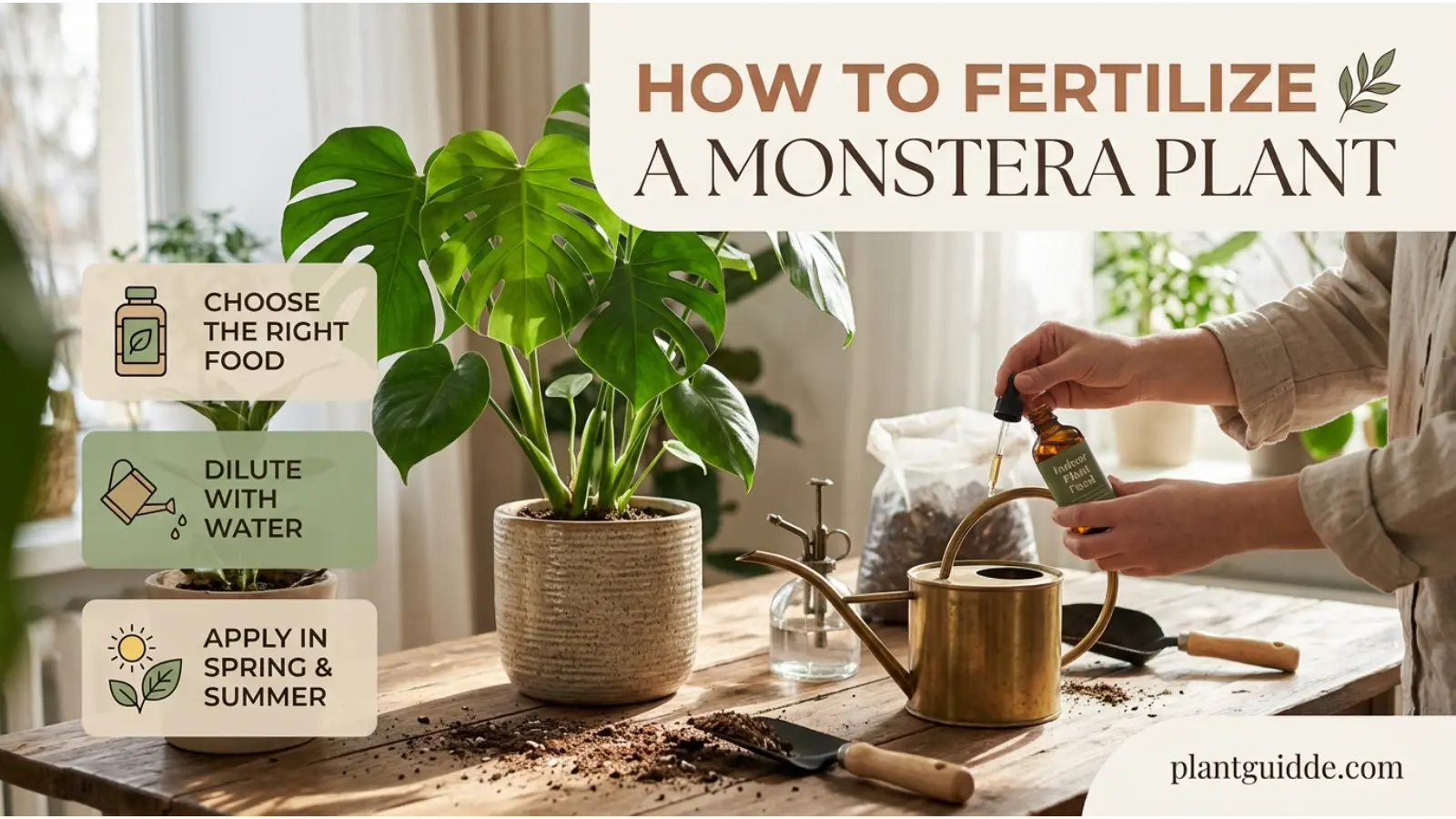
Fertilizer supplies nutrients needed for new leaves, stems, and roots. A Monstera growing actively in a container may benefit from regular but moderate feeding.
During spring and summer, use a balanced liquid houseplant fertilizer according to the label. Feeding every four to six weeks may be suitable for many actively growing plants, but the correct frequency depends on fertilizer strength, potting mix, and growth rate.
Follow these guidelines:
- Begin with the label-recommended dilution.
- Avoid fertilizing a plant with damaged or rotting roots.
- Reduce feeding when growth slows during winter.
- Flush the potting mix occasionally if fertilizer salts accumulate and drainage is good.
- Do not assume pale leaves always indicate a nutrient deficiency.
Excess fertilizer can damage roots and cause brown leaf tips. If your Monstera is growing slowly, review its light and root conditions before increasing fertilizer.
How to Encourage Large Monstera Leaves With Splits
One of the most common questions about Monstera care is why a plant produces small, solid leaves instead of the large, divided foliage associated with mature specimens.
Leaf splits and holes, known as fenestrations, often develop as Monstera deliciosa matures. Age, suitable light, climbing support, and overall growing conditions all influence leaf development.
Provide enough light
Insufficient light can limit growth and delay the development of mature foliage. Move the plant gradually to a brighter location with indirect light if its current position is too dim.
Give the plant something to climb
A moss pole, coir pole, or sturdy trellis can support the climbing stems. Attach the main stem loosely with soft plant ties, avoiding pressure on leaf stalks.
A moss pole that can be kept appropriately moist may encourage aerial roots to attach, but it does not replace good lighting or root care.
Allow the plant to mature
A young Monstera will not necessarily produce deeply split leaves immediately, even when its care is excellent. Focus on steady growth and healthy new leaves rather than trying to force fenestrations through extra fertilizer or frequent watering.
It is also normal for individual new leaves to differ in size and shape as the plant develops.
How to Prune Monstera
Pruning helps control the plant’s size, remove damaged foliage, and manage long or unbalanced growth.
Use clean, sharp pruning shears and cut the stem near a node when removing a section for propagation or reducing vine length.
You can remove leaves that are completely dead or severely damaged. However, avoid removing too many healthy leaves at once because the plant uses them to produce energy.
For a climbing Monstera, secure the main stem to its support before cutting. This reduces the chance of accidental damage to aerial roots or leaf stalks.
Important: Monstera sap can irritate skin, so wear gloves if you are sensitive and wash your hands after pruning. Keep cuttings away from children and pets.
How to Propagate Monstera
Monstera is commonly propagated from stem cuttings. Each cutting needs at least one viable node, because roots and new shoots develop from the stem’s growth points.
Propagation in water
- Select a healthy stem section with at least one node.
- Make a clean cut below the node.
- Place the node in clean water while keeping the leaf above the surface.
- Keep the cutting in bright, indirect light.
- Change the water when it becomes cloudy and monitor root growth.
- Transfer the cutting to an airy potting mix once it has developed a healthy root system.
After planting, keep the mix lightly and evenly moist while the roots adapt, but do not saturate it.
Propagation directly in soil
You can also place a node directly into a moist, well-draining propagation mix. Keep the cutting warm and provide bright, indirect light while roots develop.
Avoid burying the leaf stalk or keeping the mix waterlogged. Root development takes time, so resist the temptation to pull the cutting out repeatedly to check its progress.
A leaf without a node will not normally grow into a complete new Monstera plant.
When and How to Repot Monstera
Monstera plants often need repotting as their roots and aerial growth expand. However, repotting too frequently can create unnecessary disturbance.
Consider repotting when:
- Roots emerge from the drainage holes.
- The root ball becomes densely packed.
- Water runs through the pot unusually quickly because the roots occupy most of the container.
- The plant becomes unstable or difficult to support.
- The potting mix has broken down and drains poorly.
Repotting steps
- Choose a container one size larger, with drainage holes.
- Gently remove the plant and loosen compacted soil around the outer roots.
- Inspect the roots and remove any rotten sections.
- Position the plant at its previous depth.
- Fill around the roots with fresh, airy potting mix.
- Water appropriately and allow the excess to drain.
- Reattach the stems to their support if necessary.
Spring and early summer are often convenient times to repot because growth is active. If root rot is developing, address it promptly rather than waiting for a particular season.
Common Monstera Problems and How to Fix Them
Leaf symptoms can provide useful clues, but the same symptom may have several causes. Check soil moisture, drainage, light exposure, and recent changes before deciding on a treatment.
| Problem | Possible cause | Recommended action |
|---|---|---|
| Yellow leaves | Overwatering, root stress, or normal aging | Check soil moisture and inspect roots if yellowing spreads |
| Brown, crispy edges | Dry air, inconsistent watering, salt buildup, or root damage | Review humidity, watering, and fertilizer use |
| Small leaves | Immaturity, insufficient light, or limited climbing support | Improve indirect light and support healthy climbing growth |
| No splits in leaves | Young plant, low light, or immature growth | Provide better light and suitable support; allow time |
| Drooping foliage | Underwatering, overwatering, or root damage | Check the root zone before watering |
| Black or mushy roots | Root rot | Trim affected roots and repot in fresh, airy mix |
| Leaves curling | Moisture stress, heat, pests, or environmental changes | Inspect the soil, foliage, and location |
| White or cottony insects | Mealybugs or other pests | Isolate the plant and treat according to product instructions |
Why are my Monstera leaves turning yellow?
Care for monstera plant the soil stays wet and several leaves turn yellow, overwatering or root stress is a likely explanation. Improve drainage, allow the soil to dry appropriately, and inspect the roots if the condition worsens.
An occasional older leaf turning yellow can be normal. If only one lower leaf changes color while the rest of the plant looks healthy, monitor the plant before making major changes.
Why are my Monstera leaves turning brown?
Brown areas may result from sun scorch, dry air, inconsistent watering, fertilizer salts, or root damage. Consider where the damage appears and whether it affects new or old leaves.
If the brown patches are concentrated on the window-facing side after a move, excessive direct sun may be responsible. If several leaves develop brown edges while the soil remains wet, investigate root health instead.
Why is my Monstera drooping?
Drooping can indicate either too little or too much water. A dry root ball may need thorough watering, whereas a saturated root ball may have damaged roots that cannot absorb moisture effectively.
Check the soil before taking action. Adding water to an already wet pot can make the problem worse.
How do I treat pests on Monstera?
Inspect the undersides of leaves, leaf joints, and stems for spider mites, mealybugs, and scale insects.
If pests appear, isolate the plant, remove visible insects, and use an appropriate houseplant-labeled treatment according to its instructions. Test products on a small area first, particularly on sensitive or variegated foliage, and avoid applying treatments in strong sunlight.
Is Monstera Toxic to Pets?
Yes. Monstera plants contain insoluble calcium oxalate crystals that can irritate the mouth and digestive tract if chewed or swallowed.
Cats, dogs, and children should not be allowed to chew the leaves or stems. Possible symptoms include oral pain, drooling, pawing at the mouth, and difficulty swallowing.
Keep the plant out of reach. If a pet chews it and develops symptoms, contact a veterinarian promptly for advice.

FAQs:
How often should I water my Monstera plant?
Water when the top 1–2 inches of soil have dried and the deeper mix is not excessively wet. The interval depends on light, temperature, humidity, pot size, and soil composition. Water thoroughly and let excess water drain rather than following a fixed weekly schedule.
Can Monstera grow indoors without direct sunlight?
Yes. Monstera generally grows well in bright, indirect light and does not require harsh direct sunlight. A bright room near a window is usually suitable, while a very dark corner may lead to slow growth and smaller leaves.
Why does my Monstera have no holes or splits?
Young Monstera deliciosa plants commonly produce solid leaves before developing fenestrations as they mature. Suitable light, healthy roots, and climbing support can help the plant grow well, but splits do not appear immediately and cannot be guaranteed by a particular fertilizer or watering routine.
Should I mist my Monstera plant?
Misting is not necessary for healthy growth and does not provide a lasting increase in room humidity. If your home is very dry, a humidifier is generally more effective. Proper watering, airflow, and root health remain essential.
When should I repot my Monstera?
Repot when the roots crowd the container, emerge from drainage holes, or the plant becomes unstable. Choose a pot only one size larger and use an airy, well-draining mix. Repotting is often easiest in spring or early summer, but root rot should be addressed immediately.
Conclusion
Successful Monstera care comes down to providing bright, indirect light, an airy potting mix, careful watering, and enough support for climbing growth. Large leaves and natural splits develop as the plant matures under suitable conditions, so patience is just as important as routine maintenance.
Start by checking your Monstera’s light exposure, soil moisture, and drainage. Correct any obvious problems first, then maintain consistent conditions and monitor new growth. This approach helps you build a healthier plant without unnecessary watering, feeding, or repotting.

Asad Mumtaz is a dedicated plant enthusiast and gardening writer with a passion for helping people care for their plants successfully. He specializes in plant care guides, indoor gardening, and practical growing tips for all skill levels. His content focuses on making gardening simple, enjoyable, and rewarding. Through his work, Asad shares reliable advice to help readers create thriving green spaces.