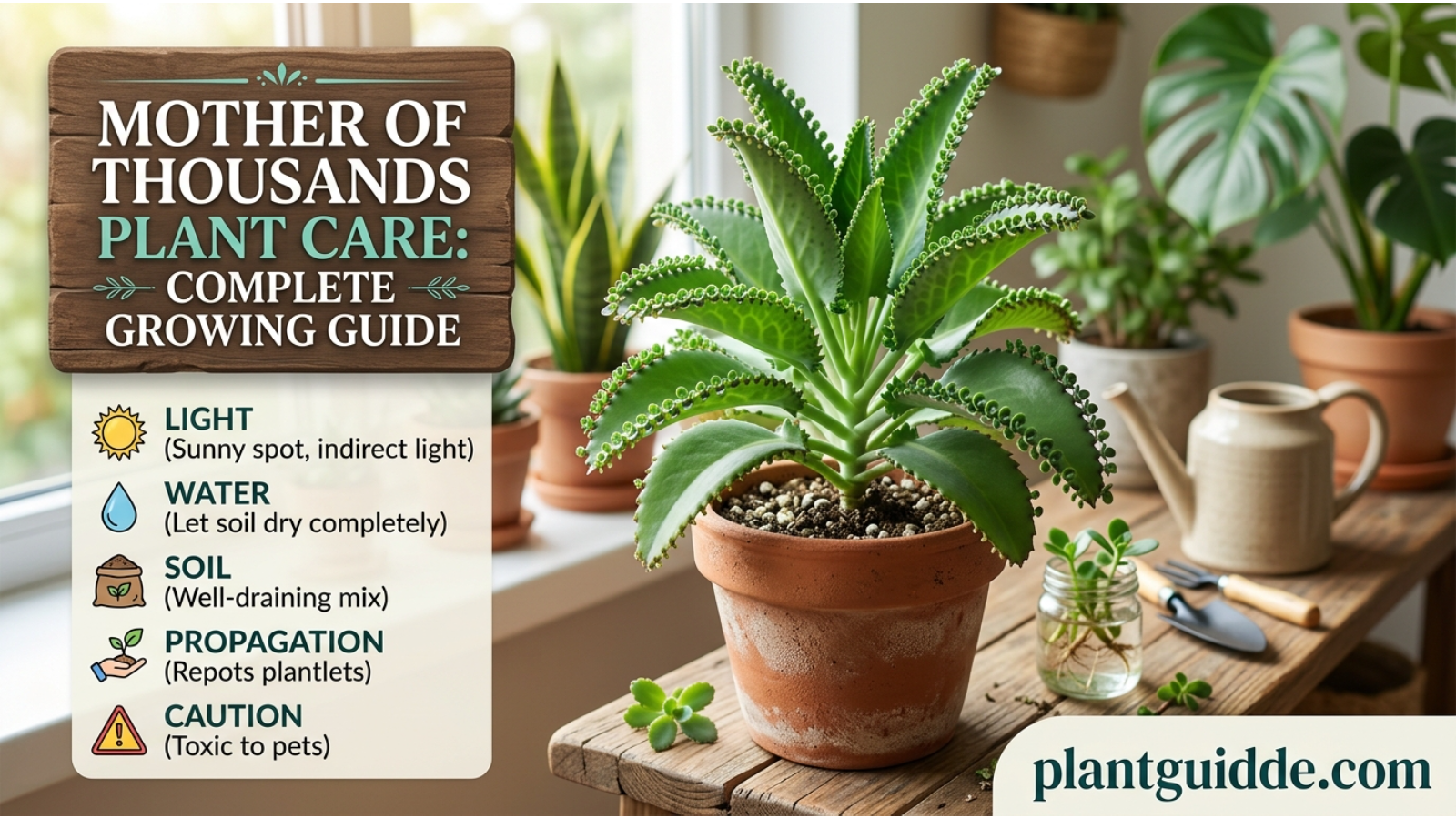
Mother of Thousands is a fascinating succulent known for producing tiny plantlets along the edges of its leaves. While it is often considered easy to grow, proper Mother of Thousands Plant Care is still important for keeping the plant healthy, compact, and attractive. The biggest problems usually come from overwatering, poor drainage, insufficient light, or sudden changes in growing conditions.
Good Mother of Thousands Plant Care starts with understanding what this succulent naturally needs: plenty of bright light, well-draining soil, and careful watering between dry periods. With the right balance of light, moisture, warmth, and occasional feeding, Mother of Thousands Plant Care becomes simple and rewarding. In this guide, you’ll learn practical Mother of Thousands Plant Care tips to encourage healthy growth and prevent common problems.
Quick Answer
Mother of thousands plant care is mainly about bright, indirect light, fast-draining soil, and careful watering. Kalanchoe daigremontiana stores water in its fleshy leaves, so it handles dry periods better than consistently wet soil. Let the soil dry substantially between waterings, use a pot with drainage, and protect the plant from prolonged cold or intense afternoon sun.
What Is a Mother of Thousands Plant?
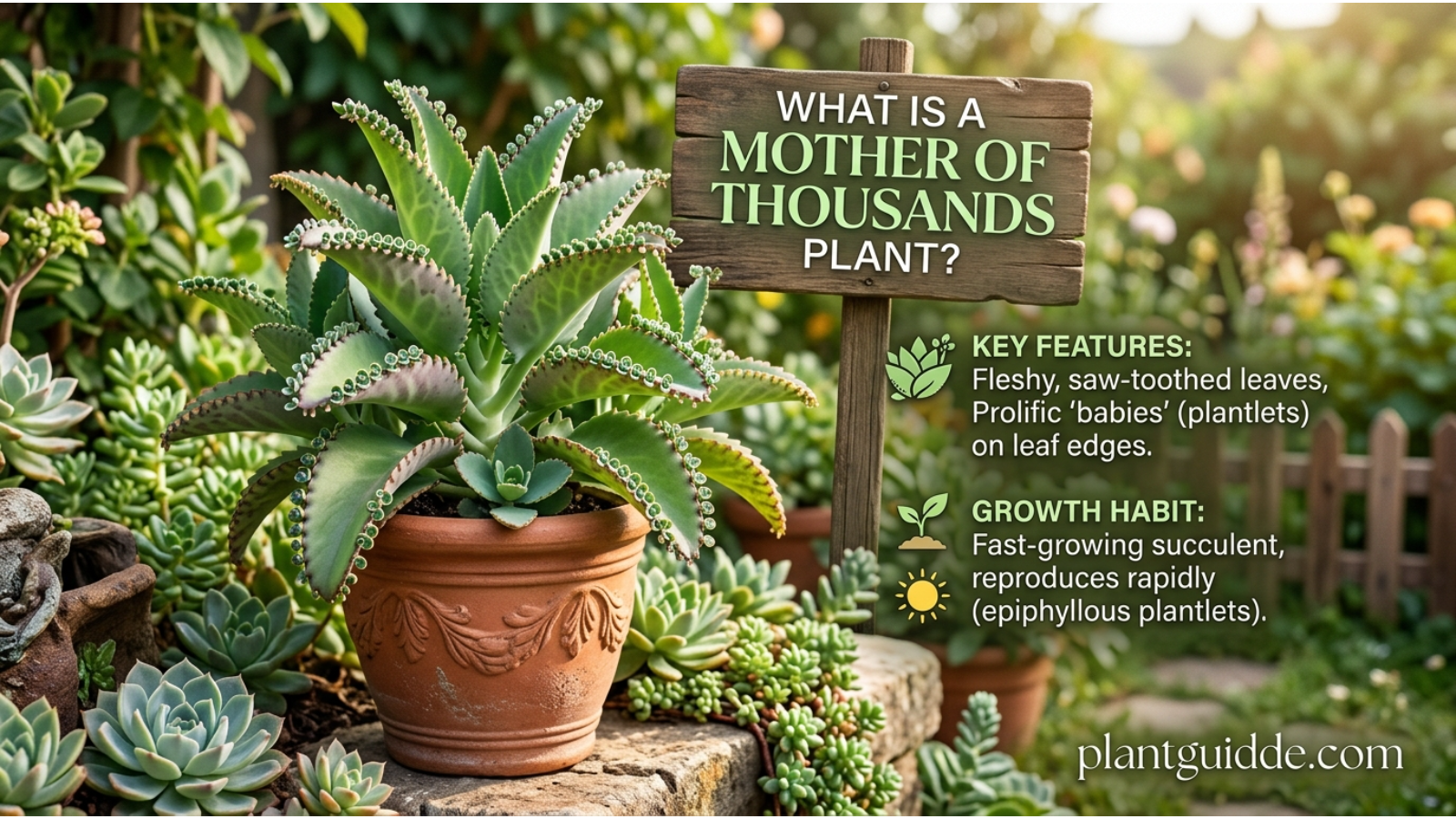
Mother of thousands is the common name generally used for Kalanchoe daigremontiana, a succulent in the Crassulaceae family. It is also commonly associated with the name Bryophyllum daigremontianum.
Its most recognizable feature is its long, fleshy leaves, which develop tiny plantlets along the margins. These baby plants can eventually detach, root where they land, and produce new plants.
The plant typically has:
- Upright, fleshy stems
- Long, narrow leaves with serrated edges
- Tiny plantlets developing along leaf margins
- Green to gray-green foliage, sometimes with darker or purplish markings underneath
- A strong preference for bright light and well-drained soil
- Excellent tolerance of short dry periods
Although it is often grown indoors as a decorative succulent, mother of thousands can become invasive in suitable outdoor climates. Keep that in mind before planting it directly into the ground.
Mother of Thousands Plant Care Requirements
| Care factor | Best conditions |
|---|---|
| Light | Bright indirect light to several hours of gentle direct sun |
| Water | Water thoroughly, then allow the soil to dry substantially |
| Soil | Very well-draining cactus or succulent mix |
| Pot | Container with drainage holes |
| Temperature | Warm conditions; protect from cold and frost |
| Humidity | Average household humidity is usually adequate |
| Fertilizer | Light feeding during active growth |
| Propagation | Plantlets, stem cuttings, or leaves |
| Difficulty | Easy for beginners when overwatering is avoided |
How Much Light Does Mother of Thousands Need?
Bright light is one of the most important parts of successful mother of thousands plant care.
Place it near a bright window where it receives plenty of light throughout the day. An east- or west-facing window can work particularly well. A south-facing window may also be suitable, but intense sunlight through glass can scorch the foliage, especially if the plant was previously grown in lower light.
Signs the plant needs more light
A mother of thousands receiving inadequate light may develop:
- Long, stretched stems
- Wider spacing between leaves
- Smaller or weaker growth
- Pale foliage
- Leaning toward the window
- Less compact growth
If the plant becomes noticeably stretched, moving it directly into strong sunlight can cause another problem: leaf scorch.
Increase light gradually instead.
Can mother of thousands grow in low light?
It may survive in lower light for a while, but survival is not the same as healthy growth.
In poor light, the plant is more likely to become stretched and weak. Because its soil may also dry more slowly under low-light conditions, keeping the usual watering schedule can increase the risk of root problems.
Practical tip: If your plant is stretching toward a window, improve the light before increasing fertilizer or watering.
How Often Should You Water Mother of Thousands?
Watering is where many mother of thousands plants fail.
This succulent stores water in its leaves and stems, so it does not need frequent watering. Instead of watering according to a fixed weekly schedule, check the soil.
When the soil has dried substantially, water thoroughly until excess moisture drains from the bottom of the pot. Then allow the soil to dry again before watering.
A useful routine is:
- Check the soil several inches below the surface.
- If it is still noticeably moist, wait.
- Once the mix has dried substantially, water deeply.
- Allow excess water to drain completely.
- Empty water collected in the saucer or decorative container.
The exact interval varies with light, temperature, pot size, soil, and season. A plant in bright light and a small porous pot may dry much faster than one sitting in a large plastic container in a dim room.
Should you mist mother of thousands?
Usually, no.
Misting does not solve the main moisture requirement of a succulent, and consistently damp foliage combined with poor airflow is unnecessary. Focus instead on proper soil moisture and drainage.
Best Soil for Mother of Thousands
Mother of thousands needs soil that drains quickly.
A standard moisture-retaining houseplant mix can stay wet too long, particularly in a large container or poorly ventilated room. A commercial cactus or succulent mix is generally a better starting point.
For additional drainage, the growing medium can be amended with materials such as perlite, pumice, or coarse mineral components.
The goal is not simply to create extremely dry soil. The goal is to prevent water from remaining around the roots for long periods after watering.
Good rule: If water sits in the soil for days after irrigation, the growing medium or container is probably working against you.
Choosing the Right Pot
A drainage hole is essential.
Mother of thousands should not be planted in a container that has nowhere for excess water to escape. Decorative cachepots can be used, but the plant should remain in a draining nursery pot inside the decorative container.
Terracotta can be useful because it allows moisture to evaporate through the container walls, although the pot material is less important than proper drainage and an appropriate soil mix.
Avoid choosing a very large pot simply because you want the plant to grow quickly. A large volume of unused soil can remain wet longer than the root system needs.
Temperature and Humidity
Mother of thousands prefers warm growing conditions and should be protected from frost and prolonged cold.
Normal indoor temperatures are generally suitable. During winter, avoid placing the plant directly against a cold window or near a strong heating or cooling vent.
Unlike many tropical houseplants, it does not require high humidity to remain healthy. Average indoor humidity is usually sufficient.
This is another reason not to treat it like a humidity-loving plant such as a calathea or some ferns.
Does Mother of Thousands Need Fertilizer?
Not much.
Because mother of thousands is a succulent adapted to relatively lean conditions, excessive fertilizer is more likely to create unnecessary soft or stretched growth than dramatically improve the plant.
During active growth, you can use a balanced fertilizer diluted according to the product instructions. Feeding occasionally is generally more appropriate than fertilizing every time you water.
Avoid heavy feeding when:
- The plant is stressed
- The soil is staying wet
- The plant has recently been repotted
- Growth has slowed significantly during a cooler, darker season
Healthy light and appropriate watering matter far more than frequent fertilizer.
How to Repot Mother of Thousands
Repot when the plant has outgrown its container, roots are becoming crowded, or the growing medium has deteriorated.
Choose a pot only moderately larger than the existing root system.
Repotting steps
- Let the soil become relatively dry before repotting.
- Remove the plant carefully from its container.
- Inspect the roots for soft, dark, or damaged areas.
- Remove compromised roots with a clean tool if necessary.
- Place the plant in fresh, well-draining succulent soil.
- Keep the plant stable without burying the stem excessively.
- Give the roots time to settle before returning to a normal watering routine.
If you discover extensive root rot, do not simply move the entire wet root ball into fresh soil. Remove damaged material first and correct the underlying drainage or watering problem.
How to Propagate Mother of Thousands
Propagation is one of the easiest and most interesting aspects of this plant.
The tiny plantlets that form along the leaf edges are naturally designed to produce new plants.
Propagating from plantlets
When mature plantlets have developed roots or are large enough to handle, they can be gently separated and placed on or lightly into a well-draining growing medium.
Keep the medium only lightly moist while the young plant establishes. Avoid keeping it saturated.
Propagating from stem cuttings
Healthy stem cuttings can also be used for propagation.
Allow a fresh cutting to dry and form a callused surface before planting it into an appropriate succulent mix. Once established, gradually return to normal succulent watering practices.
Propagation tip: Do not flood newly propagated plants simply because they have small root systems. Young roots can be particularly vulnerable to prolonged wet conditions.
How to Encourage Compact, Healthy Growth
If your mother of thousands is becoming tall, thin, or floppy, look at the growing conditions before assuming it needs more fertilizer.
The most common issue is insufficient light.
Move the plant to a brighter location gradually. Rotate the pot periodically so one side does not remain permanently shaded.
You can also prune excessively long stems using a clean cutting tool. Pruning can help improve the plant’s shape, but it cannot compensate for inadequate light.
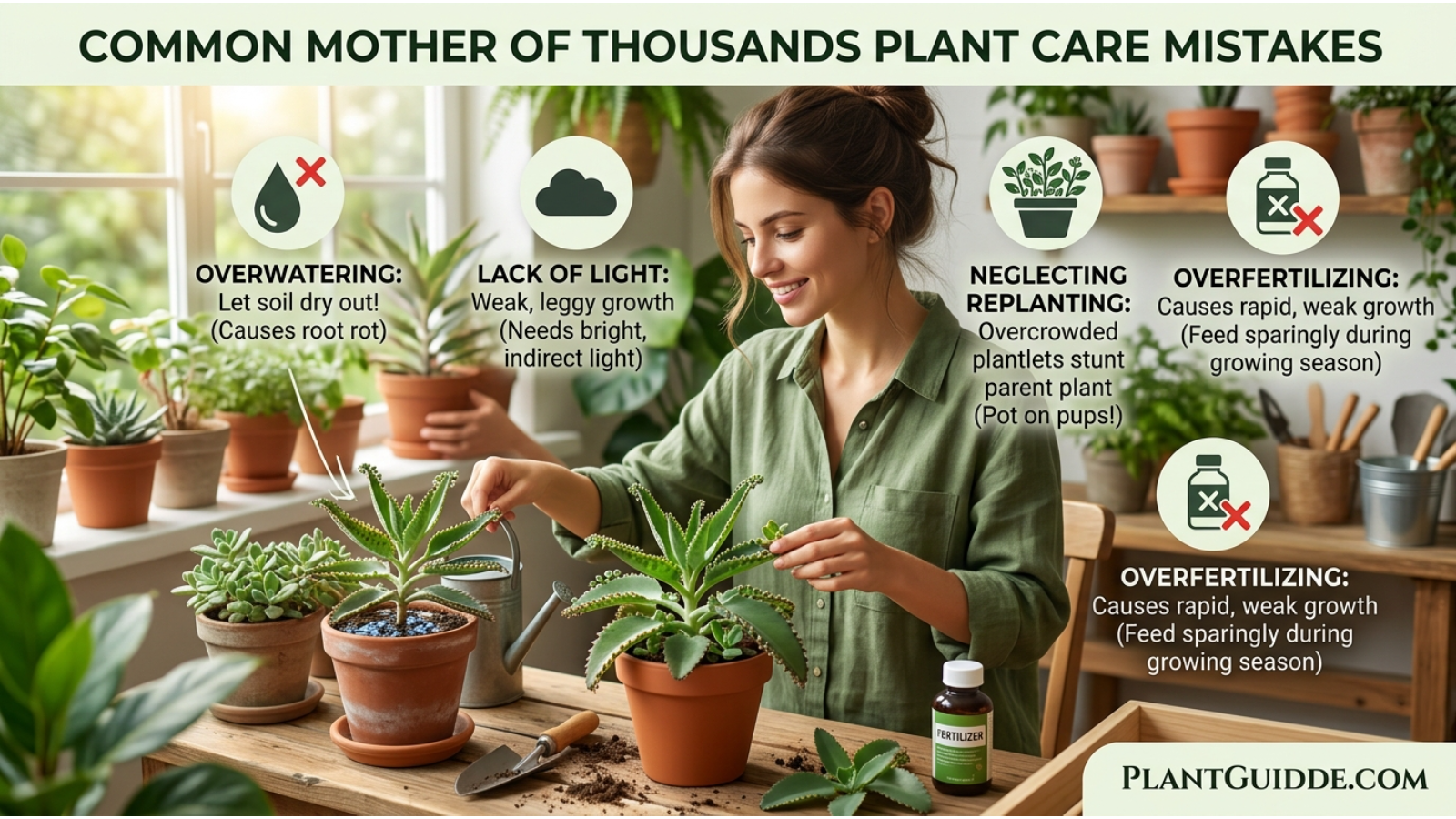
Common Mother of Thousands Plant Care Mistakes
Watering on a fixed schedule
“Water every Sunday” sounds convenient, but indoor conditions change. A plant may dry quickly during hot, bright weather and remain wet much longer during cool, dark periods.
Better approach: Check the soil and plant conditions before watering.
Using ordinary garden soil
Garden soil can be heavy and poorly suited to container-grown succulents.
Better approach: Use a fast-draining succulent medium.
Keeping the plant in a pot without drainage
Even careful watering becomes risky when excess water has nowhere to escape.
Better approach: Always use a container with a drainage hole.
Giving sudden intense sunlight
A plant that has adapted to moderate indoor light can scorch when moved immediately into harsh direct sun.
Better approach: Acclimate it gradually.
Treating it like a tropical houseplant
Frequent watering and constant moisture are unnecessary.
Better approach: Remember that mother of thousands is a water-storing succulent.
Ignoring fallen plantlets
The tiny offspring can root wherever they land in suitable conditions.
Better approach: Remove unwanted plantlets before they establish, particularly when growing the plant outdoors in a warm climate.
Mother of Thousands Leaves Turning Yellow
Yellow leaves can have several causes, but excessive moisture is one of the first things to investigate.
Check:
- How frequently you are watering
- Whether the soil has dried between waterings
- Whether the pot has drainage holes
- How long the soil remains wet
- Whether the plant is receiving adequate light
- Whether the roots show signs of rot
If several lower leaves are yellow and soft while the soil remains wet, overwatering is a strong possibility.
Do not automatically respond by giving the plant more fertilizer. Fix the growing conditions first.
Mother of Thousands Leaves Turning Brown or Crispy
Brown, crispy patches may result from excessive direct sunlight, prolonged dryness, or environmental stress.
Consider the location carefully. A bright window can provide excellent light, but intense afternoon sun through glass can become surprisingly hot.
If only the exposed side of the plant is developing bleached or crispy patches, excessive light or heat becomes more likely.
If the entire plant is severely dry and the leaves are shriveling, inadequate watering may be involved.
Why Is My Mother of Thousands Drooping?
A drooping mother of thousands can be responding to either too little or too much water.
Check the soil before doing anything else.
Dry soil + shriveled foliage: The plant may need water.
Wet soil + soft or yellowing foliage: Excess moisture or root damage is more concerning.
This distinction is important because watering a plant with damaged roots can make the problem worse.
Why Is My Mother of Thousands Losing Leaves?
Older leaves naturally age and may eventually drop, but sudden or widespread leaf loss deserves attention.
Common causes include:
- Overwatering
- Root problems
- Abrupt changes in temperature
- Very low light
- Severe underwatering
- Physical damage
- Sudden relocation to harsh sunlight
Look at the pattern rather than focusing on one fallen leaf. A single old leaf is rarely a reason to panic; widespread leaf drop accompanied by soft stems or yellow foliage is much more significant.
Pests to Watch For
Mother of thousands can occasionally be affected by common succulent pests such as mealybugs, scale insects, or aphids.
Inspect:
- Leaf undersides
- Stem joints
- New growth
- Areas where leaves meet the stem
Small cottony clusters may indicate mealybugs, while scale can appear as small, immobile bumps attached to plant tissue.
Early detection makes control much easier. Isolate an affected plant from nearby houseplants while you investigate and treat the infestation.
Is Mother of Thousands Toxic?
Yes. Kalanchoe daigremontiana contains cardiac-active compounds known as bufadienolides and is considered toxic if eaten.
This is particularly important for households with pets or young children. Dogs, cats, livestock, and other animals can become seriously ill after consuming kalanchoe plants.
Keep the plant out of reach and do not allow pets to chew on fallen leaves or plantlets. If a pet may have consumed the plant, contact a veterinarian or an appropriate animal poison service promptly.
Mother of Thousands vs. Mother of Millions
These names are often confused.
Mother of thousands generally refers to Kalanchoe daigremontiana, recognized by the many plantlets developing along the edges of its broad, elongated leaves.
Mother of millions commonly refers to related Kalanchoe species that produce plantlets primarily near the tips of more upright, narrow leaves.
Both are prolific succulents, but their leaf shape and plantlet placement can help distinguish them.
Can Mother of Thousands Grow Outdoors?
Yes, if the climate is warm enough and frost is not a concern.
Outdoors, provide bright light and very well-drained soil. However, consider its ability to spread before planting it directly into garden beds.
In regions where it can survive year-round, escaped plantlets may establish beyond the area where you originally planted the mother plant.
Growing it in a container gives you much more control over its spread.
Image Suggestion: A realistic close-up of a mature mother of thousands showing tiny plantlets along the leaf margins, with a second potted plant in the background illustrating propagation.
A Simple Mother of Thousands Care Routine
For beginners, the entire routine can be reduced to a few important habits:
- Give it bright light. Move it closer to a bright window if growth becomes stretched.
- Use fast-draining soil. Avoid heavy mixes that remain wet.
- Use a drainage hole. Never allow the root zone to sit in standing water.
- Check the soil before watering. Do not follow an automatic weekly schedule.
- Water thoroughly when needed. Then allow the soil to dry substantially again.
- Protect it from frost. Bring outdoor plants inside before cold weather becomes a problem.
- Watch for plantlets. Remove or propagate them before they spread where you do not want them.
- Inspect regularly. Early detection of pests or root problems is much easier than trying to rescue a severely damaged plant.
FAQs:
How often should I water a mother of thousands plant?
Water when the soil has dried substantially rather than watering on a fixed schedule. Brightness, temperature, pot size, and soil type all affect how quickly the plant dries.
Does mother of thousands need direct sunlight?
It can tolerate some gentle direct sunlight, but intense afternoon sun can scorch leaves, particularly after a sudden change from lower light. Bright indirect light is a reliable indoor option.
Why is my mother of thousands growing tall and thin?
Insufficient light is the most common reason for stretched, leggy growth. Move the plant toward a brighter location gradually and rotate the pot periodically.
Can I grow mother of thousands from the baby plants?
Yes. The small plantlets along the leaf margins can be separated and established in a well-draining growing medium. Avoid keeping the propagation medium saturated.
Is mother of thousands safe
No. Mother of thousands is considered toxic to pets if eaten. Keep it away from dogs, cats, and other animals that may chew on its leaves or fallen plantlets.
Conclusion
Successful mother of thousands plant care comes down to resisting the urge to overmanage this succulent. Give it plenty of light, fast-draining soil, a container with drainage, and enough time for the growing medium to dry between waterings.
If the plant is stretching, improve the light. If the leaves are soft and yellow while the soil stays wet, investigate watering and drainage. And if tiny plantlets begin appearing everywhere, remember that the plant is doing exactly what it is famous for.
The best next step is simple: check your plant’s light, pot, and soil moisture today. Those three factors usually tell you more about its health than a fixed watering

Asad Mumtaz is a dedicated plant enthusiast and gardening writer with a passion for helping people care for their plants successfully. He specializes in plant care guides, indoor gardening, and practical growing tips for all skill levels. His content focuses on making gardening simple, enjoyable, and rewarding. Through his work, Asad shares reliable advice to help readers create thriving green spaces.