String of hearts plant care is one of those houseplants that looks delicate but is surprisingly resilient once you understand how it stores and uses water. Its thin trailing stems, heart-shaped leaves, and unusual bead-like structures make it especially attractive in hanging baskets or on high shelves.
The challenge is that its appearance can encourage the wrong approach to watering. Unlike thirsty tropical plants, string of hearts prefers its roots to dry between waterings. Too much moisture, especially in a heavy potting mix, can quickly cause root problems.
Good string of hearts plant care is therefore less about constant attention and more about creating conditions that match the plant’s natural growth habits. Give it plenty of light, keep excess water away from the roots, and avoid making frequent small changes to its environment.
This guide explains exactly how to care for a string of hearts, how often to water it, where to place it, what soil to use, and how to troubleshoot common problems such as yellow leaves, leaf drop, shriveled foliage, and weak growth.
Quick Answer
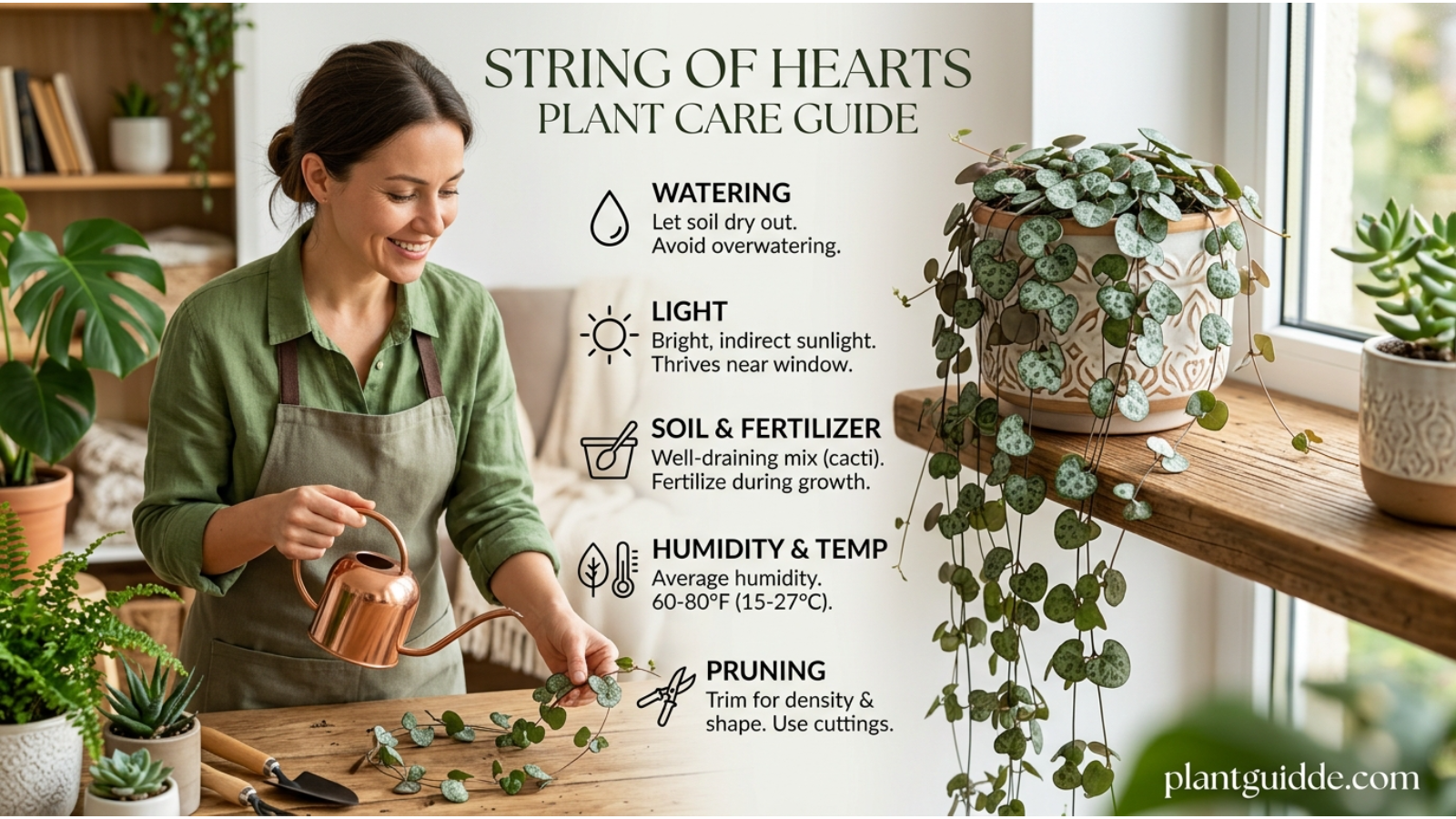
String of hearts plant care is relatively easy when you provide bright, indirect light, a fast-draining soil mix, moderate watering, good airflow, and warm temperatures. Let the soil dry substantially between waterings, avoid constantly wet roots, and give the trailing stems enough space to grow. With the right conditions, a string of hearts can produce long vines, attractive heart-shaped leaves, and small flowers.
What Is a String of Hearts Plant?
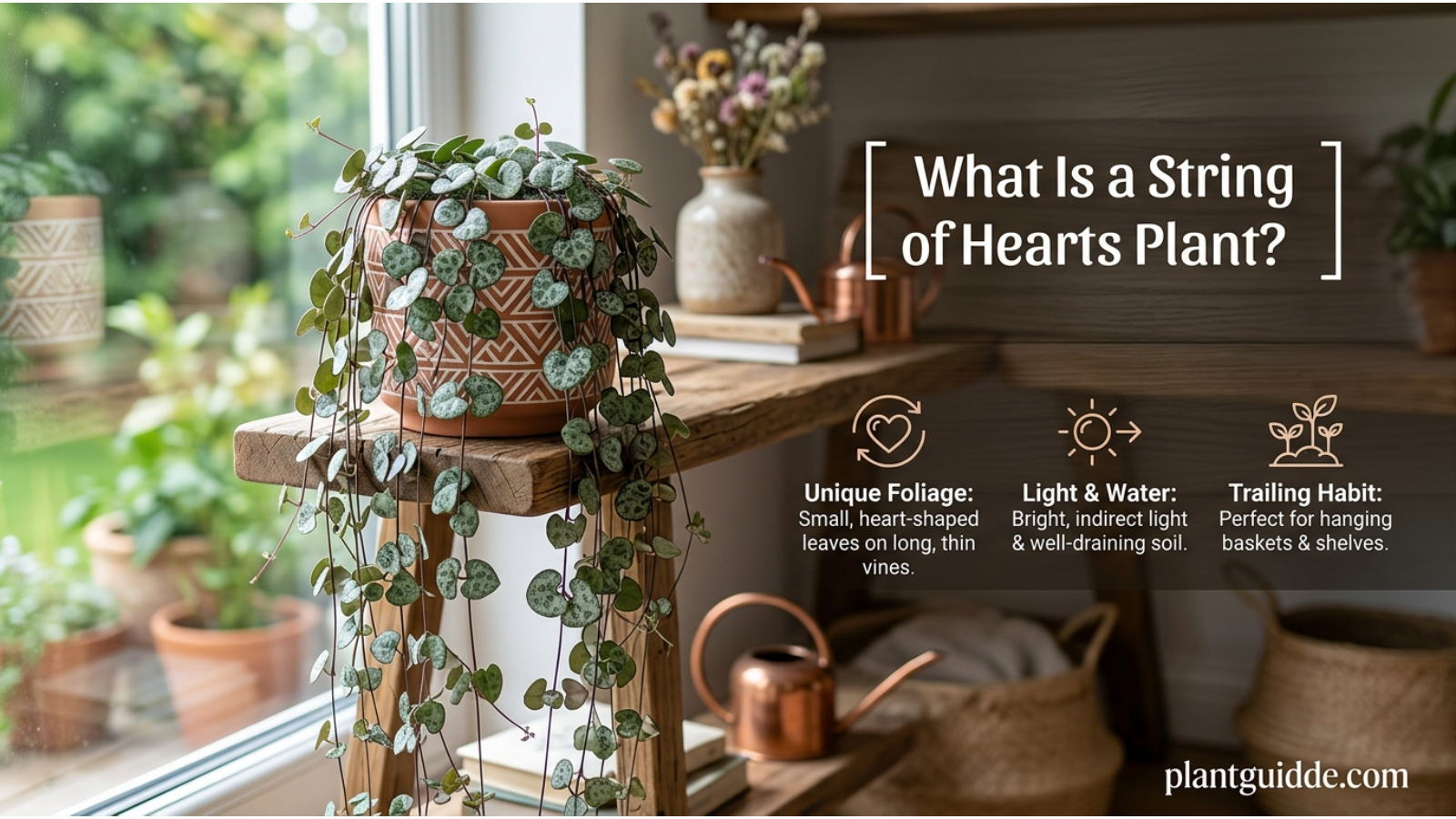
The string of hearts, botanically known as Ceropegia woodii, is a trailing succulent-like plant in the Apocynaceae family. It is native to southern Africa and is commonly grown as an indoor hanging plant.
Its most recognizable features include:
- Small heart-shaped leaves
- Long, thin trailing stems
- Green leaves often marked with silver or pale patterns
- Purple or reddish coloring underneath the leaves
- Small tubular flowers under suitable conditions
- Underground tubers and aerial tubers that help the plant store resources
Those storage structures explain why the plant can tolerate periods of dryness better than many ordinary houseplants.
The plant is also commonly called chain of hearts, rosary vine, or sweetheart vine.
String of Hearts Plant Care Requirements at a Glance
| Care Factor | Best Condition |
|---|---|
| Light | Bright indirect light; some gentle direct sun |
| Water | Water thoroughly, then allow soil to dry |
| Soil | Very well-draining, airy mix |
| Pot | Drainage hole is essential |
| Humidity | Average indoor humidity is usually adequate |
| Temperature | Warm, stable indoor conditions |
| Fertilizer | Light feeding during active growth |
| Growth habit | Trailing or cascading |
| Repotting | Only when necessary |
| Propagation | Stem, tuber, or leaf methods |
The most important factors are light, drainage, and watering. If those three are right, the rest of the routine becomes much easier.
How Much Light Does a String of Hearts Need?
String of hearts grows best in bright light. A position close to a bright window is usually much better than a dark corner.
It can tolerate some direct sunlight, particularly gentle morning or late-afternoon sun. However, intense sunlight through hot glass can scorch the leaves, especially if the plant has previously been growing in lower light.
A useful approach is to gradually increase light rather than suddenly moving a shaded plant into strong midday sun.
Signs your string of hearts needs more light
Insufficient light may cause:
- Long gaps between leaves
- Small or pale foliage
- Slow growth
- Weak, thin stems
- Loss of attractive leaf coloration
- Very sparse trailing vines
If the vines are growing rapidly but the leaves are widely spaced, don’t immediately assume the plant needs more fertilizer. Light is often the first thing worth checking.
Can string of hearts grow in direct sunlight?
Yes, but context matters. Several hours of gentle direct sunlight can be beneficial, while harsh afternoon sun through a hot window can cause leaf scorching.
If the leaves develop bleached, brown, or crispy patches on the side facing the window, move the plant slightly farther away or filter the strongest sunlight with a sheer curtain.
Image Suggestion: A healthy string of hearts cascading from a hanging pot near a bright window, showing the ideal light position.
How Often Should You Water a String of Hearts?
Watering is one of the most important parts of string of hearts plant care.
There is no reliable calendar such as “water every seven days.” Indoor conditions change with temperature, light, pot size, soil composition, and season.
Instead, check the soil.
When the upper portion of the potting mix has dried substantially and the pot feels noticeably lighter, water thoroughly until excess moisture drains from the bottom.
Then empty any water sitting in the saucer or decorative container.
The biggest mistake is giving small amounts of water frequently. This can leave parts of the root zone repeatedly damp without properly hydrating the entire root system.
A practical watering method
- Check the soil with your finger or a moisture check.
- Feel the weight of the pot if you know how it feels when dry.
- If the mix is still noticeably moist, wait.
- When it has dried sufficiently, water thoroughly.
- Allow excess water to drain completely.
- Return the plant to its normal position.
During winter or periods of lower light, the plant may need considerably less water.
Why Is My String of Hearts Turning Yellow?
Yellow leaves are not always caused by the same problem, but excess moisture is one of the first things to investigate.
If several leaves are turning yellow and the soil remains wet for a long time, the combination of frequent watering, poor drainage, and limited airflow may be stressing the roots.
Other possibilities include:
- Natural aging of individual leaves
- Sudden environmental changes
- Poor light
- Root damage
- Temperature stress
Do not respond to yellow leaves by automatically watering more. Check the soil first.
If the plant is sitting in wet soil for many days, improving drainage and adjusting watering is usually more useful than adding fertilizer.
Why Are My String of Hearts Leaves Curling or Shriveling?
Slightly wrinkled or shriveled leaves often indicate that the plant is using its stored moisture faster than it is receiving water.
Check several things before watering:
- Is the soil completely dry?
- Is the plant receiving unusually strong sunlight?
- Has the room become hotter than usual?
- Is the pot extremely small?
- Are the roots healthy?
If the soil is bone dry and the leaves are becoming noticeably wrinkled, give the plant a thorough watering rather than repeatedly adding a few drops.
However, shriveled leaves combined with wet soil tell a different story. Damaged roots may prevent the plant from taking up water properly, so adding more water can make the situation worse.
This is an important distinction in string of hearts care: a thirsty-looking plant is not automatically a plant that needs more water.
Best Soil for String of Hearts
String of hearts needs a growing medium that drains quickly and contains plenty of air spaces.
A suitable mix can contain:
- High-quality potting soil
- Perlite or pumice
- Orchid bark or another coarse component
The goal is not to create extremely dry soil. The goal is to prevent the roots from remaining saturated for extended periods.
A dense mix designed for moisture-loving houseplants can hold too much water around the roots.
String of hearts plant care your current soil remains wet for a week or more after watering, the problem may not be your watering schedule. The growing medium itself may be holding too much moisture.
Choosing the Right Pot
A drainage hole is more important than the material or appearance of the pot.
String of hearts can perform well in:
- Terracotta pots
- Plastic nursery pots
- Hanging baskets
- Decorative containers used with an inner pot
The key is that excess water must be able to escape.
Avoid choosing an oversized pot simply because you want the plant to grow faster. A large volume of wet soil can take much longer to dry, increasing the risk of root problems.
For a trailing plant with relatively small roots, a modestly sized container is often easier to manage.
Temperature and Humidity
String of hearts generally prefers warm indoor conditions and does not need extremely high humidity to thrive.
Normal household humidity is often sufficient if the plant receives good light and is watered appropriately.
Avoid placing it directly against:
- Cold windows during winter
- Heating vents
- Air-conditioning outlets
- Drafty exterior doors
Sudden temperature changes can be more problematic than ordinary fluctuations.
Unlike some tropical houseplants, string of hearts usually does not require constant misting. Misting the foliage does not compensate for poor soil drainage or incorrect watering.
Does String of Hearts Need Fertilizer?
String of hearts is not a heavy feeder.
During active growth, you can use a balanced houseplant fertilizer diluted according to the product instructions. Feeding too aggressively is unnecessary and may contribute to salt buildup in the soil.
A simple approach is to fertilize occasionally during the growing season and reduce or stop feeding when growth naturally slows.
If the plant has poor light, damaged roots, or serious watering problems, fertilizer is not the first solution.
Healthy roots and adequate light come before feeding.
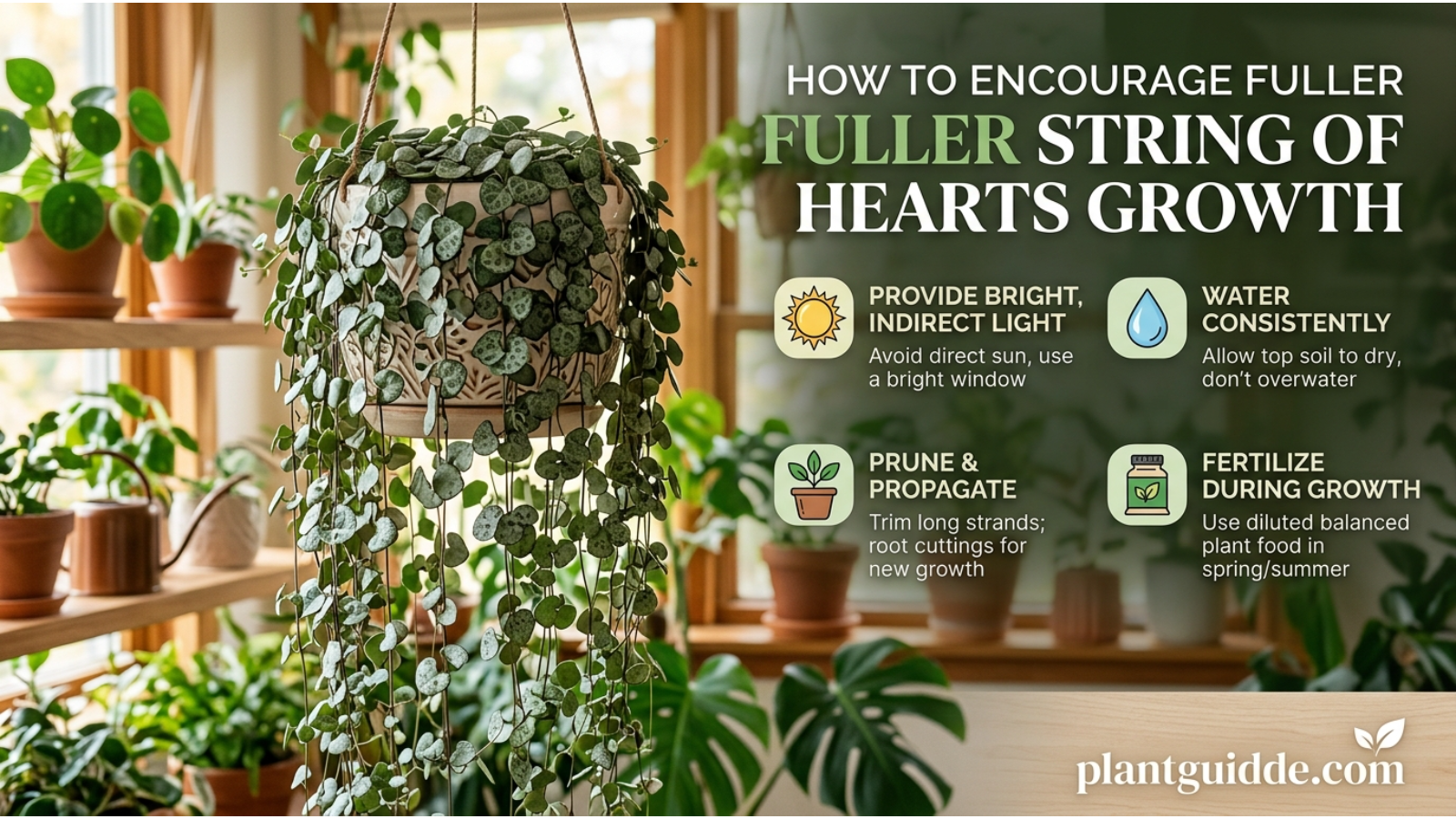
How to Encourage Fuller String of Hearts Growth
One common frustration is having a long string of hearts vine that looks sparse rather than full.
The solution is usually not simply “give it more fertilizer.”
Improve light first
Bright light encourages stronger, more compact growth. A plant growing in insufficient light may produce long sections of stem with large gaps between leaves.
Prune strategically
Trim excessively long or weak stems with clean scissors. Pruning encourages branching from nodes farther back on the vine.
Don’t throw away healthy cuttings. They can be used for propagation.
Root cuttings back into the pot
One effective way to create a fuller plant is to place healthy cuttings on the surface of the potting mix so that appropriate nodes can develop roots.
As new growth develops, the original plant and rooted cuttings can eventually create a denser cascade.
How to Propagate String of Hearts
String of hearts is particularly rewarding to propagate because individual vines can produce many potential cuttings.
Stem cutting propagation
- Choose a healthy section of vine.
- Cut a piece containing one or more viable nodes.
- Allow the cutting to sit briefly if needed so the cut surface is not excessively wet.
- Place the appropriate node against lightly moist, well-draining propagation medium.
- Keep it warm and in bright, indirect light.
- Maintain light moisture without saturating the medium.
- Wait for roots and new growth to develop.
You can also root suitable cuttings in water, although transferring delicate new roots into soil requires some care.
Tuber propagation
Mature string of hearts plants may produce small aerial tubers along their stems.
These structures can be particularly useful for propagation. A tuber can be positioned against suitable moist growing medium while remaining attached to the parent vine until roots develop.
This method takes advantage of one of the plant’s natural growth strategies and can be more reliable than trying to propagate very small pieces of stem.
When Should You Repot a String of Hearts?
String of hearts generally does not need frequent repotting.
Consider repotting when:
- Roots are filling the container
- The soil has become compacted
- Drainage has deteriorated
- The plant dries out unusually quickly
- The existing pot is damaged
- You need to inspect or correct root problems
Choose a new pot only slightly larger than the existing container.
After repotting, avoid immediately establishing an aggressive watering routine. Allow the new soil and root system to settle while continuing to prioritize good drainage.
Common String of Hearts Care Mistakes
Watering on a fixed schedule
A calendar may say to water every week, but your plant does not know what day it is.
Check the soil and pot weight instead.
Using heavy soil
A moisture-retentive mix can stay wet around the roots longer than expected.
Use an airy, fast-draining medium.
Keeping the plant too far from the window
String of hearts can survive in lower light, but surviving is not the same as producing dense, attractive growth.
If your vines are sparse and stretched, evaluate light before changing everything else.
Keeping the soil permanently damp
This is particularly risky for a plant adapted to periods of dryness.
Allow the soil to dry substantially before watering again.
Overusing fertilizer
More fertilizer does not automatically mean more growth.
If light, roots, and watering are not right, additional fertilizer is unlikely to solve the underlying problem.
Constantly moving the plant
Plants can respond poorly to repeated changes in light and temperature.
Find a suitable location and give the plant time to adjust.
String of Hearts Problems and Solutions
| Problem | Likely Cause | What to Check First |
|---|---|---|
| Yellow leaves | Excess moisture, root stress, aging | Soil moisture and drainage |
| Wrinkled leaves | Dry roots or environmental stress | Soil dryness |
| Sparse vines | Insufficient light | Window position |
| Brown patches | Sun scorch or stress | Light intensity |
| Leaf drop | Watering or temperature stress | Recent environmental changes |
| Soft stems | Excess moisture or rot | Roots and soil |
| Slow growth | Low light, season, poor roots | Light and root condition |
| Long gaps between leaves | Insufficient light | Move closer to bright light |
| Mushy roots | Prolonged wetness | Drainage and potting mix |
The most useful diagnostic habit is to avoid treating the visible symptom in isolation. Look at the soil, roots, light, temperature, and recent changes together.
How to Revive a Struggling String of Hearts
If your plant is declining, don’t change five things at once.
Start with a simple diagnosis.
Step 1: Check the soil.
Determine whether it is extremely dry, moderately dry, or staying wet for too long.
Step 2: Check the roots if necessary.
If the soil is consistently wet and the plant is deteriorating, inspect the root system for signs of damage.
Step 3: Evaluate light.
Move the plant to brighter conditions if growth is weak or widely spaced.
Step 4: Check temperature.
Look for cold drafts, heating vents, or sudden temperature changes.
Step 5: Correct one major problem at a time.
Give the plant time to respond before making another major change.
This approach is much more useful than immediately watering, fertilizing, misting, and repotting a stressed plant all at once.
Seasonal String of Hearts Care
Spring and summer
During active growth, your plant may use water more quickly and produce longer vines.
This is a good period for:
- Propagation
- Light pruning
- Occasional fertilization
- Repotting when necessary
- Training vines over a shelf or hanging basket
Still, allow the soil to dry appropriately between waterings.
Fall and winter
Growth may slow considerably as light levels decrease.
Reduce watering according to the plant’s actual needs rather than continuing a summer watering schedule.
Avoid placing the plant beside a cold window or heating source simply because it is convenient.
How to Tell if Your String of Hearts Is Healthy
A healthy plant should generally show:
- Firm leaves
- Consistent leaf production
- Strongly colored foliage
- Active trailing growth
- No persistent mushy stems
- Soil that dries appropriately between waterings
- Healthy roots without a sour or rotten smell
New growth is one of the best indicators.
A few older leaves naturally aging does not necessarily mean something is wrong. Look at the plant as a whole rather than judging its health from one leaf.
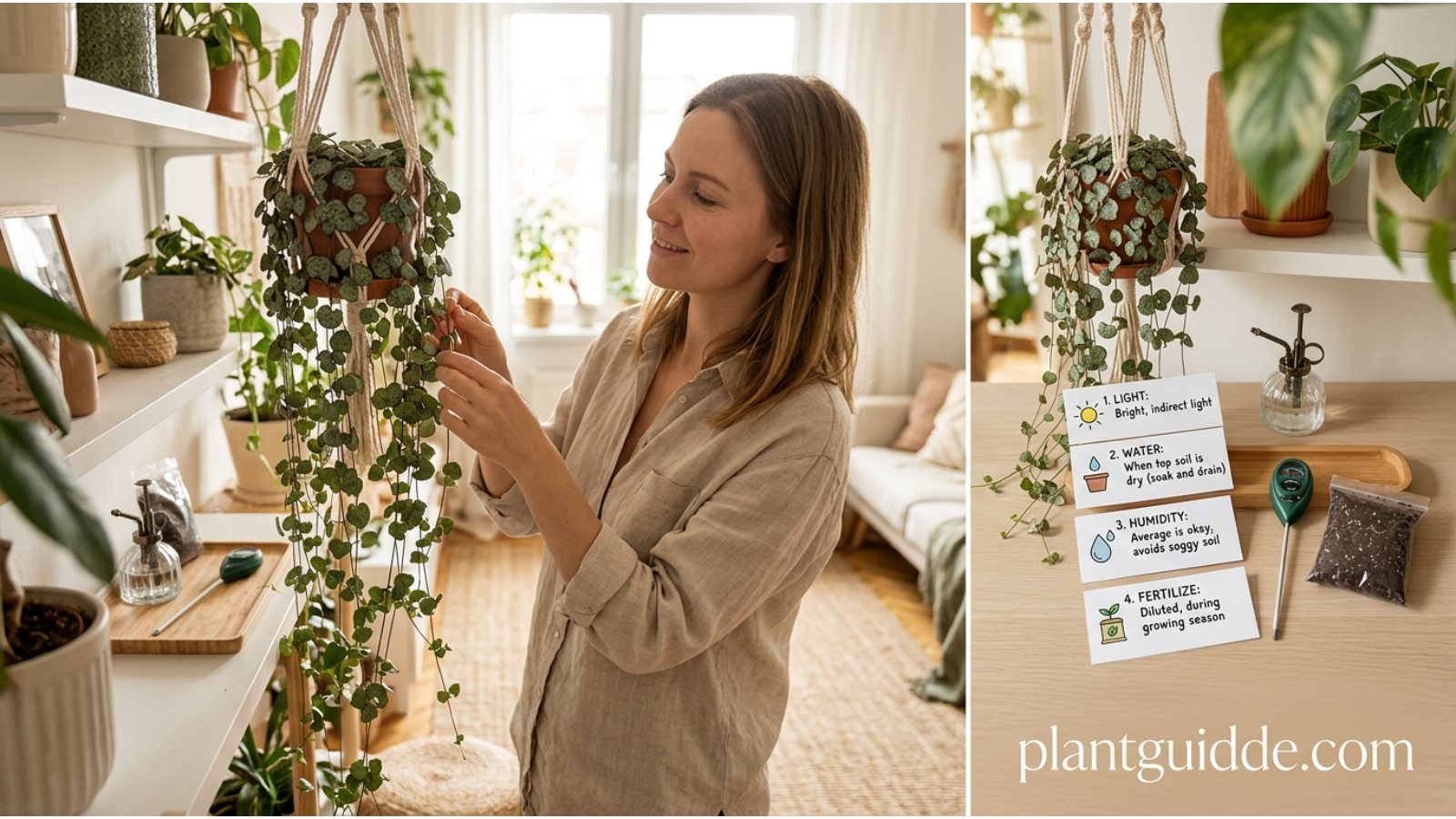
A Simple Weekly String of Hearts Care Routine
You don’t need to fuss over this plant every day.
Once a week, take a quick look at:
- Leaves: Are they firm, healthy, and normally colored?
- Soil: Is it still damp or has it dried sufficiently?
- Vines: Is new growth appearing?
- Light: Has anything changed around the window?
- Pot: Is excess water draining properly?
This five-minute inspection can catch problems before they become severe.
The actual watering interval will vary. During bright, warm periods it may dry faster; during cool, low-light periods it may remain moist considerably longer.
FAQs:
Is string of hearts easy to care for?
Yes. String of hearts is generally considered an easy-care houseplant once its basic requirements are understood. Bright light, excellent drainage, and appropriate drying between waterings are more important than constant maintenance.
How much sunlight does string of hearts need?
It prefers bright light and can tolerate some gentle direct sunlight. Strong afternoon sunlight through hot glass can scorch the foliage, so introduce direct sun gradually and watch for bleaching or crispy patches.
How often should I water string of hearts?
Water when the soil has dried substantially rather than following a fixed schedule. Water thoroughly and let excess moisture drain away completely. The exact interval depends on light, temperature, pot size, soil, and season.
Why is my string of hearts losing leaves?
Leaf loss can result from excessive moisture, prolonged dryness, low light, temperature changes, or root problems. Check the soil and recent environmental changes before deciding on a treatment.
Can string of hearts grow indoors?
Yes. It is well suited to indoor growing when placed in a bright location with good airflow and a fast-draining potting mix. Hanging baskets and elevated shelves work particularly well because the vines can naturally cascade.
Final Thoughts
Successful string of hearts plant care comes down to understanding that this plant prefers a cycle of thorough watering followed by appropriate drying rather than constantly moist soil.
Give it bright light, use a well-draining mix, choose a pot with drainage, and resist the temptation to water simply because a certain number of days has passed. If the plant develops yellow leaves, sparse growth, or shriveled foliage, investigate the growing conditions before reaching for fertilizer.
For a fuller plant, use healthy vine cuttings to propagate and replant them into the same container. With consistent conditions and enough light, a string of hearts can develop into a long, dense cascade that requires surprisingly little day-to-day attention.

Asad Mumtaz is a dedicated plant enthusiast and gardening writer with a passion for helping people care for their plants successfully. He specializes in plant care guides, indoor gardening, and practical growing tips for all skill levels. His content focuses on making gardening simple, enjoyable, and rewarding. Through his work, Asad shares reliable advice to help readers create thriving green spaces.