String of pearls plant care is one of those houseplants that looks almost too unusual to be real. Its thin trailing stems are covered with small, spherical leaves that resemble green beads, making it especially attractive in hanging baskets and elevated planters. But its unusual appearance also leads to a common mistake: assuming that because it is a succulent, it can simply be ignored.
In reality, successful string of pearls plant care is about finding the right balance between light and moisture. Too little light can produce weak, stretched growth, while frequent watering can leave the roots sitting in moisture for too long. The plant may then develop yellowing, shriveled pearls, mushy stems, or root problems.
The good news is that once you understand how the plant stores water and how quickly its soil should dry, caring for string of pearls becomes much more predictable. This guide explains what Curio rowleyanus needs, how to water it properly, how to diagnose common problems, and how to encourage fuller trailing growth.
Quick Answer
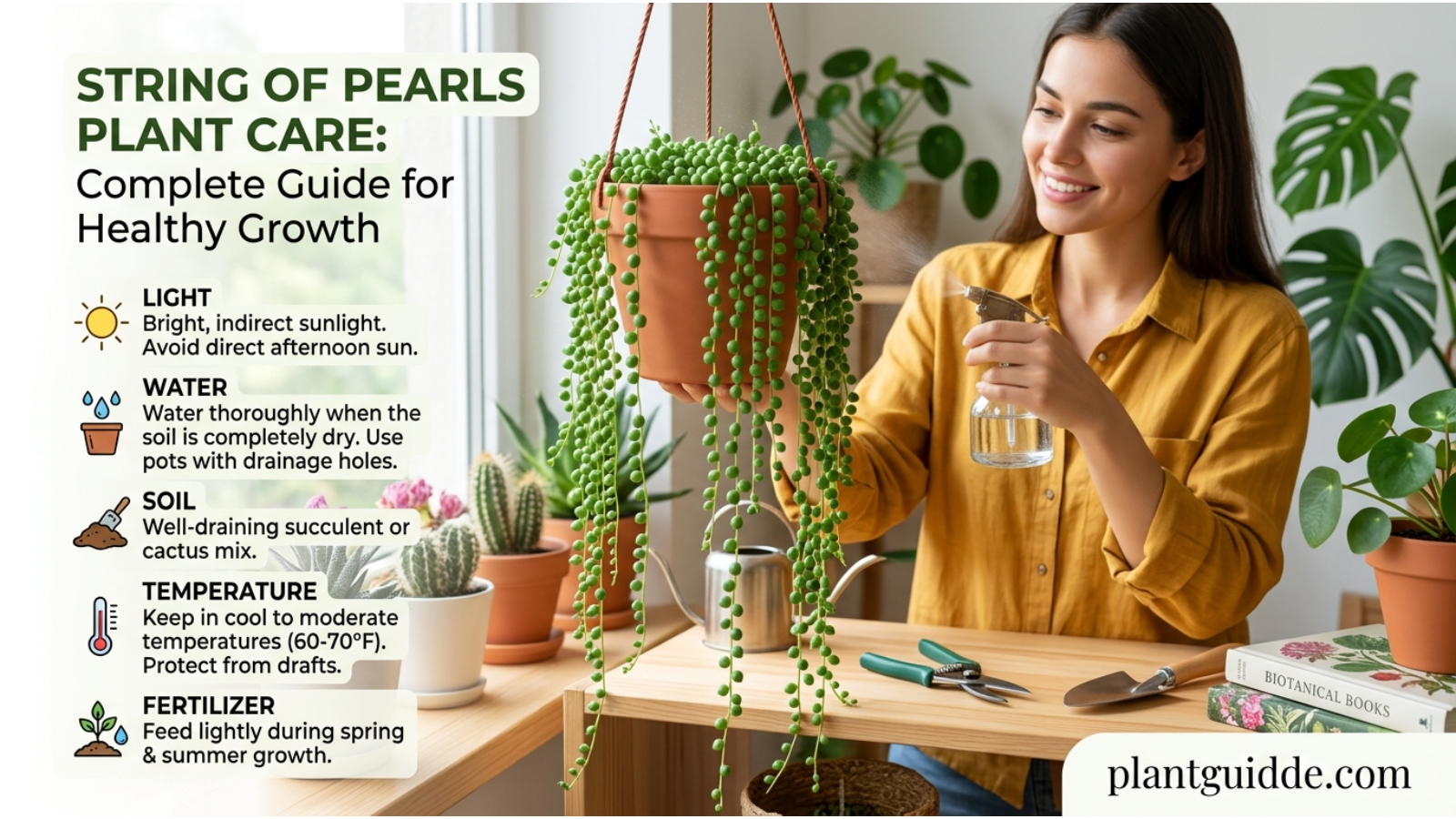
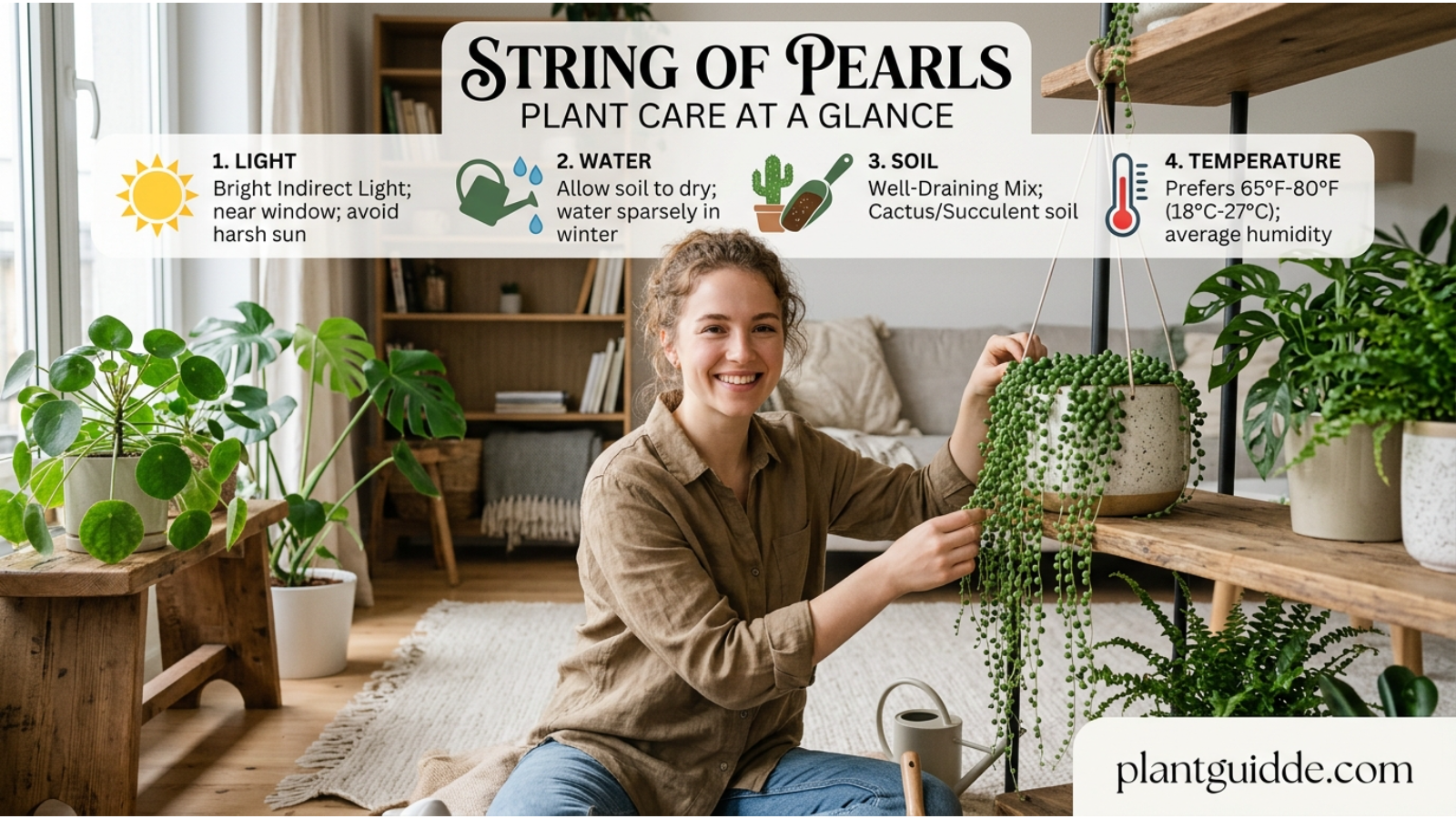
String of pearls plant care mainly comes down to bright indirect light, fast-draining soil, careful watering, good airflow, and a warm, stable environment. Curio rowleyanus stores water in its bead-like leaves, so it handles short dry periods better than consistently wet soil. Let the soil dry substantially between waterings and give the plant enough light to maintain compact, healthy growth.
What Is a String of Pearls Plant?
String of pearls, botanically known as Curio rowleyanus, is a trailing succulent native to southwestern Africa. It was formerly classified under the genus Senecio, which is why older plant-care information may refer to it as Senecio rowleyanus.
Its most recognizable feature is its bead-like foliage. Each spherical leaf functions partly as a water-storage structure, allowing the plant to cope with periods when moisture is unavailable.
The plant produces long, slender stems that naturally spill over the edge of a container. Under suitable conditions, mature plants can also produce small, usually white flowers with a sweet, cinnamon-like fragrance.
String of pearls plant care water-storage ability explains an important principle of string of pearls care:
A dry period is generally safer than keeping the root zone constantly wet.
That does not mean the plant should be neglected or left bone-dry indefinitely. It means watering should be deliberate rather than frequent.
String of Pearls Plant Care Requirements at a Glance
| Care factor | What string of pearls needs |
|---|---|
| Light | Bright light with several hours of gentle direct sun when acclimated |
| Soil | Very fast-draining succulent or cactus mix |
| Water | Thorough watering followed by substantial drying |
| Humidity | Average indoor humidity is usually adequate |
| Temperature | Warm, stable conditions; protect from cold |
| Fertilizer | Light feeding during active growth |
| Pot | Container with drainage holes |
| Growth habit | Trailing and naturally spreading |
| Main risk | Overwatering and poor drainage |
The exact watering frequency will depend on the season, pot size, soil, temperature, airflow, and amount of light. A fixed calendar is therefore less reliable than checking the plant and its growing medium.
How Much Light Does String of Pearls Need?
Light is one of the most important factors in keeping a string of pearls compact and attractive.
Give the plant bright light, preferably near a bright window where it receives plenty of illumination throughout the day. Some gentle direct sunlight can be beneficial, particularly in the morning or later afternoon.
A plant that receives insufficient light may survive, but its appearance can change noticeably.
Signs of inadequate light include:
- Long gaps between leaves along the stems
- Thin or weak new growth
- Small or poorly developed pearls
- Reduced overall fullness
- Stems stretching toward the nearest window
- Slow growth
String of pearls plant care stretched growth is called etiolation. Once a stem has stretched, moving the plant into brighter conditions will not make those existing gaps disappear. New growth can, however, become more compact.
Can string of pearls grow in a sunny window?
Yes, but sudden exposure to intense sunlight can cause problems.
A string of pearls that has been growing in relatively dim indoor conditions may be damaged if immediately placed in strong midday sun. Acclimate it gradually by increasing exposure over several days or weeks.
If the pearls develop pale, bleached, tan, or scorched areas, the light may be too intense for the plant’s current level of acclimation.
Practical tip: If you are choosing between a beautiful but dim corner and a brighter window, prioritize the brighter location and adjust the plant’s exposure gradually.
Image Suggestion: A healthy string of pearls hanging beside a bright window, showing compact stems and evenly spaced green pearls.
How to Water a String of Pearls Plant
Watering is where many string of pearls problems begin.
Because the plant stores water in its leaves, it does not need constantly moist soil. Instead, water thoroughly when the growing medium has dried significantly.
When watering:
- Check the soil rather than relying only on the calendar.
- Make sure the upper and deeper portions of the mix have had time to dry.
- Water thoroughly until excess moisture drains from the bottom.
- Empty any standing water from the saucer or outer container.
- Allow the soil to dry again before watering.
The exact interval may vary considerably. A small pot in a warm, bright room may dry much faster than a large container in a cool, poorly lit room.
Should you water string of pearls from the top or bottom?
Either method can work if the root zone becomes evenly moistened and excess water can drain away.
Bottom watering can be useful when dense foliage makes it difficult to apply water without wetting the stems. However, it should not be used as a reason to leave the pot sitting in water indefinitely.
For most home growers, thorough watering from the top is perfectly practical when done carefully.
How do you know when string of pearls needs water?
Look at both the plant and the soil.
A thirsty plant may develop:
- Slightly flattened or less plump pearls
- Wrinkled leaves
- A dry growing medium
- Reduced firmness in the stems
But wrinkled pearls do not always mean the plant simply needs more water. Root damage from excessive moisture can prevent a plant from taking up water, causing it to appear dehydrated even though the soil is wet.
String of pearls plant care distinction is important.
String of pearls plant care the soil is dry, watering may solve the problem. If the soil is wet and the pearls are shriveling, investigate the roots and drainage before adding more water.
The Best Soil for String of Pearls
String of pearls needs a growing medium that drains quickly and does not remain saturated for long periods.
A commercial cactus or succulent mix can work well. If the mix feels heavy or stays wet for many days, improve its drainage by incorporating an appropriate amount of coarse mineral material such as perlite or pumice.
The goal is not simply “dry soil.” The goal is fast drainage combined with enough structure to support healthy roots.
A suitable mix should:
- Drain excess water quickly
- Allow air into the root zone
- Avoid becoming compacted
- Dry at a reasonable rate
- Provide enough support for the trailing stems
Avoid using ordinary heavy garden soil by itself in a small indoor container. It can hold too much moisture and compact around the roots.
Choosing the Right Pot
A drainage hole is essential.
String of pearls does not benefit from being planted in a container that traps excess water around its roots. Decorative pots without drainage can still be used as outer cachepots, but the plant should remain in a nursery pot or inner container that allows water to escape.
Choose a pot that is appropriately sized for the root system rather than dramatically oversized.
An oversized container holds more soil, and more soil can mean a longer drying period. For a plant that is particularly sensitive to prolonged wetness, that can create unnecessary risk.
Terracotta can be useful because its porous material allows some moisture to evaporate through the sides, although the growing conditions and soil mix still matter more than the container material alone.
Temperature and Humidity
String of pearls generally performs best in warm indoor conditions with relatively stable temperatures.
Protect it from:
- Cold drafts
- Frost
- Sudden temperature drops
- Direct contact with cold windows during winter
- Hot air blowing directly from heaters
Average household humidity is usually sufficient. Unlike many tropical foliage plants, string of pearls does not require extremely humid conditions simply to survive.
In fact, increasing humidity while simultaneously keeping the soil wet can make an already poorly ventilated environment less suitable.
Good airflow is more useful than trying to create a constantly humid microclimate.
Does String of Pearls Need Fertilizer?
String of pearls is not a heavy feeder.
During active growth, you can use a diluted, balanced houseplant or succulent fertilizer occasionally. Avoid applying concentrated fertilizer to dry roots, and do not assume that more fertilizer will produce faster or fuller growth.
A practical approach is to:
- Fertilize during active growth.
- Use a diluted solution rather than a strong dose.
- Reduce or stop feeding during periods of slow growth.
- Avoid fertilizing a stressed, diseased, or severely dehydrated plant.
If the plant is growing slowly because it lacks sufficient light, fertilizer will not solve the underlying problem.
Light first, roots second, fertilizer third.
That order prevents one of the most common mistakes in houseplant care: trying to fertilize a plant out of an environmental problem.
How to Encourage Fuller String of Pearls Growth
String of pearls naturally grows outward and downward, but indoor plants can become sparse if light is inadequate or if long stems are never encouraged to branch.
To encourage fuller growth:
Provide enough light
Bright light helps new growth develop more compactly.
Rotate the container
Turning the pot periodically can help prevent one side from receiving dramatically more light than the other.
Prune excessively long or weak stems
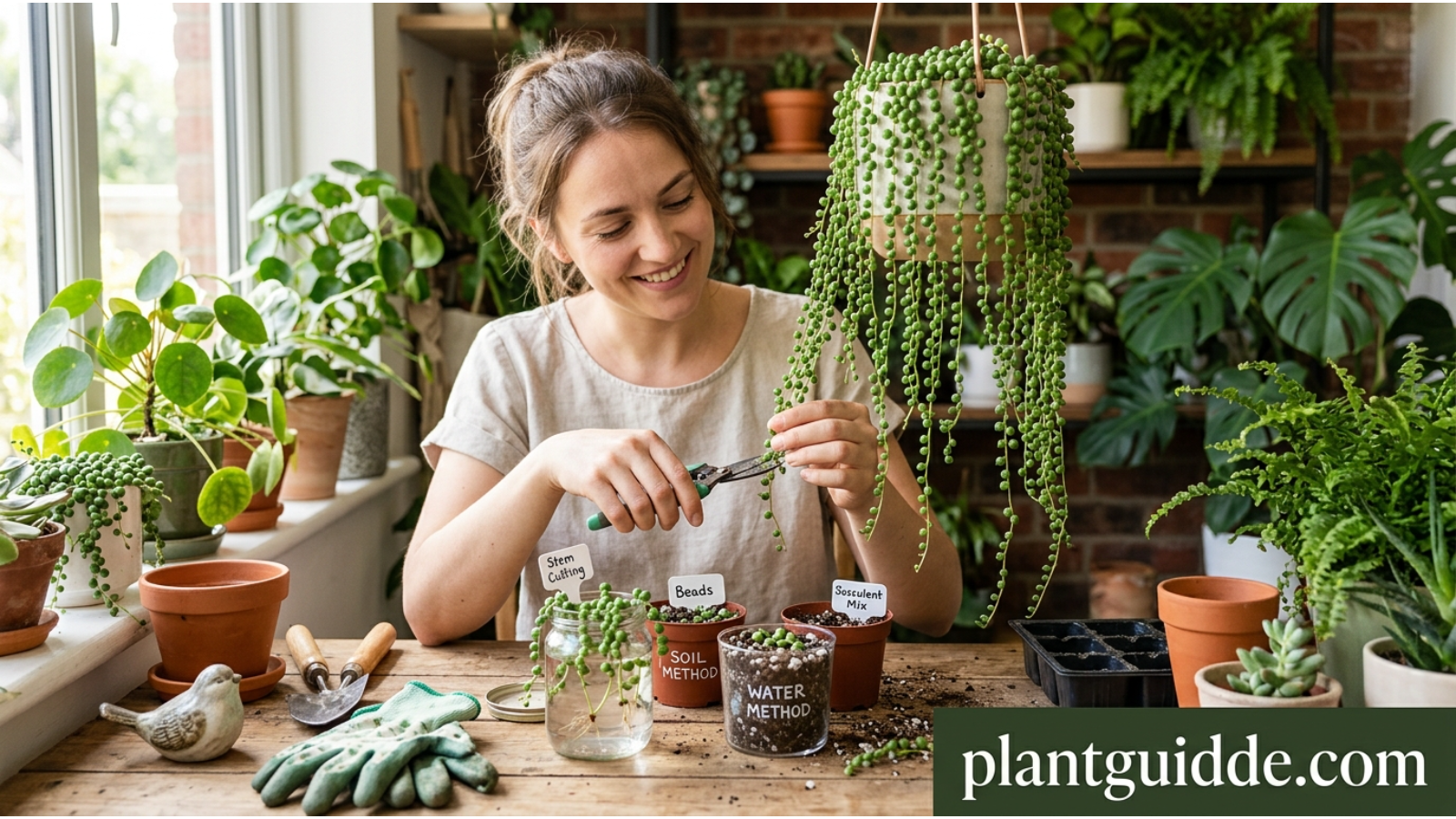
Clean pruning shears can be used to remove damaged or excessively stretched sections. Healthy cuttings can also provide propagation material.
Encourage stems to contact the soil
One useful technique is to gently lay healthy sections of stem across the surface of suitable soil. Where conditions are favorable, portions of the stem can root, allowing the plant to become fuller over time.
Do not bury the entire stem deeply. String of pearls is still susceptible to rot if plant material remains excessively wet.
How to Propagate String of Pearls
String of pearls is commonly propagated from stem cuttings.
A straightforward method is:
- Choose a healthy stem.
- Cut a section containing several pearls.
- Allow the cut surface to dry briefly if appropriate for your conditions.
- Place the cutting on or lightly into a well-draining succulent medium.
- Keep the medium only lightly moist rather than saturated.
- Provide bright, indirect light.
- Once roots establish, continue normal succulent care.
Another approach is to lay a healthy stem directly across the soil surface so that several nodes contact the growing medium.
The important point is to avoid treating fresh cuttings like thirsty tropical plants. Excess moisture can cause unrooted material to rot before it has a chance to establish.
Common String of Pearls Problems
Understanding symptoms is often more useful than memorizing a watering schedule.
String of Pearls Leaves Are Shriveling
Shriveled pearls commonly indicate insufficient water, but the cause should be confirmed before watering.
Possible causes include:
- Soil has become excessively dry
- Roots have been damaged
- The plant was recently repotted
- The plant is receiving intense heat
- Watering is inconsistent
If the soil is completely dry, give the plant a thorough watering and allow excess water to drain.
If the soil is already wet, do not automatically water again. Check the roots and soil condition instead.
String of Pearls Turning Yellow
Yellowing can have several causes, but excess moisture is one of the first things to investigate.
Check:
- How often you water
- Whether the pot drains freely
- How long the soil remains wet
- Whether the plant receives enough light
- Whether the roots appear healthy
If the soil stays wet for an unusually long time, improving drainage and adjusting the watering routine may be more important than adding fertilizer.
String of Pearls Is Turning Brown
Brown or tan areas can result from several environmental stresses, including excessive sunlight, physical damage, or severe dehydration.
Consider where the discoloration occurs.
If only the side exposed to strong sunlight is affected, excessive light or sudden sun exposure may be involved. If the entire plant is becoming dry and shriveled, water stress deserves closer attention.
String of Pearls Is Losing Pearls
Individual pearls can occasionally drop for natural or environmental reasons. Significant leaf loss, however, usually deserves investigation.
Potential causes include:
- Overwatering
- Root damage
- Poor light
- Severe dehydration
- Physical disturbance
- Temperature stress
Rather than focusing on the fallen leaves alone, inspect the stems and root zone.
String of Pearls Is Getting Long and Sparse
This is frequently a light problem.
If the plant is growing rapidly toward a window while producing long stretches of bare stem, it likely needs brighter conditions.
Move it gradually toward stronger light rather than making an abrupt change.
String of Pearls Has Mushy Stems
Mushy or collapsing stems are a serious warning sign and are commonly associated with excessive moisture and root or stem rot.
Take action quickly:
- Stop watering temporarily.
- Remove severely damaged material.
- Inspect the roots if the problem appears to originate below the soil.
- Repot healthy portions into fresh, fast-draining medium if necessary.
- Make sure the new container has drainage.
Healthy cuttings can sometimes be used to preserve a plant when the original root system is badly damaged.
Overwatering vs. Underwatering: How to Tell the Difference
These symptoms can overlap, which is why simply adding water whenever the pearls look wrinkled can make the problem worse.
| Symptom | Possible underwatering | Possible overwatering |
|---|---|---|
| Wrinkled pearls | Common | Can occur when damaged roots cannot absorb water |
| Yellowing | Sometimes | Common warning sign |
| Mushy stems | Unlikely | Strong warning sign |
| Wet soil for many days | No | Strong warning sign |
| Dry, crispy tissue | Common | Less typical |
| Root deterioration | No | Common |
| Plant looks thirsty despite wet soil | Unlikely | Possible |
The soil condition and root health are often more informative than the appearance of one or two pearls.
Common String of Pearls Care Mistakes
Watering on a fixed schedule
“Water every Sunday” sounds convenient, but plants do not consume water at exactly the same rate every week.
Instead, check the growing medium and environmental conditions.
Using a pot without drainage
A beautiful decorative container is not worth sacrificing the root system.
Always provide a reliable route for excess water to escape.
Keeping the plant in low light
String of pearls may tolerate less-than-ideal light for a while, but weak, stretched growth is often the result.
Giving intense sun too quickly
A plant accustomed to filtered indoor light can be damaged by an abrupt transition to strong direct sunlight.
Misting frequently
Misting is not necessary for routine string of pearls care. Focus on proper soil moisture, light, drainage, and airflow instead.
Using heavy soil
If water remains trapped around the roots, even a careful watering routine can fail.
Fertilizing a struggling plant
Fertilizer is not a cure for root rot, poor light, or watering problems.
Correct the growing conditions first.
A Simple Weekly String of Pearls Care Routine
You do not need to spend a lot of time maintaining this plant.
Once a week, take a quick look at:
1. Soil: Is it still wet, or has it dried sufficiently?
2. Pearls: Are they plump and firm, or increasingly shriveled?
3. Stems: Are they healthy and firm, or becoming soft and dark?
4. Light: Is the plant receiving enough bright light?
5. Drainage: Is water able to escape freely?
6. Pests: Look along stems and around leaf joints for signs of infestation.
This five-minute inspection is more useful than blindly following a watering calendar.
Should You Move String of Pearls Outdoors?
String of pearls can benefit from outdoor conditions during suitable weather, particularly when it receives stronger natural light and good airflow.
However, outdoor placement should be introduced gradually.
Start with bright but sheltered conditions and increase sun exposure progressively. Protect the plant from prolonged heavy rain, extreme heat, and cold temperatures.
An outdoor plant may also dry considerably faster than an indoor plant, so its watering needs can change after relocation.
FAQs:
How often should you water a string of pearls?
Water when the growing medium has dried substantially rather than following a strict weekly schedule. Water thoroughly, allow excess water to drain, and then let the soil dry again before watering.
Does string of pearls need direct sunlight?
It benefits from bright light and can tolerate some direct sun when properly acclimated. Avoid suddenly moving a low-light plant into intense midday sunlight because the foliage can scorch.
Why is my string of pearls dying even though I water it?
Overwatering and root damage can create a situation where the plant looks dehydrated even though the soil is wet. Check the soil, drainage, roots, and light before adding more water.
Can string of pearls grow indoors?
Yes. It can perform very well indoors when placed in a bright location with fast-draining soil and careful watering. A hanging planter near a bright window is particularly suitable for its trailing growth habit.
How do I make my string of pearls fuller?
Provide strong, appropriate light, prune weak or excessively bare stems, and propagate healthy cuttings back into the container. Laying healthy stems across the soil can also encourage additional rooting and fullness.
Final Thoughts
Successful string of pearls plant care is less about constant attention and more about getting a few fundamentals right. Give Curio rowleyanus plenty of bright light, use a fast-draining growing medium, provide a pot with drainage, and resist the temptation to water every time a pearl looks slightly wrinkled.
When problems appear, look at the whole growing environment rather than treating a single symptom. A sparse plant may need more light, while a shriveling plant in wet soil may actually have damaged roots.
The best next step is simple: check the light, inspect the soil, and look at the roots before changing your watering routine. Once those conditions are balanced, string of pearls can reward you with long, healthy trailing stems and the distinctive bead-like foliage that makes this succulent so appealing.

Asad Mumtaz is a dedicated plant enthusiast and gardening writer with a passion for helping people care for their plants successfully. He specializes in plant care guides, indoor gardening, and practical growing tips for all skill levels. His content focuses on making gardening simple, enjoyable, and rewarding. Through his work, Asad shares reliable advice to help readers create thriving green spaces.