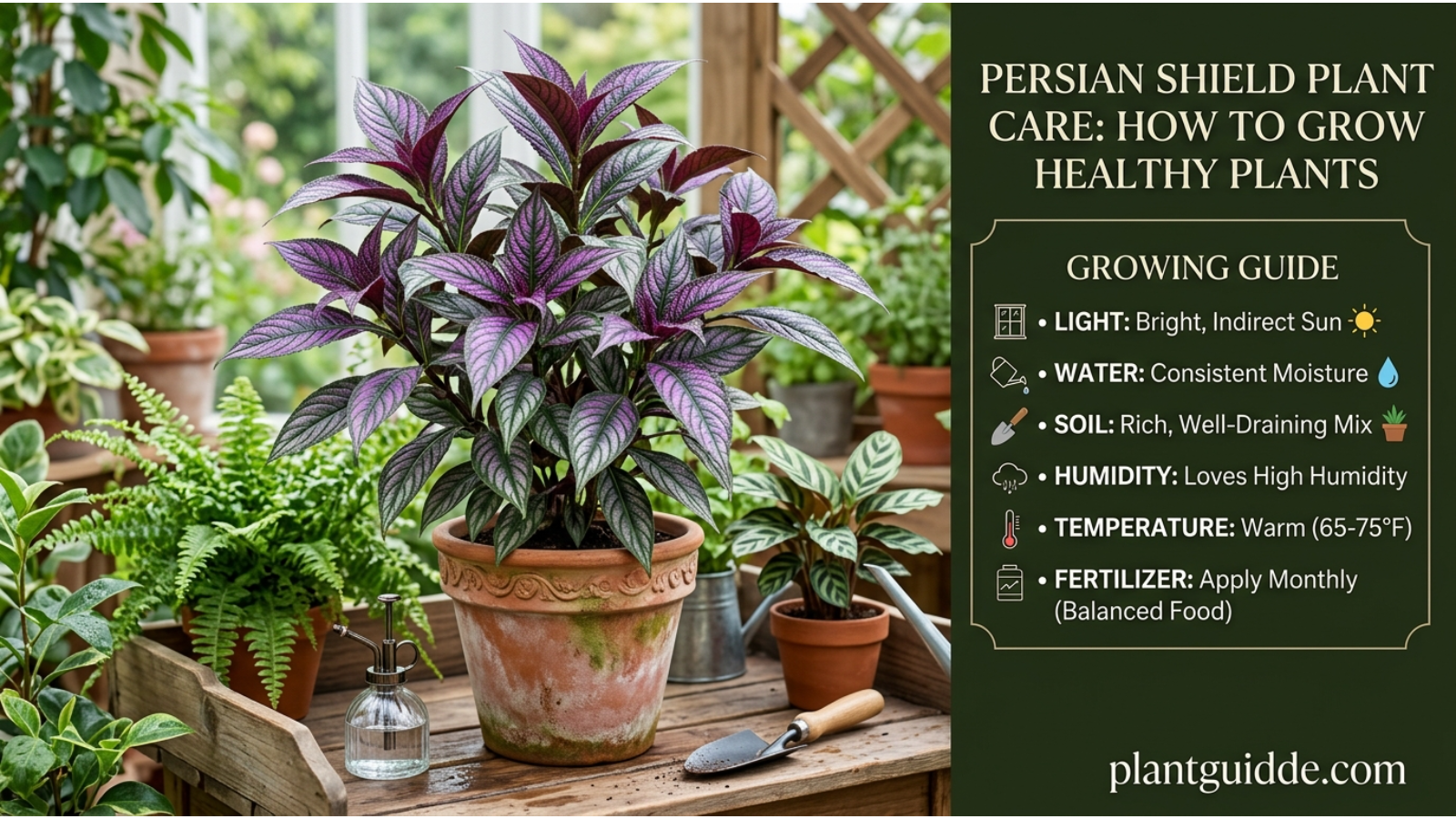
Persian shield plant care is one of those plants that can transform an ordinary indoor space with surprisingly little effort. Its large, textured leaves develop striking shades of purple, silver, and green, making the foliage the main attraction rather than the flowers.
The challenge is keeping those colors strong and the plant looking full. When conditions are unsuitable, a Persian shield may develop faded leaves, brown edges, curling foliage, drooping stems, or stretched growth. Most of these problems are connected to light, watering, humidity, temperature, or pruning rather than a mysterious disease.
Good Persian shield plant care is therefore about maintaining a stable growing environment. Give the plant enough filtered light to produce vivid foliage, keep the root zone evenly moist without making it soggy, provide reasonable humidity, and prune regularly to encourage branching.
Quick Answer
Persian shield (Strobilanthes dyerianus) grows best in bright, indirect light, consistently moist but well-drained soil, moderate to high humidity, and warm temperatures. Water when the top inch of soil begins to dry, protect it from harsh afternoon sun, and pinch growing tips to keep the plant compact and bushy. Regular pruning also helps maintain its vivid purple foliage.
What Is a Persian Shield Plant?
The Persian shield (Strobilanthes dyerianus) is a tropical foliage plant in the Acanthaceae family. Despite its common name, it is not actually from Persia; the species is native to Myanmar.
Its most recognizable feature is its colorful foliage. Mature leaves can display deep purple, violet, green, and metallic-silver tones, with the exact coloration influenced by growing conditions.
Persian shield is commonly grown as:
- An indoor foliage plant
- A patio or container plant
- A seasonal outdoor ornamental
- A bedding plant in warm climates
- A colorful accent plant in shaded gardens
The plant can produce small tubular flowers, but gardeners generally grow it for the dramatic foliage.
Image Suggestion: Close-up image of a healthy Persian shield showing purple-and-silver foliage alongside a potted plant in bright filtered light.
Persian Shield Plant Care at a Glance
| Care Requirement | Best Condition |
|---|---|
| Light | Bright, indirect or filtered light |
| Soil | Rich, loose, well-draining soil |
| Water | Keep soil consistently lightly moist |
| Humidity | Moderate to high |
| Temperature | Warm and stable |
| Fertilizer | Balanced fertilizer during active growth |
| Pruning | Regular pinching and trimming |
| Repotting | When roots become crowded |
| Growth habit | Upright, bushy, sometimes spreading |
| Main attraction | Purple, silver, and green foliage |
Light Requirements for Persian Shield
Light has a major influence on the appearance of Persian shield foliage.
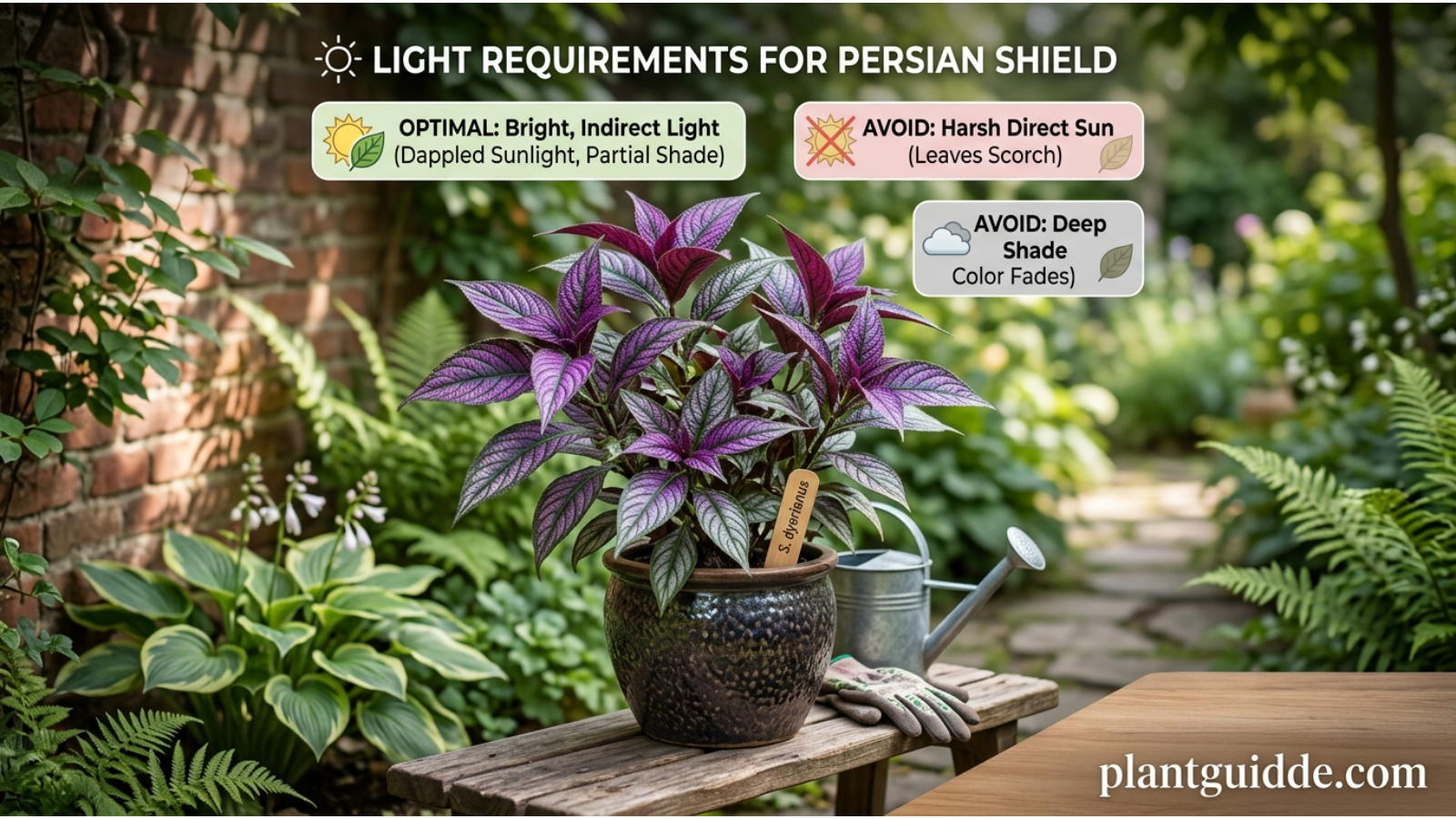
The plant generally performs best in bright, indirect light or filtered sunlight. Too little light can cause the vivid purple coloration to become less intense and may result in thin, elongated growth.
At the same time, strong direct afternoon sunlight through a window can scorch the foliage, particularly when the plant has not been gradually acclimated.
A good indoor location is often:
- Near a bright east-facing window
- A few feet back from a strong south- or west-facing window
- Behind a sheer curtain where sunlight is intense
- In a bright room with plenty of reflected daylight
How to Tell If the Light Is Wrong
Too little light:
The plant may become leggy, leaves may lose some of their rich coloration, and new growth may appear weaker.
Too much direct sun:
Leaves can develop bleached patches, crispy brown areas, or scorched edges.
Practical tip: If your Persian shield is growing toward a window, rotate the pot every week or two. This helps maintain more even growth.
How Much Water Does a Persian Shield Need?
Persian shield prefers soil that stays evenly moist but never continuously saturated.
Allowing the plant to become extremely dry can cause rapid wilting, while repeatedly keeping the roots waterlogged can reduce oxygen around the roots and increase the risk of root problems.
Instead of watering according to a fixed calendar, check the soil.
Insert your finger about an inch into the growing medium. If the surface and upper layer feel noticeably dry, it is usually time to water.
When watering:
- Water thoroughly until some water drains from the bottom.
- Allow excess water to escape completely.
- Empty standing water from a saucer or cachepot.
- Check the soil again before watering next time.
The frequency can vary considerably depending on temperature, pot size, light level, soil composition, and humidity.
Should You Let Persian Shield Dry Out Completely?
Usually, no.
A short period of dryness is different from allowing the entire root ball to become bone dry repeatedly. Persian shield generally looks better when moisture remains relatively consistent.
If the plant repeatedly wilts between waterings, consider whether the pot is too small, the soil is excessively dry, or the plant is receiving unusually strong light or heat.
Best Soil for Persian Shield
Persian shield benefits from a rich but well-draining potting mix that holds some moisture without becoming compacted.
A practical mix can include:
- Quality all-purpose potting soil
- Compost or another organic component
- Perlite or another drainage-enhancing material
The goal is not simply “fast drainage.” The soil should drain excess water while still holding enough moisture around the roots.
Avoid heavy garden soil in indoor containers. It can compact inside a pot, restrict airflow around the roots, and remain wet for too long.
A container must also have drainage holes. Even an excellent potting mix cannot compensate for a container that traps excess water.
Humidity for Persian Shield
Because Persian shield comes from a warm tropical environment, it generally appreciates moderate to high humidity.
Low humidity can contribute to:
- Brown leaf edges
- Crispy tips
- Curling leaves
- Faster moisture loss
- General foliage stress
If your indoor air is very dry, especially during periods of heating or air conditioning, consider using a humidifier near the plant.
Grouping plants together can also slightly increase the humidity immediately around their foliage, although it should not replace good airflow.
Does Misting Help Persian Shield?
Occasional misting may temporarily wet the foliage, but it is not a dependable way to maintain consistently higher humidity.
If humidity is genuinely low, a humidifier is usually a more effective solution.
Also avoid keeping the foliage constantly wet in a poorly ventilated area. Good airflow is important because stagnant, damp conditions can encourage fungal and bacterial problems.
Temperature and Placement
Persian shield prefers warm conditions and can react poorly to cold drafts or sudden temperature changes.
Keep it away from:
- Cold exterior doors
- Drafty windows
- Strong air-conditioning vents
- Heating vents
- Locations with large temperature swings
A stable room environment is generally more useful than trying to create a highly controlled tropical setup.
For outdoor plants, bring Persian shield indoors before temperatures become consistently cold if you live in a climate where winters are too chilly for tropical plants.
Fertilizing Persian Shield
Persian shield benefits from regular feeding during active growth, particularly when grown in containers.
A balanced, water-soluble houseplant fertilizer can be applied according to the product’s directions. Avoid assuming that more fertilizer will produce more colorful leaves.
Overfertilization can cause salt accumulation in the soil and damage roots.
A sensible approach is:
- Feed during active growth.
- Reduce or stop feeding when growth slows significantly.
- Water normally rather than using fertilizer every time unless the product specifically recommends that schedule.
- Avoid applying concentrated fertilizer to very dry soil.
If the plant is already stressed from severe dryness, heat, or root problems, correct the environmental issue before increasing fertilizer.
How to Prune Persian Shield
Pruning is one of the most useful parts of Persian shield plant care.
Without regular trimming, the plant can become tall, sparse, or less attractive as stems stretch outward.
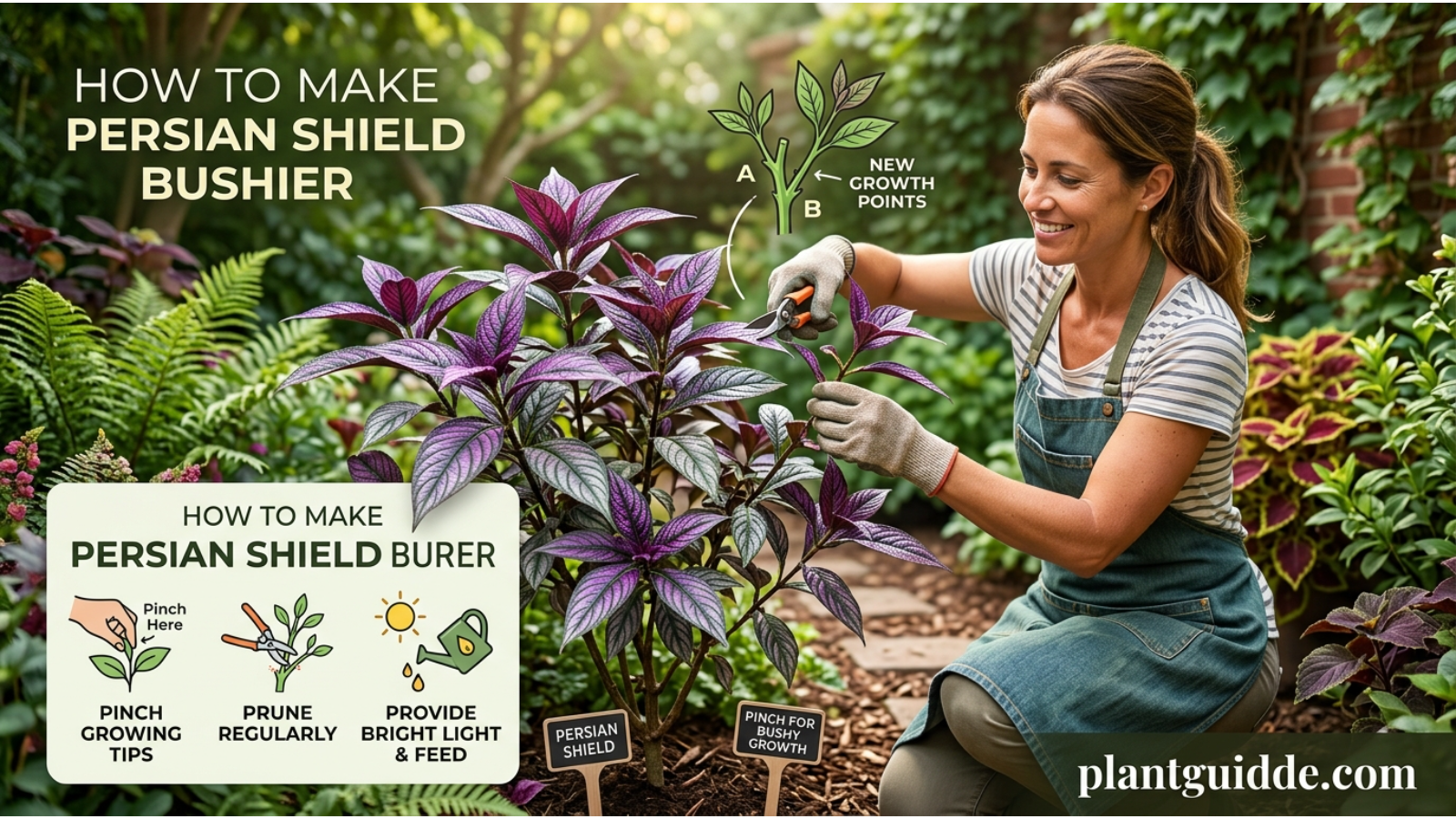
Pinching the growing tips encourages branching and can create a fuller plant.
Simple Pruning Method
Use clean, sharp scissors or pruning shears.
Cut just above a leaf node, particularly on long stems that have become thin or overly tall.
Do not remove large amounts of healthy growth unnecessarily. Instead, prune gradually and use the new branching that develops below the cuts to build a more compact shape.
Regular tip-pinning is particularly useful when growing Persian shield as a houseplant.
How to Make Persian Shield Bushier
If your Persian shield looks thin or leggy, pruning is usually more useful than simply adding fertilizer.
Try this combination:
- Move the plant into brighter filtered light if it is currently too dim.
- Pinch the tips of long stems.
- Remove weak or badly damaged growth.
- Keep watering consistent.
- Rotate the pot periodically.
- Allow new side shoots time to develop.
The key is to encourage branching rather than simply producing longer stems.
A common mistake is allowing a young plant to grow tall for months before making the first pruning cut. Starting light pinching earlier usually makes it easier to maintain a dense shape.
Repotting Persian Shield
Persian shield does not necessarily need frequent repotting. Move it into a larger container when the roots have substantially filled the existing pot or water is passing through the container unusually quickly.
Choose a pot only modestly larger than the current one.
A dramatically oversized container can hold more wet soil than the plant’s root system can use, which may increase the risk of prolonged moisture around the roots.
When repotting:
- Use fresh, well-draining potting mix.
- Choose a container with drainage holes.
- Avoid aggressively disturbing healthy roots.
- Water appropriately after repotting.
- Keep the plant away from stressful conditions while it adjusts.
How to Propagate Persian Shield
Stem cuttings are a practical way to propagate Persian shield.
Take a healthy stem cutting with several nodes. Remove the lower leaves and place the cutting in a suitable propagation medium or water, depending on your preferred method.
Keep the cutting warm and provide bright, indirect light.
Once roots have developed sufficiently, transplant the cutting into a suitable potting mix.
Propagation is also useful when an older plant becomes unattractive. You can root healthy cuttings and establish a younger, more compact plant rather than trying to preserve every old stem.
Persian Shield Brown Leaves: What Does It Mean?
Brown leaves or brown edges are symptoms rather than a diagnosis.
Several environmental problems can produce similar damage.
Common Causes of Brown Edges
Low humidity:
Dry indoor air can cause leaf margins and tips to become crispy.
Inconsistent watering:
Allowing the plant to become severely dry can result in stressed or damaged foliage.
Excessive direct sunlight:
Strong sun can scorch exposed leaves.
Fertilizer buildup:
Too much fertilizer can contribute to brown leaf margins and root stress.
Root problems:
If roots have been damaged by prolonged waterlogging, the plant may struggle to move water effectively even when the soil appears wet.
Look at the pattern of damage rather than reacting to the brown areas alone.
Why Are Persian Shield Leaves Curling?
Curling foliage often indicates environmental stress.
Check these factors first:
- Is the soil extremely dry?
- Is the plant receiving intense direct sun?
- Is the room unusually hot?
- Is humidity very low?
- Has the plant recently been moved?
- Are the roots staying wet for too long?
If the leaves curl shortly after the soil becomes very dry, watering may solve the immediate problem. But if curling repeatedly occurs despite moist soil, investigate light, heat, humidity, and root health rather than simply watering more frequently.
Why Is My Persian Shield Drooping?
Persian shield can wilt quickly when its root zone becomes too dry, but watering is not always the answer.
If the soil is dry several inches down, water thoroughly and monitor the plant.
If the soil is already wet, investigate further. Persistent drooping in wet soil can indicate root stress rather than thirst.
Also check for excessive heat and strong direct sunlight.
A useful rule is:
Drooping + dry soil = investigate water shortage first.
Drooping + wet soil = investigate the roots and growing conditions before adding more water.
Why Is My Persian Shield Losing Its Purple Color?
Fading coloration is often associated with inadequate light, although other growing conditions can also influence foliage appearance.
Move a low-light plant gradually toward a brighter location with filtered light.
Avoid immediately placing it into intense direct afternoon sun. Sudden changes can create a second problem: leaf scorch.
If the plant receives adequate light but still looks generally weak and pale, also evaluate nutrition, watering consistency, and root health.
Persian Shield Pests
Like many soft-leaved plants, Persian shield can occasionally attract common houseplant pests.
Watch for:
- Spider mites
- Aphids
- Whiteflies
- Mealybugs
- Scale insects
Inspect the undersides of leaves and the newest growth regularly.
Early detection makes pest management much easier. Look for fine webbing, sticky residue, distorted new growth, clusters of insects, cottony material, or unusual leaf stippling.
Persian shield plant care you identify pests, isolate the affected plant from nearby houseplants while you address the infestation.
Common Persian Shield Care Mistakes
Keeping the Soil Permanently Wet
Persian shield likes moisture, but moisture does not mean saturated soil. Roots need oxygen as well as water.
Putting It in Harsh Afternoon Sun
Bright light is useful, but intense direct sunlight can scorch the foliage.
Watering on a Fixed Schedule
A plant does not use the same amount of water every week. Seasonal changes, room temperature, pot size, and light can all change its needs.
Ignoring Pruning
Allowing long stems to grow unchecked can result in a sparse plant that becomes harder to reshape later.
Overfertilizing
More fertilizer does not automatically mean better growth or brighter foliage.
Moving the Plant Suddenly
A Persian shield grown in lower indoor light can struggle if immediately moved into strong outdoor sunlight. Acclimate it gradually.
Indoor vs. Outdoor Persian Shield Care
Persian shield can perform well outdoors in suitable warm conditions, but its requirements change somewhat depending on the environment.
| Condition | Indoors | Outdoors |
|---|---|---|
| Light | Bright filtered light | Bright shade or filtered sun |
| Water | Check soil regularly | May need more frequent checks |
| Humidity | Often needs supplemental humidity in dry rooms | Usually benefits from naturally humid conditions |
| Temperature | Easier to keep stable | Protect from cold and extreme heat |
| Pests | Easier to monitor | Greater exposure to insects |
| Pruning | Useful for compact growth | Useful for shaping and branching |
Outdoor plants can grow more vigorously when temperatures and humidity are favorable, but they may also dry out faster because of wind and increased light.
A Simple Weekly Persian Shield Care Routine
You do not need to spend hours maintaining this plant.
Once a week, check:
1. Soil moisture
Feel the upper layer rather than watering automatically.
2. Leaves
Look for curling, brown edges, discoloration, pests, or unusual spots.
3. Light
Make sure the plant has not been shaded by curtains, furniture, or seasonal changes.
4. Growth
Pinch overly long shoots when necessary.
5. Pot drainage
Make sure water is not accumulating in an outer container.
Persian shield plant care short inspection can catch problems before they become severe.
When Should You Move a Persian Shield?
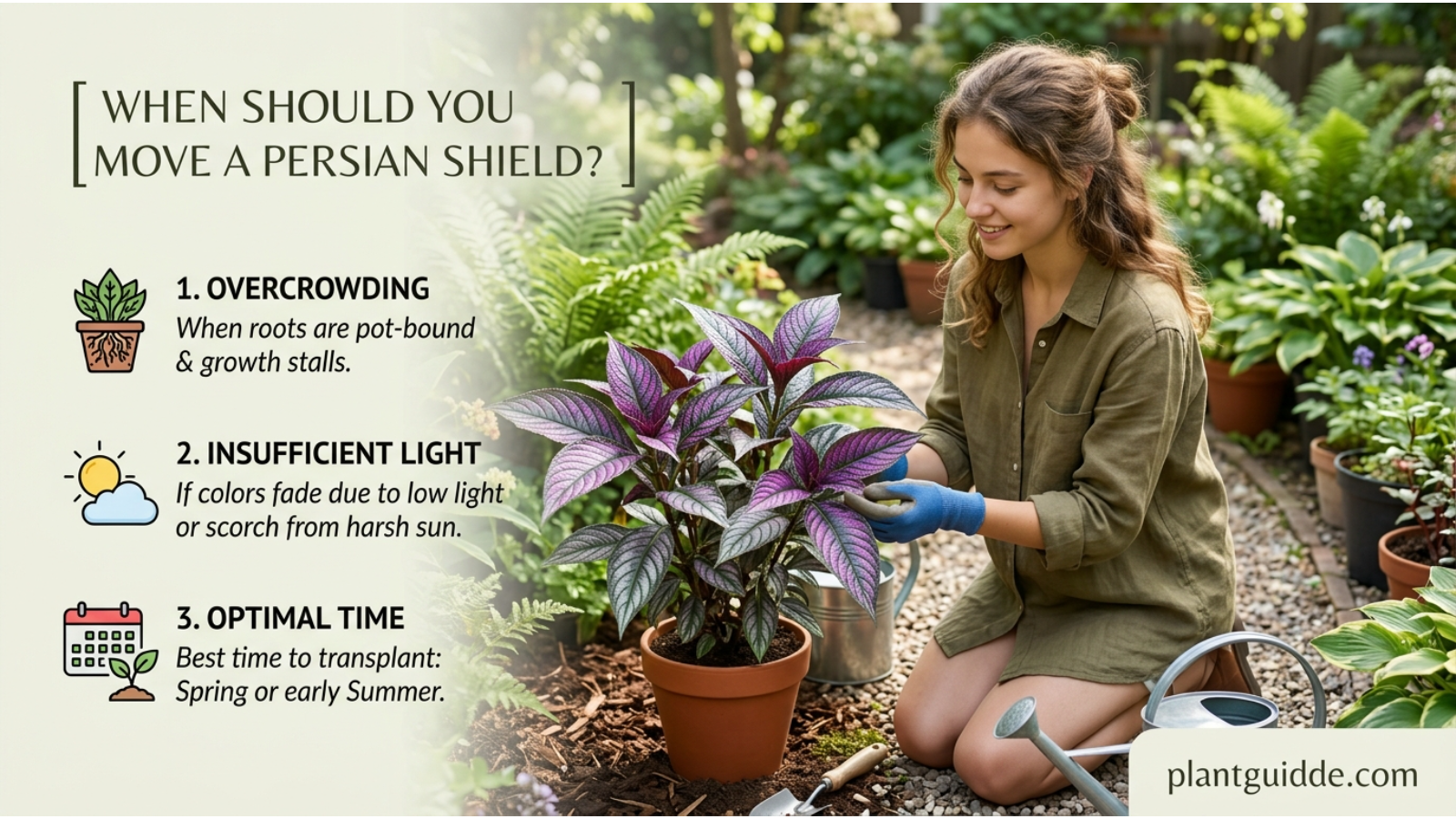
Move the plant when its current location is clearly causing problems rather than moving it repeatedly in search of the “perfect” spot.
Consider relocating it if:
- Leaves scorch near the window.
- New growth becomes very stretched.
- The plant repeatedly dries out too quickly.
- Cold drafts cause recurring stress.
- The location has extremely dry air.
Make one meaningful environmental adjustment at a time when possible. This makes it easier to determine what actually helped.
FAQs:
Is Persian shield easy to grow indoors?
Yes, provided it receives enough bright filtered light and consistent moisture. It is generally more forgiving when its basic environmental needs are stable.
Does Persian shield need full sun?
Not necessarily. It usually performs well in bright filtered light, while intense direct sunlight, especially hot afternoon sun, can scorch its leaves.
How often should I water a Persian shield?
Water when the upper layer of soil begins to dry rather than following a strict schedule. The exact frequency depends on light, temperature, humidity, pot size, and soil.
Why is my Persian shield turning green?
Insufficient light is one common reason the purple coloration becomes less pronounced. Gradually provide brighter filtered light while avoiding sudden exposure to harsh direct sun.
Can Persian shield grow from cuttings?
Yes. Healthy stem cuttings can be used for propagation, making it relatively easy to produce new plants from an established specimen.
Final Thoughts
Successful Persian shield plant care comes down to balance rather than complicated techniques. Give it bright filtered light, keep the soil consistently but moderately moist, provide suitable humidity, protect it from temperature extremes, and prune regularly to encourage branching.
If the foliage starts losing color, curling, browning, or drooping, do not immediately assume the plant needs more water or fertilizer. Check the soil, light, humidity, temperature, and roots together. That simple diagnostic approach is often the fastest way to identify what has changed.
For a fuller, more colorful plant, focus first on stable conditions and regular tip-pruning. Once those two fundamentals are right, Persian shield becomes much easier to maintain and its distinctive purple foliage can remain the centerpiece of your indoor plant collection.

Asad Mumtaz is a dedicated plant enthusiast and gardening writer with a passion for helping people care for their plants successfully. He specializes in plant care guides, indoor gardening, and practical growing tips for all skill levels. His content focuses on making gardening simple, enjoyable, and rewarding. Through his work, Asad shares reliable advice to help readers create thriving green spaces.