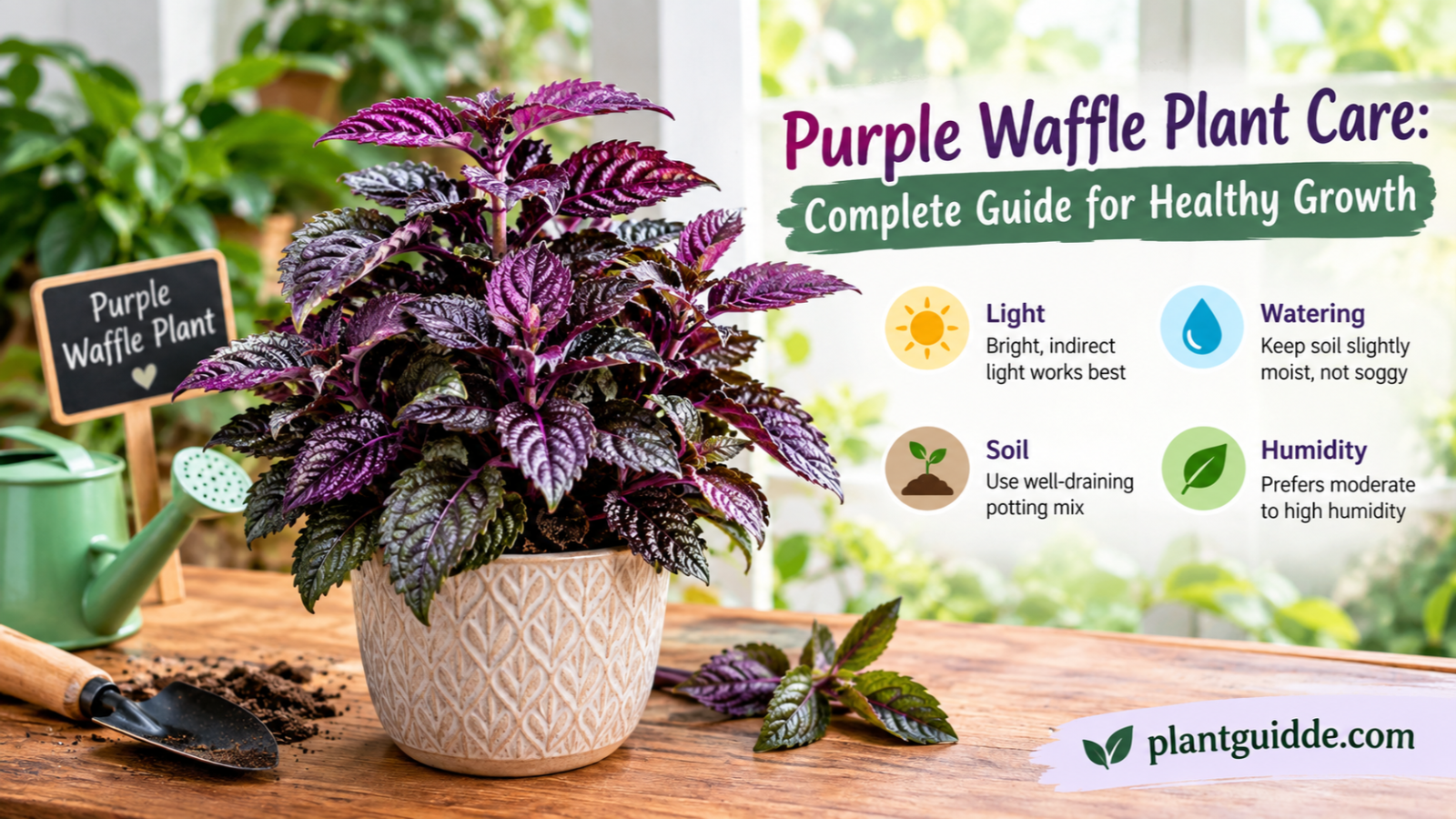
Purple waffle plant care are popular indoor plants because their deeply textured leaves combine green, purple, and burgundy tones with a naturally spreading growth habit. Their foliage can make a small shelf, desk, or hanging container look much more colorful.
But attractive foliage does not mean the plant is maintenance-free. A purple waffle plant may develop crispy edges, fading color, yellow leaves, wilting, or sparse growth when light, moisture, humidity, or temperature is consistently wrong. The key to successful purple waffle plant care is maintaining steady growing conditions rather than repeatedly trying to correct problems after they appear.
This guide explains what Hemigraphis alternata needs, how to water it properly, where to place it indoors, how to keep its purple foliage vibrant, and what to do when something starts going wrong.
Quick Answer
Purple waffle plant care is easiest when the plant gets bright, indirect light, consistently moist but well-drained soil, moderate to high humidity, and warm temperatures. Avoid harsh direct sun, prolonged dry soil, and waterlogged roots. Regular pinching also helps keep Hemigraphis alternata compact, bushy, and attractive.
What Is a Purple Waffle Plant?
The purple waffle plant (Hemigraphis alternata) is a low-growing tropical plant grown primarily for its highly textured foliage. Its leaves have a wrinkled or quilted appearance, which explains the “waffle” part of its common name. Depending on growing conditions and variety, the foliage can show combinations of green, purple, burgundy, and metallic-looking tones.
It naturally develops a spreading habit rather than growing into a tall upright houseplant. This makes it particularly useful for:
- Shelves and plant stands
- Hanging baskets
- Terrariums and humid indoor spaces
- Bright bathrooms
- Mixed tropical plant displays
- Small containers where trailing growth is desirable
One important point for beginners is that purple waffle plants generally respond better to stable moisture and humidity than to neglect. They are not the type of houseplant you should allow to become completely dry for long periods.
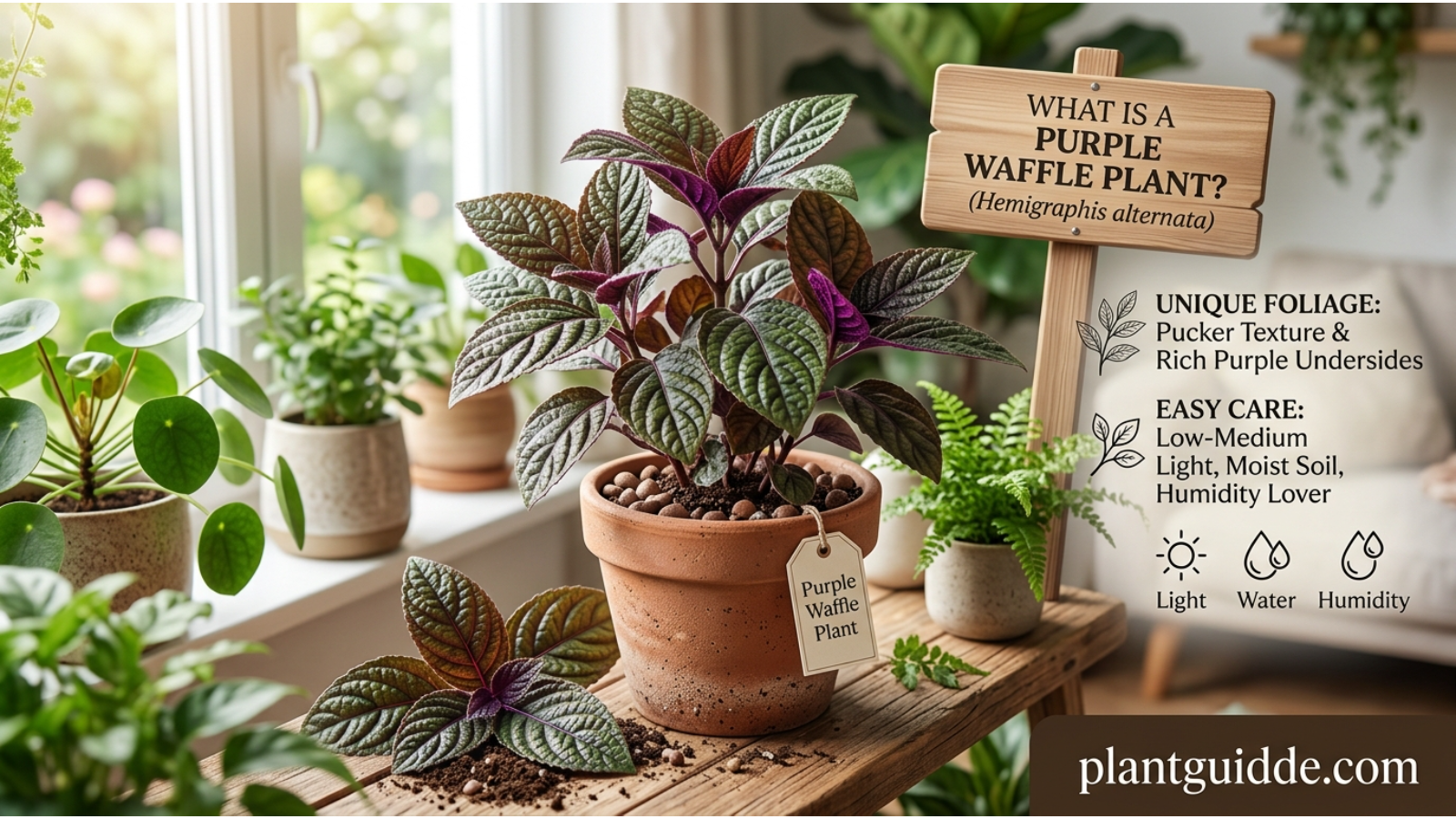
Purple Waffle Plant Care Requirements at a Glance
| Care factor | Best approach |
|---|---|
| Light | Bright, indirect light |
| Water | Keep soil lightly and consistently moist |
| Soil | Rich, airy, well-draining potting mix |
| Humidity | Moderate to high humidity |
| Temperature | Warm, stable indoor temperatures |
| Fertilizer | Light feeding during active growth |
| Pruning | Pinch growing tips to encourage bushiness |
| Repotting | When roots become crowded or soil dries too quickly |
| Growth habit | Low, spreading, and trailing |
| Common problems | Curling, browning, yellow leaves, fading color, wilting |
The exact watering frequency will depend on pot size, temperature, light, humidity, and soil composition. Checking the soil is more reliable than following a fixed calendar.
Light Requirements for a Purple Waffle Plant
Bright, indirect light is usually the best starting point for purple waffle plant care.
Place the plant near a bright window where it receives plenty of filtered daylight without sitting in intense midday sunlight. An east-facing window can work well, while a bright location near a north- or partially shaded south- or west-facing window may also be suitable depending on the room.
What happens with too little light?
When light is insufficient, you may notice:
- Longer spaces between leaves
- Weak or stretched growth
- Less intense purple coloration
- Smaller new leaves
- A generally thinner appearance
If the plant looks healthy but increasingly green and sparse, insufficient light should be one of the first things you investigate.
What happens with too much direct sun?
Strong direct sunlight, particularly through hot glass, can scorch the foliage. Damaged leaves may develop:
- Brown patches
- Bleached areas
- Crispy edges
- Faded coloration
If this happens, move the plant farther from the window or filter the light with a sheer curtain.
Practical tip: If you are unsure whether a location is bright enough, observe the plant for several weeks rather than judging it after one day. New growth is often a better indicator of whether the location is working.
How to Water a Purple Waffle Plant
Watering is one of the most important parts of purple waffle plant care.
The plant prefers soil that stays somewhat moist but never remains saturated. Allowing the root zone to become bone dry can cause rapid wilting, while continually wet soil reduces oxygen around the roots and can contribute to root problems.
A useful routine is:
- Check the surface of the potting mix.
- Feel slightly below the surface rather than relying only on appearance.
- If the upper layer has started to dry but the deeper mix remains lightly moist, assess whether watering is needed.
- Water thoroughly until excess water drains from the bottom.
- Empty standing water from the saucer or decorative container.
The frequency may be every few days in a warm, bright, dry room or considerably less often in cooler, dimmer conditions.
Should you let a purple waffle plant dry out completely?
Generally, no.
This plant is better suited to consistent moisture than repeated cycles of severe drying followed by heavy watering. If the leaves repeatedly wilt before watering, the plant may be experiencing unnecessary stress.
At the same time, constantly wet soil is not the solution. Moisture and drainage need to work together.
Best Soil for Purple Waffle Plants
Purple waffle plants benefit from a potting mix that holds moisture while still allowing excess water and air to move through the root zone.
A practical mix can contain:
- Quality indoor potting soil
- Coco coir or another moisture-retaining component
- Perlite or another material that improves aeration
- A small amount of compost or other organic material if appropriate
The exact recipe is less important than the result: the soil should remain lightly moist without becoming dense and waterlogged.
A pot with drainage holes is especially important. A decorative pot without drainage can trap water around the roots even when your watering habits seem reasonable.
Humidity: An Important Part of Purple Waffle Plant Care
Because Hemigraphis alternata is a tropical plant, it generally performs better when indoor air is not extremely dry.
Low humidity can contribute to:
- Brown leaf edges
- Crispy foliage
- Curling leaves
- Increased water loss
- Stress during hot or dry weather
If your home has dry air, especially during periods of heating or air conditioning, consider using a humidifier or grouping compatible tropical plants together.
Misting can temporarily wet the foliage, but it is not a reliable way to maintain a consistently higher humidity level.
Better approach: Increase ambient humidity around the plant while maintaining good airflow. Very humid, stagnant conditions can create a different set of problems.
Temperature Requirements
Purple waffle plants prefer warm, stable conditions.
Keep the plant away from:
- Cold drafts
- Exterior doors that frequently open
- Very cold windows during winter
- Strong air-conditioning vents
- Direct blasts from heaters
Sudden temperature changes can cause stress even when the average room temperature seems acceptable.
A stable indoor environment is generally more useful than constantly moving the plant from one location to another.
Fertilizing a Purple Waffle Plant
Purple waffle plants can benefit from regular but moderate feeding during active growth.
Use a balanced houseplant fertilizer according to the manufacturer’s dilution instructions. Applying a weaker solution periodically is generally safer than repeatedly applying excessive fertilizer.
Avoid fertilizing:
- Bone-dry soil
- A visibly stressed or severely wilted plant
- A plant with suspected root problems
- Immediately after major root disturbance unless appropriate for the product and situation
Excess fertilizer can contribute to salt accumulation and leaf-edge damage.
If the plant is producing healthy new foliage, there is usually little reason to increase fertilizer simply because growth seems slower during a darker or cooler period.
How to Make a Purple Waffle Plant Bushier
A purple waffle plant can become sparse if its growing tips are allowed to extend without regular pruning.
Pinching the tips encourages the plant to produce additional side growth. You do not need complicated pruning equipment for routine shaping.
Simple pruning method
- Identify long or leggy stems.
- Cut or pinch just above a healthy leaf node.
- Remove damaged or badly discolored leaves.
- Repeat as necessary as new growth develops.
Don’t remove a large portion of the plant simply to make it bushier. Gradual pruning allows the plant to continue photosynthesizing while producing new shoots.
The removed healthy stem sections can also potentially be used for propagation.
How to Propagate a Purple Waffle Plant
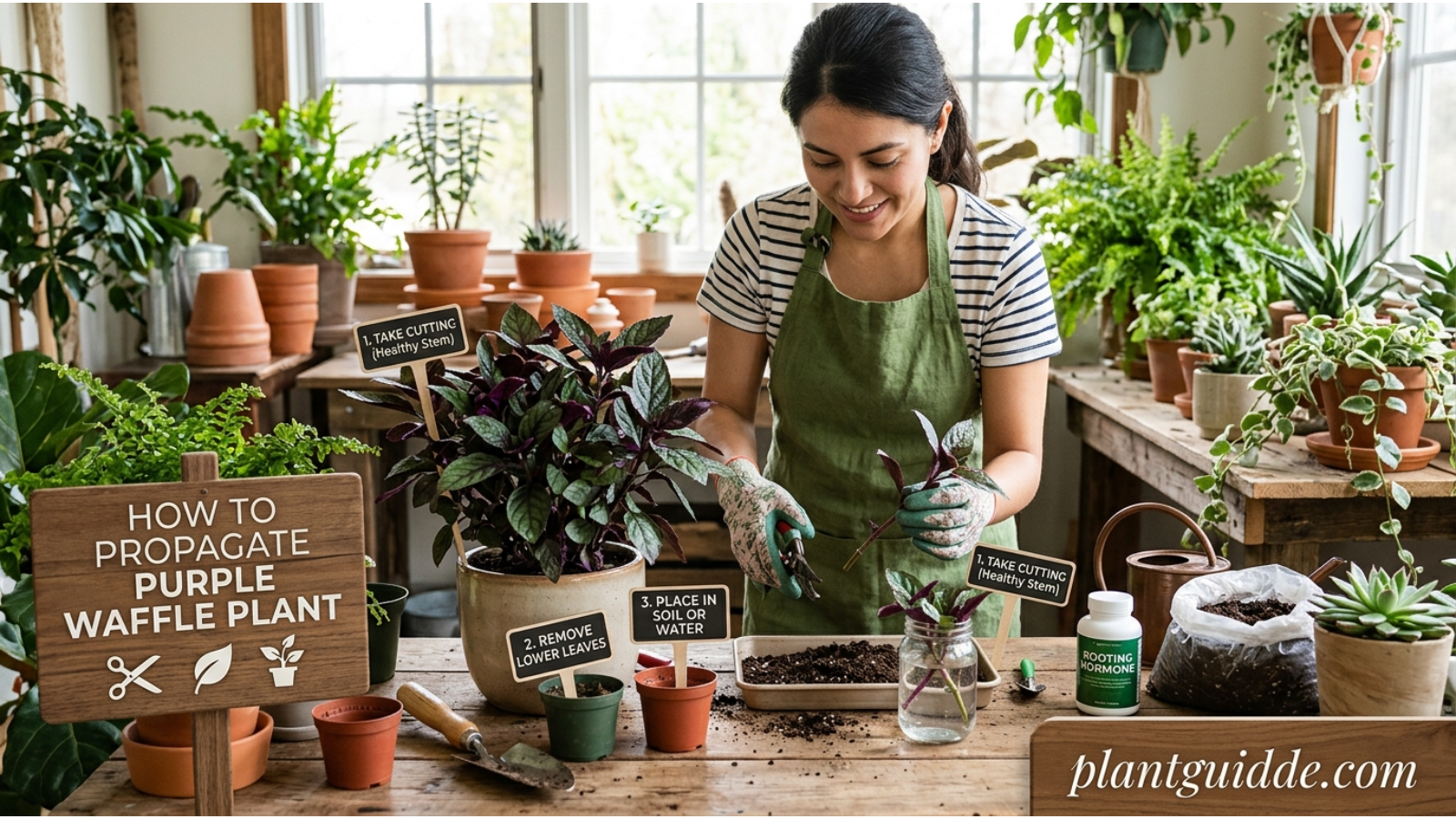
Purple waffle plants can be propagated from stem cuttings.
Propagation in water
Take a healthy stem cutting with several leaves. Remove the lower leaves so that the lower portion of the stem can sit in water without leaves being submerged.
Place the cutting in clean water and keep it in bright, indirect light. Change the water regularly and watch for root development.
Once a useful root system has formed, transfer the cutting into a suitable moist potting mix.
Propagation in soil
You can also place a prepared stem cutting directly into a lightly moist, well-draining propagation mix.
Keep the medium evenly moist rather than saturated. High humidity and warm conditions can help reduce moisture loss while roots are developing.
Practical observation: Smaller cuttings can lose water quickly before they have roots. A humid environment is therefore particularly useful during the early propagation stage.
Repotting a Purple Waffle Plant
Repot when the plant has genuinely outgrown its container rather than automatically repotting every year.
Signs that repotting may be useful include:
- Roots emerging from drainage holes
- Soil drying unusually quickly
- Roots tightly circling the root ball
- Water running through the pot unusually fast
- The plant becoming unstable in its container
Choose a pot only modestly larger than the current one. Moving a small plant into a very large container can leave a much larger volume of soil wet for longer, increasing the risk of root problems.
After repotting, water appropriately and place the plant back into bright, indirect light.
Common Purple Waffle Plant Problems
Purple waffle plant leaves turning yellow
Yellow leaves can have several causes, so avoid immediately assuming that the plant needs more fertilizer.
Possible causes include:
- Excessive watering
- Poor drainage
- Root stress
- Insufficient light
- Natural aging of older leaves
- Environmental stress
If several leaves are turning yellow and the soil remains wet for a long time, inspect the roots and reassess your watering and drainage.
Purple waffle plant leaves turning brown
Brown edges or patches often indicate environmental stress.
Common possibilities include:
- Very dry air
- Inconsistent watering
- Excessive direct sunlight
- Fertilizer buildup
- Root problems
Look at the pattern carefully. Crispy brown edges in a dry room suggest a different problem from soft, dark discoloration associated with chronically wet conditions.
Purple waffle plant leaves curling
Curling leaves can occur when the plant is losing water faster than the roots can supply it.
Check:
- Soil moisture
- Humidity
- Light intensity
- Temperature
- Nearby heating or cooling vents
If the soil is extremely dry, water thoroughly and monitor recovery. If the soil is already saturated, adding more water will not solve the underlying problem.
Purple waffle plant losing its purple color
If the foliage is becoming noticeably less purple or more green, evaluate the lighting first.
Insufficient light can reduce the intensity of foliage coloration and also lead to weaker growth.
Move the plant gradually toward a brighter position with filtered or indirect light rather than immediately placing it in strong direct sun.
Purple waffle plant wilting
Wilting does not automatically mean “water more.”
First check the soil.
Dry soil + wilted leaves: The plant may need water.
Wet soil + wilted leaves: The roots may be struggling to function properly because of excess moisture or poor aeration.
That simple distinction can prevent one of the most common houseplant mistakes: treating every wilted plant with more water.
Common Mistakes to Avoid
1. Watering on a fixed schedule
A calendar cannot account for changing room conditions. Check the soil and plant instead.
2. Using a pot without drainage
Even excellent watering technique cannot compensate for a container that traps excess water.
3. Putting it in harsh direct sunlight
Purple foliage can look especially attractive in bright light, but intense direct sun can scorch leaves.
4. Letting the soil become bone dry repeatedly
Severe drying can cause wilting and crispy foliage.
5. Keeping the plant constantly wet
Moist soil is not the same as saturated soil. Roots need access to oxygen.
6. Ignoring dry indoor air
A tropical plant may struggle when placed directly beside a heater or in an exceptionally dry room.
7. Overfertilizing
More fertilizer does not automatically mean faster or healthier growth. Excess salts can damage roots and foliage.
8. Pruning only after the plant becomes severely leggy
Regular pinching is easier than trying to reshape a neglected plant all at once.
Where Should You Place a Purple Waffle Plant Indoors?
A good location combines bright filtered light, warmth, moderate humidity, and protection from drafts.
Suitable locations may include:
- A bright bathroom with natural light
- A shelf near an east-facing window
- A plant stand near filtered western light
- A bright kitchen away from cooking heat
- A hanging planter in a warm room
Avoid placing it immediately beside a heating or cooling vent.
Image Suggestion: A realistic indoor purple waffle plant positioned beside a bright window, showing filtered light, a drainage pot, moist well-draining soil, and healthy purple-green foliage.
Is a Purple Waffle Plant Good for Beginners?
Yes, provided the beginner understands one important point: this is not a plant that enjoys extreme swings between drought and saturation.
It can be a rewarding houseplant because its foliage gives you useful visual feedback. If growth becomes sparse, examine the light. If leaves become crispy, investigate moisture and humidity. If the plant stays wet and begins yellowing, check drainage and the roots.
Instead of memorizing a strict watering schedule, learn to read those signals.
A Simple Weekly Purple Waffle Plant Routine
A few minutes each week can prevent many problems.
Check the soil: Make sure it is not becoming extremely dry or remaining saturated.
Inspect the foliage: Look for brown edges, yellowing, curling, pests, or unusual spots.
Check the light: Make sure nearby plants or seasonal changes have not significantly altered the amount of light reaching the leaves.
Look underneath the pot: Confirm that drainage holes are not blocked and that water is not collecting in the saucer.
Check growth: Healthy new leaves and compact stems are useful signs that the environment is working.
Prune when necessary: Pinch long stems before the plant becomes excessively leggy.
This routine is more useful than watering automatically every Monday or Wednesday.
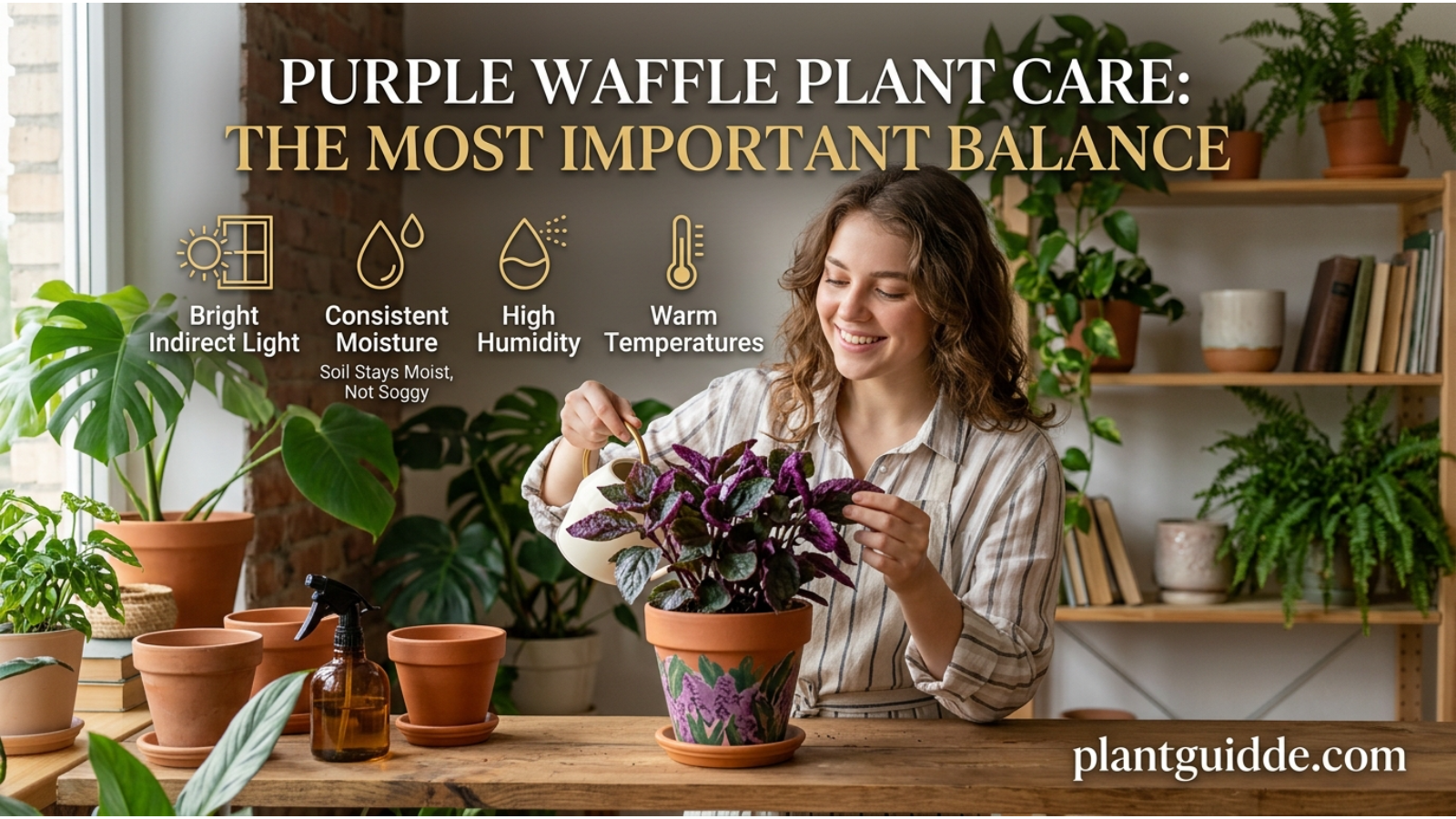
Purple Waffle Plant Care: The Most Important Balance
The best way to think about purple waffle plant care is as a balance between moisture, light, humidity, drainage, and airflow.
For example, a plant sitting in bright indirect light may use water much faster than the same plant in a dim room. A plant in dry air may lose moisture rapidly, while one in a humid bathroom may need watering less frequently.
That is why two purple waffle plants in different homes can need completely different watering schedules.
Instead of asking, “How often should I water it?” ask:
“What are the soil and environmental conditions telling me right now?”
That shift in approach is one of the most useful habits a houseplant grower can develop.
FAQs:
How often should I water a purple waffle plant?
Water when the potting mix has begun to dry but before the plant repeatedly reaches severe drought stress. The exact interval depends on light, temperature, humidity, pot size, and soil.
Does a purple waffle plant need direct sunlight?
Usually, bright indirect or filtered light is preferable. Strong direct sunlight can scorch the foliage, while very low light can cause weak growth and reduced coloration.
Why is my purple waffle plant turning green?
Insufficient light is one possible cause. Move the plant gradually to a brighter location with filtered light and observe the color of new growth.
Why are my purple waffle plant leaves turning brown?
Brown edges can result from dry air, inconsistent watering, excessive sunlight, fertilizer buildup, or root stress. Examine the soil and environment before changing your watering routine.
Can you grow a purple waffle plant from cuttings?
Yes. Healthy stem cuttings can be rooted in water or a suitable moist propagation medium. Warm temperatures, adequate humidity, and bright indirect light can support successful rooting.
Conclusion
Successful purple waffle plant care does not require a complicated routine. Give Hemigraphis alternata bright indirect light, lightly moist but well-drained soil, warm temperatures, reasonable humidity, and enough airflow, then adjust your routine according to how the plant responds.
If problems appear, diagnose the environment before reaching for fertilizer or watering again. A yellow plant may need better drainage, a faded plant may need more suitable light, and a wilted plant may be either too dry or suffering from overly wet roots.
The most practical next step is simple: check your plant’s light and soil moisture today, then make one small environmental adjustment rather than changing everything at once.

Asad Mumtaz is a dedicated plant enthusiast and gardening writer with a passion for helping people care for their plants successfully. He specializes in plant care guides, indoor gardening, and practical growing tips for all skill levels. His content focuses on making gardening simple, enjoyable, and rewarding. Through his work, Asad shares reliable advice to help readers create thriving green spaces.