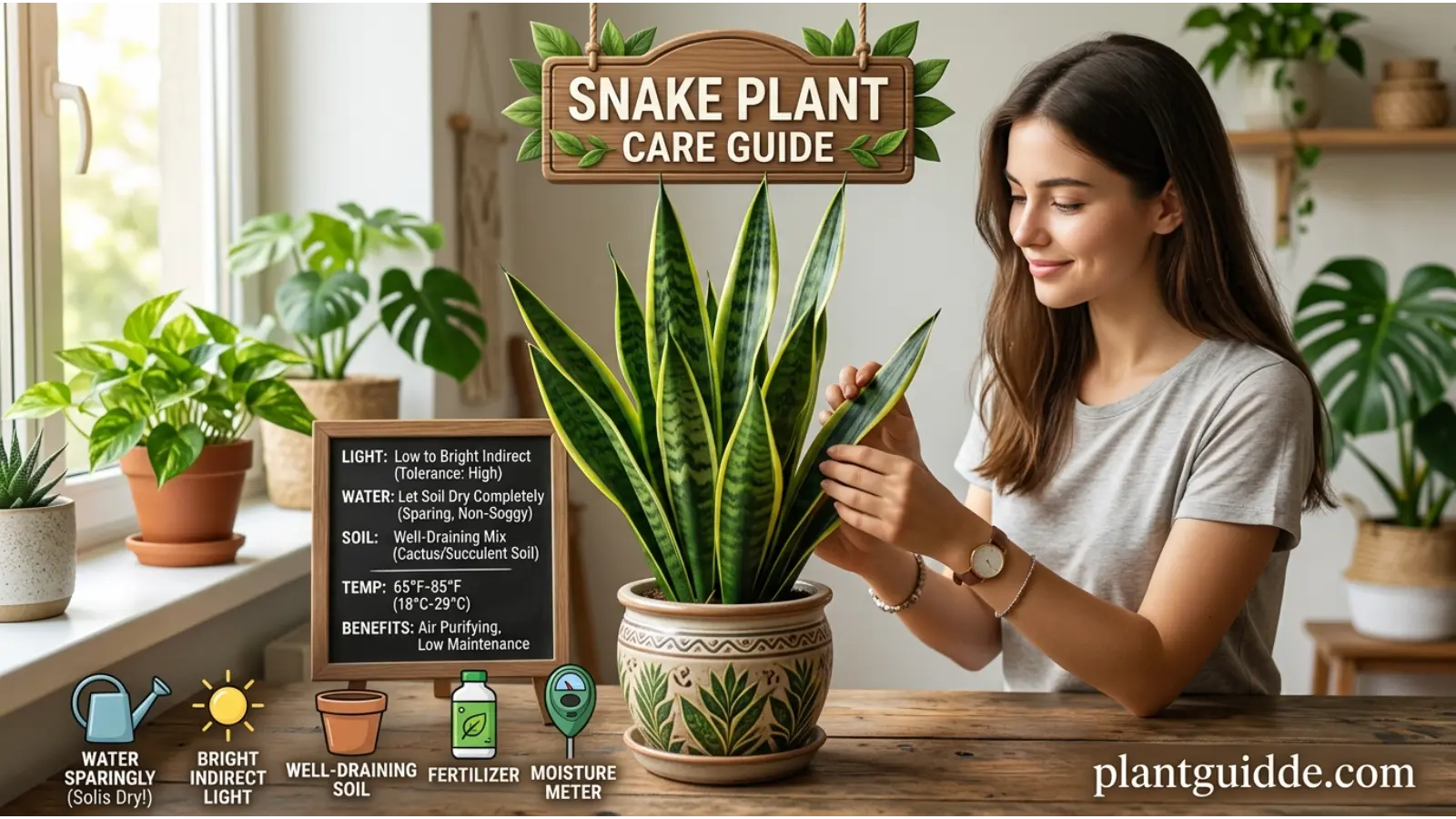
Care of a snake plant are popular houseplants because they have upright, architectural leaves and can tolerate a range of indoor conditions. They work well in bedrooms, offices, living rooms, and other spaces where a low-maintenance plant is desirable.
However, knowing how do you take care of a snake plant properly means understanding more than its reputation for surviving neglect. Although snake plants tolerate occasional missed waterings, they can struggle when their roots stay wet, their soil drains poorly, or their growing conditions change suddenly.
The key is to provide enough light for healthy growth, allow the soil to dry between waterings, and pay attention to changes in the leaves. With a few simple habits, you can keep your snake plant healthy and encourage steady growth without making plant care complicated.
Quick Answer
To take care of a snake plant, place it in bright, indirect light, use well-draining soil, and water only when the soil has dried out completely. Choose a pot with drainage holes, keep the plant in a warm indoor environment, and fertilize lightly during the growing season. Avoid overwatering, as consistently wet soil can cause root rot and yellow, soft leaves.
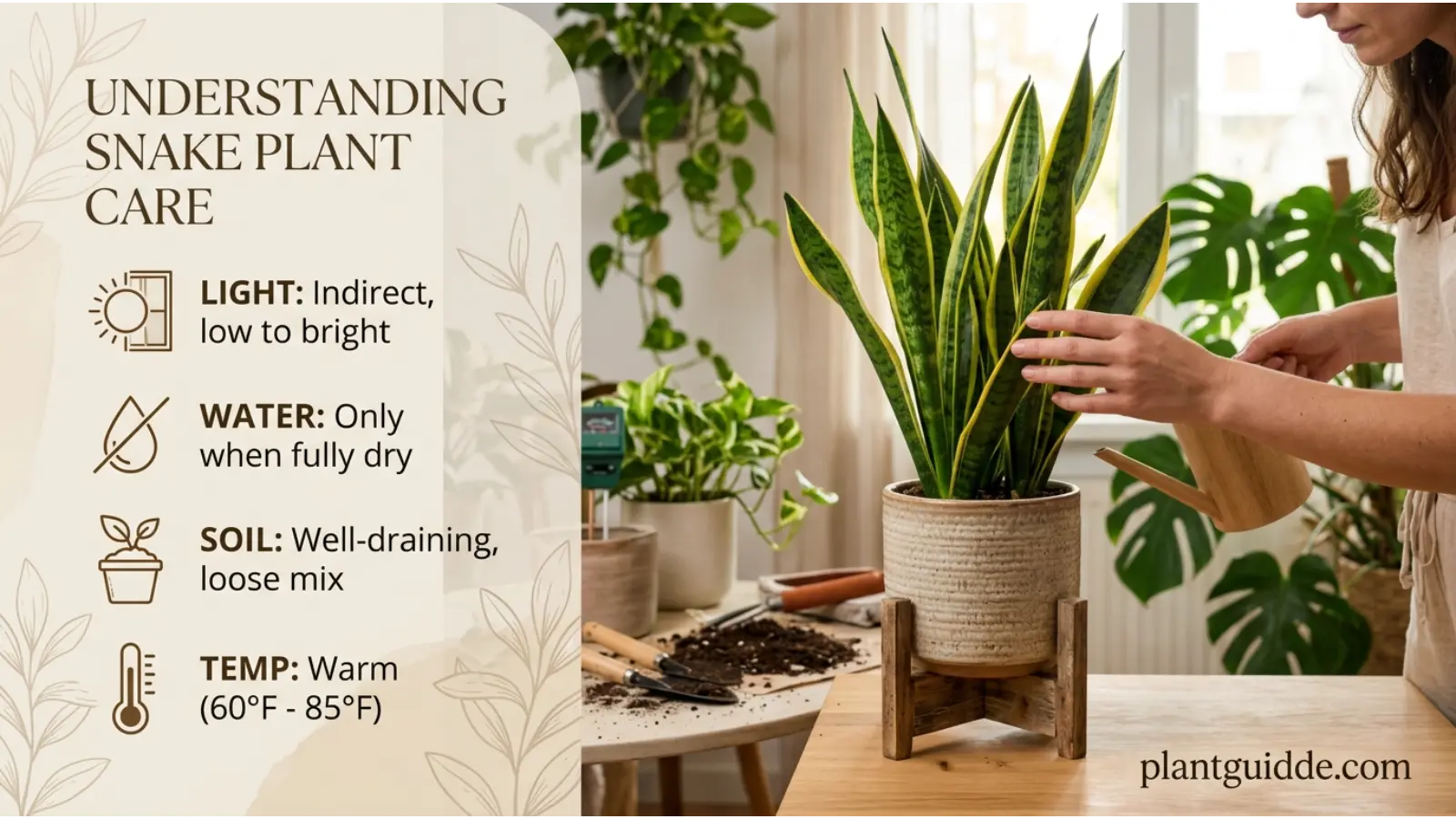
Understanding Snake Plant Care
Snake plants are commonly known as mother-in-law’s tongue. They were traditionally classified under the genus Sansevieria and are now included in the genus Dracaena. One of the most widely grown species is Dracaena trifasciata, which has stiff, sword-shaped leaves with green patterns and, in some varieties, yellow edges.
These plants store water in their thick leaves and underground rhizomes. This adaptation helps them tolerate dry periods, but it also means they are vulnerable to excessive watering.
Before changing your plant’s care routine, consider three important factors:
- Light: Brighter indirect light generally supports faster, healthier growth.
- Water: The roots need time to dry between thorough waterings.
- Soil: A loose, well-draining potting mix prevents water from lingering around the roots.
Getting these three conditions right prevents many common snake plant problems.
How Much Light Does a Snake Plant Need?
Snake plants adapt to different indoor lighting conditions, but the amount of light they receive affects their growth rate, leaf strength, and appearance.
Best lighting conditions
Bright, indirect light is usually ideal. A spot near an east-facing window or a short distance from a bright south- or west-facing window can work well, depending on the intensity of the sunlight.
Snake plants can also survive in lower-light rooms, although growth may slow considerably. Variegated varieties may lose some of their distinctive appearance or produce less vibrant new growth when light is insufficient.
For the best results:
- Place the plant near a window with filtered sunlight.
- Rotate the pot occasionally if growth leans toward one direction.
- Keep leaves away from intense midday or afternoon sunlight until the plant has adjusted.
- If the room is naturally dark, consider using a suitable grow light.
Can a snake plant grow without sunlight?
A snake plant can survive without direct sunlight, but it still needs light to grow. An interior room with some natural light may be sufficient, while a windowless room usually requires artificial lighting.
Practical tip: If your snake plant has remained unchanged for months, produces very little new growth, or develops weak, stretched leaves, assess its lighting before increasing fertilizer or watering.
How Often Should You Water a Snake Plant?
Watering is one of the most important parts of snake plant care. Overwatering is particularly dangerous because the roots need oxygen, and prolonged moisture can cause them to decay.
There is no universal watering schedule. A plant in a warm, bright room may dry much faster than one in a cool, low-light space.
How to tell when your snake plant needs water
Use these steps before watering:
- Check the soil: Insert a finger several inches into the potting mix or use a moisture meter. Make sure the soil is dry well below the surface.
- Consider the environment: Cooler temperatures, low light, and a large pot can keep the soil wet for longer.
- Water thoroughly: When the soil has dried, water evenly until excess water drains from the bottom.
- Empty the saucer: Do not leave the pot sitting in collected water.
- Check again later: Wait until the soil dries before watering again.
A common mistake is adding small amounts of water every few days. This can keep parts of the root zone continually damp without thoroughly hydrating the entire soil mixture when watering is actually needed.
How often should you water in different seasons?
| Season or condition | Watering guidance |
|---|---|
| Spring and summer | Check the soil regularly; growth and drying may be faster. |
| Fall | Reduce watering if the soil takes longer to dry. |
| Winter | Water less frequently when growth slows and indoor conditions are cooler. |
| Bright, warm room | The soil may dry sooner, so check more often. |
| Cool, low-light room | Allow extra time for the soil to dry. |
These are general patterns, not a fixed calendar. Always let soil moisture guide your decision.
What happens if you overwater a snake plant?
Common warning signs include yellowing leaves, soft or mushy leaf bases, a persistently wet potting mix, and an unpleasant smell from the soil.
If you suspect root rot, remove the plant from its pot and inspect the roots. Healthy roots are generally firm, while rotten roots may be brown or black, soft, and unpleasant-smelling. Trim damaged roots with clean tools and repot the plant in fresh, well-draining soil. If the base of a leaf or the rhizome has become extensively rotten, recovery may be difficult.
What Is the Best Soil for a Snake Plant?
Snake plants need a potting mix that allows water to drain quickly while retaining enough moisture for the roots to absorb what they need.
Ordinary potting soil can work if it drains well, but dense mixes that remain wet for long periods are a poor choice.
Recommended soil mixture
A practical homemade mixture can include:
- Two parts standard indoor potting mix.
- One part perlite or pumice.
- One part coarse horticultural material suitable for improving drainage, such as appropriately sized bark or another airy mineral component.
The exact proportions are flexible. The goal is a loose mix that does not become compacted or waterlogged.
A commercial cactus and succulent mix is another convenient option. If it remains wet for too long in your environment, improve its drainage with additional perlite or pumice.
Important: Drainage holes are just as important as the soil mixture. Even a well-draining mix can cause problems if excess water has nowhere to escape.
Which Pot Is Best for a Snake Plant?
Choose a pot with drainage holes and a size appropriate for the root system. Snake plants generally tolerate being slightly root-bound, so moving them into a much larger container is rarely necessary.
An oversized pot contains more soil than the roots can use, which can cause the mixture to remain wet for longer.
Terracotta pots can be helpful because their porous sides allow moisture to evaporate more readily. Plastic and glazed ceramic pots can also work well, but you may need to wait longer between waterings.
Consider repotting when:
- Roots are tightly crowded or growing through the drainage holes.
- The pot has cracked or become unstable.
- The soil has deteriorated or drains poorly.
- The plant’s rhizomes have filled most of the container.
When repotting, select a pot only slightly wider than the root ball and use fresh, well-draining soil. A heavy plant may also benefit from a sturdy container that will not tip over easily.
What Temperature and Humidity Do Snake Plants Prefer?
Snake plants generally do well at normal indoor temperatures. A comfortable range of approximately 65–85°F (18–29°C) is suitable for many homes.
Protect them from cold drafts, frost, and sudden temperature changes. Cold exposure can damage the leaves, especially when the plant is also sitting in wet soil.
Do snake plants need high humidity?
No. Snake plants are relatively tolerant of ordinary indoor humidity and usually do not require a humidifier.
You generally do not need to mist their leaves. Misting provides little lasting increase in humidity and can leave moisture sitting on the foliage without improving root health.
Keep the plant away from cold windows during winter and avoid placing it directly against heating vents that create repeated blasts of hot, dry air.
Should You Fertilize a Snake Plant?
Snake plants are not heavy feeders. Too much fertilizer can damage roots or contribute to a buildup of mineral salts in the soil.
During active growth in spring and summer, you can apply a balanced houseplant fertilizer diluted according to the product label. For a conservative approach, use it less frequently than you would for a fast-growing foliage plant.
Keep these points in mind:
- Do not fertilize a severely stressed or rotting plant.
- Avoid routine feeding during winter if growth has slowed.
- Never apply concentrated fertilizer to dry roots.
- Do not expect fertilizer to solve problems caused by insufficient light or poor drainage.
If your snake plant is growing well without fertilizer, there is no need to increase feeding simply because the calendar says it is time.
How to Repot a Snake Plant Correctly
Repotting is straightforward when the plant is healthy and the soil drains properly. The best time is generally during spring or early summer, when the plant can resume active growth.
Follow these steps:
- Choose a pot with drainage holes that is slightly larger than the current root system.
- Remove the plant carefully, supporting the base rather than pulling hard on individual leaves.
- Inspect the roots and rhizomes for soft, discolored, or rotten sections.
- Trim damaged tissue with clean cutting tools if necessary.
- Place the plant in fresh, well-draining potting mix at approximately its previous planting depth.
- Settle the soil gently around the roots without compacting it tightly.
- Water appropriately for the condition of the roots and soil, then let excess water drain completely.
If you removed rotten roots, avoid immediately saturating the new soil. Allow damaged areas to dry as appropriate before resuming careful watering.
A snake plant does not need repotting every year. Repot when its roots, rhizomes, pot condition, or soil quality indicate that it is necessary.

How to Prune and Maintain a Snake Plant
Snake plants generally require little pruning. Most maintenance involves removing damaged leaves and keeping the plant clean.
Use clean, sharp scissors or pruning shears to remove leaves that are completely dead, severely damaged, or rotting. Cut close to the soil line without damaging the rhizome or neighboring leaves.
Brown tips do not always mean the entire leaf needs removal. If only the tip is brown and the rest of the leaf is healthy, you can trim the damaged portion to improve its appearance. Follow the leaf’s natural shape, but understand that the cut edge will not turn green again.
Wipe dusty leaves gently with a damp cloth. Clean foliage makes it easier to inspect for pests and notice changes in color or texture.
How to Propagate a Snake Plant
You can propagate a snake plant through division or leaf cuttings. Division is usually the better choice when you want a new plant that retains the original variety’s leaf pattern.
Propagation by division
Division separates established plant sections that have their own roots and rhizomes.
- Remove the plant from its pot.
- Identify natural sections with healthy roots and growing points.
- Separate the sections carefully, using a clean knife if necessary.
- Plant each division in an appropriately sized container with drainage holes.
- Use a well-draining mix and provide bright, indirect light while the divisions establish.
Avoid dividing a weak or severely stressed plant unless necessary to remove diseased tissue.
Propagation from leaf cuttings
Healthy leaves can be cut into sections and rooted in a suitable propagation medium. Allow cut surfaces to dry before placing them in the medium, and avoid keeping the medium saturated.
However, there is an important limitation: leaf cuttings from some variegated snake plants may produce offspring that lose the original yellow or other distinctive leaf margins. Division is preferable when preserving the parent plant’s appearance matters.
Common Snake Plant Problems and How to Fix Them
Changes in leaf color, texture, and growth often provide clues about what needs attention. Look at the entire growing environment rather than treating one symptom as proof of a single problem.
| Symptom | Possible cause | What to do |
|---|---|---|
| Yellow leaves | Overwatering, poor drainage, or natural aging of an older leaf | Check soil moisture and inspect the roots if the problem continues. |
| Soft or mushy leaves | Root or rhizome rot, often associated with excess moisture | Remove the plant from wet soil, inspect damaged tissue, and repot if needed. |
| Wrinkled or thin leaves | Prolonged dryness or damaged roots that cannot absorb water | Check soil moisture and root health before watering. |
| Brown leaf tips | Physical damage, inconsistent moisture, or mineral and fertilizer buildup | Review watering practices and fertilizer use; trim damaged tips if desired. |
| Drooping or leaning leaves | Physical damage, weak light, root problems, or an unstable plant | Check the base, roots, light level, and pot stability. |
| Slow growth | Low light, seasonal dormancy, or limited growing conditions | Improve indirect light if needed and allow time for new growth. |
| Pale or faded patterns | Insufficient light or other growing stress | Move the plant gradually to brighter indirect light. |
Why are snake plant leaves falling over?
If leaves become soft near the soil line, inspect the roots and rhizomes for rot. If they remain firm but lean outward, the plant may be crowded, unevenly lit, physically damaged, or top-heavy.
Do not automatically add water when a leaf droops. A plant with rotten roots may droop because it cannot absorb water even though the soil is already wet.
Why does a snake plant have brown tips?
Brown tips can develop for several reasons, including inconsistent watering, fertilizer or salt accumulation, physical damage, or unsuitable growing conditions.
Check whether the soil drains well, whether the pot has drainage holes, and whether fertilizer is being used too frequently. If the damage is limited to a few tips and new growth looks healthy, drastic changes to the care routine may not be necessary.
Common Snake Plant Care Mistakes to Avoid
Even a resilient snake plant can decline when several small mistakes occur together.
1. Watering on a fixed schedule. A weekly routine may work in one home but keep the soil too wet in another. Check the soil before watering.
2. Using a pot without drainage holes. Excess water can accumulate around the roots, increasing the risk of rot.
3. Choosing a pot that is too large. Extra soil may stay wet long after the root zone has received enough moisture.
4. Assuming low light is ideal. Snake plants tolerate low light, but they generally grow better with sufficient indirect light.
5. Overusing fertilizer. More fertilizer does not necessarily mean faster growth and may damage the roots.
6. Ignoring early warning signs. A soft leaf base or persistent wet soil deserves attention before the entire plant deteriorates.
7. Making several changes at once. If a plant looks unhealthy, assess its soil, roots, light, and recent care first. Changing everything simultaneously makes it harder to identify the actual problem.
A Simple Snake Plant Care Routine
You do not need to inspect your snake plant every day. A quick, consistent check is more useful than frequent unnecessary watering.
- Every week or two: Look for yellowing leaves, pests, soft areas, and other visible changes.
- Before watering: Check the soil several inches below the surface and consider how quickly the pot has been drying.
- During spring and summer: Watch for new growth and fertilize lightly when appropriate.
- During winter: Reduce watering as needed if the soil dries more slowly.
- Every few months: Check whether the plant is leaning, the pot is stable, and the soil still drains properly.
- When repotting becomes necessary: Inspect the roots and rhizomes and replace deteriorated soil.
This routine gives you a practical way to monitor plant health without disturbing the roots or watering unnecessarily.
Pet safety note: Snake plants can cause gastrointestinal irritation if cats or dogs chew or ingest them. Keep the plant out of reach of pets and seek veterinary advice if a pet eats part of it and develops concerning symptoms.
Image Suggestion: A realistic snake plant care infographic showing the ideal bright-indirect-light location, a well-draining potting mix, drainage holes, a dry-soil check before watering, and healthy versus overwatered leaves. Include the website branding “plantguidde.com” in the bottom-right corner.

FAQs:
How often should you water a snake plant indoors?
Water when the potting mix has dried out completely or nearly completely throughout the root zone. The interval depends on light, temperature, pot size, soil, and season, so check the soil instead of following a fixed weekly schedule.
Do snake plants need direct sunlight?
No. Bright, indirect light is generally ideal. Snake plants can tolerate some gentle direct sunlight if they are gradually acclimated, but intense sunlight can scorch leaves, particularly when the plant has been growing in a darker location.
Why is my snake plant turning yellow?
Yellow leaves may indicate overwatering, poor drainage, root rot, or natural aging. Check whether the soil remains wet and inspect the roots if multiple leaves turn yellow or the leaf bases become soft.
Should I mist my snake plant?
Usually not. Snake plants tolerate normal household humidity, and misting does not provide a lasting increase in humidity. Focus instead on suitable light, well-draining soil, and proper watering.
How do I make my snake plant grow faster?
Provide brighter indirect light, maintain a well-draining potting mix, water when the soil dries, and fertilize lightly during active growth. Avoid excessive watering or oversized pots, since these can damage roots and slow growth rather than improve it.
Conclusion
The best way to take care of a snake plant is to provide enough indirect light, use well-draining soil, and water only when the root zone has dried sufficiently.
A pot with drainage holes, moderate feeding, and occasional checks for leaf or root problems will help the plant remain healthy.
Start by checking your plant’s light and soil moisture before changing anything else. Once you understand how quickly its pot dries and how its leaves respond, snake plant care becomes simpler, more predictable, and easier to maintain over time.

Asad Mumtaz is a dedicated plant enthusiast and gardening writer with a passion for helping people care for their plants successfully. He specializes in plant care guides, indoor gardening, and practical growing tips for all skill levels. His content focuses on making gardening simple, enjoyable, and rewarding. Through his work, Asad shares reliable advice to help readers create thriving green spaces.