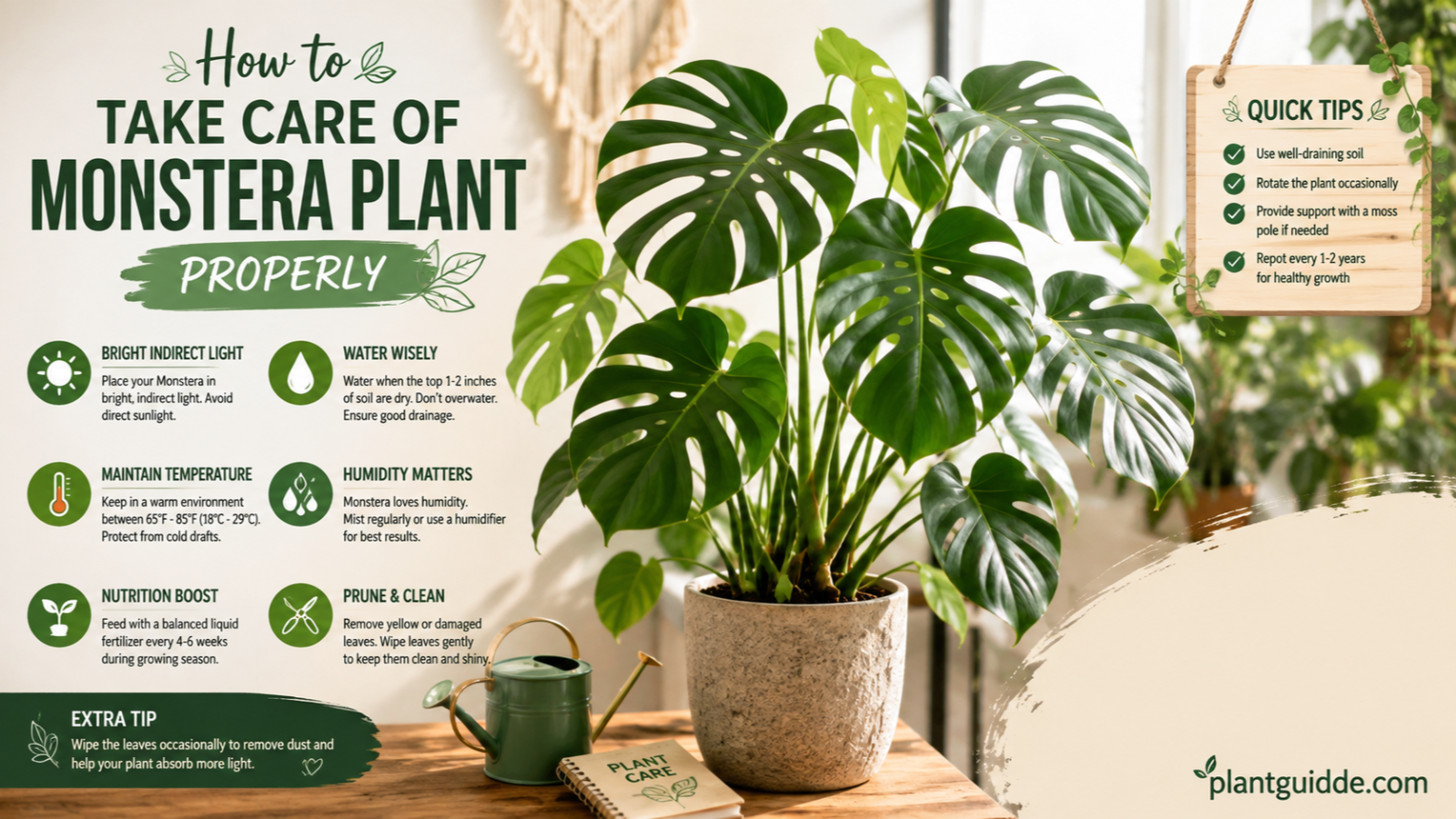
Few houseplants change the appearance of a room as dramatically as a healthy Monstera. Its large, glossy leaves, natural splits, and tropical growth habit make it popular with beginners and experienced indoor gardeners alike. how to take care of monstera plant.
But learning how to take care of Monstera plant properly involves more than placing it near a window and watering it once a week. Monsteras respond strongly to their growing conditions.
Too little light can lead to slow, stretched growth and fewer characteristic leaf openings, while excessive direct sunlight can scorch the foliage. Poor drainage and frequent watering can create an even bigger problem by keeping the roots wet for too long.
Quick Answer
To take care of a Monstera plant, place it in bright, indirect light, use a loose, well-draining potting mix, and water thoroughly when the upper portion of the soil has dried. Keep it warm and moderately to highly humid, provide a moss pole or other support as it matures, and avoid leaving the roots sitting in water. Clean the leaves regularly and adjust watering according to light, temperature, season, and pot size rather than following a rigid schedule.
What Is a Monstera Plant?
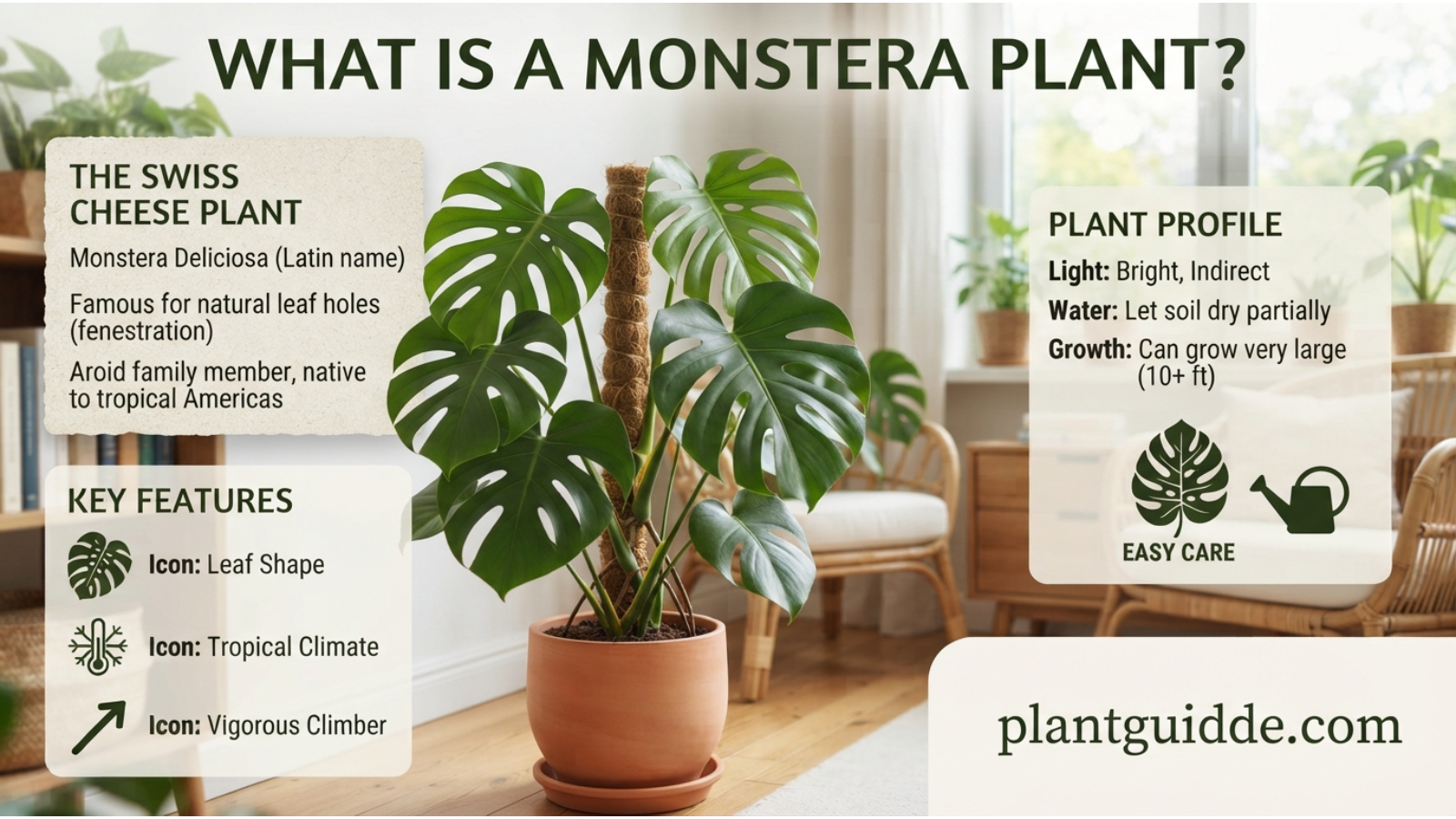
The plant most people mean when they say “Monstera” is Monstera deliciosa, commonly called the Swiss cheese plant. It is a tropical climbing plant in the Araceae family and is native to areas from Mexico to Panama. In its natural environment, it can climb trees using aerial roots and become considerably larger than the typical indoor specimen.
The familiar holes and splits in mature leaves are called fenestrations. Young Monstera leaves may initially be mostly solid, so a new plant without dramatic holes is not necessarily unhealthy.
In fact, expecting every young Monstera to immediately produce huge split leaves is one of the common misconceptions surrounding this plant. Light, maturity, growing conditions, and the plant’s natural development all influence leaf appearance. The RHS notes that younger plants and plants grown in poor light tend to develop fewer holes.
Monstera is also a climbing plant rather than simply a large leafy shrub. Understanding that growth habit becomes important when deciding where to place it and whether to add a moss pole, trellis, or another sturdy support.
Give Your Monstera Bright, Indirect Light
Light is one of the most important factors affecting Monstera growth.
A good location is usually bright enough to cast a noticeable shadow but protected from harsh, prolonged direct sunlight. An east-facing window can work particularly well, while a bright south- or west-facing location may require a sheer curtain or some distance from the glass.
Monsteras naturally grow beneath or among taller vegetation, so they are adapted to bright but filtered conditions. The RHS recommends bright, indirect light for indoor Monstera, while North Carolina Extension describes its preferred conditions as moderate brightness rather than direct sun.
How to tell if the light is wrong
Too little light may cause:
- Slow growth
- Long spaces between leaves
- Smaller new leaves
- Fewer or less-developed fenestrations
- Growth leaning toward the window
Too much intense direct sun may cause:
- Pale or bleached patches
- Brown, crispy areas
- Scorched leaf surfaces
A practical approach is to move the plant gradually if it needs more light rather than suddenly placing it in strong afternoon sun.
What about variegated Monstera?
Variegated cultivars generally need more light than dark-green forms because portions of their leaves contain less chlorophyll. However, their white or cream sections can also be particularly vulnerable to sunburn.
For a variegated Monstera, prioritize very bright filtered light, rather than assuming more direct sun is always better.
Water According to the Soil, Not the Calendar
One of the most important lessons in Monstera care is to stop thinking in terms of “water every seven days.”
Your plant may need water more frequently during periods of strong growth, warmth, and bright light and less frequently during cool, darker periods.
The RHS recommends allowing the growing medium to dry before watering and emphasizes thorough watering rather than frequent small amounts. North Carolina Extension recommends watering thoroughly and allowing roughly the upper quarter to one-third of the soil to dry before watering again.
A simple Monstera watering method
- Check the upper portion of the potting mix with your finger.
- Feel whether it has dried rather than relying only on the appearance of the surface.
- If the appropriate portion of the mix is dry, water thoroughly.
- Allow excess water to drain from the bottom.
- Empty standing water from the saucer or decorative container.
- Wait until the soil has dried sufficiently before watering again.
The exact interval can vary substantially between homes.
A Monstera in a small pot near a bright window may dry much faster than a large plant in a low-light room.
Why overwatering is so damaging
Roots require oxygen as well as water. When soil remains saturated for extended periods, air spaces can become filled with water, reducing the oxygen available around the roots. Poor drainage and prolonged standing water increase the risk of root problems.
This is why “the leaves look thirsty” is not always a reason to immediately add more water.
If the soil is already wet, adding more water can make the underlying problem worse.
Use a Loose, Well-Draining Monstera Soil Mix
Monstera needs moisture, but it should not live in dense, permanently wet soil.
A suitable potting mix should hold enough moisture for the roots while allowing excess water and air to move through the root zone.
A practical homemade mixture can include:
- Quality indoor potting mix
- Orchid bark
- Perlite or pumice
- A smaller amount of moisture-retentive organic material if needed
The exact recipe is less important than the result: the mix should drain readily without becoming hydrophobic or collapsing into a dense mass.
North Carolina Extension recommends good drainage and high-organic-matter soil, while the RHS recommends a loam-based, peat-free potting compost that remains moist but well drained.
A common mistake
Adding a thick layer of rocks or gravel to the bottom of a pot does not solve poor drainage.
The better solution is to use a container with an actual drainage hole and a potting medium that allows water to move through the root zone.
Choose a Pot With Good Drainage
A Monstera container should have at least one effective drainage hole.
The decorative appearance of a pot matters much less than what happens beneath the soil.
When choosing a new container:
- Avoid dramatically oversized pots.
- Make sure water can escape.
- Select a pot only moderately larger than the current root system when repotting.
- Never allow the plant to sit permanently in collected water.
An oversized container can retain moisture for longer because there is more unused soil around the roots. This can make watering mistakes harder to recover from.
Image Suggestion: Cutaway diagram of a Monstera pot showing drainage holes, airy soil, roots, and excess water draining away.
Keep Humidity Reasonably High
Monsteras come from tropical environments and generally perform best in warm, humid conditions. The RHS describes Monstera as enjoying humid air, while North Carolina Extension recommends high humidity and suggests measures such as a humidifier or pebble tray for dry interiors.
However, you do not need to turn your entire home into a rainforest.
If your indoor air is dry, particularly during periods of heating or air conditioning, consider:
- Running a room humidifier
- Grouping compatible tropical plants
- Keeping the plant away from heating vents
- Avoiding extremely dry drafts
- Monitoring humidity with a simple hygrometer
Does misting work?
Misting can temporarily increase moisture directly around the leaves, but it is not a substitute for maintaining appropriate room humidity.
If the surrounding air remains dry, the effect of a quick mist is short-lived.
For a consistently dry room, a humidifier is generally a more controllable solution.
Keep Temperatures Warm and Stable
Monstera is a tropical plant, so it performs best in warm indoor conditions.
North Carolina Extension gives an approximate preferred range of 60–85°F (16–29°C), while the RHS describes typical indoor growing conditions around 18–25°C (65–77°F).
The practical takeaway is simple:
Keep your Monstera warm, and protect it from sudden cold conditions.
Avoid placing it directly beside:
- Cold drafts
- Frequently opened exterior doors
- Strong air-conditioning outlets
- Heating appliances
- Very hot windows where foliage can overheat
Stable conditions are generally easier for the plant to handle than repeated temperature swings.
Give Your Monstera Something to Climb
This is one of the most overlooked parts of Monstera care.
Monstera deliciosa is naturally a climbing plant. As it matures, its stems and leaves can become heavy, and a plant left unsupported may sprawl across furniture or develop awkward growth.
A moss pole, coir pole, trellis, or sturdy stake can provide useful structure. North Carolina Extension specifically recommends sturdy support because the stems can become difficult to manage as the plant grows.
How to position the support
Place the support close to the main climbing stem rather than simply pushing it into an unrelated part of the pot.
You can loosely attach the stem with soft plant ties.
Do not tightly bind the stem. The goal is to guide the plant, not constrict it.
What about aerial roots?
Aerial roots are normal.
They help the plant interact with its climbing environment and should not automatically be treated as a problem.
You can guide them toward a support or leave them alone if they are not causing an issue.
Clean the Leaves Regularly
Large Monstera leaves collect dust surprisingly quickly.
A layer of dust can interfere with the clean surface of the foliage and makes it harder to notice pests or early signs of damage.
Every few weeks, gently wipe the leaves with a clean, damp cloth.
Avoid aggressive rubbing, abrasive cleaners, or products designed to create artificial leaf shine.
Cleaning also gives you an opportunity to inspect:
- Leaf undersides
- Petioles
- New growth
- Leaf axils
- Aerial roots
- Stems
North Carolina Extension specifically recommends wiping dust from Monstera leaves regularly.
Fertilize During Active Growth
A Monstera needs nutrients to produce new leaves and maintain vigorous growth, but more fertilizer does not automatically mean larger leaves.
During active growth, a balanced houseplant fertilizer can be used according to the product’s directions. The RHS recommends monthly balanced liquid fertilizer during active growth.
A sensible approach is:
- Fertilize primarily during active growth.
- Follow the label dilution.
- Avoid repeatedly applying concentrated fertilizer.
- Reduce or stop feeding when growth naturally slows.
- Water appropriately rather than using fertilizer to compensate for poor growing conditions.
If a Monstera is struggling because it has inadequate light or damaged roots, fertilizer is unlikely to solve the underlying problem.
Repot Your Monstera When It Actually Needs It
You do not need to repot a Monstera simply because a certain amount of time has passed.
Repot when there is a practical reason.
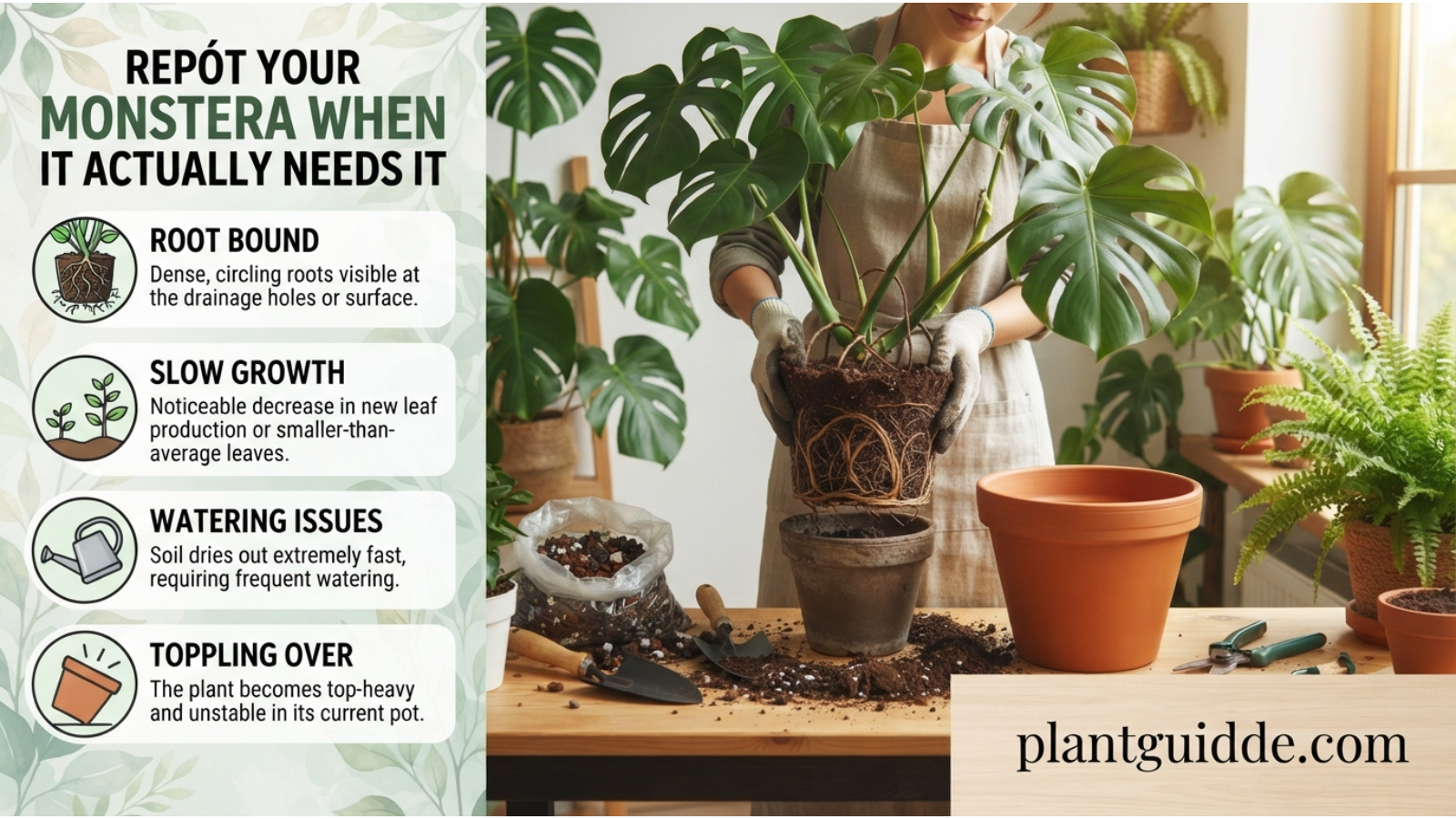
Signs your Monstera may need repotting
Look for:
- Roots emerging heavily from drainage holes
- The root ball becoming extremely compact
- Water running through the pot unusually quickly
- Growth slowing despite appropriate light and care
- The plant becoming unstable in its current container
- Potting mix breaking down or staying wet for too long
Choose a new container only modestly larger than the previous one.
Going from a small pot directly into a huge container can make moisture management more difficult.
Spring is often a convenient time for repotting and other maintenance, particularly when the plant is entering stronger growth. North Carolina Extension also recommends pruning or repotting in spring when needed.
Prune With a Purpose
Pruning is not necessary simply to make a Monstera “healthier.”
Instead, prune when you want to:
- Remove damaged or dead foliage
- Control size
- Improve the plant’s shape
- Remove unhealthy sections
- Take cuttings for propagation
Use clean, sharp tools and make deliberate cuts.
Avoid repeatedly removing healthy leaves just because they are older. A healthy mature leaf is still contributing to the plant.
How to Encourage Bigger Monstera Leaves
Large Monstera leaves are usually the result of maturity plus good growing conditions, not one secret fertilizer or trick.
Focus on:
- Adequate bright, indirect light
- Consistent watering without prolonged saturation
- Healthy roots
- Warm temperatures
- Suitable humidity
- Nutrient availability
- A climbing support
- Time
A support structure is particularly useful because Monstera’s natural climbing habit is associated with mature growth.
Why does my Monstera have no holes?
Don’t assume the plant is unhealthy.
Young Monstera leaves can be mostly solid, and poor light can also reduce fenestration. Providing stronger filtered light and allowing the plant to mature can help, but you cannot force every new leaf to develop dramatic holes overnight.
Monstera Care Throughout the Seasons
Your Monstera’s needs change with its environment.
| Season | What to Watch |
|---|---|
| Spring | Increasing growth may mean more frequent watering and feeding |
| Summer | Bright light and warmth can increase water use; protect leaves from intense direct sun |
| Autumn | Growth may gradually slow, so check soil before watering |
| Winter | Lower light and cooler temperatures usually mean slower drying and less frequent watering |
The important point is that seasonal care should be based on actual growing conditions rather than a fixed calendar.
A plant in a warm, bright room may continue growing during winter, while one in a cool, dim room may slow considerably.
How to Take Care of a Variegated Monstera
Variegated Monsteras such as Monstera deliciosa ‘Variegata’ and ‘Thai Constellation’ need slightly different attention.
Because portions of their leaves have less chlorophyll, they generally benefit from strong, bright indirect light. However, the pale portions are also more vulnerable to direct-sun damage.
The RHS recommends bright indirect light for variegated Monstera and notes that the lighter leaf areas can be especially susceptible to scorching.
For variegated plants:
- Prioritize bright filtered light.
- Avoid harsh afternoon sun directly on the foliage.
- Do not compensate for low light with excessive fertilizer.
- Be especially careful with overwatering.
- Monitor new growth for changes in variegation.
A variegated Monstera may also grow more slowly than a vigorous all-green plant, so patience matters.
Monstera Problems: What the Leaves Are Telling You
The appearance of a Monstera leaf can provide useful clues, but symptoms should never be interpreted in isolation.
Brown Leaf Tips
Possible causes include:
- Dry air
- Inconsistent watering
- Excessive fertilizer salts
- Root problems
- Environmental stress
Start by checking the soil moisture and drainage rather than immediately increasing watering.
Take Care of Monstera the soil is already staying wet, adding more water could make the situation worse.
Dry indoor air can also contribute to brown edges, particularly when the plant is close to radiators or other heat sources.
Yellow Leaves
A yellow leaf does not automatically mean the plant needs fertilizer.
Consider:
- Is the soil remaining wet for a long time?
- Is the pot draining properly?
- Is the plant receiving enough light?
- Is the yellowing limited to one old leaf?
- Is new growth also affected?
Older leaves occasionally yellow as part of normal aging. Widespread yellowing combined with consistently wet soil is more concerning.
Curling Leaves
Curling can occur when the plant is experiencing water stress or unfavorable environmental conditions.
Check:
- Soil moisture
- Humidity
- Temperature
- Root condition
- Recent changes in light exposure
Do not assume curling automatically means “water immediately.”
Drooping Leaves
A drooping Monstera can be thirsty, but drooping can also occur when roots are stressed.
Check the soil first.
Take Care of Monstera the soil is dry, thorough watering may be appropriate.
Take Care of Monstera the soil is saturated, investigate drainage and root health instead of adding more water.
Brown or Bleached Patches
Sudden brown, crispy or bleached patches on the side facing a bright window may indicate excessive direct sunlight.
Move the plant farther from the window or filter the light rather than cutting off every damaged leaf immediately.
Common Monstera Care Mistakes
Mistake 1: Watering on a Fixed Schedule
“Every Sunday” sounds simple, but indoor conditions change.
Better approach: Check the soil before watering.
Mistake 2: Keeping the Soil Permanently Wet
Monstera likes moisture but does not want waterlogged roots.
Better approach: Use a well-draining mix and allow the appropriate upper portion of the soil to dry between thorough waterings.
Mistake 3: Putting It in Harsh Direct Sun
Bright light is good; intense unfiltered sun can scorch leaves.
Better approach: Use bright, filtered or indirect light.
Mistake 4: Giving a Huge Pot to a Small Plant
More soil does not automatically mean more growth.
Better approach: Increase pot size gradually.
Mistake 5: Cutting Off Every Aerial Root
Aerial roots are a normal part of Monstera’s climbing biology.
Better approach: Guide them toward support when practical.
Mistake 6: Expecting Holes on Every New Leaf
Young plants often produce more solid leaves.
Better approach: Focus on maturity, sufficient light, and overall plant health.
Mistake 7: Using Fertilizer to Fix Poor Light
Fertilizer cannot compensate for insufficient light.
Better approach: Correct environmental problems first.
A Simple Weekly Monstera Care Check
You do not need to spend hours caring for your Monstera.
Once a week, perform a quick inspection:
Check the soil
Is the upper portion dry enough to need water?
Check the leaves
Look for yellowing, browning, curling, spots, or unusual changes.
Check for pests
Inspect leaf undersides and stems.
Check the support
Make sure the plant is growing securely rather than pulling against its ties.
Check the light
Has the plant shifted away from its original position, or has the seasonal sunlight changed?
Check the overall plant
Is new growth appearing? Does the plant look stable and vigorous?
This small routine can catch problems much earlier than waiting until several leaves have deteriorated.
How to Diagnose a Struggling Monstera
When a Monstera suddenly looks unhealthy, resist the temptation to change five things at once.
Instead, work through the environment systematically:
Step 1: Check the soil.
Determine whether it is excessively dry, appropriately moist, or staying wet too long.
Step 2: Check the roots if necessary.
If the plant has persistent symptoms despite appropriate care, inspect the root system for signs of damage.
Step 3: Evaluate light.
Make sure it receives enough bright indirect light.
Step 4: Evaluate temperature and drafts.
Look for cold windows, air-conditioning vents, heaters, or other environmental extremes.
Step 5: Check humidity.
Very dry air can contribute to stressed foliage and brown edges.
Step 6: Inspect for pests.
Look closely at undersides of leaves, stems, and new growth.
Step 7: Change one major factor at a time.
This makes it much easier to determine what actually helped.
This diagnostic approach is more reliable than treating every symptom as a watering problem.
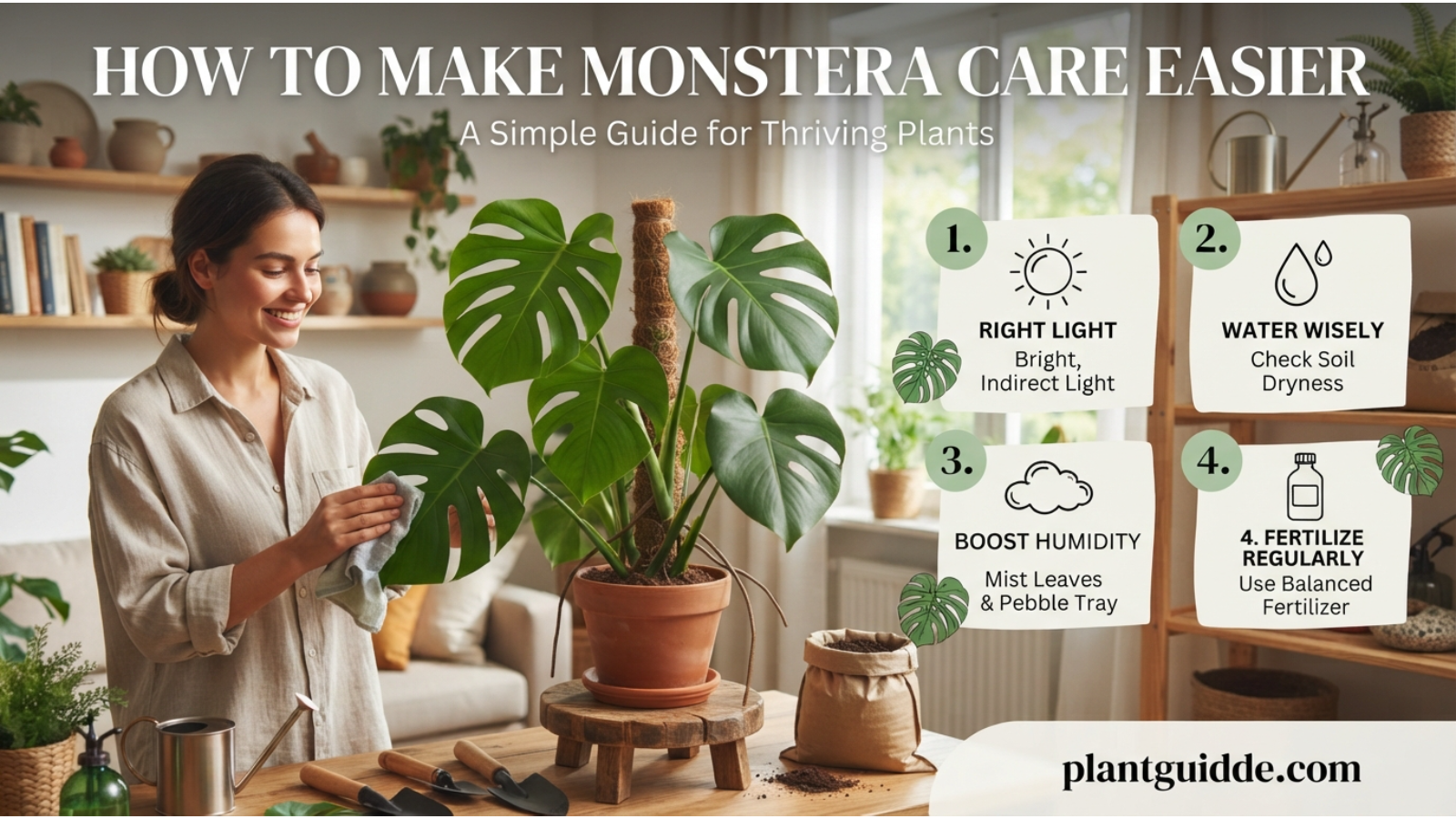
How to Make Monstera Care Easier
The easiest way to care for a Monstera is to create an environment where the plant does not constantly need correction.
Aim for:
- A stable bright location
- A pot with drainage
- Airy, well-draining soil
- A consistent watering check
- Reasonable humidity
- Warm temperatures
- Proper climbing support
- Occasional leaf cleaning
- Seasonal adjustments
The biggest improvement many beginners can make is simply observing the plant before acting.
If the soil is wet, do not water because it is “watering day.”
If the leaves are brown, do not automatically fertilize.
If the plant is growing slowly, check light before buying another product.
That habit of diagnosing first and treating second is one of the most useful skills in indoor plant care.
Is Monstera Toxic to Pets?
Monstera belongs to the Araceae family and contains compounds that can cause irritation if the plant is eaten. North Carolina Extension lists Monstera deliciosa as having low-severity poisonous characteristics, while the RHS advises caution because Monstera can be harmful if eaten and may irritate the skin or eyes.
If you have pets or young children who chew plants, keep Monstera somewhere inaccessible and avoid handling damaged plant tissue unnecessarily.
FAQs:
How often should I water a Monstera plant?
There is no universal weekly schedule. Check the soil and water thoroughly when the appropriate upper portion has dried. Plants in brighter, warmer conditions may need water more frequently than plants in cool, low-light rooms.
Does Monstera need direct sunlight?
Usually, no. Monstera generally prefers bright, indirect or filtered light. Strong direct sunlight, especially through hot glass, can scorch the leaves.
Why are my Monstera leaves turning brown?
Brown edges can result from dry air, inconsistent moisture, excessive fertilizer salts, root problems, or other environmental stress. Check the soil, drainage, humidity, and light before changing your watering routine.
Why is my Monstera not producing split leaves?
Young Monsteras often produce solid leaves. Poor light can also reduce fenestration. Give the plant adequate bright indirect light and allow it to mature rather than expecting holes immediately.
Should I cut off Monstera aerial roots?
Usually, there is no need. Aerial roots are a normal feature of the plant’s climbing growth. You can guide them toward a support when practical.
Does Monstera need a moss pole?
It does not strictly require a moss pole, but mature Monstera deliciosa benefits from sturdy vertical support because it naturally climbs. A moss pole is one option; a trellis or other strong support can also work.
What is the best soil for Monstera?
Use a loose, organic-rich, well-draining potting medium that retains some moisture without becoming waterlogged. A quality indoor mix amended with materials such as bark and perlite or pumice can provide a useful balance.
Can Monstera grow in low light?
It can survive in lower light, but growth is generally better in bright indirect light. Insufficient light can contribute to slow growth, stretched stems, and fewer characteristic fenestrations.
Should I mist my Monstera?
Misting can temporarily increase moisture around the foliage, but it is not the most reliable way to maintain room humidity. If indoor air is consistently dry, a humidifier provides more sustained control.
How do I make my Monstera grow faster?
Focus on the fundamentals rather than trying to force growth: provide sufficient bright indirect light, appropriate watering, healthy roots, suitable nutrition during active growth, warmth, humidity, and climbing support.
Can I keep Monstera in a bedroom?
Yes, provided the room has suitable light and the plant is kept in appropriate conditions. Avoid placing it directly beside heating or cooling vents.
Monstera Care Checklist
Use this quick checklist when caring for your plant:
- Light: Bright and indirect
- Water: Thoroughly when the appropriate upper soil layer dries
- Soil: Loose, organic-rich, and well drained
- Pot: Drainage hole required
- Humidity: Moderate to high is beneficial
- Temperature: Warm and stable
- Support: Recommended as the plant climbs
- Fertilizer: Balanced feed during active growth
- Pruning: Remove damaged growth and control size when necessary
- Repotting: When roots or degraded soil indicate the need
- Leaves: Clean and inspect regularly
- Troubleshooting: Diagnose soil, light, roots, temperature, humidity, and pests before treating symptoms
Conclusion
Learning how to take care of Monstera plant is less about following a rigid routine and more about understanding what the plant is telling you.
Give your Monstera bright filtered light, well-draining soil, appropriate moisture, warmth, humidity, and room to climb. Water based on soil conditions rather than the calendar, and never ignore drainage. When problems appear, look at the entire growing environment instead of assuming every brown, yellow, or curling leaf has the same cause.
Most importantly, give the plant time. Mature Monstera growth develops gradually, and dramatic fenestrated leaves are the result of good conditions combined with natural maturity.
Once you learn to observe the soil, leaves, roots, light, and growth pattern together, Monstera care becomes much more predictable, and much easier.

Asad Mumtaz is a dedicated plant enthusiast and gardening writer with a passion for helping people care for their plants successfully. He specializes in plant care guides, indoor gardening, and practical growing tips for all skill levels. His content focuses on making gardening simple, enjoyable, and rewarding. Through his work, Asad shares reliable advice to help readers create thriving green spaces.