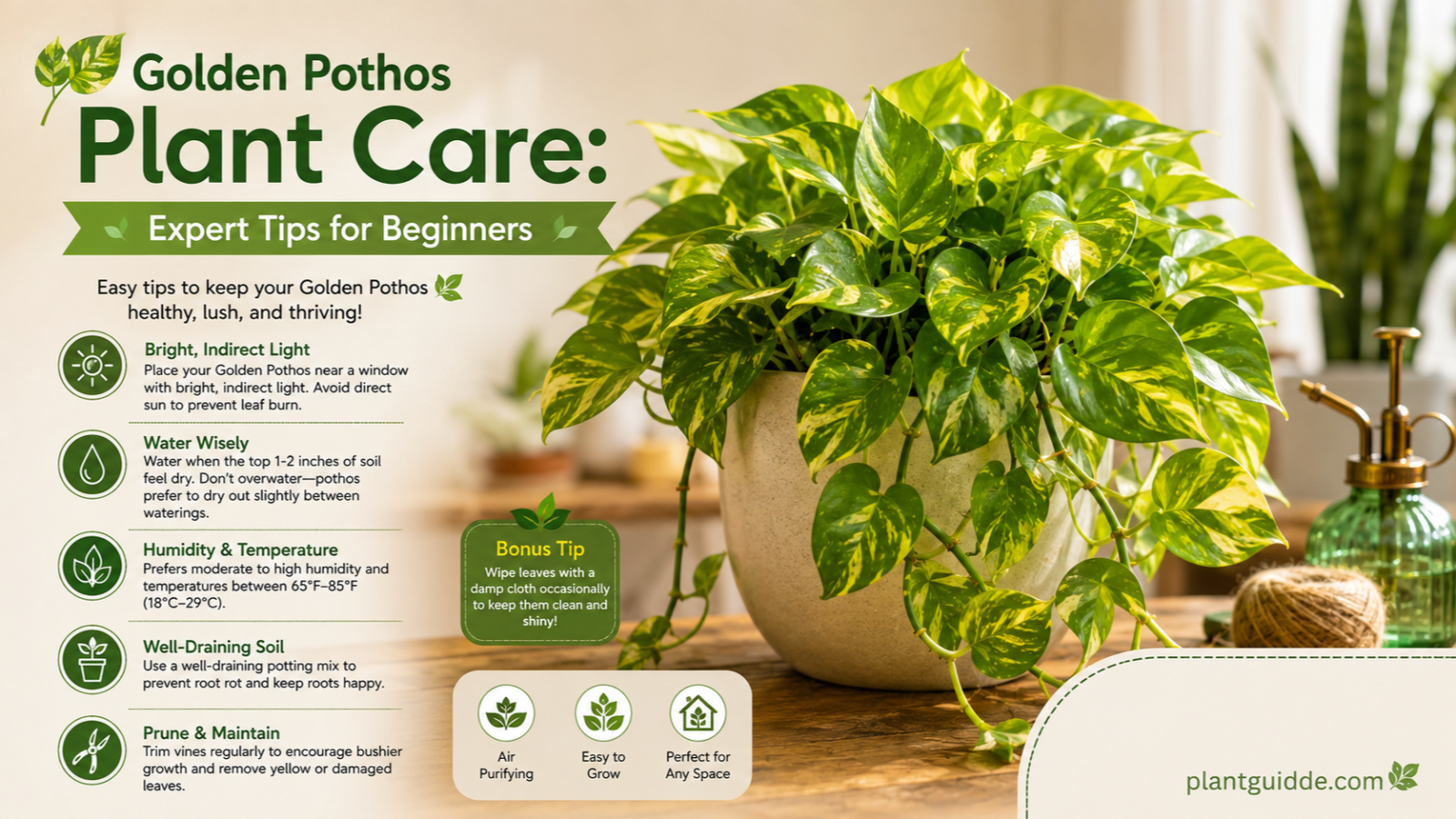
Golden Pothos is one of the most forgiving houseplants, but good Golden Pothos Plant Care can make the difference between a plant that simply survives and one that grows lush, full, and beautifully variegated. Its heart-shaped green leaves streaked with golden-yellow markings make golden pothos plant care a popular choice for homes, offices, and beginner plant collections.
Understanding Golden Pothos Plant Care also means knowing what your plant is trying to tell you. Yellow leaves, brown edges, slow growth, leggy vines, or drooping foliage can all point to different environmental problems.
The key to successful Golden Pothos Plant Care is not following a rigid schedule but learning how your plant responds to its growing conditions.
In this guide, you’ll learn practical Golden Pothos Plant Care tips for light, watering, soil, feeding, pruning, propagation, and common problems, so you can confidently provide the Golden Pothos Plant Care your plant needs to thrive year-round.
What Is Golden Pothos?
Golden pothos is a tropical climbing plant commonly known as Epipremnum aureum. It is also called devil’s ivy and is widely grown as an indoor foliage plant.
The plant produces long, flexible stems with glossy, heart-shaped leaves. In cultivation, it is normally grown in its juvenile form, either trailing from containers or trained upward on a support.
Its natural climbing habit explains some of its indoor behavior. Pothos can produce aerial roots along its stems, allowing it to attach to surfaces and climb. Given a suitable support, it can be trained vertically rather than simply allowed to trail.
The golden form is especially valued for its irregular yellow or cream-gold markings against green foliage.
Why Does Golden Pothos Sometimes Lose Its Golden Color?
Variegation requires enough light for the plant to maintain strongly patterned foliage. In low-light conditions, golden pothos may produce greener leaves and weaker growth. Illinois Extension specifically notes that leaf color can disappear under low light.
This does not mean the plant should be moved immediately into intense direct sunlight.
A better approach is to increase bright, indirect light gradually.
Golden Pothos Plant Care Requirements at a Glance
| Care factor | Best approach | What to avoid |
|---|---|---|
| Light | Bright, indirect light | Harsh prolonged direct sun |
| Water | Water when the upper soil has dried | Constantly wet soil |
| Soil | Airy, moisture-retentive, well-draining mix | Heavy compacted soil |
| Pot | Container with drainage holes | Decorative pot with trapped water |
| Temperature | Warm, stable conditions | Cold drafts and sudden temperature changes |
| Humidity | Average household humidity is usually adequate | Assuming very high humidity is mandatory |
| Fertilizer | Light feeding during active growth | Heavy or frequent fertilizing |
| Pruning | Trim long or sparse vines to encourage fuller growth | Removing healthy foliage unnecessarily |
| Propagation | Stem cuttings | Leaf-only cuttings without a node |
| Pets | Keep away from pets and children | Allowing chewing or ingestion |
RHS describes epipremnums as adaptable plants that prefer bright filtered light, tolerate some shade, and do not require unusually high humidity. It also emphasizes avoiding overwatering.
Give Golden Pothos the Right Light
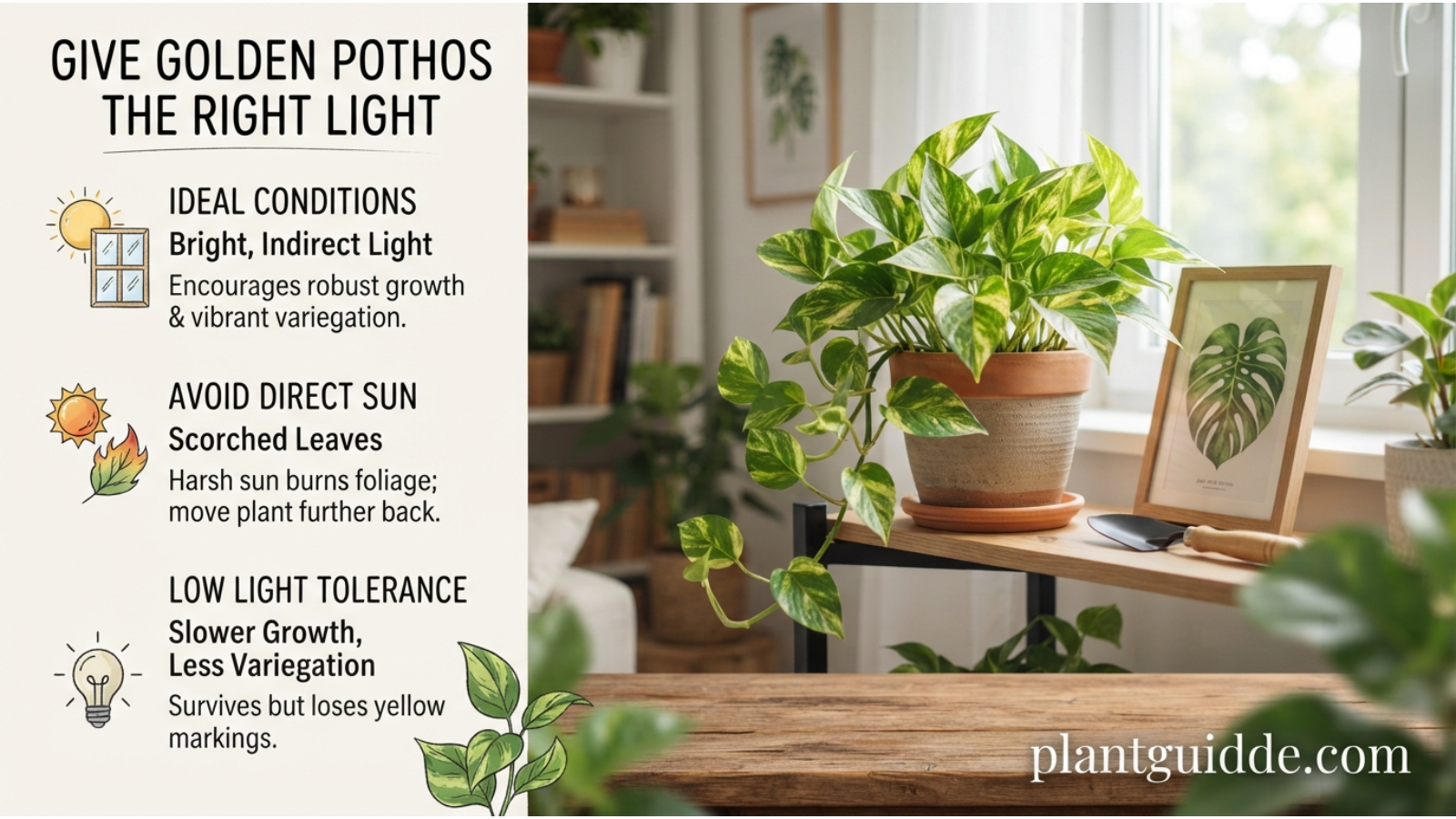
Light is one of the most important factors in golden pothos plant care, especially if you want strong variegation and vigorous growth.
The ideal light
Aim for bright, indirect or filtered light.
A position near an east- or west-facing window can work well, while a south-facing window may require a sheer curtain or some distance from the glass. RHS recommends bright indirect light and warns that strong direct summer sun can scorch foliage.
What happens in low light?
Golden pothos can survive surprisingly dim conditions, but survival and good growth are different things.
Low light may result in:
- Longer gaps between leaves
- Slower growth
- Smaller leaves
- Greener foliage
- Less obvious golden variegation
If the plant is growing but becoming increasingly green and sparse, light is one of the first things to investigate.
What happens with too much direct sun?
Strong direct sunlight, particularly through hot glass, can cause:
- Pale or bleached patches
- Brown scorched areas
- Crispy leaf edges
- Rapid moisture loss
If your pothos is currently in a dim room, do not suddenly place it in intense afternoon sunlight. Increase light gradually.
Practical Tip: If you want to preserve golden variegation, prioritize bright filtered light rather than choosing a location simply because pothos can “survive” there.
Image Suggestion: Diagram showing ideal golden pothos placement near east, west, and filtered south-facing windows.
Water Golden Pothos by Soil Condition, Not by Calendar
One of the most common golden pothos care mistakes is watering on a fixed schedule.
For example, watering every Sunday may work during one season and cause problems during another because evaporation, temperature, light, pot size, and root development all change.
Instead, check the soil.
RHS recommends allowing the compost to approach dryness before watering and warns that keeping the plant too wet can cause root rot.
How to know when to water
Before watering:
- Push your finger into the upper layer of soil.
- Check whether it has dried noticeably.
- Consider the weight of the pot.
- If the soil is still wet several centimeters down, wait.
- When the plant is ready, water thoroughly.
When watering, moisten the root ball rather than adding tiny amounts of water every day.
Allow excess water to drain completely.
Why overwatering is so damaging
Roots need both moisture and oxygen. Constantly saturated soil reduces the air available around the roots and creates conditions where root health can deteriorate.
This is why a pothos can look thirsty even though its pot is wet.
The leaves may droop, yellow, or become soft while the soil remains saturated.
Important distinction: drooping does not automatically mean the plant needs water.
Always check the soil before adding more.
Choose an Airy, Well-Draining Soil Mix
Golden pothos is adaptable, but it performs best when its roots have access to both moisture and air.
RHS recommends an open, moisture-retentive but well-drained growing medium and gives a custom mix based on acidic peat-free compost, grit, and orchid bark.
For most home growers, you do not need an elaborate recipe.
A practical mix can contain:
- Quality indoor potting mix
- Orchid bark
- Perlite or another material that improves aeration
The goal is simple: the mix should hold enough moisture for the roots without staying saturated for days.
Why ordinary garden soil is usually a poor choice
Garden soil can become dense inside a container. Poor drainage combined with slow evaporation makes it easier to keep the root zone excessively wet.
A loose indoor potting mix is generally a better starting point.
Use a Pot With Drainage Holes
A drainage hole is not a minor detail.
It gives excess water somewhere to go after watering.
A decorative container without drainage can trap water underneath the root ball even when the surface looks reasonably dry.
When should you repot golden pothos?
You do not need to repot every year simply because the calendar says so.
Consider repotting when:
- Roots are emerging from drainage holes.
- Water passes through the pot unusually quickly.
- The root ball has become extremely crowded.
- Growth has slowed despite appropriate light and care.
- The existing potting mix has broken down and drains poorly.
RHS recommends moving an epipremnum into a slightly larger container when roots become crowded and specifically cautions against overpotting because excessive soil can remain wet for too long.
Choose only a slightly larger pot
A common mistake is moving a small pothos into a dramatically larger container.
More soil does not automatically mean more growth.
Instead, the extra soil can retain moisture around a relatively small root system for longer, increasing the risk of root problems.
Keep Temperature Stable
Golden pothos is a tropical plant and generally prefers warm indoor conditions.
RHS recommends approximately 18–30°C (65–86°F) for best results and advises avoiding cold drafts and direct heat sources.
Avoid placing the plant:
- Directly beside an air conditioner
- Against a very cold window
- Beside a heater or radiator
- In a location exposed to repeated hot-and-cold fluctuations
A stable room is usually more useful than trying to create an artificially tropical environment.
Does Golden Pothos Need High Humidity?
Not necessarily.
This is an area where houseplant advice often becomes more complicated than it needs to be.
Golden pothos can tolerate ordinary household conditions. RHS specifically notes that epipremnums do not require high humidity, which is one reason they are relatively easy indoor plants.
If your home’s air is particularly dry, moderate humidity can still support healthier foliage, especially during periods of strong heating or air conditioning.
But you generally do not need to mist the leaves repeatedly to keep golden pothos alive.
A better priority order
If your pothos is struggling, address these first:
- Light
- Watering
- Drainage
- Temperature
- Root health
Do not assume humidity is the solution to every brown leaf.
Fertilize Golden Pothos Without Overdoing It
Golden pothos does not need heavy feeding.
During active growth, a balanced houseplant fertilizer can be used according to its label directions. RHS recommends monthly feeding during the growing season.
If the plant is growing slowly during darker months, reduce feeding rather than trying to force growth with extra fertilizer.
Why too much fertilizer can backfire
More fertilizer does not necessarily mean more growth.
Excessive fertilizer can contribute to salt buildup in the growing medium and may damage roots or cause leaf-edge problems.
If you have recently repotted into fresh, nutrient-containing potting mix, you may not need to fertilize immediately.
Prune Golden Pothos for Fuller Growth
Golden pothos naturally wants to trail.
If you allow a single vine to grow continuously, you may eventually have a long stem with leaves spaced farther apart.
Pruning gives you a chance to reshape the plant.
How to make golden pothos bushier
Use clean, sharp scissors to trim long stems.
Make cuts near a node—the point where a leaf and aerial root may emerge from the stem.
You can then propagate suitable cuttings and plant rooted pieces back into the original container to create a fuller-looking pot.
RHS recommends tip pruning to encourage branching.
Expert Tip: If the plant is very sparse, pruning alone will not solve the underlying problem. Check light first. A pothos kept too dark may repeatedly produce weak, stretched growth.
Train Golden Pothos to Climb or Trail
Golden pothos can be used in two very different ways.
Trailing pothos
Place it on:
- A high shelf
- A hanging planter
- A bookcase
- A plant stand
The vines can cascade naturally downward.
Climbing pothos
A moss pole, coir support, trellis, or similar structure can encourage the plant upward.
Epipremnums naturally climb using aerial roots, so providing a support can better match their growth habit.
Image Suggestion: Side-by-side illustration comparing a trailing golden pothos with one trained vertically on a support.
Propagating Golden Pothos From Cuttings
Golden pothos is particularly beginner-friendly for propagation because its stems can produce roots from nodes.
Simple water-propagation method
- Select a healthy vine.
- Cut a section containing at least one node.
- Place the node in water.
- Keep the cutting in bright, indirect light.
- Change the water periodically if it becomes cloudy.
- Once a useful root system develops, transfer the cutting to an appropriate potting mix.
The critical point is the node.
A leaf without a node cannot normally produce a complete new pothos plant because the necessary growth point is absent.
RHS lists stem cuttings and layering among the easiest propagation methods for epipremnums.
Golden Pothos Troubleshooting Guide
Healthy pothos care is mostly preventative, but problems still happen.
The important thing is to diagnose the pattern rather than reacting to a single leaf.
Why Are Golden Pothos Leaves Turning Yellow?
Yellow leaves can have several causes.
Possible causes
Too much water:
If several leaves are yellow and the soil remains wet for long periods, investigate watering frequency and drainage first.
Natural aging:
An occasional older leaf turning yellow and eventually dropping can be normal.
Poor root health:
Persistent wet soil can damage roots, reducing the plant’s ability to support healthy foliage.
Insufficient light:
Low light can reduce growth and contribute to weaker overall plant performance.
What to do
Do not automatically fertilize a yellowing plant.
First inspect:
- Soil moisture
- Drainage
- Root condition
- Light level
- Recent watering habits
Why Are Golden Pothos Leaves Turning Brown?
Brown leaves are often associated with environmental stress rather than one single problem.
Potential causes include:
- Strong direct sunlight
- Dry soil
- Very dry air
- Fertilizer buildup
- Physical damage
- Root problems
Look at where the browning occurs.
Crispy patches facing a bright window suggest a different problem from brown edges appearing across a plant that has repeatedly dried out.
Why Are Golden Pothos Leaves Curling?
Curling can be a response to water stress or unfavorable environmental conditions.
Check the soil first.
If the soil is extremely dry, water thoroughly and monitor the plant.
If the soil is consistently wet, do not respond by adding more water. Instead, investigate drainage and root health.
Also check whether the plant is exposed to intense direct sun, hot air, cold drafts, or sudden environmental changes.
Why Is My Golden Pothos Leggy?
Leggy growth usually means the plant is stretching toward available light.
Typical signs include:
- Long spaces between leaves
- Small new leaves
- Growth concentrated toward one direction
- Sparse vines
Move the plant toward brighter indirect light.
Once lighting improves, pruning the longest sparse stems can help create a fuller shape.
Do not expect pruning to replace better lighting.
Why Is My Golden Pothos Losing Its Variegation?
If new leaves are becoming mostly green, insufficient light is one of the first factors to investigate.
Golden pothos can tolerate lower light, but low light can reduce the intensity of its variegation.
Move it gradually into brighter indirect light.
Avoid trying to “restore” variegation by placing the plant in harsh direct sun.
Golden Pothos Seasonal Care
Your watering routine should change with the environment.
Spring and Summer
During active growth:
- Check soil more frequently.
- Provide strong indirect light.
- Feed lightly according to fertilizer instructions.
- Prune and propagate if needed.
- Monitor rapidly drying containers.
Autumn
As growth slows:
- Check the soil before every watering.
- Avoid continuing a summer watering schedule automatically.
- Reduce fertilizer as active growth decreases.
Winter
Indoor plants often use water more slowly during darker, cooler periods.
The biggest mistake is continuing to water on the same schedule used during summer.
Before watering, check the soil.
Real-world rule: The calendar can tell you what season it is; the soil tells you whether your pothos needs water.
Common Golden Pothos Care Mistakes
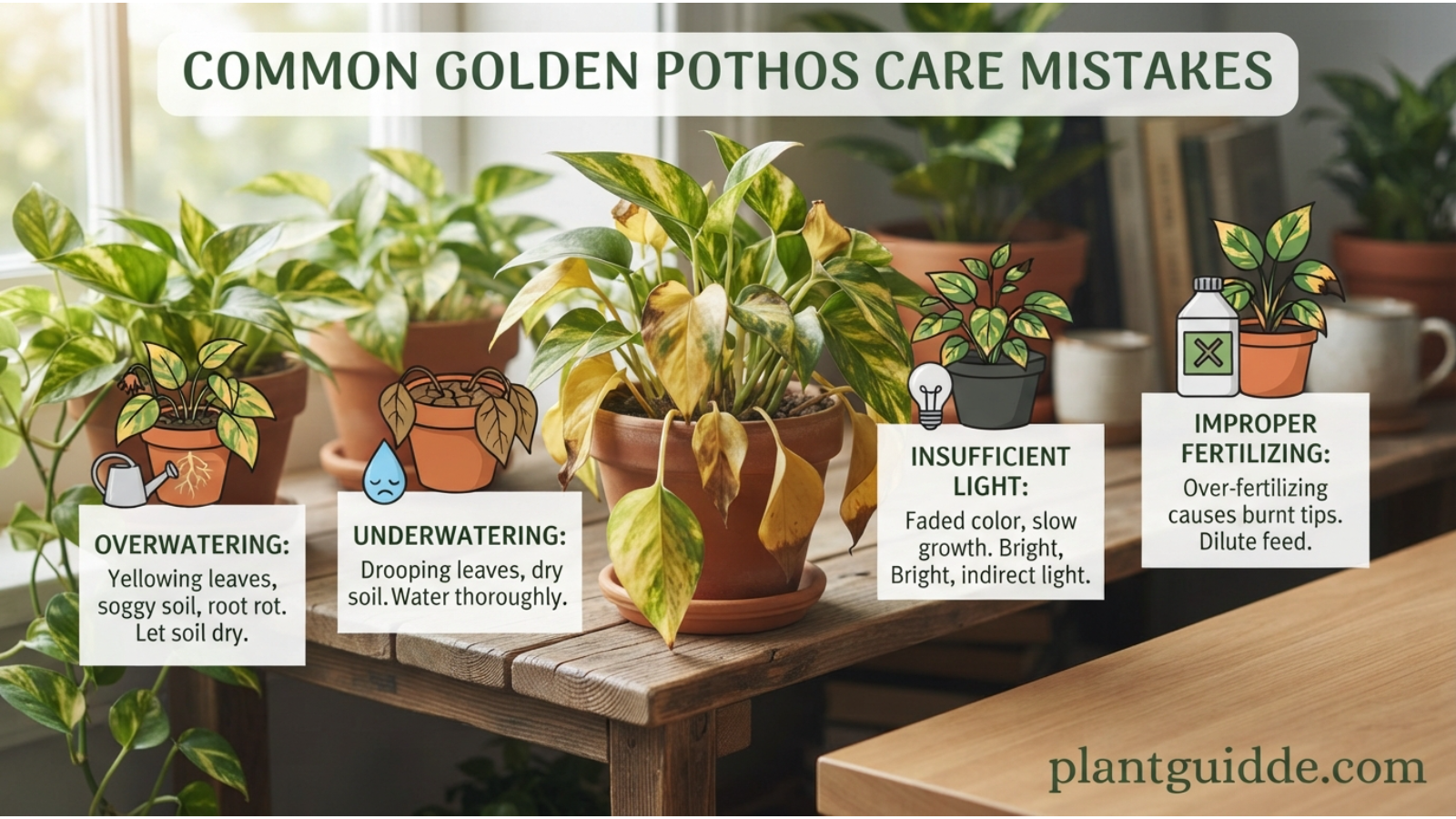
1. Watering every week automatically
A fixed schedule ignores changes in light, temperature, pot size, and soil moisture.
Better: check the plant and soil first.
2. Assuming drooping always means thirst
A plant sitting in wet soil can also droop.
Better: diagnose the root zone before watering.
3. Putting golden pothos in a dark corner
It may survive, but growth and variegation can suffer.
Better: give it bright indirect light.
4. Using a pot that is far too large
Extra soil can stay wet for too long.
Better: increase pot size gradually.
5. Fertilizing a stressed plant heavily
More nutrients cannot compensate for poor drainage or inadequate light.
Better: correct environmental problems first.
6. Cutting leaves instead of stems when pruning
Removing random leaves may make the plant look thinner.
Better: prune strategically along stems near nodes.
7. Repotting unnecessarily
A healthy pothos does not need constant repotting.
Better: repot when the root system or potting medium actually indicates a need.
A Simple Golden Pothos Care Routine
If you want a routine that is easy to maintain, use this checklist.
Weekly
- Check the soil rather than watering automatically.
- Look underneath leaves for pests.
- Check whether vines need support or pruning.
- Rotate the pot if growth is becoming strongly one-sided.
Monthly
- Inspect the drainage holes.
- Clean dusty leaves gently with a damp cloth.
- Assess whether growth and variegation look normal.
- Fertilize during active growth if needed.
Every Few Months
- Inspect roots if there are persistent watering problems.
- Trim excessively long or damaged vines.
- Check whether the current location still provides adequate light.
- Evaluate whether the plant needs support or repotting.
RHS also recommends occasionally wiping leaves with a damp cloth to remove dust and help the foliage use available light efficiently.
Is Golden Pothos Safe Around Pets?
No. Golden pothos should be treated as a potentially harmful plant if chewed or eaten.
RHS identifies epipremnum as harmful if eaten and notes that it can irritate the skin and eyes.
If you have cats, dogs, or young children, keep the plant somewhere they cannot chew the foliage.
Wear gloves when pruning or handling the plant if you are sensitive to plant sap.
Golden Pothos vs. Low-Light Conditions
Golden pothos has a reputation for surviving difficult indoor conditions, and that reputation is deserved to an extent.
But there is an important distinction:
Surviving low light ≠ thriving in low light.
A plant may remain alive in a dim room while producing slower, less compact growth and weaker variegation.
Missouri Botanical Garden lists golden pothos among its adaptable “tough as nails” houseplants, while Illinois Extension recommends bright indirect light and notes the effect of low light on leaf color.
For the best appearance, give the plant considerably better light than the minimum it can tolerate.
FAQs,
How often should I water golden pothos?
There is no reliable universal number of days. Check the soil and water when the upper portion has dried rather than following a fixed weekly schedule. The plant should not remain continuously waterlogged.
Does golden pothos need direct sunlight?
No. Bright indirect or filtered light is generally a better choice. Strong direct sun can scorch the foliage, particularly during hot periods.
Can golden pothos grow in low light?
Yes, but growth can become slower and the golden variegation may become less pronounced.
Why is my golden pothos turning green?
Insufficient light is a common reason variegated pothos produces greener-looking growth. Moving it to brighter indirect light can help the plant maintain stronger coloration.
Should I mist golden pothos?
Misting is not essential. Golden pothos is adaptable and does not require unusually high humidity. Focus first on appropriate light, watering, drainage, and temperature.
Can golden pothos grow in water?
Stem cuttings can readily develop roots in water, making water propagation a simple way to start new plants. For long-term growth, however, growing the plant in an appropriate potting medium provides a more conventional root environment.
How do I make golden pothos grow faster?
Give it bright indirect light, appropriate watering, an airy growing medium, adequate warmth, and modest nutrition during active growth. Avoid trying to accelerate growth by keeping the soil constantly wet.
How do I make golden pothos bushier?
Prune long vines near nodes to encourage branching, and use healthy cuttings for propagation. Adequate light is equally important because pruning alone will not correct weak, stretched growth.
Should I cut off yellow pothos leaves?
Remove leaves that are fully yellow, damaged, or dying, but do not treat every yellow leaf as a pruning problem. First determine why the foliage is yellowing, particularly if multiple leaves are affected.
Does golden pothos need a moss pole?
No. A moss pole is optional. It is useful if you want to encourage the plant’s natural climbing habit, but golden pothos can also grow successfully as a trailing plant.
When should I repot golden pothos?
Repot when roots are crowded, emerge from drainage holes, or the existing potting mix has deteriorated. Move it into a container only slightly larger than the current one to avoid unnecessarily wet soil.
Final Takeaway
Successful golden pothos plant care is less about maintaining a complicated routine and more about recognizing what the plant is telling you.
Give it bright indirect light, let the soil dry appropriately between waterings, use a well-draining and well-aerated mix, and avoid oversized pots that remain wet for too long. Keep temperatures reasonably warm and stable, feed modestly during active growth, and prune strategically when vines become sparse.
When problems appear, resist the urge to change everything at once. Check the soil, light, drainage, and recent care history first. That simple diagnostic approach is often what separates a struggling pothos from one that stays full, vigorous, and beautifully variegated for years.

Asad Mumtaz is a dedicated plant enthusiast and gardening writer with a passion for helping people care for their plants successfully. He specializes in plant care guides, indoor gardening, and practical growing tips for all skill levels. His content focuses on making gardening simple, enjoyable, and rewarding. Through his work, Asad shares reliable advice to help readers create thriving green spaces.