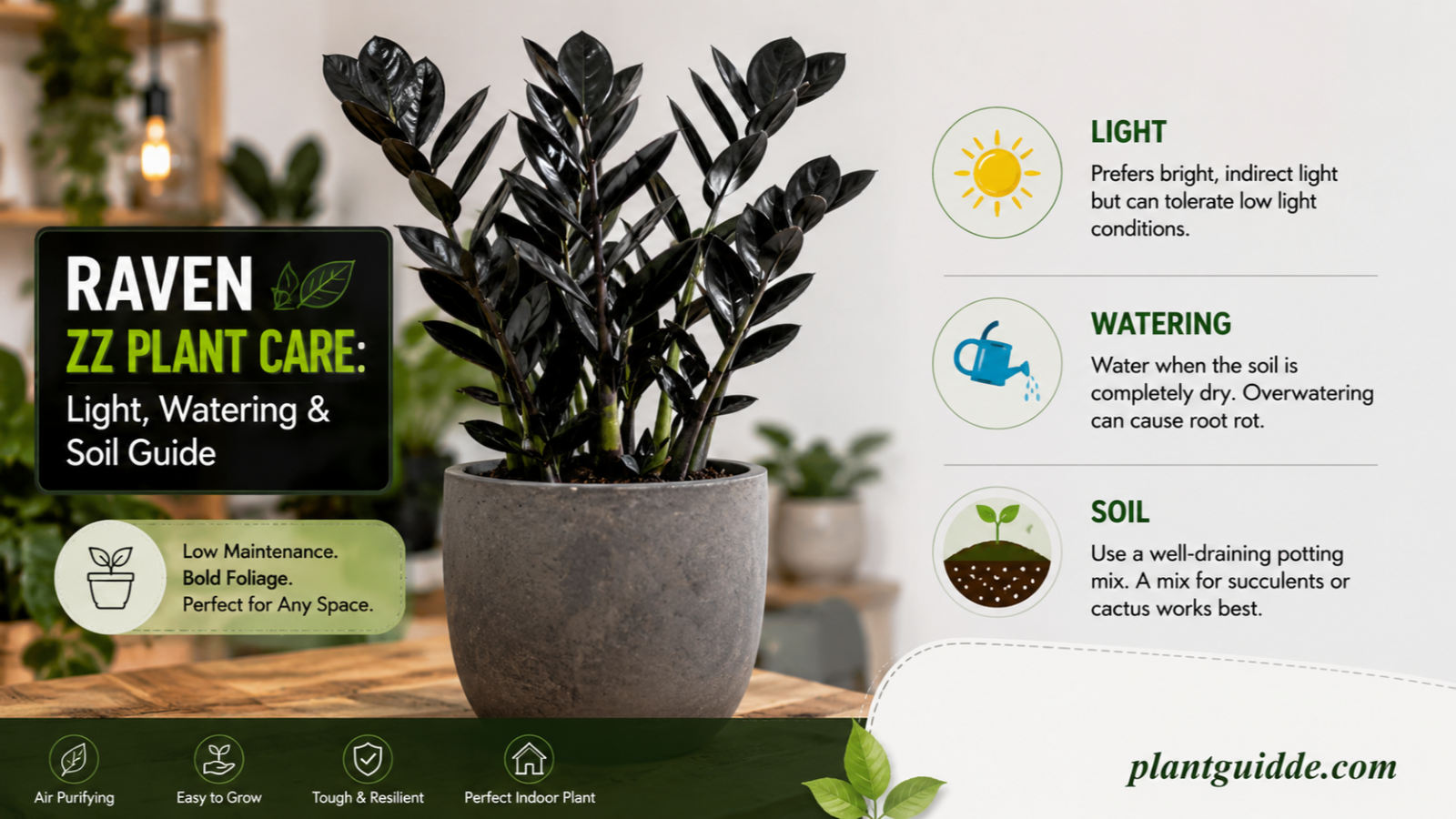
The Raven ZZ plant is one of those houseplants that looks difficult to grow but is actually remarkably forgiving. raven zz plant care.
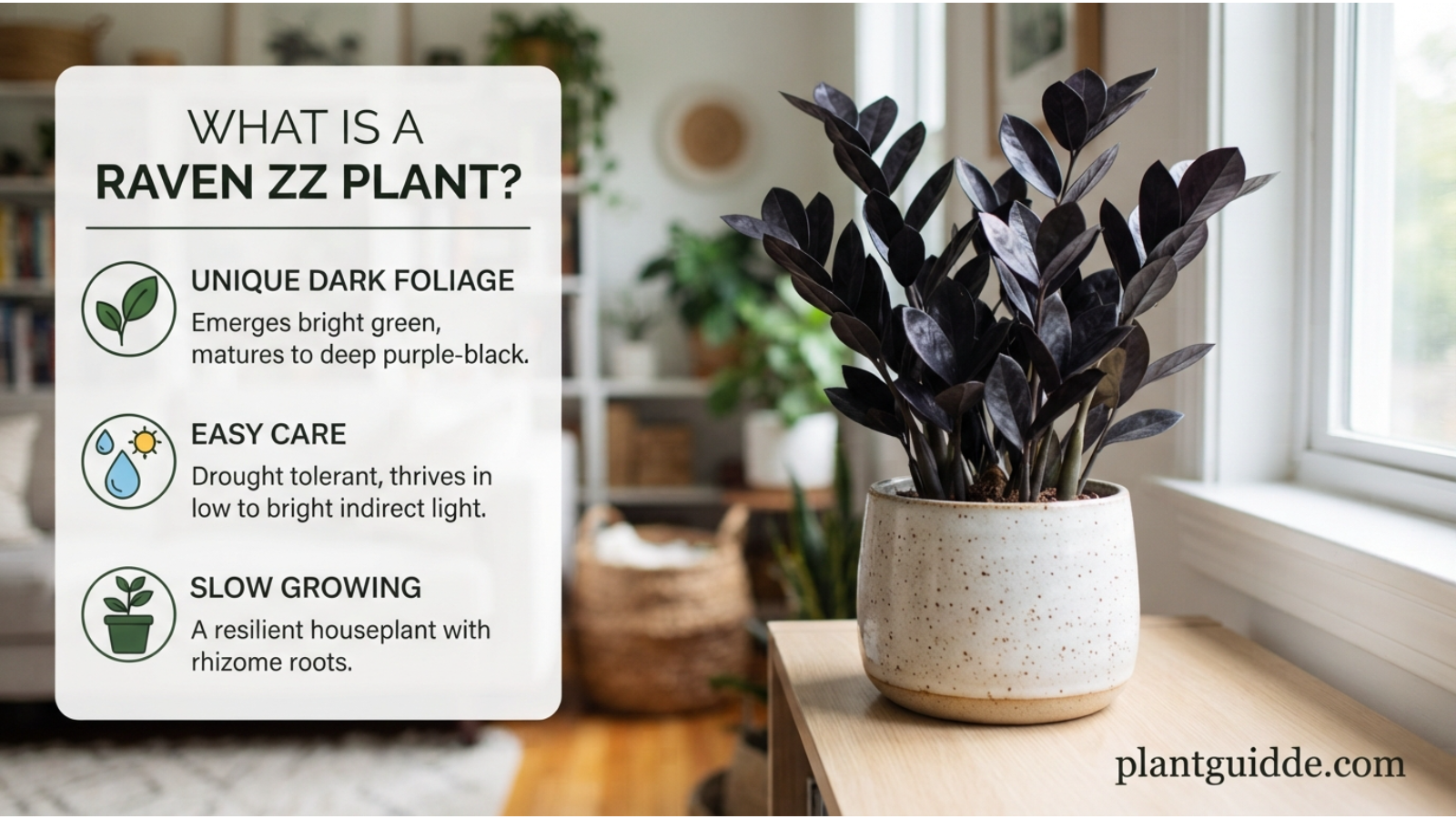
Its upright stems and glossy foliage make it perfect for modern interiors, while mature leaves develop a dramatic purple-black color that sets Raven ZZ apart from the ordinary green ZZ plant. New leaves emerge bright green and gradually darken as they mature.
The key to successful Raven ZZ plant care is understanding that this is a drought-tolerant rhizomatous plant, not a houseplant that needs frequent watering. Its underground rhizomes store water, allowing it to handle dry periods, but making overwatering one of the biggest risks.
This guide covers everything you need to know about Raven ZZ plant light, watering, soil, humidity, temperature, fertilizer, repotting, propagation, and common problems so you can keep its striking foliage healthy and vibrant.
Quick Answer
For Raven ZZ plant care, place Zamioculcas zamiifolia ‘Raven’ in bright, indirect light, although it tolerates low light. Water thoroughly only when the potting mix has dried completely, and always use a pot with drainage holes and a fast-draining soil mix. Average household humidity is sufficient. Keep temperatures comfortably warm, avoid prolonged cold or direct afternoon sun, and fertilize lightly during active growth.
What Is a Raven ZZ Plant?
Raven zz plant care is the dark-leaved cultivar Zamioculcas zamiifolia ‘Raven’, also known as Raven™ ZZ or Jet-Black Raven.
It belongs to the arum family, Araceae, and grows from underground, water-storing rhizomes. The cultivar is particularly recognizable because new leaves emerge lime green and gradually mature to a deep purple-black shade.
Unlike many foliage plants, Raven ZZ does not need consistently moist soil to remain healthy. Its natural water-storage system allows it to withstand periods of dryness.
Raven ZZ at a glance
| Care factor | Best approach |
|---|---|
| Light | Bright, indirect light |
| Low light | Tolerated, but growth slows |
| Direct sun | Avoid prolonged intense sun |
| Water | Only after soil dries completely |
| Soil | Fast-draining, well-aerated mix |
| Humidity | Average household humidity |
| Temperature | Warm, stable indoor temperatures |
| Fertilizer | Light feeding during active growth |
| Growth rate | Slow |
| Repotting | Only when necessary |
| Toxicity | Harmful if ingested by people or pets |
Clemson Extension lists Raven among ZZ cultivars and notes that it can reach around 2.5 feet, while North Carolina Extension describes Raven ZZ as capable of reaching approximately 3 feet in height and width depending on growing conditions.
Image Suggestion: Close-up comparison of a green ZZ plant and Raven ZZ showing the characteristic dark mature foliage.
Raven ZZ Plant Light Requirements
Bright, indirect light is the best starting point for Raven ZZ plant care.
The plant can survive surprisingly low light, but surviving and growing well are not the same thing. Extension sources consistently identify bright indirect light as the preferred condition, while noting that ZZ plants tolerate much lower light.
A useful way to think about light is:
Low light = survival and slower growth.
Bright indirect light = better growth and stronger overall appearance.
Where should you put a Raven ZZ?
Good locations include:
- A few feet from a bright east- or north-facing window
- A bright room where sunlight is filtered through a sheer curtain
- A spot receiving plenty of ambient daylight without harsh afternoon rays
- An office with suitable artificial lighting
Avoid placing the plant directly against a hot, intensely sunny window for long periods.
Excessive direct sunlight can scorch ZZ foliage, causing pale, bleached, yellow, curled, or brown areas.
Does Raven ZZ need a grow light?
Not necessarily.
If your plant is surviving in a dim room but producing little new growth, a grow light can be useful. More light generally supports faster growth, but there is no reason to expose the plant to intense light simply to make it grow faster.
Expert tip: If your Raven ZZ is healthy but barely growing, evaluate light before automatically increasing fertilizer. Light is often the more important limiting factor.
How to Water a Raven ZZ Plant
Watering is probably the most important part of Raven ZZ plant care.
The plant stores water in its rhizomes, so constantly moist soil provides little benefit and can create serious problems. Clemson Extension recommends allowing the potting medium to dry completely before watering, while RHS similarly recommends sparse watering and complete drying between waterings.
The right watering method
Instead of watering according to a calendar, check the soil.
- Feel the potting mix several inches below the surface.
- Make sure it has dried thoroughly.
- Water slowly and thoroughly.
- Allow excess water to drain from the bottom.
- Empty water collected in the saucer or decorative container.
- Wait until the mix dries completely again before watering.
The exact interval can vary substantially depending on pot size, soil composition, temperature, light, and season.
How often should you water Raven ZZ?
There is no universal schedule.
Under typical indoor conditions, you may find that the plant needs water every couple of weeks or even less frequently. Clemson Extension gives approximately one to two waterings per month as a general guide, while NC Extension suggests roughly twice monthly during summer and once monthly during winter—but both emphasize allowing the soil to dry completely rather than blindly following the calendar.
A small plant in a warm, bright room may dry faster than a large plant sitting in a large container in low light.
Raven ZZ watering rule
Do not ask, “Has it been two weeks?”
Ask, “Has the soil actually dried?”
That small change in thinking prevents one of the most common Raven ZZ mistakes.
How to Tell When Raven ZZ Needs Water
Look at the entire situation rather than relying on one symptom.
Signs the soil may be ready for water
- The pot feels noticeably lighter.
- The mix is dry deep into the container.
- There is no persistent moisture around the rhizomes.
- The plant is otherwise healthy.
Do not wait for dramatic wilting. ZZ plants can tolerate substantial dryness, but you don’t need to deliberately stress the plant before watering.
What happens when you overwater?
Overwatering can cause:
- Yellowing leaves
- Soft or collapsing stems
- Persistently wet soil
- Unpleasant-smelling roots or soil
- Root or rhizome rot
- Sudden decline despite apparently “good” care
University of Connecticut identifies excessive watering as one of the main ways to damage ZZ plants and notes that yellow leaves and rotting rhizomes can accompany overwatering.
Image Suggestion: Diagram showing a Raven ZZ rhizome in healthy dry soil versus a rotting rhizome in waterlogged soil.
Best Soil for Raven ZZ Plant Care
The ideal Raven ZZ soil is fast-draining and well-aerated.
You do not need an elaborate specialty recipe. The goal is to prevent the root zone from staying wet for long periods.
A practical mix can contain:
- Quality indoor potting mix
- Perlite or pumice
- A coarse component such as bark or another material that improves drainage
Clemson Extension provides a coarse mix using potting soil/coir, perlite, and sand, while other extension sources recommend well-drained potting media.
What soil should you avoid?
Avoid heavy soil that remains wet for long periods.
The problem isn’t simply “too much water.” It is the combination of excess moisture + poor aeration + slow drying around the roots and rhizomes.
This is why a Raven ZZ planted in a huge decorative pot filled with dense, wet soil can fail even if you only water occasionally.
Choosing the Right Pot
A good pot is almost as important as good soil.
Always choose a container with drainage holes.
A drainage hole gives excess water somewhere to escape. Without one, even careful watering can leave water trapped around the rhizomes.
Should Raven ZZ be root-bound?
There is usually no reason to rush into a larger pot.
Because Raven ZZ grows slowly, frequent repotting can create a larger volume of soil that takes too long to dry.
Repot when:
- Roots are severely crowded.
- The plant has clearly outgrown its container.
- The potting mix has deteriorated.
- Drainage has become poor.
- The plant is repeatedly drying out unusually quickly.
Choose a new pot only modestly larger than the existing root system.
Expert tip: A slightly snug pot is often easier to manage than an oversized container for a slow-growing ZZ.
Raven ZZ Humidity Requirements
One of the easiest parts of Raven ZZ plant care is humidity.
Despite being a tropical-looking plant, Raven ZZ does not require high humidity to remain healthy. RHS states that average household humidity is adequate, and Clemson Extension similarly notes that ZZ plants are comfortable with normal indoor humidity.
You generally do not need:
- Daily misting
- A humidifier
- Pebble trays
- A bathroom environment
If your home has ordinary indoor humidity, focus more attention on light, watering, drainage, and temperature.
This is an important distinction between Raven ZZ and genuinely humidity-demanding houseplants.
Best Temperature for Raven ZZ
Keep Raven ZZ in a warm, stable indoor environment.
RHS recommends approximately 15–24°C (59–75°F), while other extension guidance gives a somewhat broader acceptable indoor range.
The practical rule is more important than chasing a precise number:
Protect the plant from prolonged cold, freezing temperatures, and cold drafts.
Keep it away from:
- Cold exterior doors
- Drafty windows during winter
- Strong air-conditioning vents
- Unheated spaces
- Sudden temperature extremes
Clemson Extension recommends keeping ZZ plants above 60°F, while NC Extension similarly advises bringing container-grown plants indoors when temperatures fall below about 60°F.
How to Fertilize Raven ZZ
Raven ZZ is a slow grower, so it does not need aggressive fertilization.
During active growth, use a balanced houseplant fertilizer at a diluted rate.
A conservative approach is usually better than frequent heavy feeding. Clemson Extension recommends fertilizing once or twice during the growing season, while other extension guidance also supports limited feeding.
Avoid fertilizing when:
- The plant is severely stressed.
- The soil is bone dry.
- Roots may be damaged.
- The plant is not actively growing.
- You recently repotted into fresh, already-fertilized soil.
Common mistake: Assuming fertilizer will make a low-light Raven ZZ grow rapidly. If light is insufficient, adding more fertilizer isn’t a substitute for better growing conditions.
Why Is My Raven ZZ Not Black?
This is one of the most common questions about Raven ZZ plants.
New Raven ZZ leaves normally emerge green.
As the foliage matures, it gradually develops the characteristic deep purple-black coloration. NC Extension specifically describes the cultivar as producing lime-green new growth that becomes purple-black with age.
So if your new shoot is green, don’t immediately assume something is wrong.
If mature leaves remain greener than expected
Consider:
- How much light the plant receives
- Whether the foliage is genuinely new
- Whether growth has slowed because of low light
- Whether the plant has recently been moved or repotted
Give the plant appropriate bright, indirect light and time.
Do not increase fertilizer simply because a new leaf is green.
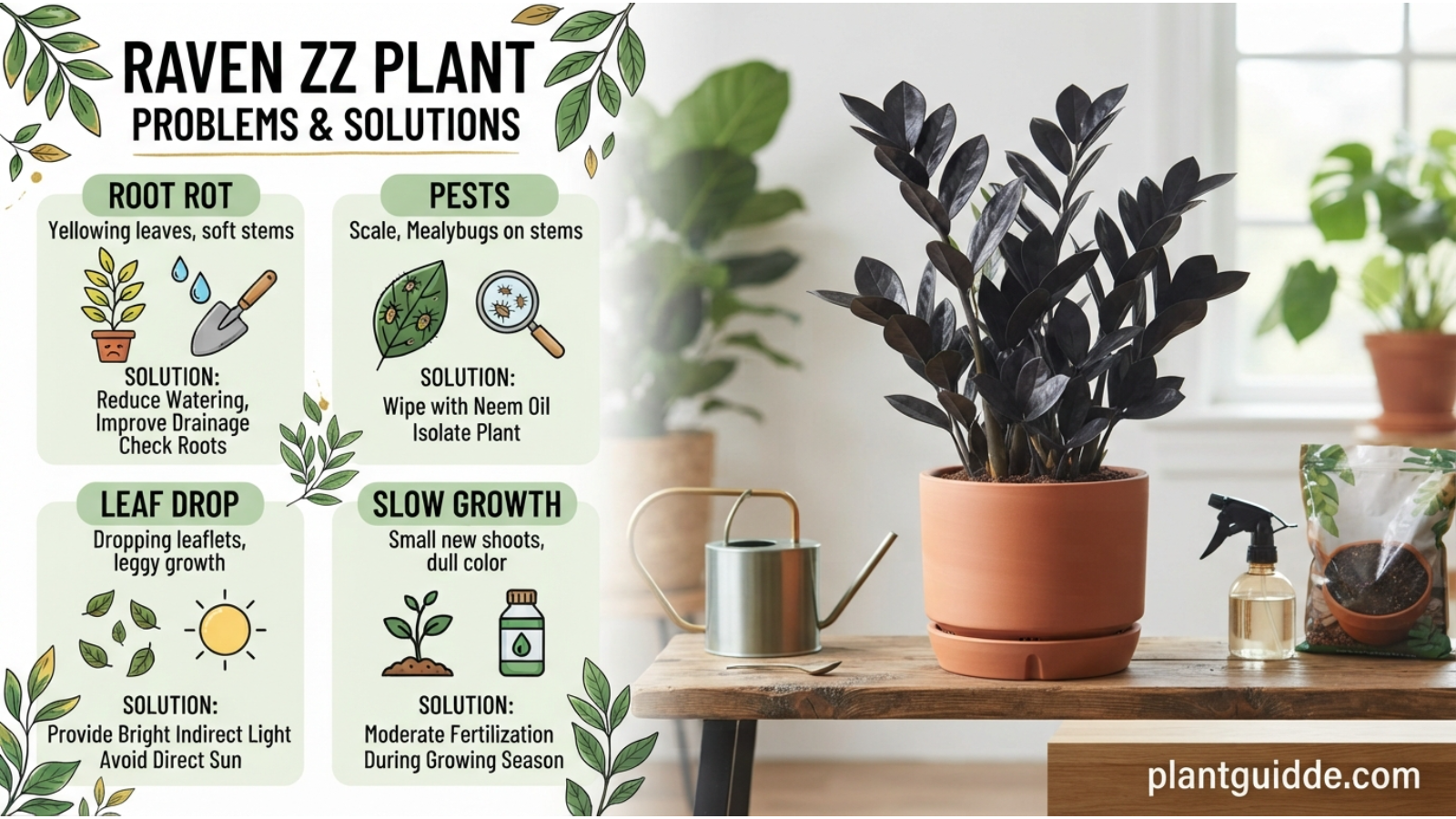
Raven ZZ Plant Problems and Solutions
Yellow Leaves
Yellow leaves can have several causes, but excess moisture is one of the first things to investigate.
Check:
- Is the soil still wet?
- Does the pot have drainage holes?
- Is the container oversized?
- Are you watering on a fixed schedule?
- Does the soil remain wet for many days?
If the answer to several of these is yes, overwatering is a strong possibility.
If only an older leaf occasionally yellows while the plant otherwise looks healthy, the situation may be less serious.
Brown or Crispy Leaves
Brown areas can result from several environmental stresses.
Potential causes include:
- Excessive direct sunlight
- Severe dryness
- Root problems
- Temperature stress
- Fertilizer accumulation
ZZ foliage can be damaged by excessive direct sunlight, and UConn notes that overexposure can cause whitening, curling, yellowing, and browning.
Don’t automatically respond to brown tips by watering more.
First determine whether the soil is actually dry and whether the plant is receiving harsh direct sun.
Raven ZZ Leaves Curling
Curling leaves can be a stress response.
Check the plant’s:
- Light exposure
- Soil moisture
- Temperature
- Recent environmental changes
If it is sitting in strong direct sunlight, move it into bright filtered or indirect light.
If the soil is excessively wet, address drainage rather than adding more water.
If the plant has recently been moved, give it time to acclimate rather than changing several conditions simultaneously.
Raven ZZ Stems Falling Over
A few stems leaning outward isn’t necessarily a disease.
Possible explanations include:
- Uneven light
- Natural growth habit
- Heavy foliage
- Weak growth from poor lighting
- Root or rhizome problems
If stems are soft, collapsing, or accompanied by persistently wet soil, investigate root or rhizome rot.
If they are firm but leaning toward a light source, the plant may simply need more evenly distributed indirect light.
Black Spots on Raven ZZ Stems
Not every black mark is rot.
Clemson Extension specifically notes that black spots on ZZ stems can be normal.
The important question is whether the tissue is firm and healthy or soft and deteriorating.
Don’t diagnose a problem from color alone. Check texture, moisture, and the condition of the entire plant.
Raven ZZ Plant Repotting: When and How
Raven ZZ usually doesn’t need frequent repotting because it is naturally slow-growing.
When repotting becomes necessary:
- Choose a container only slightly larger than the current one.
- Make sure it has drainage holes.
- Prepare a loose, well-draining potting mix.
- Remove the plant carefully.
- Inspect the rhizomes and roots.
- Remove obviously rotten material with a clean tool.
- Replant at approximately the same depth.
- Avoid immediately saturating a damaged root system.
If the roots and rhizomes are healthy, there is no reason to disturb them unnecessarily.
Image Suggestion: Step-by-step Raven ZZ repotting diagram showing pot selection, healthy rhizomes, soil mix, and final planting depth.
How to Propagate Raven ZZ
Raven ZZ can be propagated, although patience is required.
Common propagation approaches for ZZ plants include:
- Division
- Leaf cuttings
Extension sources identify both division and leaf-cutting propagation as viable methods for ZZ plants.
Division
Division is generally the more straightforward option when a mature plant has multiple rhizomes.
Carefully separate sections so that each division has a viable portion of the rhizome and associated growth.
Leaf propagation
Leaf propagation is possible but slow.
This is not a method for someone expecting a new Raven ZZ in a few weeks. ZZ plants are naturally slow-growing, so patience is part of the process.
Expert tip: If you already have a large, multi-rhizome plant, division is usually more practical than propagating dozens of individual leaves.
Seasonal Raven ZZ Plant Care
Spring and Summer
As light and temperatures increase:
- Check soil moisture more frequently.
- Resume light fertilization during active growth.
- Watch for new green shoots.
- Rotate the pot occasionally for balanced growth.
- Avoid increasing watering simply because the calendar says it is summer.
A bright, warm room can make the soil dry considerably faster than a dim room.
Fall and Winter
Growth may slow substantially.
That means the plant may use less water.
Reduce watering frequency according to how quickly the soil dries rather than maintaining your summer routine. NC Extension specifically recommends less frequent winter watering for ZZ plants.
Also pay attention to:
- Cold drafts
- Low natural light
- Overwatering
- Heating vents
- Sudden temperature changes
The biggest winter mistake is often continuing a summer watering schedule after the plant’s growth and water use have slowed.
The 7 Most Common Raven ZZ Care Mistakes
1. Watering on a calendar
A fixed schedule ignores changes in light, temperature, pot size, and soil.
Better: Check the actual moisture level.
2. Using a pot without drainage
This creates unnecessary risk around the rhizomes.
Better: Always use drainage.
3. Keeping the soil constantly moist
Raven ZZ stores water; it doesn’t need constantly wet roots.
Better: Allow the mix to dry completely between waterings.
4. Putting it in harsh afternoon sun
Low-light tolerance doesn’t mean unlimited sun tolerance.
Better: Provide bright, filtered or indirect light.
5. Expecting every new leaf to emerge black
New Raven ZZ growth is normally green.
Better: Allow the foliage to mature naturally.
6. Over-fertilizing a slow grower
More fertilizer doesn’t automatically mean more growth.
Better: Feed lightly during active growth.
7. Repotting too often
Repeated disturbance isn’t necessary for a slow-growing plant.
Better: Repot when the container or potting medium genuinely needs attention.
A Simple Raven ZZ Care Routine
If you want a low-maintenance routine, use this checklist:
Every 1–2 weeks
Check the soil rather than automatically watering.
When the soil is completely dry
Water thoroughly and allow excess water to drain.
Every few weeks
Inspect the foliage for pests, yellowing, damaged leaves, or unusual changes.
During active growth
Provide modest fertilizer according to the product instructions.
Every few months
Rotate the plant if growth is becoming strongly one-sided and wipe dust from the glossy foliage with a soft, damp cloth.
Once or twice a year
Evaluate whether the plant actually needs repotting.
This approach is more reliable than trying to follow a rigid “water every X days” routine.
Raven ZZ vs Regular ZZ Plant
Raven ZZ and the standard green ZZ are forms of the same species, Zamioculcas zamiifolia, so their fundamental care requirements are very similar.
| Feature | Raven ZZ | Regular ZZ |
|---|---|---|
| Botanical name | Zamioculcas zamiifolia ‘Raven’ | Zamioculcas zamiifolia |
| New growth | Green | Green |
| Mature foliage | Purple-black | Green |
| Light | Bright indirect; tolerates low light | Bright indirect; tolerates low light |
| Watering | Allow soil to dry completely | Allow soil to dry between waterings |
| Humidity | Average indoor humidity | Average indoor humidity |
| Growth | Slow | Slow |
| Difficulty | Beginner-friendly | Beginner-friendly |
The biggest difference is visual rather than fundamental: Raven develops dramatically dark mature foliage.
Is Raven ZZ Plant Good for Beginners?
Yes—provided the beginner understands one important rule:
Don’t love it to death.
Raven ZZ is forgiving because it tolerates low light, dry periods, and ordinary household humidity. But its tolerance for drought can encourage people to swing too far in the opposite direction and water heavily whenever they remember it.
For a beginner, Raven ZZ is especially useful because it teaches an important houseplant-care principle:
Watering frequency should follow the plant’s environment, not the calendar.
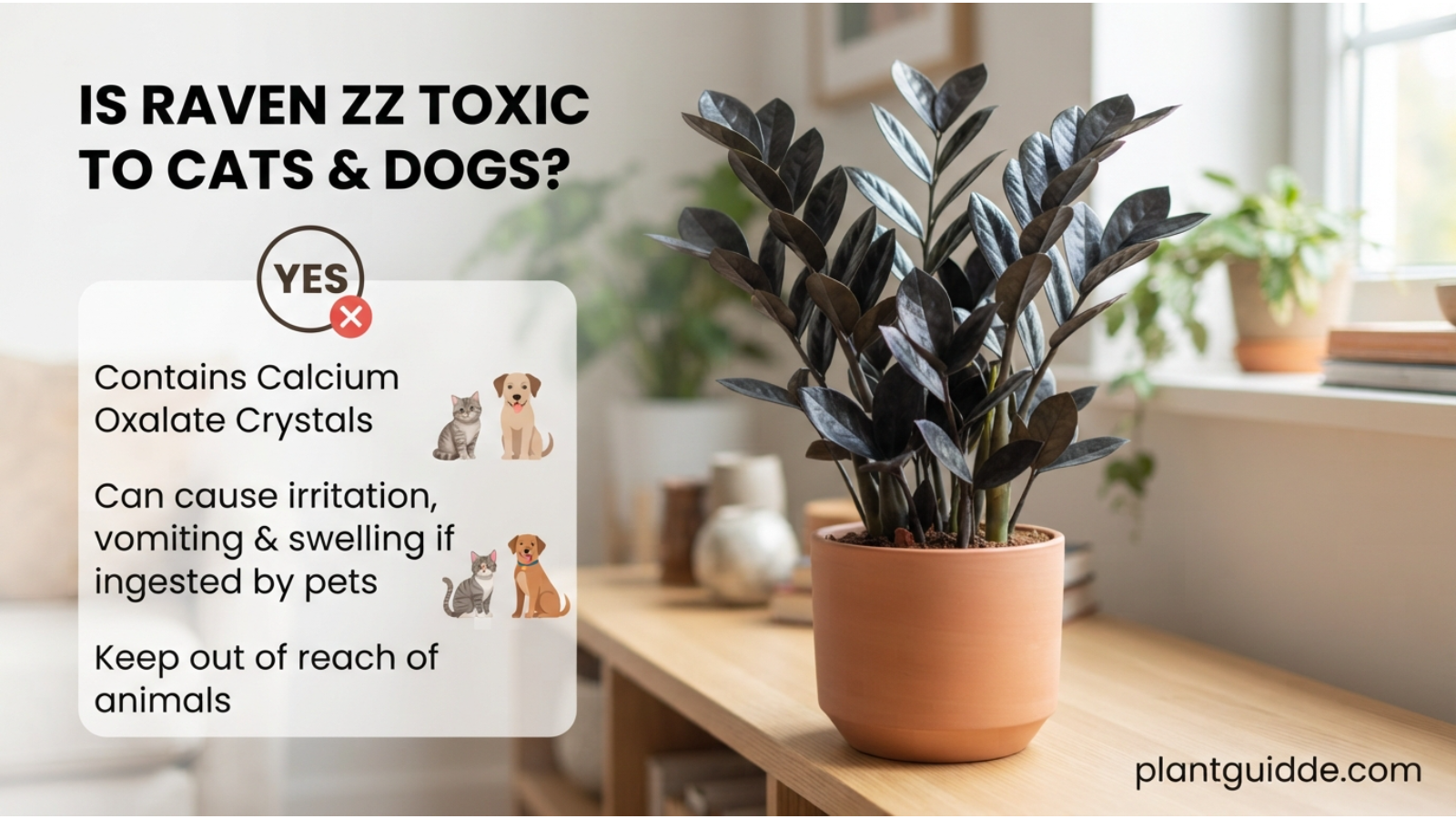
Is Raven ZZ Toxic to Cats and Dogs?
Yes. ZZ plants are considered toxic if ingested.
North Carolina Extension describes ZZ plant and Raven ZZ as having medium toxicity to cats and dogs, while UF/IFAS states that all parts of the plant are toxic if ingested.
If pets or children are likely to chew the plant, keep it somewhere inaccessible.
If ingestion occurs, contact an appropriate medical or veterinary professional for advice.
FAQs,
How often should I water a Raven ZZ plant?
Water only after the potting mix has dried completely. The interval varies with light, temperature, pot size, and soil, so a fixed schedule is less reliable than checking the soil.
Does Raven ZZ need direct sunlight?
No. Bright, indirect or filtered light is preferable. Prolonged intense direct sunlight can damage the foliage.
Why is my Raven ZZ growing green leaves?
New Raven ZZ foliage naturally emerges green and gradually becomes purple-black as it matures.
Does Raven ZZ need high humidity?
No. Average household humidity is generally sufficient.
Can Raven ZZ grow in low light?
Yes. It tolerates low light remarkably well, although growth is generally slower than it would be under brighter indirect light.
Why are my Raven ZZ leaves turning yellow?
Overwatering is one of the first things to investigate, particularly if the soil stays wet for long periods. Check drainage, soil moisture, and pot size before increasing watering.
Can I put Raven ZZ in a bathroom?
It can tolerate ordinary indoor conditions, but a bathroom isn’t necessary. Choose the location based primarily on suitable light and temperature rather than humidity.
How fast does Raven ZZ grow?
It is naturally slow-growing. Growth becomes faster under favorable conditions but remains considerably slower than many common tropical houseplants.
Does Raven ZZ need fertilizer?
Only modest amounts. A balanced fertilizer used sparingly during active growth is generally sufficient.
Should I mist my Raven ZZ?
Misting is unnecessary for normal indoor care. Average household humidity is adequate.
Final Takeaway
Successful Raven ZZ plant care is less about doing more and more about avoiding the wrong things.
Give it bright, indirect light, use a fast-draining soil mix, plant it in a container with drainage holes, and wait for the soil to dry completely before watering again. Keep temperatures comfortably warm, don’t worry about creating tropical humidity, and fertilize modestly during active growth.
Most importantly, don’t mistake Raven ZZ’s tolerance for neglect as permission to ignore its environment. A healthy plant should have firm stems, attractive foliage, and gradual new growth. If something goes wrong, investigate water, drainage, light, and temperature first before reaching for fertilizer or complicated treatments.
And if a new Raven ZZ leaf appears green, don’t panic, that is part of the plant’s normal development. With time, the foliage can transform into the deep, almost black color that makes the Raven cultivar so distinctive.

Asad Mumtaz is a dedicated plant enthusiast and gardening writer with a passion for helping people care for their plants successfully. He specializes in plant care guides, indoor gardening, and practical growing tips for all skill levels. His content focuses on making gardening simple, enjoyable, and rewarding. Through his work, Asad shares reliable advice to help readers create thriving green spaces.