The ZZ plant is one of the most forgiving houseplants you can grow indoors, but tolerating neglect and thriving under neglect are not the same thing. zz plant care indoors.
Zamioculcas zamiifolia stores water in thick underground rhizomes, allowing it to handle dry periods and relatively low light. This makes it an excellent choice for beginners, offices, apartments, and rooms where other houseplants may struggle.
However, the biggest mistake with ZZ plant care indoors is often giving it too much rather than too little. Repeatedly wet soil can lead to root and rhizome rot, while excessive watering is far more dangerous than a missed watering. The key to a healthy ZZ plant is simple: provide the right balance of light, water, soil, and feeding, and let the plant’s natural drought tolerance work in your favor.
Quick Answer
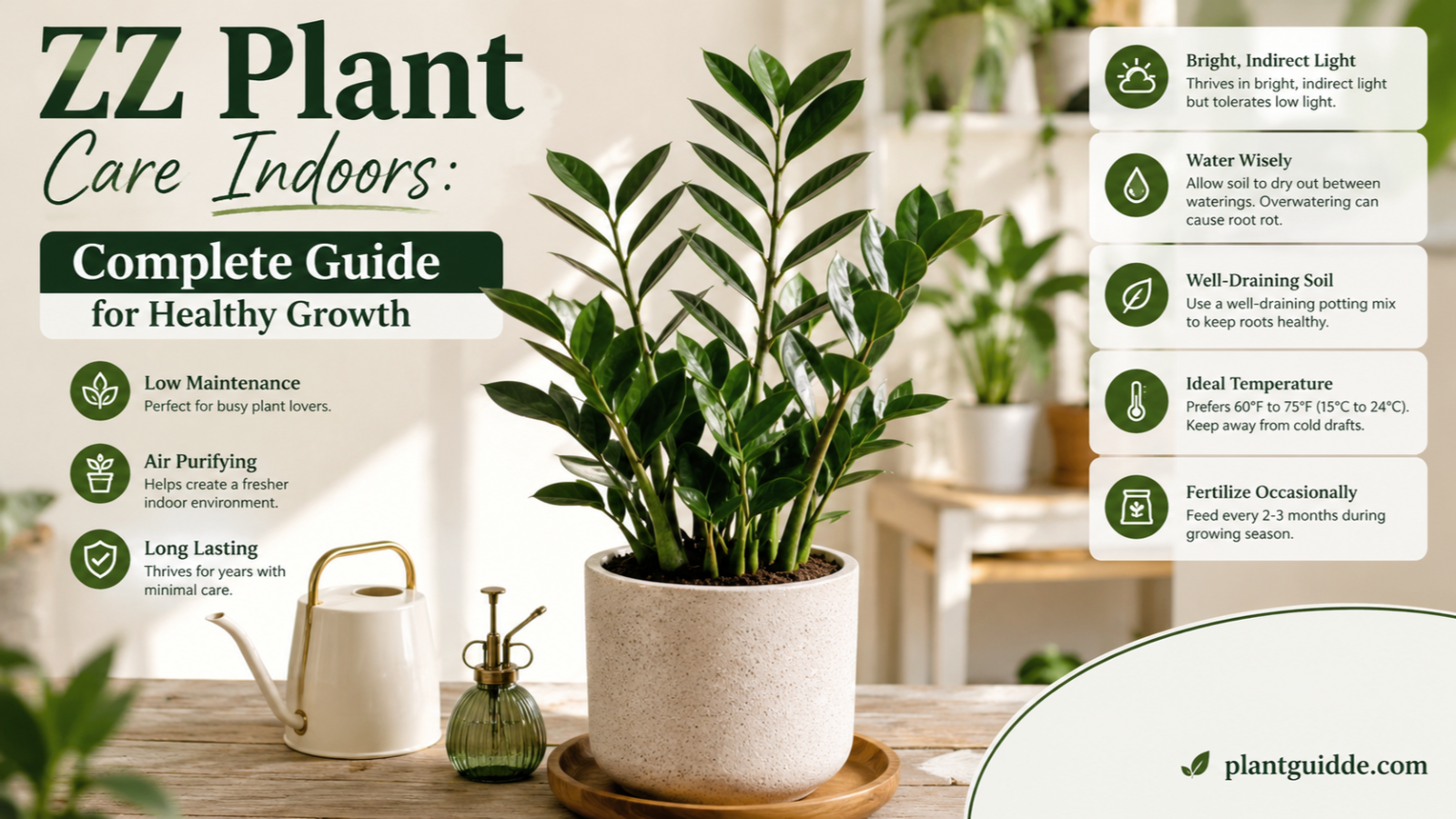
For successful ZZ plant care indoors, place your ZZ plant in bright, indirect light, although it can tolerate low light. Water thoroughly only when the potting mix has dried out, and always use a pot with drainage. A coarse, well-draining soil mix prevents water from remaining around the rhizomes. Average household humidity is usually sufficient. Avoid frequent watering, soggy soil, and strong direct afternoon sunlight.
ZZ Plant Care at a Glance
| Care factor | What your ZZ plant needs |
|---|---|
| Light | Bright, indirect light is ideal; low light is tolerated |
| Water | Allow the soil to dry between waterings |
| Soil | Loose, coarse, fast-draining potting mix |
| Pot | Drainage holes are essential |
| Humidity | Average household humidity is generally adequate |
| Temperature | Warm indoor conditions; protect from cold |
| Fertilizer | Light feeding during active growth |
| Growth rate | Naturally slow to moderate indoors |
| Repotting | Only when the plant becomes root/rhizome-bound or the mix deteriorates |
| Pets | Not considered pet-safe if eaten |
These requirements are consistent with recommendations from university extension services and the RHS.
Image Suggestion: A labeled ZZ plant care infographic showing light, watering, soil, temperature, and pot requirements.
Understand Your ZZ Plant Before Changing Its Care
The common zz plant care indoors is Zamioculcas zamiifolia, an evergreen member of the Araceae family native to eastern Africa. Its thick rhizomes act as water-storage organs, which explains much of its unusual tolerance for drought.
Those rhizomes change how you should think about watering.
With many tropical houseplants, people worry about the soil becoming too dry. With a ZZ plant, the more important question is often:
Has the soil stayed wet for too long?
The plant can draw on stored moisture in its rhizomes during dry periods. This is why a ZZ plant can remain healthy despite periods of neglect, while frequent watering can create serious problems.
This also explains why ZZ plant care indoors should be based on the condition of the soil and the plant rather than an automatic weekly schedule.
How Much Light Does a ZZ Plant Need?
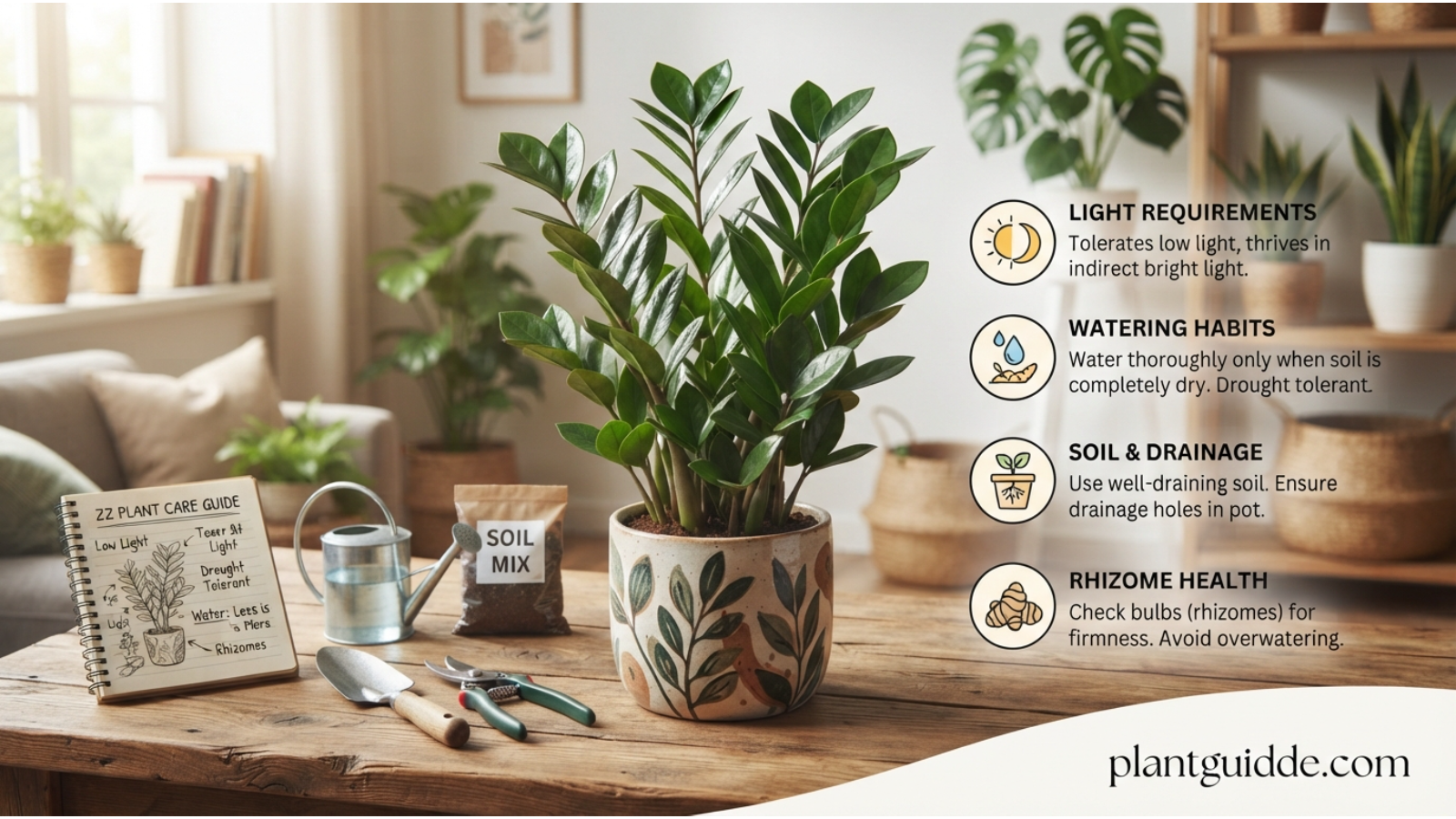
zz plant care indoors are famous for tolerating low light, but low light is not the same thing as ideal light.
For the best combination of healthy foliage and reasonable growth, place your ZZ plant in bright, indirect light. It can tolerate considerably lower light, but growth becomes slower as available light decreases.
Best indoor locations
Good options include:
- A few feet from a bright window
- A room with filtered daylight
- An east-facing window with gentle morning light
- A bright office
- A location receiving strong ambient daylight without harsh sun hitting the leaves
Avoid placing the plant where strong afternoon sunlight falls directly onto its foliage for long periods. Excessive direct light can cause leaf scorching, bleaching, curling, yellowing, and browning.
Can a ZZ plant grow in a dark room?
It can tolerate low-light conditions, but there is a limit.
A plant may survive in a dim corner while barely producing new growth. If you want your ZZ plant to grow more actively, move it toward brighter indirect light.
For genuinely windowless spaces, artificial lighting can be useful. Indoor plants can be grown successfully with appropriate artificial lighting when natural daylight is inadequate.
A useful placement rule
If you can comfortably read a book in the room during the daytime without turning on a light, the space may have enough ambient light for a ZZ plant to survive—but brighter indirect light will generally produce better growth.
Image Suggestion: Three indoor ZZ plant placements labeled “bright indirect,” “low light,” and “too much direct sun.”
ZZ Plant Watering: The Most Important Part of Care
If you remember only one thing about ZZ plant watering, remember this:
Do not water simply because it is watering day. Check the soil first.
ZZ plants prefer to dry between waterings. Extension and horticultural sources consistently warn against keeping the plant continuously wet.
How to water a ZZ plant correctly
- Check the potting mix several inches below the surface.
- If it is still noticeably moist, wait.
- If the mix has dried substantially, water thoroughly.
- Allow excess water to drain completely from the bottom.
- Empty standing water from a saucer or decorative container.
The exact interval varies because indoor conditions differ.
A plant in bright light and warm conditions may use water faster than one sitting in a dim, cool room. Pot size and soil composition also make a major difference.
Some extension guidance gives roughly weekly-to-biweekly watering under typical conditions, while more conservative ZZ-specific guidance recommends watering only after the medium has completely dried. The condition of the soil is therefore more reliable than a fixed calendar.
What if you are unsure whether to water?
Wait.
For an established ZZ plant, being slightly too dry is generally safer than repeatedly watering soil that is still wet.
Winter watering
During winter, indoor growth commonly slows. Reduced growth means the plant may use water more slowly.
Do not continue your summer watering routine automatically.
Check the soil and extend the interval when necessary. North Carolina Extension, for example, recommends watering much less frequently during winter when the plant is not actively growing.
What Soil Is Best for a ZZ Plant?
The ideal ZZ plant soil should drain quickly rather than hold large amounts of water around the roots and rhizomes.
A practical mix can contain:
- Quality indoor potting soil
- Perlite or pumice
- Coarse material such as bark or another drainage-improving component
Clemson Extension gives a more specific example of approximately 50% peat/coir-based potting soil, 25% perlite, and 25% sand for a coarse, well-draining medium.
You do not need to copy that exact ratio for every plant.
The more useful principle is:
Choose a mix that becomes adequately moist when watered but drains freely afterward.
Avoid dense garden soil in an indoor pot. It can compact around the roots and reduce drainage.
Why soil matters so much
Imagine two identical ZZ plants.
- Plant A is in loose, well-draining soil.
- Plant B is in dense soil that stays wet for a long time.
Even if both receive the same amount of water, Plant B is at greater risk because its roots and rhizomes remain exposed to excessive moisture.
Image Suggestion: Side-by-side diagram comparing a compacted, water-retentive mix with a loose ZZ plant potting mix.
Choose a Pot With Drainage
A drainage hole is not a minor feature for ZZ plant care—it is one of the easiest ways to prevent watering mistakes.
When you water thoroughly, excess water needs somewhere to go.
A decorative cachepot without drainage can trap water around the root system even when the soil surface appears dry.
Best practice
If you like decorative pots:
Use a nursery pot with drainage holes inside the decorative container.
After watering, allow the nursery pot to drain completely before returning it to the outer pot.
Clemson Extension specifically advises ensuring the container drains fully and not allowing the plant to sit in water.
Temperature and Humidity
One reason ZZ plants work so well indoors is their adaptability.
Average household humidity is generally sufficient; unlike some tropical houseplants, a ZZ plant does not require constant misting or a humidifier to remain healthy.
Temperature
Aim for normal warm indoor temperatures and protect the plant from:
- Cold drafts
- Freezing temperatures
- Very cold windows
- Sudden temperature extremes
- Direct blasts from heating or cooling equipment
RHS guidance places an appropriate range for ZZ plants around 18–26°C, with protection below approximately 15°C.
Does a ZZ plant need misting?
Usually, no.
Misting may temporarily increase moisture around the foliage, but it is not necessary for normal ZZ plant care indoors.
Instead of focusing on misting, concentrate on the factors that matter much more:
light + drainage + watering + temperature stability.
Does a ZZ Plant Need Fertilizer?
ZZ plants are naturally slow-growing, so heavy feeding is unnecessary.
During active growth, a diluted balanced houseplant fertilizer can be used sparingly. Recommendations vary by growing conditions, but extension guidance commonly suggests light feeding rather than aggressive fertilization.
For a beginner, a simple approach is:
- Feed lightly during spring and summer.
- Follow the fertilizer label.
- Dilute when appropriate.
- Reduce or stop feeding during slow winter growth.
- Never use fertilizer to compensate for poor light or unhealthy roots.
Why more fertilizer is not better
Fertilizer does not create growth by itself.
If a plant lacks adequate light, water, or healthy roots, adding more fertilizer can increase salt accumulation without solving the underlying problem.
A slow-growing ZZ plant is not necessarily unhealthy.
How Fast Does a ZZ Plant Grow?
One of the most common beginner mistakes is assuming that a healthy plant should constantly produce new leaves.
ZZ plants are relatively slow growers indoors, particularly in low-light environments. University extension sources describe them as slow-growing and note that increased light can encourage more active growth.
A ZZ plant may appear unchanged for weeks or months and then produce a new shoot.
That is normal.
If your ZZ plant is not growing
Check these factors before adding fertilizer:
- Is it receiving enough indirect light?
- Is the soil staying wet too long?
- Is the pot excessively large?
- Is the plant currently in a slower season?
- Are the roots and rhizomes healthy?
More fertilizer is rarely the first solution.
How to Tell if Your ZZ Plant Is Healthy
A healthy ZZ plant generally has:
- Firm, upright stems
- Glossy, intact leaflets
- Consistent green coloration appropriate to its variety
- No persistent mushiness around the base
- Gradual production of new shoots under favorable conditions
New growth can appear as a tightly rolled or spear-like shoot before expanding.
Don’t judge the plant’s health solely by how quickly it grows.
For ZZ plants, stable foliage and healthy stems can be a better sign than rapid new growth.
Common ZZ Plant Problems and What They Mean
Yellow Leaves
Yellowing leaves can have several causes, but persistent yellowing combined with wet soil should immediately make you examine your watering routine.
What to check
- Is the soil still wet?
- Does the pot have drainage holes?
- Is water collecting in the saucer?
- Is the potting mix compacted?
- Are the stems or rhizomes becoming soft?
Overwatering is a major cause of ZZ plant decline, and root or rhizome rot can follow prolonged excessive moisture.
Do not respond to yellow leaves by automatically giving the plant more water.
Brown Leaves or Brown Tips
Brown areas may result from several environmental stresses.
Check:
- Excessive direct sunlight
- Very dry conditions combined with prolonged dehydration
- Root problems
- Physical damage
- Aging foliage
If the browning appears on the side facing intense sunlight, examine the plant’s location first. Direct sunlight can scorch ZZ foliage.
Curling Leaves
Curling leaves can indicate stress.
Consider:
- Excessive direct light
- Dehydration
- Temperature stress
- Root damage
- Sudden environmental changes
Avoid diagnosing the problem from the leaf shape alone.
Instead, inspect the soil, roots, light exposure, and temperature together.
Drooping or Leaning Stems
A leaning stem does not automatically mean the plant needs water.
Possible causes include:
- Uneven light
- New growth naturally changing position
- Weak or damaged roots
- Overwatering-related root problems
- A plant becoming crowded
If the soil is already wet, watering again is likely to make the situation worse.
Soft or Mushy Stems
This is more concerning than ordinary drooping.
Softness near the base, persistent wet soil, unpleasant soil odor, or deteriorating roots can indicate excessive moisture and rot.
In that situation, stop routine watering and inspect the root system.
If damaged roots or rhizomes are found, remove the affected material with a clean tool and repot the healthy portions into fresh, well-draining medium.
The Most Common ZZ Plant Care Mistakes
1. Watering on a fixed schedule
“Every Sunday” sounds simple, but indoor conditions change.
Better approach: Check the soil before watering.
2. Putting the plant in a completely dark corner
ZZ plants tolerate low light, but they do not need to be deliberately starved of light.
Better approach: Give it bright indirect light whenever possible.
3. Using a pot without drainage
Water trapped at the bottom can keep the root zone wet long after the surface appears dry.
Better approach: Use a drainage hole.
4. Treating the ZZ like a tropical humidity-loving plant
Constant misting is unnecessary.
Better approach: Focus on appropriate light, soil, and watering.
5. Using heavy soil
Poor drainage increases the risk of prolonged moisture.
Better approach: Use a loose, well-draining mix.
6. Fertilizing too aggressively
Slow growth is normal.
Better approach: Feed lightly during active growth rather than trying to force rapid growth.
7. Repotting too often
ZZ plants do not need frequent disturbance.
Better approach: Repot when the plant is genuinely outgrowing its container or the potting medium has deteriorated.
When Should You Repot a ZZ Plant?
Repotting is not something you need to do every year simply because the calendar says so.
Consider repotting when:
- Roots or rhizomes are becoming severely crowded
- The container is unstable
- Water drains unusually poorly
- The potting medium has broken down
- The plant has clearly outgrown its container
Choose a container only moderately larger than the current one.
A dramatically oversized pot can hold more moisture than the plant can use, which is particularly undesirable for a plant that prefers drying between waterings.
After repotting
Do not immediately compensate for the disturbance with excessive watering.
Use a well-draining mix, ensure good drainage, and return the plant to suitable light.
How to Clean ZZ Plant Leaves
The glossy leaves naturally collect dust.
A soft, damp cloth can be used gently to clean the foliage.
Avoid relying on commercial leaf-shine products. The ZZ plant’s foliage is naturally glossy, and UF/IFAS notes that its leaves do not require polish.
Cleaning the leaves also gives you an opportunity to inspect them for:
- Mealybugs
- Aphids
- Thrips
- Whiteflies
- Other signs of pest activity
Although ZZ plants are generally resilient, they are not completely immune to common houseplant pests.
ZZ Plant Care Indoors in Different Seasons
Spring
As light levels increase, the plant may become more active.
Check the soil more frequently, but do not increase watering automatically.
This is also a suitable period for light fertilization.
Summer
Bright indirect light and warmer temperatures can increase water use.
Check the soil regularly, especially if the plant is close to a bright window.
Do not confuse increased water consumption with a need to keep the soil constantly moist.
Fall
Growth may begin slowing as daylight decreases.
Adjust watering according to the soil rather than maintaining a summer routine.
Winter
This is often when overwatering becomes particularly easy.
Lower light and slower growth can mean the soil remains wet longer.
Reduce watering frequency when necessary and keep the plant away from cold drafts.
How to Get a ZZ Plant to Grow Faster
There is no reliable shortcut to turning a naturally slow-growing ZZ plant into a fast-growing plant.
Instead, optimize the conditions that support growth:
Give it better light
Move it from deep shade toward bright indirect light.
Maintain healthy roots
Avoid keeping the potting mix continuously wet.
Use appropriate nutrition
Apply a balanced fertilizer sparingly during active growth.
Give it time
ZZ plants naturally grow more slowly than many popular tropical houseplants.
One of the most useful lessons in ZZ plant care indoors is that patience is part of the process.
If the plant is healthy but slow, slow growth is not necessarily a problem.
Can You Propagate a ZZ Plant?
Yes. ZZ plants can be propagated by methods including leaf cuttings and division.
However, propagation is not instant.
A leaf cutting may take considerable time to develop roots and new growth. This is another area where beginners often become impatient.
Division is generally more immediately rewarding when a mature plant has multiple rhizomes that can be separated.
Image Suggestion: Step-by-step ZZ plant propagation diagram showing leaf cutting, rooting, rhizome development, and new shoot emergence.
Is a ZZ Plant Safe for Cats and Dogs?
No. ZZ plants should be treated as harmful if eaten by pets.
The ASPCA identifies ZZ plants among plants containing insoluble calcium oxalates. Chewing the plant can cause mouth irritation and symptoms such as drooling, retching, nausea, vomiting, and gastrointestinal upset.
The RHS also lists Zamioculcas zamiifolia as harmful if eaten and notes that it can irritate the skin and eyes.
If you have cats, dogs, or young children who may chew plants, place the ZZ plant somewhere inaccessible.
If a pet has eaten part of the plant and is showing concerning symptoms, contact a veterinarian or appropriate poison-control service rather than relying on internet diagnosis.
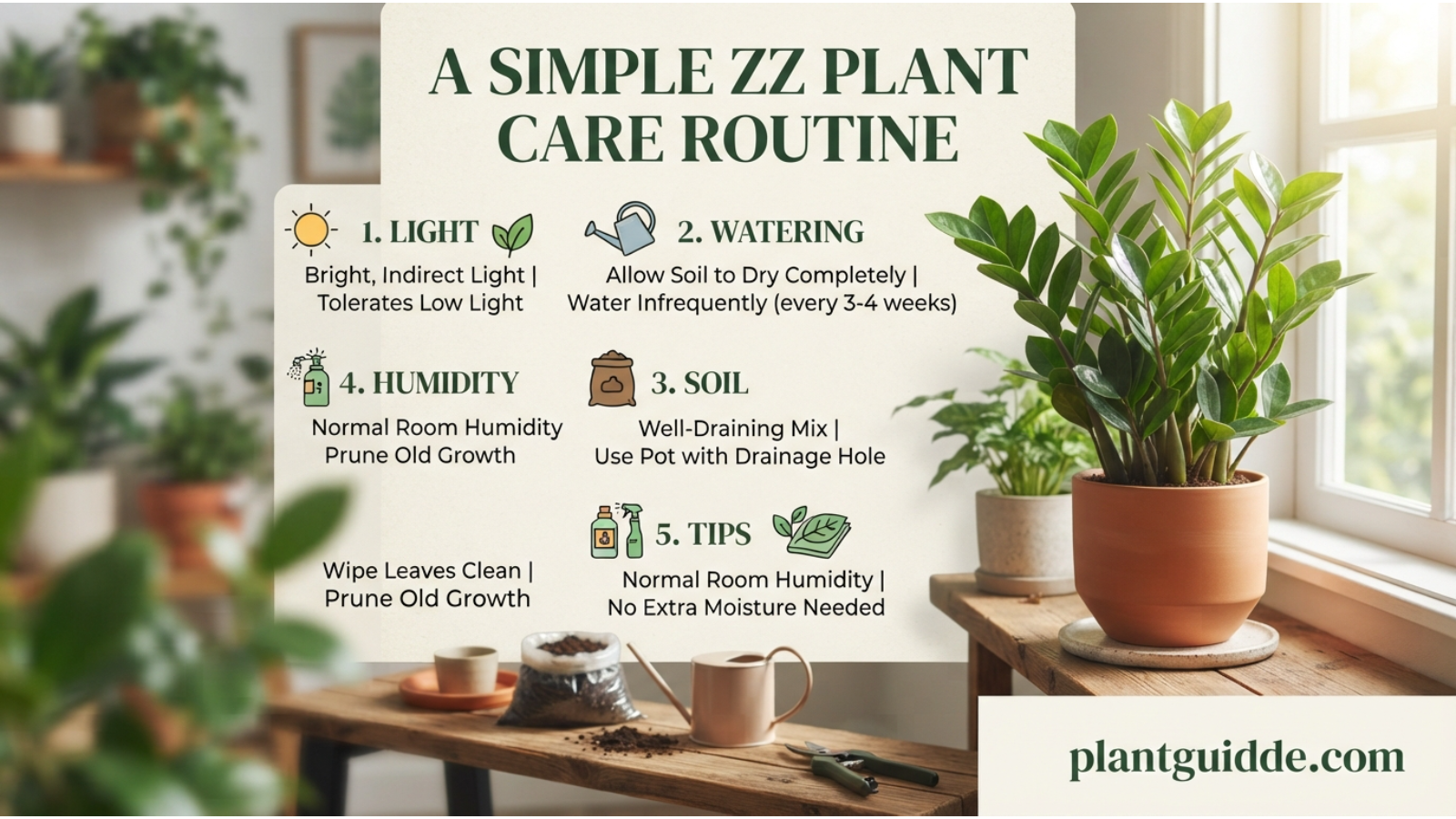
A Simple ZZ Plant Care Routine
You do not need a complicated maintenance schedule.
Every few days
Look at the plant.
Check for:
- New growth
- Damaged leaves
- Pest activity
- Unusual yellowing
- Changes in stem firmness
Before watering
Check the soil.
If it is still moist, wait.
When watering
Water thoroughly enough to moisten the mix, then allow excess water to drain away completely.
Monthly
Inspect:
- Light exposure
- Soil condition
- Pot drainage
- Leaf cleanliness
- Pest activity
During active growth
Consider light fertilization if the plant is healthy and actively growing.
This routine is more useful than trying to follow an exact watering calendar because indoor conditions vary.
ZZ Plant Troubleshooting: What Should You Check First?
When something looks wrong, use this order:
1. Soil moisture → 2. Drainage → 3. Light → 4. Temperature → 5. Roots → 6. Fertilizer
This sequence prevents one of the most common houseplant mistakes: treating the visible symptom instead of the underlying problem.
For example, yellow leaves may tempt you to add fertilizer, but if the soil is saturated, fertilizer is not the first thing the plant needs.
Likewise, slow growth may tempt you to water more, even though insufficient light could be the real limiting factor.
FAQs,
How often should I water a ZZ plant indoors?
Water when the potting mix has dried substantially rather than following a strict calendar. Depending on light, temperature, pot size, and soil, this may be every week or two or considerably less often. During winter, watering may need to be reduced further.
Does a ZZ plant need direct sunlight?
No. Bright, indirect light is preferable. ZZ plants tolerate low light, while strong direct sunlight—especially harsh afternoon sun—can scorch the foliage.
Can ZZ plants grow in low light?
Yes. They are unusually tolerant of low-light interiors. However, lower light generally means slower growth. Bright indirect light is better when your goal is active, healthy growth.
Why are my ZZ plant leaves turning yellow?
Overwatering is one of the first things to investigate, especially if the soil stays wet for long periods. Also check drainage and the condition of the roots and rhizomes.
Why is my ZZ plant not growing?
ZZ plants naturally grow slowly indoors. Low light can slow growth even further. Improve indirect light, maintain healthy roots, and give the plant time rather than immediately increasing fertilizer.
Does a ZZ plant need high humidity?
No. Average household humidity is generally adequate. ZZ plants are considerably less demanding about humidity than many tropical houseplants.
Should I mist my ZZ plant?
Misting is generally unnecessary. Proper light, watering, drainage, and soil are much more important to long-term plant health.
What is the best soil for a ZZ plant?
Use a loose, well-draining potting mix that does not remain saturated. A mix incorporating potting soil with materials such as perlite and other coarse components can improve drainage.
Can I put a ZZ plant in a bathroom?
Yes, provided the bathroom has adequate light. Humidity itself is usually not the deciding factor; light and proper watering matter more.
Can a ZZ plant survive without water for a long time?
Yes. Its water-storing rhizomes make it highly drought tolerant. However, prolonged neglect can eventually cause stress and leaf loss, so drought tolerance should not be confused with an ideal care strategy.
Are ZZ plants toxic to cats and dogs?
Yes. The ASPCA lists ZZ plants among plants containing insoluble calcium oxalates that can irritate the mouth and gastrointestinal tract when chewed or eaten.
Conclusion
Successful ZZ plant care indoors is surprisingly simple once you understand what the plant is designed to do. Give it bright indirect light when possible, use a well-draining pot and soil, and allow the growing medium to dry between waterings. Keep it in a stable indoor environment, fertilize sparingly during active growth, and resist the urge to fix slow growth with more water or fertilizer.
If your ZZ plant is struggling, start with the basics, check the soil, inspect drainage, evaluate the light, and examine the roots before changing anything else. That approach solves many of the problems that make an otherwise easy houseplant suddenly look unhealthy. For beginners, that is the real advantage of the ZZ plant: it gives you room to learn without demanding constant attention.

Asad Mumtaz is a dedicated plant enthusiast and gardening writer with a passion for helping people care for their plants successfully. He specializes in plant care guides, indoor gardening, and practical growing tips for all skill levels. His content focuses on making gardening simple, enjoyable, and rewarding. Through his work, Asad shares reliable advice to help readers create thriving green spaces.