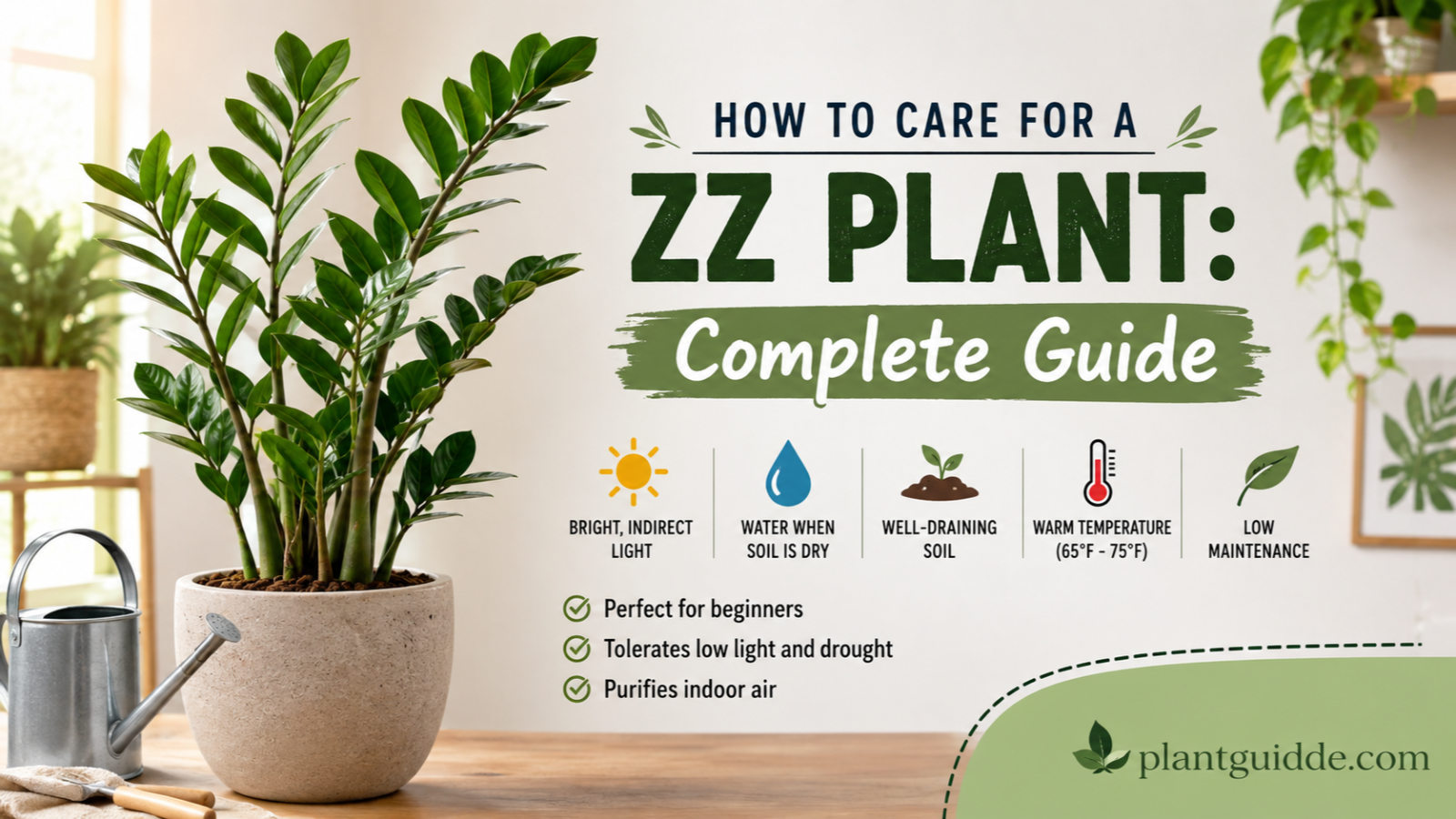
The ZZ plant has earned its reputation as one of the easiest houseplants to grow, and for good reason. Its thick stems, waxy leaflets, and underground rhizomes help it tolerate low light and periods of drought that can quickly stress other indoor plants. Care for a ZZ Plant.
Most ZZ plant problems come from giving it too much rather than too little. Overwatering, heavy soil, poor drainage, and intense direct sunlight can cause more trouble than occasional neglect.
The secret to successful ZZ plant care is understanding what this plant actually needs. Its water-storing rhizomes allow it to handle dry periods, while bright, indirect light supports healthier and stronger growth.
In this guide, you’ll learn how to care for a ZZ plant indoors, including watering, light, soil, humidity, temperature, fertilizer, repotting, pruning, propagation, seasonal care, and common problems.
Quick Answer
To care for a ZZ plant (Zamioculcas zamiifolia), place it in bright, indirect light, use a well-draining potting mix, and allow the soil to dry completely or nearly completely between thorough waterings. Keep it away from prolonged direct afternoon sun and standing water. ZZ plants tolerate low light, dry conditions, and average household humidity, but overwatering is the most common mistake.
What Is a ZZ Plant?
The ZZ plant, scientifically known as Zamioculcas zamiifolia, is a tropical perennial in the Araceae family. It is native to eastern Africa and is commonly sold under names such as Zanzibar gem, eternity plant, and aroid palm.
Unlike many tropical houseplants, ZZ plants have thick underground rhizomes that store water. Their fleshy leaf stalks and glossy leaflets also help the plant conserve moisture.
This explains several characteristics that can otherwise seem unusual:
- The plant can tolerate missed waterings.
- It can survive in relatively low light.
- It grows slowly indoors.
- Constantly wet soil can cause serious problems.
- A healthy ZZ does not need high humidity to thrive.
- New growth may appear in occasional bursts rather than continuously.
A ZZ plant can eventually become a substantial indoor specimen, but patience is important. Growth is naturally slow, particularly when light levels are low.
Image Suggestion: Botanical-style labeled illustration showing a ZZ plant, glossy leaflets, thick petioles, and underground water-storing rhizomes.
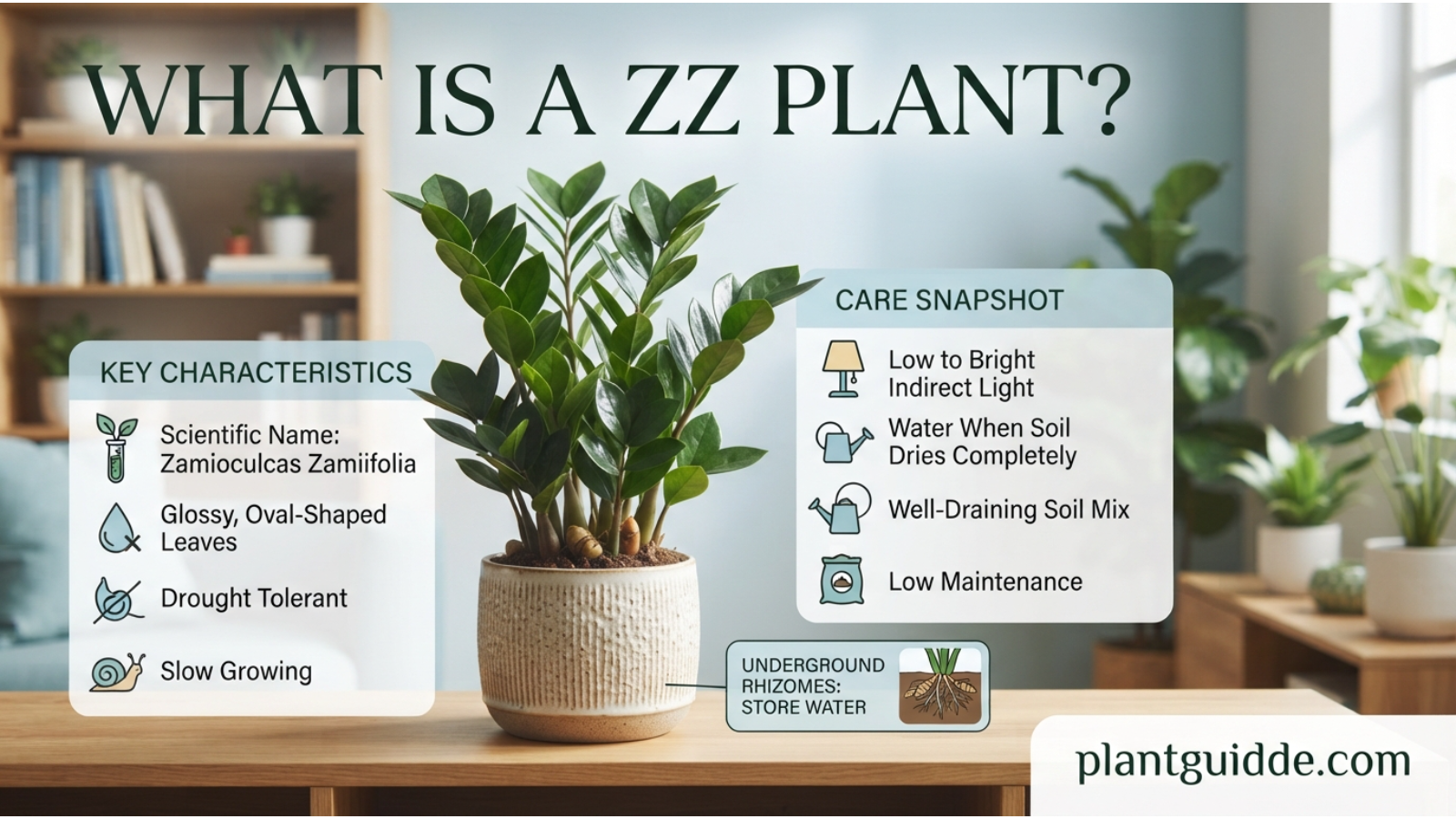
ZZ Plant Care Requirements at a Glance
| Care factor | Best approach |
|---|---|
| Light | Bright, indirect light is ideal |
| Low light | Tolerated, but growth may be slower |
| Direct sun | Avoid prolonged intense afternoon sun |
| Water | Water thoroughly, then let soil dry before watering again |
| Soil | Coarse, well-draining potting mix |
| Pot | Container with drainage holes |
| Humidity | Average household humidity is usually sufficient |
| Temperature | Warm indoor conditions; avoid cold drafts |
| Fertilizer | Light feeding during active growth |
| Growth rate | Naturally slow to moderate indoors |
| Repotting | Only when the plant becomes root/rhizome crowded or the soil breaks down |
| Main risk | Overwatering and poor drainage |
These recommendations are consistent with university extension and horticultural guidance, although the exact watering interval varies with light, temperature, pot size, soil, and season.
Give Your ZZ Plant the Right Light
Light is one of the most misunderstood parts of ZZ plant care.
ZZ plants are famous for tolerating low light, but tolerating low light is not the same as preferring it.
The best indoor position is generally somewhere with bright, filtered or indirect light. A location near a bright window where the plant is protected from harsh direct afternoon sun is usually a good starting point.
Can a ZZ plant grow in low light?
Yes.
ZZ plants can remain healthy in surprisingly dim indoor locations. They are even used successfully in offices and other interiors with limited natural light. However, lower light generally means slower growth.
If your priority is simply keeping the plant alive, low light may be acceptable.
If your goal is new shoots, fuller growth, and faster development, give it brighter indirect light.
Can ZZ plants tolerate direct sunlight?
Some gentle direct sunlight may be tolerated, but prolonged intense sun—especially strong afternoon exposure through glass—can scorch foliage.
Signs of excessive light can include:
- Bleached or pale patches
- Curling leaves
- Yellowing
- Brown or scorched areas
If these symptoms develop after moving the plant into a brighter location, gradually reduce the intensity rather than assuming the plant needs even more light.
Practical tip: Think of the ideal location as bright enough to read comfortably during the day, but without harsh sunlight continuously striking the leaves.
Image Suggestion: Diagram comparing low light, bright indirect light, and harsh direct sunlight for a ZZ plant.
Water Your ZZ Plant Less Often Than You Think
If there is one ZZ plant care rule worth remembering, it is this:
Do not water simply because it is watering day. Check the soil first.
ZZ plants store water in their rhizomes, which makes them unusually tolerant of dry conditions. Problems are much more likely when the roots remain wet for extended periods.
How often should you water a ZZ plant?
There is no universally correct schedule.
Under many indoor conditions, watering may be needed roughly every couple of weeks, while plants in darker, cooler rooms may need considerably less frequent watering. Clemson Extension currently recommends watering only after the potting medium has completely dried, while other extension guidance gives approximate intervals such as 7–14 days under typical conditions.
The difference matters because watering frequency depends on the environment.
A ZZ plant in:
- bright light,
- a warm room,
- a small pot,
- and a fast-draining mix
will dry much faster than one in:
- low light,
- a cool room,
- a large pot,
- and moisture-retentive soil.
The correct way to water
When the soil is dry enough to water:
- Water the soil thoroughly.
- Allow excess water to drain from the bottom.
- Empty the saucer or decorative container.
- Do not let the pot sit in standing water.
- Wait until the soil dries again before watering.
Thorough watering followed by a genuine drying period is generally better than giving the plant small amounts of water repeatedly.
The biggest watering mistake
A common beginner habit is giving a ZZ plant a small amount of water every few days.
That sounds cautious, but it can actually keep the root zone persistently damp.
For this plant, less frequent but thorough watering is usually safer than frequent little sips.
Choose Soil That Drains Quickly
ZZ plants are forgiving about soil composition, but they are not forgiving of prolonged waterlogged conditions.
A good ZZ plant soil should:
- drain readily,
- contain enough air space around the roots,
- resist becoming compacted,
- and dry reasonably between waterings.
Clemson Extension recommends a coarse, well-draining mix and gives a practical example based on potting mix, perlite, and sand. UF/IFAS likewise recommends well-drained potting media.
A practical ZZ plant soil mix
For indoor growing, you can use:
- 50% quality peat- or coir-based potting mix
- 25% perlite
- 25% coarse material such as horticultural sand
The exact recipe is less important than the final behavior of the mix.
If water remains trapped around the rhizomes for a long time, the mix is not performing well for your particular growing conditions.
Why drainage matters more than the exact recipe
Many plant owners spend too much time searching for the “perfect” soil recipe.
For a ZZ plant, the more useful question is:
Does this soil drain well and dry appropriately between waterings?
That is what determines whether the roots remain oxygenated or sit in prolonged moisture.
Image Suggestion: Close-up infographic showing healthy airy soil versus compacted, waterlogged soil around ZZ rhizomes.
Use a Pot With Drainage Holes
Even excellent soil cannot compensate for a container that traps water.
Choose a pot with at least one functional drainage hole. If your ZZ plant is placed inside a decorative cachepot, remove the growing pot when watering or make sure excess water can escape completely.
Oversized containers can also create problems because a large volume of soil may remain wet for much longer than the root system requires.
When should you repot?
ZZ plants do not need frequent repotting.
Consider repotting when:
- roots or rhizomes have become severely crowded,
- the plant repeatedly dries out extremely quickly,
- the pot has become unstable,
- or the potting mix has broken down and drains poorly.
When repotting, avoid moving a small plant into a dramatically oversized container.
A slightly larger pot is generally more manageable because it allows the soil to dry at a reasonable rate.
Keep Humidity and Temperature Reasonable
One advantage of the ZZ plant is that it does not demand tropical humidity indoors.
Average household humidity is generally adequate, and RHS guidance specifically notes that ZZ plants are adaptable to ordinary indoor humidity.
That means you usually do not need:
- daily misting,
- a humidifier,
- pebble trays,
- or a greenhouse-style environment.
What temperature does a ZZ plant like?
Warm indoor temperatures are best. RHS recommends approximately 15–24°C for ZZ Raven, while other extension guidance gives a broader warm range and warns that growth and appearance can suffer with cold exposure.
Protect your plant from:
- freezing temperatures,
- cold drafts,
- prolonged exposure to very cold windows,
- and sudden temperature changes.
A stable indoor environment is more useful than trying to create artificially high humidity.
Fertilize Lightly—ZZ Plants Are Slow Growers
ZZ plants naturally grow slowly, so fertilizer should not be used as a shortcut to force rapid growth.
During active growth, a balanced houseplant fertilizer can be used at a reduced strength according to the product instructions. Extension recommendations vary from once or twice during the growing season to more frequent light feeding, so the safest approach for a home grower is to keep feeding conservative rather than aggressive.
Avoid overfertilizing
Too much fertilizer can lead to salt buildup in the potting mix and may damage roots.
If your ZZ plant is growing slowly but otherwise looks healthy, do not automatically assume it needs more fertilizer.
Often, light is the limiting factor.
Clean the Leaves Regularly
The glossy leaves of a ZZ plant naturally collect dust.
A layer of dust can make the foliage look dull and can interfere with the plant’s normal leaf surface function.
Every few weeks, gently wipe the leaves with a clean, damp cloth.
Avoid commercial leaf-shine products unless you have a specific reason to use them. A clean, naturally glossy leaf is usually all you need.
This is also a useful opportunity to inspect the plant for pests.
How to Tell When Your ZZ Plant Is Unhappy
ZZ plants often communicate problems through changes in their foliage or growth pattern.
| Symptom | Likely causes | What to check first |
|---|---|---|
| Yellow leaves | Overwatering, prolonged wet soil | Soil moisture and drainage |
| Brown/scorched patches | Excessive direct sunlight | Window exposure |
| Curling leaves | Light stress, heat, watering problems | Light and soil moisture |
| Soft or rotting rhizomes | Chronic overwatering | Roots and pot drainage |
| Drooping stems | Watering or root problems | Soil moisture and root condition |
| No new growth | Low light, season, natural slow growth | Light level and patience |
| Leggy or sparse growth | Insufficient light | Move to brighter indirect light |
| Dusty foliage | Normal indoor dust accumulation | Clean leaves gently |
| Mealybugs or other pests | Pest infestation | Inspect stems and leaf joints |
Not every yellow leaf means the same thing. Diagnosis should begin with the growing conditions rather than treating the symptom in isolation.
ZZ Plant Leaves Turning Yellow
Yellow leaves are one of the most common reasons people search for ZZ plant care advice.
The first thing to investigate is water.
If the soil stays wet for long periods and several leaves begin turning yellow, particularly alongside soft stems or deteriorating roots, excessive moisture becomes a strong suspect. ZZ plants are particularly intolerant of sustained wet conditions.
What to do
Check:
- How wet the soil is.
- Whether the pot has drainage holes.
- Whether water collects inside the decorative pot.
- How quickly the soil dries.
- Whether the plant is receiving enough light.
Do not respond to yellow leaves by automatically watering more.
That can make the underlying problem worse.
ZZ Plant Leaves Turning Brown
Brown foliage has several possible causes.
Brown, crispy areas
These can occur after excessive direct sunlight or significant dryness.
Brown leaves with persistently wet soil
This combination is more concerning because prolonged moisture can damage roots and rhizomes.
Brown tips only
Look at the overall plant rather than focusing on one leaf. An occasional older leaf naturally declining is not necessarily a major problem.
The pattern, location, and growing conditions matter more than the color alone.
Image Suggestion: Troubleshooting infographic showing brown sun-scorched leaves, underwatering symptoms, and overwatering-related decline side by side.
Why Is My ZZ Plant Not Growing?
This is where many otherwise healthy plants get misdiagnosed.
ZZ plants are naturally slow growers. Under good indoor conditions, they may produce growth in noticeable bursts rather than continuously. Extension sources also note that growth is slower under lower-light household conditions.
Before adding fertilizer, ask:
How much usable light is the plant actually receiving?
If it is sitting in a dark corner, moving it to brighter indirect light may have a greater impact on growth than increasing fertilizer.
Also remember that a ZZ plant does not need to produce a new stem every few weeks to be healthy.
Sometimes the correct intervention is simply patience.
How to Repot a ZZ Plant
Repotting is relatively straightforward.
Step 1: Choose an appropriate pot
Select a container only moderately larger than the existing one and make sure it has drainage holes.
Step 2: Prepare a well-draining mix
Use a coarse indoor potting mix that allows excess water to escape.
Step 3: Remove the plant carefully
Support the stems and root mass rather than pulling aggressively on individual leaves.
Step 4: Inspect the rhizomes
Healthy rhizomes should be firm. Soft, deteriorating tissue can indicate prolonged moisture problems.
Step 5: Replant at the appropriate depth
Avoid burying the plant substantially deeper than it was growing before.
Step 6: Allow the plant to settle
After repotting, place it back in suitable indirect light and avoid creating an excessively wet root environment.
A common mistake is combining repotting with aggressive watering, fertilizer, and a dramatically larger pot. ZZ plants generally benefit more from a restrained approach.
How to Propagate a ZZ Plant
ZZ plants can be propagated by division or leaf cuttings.
Propagation by division
Division is generally the more straightforward method when the plant has multiple established rhizomes.
Separate portions of the plant so that each division has viable roots and rhizome material, then pot them individually in a suitable well-draining medium.
Propagation from leaf cuttings
Leaf propagation is possible, but it requires patience.
Under household conditions, development can be very slow. University of Connecticut guidance notes that rhizome formation from leaf cuttings can take many months indoors.
This is important because impatient growers often assume the cutting has failed simply because nothing visible happens quickly.
With ZZ plants, slow does not necessarily mean unsuccessful.
Image Suggestion: Step-by-step ZZ plant propagation diagram showing leaf cutting → callusing → rooting/rhizome formation → new growth.
Seasonal ZZ Plant Care
Your watering routine should change with the plant’s environment rather than following the calendar blindly.
Spring and summer
When light and temperatures increase, growth may become more active.
You may notice:
- faster drying,
- new shoots,
- greater water consumption,
- and a stronger response to fertilizer.
Check the soil regularly, but still allow it to dry appropriately between waterings.
Fall and winter
Growth often slows as light levels decline.
That means the plant may use less water. Continuing a summer watering schedule through winter can leave the soil wet for too long.
North Carolina Extension recommends substantially reducing watering during winter for ZZ plants.
The important rule: Adjust watering to drying speed, not simply to the month on the calendar.
Common ZZ Plant Care Mistakes
Mistake 1: Watering every week automatically
A calendar cannot account for differences in light, soil, temperature, and pot size.
Better approach: Check the soil before watering.
Mistake 2: Keeping the soil constantly moist
ZZ rhizomes store water. They do not need a permanently wet root zone.
Better approach: Let the soil dry appropriately between thorough waterings.
Mistake 3: Putting the plant in harsh sun
Low-light tolerance sometimes gets misunderstood as sun tolerance.
Better approach: Choose bright indirect or filtered light.
Mistake 4: Assuming slow growth means something is wrong
ZZ plants are naturally slow.
Better approach: Evaluate light, season, and overall plant health before adding fertilizer.
Mistake 5: Using a huge decorative pot
Extra soil can hold moisture for too long.
Better approach: Use a container appropriate to the root/rhizome mass with reliable drainage.
Mistake 6: Overcorrecting after one yellow leaf
A single aging leaf is not automatically evidence of a serious problem.
Better approach: Look for patterns across the plant and examine the growing conditions.
The Simplest ZZ Plant Care Routine
If you want a routine that is easy to remember, use this:
Every week
Look at the plant.
Check for:
- pests,
- damaged leaves,
- unusual yellowing,
- excessive dryness,
- and changes in light exposure.
Before watering
Check the soil.
Do not water solely because seven days have passed.
After watering
Let the excess drain completely.
Never leave the pot sitting in collected water.
Every few weeks
Clean the leaves and inspect the stems.
During active growth
Consider light fertilizer feeding.
Keep it conservative.
Every few months
Reassess the location.
If the plant has become stretched, growth has stalled, or the room’s light has changed seasonally, its position may need adjustment.
This routine is more reliable than a fixed “water every Sunday” schedule because it responds to the plant’s actual conditions.
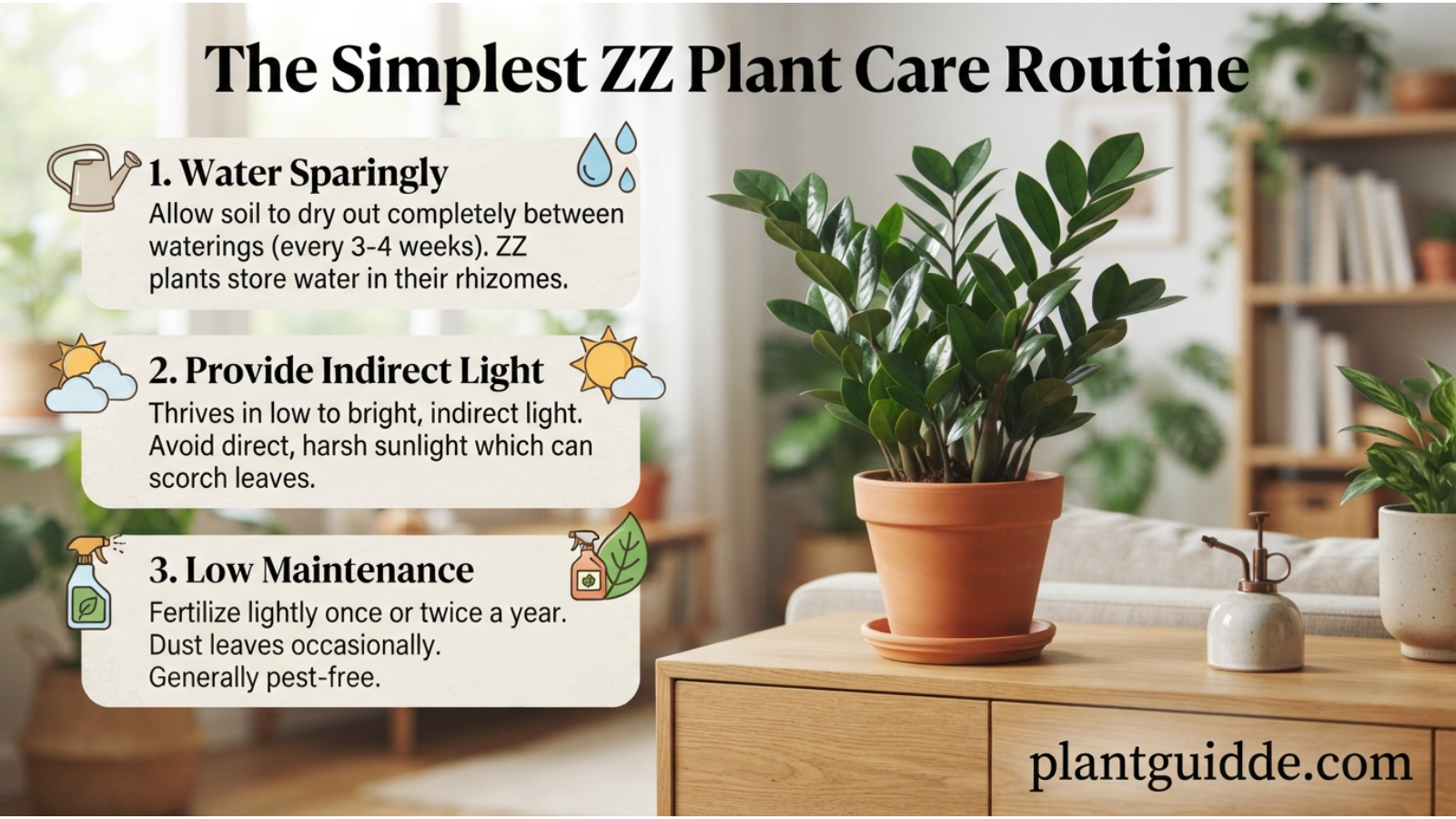
What Makes ZZ Plant Care Different?
Many houseplants punish you for forgetting to water them.
ZZ plants often punish you for watering them too much.
That difference is the key to understanding the species.
Its water-storing rhizomes are an adaptation that allows the plant to endure periods of dryness. The same adaptation means that a well-meaning owner can create trouble by keeping the root zone constantly saturated.
So if you remember only three things, remember these:
Bright indirect light.
Well-draining soil.
Let the soil dry between waterings.
Everything else is refinement.
Is a ZZ Plant Safe Around Pets?
No. ZZ plants should not be considered pet-safe.
ZZ plants contain calcium oxalate crystals, and ingestion can cause painful irritation to the mouth and throat. North Carolina Extension and University of Connecticut both advise keeping ZZ plants away from children and pets that may chew them.
If you have curious pets or young children, place the plant somewhere inaccessible.
Image Suggestion: Small safety callout graphic showing a ZZ plant with a clear “keep away from pets and children” warning.
FAQs,
How often should I water a ZZ plant?
Water when the soil has dried appropriately rather than following a fixed schedule. Depending on light, temperature, pot size, and soil, this may range from roughly every couple of weeks to much longer.
Does a ZZ plant need direct sunlight?
No. Bright indirect light is preferable. Prolonged intense direct sunlight can scorch or discolor the foliage.
Can ZZ plants grow in low light?
Yes. ZZ plants tolerate low light extremely well, although growth is generally slower than it would be in brighter indirect light.
Why are my ZZ plant leaves turning yellow?
Persistent wet soil and overwatering are important possibilities. Check the moisture level, drainage, pot size, and watering routine before adding more water.
Should I mist my ZZ plant?
Usually, no. ZZ plants are adaptable to average indoor humidity and do not require high humidity to grow well.
What is the best soil for a ZZ plant?
Use a coarse, well-draining mix that does not remain saturated for long periods. A potting mix amended with materials such as perlite can improve drainage and aeration.
Why is my ZZ plant growing so slowly?
Slow growth is normal for ZZ plants, especially indoors and in lower light. If the plant otherwise looks healthy, slow growth alone is not necessarily a problem.
Can I keep a ZZ plant in a dark room?
It can tolerate low light, but “low light” does not mean complete darkness. If there is very little usable light, growth will be extremely slow. Moving the plant closer to bright indirect light usually supports better growth.
How do I know if I am overwatering my ZZ plant?
Look for persistently wet soil, yellowing leaves, soft stems, and deteriorating roots or rhizomes. Sustained excessive moisture is one of the main risks for ZZ plants.
Should I fertilize my ZZ plant?
Yes, but lightly. ZZ plants are slow growers and do not require heavy feeding. A balanced houseplant fertilizer used conservatively during active growth is generally sufficient.
Final Takeaway
Learning how to care for a ZZ plant is less about giving it constant attention and more about avoiding the conditions it dislikes.
Give your plant bright indirect light when possible, fast-draining soil, a container with drainage, and thorough but infrequent watering. Allow the soil to dry between waterings, reduce watering when growth slows, and resist the temptation to fertilize or repot simply because growth seems slow.
The ZZ plant is remarkably forgiving, but its greatest strength, its ability to store water, is also why overwatering causes so many problems.
When in doubt, look at the soil, examine the roots and rhizomes if necessary, and consider the amount of light the plant receives before changing your entire care routine.

Asad Mumtaz is a dedicated plant enthusiast and gardening writer with a passion for helping people care for their plants successfully. He specializes in plant care guides, indoor gardening, and practical growing tips for all skill levels. His content focuses on making gardening simple, enjoyable, and rewarding. Through his work, Asad shares reliable advice to help readers create thriving green spaces.