

The mother in law tongue plant, better known as the snake plant, is one of the most forgiving houseplants you can grow. Its thick, upright leaves store water, allowing it to tolerate dry conditions and occasional neglect, making it an excellent choice for beginners and busy plant owners. Mother in Law Tongue Plant Care.
But drought tolerance does not mean you can ignore its basic needs. Overwatering, poorly draining soil, and insufficient light are among the most common reasons snake plants struggle.
Give it enough light to grow, and let the soil dry between waterings. This guide covers everything you need to know, from watering and light to soil, fertilizing, repotting, propagation, seasonal care, and common problems.
Quick Answer
Mother in law tongue plant care is surprisingly simple: give the plant bright indirect light or suitable lower light, use fast-draining soil, and let the soil dry thoroughly between waterings. Water deeply only when the soil is dry, then allow excess water to drain completely. Keep the plant in normal room temperatures and avoid constantly wet soil. These plants tolerate neglect much better than overwatering.
What Is a Mother in Law Tongue Plant?
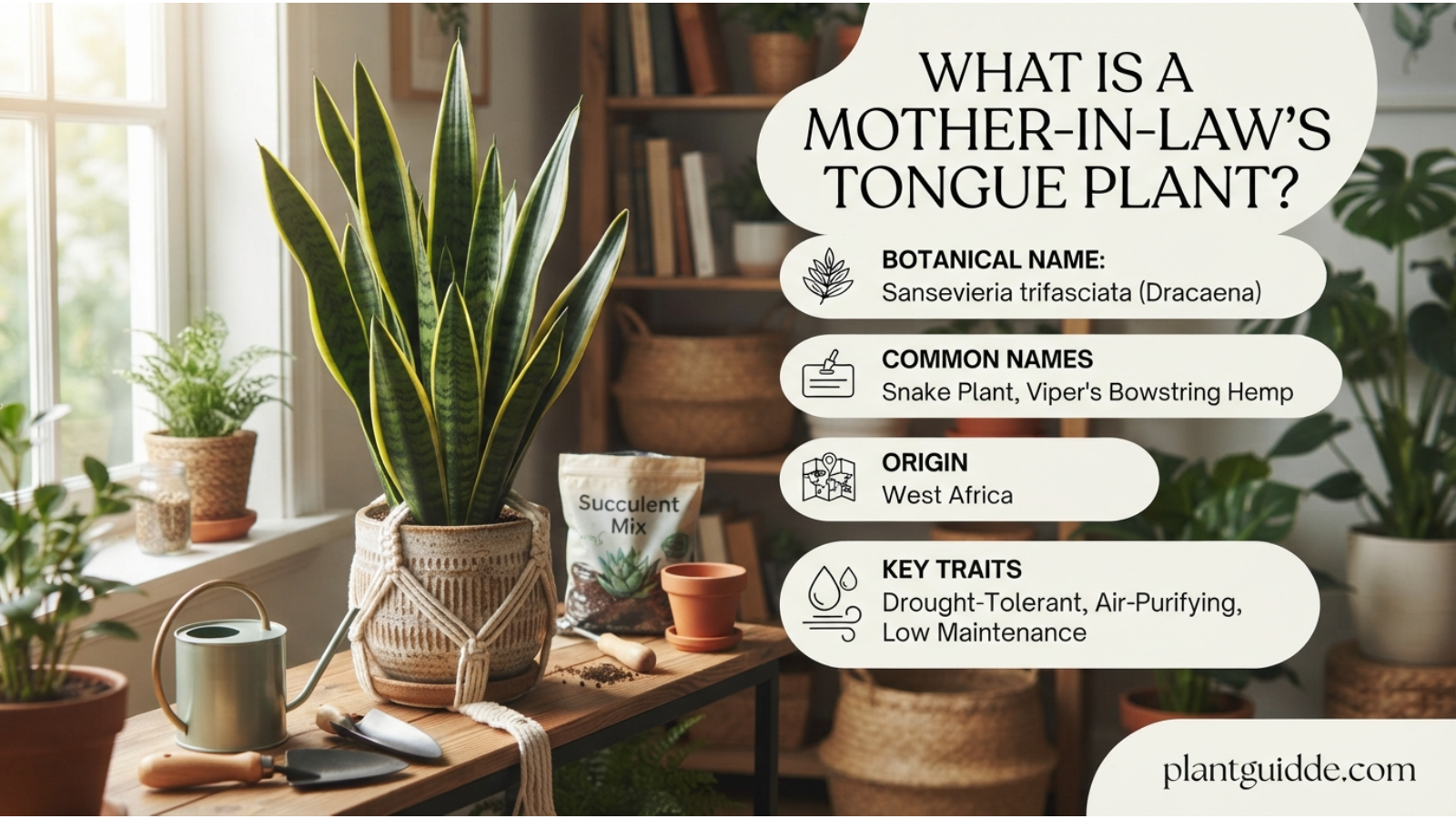
The name mother-in-law’s tongue commonly refers to plants in the Sansevieria group, particularly Sansevieria trifasciata, which is now classified botanically as Dracaena trifasciata. The plant belongs to the Asparagaceae family.
You may also see it sold under several names:
- Snake plant
- Mother-in-law’s tongue
- Sansevieria
- Sansevieria trifasciata
- Dracaena trifasciata
- Viper’s bowstring hemp
These plants have thick, leathery leaves that emerge from the base and form upright clumps. Different cultivars can have green, silver, yellow, or variegated markings.
The RHS describes Sansevierias as drought-tolerant, low-maintenance houseplants that can adapt to a wide range of indoor conditions.
That adaptability is one reason they have become such popular indoor plants.
Mother in Law Tongue Plant Care at a Glance
| Care factor | Best approach |
|---|---|
| Light | Bright indirect light is ideal; lower light is tolerated |
| Water | Water only after the soil has dried substantially |
| Soil | Fast-draining cactus or succulent-style mix |
| Pot | Container with drainage holes |
| Temperature | Around 60–75°F (15–24°C) is ideal |
| Humidity | Normal household humidity is usually sufficient |
| Fertilizer | Light feeding during active growth |
| Repotting | Only when the plant becomes crowded or root-bound |
| Pruning | Remove damaged leaves cleanly at the base |
| Propagation | Division, offsets, or leaf cuttings |
| Biggest risk | Overwatering and poorly drained soil |
The most important principle is simple: dryness is generally safer than constantly wet roots.
Give Your Snake Plant the Right Light
One reason mother-in-law’s tongue is considered beginner-friendly is its ability to tolerate different light levels.
It can survive in lower light, but that does not necessarily mean low light is the best condition for strong growth.
Best light
For healthy growth, aim for:
- Bright indirect light
- Filtered sunlight
- An east- or west-facing window
- Bright rooms where the plant receives plenty of ambient light
Some cultivars can handle direct sun, but suddenly moving a plant from a dim room into intense midday sunlight can scorch the leaves.
The RHS recommends bright, lightly shaded conditions while noting that Sansevierias can also adapt to lower light. Plants in shade may produce taller leaves, while brighter conditions can encourage more compact growth.
What happens in low light?
A snake plant may survive for a long time in a dim room, but growth can become extremely slow.
This creates a common care mistake:
The plant looks unchanged, so the owner assumes it needs more water.
It usually doesn’t.
If light is low, the plant uses water more slowly. Adding more water can leave the soil wet for too long and increase the risk of root problems.
What about direct sunlight?
A few hours of gentle morning sunlight can be beneficial, but intense afternoon sunlight through glass can cause leaf scorching, especially if the plant has not been acclimated.
Look for:
- Bleached patches
- Brown or crispy areas
- Sudden pale spots
- Heat damage on the side facing the window
Image Suggestion: A simple diagram showing low light, bright indirect light, and harsh direct sunlight for snake plants.
How Often Should You Water a Mother in Law Tongue Plant?
This is the most important part of mother in law tongue plant care.
Do not water according to a strict weekly schedule.
Instead, check the soil.
The RHS specifically recommends allowing the compost to dry before watering and warns that overwatering is a common cause of poor health because the roots can rot.
A better watering method
- Push your finger several centimeters into the soil.
- Check whether the soil is still damp.
- If it feels moist, wait.
- If the soil has dried substantially, water thoroughly.
- Allow excess water to drain from the bottom.
- Empty any standing water from the saucer or outer pot.
The goal is not to give the plant a tiny amount of water every few days.
Instead, when watering is actually needed, water thoroughly and then allow the soil to dry again.
How often will that be?
There is no universal schedule because watering depends on:
- Light
- Temperature
- Pot size
- Soil composition
- Humidity
- Season
- Root development
- Indoor airflow
A plant in bright light and warm conditions may dry considerably faster than the same plant sitting in a cool, dim room.
Winter watering
During winter, growth often slows and the plant uses less water. The RHS notes that Sansevierias need very little water during winter unless kept in a particularly warm location.
So don’t continue a summer watering routine automatically.
Choose Fast-Draining Snake Plant Soil
The best snake plant soil is one that allows water to move through quickly.
Mother-in-law’s tongue plants dislike sitting in saturated soil.
A heavy garden soil or moisture-retaining potting mix can remain wet around the roots for too long, particularly indoors.
A cactus or succulent-style potting mix is a practical choice because it is designed to drain more freely.
The RHS recommends a free-draining, peat-free cactus compost and gives a DIY option using loam-based compost with horticultural grit or fine gravel.
What makes good soil?
Look for a mixture that is:
- Airy
- Fast-draining
- Structurally stable
- Not heavily water-retentive
- Suitable for containers
A useful approach is to combine regular quality potting mix with an inorganic drainage component such as perlite, pumice, or horticultural grit.
The exact recipe matters less than the final result:
After watering, excess moisture should be able to escape rather than remaining trapped around the roots.
Use a Pot With Drainage Holes
Even excellent soil can cause problems if the container has nowhere for excess water to escape.
Always choose a pot with drainage holes.
Decorative cachepots can still be used, but the plant should ideally remain in a nursery pot or inner container that allows water to drain.
After watering:
- Let excess water escape.
- Do not leave the pot sitting in a tray of water.
- Empty standing water when necessary.
This small habit can make a significant difference to root health.
Temperature and Humidity
Mother-in-law’s tongue plants are comfortable with ordinary indoor conditions.
The RHS recommends approximately 60–75°F (15–24°C) for Sansevierias.
Avoid placing them directly against:
- Cold drafts
- Frequently opened exterior doors
- Very cold windows
- Strong heating vents
- Radiators
Does a snake plant need high humidity?
No.
This is another advantage of the plant.
Sansevierias generally tolerate normal household humidity and do not require the high humidity demanded by many tropical houseplants. The RHS specifically advises against misting them and notes that they prefer good airflow without chilly drafts.
So you generally don’t need:
- Daily misting
- Humidity trays
- A humidifier
- A steamy bathroom
If your home is reasonably comfortable for people, it is usually comfortable for a snake plant as well.
Should You Fertilize a Mother in Law Tongue Plant?
Snake plants are not heavy feeders.
Fertilizer should support growth rather than compensate for poor light, bad soil, or incorrect watering.
During active growth, a light application of a balanced houseplant fertilizer can be useful. The RHS recommends monthly feeding during the growing season with a liquid houseplant fertilizer or specialist cactus feed.
Avoid overfertilizing
Too much fertilizer can cause:
- Salt buildup
- Leaf-tip damage
- Root stress
- Weak or uneven growth
If the plant is growing slowly in low light, increasing fertilizer is usually not the first solution.
Fix the growing conditions first.
Repotting a Mother in Law Tongue Plant
Snake plants generally do not need frequent repotting.
In fact, they can remain in the same container for years if the roots and soil remain healthy.
The RHS recommends repotting only when plants become pot-bound.
Signs it may be time to repot
Consider repotting when:
- Roots are tightly filling the container.
- Rhizomes are pushing against the pot.
- The plant repeatedly dries extremely quickly.
- The container is becoming unstable.
- The soil has broken down and drains poorly.
- Offsets have crowded the container.
Don’t automatically choose a huge pot
A much larger pot holds more soil, and more soil can remain wet for longer.
For a drought-tolerant plant, that can create unnecessary risk.
Choose a container only moderately larger than the current root system.
Image Suggestion: Step-by-step photo sequence showing a snake plant being removed from a pot, roots inspected, and replanted into a slightly larger container.
How to Prune a Snake Plant
Most snake plants require very little pruning.
You don’t need to routinely trim healthy leaves.
Remove leaves that are:
- Completely damaged
- Rotten
- Severely broken
- Dead
- Diseased
Use a clean, sharp blade and cut damaged leaves near their base.
Avoid repeatedly cutting leaf tips simply to change their shape. A cut leaf tip will not grow back into its original pointed form.
If only the tip is brown, you can cosmetically trim the damaged portion, but the leaf itself may continue to show the cut.
How to Propagate Mother in Law Tongue
One of the most rewarding aspects of snake plant care is propagation.
You can propagate many varieties through:
- Division
- Offsets or pups
- Leaf cuttings
Propagation by division
Division is especially useful when the plant has become a crowded clump.
Carefully remove the plant from its pot and identify individual growth sections connected through the rhizome system.
Separate healthy sections and replant them in suitable fast-draining soil.
Propagation from leaf cuttings
Healthy leaves can also be cut into sections and rooted.
However, there is an important detail with variegated cultivars:
Leaf-cutting propagation may not preserve the original variegation.
The RHS specifically notes that offspring from variegated cultivars may lack their variegation when raised from leaf cuttings.
If preserving the appearance of a particular variegated plant matters, division or offsets are generally the better choice.
Common Mother in Law Tongue Plant Problems
The most useful way to diagnose snake plant problems is to look at the combination of symptoms and growing conditions, rather than treating every yellow or brown leaf the same way.
Yellow Leaves
Yellow leaves can occur for several reasons, but consistently wet soil is one of the first things to investigate.
Check:
- Is the soil staying wet for many days?
- Does the pot have drainage holes?
- Is the plant sitting in water?
- Is the soil heavy?
- Is the plant receiving very little light?
If the soil is wet and the leaves are becoming soft or discolored, inspect the roots for signs of rot.
What to do
Reduce watering and improve drainage.
If roots are damaged, remove rotten material and repot the healthy portions into fresh, fast-draining soil.
Brown Leaf Tips
Brown tips don’t automatically mean the plant needs more water.
Possible causes include:
- Inconsistent watering
- Root stress
- Excess fertilizer
- Physical damage
- Very dry conditions combined with other stress
- Poor root function caused by overwatering
Start by checking the soil and roots rather than simply watering more.
Soft or Mushy Leaves
This is more concerning than a slightly dry leaf.
Soft, collapsing tissue can indicate excessive moisture or rot.
Check the root system and rhizomes if the problem is spreading.
Healthy roots should not be extensively soft, slimy, or foul-smelling.
Curling Leaves
Curling or folding leaves can be a stress response.
Check:
- Soil moisture
- Light levels
- Temperature
- Recent environmental changes
- Root condition
Don’t immediately assume the plant needs water.
If the soil is already wet, adding more water can make the underlying problem worse.
Drooping Leaves
Snake plants have naturally upright foliage, so persistent drooping deserves investigation.
Possible causes include:
- Root problems
- Severe dehydration
- Insufficient light
- Physical damage
- Poorly anchored roots
- Overly wet soil
The fastest diagnostic step is often simply to inspect the soil and root zone.
The Biggest Mother in Law Tongue Plant Care Mistakes
Mistake 1: Watering on a calendar
“Every Sunday” sounds simple, but indoor conditions change.
Better approach: Check the soil before watering.
Mistake 2: Assuming low light means low maintenance
A plant can survive in low light but still grow very slowly.
Better approach: Give it the brightest suitable light available without exposing it suddenly to harsh sunlight.
Mistake 3: Using dense soil
A moisture-retentive mix can remain wet too long.
Better approach: Use a fast-draining medium.
Mistake 4: Using an oversized pot
More soil means more moisture around the roots.
Better approach: Choose a container appropriate to the root system.
Mistake 5: Misting the leaves
Snake plants don’t need tropical humidity.
Better approach: Focus on good airflow and appropriate watering.
Mistake 6: Fertilizing a struggling plant heavily
Fertilizer cannot fix rotten roots or inadequate light.
Better approach: Correct environmental problems before feeding.
Seasonal Snake Plant Care
Spring
As light levels increase, the plant may begin growing more actively.
- Check the soil more frequently.
- Resume light fertilizing if the plant is actively growing.
- Consider repotting if the plant is severely root-bound.
- Propagate offsets if desired.
Summer
Warm, bright conditions can increase water use.
- Monitor soil moisture.
- Protect the plant from intense midday sun if leaves scorch.
- Maintain good airflow.
- Avoid leaving water standing in the saucer.
Autumn
Growth may gradually slow.
- Reduce fertilizer as active growth declines.
- Allow the soil to dry more thoroughly between waterings.
Winter
This is the season when overwatering becomes particularly easy.
- Water less frequently.
- Keep the plant away from cold drafts.
- Avoid placing it directly beside heating equipment.
- Don’t fertilize heavily when growth has stopped.
The key seasonal lesson is simple:
Water according to how quickly the soil dries, not according to the month on the calendar.
How to Make a Snake Plant Grow Faster
Snake plants are naturally not among the fastest-growing houseplants.
Trying to force rapid growth with extra water or fertilizer usually creates more problems than benefits.
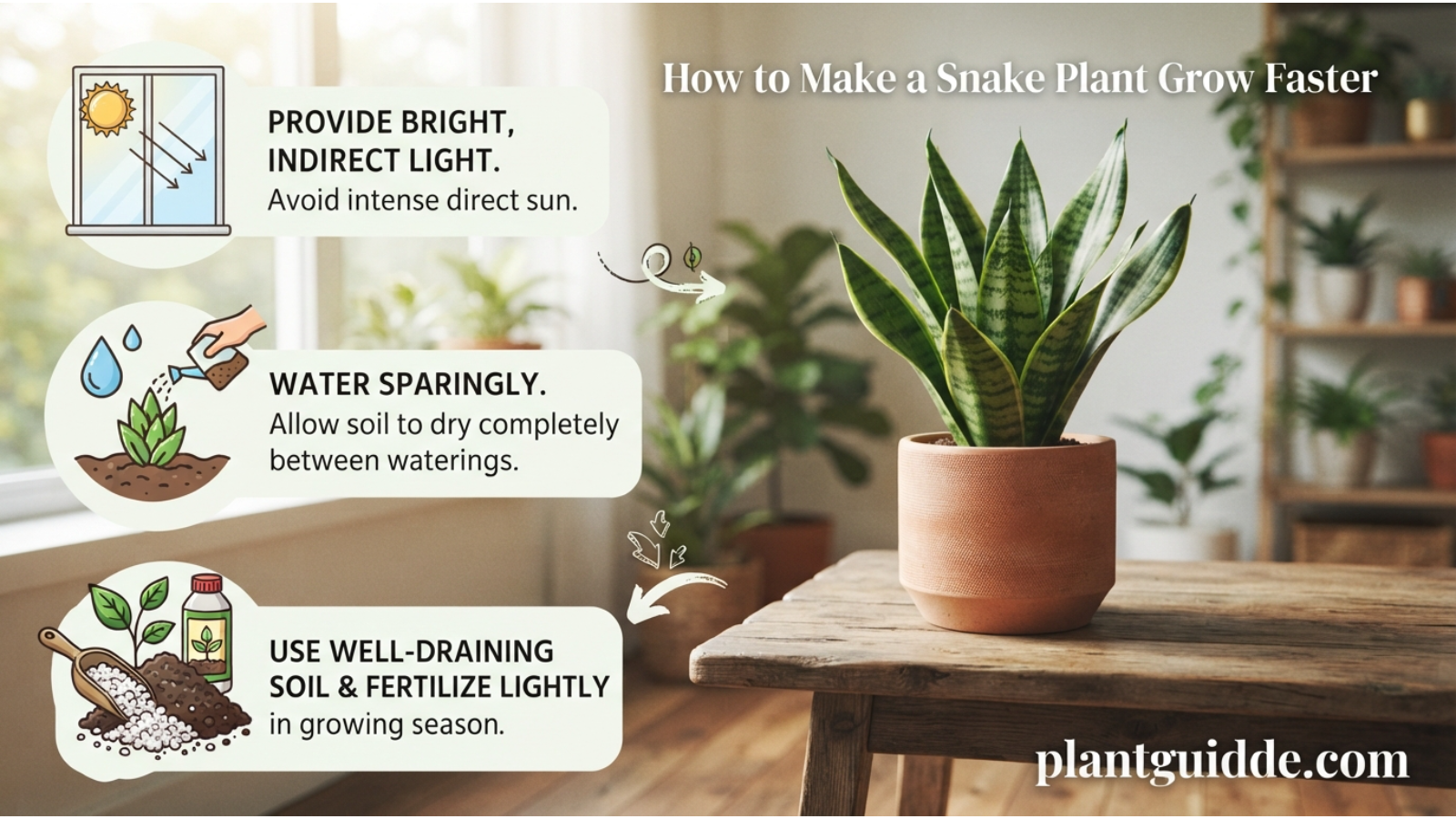
Instead, optimize the basics:
1. Improve light
Bright, indirect light generally provides better growing conditions than a very dark corner.
2. Use healthy soil
Fast drainage allows roots to receive both moisture and oxygen.
3. Water appropriately
Wait until the soil has dried substantially before watering again.
4. Feed lightly
Provide nutrients during active growth rather than constantly feeding.
5. Avoid unnecessary disturbance
A healthy snake plant does not need to be repotted every year.
Consistency is more useful than constant intervention.
How to Tell If Your Snake Plant Is Healthy
A healthy mother-in-law’s tongue typically has:
- Firm leaves
- Strong upright growth
- Good leaf color
- No widespread mushiness
- No persistent foul smell from the soil
- Stable new growth
- A firm root and rhizome system
Don’t worry if the plant doesn’t produce new leaves every week.
Snake plants can be relatively slow-growing, particularly in lower light.
A plant that looks stable and healthy is often doing exactly what it should.
An Easy Weekly Snake Plant Check
You don’t need to spend much time caring for this plant.
Once a week, quickly check:
1. Soil:
Is it still damp?
2. Leaves:
Are they firm and upright?
3. Light:
Is the plant receiving adequate light?
4. Pot:
Is water draining properly?
5. Pests:
Do you notice unusual spots, webbing, or insects?
If everything looks normal, leave the plant alone.
That last step is surprisingly important.
Good snake plant care often means knowing when not to interfere.
FAQs,
How often should I water a mother in law tongue plant?
Water when the soil has dried substantially rather than following a fixed schedule. The exact interval depends on light, temperature, pot size, soil, and season. Always allow excess water to drain away.
Does mother-in-law’s tongue need direct sunlight?
Not necessarily. Bright indirect light is an excellent choice, while many snake plants tolerate lower light. Strong direct summer sunlight can scorch leaves, particularly when a plant is suddenly exposed to it.
Why are my snake plant leaves turning yellow?
Overwatering and poorly draining soil are important possibilities. Check the soil moisture, drainage, pot, and roots before adding more water.
Why are my snake plant leaves turning brown?
Brown tips can result from several forms of stress, including inconsistent watering, root problems, physical damage, or fertilizer-related stress. Look at the entire growing environment rather than treating the brown tip alone.
Do snake plants need humidity?
No. They generally tolerate normal household humidity and do not require regular misting.
What is the best soil for a mother-in-law’s tongue plant?
Use a fast-draining potting medium. A cactus or succulent mix is a practical option. The RHS recommends free-draining, peat-free cactus compost for Sansevierias.
When should I repot a snake plant?
Repot when the plant becomes significantly root-bound, the container becomes unstable, or the existing soil has deteriorated. Snake plants generally do not need frequent repotting.
Can I propagate a mother-in-law’s tongue from a leaf?
Yes. Many Sansevierias can be propagated from leaf cuttings. However, variegated cultivars may not retain their original variegation through leaf-cutting propagation.
Why is my snake plant not growing?
Low light, seasonal dormancy, cool conditions, and naturally slow growth can all contribute. Before adding fertilizer, check whether the plant is receiving enough usable light and whether its roots and soil are healthy.
Is mother-in-law’s tongue toxic to pets?
Sansevieria is listed by the RHS as potentially harmful if eaten, so it is sensible to keep the plant away from pets and children who may chew the leaves.
Final Takeaway
Successful mother in law tongue plant care is less about doing more and more about avoiding the wrong things.
Give your snake plant appropriate light, plant it in fast-draining soil, use a container with drainage holes, and wait for the soil to dry substantially before watering again. Keep feeding modest, repot only when necessary, and don’t try to create tropical humidity around a plant that is naturally adapted to dry conditions. The biggest mistake is usually not forgetting to water.
It is watering before the plant actually needs it. Once you learn to read the soil, leaves, light, and root condition together, caring for a mother-in-law’s tongue becomes remarkably straightforward, and the plant can remain a healthy, attractive part of your indoor space for years.

Asad Mumtaz is a dedicated plant enthusiast and gardening writer with a passion for helping people care for their plants successfully. He specializes in plant care guides, indoor gardening, and practical growing tips for all skill levels. His content focuses on making gardening simple, enjoyable, and rewarding. Through his work, Asad shares reliable advice to help readers create thriving green spaces.