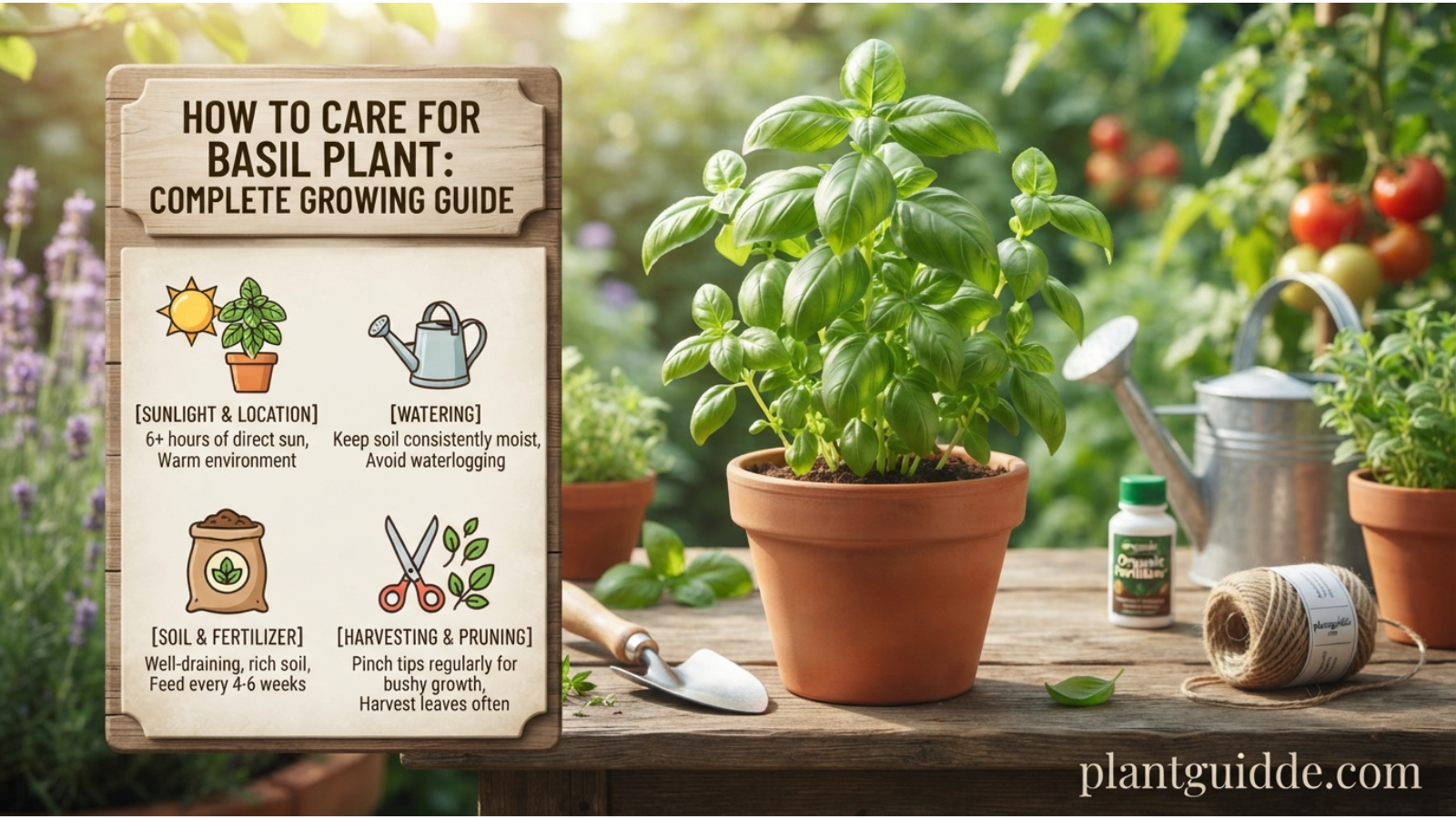
Basil is one of the most rewarding herbs to grow at home. A healthy plant can provide fresh leaves for pesto, pasta, salads, sauces, sandwiches, and countless other dishes with surprisingly little space. But there is a catch: basil grows quickly, and that means it can also show stress quickly. How to Care for Basil Plant.
A plant that looked perfectly healthy a few days ago may suddenly become limp, develop yellow leaves, stretch toward a window, or start producing flowers instead of the tender foliage you actually want to harvest.
Learning how to care for basil plant is therefore less about following a rigid watering schedule and more about understanding what the plant is telling you. Basil needs strong light, warmth, moisture, drainage, nutrition, and regular harvesting—but the balance between these factors matters. The good news is that most basil problems are preventable once you understand the basics.
Quick Answer
To care for a basil plant, give it 6–8 hours of bright sunlight, warm temperatures, well-draining fertile soil, and consistent moisture without keeping the roots waterlogged. Water when the soil begins to dry, provide good drainage and airflow, and regularly pinch the growing tips and flower buds to encourage bushy leaf production. Container basil usually needs more frequent watering and occasional feeding than basil growing in the ground.
Basil Plant Care at a Glance
| Care factor | What basil needs |
|---|---|
| Light | About 6–8 hours of bright light daily |
| Temperature | Warm conditions; protect from cold |
| Water | Consistent moisture without waterlogged soil |
| Soil | Fertile, loose, well-draining mix |
| Container | Pot with drainage holes |
| Feeding | Light, regular feeding when grown in containers |
| Pruning | Pinch growing tips regularly |
| Flowering | Remove flower buds if growing primarily for leaves |
| Airflow | Good circulation around the foliage |
| Harvesting | Frequent harvesting encourages branching |
Basil is generally considered an easy herb, but it is sensitive to cold and does best when its growing conditions remain stable.
Give Basil Plenty of Light
Light is one of the first things to check when basil becomes tall, thin, or pale.
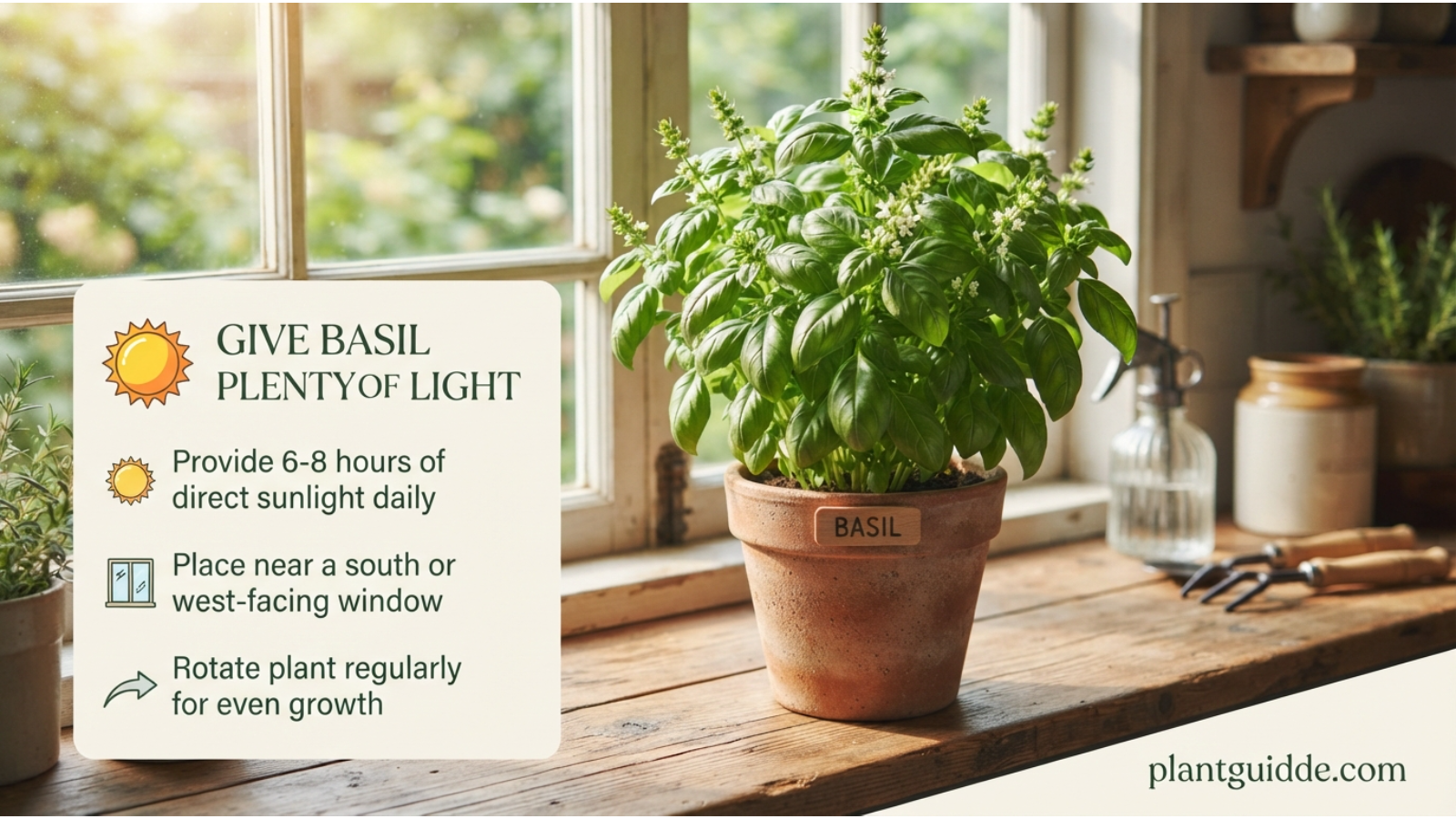
Basil grows best in a sunny location and generally needs around 6–8 hours of bright light per day. Indoor plants should be placed in the brightest suitable window you have. If natural light is inadequate, a grow light can help maintain compact growth.
What happens when basil gets too little light?
You may notice:
- Long, weak stems
- Large gaps between leaves
- Growth leaning toward the window
- Smaller leaves
- Pale foliage
- Slow growth
This is called etiolation, where a plant stretches in search of more light.
Best indoor location
A bright south-facing window can work well in many homes. However, extremely hot glass or intense afternoon sun can sometimes scorch foliage, particularly when a plant has recently been moved from a lower-light environment.
Practical tip: Don’t move a basil plant suddenly from a dim room into intense outdoor sun. Acclimate it gradually to stronger light.
Image Suggestion: Healthy compact basil beside a leggy basil plant showing the difference between adequate and inadequate light.
Keep Basil Warm
Basil is a warm-season herb and does not tolerate cold conditions well.
Cold soil and air can slow growth, while sufficiently low temperatures can cause leaf damage. Basil should generally be planted outdoors only after the danger of frost has passed.
For indoor basil, keep the plant away from:
- Cold drafts
- Frequently opened exterior doors
- Very cold windows at night
- Air-conditioning vents
- Sudden temperature changes
Warmth is particularly important when growing basil from seed because germination and early growth are faster under warm conditions.
Water Basil Correctly
Watering is one of the easiest parts of basil care to get wrong.
Basil likes moisture, but that does not mean the roots should sit in constantly saturated soil.
The goal is to keep the root zone from becoming bone-dry while allowing excess water to drain away. Extension guidance consistently emphasizes regular moisture and good drainage. How to Care for Basil Plant.
How to know when basil needs water
Instead of watering automatically every day, check the soil.
Insert your finger into the upper layer of potting mix. If the surface and upper portion are beginning to dry, water thoroughly.
When watering a container basil plant:
- Pour water slowly around the soil.
- Wet the root zone thoroughly.
- Allow excess water to drain from the bottom.
- Empty standing water from a saucer.
- Check the soil again before the next watering.
Container basil can dry out considerably faster than basil growing in the ground, especially during hot weather.
Should you water basil every day?
Not necessarily.
A small basil pot sitting in hot sunlight may need water frequently, while a larger container in cooler weather may remain moist for longer.
Use the plant and soil—not the calendar—as your guide.
Avoid two common extremes
Underwatering:
The plant wilts, growth slows, and leaves may become stressed.
Overwatering:
Roots remain excessively wet, oxygen availability decreases, and root problems can develop.
Basil is unusual in that it dislikes both extremes: it does not handle prolonged drought well, but it also does not tolerate constantly wet roots.
Image Suggestion: Diagram showing properly moist basil soil versus dry and waterlogged soil.
Use Well-Draining Soil
Good basil soil needs to perform two jobs at once:
- Hold enough moisture for active growth
- Allow excess water and air to move through the root zone
A fertile, well-drained growing medium is ideal. Basil can be grown successfully in containers, raised beds, and garden soil when drainage is adequate.
For indoor basil, use a quality potting mix rather than heavy garden soil.
A container mix should not become a dense, muddy mass after watering.
Why drainage matters
If water sits around basil roots for too long, the roots can become stressed or rot. Once the root system is damaged, symptoms may appear above the soil as yellow leaves, weak growth, wilting, or general decline.
This is why adding more water is not always the answer when basil looks wilted.
Choose a Pot With Drainage Holes
A beautiful container is useless if excess water has nowhere to go.
Choose a pot with at least one functional drainage hole. Larger containers can be useful because they hold more growing medium and may dry out more slowly than tiny pots.
However, avoid putting a small basil plant into an excessively large container simply because it looks attractive. A very large volume of wet soil can remain moist for a long time.
Signs your basil may need a larger pot
Consider repotting when:
- Roots are circling heavily inside the container.
- The plant dries out unusually quickly.
- Water runs straight through the pot.
- Growth has slowed despite adequate light and nutrition.
- The plant has become crowded.
Supermarket basil is a special case. Many grocery-store pots contain numerous closely packed seedlings intended for short-term harvesting rather than long-term growth. Dividing and repotting them promptly can improve their chances of producing a longer-lasting plant.
Fertilize Basil Without Overdoing It
Basil produces leaves rapidly, so it needs access to nutrients.
However, more fertilizer does not automatically mean more flavorful basil.
Plants growing in containers have a limited amount of soil, and nutrients can gradually become depleted through repeated watering. How to Care for Basil Plant. Extension recommendations commonly suggest light, regular feeding for container-grown basil rather than excessive fertilization.
A balanced liquid fertilizer used according to its label directions can work well during active growth.
For indoor basil, some extension guidance recommends a low-dose water-soluble fertilizer approximately every two weeks.
Don’t overfertilize
Excess fertilizer can encourage lush growth without necessarily improving flavor. Illinois Extension specifically warns that over-fertilizing herbs can reduce aroma and taste.
If your basil is growing vigorously and has healthy green foliage, there is usually no reason to keep increasing fertilizer.
Prune Basil to Make It Bushier
One of the most important basil care techniques is also one of the simplest: pinch the growing tips.
If you allow basil to grow upward without regular harvesting, it can become tall and sparse.
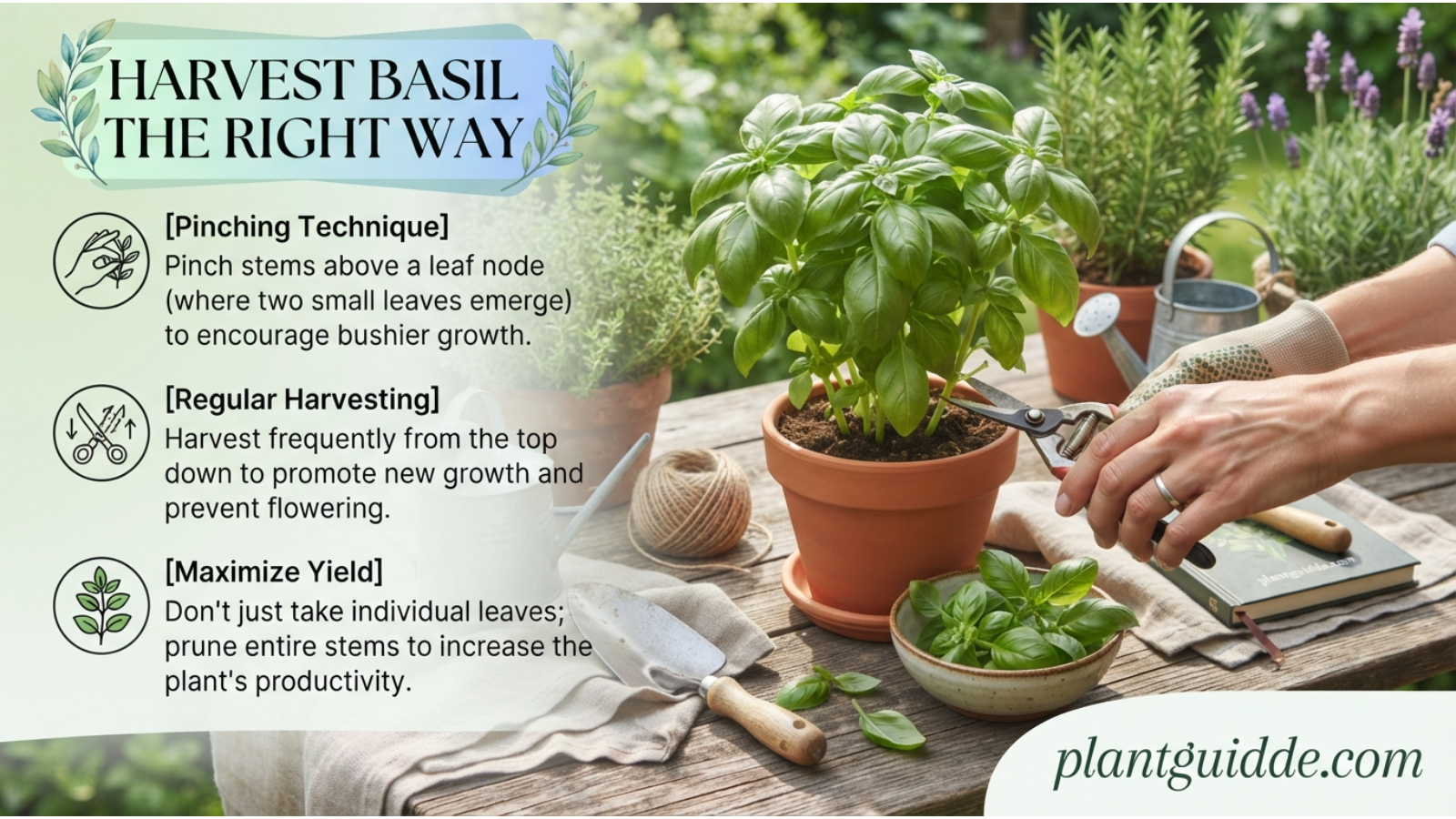
Instead, remove the growing tip just above a pair of leaves. This encourages the plant to produce side branches.
Over time, repeated pruning creates a fuller, bushier plant.
How to prune basil
When a stem has several sets of leaves:
- Identify a healthy growing tip.
- Find a pair of leaves lower on the stem.
- Cut or pinch just above that pair.
- Allow the side shoots below the cut to develop.
- Repeat as the plant grows.
This is more than harvesting—it is a way of shaping the plant.
Image Suggestion: Close-up illustration showing exactly where to pinch a basil stem above a pair of leaves.
Remove Flowers if You Want More Leaves
Basil naturally wants to mature and reproduce.
Once flowering begins, the plant starts shifting toward reproduction rather than producing the tender vegetative growth most cooks want.
For culinary basil, remove flower buds when they appear if your priority is continued leaf production. RHS recommends removing flower stems to delay flowering and maintain leafy growth.
But don’t panic if your basil flowers
Flowering does not mean the plant has suddenly become useless.
Basil flowers can be attractive and provide nectar for pollinators. You can allow some plants to flower if you want seeds or simply want to support insects.
If you have several basil plants, a practical compromise is to keep most plants regularly pinched while allowing one to flower.
Harvest Basil the Right Way
Regular harvesting is one of the secrets to keeping basil productive.
Instead of repeatedly stripping individual leaves from random locations, harvest stem tips in a way that encourages branching.
Cut above a pair of leaves so that the plant can develop new shoots.
RHS recommends picking shoot tips regularly to keep basil bushy and productive.
How much basil can you harvest?
Avoid removing nearly all of the foliage at once from a small or stressed plant.
A healthy, established plant can tolerate substantial harvesting, but the plant still needs enough leaves to continue photosynthesis and produce new growth.
Harvest in the morning
For the best freshness, harvest when the plant is hydrated and use the leaves relatively soon after cutting.
Basil is particularly valuable fresh because its aroma and texture are easily lost with poor storage.
Give Basil Good Airflow
Dense basil foliage can create a humid microclimate around leaves.
Good spacing and airflow help foliage dry more quickly and reduce conditions favorable to some diseases. How to Care for Basil Plant.
Avoid packing several large basil plants tightly against one another.
Outdoor basil benefits from adequate spacing, while indoor plants should not be wedged into a dark, stagnant corner.
If growing basil in a greenhouse or enclosed growing area, ventilation becomes especially important. RHS recommends good ventilation to help reduce fungal disease problems.
How to Care for Basil Plant Indoors
Growing basil indoors is convenient because you can keep fresh leaves within reach of the kitchen.
But indoor basil has one major challenge: light.
A plant may sit beside a window and still receive significantly less useful light than a basil plant growing outdoors. How to Care for Basil Plant.
For successful indoor basil care:
- Put it in the brightest suitable location.
- Aim for roughly 6–8 hours of bright light.
- Rotate the pot occasionally if growth leans toward the window.
- Use a grow light if natural light is inadequate.
- Keep the soil consistently but moderately moist.
- Use a pot with drainage.
- Feed lightly during active growth.
- Pinch the stems regularly.
- Keep the plant away from cold drafts and heating or cooling vents.
Basil generally prefers warm conditions and does not need unusually high humidity to survive indoors, although very dry indoor environments can increase water loss.
A common indoor basil mistake
Many people see a basil plant sitting on a kitchen counter and assume it is receiving enough light.
If the stems are stretching toward a nearby window, that is valuable feedback: the plant is telling you the light is not strong enough where it is currently growing.
How to Care for Basil Plant in a Pot
Container basil needs slightly closer monitoring than basil planted in the ground.
The smaller volume of soil can heat up and dry out quickly, especially in summer.
For healthy potted basil:
- Use a container with drainage holes.
- Choose fertile, well-draining potting mix.
- Place the container in strong light.
- Check soil moisture frequently during hot weather.
- Water thoroughly when needed.
- Feed lightly during active growth.
- Harvest and pinch regularly.
- Ensure enough space for air movement.
Container plants also lose nutrients through repeated watering, which is why occasional feeding can become more important than it is in a well-prepared garden bed.
Basil Care During Very Hot Weather
Basil loves warmth, but extreme heat combined with water stress can trigger problems.
During hot weather:
- Check container moisture more frequently.
- Water thoroughly rather than giving tiny splashes.
- Protect pots from extreme reflected heat.
- Provide some afternoon protection if intense heat causes wilting or leaf scorch.
- Maintain airflow around the foliage.
Basil grown in exceptionally sunny locations may benefit from some afternoon shade in very hot conditions.
A useful distinction is this:
Warm and sunny is good. Hot, dry, and chronically stressed is not.
Common Basil Problems and What They Mean
Basil Leaves Turning Yellow
Yellow leaves can have several causes, so don’t automatically assume the plant needs fertilizer.
Check:
- Is the soil staying wet for too long?
- Does the container drain properly?
- Is the plant receiving enough light?
- Has the pot become root-bound?
- Is the plant overdue for feeding?
- Has it recently experienced extreme weather?
Container plants can develop nutrient deficiencies because repeated watering gradually removes nutrients from the growing medium.
Basil leaves turning yellow and soil staying wet
Start by investigating drainage and watering rather than immediately adding fertilizer.
Basil Leaves Wilting
Wilting can result from:
- Dry soil
- Excessive heat
- Root damage
- Poor drainage
- Recent transplant stress
The important lesson is that wilting does not always mean “add more water.”
Check the soil first.
If it is bone-dry, water thoroughly.
If it is already saturated, adding more water can make the underlying problem worse.
Basil Becoming Leggy
Leggy basil is usually a light problem.
Move the plant toward stronger light and begin pinching the growing tips to encourage branching.
If the plant has already become very stretched, pruning it back strategically can help create new growth, provided the remaining plant is healthy.
Basil Leaves Turning Brown
Brown edges or patches can be associated with environmental stress, including inconsistent watering, excessive heat, root problems, or leaf disease.
Look at the whole pattern, not just the damaged leaf.
Ask:
- Are new leaves healthy?
- Is the soil extremely dry or constantly wet?
- Are spots spreading?
- Are insects present?
- Is airflow poor?
- Has the plant recently moved into intense sunlight?
This approach is much more useful than treating every brown leaf as the same problem.
Basil Plant Has Small Holes in Leaves
Inspect the underside and surrounding foliage for insects.
Common basil pests include aphids, whiteflies, slugs, snails, and other chewing insects depending on where you grow it.
For a small infestation, physically removing visible pests and damaged leaves may be sufficient. More serious problems require identifying the pest before choosing a treatment.
Basil flowers naturally, so flowering is not necessarily a sign that you are doing something wrong.
Why Is My Basil Flowering So Quickly?
However, water stress, heat, plant maturity, and growing conditions can encourage earlier flowering.
If your goal is maximum leaf production:
- Harvest regularly.
- Pinch growing tips.
- Remove flower buds early.
- Avoid allowing the plant to become severely water-stressed.
- Keep it growing vigorously with adequate light and nutrition.
If you want seeds, flowers, or pollinator value, simply allow some flowering instead.
Growing Basil From Seed
Basil is easy to propagate from seed when provided with warmth and moisture.
Seeds germinate quickly under favorable conditions. University of Minnesota Extension notes that basil seeds can germinate in roughly 5–7 days under suitable conditions.
Basic method
- Fill a clean seed tray or small container with moist seed-starting mix.
- Sow basil seeds shallowly.
- Keep the growing medium evenly moist.
- Place the container somewhere warm and bright.
- Once seedlings develop several true leaves, thin or transplant them.
- Gradually acclimate seedlings before moving them outdoors.
Avoid keeping young seedlings excessively wet. Seedlings are particularly vulnerable to damping-off problems when conditions remain overly wet.
Image Suggestion: Basil growth timeline from seed → seedling → young plant → mature bushy plant.
Can You Grow Basil From Cuttings?
Yes.
Basil can be propagated from healthy, non-flowering shoots.
Take a cutting from a healthy stem, remove the lower leaves, and place the cutting in water or suitable growing medium. Basil can root relatively quickly under warm conditions.
This is particularly useful if you have a basil plant with excellent flavor and want additional plants without starting from seed.
The Most Common Basil Care Mistakes
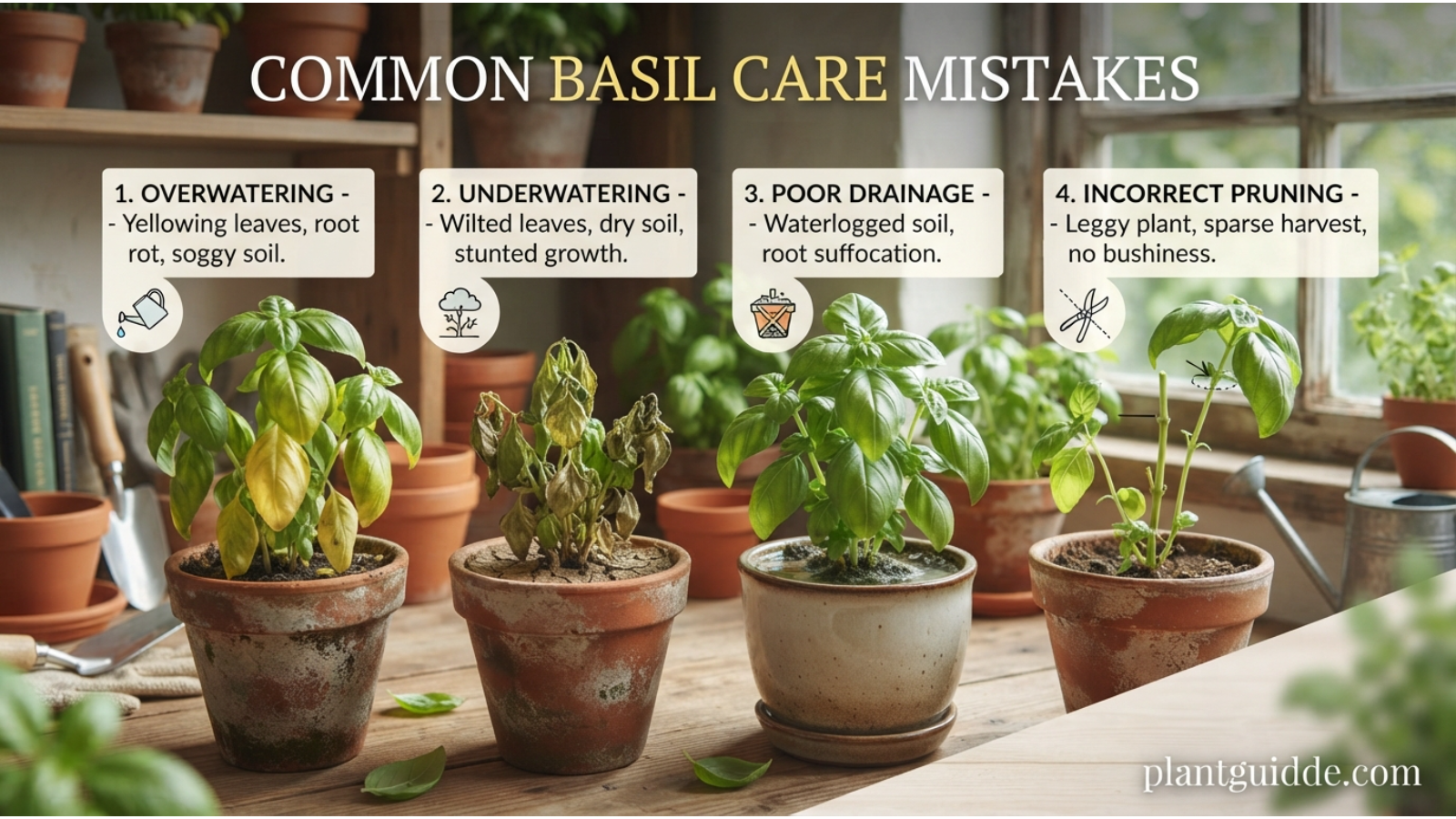
1. Watering on a fixed schedule
“Every day” or “every three days” does not work equally well in every environment.
Better approach: Check soil moisture and account for temperature, light, pot size, and weather.
2. Keeping the soil constantly wet
Basil likes moisture but still requires oxygen around its roots.
Better approach: Use well-draining soil and a container with drainage.
3. Giving indoor basil too little light
A kitchen counter may look bright to your eyes but still be inadequate for a sun-loving herb.
Better approach: Move basil closer to a strong light source or use supplemental lighting.
4. Never pruning
A basil plant allowed to grow upward without pinching can become tall and sparse.
Better approach: Regularly harvest shoot tips.
5. Ignoring flowers
If your main goal is leaves, allowing the plant to flower continuously can reduce the leafy harvest.
Better approach: Remove flower buds as they appear.
6. Overfertilizing
More fertilizer is not automatically better.
Better approach: Feed according to the product label and the plant’s actual growth.
7. Keeping supermarket basil overcrowded
A grocery-store pot may contain many tightly packed plants.
Better approach: Divide and repot if your goal is long-term growth rather than immediate harvesting.
A Simple Basil Care Routine
If you want a practical routine rather than a complicated schedule, use this checklist.
Every few days
Check:
- Soil moisture
- Leaf condition
- New growth
- Signs of pests
Weekly
Inspect:
- Drainage
- Plant shape
- Flower buds
- Air circulation
- Whether stems need pinching
During active growth
Regularly:
- Harvest leaves and shoot tips
- Pinch growing points
- Remove unwanted flowers
- Feed container plants when appropriate
When something looks wrong
Don’t immediately add fertilizer or water.
First check the four basics:
Light → Water → Roots → Temperature
These four factors explain a surprisingly large percentage of basil problems.
Basil Care: Indoor vs Outdoor
| Factor | Indoor basil | Outdoor basil |
|---|---|---|
| Light | Brightest window or grow light | Full sun is usually ideal |
| Watering | Monitor pots closely | Depends on rain and temperature |
| Temperature | Protect from drafts | Plant after cold danger has passed |
| Airflow | Avoid stagnant corners | Give plants adequate spacing |
| Fertilizer | Light regular feeding may help | Depends on soil fertility |
| Pests | Aphids, whiteflies and mites possible | Wider range of insects and slugs |
| Container drying | Often significant | Especially important in summer |
| Harvest | Year-round if conditions remain good | Mainly during warm growing season |
Outdoor basil generally has access to stronger light, while indoor basil often requires more careful management of light and watering.
When Should You Replace a Basil Plant?
Basil is commonly grown as a tender annual, so eventually even a well-cared-for plant may decline.
Consider starting fresh when:
- The plant has become heavily woody.
- Leaf production has slowed dramatically.
- Disease is severe.
- The plant repeatedly flowers despite pruning.
- The growing season is ending.
- The plant has suffered major cold damage.
Before discarding a healthy plant, however, consider taking cuttings or allowing one plant to flower and produce seed.
FAQs,
How often should I water a basil plant?
Water when the growing medium begins to dry rather than following a strict calendar. Basil prefers consistent moisture, but its roots should not remain saturated. Container plants and basil growing in hot weather may need watering more frequently.
Does basil need full sun?
Basil generally performs best with around 6–8 hours of bright sunlight daily. In exceptionally hot climates, some afternoon protection may help prevent heat stress.
Can basil grow indoors?
Yes. Basil can grow indoors successfully if it receives enough bright light, stays warm, has good drainage, and receives consistent moisture. A grow light can be useful when window light is insufficient.
Why is my basil plant dying?
Check the soil before doing anything else. Extremely dry soil points toward underwatering, while constantly wet soil can indicate drainage or root problems. Then evaluate light, temperature, pests, and nutrition.
Should I remove basil flowers?
If you primarily want leaves, yes. Pinching off flower buds can help maintain leafy growth and delay flowering. However, allowing some plants to flower is perfectly reasonable if you want seeds or flowers for pollinators.
Why is my basil plant growing tall instead of bushy?
Insufficient light and a lack of regular pinching are common reasons. Give the plant stronger light and prune the growing tips above leaf pairs to encourage branching.
Can basil survive winter indoors?
Basil can sometimes be kept growing indoors beyond the outdoor growing season if it receives enough warmth and light. However, basil is generally treated as a tender annual, and an older plant may eventually decline even under good care.
What is the best soil for basil?
Use fertile, well-draining soil or potting mix that retains some moisture without becoming waterlogged. Good drainage is particularly important for container basil.
How do I make my basil plant bushier?
Pinch or cut the growing tips just above a pair of leaves. Regular harvesting has the same benefit because it encourages the plant to produce side branches.
Can I grow basil in a small pot?
Yes, but small pots dry out faster and contain fewer nutrients. A container with drainage and enough growing medium for the plant’s root system will make ongoing care easier.
Final Takeaway
The secret to successful basil care is not complicated: give the plant strong light, warmth, consistent moisture, good drainage, and regular harvesting.
If basil looks unhealthy, resist the temptation to change everything at once. Start with the basics.
Check the light. Feel the soil. Inspect the roots and drainage. Look for pests. Then consider nutrition and pruning.
Once those fundamentals are right, basil usually responds quickly. Regularly harvesting the growing tips keeps the plant productive, while removing flowers helps extend the supply of tender leaves. And because basil grows quickly, small improvements in its environment can often produce noticeable changes in a short time.
For most home growers, the goal isn’t simply to keep a basil plant alive. It is to create a compact, leafy, continuously productive plant that you can harvest whenever you cook.

Asad Mumtaz is a dedicated plant enthusiast and gardening writer with a passion for helping people care for their plants successfully. He specializes in plant care guides, indoor gardening, and practical growing tips for all skill levels. His content focuses on making gardening simple, enjoyable, and rewarding. Through his work, Asad shares reliable advice to help readers create thriving green spaces.