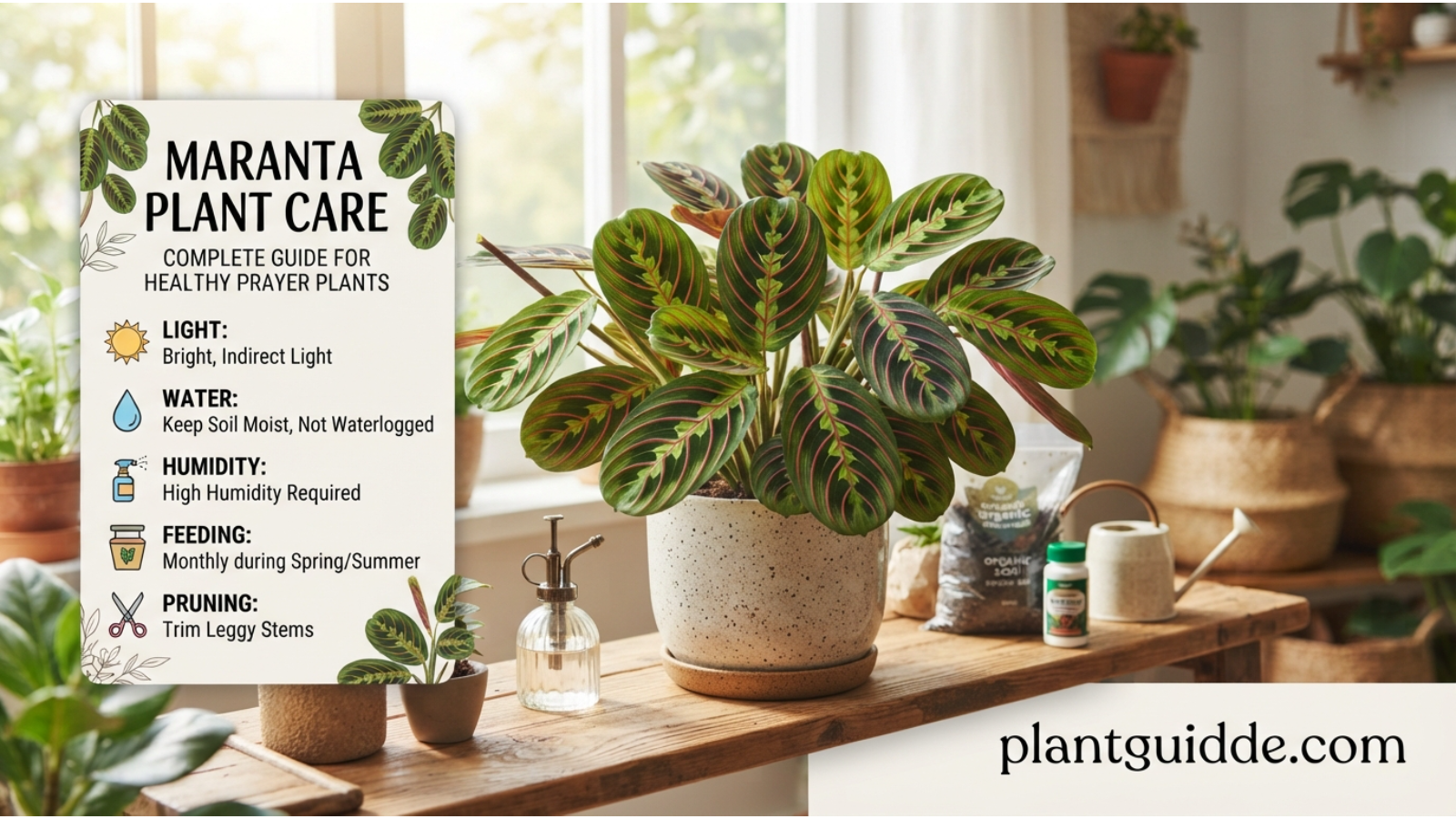
Maranta plants are popular houseplants for a reason. Their patterned foliage adds color without requiring direct sunlight, and their leaves perform an unusual daily movement: they spread during the day and fold upward at night, giving them the familiar name prayer plant. Maranta leuconeura is the species most commonly associated with prayer plants and is native to tropical regions of Brazil. Maranta Plant Care. But attractive foliage does not mean the plant is completely trouble-free.
A Maranta can quickly show environmental stress through brown leaf tips, curling leaves, yellow foliage, drooping, faded patterns, or crispy edges. In many cases, the problem is not one dramatic mistake. It is an accumulation of small issues. too much direct sun, inconsistent watering, dry indoor air, poor drainage, or a cold draft.
The key to successful Maranta plant care is therefore not following a rigid watering calendar. It is creating a stable growing environment and learning to read what the leaves are telling you.
Quick Answer
Maranta plant care is mainly about maintaining bright, indirect light, consistently moist but well-draining soil, high humidity, warm temperatures, and protection from direct sun and cold drafts. Water when the upper layer of soil begins to dry, but never leave the roots sitting in water. Marantas also benefit from regular feeding during active growth and good airflow.
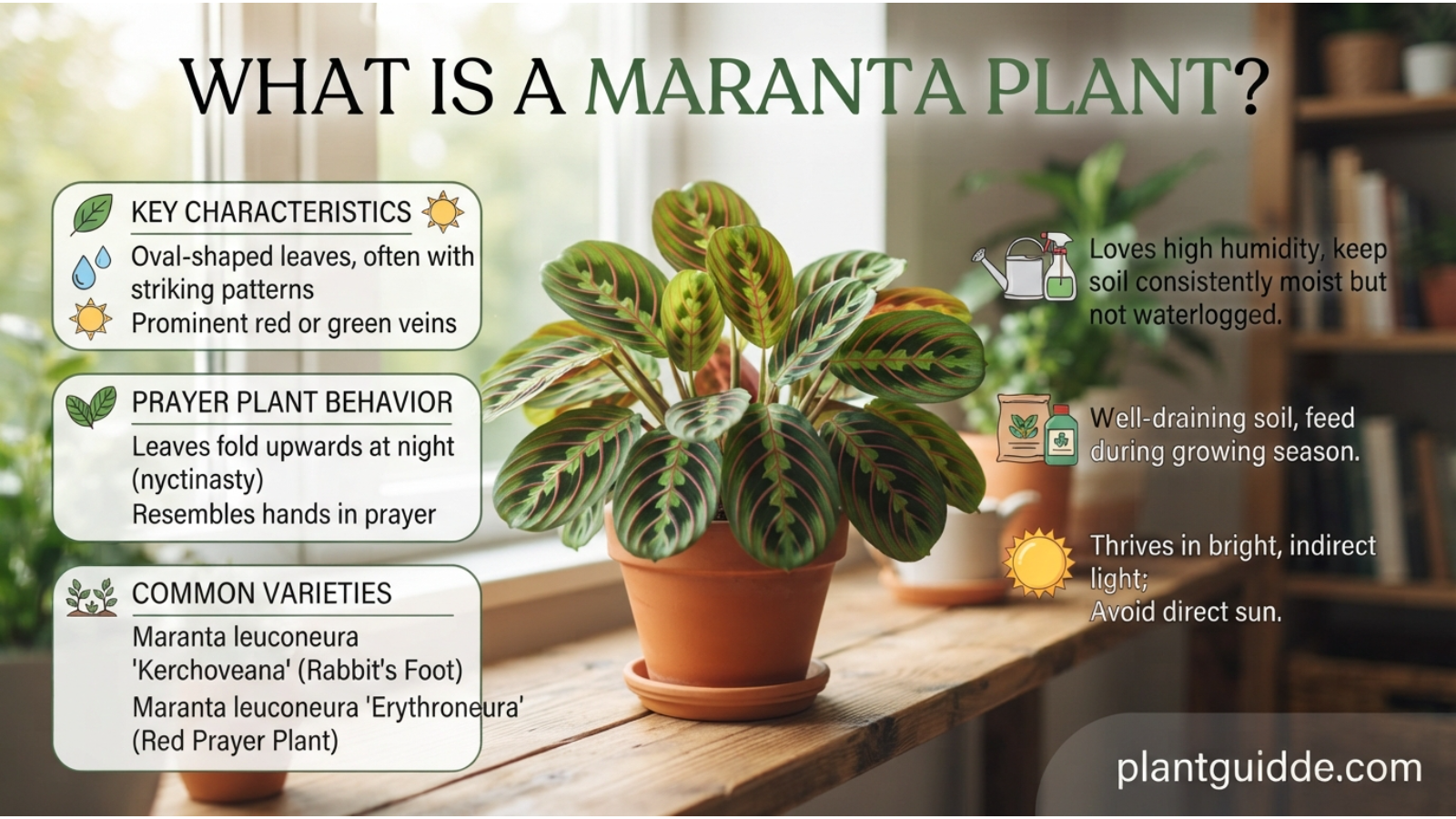
What Is a Maranta Plant?
Maranta is a genus of tropical, evergreen, rhizomatous plants in the family Marantaceae. Maranta leuconeura is commonly called prayer plant, herringbone plant, rabbit tracks, or red-veined prayer plant.
Marantas are primarily grown for their foliage rather than their flowers. Their leaves may feature contrasting veins, central markings, and colorful undersides depending on the cultivar.
One of their most distinctive characteristics is nyctinastic movement, commonly described as the plant “praying.” The leaves change position in response to the daily light cycle, becoming more upright at night.
Popular Maranta types
Some commonly encountered forms include:
- Maranta leuconeura ‘Fascinator’ — known for prominent red veins.
- Maranta leuconeura var. erythroneura — commonly associated with the red-veined or herringbone prayer plant.
- Maranta leuconeura var. kerchoveana — recognized for its darker paired leaf markings.
- Lemon Lime — valued for bright green and yellow-green foliage.
The RHS lists M. leuconeura cultivars as compact, clump-forming plants generally reaching around 30 cm under suitable conditions.
Maranta Plant Care Requirements at a Glance
| Care factor | What Maranta prefers | What to avoid |
|---|---|---|
| Light | Bright, filtered or indirect light | Strong direct afternoon sun |
| Water | Evenly moist soil during active growth | Bone-dry soil or constantly saturated soil |
| Humidity | High humidity | Very dry indoor air |
| Soil | Moisture-retentive but well-draining | Heavy, compacted soil |
| Temperature | Warm, stable conditions | Cold drafts and sudden temperature drops |
| Fertilizer | Balanced feeding during active growth | Excessive fertilizer |
| Pot | Drainage hole and suitable size | Containers that hold stagnant water |
| Airflow | Gentle, consistent circulation | Stagnant, constantly wet conditions |
These preferences are consistent with guidance from the RHS and North Carolina Extension.
Give Your Maranta the Right Light
Light is one of the easiest ways to accidentally damage a prayer plant.
Marantas generally perform best in bright, indirect or filtered light. Maranta Plant Care. They tolerate lower light than many tropical houseplants, but very strong direct sunlight can bleach or scorch their attractive foliage.
Where should you place a Maranta?
Good locations include:
- Near an east-facing window
- Near a bright north-facing window
- Several feet back from a brighter south- or west-facing window
- Behind a sheer curtain where sunlight is strong
The goal is not darkness. It is bright light without harsh, concentrated rays hitting the leaves for long periods.
Signs the light is wrong
Too much light:
- Faded leaf markings
- Bleached-looking foliage
- Brown or scorched patches
- Crispy edges
Too little light:
- Slower growth
- Less pronounced coloration
- Longer gaps between leaves
- Weak or sparse growth
A useful rule is simple: if the plant receives enough light to grow but the leaves are protected from intense direct sun, you are generally moving in the right direction.
Image Suggestion: Diagram showing ideal Maranta placement near east-, north-, south-, and west-facing windows.
How to Water a Maranta Plant
Watering is probably the most misunderstood part of Maranta plant care.
Marantas like moisture, but moist does not mean waterlogged. The RHS recommends keeping the compost moist but well drained, while North Carolina Extension recommends evenly moist soil during active growth and reduced watering during winter.
When should you water?
Instead of watering every Sunday or following a fixed schedule, check the soil.
Water when the upper portion of the potting mix has started to dry while the deeper root zone still retains some moisture.
Your watering frequency will change depending on:
- Temperature
- Humidity
- Pot size
- Soil composition
- Light level
- Season
- Root development
A Maranta in a warm, bright room may need water much sooner than one in a cool, dim room.
How to water correctly
- Check the potting mix before watering.
- If the upper layer has begun drying, water thoroughly.
- Allow excess water to drain through the drainage hole.
- Empty standing water from the saucer or cachepot.
- Wait until the plant reaches the appropriate moisture level again before watering.
The important distinction is consistent moisture versus constant saturation.
Poor drainage and excessive watering can contribute to root rot.
Should you use tap water?
Marantas can be sensitive to water quality in some indoor environments. If your tap water is heavily treated or leaves mineral deposits, filtered or otherwise suitable water may be worth trying.
However, do not automatically assume that every brown leaf tip is caused by tap water. Light, humidity, watering inconsistency, root problems, and fertilizer buildup can produce similar symptoms.
Choose a Moist but Well-Draining Soil Mix
A good Maranta soil should accomplish two things simultaneously:
Hold enough moisture for the roots while allowing excess water and air to move through the pot.
That balance is more important than chasing a specific recipe.
A practical houseplant mix can contain:
- Quality peat-free or standard houseplant potting mix
- Fine orchid bark or another airy organic component
- Perlite or pumice for drainage
The exact proportions can vary with your environment.
For example, someone growing a Maranta in a warm, dry home may want a mix that retains slightly more moisture than someone growing the same plant in a humid environment.
The RHS specifically recommends peat-free compost and emphasizes moist but well-drained conditions.
Why drainage matters
A pot can have excellent soil but still perform poorly if excess water cannot escape.
Always use a container with a drainage hole. Containers without drainage make it much harder to control root-zone moisture.
Image Suggestion: Cross-section diagram of an ideal Maranta pot showing airy soil, roots, drainage hole, and water movement.
Maintain High Humidity
Humidity is one of the biggest differences between growing Maranta successfully and constantly fighting crispy leaf edges.
These are tropical plants, and North Carolina Extension notes that Maranta is intolerant of low humidity.
Dry indoor air can become particularly problematic when:
- Heating systems are running
- Air conditioning runs continuously
- The plant sits beside a heater
- The plant is exposed to strong drafts
- The surrounding air is consistently dry
How to increase humidity
Practical options include:
Humidifier:
Usually the most controllable option when the room is consistently dry.
Plant grouping:
Placing several plants together can create a more humid local environment.
Bathroom placement:
A bright bathroom can work well if there is adequate indirect light.
Pebble tray:
A tray with damp pebbles can increase local moisture around the plant, although it should not allow the pot itself to sit in standing water.
The RHS recommends high humidity and suggests methods such as grouping plants or using dampened shingle/pebble trays.
Does misting solve humidity problems?
Not necessarily.
Misting can temporarily increase moisture around the leaves, but it is not a substitute for maintaining suitable room humidity. If your home is consistently dry, controlling the surrounding environment is usually more reliable.
Keep Temperatures Warm and Stable
Marantas are tropical plants, so they are poorly suited to cold conditions.
North Carolina Extension specifically notes that prayer plants are intolerant of low temperatures and cold drafts. Maranta Plant Care.
Avoid placing your plant:
- Directly beside an exterior door
- Against a cold window during winter
- Near an air-conditioning vent
- Next to a heater
- In a location with large temperature swings
Stable conditions are often more important than achieving a perfect number.
A plant that experiences warm days, cold nights, dry air, and frequent drafts can struggle even when its watering routine looks correct.
Fertilize During Active Growth
Marantas benefit from feeding during active growth.
The RHS recommends monthly feeding for Maranta leuconeura, while its cultivar guidance recommends balanced liquid fertilizer monthly during growth.
A balanced houseplant fertilizer used according to its label is a sensible approach.
Avoid overfertilizing
More fertilizer does not automatically mean more growth.
Excess fertilizer can damage foliage and roots, and North Carolina Extension notes that Maranta leaves can burn with over-fertilization.
Never apply concentrated fertilizer to severely dry soil. Watering first, when appropriate, helps reduce the risk of root damage.
During lower-light winter conditions, reduce feeding rather than continuing a heavy growing-season routine.
Repotting a Maranta Plant
Marantas generally do not need frequent repotting simply because a certain amount of time has passed.
Repot when the plant actually needs it.
Signs your Maranta may need repotting
Look for:
- Roots filling the container
- Roots emerging from drainage holes
- Soil drying unusually quickly
- Severely compacted potting mix
- Poor drainage
- A plant that has become unstable in its container
Marantas have a relatively shallow, spreading growth habit, so a wide, appropriately sized container can sometimes make more sense than moving immediately into a very deep pot. The RHS specifically notes their shallow root system in its guidance for M. leuconeura var. kerchoveana.
Do not dramatically increase pot size
Moving a small Maranta into a very large container can leave a large volume of wet soil around a relatively small root system.
That can make moisture management harder.
Choose the next pot based on the root system rather than trying to give the plant as much soil as possible.
Pruning and Cleaning Maranta Leaves
Marantas do not require routine heavy pruning. The RHS lists pruning as unnecessary for the plant.
However, removing damaged foliage can improve appearance and help you monitor new growth.
Use clean scissors to remove:
- Completely dead leaves
- Severely damaged leaves
- Brown sections when the damage is extensive
Do not repeatedly cut healthy leaves simply because they have a small brown edge.
Clean dusty leaves carefully
Large patterned leaves can collect dust, which can make the foliage look dull.
A gentle wipe with a clean, slightly damp cloth is usually enough.
Avoid unnecessary leaf-shine products, which can interfere with the natural surface of foliage.
Why Are My Maranta Leaves Curling?
Maranta leaves curling is one of the most common problems people search for, but curling is a symptom rather than a diagnosis.
Possible causes include:
- Dry soil
- Low humidity
- Excessive direct light
- Temperature stress
- Root problems
- Sudden environmental changes
Start with the simplest checks.
Troubleshooting sequence
Step 1: Check the soil.
If it is extremely dry, dehydration may be contributing.
Step 2: Check humidity.
If the air is very dry, improve the surrounding environment.
Step 3: Check the light.
Make sure harsh direct sunlight is not hitting the leaves.
Step 4: Check temperature.
Look for cold drafts or heating/air-conditioning vents.
Step 5: Inspect the roots if the soil stays wet.
Persistent wetness combined with declining foliage can indicate a root-zone problem.
Do not immediately repot every curling Maranta. Diagnose the environmental conditions first.
Why Does My Maranta Have Brown Leaf Tips?
Brown tips are especially common in indoor Marantas.
Potential causes include:
- Low humidity
- Inconsistent watering
- Excessive fertilizer
- Water-quality issues
- Root stress
- Excessive light or heat
The mistake is assuming there is always one universal cause.
For example, if the soil is dry, the room is very dry, and the plant sits in strong sunlight, several stresses may be acting simultaneously.
What to do
Check these conditions in order:
- Soil moisture
- Room humidity
- Light intensity
- Fertilizer frequency
- Drainage
- Water quality
- Root health if symptoms persist
Once a leaf tip has turned brown, that tissue will not become green again. The goal is to prevent new leaves from developing the same damage.
Why Are Maranta Leaves Turning Yellow?
Yellow leaves can have several causes.
If the soil stays wet
Think about:
- Overwatering
- Poor drainage
- A pot that is too large
- Compacted soil
- Root damage
If the soil is very dry
The plant may be experiencing water stress.
If older leaves occasionally yellow
A single aging leaf is not necessarily a crisis. Plants naturally shed older foliage.
If many leaves yellow at once
That deserves closer investigation.
Check the roots, moisture level, drainage, light, and recent environmental changes before assuming fertilizer deficiency.
Why Is My Maranta Drooping?
Drooping can occur when the plant’s water balance is disrupted.
Possible reasons include:
- Dry soil
- Root damage
- Excess heat
- Low humidity
- Recent environmental change
- Cold stress
Again, do not automatically add water.
Check the soil first.
If the soil is already wet and the plant is drooping, additional watering could make the underlying problem worse.
Why Are My Maranta Leaves Fading?
Maranta foliage is prized for its patterns, so fading can be particularly disappointing.
Low light can reduce the intensity of foliage coloration, while excessive sunlight can bleach or damage leaves. Maranta Plant Care. North Carolina Extension notes that both light and fertility can affect foliage coloration.
If your Maranta’s patterns look less vivid:
- Check whether the plant is receiving enough indirect light.
- Avoid suddenly moving it into intense direct sun.
- Evaluate whether the plant has been growing actively.
- Review your fertilizer routine without increasing fertilizer aggressively.
The solution is usually better-balanced conditions, not simply more fertilizer.
Maranta Pests: What to Watch For
Marantas are not considered highly pest-prone, but occasional pests can occur.
North Carolina Extension identifies spider mites and mealybugs as potential problems, while the RHS also lists pests such as red spider mite and mealybugs depending on the growing environment.
Check especially:
- Leaf undersides
- New growth
- Leaf joints
- Stems
- Areas where leaves overlap
Early detection matters
Inspect your Maranta regularly rather than waiting until the plant looks severely damaged.
If you discover pests, isolate the plant from nearby houseplants and identify the pest before choosing a treatment.
How to Propagate Maranta
Marantas can be propagated through division, particularly because they grow from rhizomatous structures. The RHS also lists basal cuttings and seed as propagation methods, while North Carolina Extension specifically recommends rhizomatous division.
Division is the practical home method
When repotting:
- Remove the plant carefully from its container.
- Examine the root and rhizome structure.
- Separate a healthy section with roots and growing points.
- Pot each division into an appropriately sized container.
- Keep the new divisions warm, humid, and evenly moist.
- Protect them from harsh light while they establish.
Avoid dividing a weak or severely stressed plant simply because you want more plants. Propagation is most successful when the parent plant is healthy and actively growing.
Image Suggestion: Step-by-step illustration showing Maranta removal, rhizome division, and repotting.
A Simple Maranta Care Routine
If you want a practical routine rather than a complicated schedule, use this:
Weekly
- Check soil moisture.
- Inspect leaves for pests.
- Look for new growth.
- Check whether the plant is receiving appropriate light.
- Remove fallen or dead foliage.
Every few weeks
- Check for mineral or fertilizer buildup.
- Clean dusty leaves.
- Assess whether humidity has changed.
- Rotate the pot if growth is becoming strongly one-sided.
During active growth
- Maintain consistent moisture.
- Feed according to your fertilizer’s directions.
- Watch for increased water demand.
During winter or low-light periods
- Expect slower growth.
- Water less frequently as the soil dries more slowly.
- Reduce feeding.
- Keep the plant away from cold drafts.
The RHS also recommends reducing watering during winter and limiting fertilizer when light levels are low.
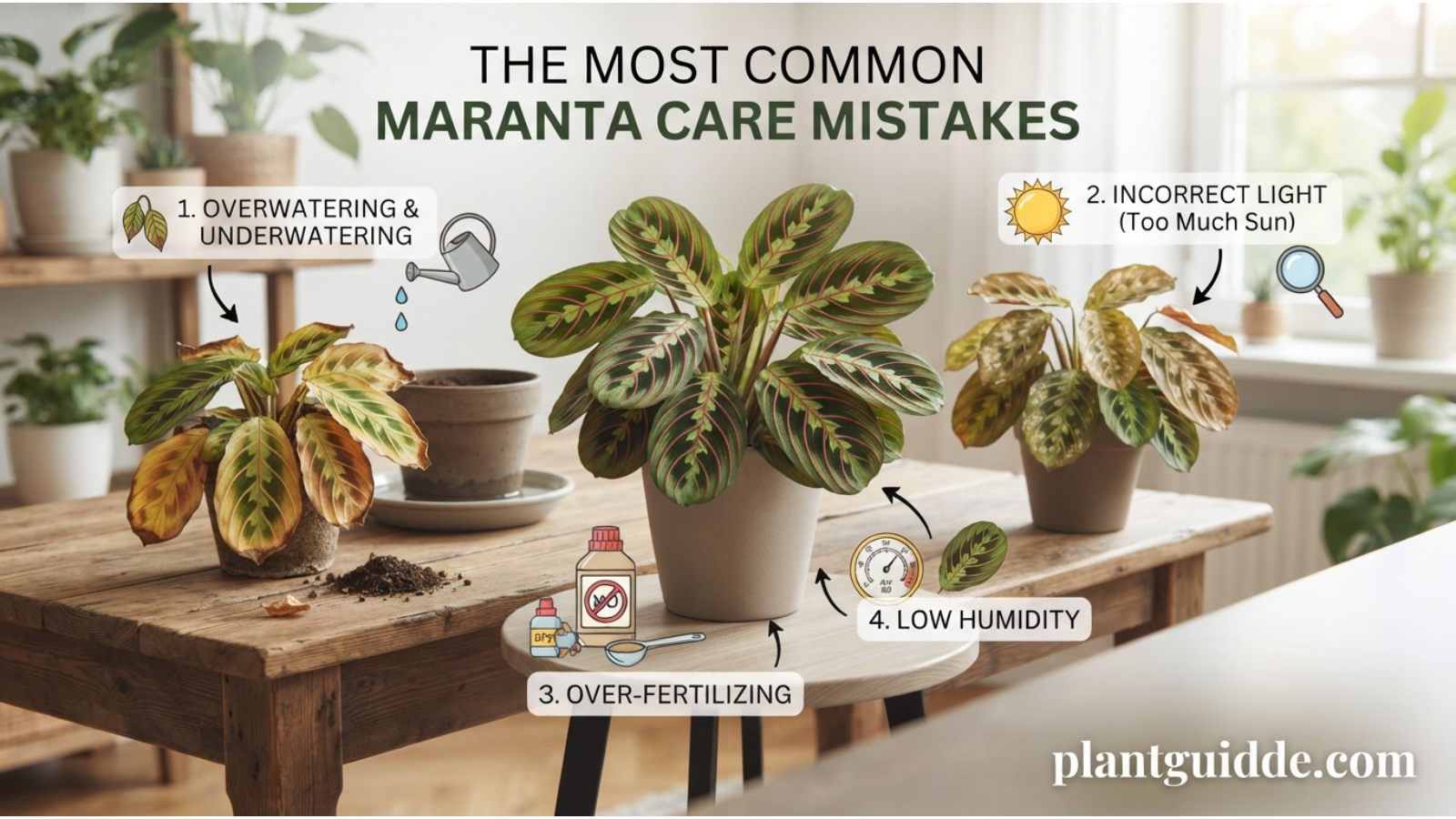
The Most Common Maranta Care Mistakes
Watering on a fixed calendar
A calendar cannot account for temperature, humidity, light, or pot size.
Better approach: Check the soil.
Putting the plant in direct sun
Marantas need light, but harsh direct sunlight can bleach and scorch their foliage.
Better approach: Use bright filtered or indirect light.
Keeping the soil permanently saturated
Moisture-loving does not mean waterlogged.
Better approach: Use an airy, well-draining mix and a container with drainage.
Ignoring humidity
A Maranta in very dry air may develop crispy edges even when watering is otherwise reasonable.
Better approach: Improve the surrounding humidity.
Increasing fertilizer when leaves look pale
Faded leaves do not automatically indicate nutrient deficiency.
Better approach: Evaluate light, watering, roots, and overall growing conditions first.
Repotting too aggressively
A much larger pot can retain excess moisture around a small root system.
Better approach: Repot based on root development.
Maranta Care: What to Change First When Something Goes Wrong
When a Maranta suddenly looks unhealthy, avoid changing five things at once.
Use this diagnostic order:
1. Soil → 2. Light → 3. Humidity → 4. Temperature → 5. Roots → 6. Fertilizer → 7. Pests
Why this order?
The first four are environmental factors you can evaluate without disturbing the plant. Root inspection and repotting should come later unless the plant is clearly suffering from persistent waterlogging or root damage.
This approach also makes it easier to identify what actually fixed the problem.
Maranta Plant Care by Season
Spring
As growth increases, monitor moisture more frequently and gradually resume regular feeding.
Summer
Higher temperatures and stronger growth can increase water demand. Protect the plant from intense direct sun and watch humidity carefully.
Autumn
Growth may slow as light decreases. Adjust watering rather than continuing the summer routine automatically.
Winter
The combination of low light, heating, and cold drafts can be particularly challenging. Water less frequently when the soil takes longer to dry, keep the plant warm, and avoid unnecessary fertilizing.
FAQs,
Is Maranta easy to care for?
Maranta is manageable when its basic environmental needs are met, but it is less forgiving of dry air, cold drafts, direct sunlight, and inconsistent moisture than some tougher houseplants. It can tolerate lower light, but it still needs usable daylight to grow.
How much light does a Maranta need?
Give it bright, indirect or filtered light. Avoid prolonged strong direct sunlight, which can bleach or damage the foliage.
How often should I water a Maranta?
There is no reliable universal schedule. Check the soil and water when the upper layer begins to dry, keeping the root zone consistently moist without leaving it saturated.
Why is my Maranta curling its leaves?
Curling can result from dry soil, low humidity, excessive light, temperature stress, or root problems. Check the growing conditions before deciding on a treatment.
Should I mist my Maranta?
Misting may temporarily increase moisture around the foliage, but it is not the most reliable way to maintain consistently high humidity. A humidifier or suitable room environment provides more dependable control.
Can Maranta grow in low light?
Maranta tolerates low to medium light better than many tropical foliage plants, but very low light can reduce growth and foliage intensity. Bright indirect light is generally a better target.
Why does my Maranta have brown tips?
Low humidity, inconsistent moisture, excessive fertilizer, water-quality issues, and root stress can all contribute. Look at the entire growing environment rather than assuming one cause.
Does Maranta need fertilizer?
Yes, regular feeding during active growth can support healthy foliage. The RHS recommends monthly feeding, but excessive fertilizer can damage leaves and roots.
Does Maranta need a drainage hole?
Yes. Good drainage is important because Maranta prefers moist soil but does not tolerate constantly waterlogged conditions.
Why do Maranta leaves move?
The leaves naturally change position as part of their daily movement, becoming more upright at night. This behavior is why the plant is commonly called a prayer plant.
Final Takeaway
Successful Maranta plant care is less about finding a perfect watering schedule and more about maintaining balance.
Give your plant bright indirect light, evenly moist but well-drained soil, high humidity, warm stable conditions, moderate feeding, and good drainage. Then pay attention to the leaves. Curling, browning, yellowing, and fading are useful signals that something in the environment needs to be adjusted.
The biggest mistake is reacting to one symptom with one quick fix. Instead, look at the entire growing environment. Once a Maranta receives consistent conditions, its colorful foliage and distinctive day-to-night leaf movement become much easier to enjoy.

Asad Mumtaz is a dedicated plant enthusiast and gardening writer with a passion for helping people care for their plants successfully. He specializes in plant care guides, indoor gardening, and practical growing tips for all skill levels. His content focuses on making gardening simple, enjoyable, and rewarding. Through his work, Asad shares reliable advice to help readers create thriving green spaces.