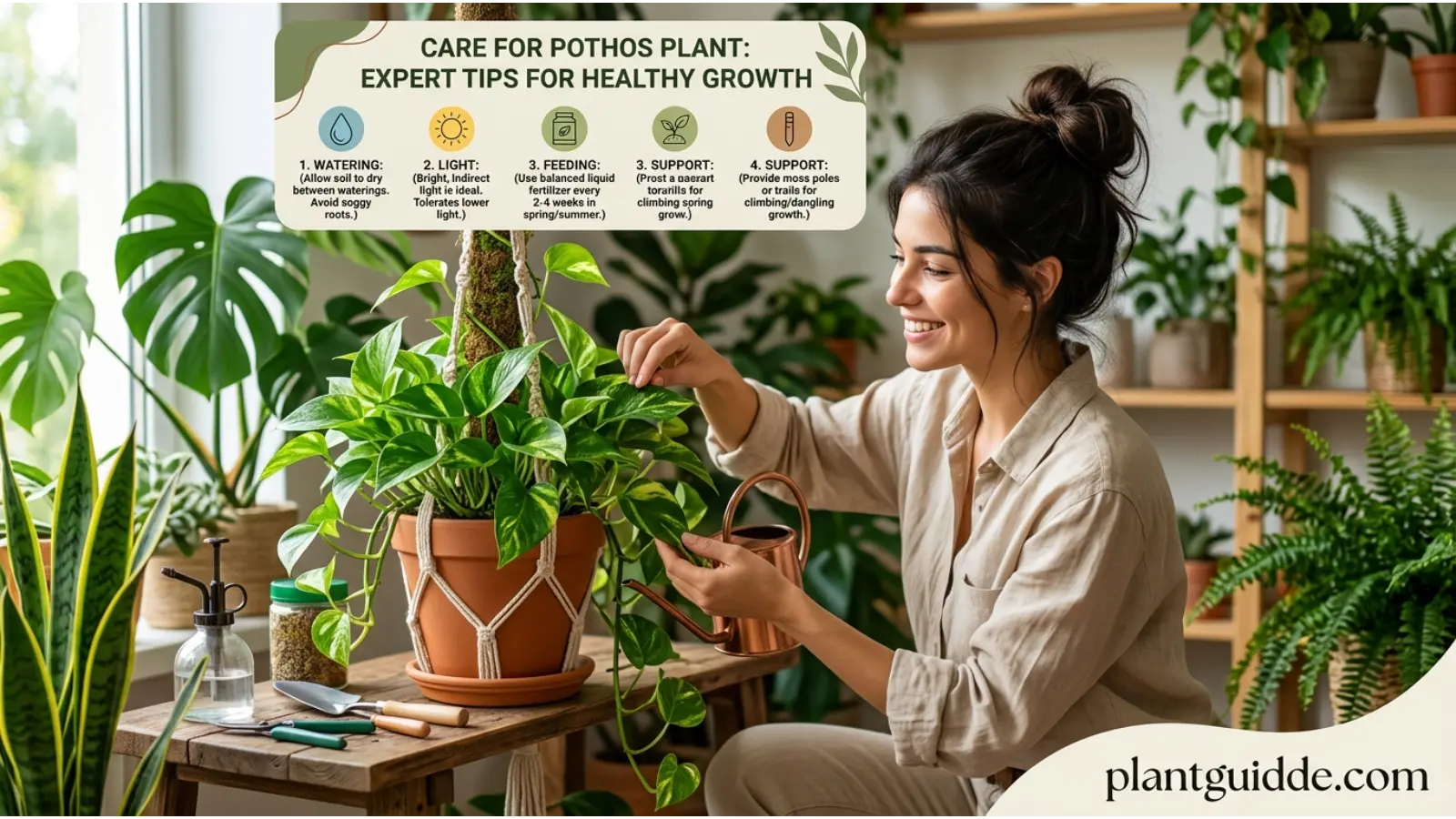
Care for pothos plant is a favorite among indoor plant enthusiasts because it combines attractive trailing vines with relatively simple growing requirements. Its heart-shaped leaves, which may be solid green, golden, or marbled with white, make it suitable for hanging baskets, shelves, desks, and climbing displays.
Despite its reputation as an easy houseplant, pothos can develop yellow leaves, brown tips, sparse vines, and root problems when its growing conditions are unsuitable. The key to successful pothos plant care is understanding how light, water, soil, and temperature work together rather than following a rigid watering schedule.
Whether you are growing your first Golden Pothos or trying to revive a mature plant, this guide explains how to create the right conditions, encourage fuller growth, propagate new plants, and identify common problems before they become serious.
Quick Answer
To care for pothos plant varieties successfully, provide bright, indirect light, well-draining soil, and water when the top 1–2 inches of soil feel dry. Keep the plant in a warm environment, fertilize lightly during active growth, and prune long vines to encourage fuller foliage. Avoid waterlogged soil, poor drainage, and sudden exposure to intense sunlight to maintain healthy roots and vibrant leaves.
Understanding the Pothos Plant
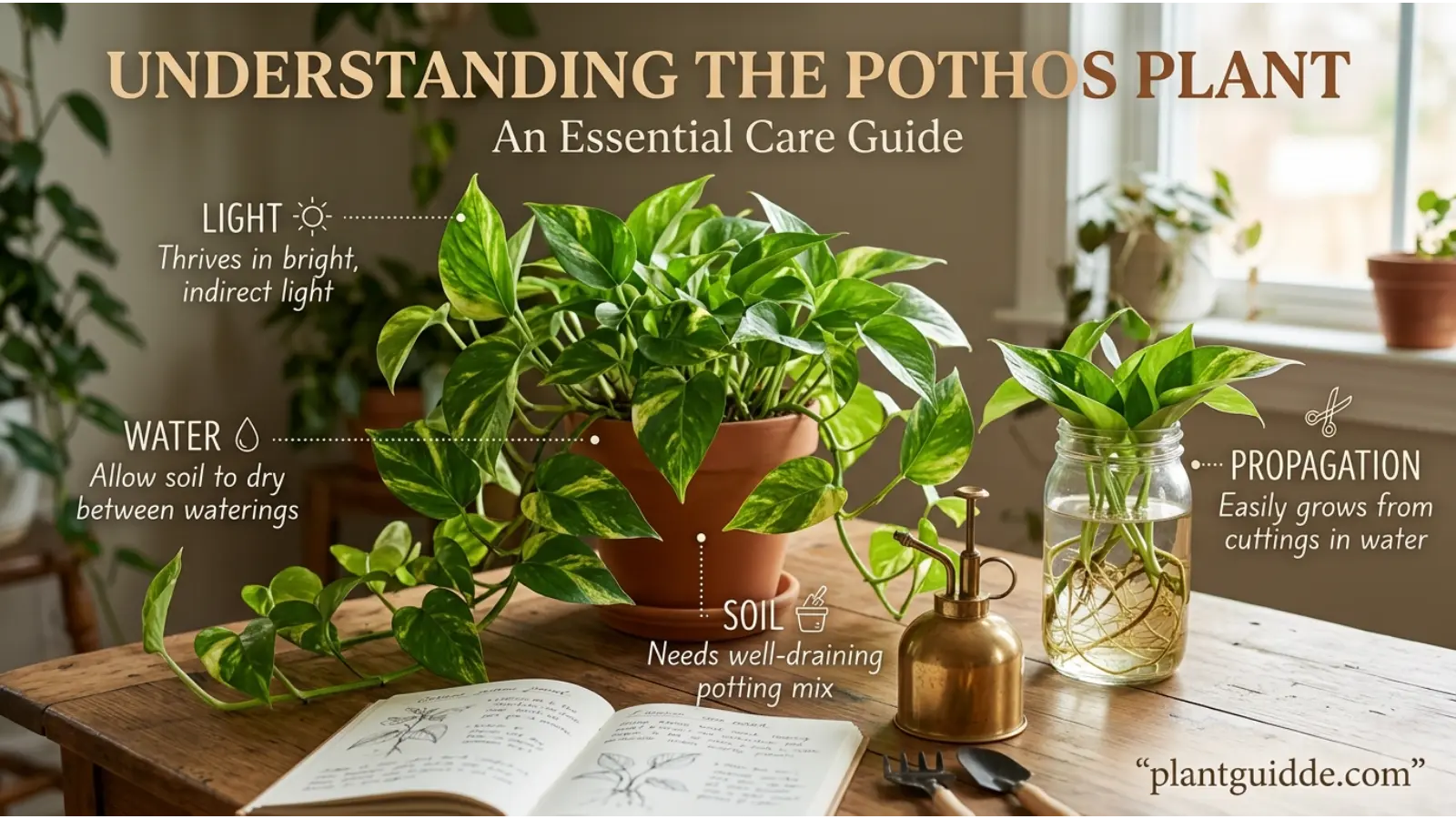
Pothos (Epipremnum aureum) is a tropical evergreen climbing vine belonging to the Araceae family. It naturally climbs trees using aerial roots and can produce larger leaves as it matures under suitable conditions. Indoors, it is commonly grown as a trailing plant or trained to climb a moss pole or other support.
Popular pothos varieties include:
- Golden Pothos: Green leaves with golden-yellow markings.
- Marble Queen Pothos: White and green marbled leaves that benefit from brighter indirect light.
- Neon Pothos: Bright chartreuse foliage that adds color to indoor spaces.
- Jade Pothos: Solid green leaves that can be more forgiving in lower-light rooms.
- Pearls and Jade Pothos: Green foliage with distinctive white and gray-green markings.
Varieties with substantial white or cream variegation generally need brighter indirect light to maintain their patterns. Solid-green varieties often tolerate lower light more readily, although all pothos plants grow best when they receive enough light for healthy development.
Best Conditions for Pothos Plant Care
The most reliable approach is to provide consistent growing conditions while adjusting watering and feeding to the plant’s actual needs.
| Care factor | Recommended conditions | Common mistake |
|---|---|---|
| Light | Bright, indirect light | Keeping the plant in deep shade |
| Water | Water when the upper 1–2 inches of soil dry | Watering while soil is still wet |
| Soil | Loose, well-draining potting mix | Using dense soil that stays saturated |
| Temperature | Approximately 65–85°F (18–29°C) | Exposing the plant to cold drafts |
| Humidity | Average household humidity or higher | Assuming frequent misting is essential |
| Fertilizer | Balanced houseplant fertilizer during active growth | Feeding too frequently |
| Pot | Container with drainage holes | Allowing water to collect around the roots |
These recommendations are starting points, not fixed rules. A pothos in a warm, bright room will usually use water faster than one growing in a cool room with limited light.
How Much Light Does a Pothos Plant Need?
Light influences the plant’s growth rate, leaf size, vine length, and variegation. Bright, indirect light is usually the best choice for maintaining attractive foliage without risking sun damage.
Bright, indirect light
Place pothos near an east-facing window or close to a bright south- or west-facing window where strong sunlight is filtered by a sheer curtain.
Adequate light helps the plant produce stronger growth and maintain the characteristic patterns of variegated varieties. If your plant is producing increasingly small leaves or long stretches of bare vine, insufficient light may be contributing to the problem.
Can pothos grow in low light?
Yes. Pothos can survive in relatively dim indoor conditions, but survival and vigorous growth are not the same thing. Growth may slow, the spaces between leaves may increase, and variegated foliage may become greener.
Low light also means the soil dries more slowly. If you move your pothos from a bright window to a darker corner, check the soil before watering rather than maintaining the same routine.
Signs of lighting problems
- Leggy vines: Often associated with insufficient light.
- Faded or scorched patches: May result from intense, sudden sun exposure.
- Loss of variegation: Can occur when a variegated variety receives insufficient light.
- Slow growth: May indicate low light, seasonal changes, or other growing limitations.
Rotate the pot occasionally to encourage balanced growth. When moving pothos into stronger light, increase exposure gradually to reduce the risk of leaf scorch.
How Often Should You Water Pothos?
Watering is one of the most important aspects of caring for pothos. Although the plant appreciates some moisture, its roots also need oxygen. Soil that stays wet for extended periods can encourage root rot.
Rather than watering every few days, use the soil’s moisture level to determine when your plant needs water.
Follow these watering steps
- Check the soil: Insert your finger approximately 1–2 inches into the potting mix.
- Assess moisture: If the upper layer is still damp, wait and check again later.
- Water thoroughly: When the soil has dried sufficiently, water evenly until excess water drains through the bottom.
- Empty the saucer: Do not allow the pot to stand in collected water.
- Recheck before watering again: Let the upper soil dry between waterings.
The interval may be several days or longer than a week, depending on light, temperature, pot size, soil composition, and season.
How to recognize overwatering
Overwatering can cause yellowing leaves, persistently damp soil, soft stems, and root rot. However, yellow leaves alone do not prove that the plant has received too much water.
Check the soil first. Care for pothos plant it remains wet for a long time and several leaves are yellowing, inspect the roots for damage. Healthy roots are generally firm, while rotting roots may be dark, mushy, or unpleasant-smelling.
Care for pothos plant root rot is present, remove the plant from its pot, trim damaged roots with clean tools, and repot it in fresh, well-draining soil.
How to recognize underwatering
A thirsty pothos may develop drooping leaves, dry leaf edges, or a noticeably lightweight pot. The soil will usually be dry, and the plant may recover after thorough watering.
Care for pothos plant the soil is dry, water the plant completely and let excess moisture drain. If the soil is already damp but the leaves remain limp, investigate possible root damage instead of adding more water.
Best Soil and Pot for Pothos
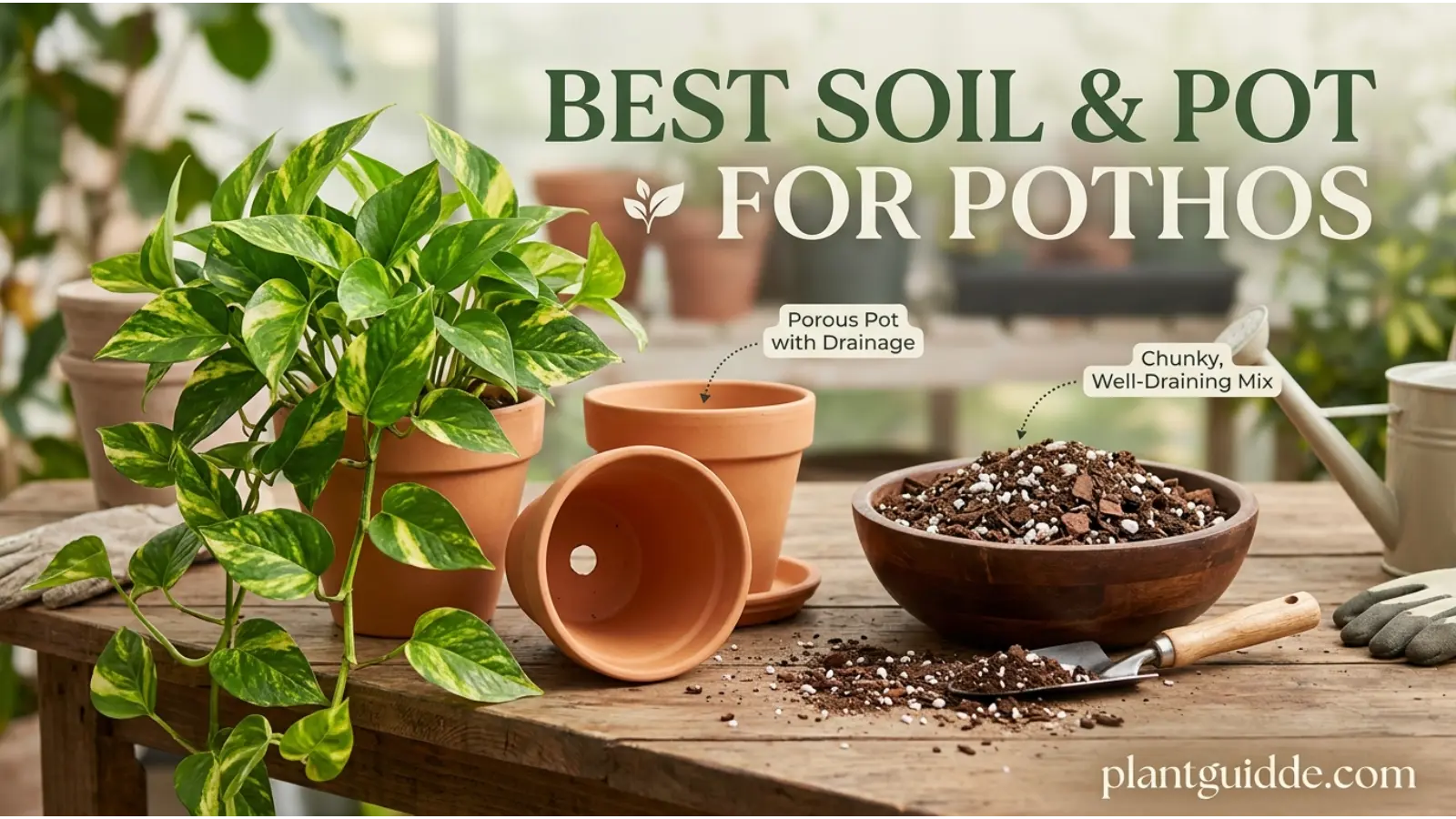
Good drainage protects pothos roots from prolonged moisture and helps maintain the balance between water retention and airflow.
Choose a well-draining potting mix
A general-purpose indoor potting mix can work well when it does not become compacted or remain wet for too long. For additional drainage, combine it with perlite or pumice.
A practical starting mix is:
- Two parts general-purpose potting mix
- One part perlite or pumice
Adjust the mixture based on how quickly it dries in your home. The ideal mix holds enough moisture for the roots to absorb water but allows excess water to drain freely.
Avoid using heavy garden soil alone in indoor containers. It may compact, restrict airflow, and create conditions that encourage root problems.
Select a suitable pot
Choose a container with drainage holes that accommodates the root system without leaving a large volume of excess soil around it.
Plastic pots retain moisture longer, while terracotta allows more moisture to evaporate through its walls. Either can work, but your watering routine should reflect the material and the environment.
Care for pothos plant you prefer a decorative pot without drainage holes, keep the pothos in a separate nursery pot and remove it for watering. Allow it to drain before returning it to the decorative container.
Ideal Temperature and Humidity for Pothos
Pothos grows well in ordinary household temperatures. Approximately 65–85°F (18–29°C) is a suitable range for many indoor plants.
Protect it from cold drafts, air-conditioning vents, and temperatures approaching freezing. Sudden temperature changes can cause stress, especially when combined with wet soil.
Average household humidity is usually sufficient. Higher humidity may support more comfortable growth, but a humidifier is rarely necessary solely for pothos.
Misting the leaves is not an effective substitute for appropriate watering or humidity management. Instead, focus on stable temperatures, adequate light, and healthy roots.
How to Fertilize Pothos for Healthy Growth
Pothos does not require heavy feeding. Too much fertilizer can cause salt buildup in the soil and damage roots or leaf edges.
During active growth in spring and summer, use a balanced liquid houseplant fertilizer according to the label. Feeding approximately every four to eight weeks may be sufficient, although the appropriate frequency depends on the product and growing conditions.
Follow these guidelines:
- Apply fertilizer only at the recommended concentration.
- Avoid fertilizing plants with severely damaged roots.
- Reduce feeding when growth slows during winter.
- Do not use fertilizer to compensate for inadequate light.
- If salts accumulate, flush the potting mix with water when drainage is adequate.
Care for pothos plant your pothos is growing slowly, check light levels and root health before increasing fertilizer. More nutrients will not correct a plant that is struggling because its roots remain waterlogged.
How to Prune Pothos for Fuller Growth
Pothos naturally produces long vines, but pruning can encourage a more compact appearance and help manage excessive growth.
Use clean, sharp scissors to cut a vine just above a leaf node. A node is the point where a leaf and an aerial root may emerge from the stem.
Pruning helps control length and can encourage growth from nodes farther back on the plant. However, one cut will not necessarily make every vine branch, so the result depends on the plant’s growth pattern and condition.
For a fuller-looking pot:
- Identify excessively long or sparse vines.
- Cut selected stems just above healthy nodes.
- Remove yellow or damaged leaves.
- Provide adequate indirect light.
- Use healthy cuttings to add more rooted stems to the same pot later.
Avoid removing too much foliage at once from a weak or stressed plant. Pruning is most effective when the plant has suitable growing conditions and enough healthy leaves to support new growth.
How to Propagate Pothos
Stem cuttings make pothos easy to propagate. You can use them to grow new plants, replace sparse growth, or create a fuller display in an existing container.
Propagating pothos in water
- Select a healthy vine with several leaves.
- Cut a section containing at least one node.
- Remove any leaf that would sit underwater.
- Place the node in clean water while keeping the remaining leaves above the surface.
- Position the container in bright, indirect light.
- Refresh the water regularly and watch for root development.
- Transfer the cutting to potting mix once the roots have developed sufficiently.
A cutting without a node will not produce a normal new pothos plant because the node contains the growth point needed for new roots and shoots.
Propagating pothos in soil
You can also place a cutting with a node directly into lightly moist, well-draining potting mix.
Keep the mix slightly moist during establishment, not saturated. Bright, indirect light and warmth help the cutting develop roots.
Water-rooted cuttings may need time to adjust when transferred to soil. After potting, avoid keeping the mix constantly wet in an attempt to prevent the cutting from drying out.
Common Pothos Problems and Their Solutions
Changes in leaf color, texture, or growth can help you identify problems. Look at the overall pattern and examine the soil before deciding what treatment is needed.
| Problem | Possible cause | Recommended action |
|---|---|---|
| Yellow leaves | Overwatering, root damage, or natural aging | Check soil moisture and inspect roots if symptoms spread |
| Brown, crispy tips | Dry conditions, fertilizer salts, or root stress | Review watering and feeding habits |
| Drooping leaves | Underwatering, root damage, or environmental stress | Check soil moisture before watering |
| Leggy vines | Insufficient light or natural growth habit | Increase suitable light and prune selectively |
| Small new leaves | Low light or lack of climbing support | Improve light and consider a support pole |
| Black or mushy stems | Rot or severe tissue damage | Remove affected sections and inspect roots |
| Pale or scorched patches | Excessive direct sunlight | Move the plant to filtered light |
| Cottony white pests | Mealybugs | Isolate the plant and treat the infestation |
Why are pothos leaves turning yellow?
Yellow leaves may result from overwatering, insufficient light, root damage, or normal aging. If only one older leaf yellows while the rest of the plant looks healthy, the change may be natural.
If multiple leaves yellow over a short period, inspect the soil and drainage. Persistently wet soil is a warning sign, especially if the leaf stems or roots also become soft.
Do not respond automatically by watering more or applying fertilizer. Identify the likely cause first.
Why is my pothos not growing?
Slow growth can occur during winter, in low light, or when roots are unhealthy. Variegated varieties may also grow more slowly because their lighter leaf areas contain less chlorophyll.
Move the plant to brighter indirect light if necessary, check whether the roots are crowded or damaged, and feed lightly during active growth if nutrients are needed.
How do you treat pothos pests?
Common pests include mealybugs, scale insects, and spider mites. Inspect the undersides of leaves, stems, and nodes when you notice speckling, sticky residue, fine webbing, or cotton-like clusters.
Isolate an affected plant, remove visible pests where practical, and use a houseplant-labeled insecticidal soap or other suitable treatment according to its instructions. Test the product on a small area first and avoid applying treatments in strong direct sunlight.
Repeat inspections because pests can survive in leaf joints or on nearby plants.
Common Mistakes to Avoid When Caring for Pothos
Even a forgiving houseplant can struggle when its basic needs are misunderstood.
Watering on a fixed schedule: Indoor conditions change throughout the year. Check soil moisture rather than assuming the plant needs water every week.
Using a pot without drainage: Excess water can collect around the roots even when the soil surface looks dry.
Keeping the plant in deep shade: Pothos may survive in low light, but growth can become sparse and variegation may fade.
Using an oversized pot: Excess soil can retain moisture longer than the roots can use it.
Overfertilizing: Excess nutrients can harm roots and cause leaf-edge damage.
Cutting vines without checking for nodes: Nodes are essential when selecting cuttings for propagation.
Ignoring early signs of root trouble: Persistent wet soil combined with yellowing or soft stems deserves attention before the damage spreads.
A useful practice is to note when you water and how long the soil takes to dry. This simple observation helps you understand your plant’s needs more accurately than a generic care calendar.
Is Pothos Toxic to Pets?
Yes. Pothos contains insoluble calcium oxalate crystals that can irritate the mouth and digestive tract when chewed or swallowed by cats, dogs, and people.
Possible symptoms include oral pain, drooling, pawing at the mouth, difficulty swallowing, and vomiting. Keep the plant away from pets and young children who might chew its leaves.
If a pet eats pothos and develops symptoms, contact a veterinarian for advice. Do not assume that a plant is safe simply because it is commonly grown indoors.
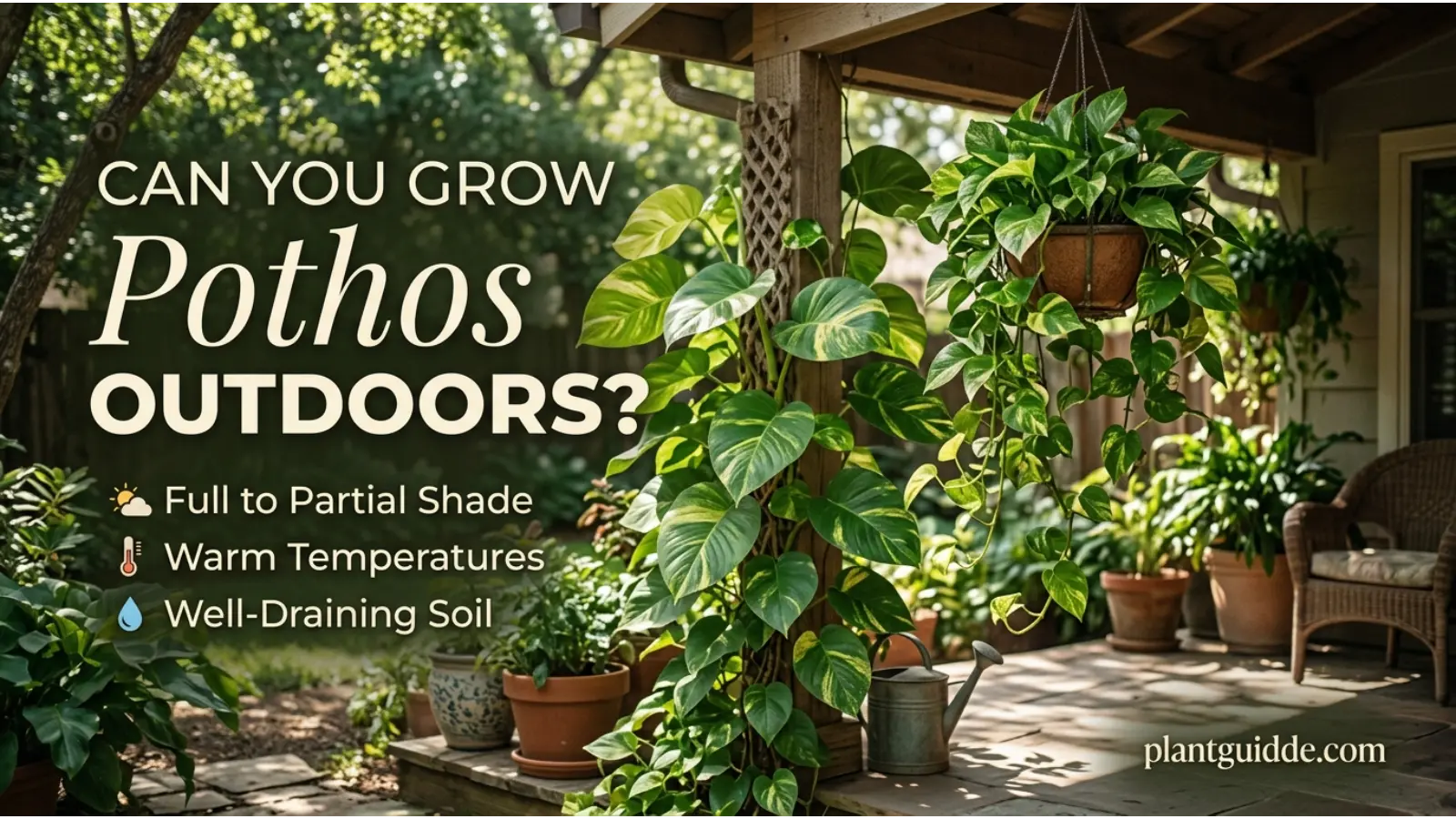
Can You Grow Pothos Outdoors?
Pothos can grow outdoors in warm, frost-free climates. Choose a sheltered location with bright, filtered light and soil that drains well.
Plants grown indoors should be introduced to outdoor conditions gradually. Sudden exposure to strong sunlight may scorch the leaves, while heavy rainfall and poorly drained soil can cause root problems.
In colder climates, grow pothos in a container and bring it indoors before temperatures become damaging.
Remember that pothos can grow aggressively in some tropical outdoor environments. Check local guidance before planting it in the ground, and avoid allowing discarded cuttings to establish in natural areas.
FAQs:
How often should I water a pothos plant?
Water when the top 1–2 inches of soil have dried and the remaining root zone is not excessively wet. The interval varies with light, temperature, soil, and pot size. Water thoroughly and let excess water drain before returning the pot to its usual location.
Should I mist my pothos plant?
Regular misting is unnecessary for most indoor pothos plants. It does not reliably increase humidity for long, and it cannot correct problems caused by poor watering or root damage. Normal household humidity is generally sufficient.
Why are my pothos leaves turning yellow and brown?
Yellow leaves can indicate excess moisture, root problems, low light, or normal aging. Brown tips may result from dry conditions, fertilizer salts, or other environmental stress. Examine the soil, roots, and recent care routine before deciding what to change.
How do I make my pothos grow fuller?
Provide bright, indirect light, prune selected long vines above healthy nodes, and maintain appropriate watering. You can also root healthy stem cuttings and plant them in the same container once they have developed suitable roots, creating a denser arrangement.
Can pothos grow in water permanently?
Yes, pothos can grow in water when its roots receive adequate oxygen and the water is maintained appropriately. Use a clean container, keep the nodes submerged while leaving the leaves above the water, and refresh the water regularly. Plants grown in water may need suitable nutrients because ordinary water alone does not provide everything required for long-term growth.
Conclusion
Successful care for pothos plant varieties comes down to a few dependable habits: provide suitable indirect light, use well-draining soil, check moisture before watering, and prune when necessary to manage vine growth. Pay attention to yellowing leaves, slow growth, and changes in soil moisture instead of treating every problem with more water or fertilizer.
Start by checking your pothos’s light exposure, soil, and drainage. Once those fundamentals are right, the plant can reward you with healthy foliage and long, attractive vines with relatively little maintenance.

Asad Mumtaz is a dedicated plant enthusiast and gardening writer with a passion for helping people care for their plants successfully. He specializes in plant care guides, indoor gardening, and practical growing tips for all skill levels. His content focuses on making gardening simple, enjoyable, and rewarding. Through his work, Asad shares reliable advice to help readers create thriving green spaces.